- Home
- About Us
- Industry
- Services
- Reading
- Contact Us
Africa Hot Sauce Market: Current Analysis and Forecast (2025-2033)
Emphasis By Product Type (Medium Hot Sauce, Mild Hot Sauce, and Very Hot Sauce), By Application (Table Sauce and Cooking Sauce), By Packaging (Jars, Bottles, and Others), By Distribution Channel (Supermarkets/Hypermarkets, Traditional Grocery Retailers, Online Stores, and Others), By Country (Egypt, South Africa, Nigeria, Uganda, Rest of Africa)
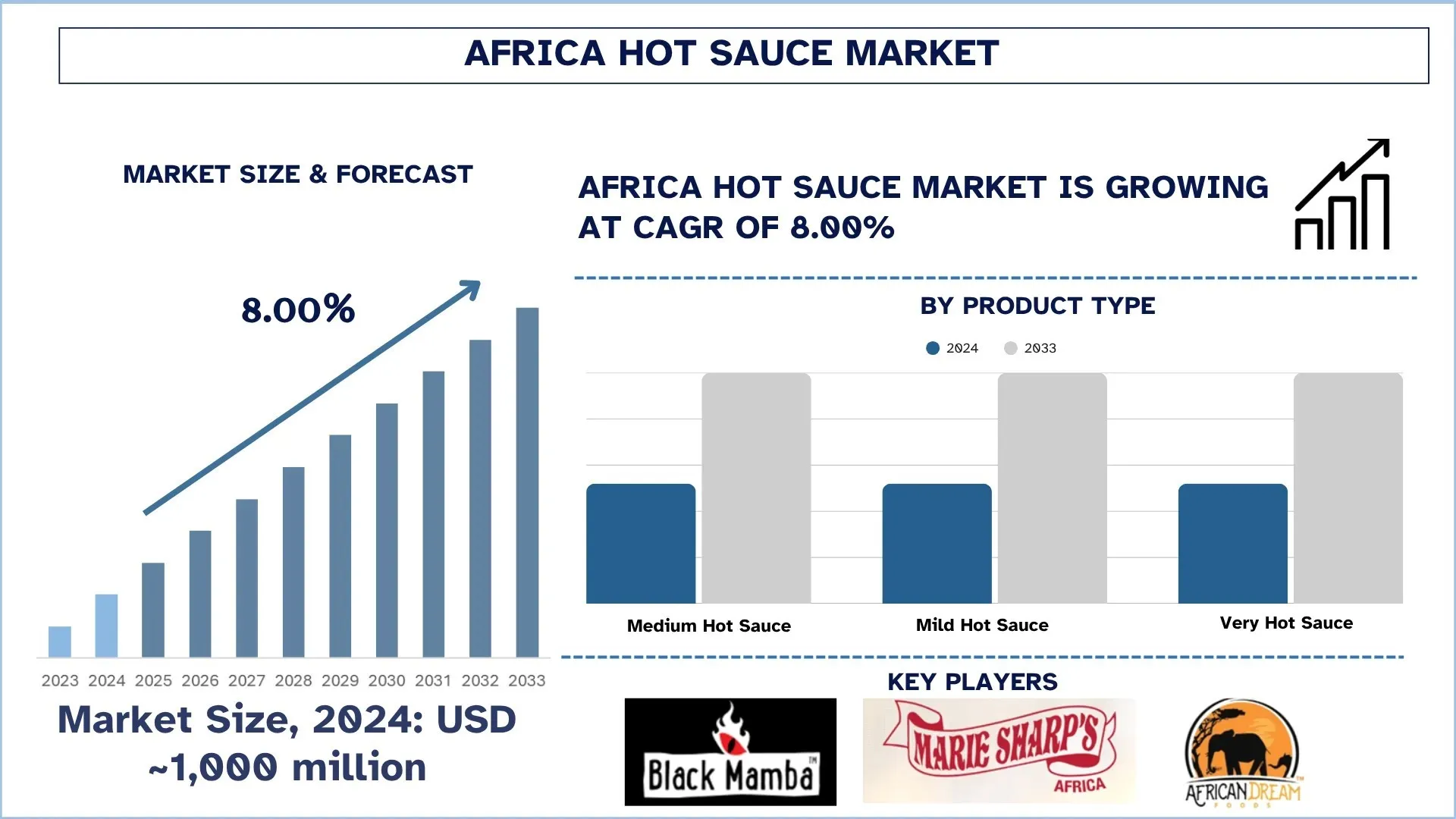
Africa Hot Sauce Market Size & Forecast
The Africa Hot Sauce Market was valued at USD 1,000 million in 2024 and is expected to grow at a strong CAGR of around 8.00% during the forecast period (2025- 2033F). Growing demand for spicy/ethnic flavors among consumers, and the Expansion of foodservice/quick-service restaurants (QSRs) and street-food culture have led to the market rise.
Africa Hot Sauce Market Analysis
The African Hot Sauce market is also enjoying a stable growth as a result of shifting preferences to consumers, an increase in the urban population, and even the emergence of local craftsmen's brands. As the African population grows to be more adventurous, spicy, and real, consumers are accepting hot sauces that combine the traditional native ingredients with contemporary culinary artistry. The presence of better agricultural production, especially in the production of chili and spices, is empowering the local supply chains, whereas the disposable incomes and the exposure to international foods are supporting experimentation. Furthermore, collaborations of local manufacturers and retailers with international distributors are creating new market opportunities and increasing accessibility both in physical and digital retail outlets.
Africa Hot Sauce Market Trends
This section discusses the key market trends that are influencing the various segments of the Africa Hot Sauce market, as found by our team of research experts.
Preference for bold, exotic, fusion, and ethnic flavor variants:
The tendency toward the increased popularity of bold, exotic, fusion, and ethnic taste options is one of the characteristics that mark the development of the African hot sauce market. The consumers are becoming more attracted to the nature of the sauces that will have the traditional African spiciness, with the global tastes that will provide a unique experience of taste that will be accepted by both local and international tastes. The factors that have influenced this evolution are cultural pride, exploration in home cooking, and global food trends highlighted by the use of digital media. Small-scale and artisanal producers are taking advantage of this trend by creating distinctive blends that put the indigenous ingredients in the focus: peri-peri, habanero, and African bird's eye chili, with the modern fusion twist of mango, garlic, and smoked paprika. The consequence is a vibrant marketplace where normalcy is joined with novelty, to place African hot sauces as condiments, as well as major ingredients of modern food creativity and food identity in the world.
Key Market Segmentation:
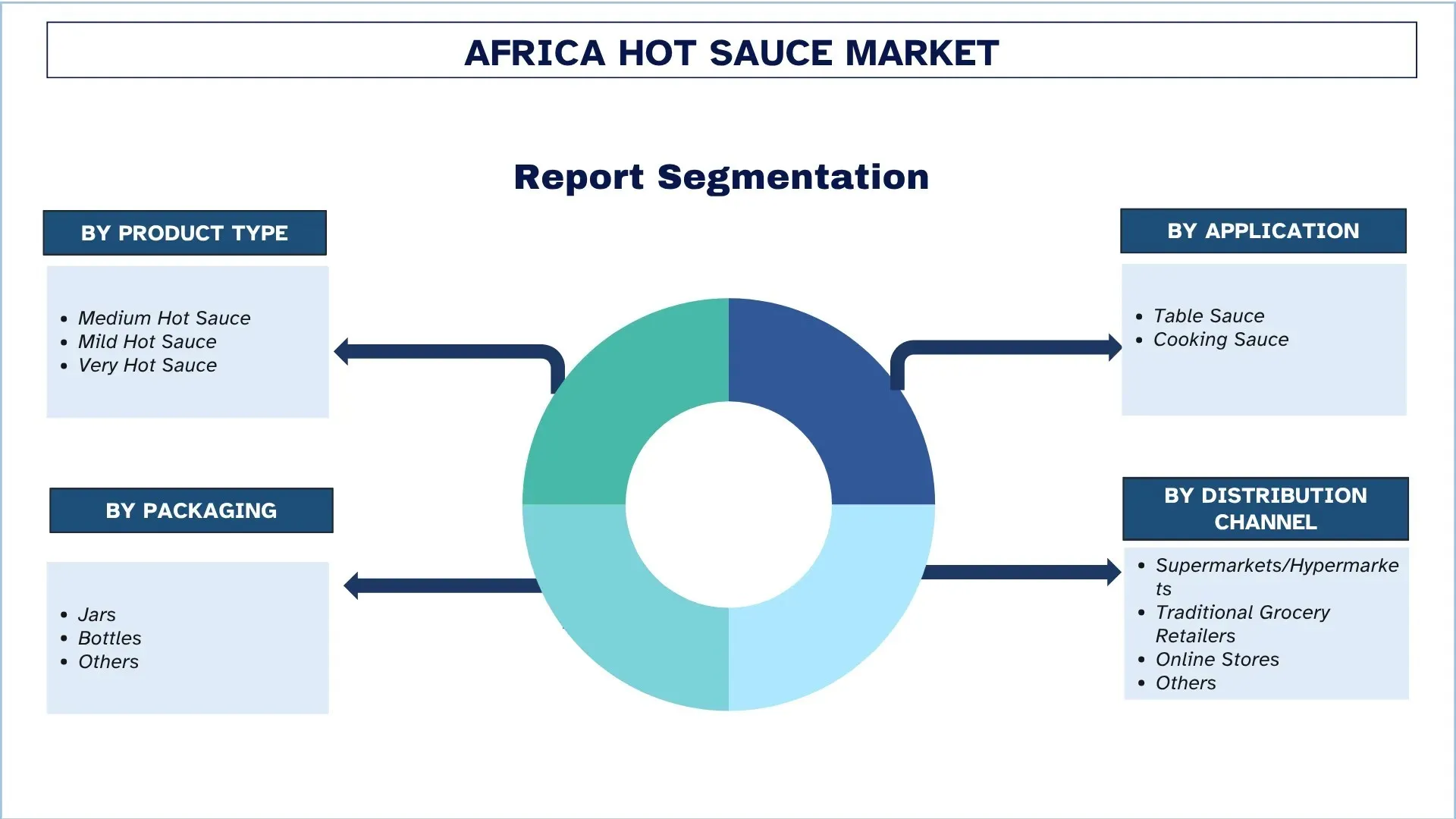
This section provides an analysis of the key trends in each segment of the Africa Hot Sauce market report, along with forecasts at the country and regional levels for 2025-2033.
Medium Hot Sauce has shown promising growth in the Hot Sauce Market.
The market of African Hot Sauce has been divided into medium hot sauce, mild hot sauce, and very hot sauce based on product type. Among them, medium hot sauces occupy the biggest portion because of their moderate flavor scheme that would attract the greatest number of consumers, catering to either those who are passionate about spices or those with moderate tolerance. The new consumers and global markets that do not crave the spiciness of hot sauces but rather want to add flavor to their food are also switching to mild hot sauces, which are common in family cuisine and casual cooking. On the other hand, extremely hot sauces are finding a niche with younger and adventurous consumers and export markets who are interested in the intensity of African chilies. Social media challenges, culinary tourism, and high-end art traditional brands, with the focus on authenticity and heat, contribute to the growth of this segment. To meet the changing tastes and preferences of consumers, manufacturers are diversifying product ranges with flavor-enhanced versions of products, including garlic, lemon, or fruit-based combinations, as a way of boosting market coverage in various regions.
The Table Sauces category held a significant share of the African Hot Sauce Market.
The African hot sauce market is segmented into table sauce and cooking sauce based on application. Table sauces are consumed in large quantities as condiments to add value to ready-to-eat foods, snacks, and fast foods to provide convenience and variety. Cooking Sauces, on the other hand, are added in the course of preparing meals to add flavor and spiciness to stews, meats, and national dishes. The developing popularity of fast-food restaurants and changing preferences of consumers to taste foods are driving the demand of both segments, and table sauces are becoming increasingly popular among urban consumers, and cooking sauces have been accepted in home and professional kitchens.
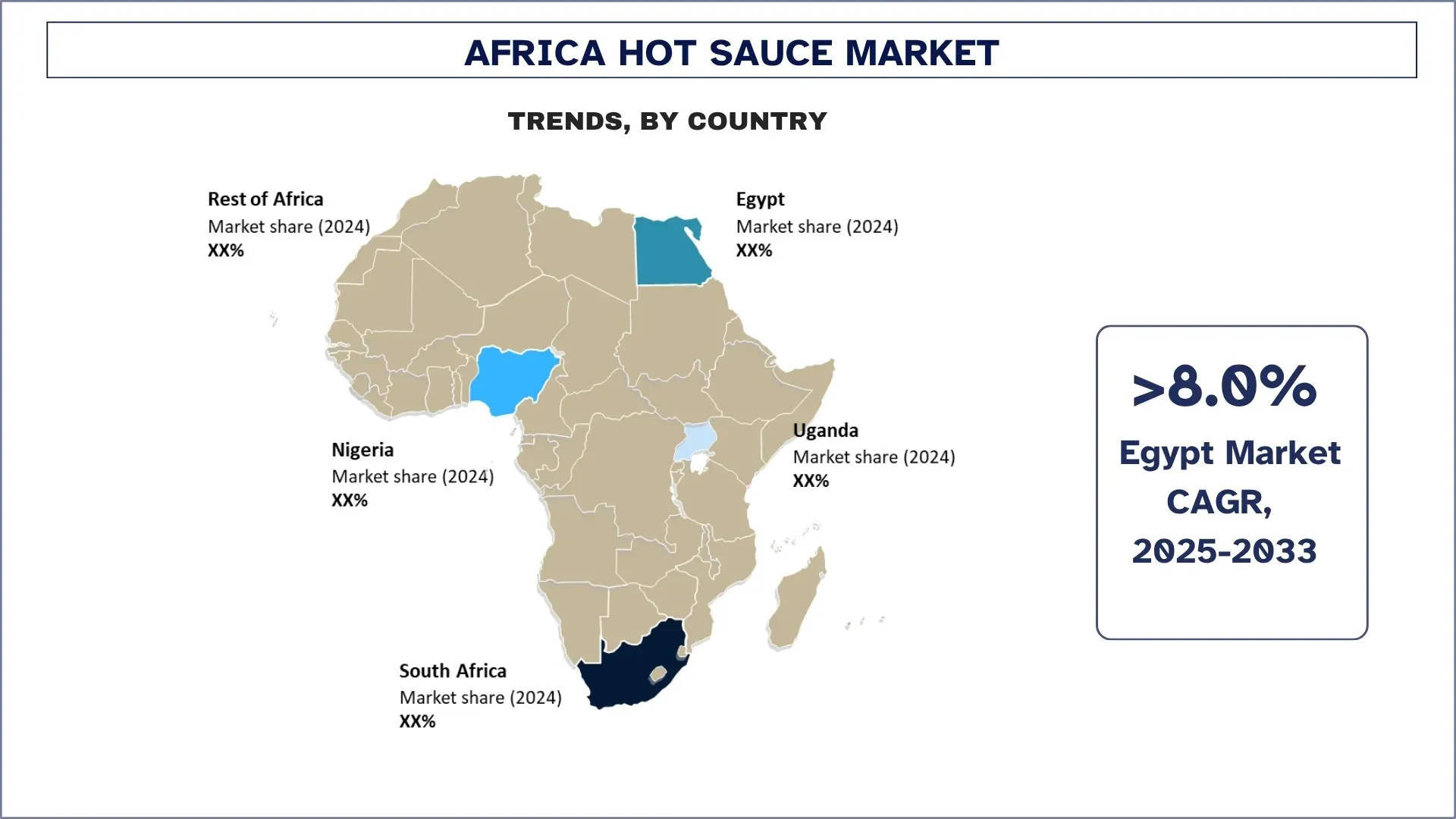
Egypt is expected to grow at a considerable rate during the forecast period.
The Egyptian hot sauce market is experiencing consistent growth due to the changing food culture, urbanization, and the growing popularity of the bold and spicy taste. Hot sauce consumption has a solid base with traditional Egyptian cuisine, which already uses chili and tangy seasoning. Increased exposure of people to the cuisines of other countries in terms of tourism, restaurants, and social media has further diversified the taste of consumers, enhancing demand for both local and foreign brands. Local manufacturers are experimenting with flavors that combine local spices with Mediterranean foods that are attractive to the local and international markets. The growth of contemporary retailing outlets and e-commerce websites is also making things more accessible, and the continued product development, along with low prices, is making Egypt a prospective and competitive market in the hot sauce industry in North Africa.
Africa Hot Sauce Industry Competitive Landscape:
The Africa Hot Sauce market is competitive, with several global and international market players. The key players are adopting different growth strategies to enhance their market presence, such as partnerships, agreements, collaborations, new product launches, geographical expansions, and mergers and acquisitions.
Top Africa Hot Sauce Companies
Some of the major players in the market are Sauce King, Black Mamba Chilli, Fynbos Fine Foods, Marie Sharp's Africa, Culex Food Production L.L.C., Africa Dreams, Soweto Spice Company, The Kraft Heinz Company, Huy Fong Foods, Inc., and DELI SPICES.
Africa Hot Sauce Market Report Coverage
Report Attribute | Details |
Base year | 2024 |
Forecast period | 2025-2033 |
Growth momentum | Accelerate at a CAGR of 8.00% |
Market size 2024 | USD 1,000 Million |
Country analysis | Egypt, South Africa, Nigeria, Uganda, and the Rest of Africa |
Major contributing Country | Egypt is expected to dominate the market during the forecast period. |
Companies profiled | Sauce King, Black Mamba Chilli, Fynbos Fine Foods, Marie Sharp's Africa, Culex Food Production L.L.C., Africa Dreams, Soweto Spice Company, The Kraft Heinz Company, Huy Fong Foods, Inc., and DELI SPICES |
Report Scope | Market Trends, Drivers, and Restraints; Revenue Estimation and Forecast; Segmentation Analysis; Demand and Supply Side Analysis; Competitive Landscape; Company Profiling |
Segments Covered | by Product Type, by Application, by Packaging, by Distribution Channel, by Country |
Reasons to Buy the Africa Hot Sauce Market Report:
The study includes market sizing and forecasting analysis confirmed by authenticated key industry experts.
The report briefly reviews overall industry performance at a glance.
The report covers an in-depth analysis of prominent industry peers, primarily focusing on key business financials, type portfolios, expansion strategies, and recent developments.
Detailed examination of drivers, restraints, key trends, and opportunities prevailing in the industry.
The study comprehensively covers the market across different segments.
Deep dive Country-level analysis of the industry.
Customization Options:
The Africa Hot Sauce Market can further be customized as per requirements or any other market segment. Besides this, UnivDatos understands that you may have your own business needs; hence, feel free to contact us to get a report that completely suits your requirements.
Table of Content
Research Methodology for the Africa Hot Sauce Market Analysis (2023-2033)
We analyzed the historical market, estimated the current market, and forecasted the future market of the Africa Hot Sauce market to assess its application in major countries. We conducted exhaustive secondary research to gather historical market data and estimate the current market size. To validate these insights, we carefully reviewed numerous findings and assumptions. Additionally, we conducted in-depth primary interviews with industry experts across the Hot Sauce value chain. After validating market figures through these interviews, we used both top-down and bottom-up approaches to forecast the overall market size. We then employed market breakdown and data triangulation methods to estimate and analyze the market size of industry segments and sub-segments.
Market Engineering
We employed data triangulation techniques to finalize the overall market estimation and derive precise statistical numbers for each segment and sub-segment of the Africa Hot Sauce market. We split the data into several segments and sub-segments by analyzing various parameters and trends, by Product Type, by Application, by Packaging, by Distribution Channel, and by country within the Africa Hot Sauce market.
The Main Objective of the Africa Hot Sauce Market Study
The study identifies current and future trends in the African Hot Sauce market, providing strategic insights for investors. It highlights Country-level market attractiveness, enabling industry participants to tap into untapped markets and gain a first-move advantage. Other quantitative goals of the studies include:
Market Size Analysis: Assess the current forecast and market size of the Africa Hot Sauce market and its segments in terms of value (USD).
Africa Hot Sauce Market Segmentation: Segments in the study include areas by Product Type, by Application, by Packaging, by Distribution Channel, and by
Regulatory Framework & Value Chain Analysis: Examine the regulatory framework, value chain, customer behavior, and competitive landscape of the Africa Hot Sauce industry.
Country Analysis: Conduct a detailed Country analysis for key areas such as Egypt, South Africa, Nigeria, Uganda, and the Rest of Africa.
Company Profiles & Growth Strategies: Company profiles of the Africa Hot Sauce market and the growth strategies adopted by the market players to sustain the fast-growing market.
Frequently Asked Questions FAQs
Q1: What is the Africa Hot Sauce market’s current market size and growth potential?
The Africa Hot Sauce Market was valued at 1,000 million in 2024 and is expected to grow at a CAGR of 8.00% during the forecast period (2025-2033).
Q2: Which segment has the largest share of the Africa Hot Sauce market by Product Type?
Medium hot sauces occupy the biggest portion because of their moderate flavor scheme that would attract the greatest number of consumers, catering to either those who are passionate about spices or those with moderate tolerance.
Q3: What are the driving factors for the growth of the Africa Hot Sauce market?
• Growing Demand for Spicy/Ethnic Flavors Among Consumers: Increasing consumer preference for bold and authentic flavors is boosting the demand for hot sauces across Africa.
• Expansion of Foodservice/Quick-Service Restaurants (QSRs) and Street-Food Culture: The rapid rise of fast-food outlets and vibrant street-food scenes is fueling higher consumption of hot sauces.
• Africa’s Spice and Chili Raw-Material Potential/Agricultural Base: The continent’s rich agricultural resources and favorable climate support large-scale chili and spice production, reducing import dependency and encouraging local value addition.
Q4: What are the emerging technologies and trends in the Africa Hot Sauce market?
• Preference for Bold, Exotic, Fusion, and Ethnic Flavor Variants: Consumers are increasingly drawn to unique flavor blends that combine traditional African spice profiles with global taste influences.
• Growth of E-Commerce/Retail Modernization and Improved Distribution: Expanding digital marketplaces, modern supermarkets, and enhanced logistics are improving product accessibility and visibility across urban and semi-urban regions.
Q5: What are the key challenges in the Africa Hot Sauce market?
• Volatility of Raw-Material Costs/Supply-Chain/Infrastructure Constraints: Fluctuating prices of agricultural inputs, inconsistent supply chains, and weak infrastructure impact production and distribution efficiency.
• Competition, Awareness & Consumer Education, Fragmentation of the Market: High market fragmentation and limited consumer awareness challenge brand differentiation and long-term growth potential.
Q6: Which country dominates the Africa Hot Sauce market?
The Egyptian hot sauce market is experiencing consistent growth due to the changing food culture, urbanization, and the growing popularity of the bold and spicy taste. Hot sauce consumption has a solid base with traditional Egyptian cuisine, which already uses chili and tangy seasoning.
Q7: Who are the key players in the Africa Hot Sauce market?
Some of the top Hot Sauce companies in Africa include:
• Sauce King
• Black Mamba Chilli
• Fynbos Fine Foods
• Marie Sharp's Africa
• Culex Food Production L.L.C.
• Africa Dreams
• Soweto Spice Company
• The Kraft Heinz Company
• Huy Fong Foods, Inc.
• DELI SPICES
Q8: What are the opportunities for companies within the Africa Hot Sauce market?
• Premium/Branded Hot Sauces Leveraging Local Heritage and Export Potential: There is a growing opportunity for brands to create premium hot sauces that highlight Africa’s rich culinary heritage, unique chili varieties, and authentic flavor profiles. Such products appeal to both domestic and international markets, enhancing Africa’s position in global condiment exports.
• Expanding into Under-Penetrated Distribution/Urbanizing and Township Markets: Rapid urbanization, rising disposable incomes, and improved retail infrastructure are opening new growth avenues in previously untapped township and semi-urban markets, enabling broader brand reach and market penetration across diverse consumer segments.
Q9: How are consumer preferences shaping product development in the Africa Hot Sauce market?
Evolving consumer preferences for bold, authentic, and fusion Flavors are driving innovation in the Africa hot sauce market, encouraging producers to develop locally inspired, high-quality, and globally appealing product varieties.
Related Reports
Customers who bought this item also bought





Southeast Asia Household Appliances Market: Current Analysis and Forecast (2025-2033)
Emphasis on Product Type (Major Appliances {Refrigerators, Washing Machine, Air Conditioner, Dishwashing Machines, Others}, Small Appliances {Coffee Makers, Air Purifiers, Cookers & Steamers, Personal Care Appliances, Others}); Distribution Channel (Hypermarkets & Supermarkets, Exclusive Brand Outlets, Electronic Stores, Online Platforms, Others); and Country.
November 7, 2025

Cocktail Shakers Market: Current Analysis and Forecast (2025-2033)
Emphasis on Product (Cobbler Shaker, Boston Shaker, French Shaker, and Others); Material (Stainless Steel, Glass, Plastic, and Others); Capacity (Small {less than 500 ml}, Medium {500 ml - 1000 ml}, and Large {Above 1000 ml}); Distribution Channel (Online and Offline); Application (Individual and Commercial); and Region/Country
November 6, 2025