
Even in a world where people are always connected online, the customer’s voice still matters. When you need structured, dependable feedback without meeting respondents in person CATI (Computer-Assisted Telephone Interviewing) remains a widely used and effective approach for structured telephone research.
CATI combines trained interviewers with computer-guided questionnaires to run consistent telephone interviews at scale. This typically enables faster turnaround, stronger quality control, and cleaner data compared with unstructured manual calling. For many organizations, this approach remains a cornerstone of phone-based market research, especially when speed and field oversight are critical.
What is CATI?
CATI is a structured telephone interviewing method where interviewers follow a programmed questionnaire on a computer system while speaking with respondents over the phone. The system guides the interviewer through the survey, records answers digitally, and applies real-time logic checks such as:
Skip patterns and routing (showing only relevant questions)
Range and consistency validations (reducing entry errors)
Quota controls (balancing sample by target groups)
Mandatory fields and standardized response options
This combination of human-led interviewing and system-led structure helps ensure consistency across interviews and improves the reliability of the final dataset, making CATI a highly controlled form of voice-based data collection.
How the CATI Process Works?
A well-run CATI study typically follows these steps:
Questionnaire Design: The questionnaire is converted into a computer-guided script with logic checks, skip patterns, and validations. This step is critical because it determines interview flow, respondent experience, and data quality.
Interviewer briefing and training: Interviewers are trained on:
Study objective and target respondent profile
Screening criteria and respondent recruitment approach
Neutrality, tone, and probing techniques
Handling objections and maintaining respondent comfort.
Live telephone interviewing: Interviews are conducted over the phone using the programmed script. Interviewers can clarify questions, confirm understanding, and probe, when necessary, especially helpful for complex topics or B2B audiences.
Real-time monitoring and quality control: Supervisors track progress and quality throughout fieldwork, including:
Length of interview (LOI) and drop-off points
Quotas achieved vs pending
Call outcomes (no answer, busy, refusal, callback)
Interviewer adherence to script and neutrality
Where permitted and appropriate, verification checks may be used to confirm interview authenticity and consistency.
Data review and delivery: Once fieldwork is complete, the dataset is cleaned, reviewed for outliers or inconsistencies, and delivered in an analysis-ready format. Clients typically receive:
Structured dataset (Excel/CSV/SPSS-ready)
Codebook / variable dictionary
Field summary (sample disposition, quotas, LOI, etc.)
Optional toplines, crosstabs, and insight summary.
Why CATI is effective.
CATI improves research efficiency and data quality by digitizing the interview process and standardizing execution. Compared with manual calling, CATI reduces data-entry errors and speeds up the path from interviews to usable outputs. Compared with self-administered surveys, CATI enables clarification and probing, which often improves completeness and interpretability.
CATI is especially valuable when:
You need quick answers with structured data
Respondents may not complete online surveys
Questions require explanation or confirmation
Quality monitoring during fieldwork is important.
Because responses are captured in real time with programmed checks, teams also get stronger field visibility, such as quota movement, LOI trends, and disposition patterns making CATI a practical choice for remote data collection services when in-person work is not feasible or not required.
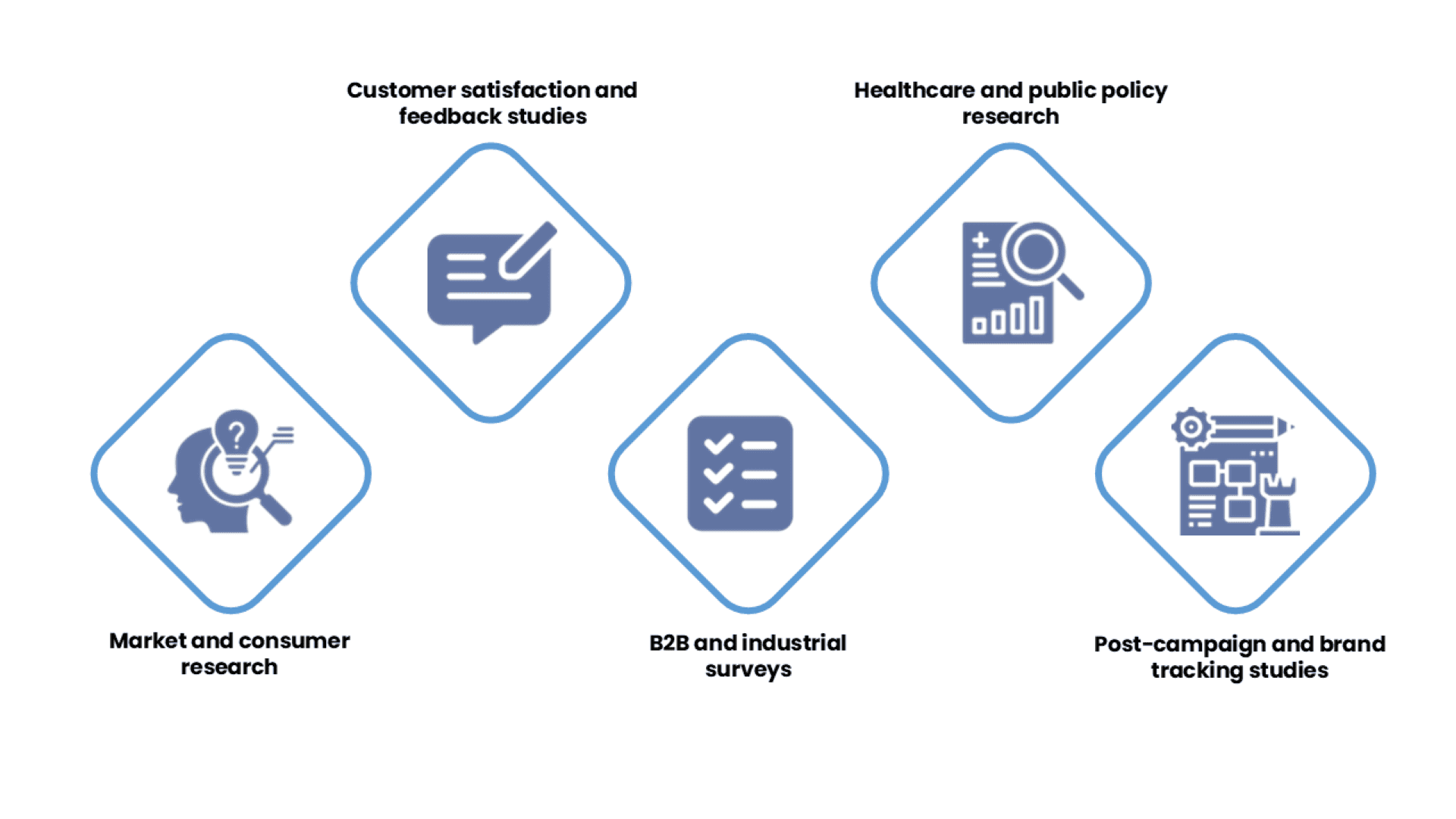
Common real-life applications of CATI
Key benefits of CATI
CATI is often chosen because it offers a strong balance of reach, speed, and control:
Reach without travel: Access respondents across regions without on-ground logistics
Faster turnaround: Digital capture reduces time spent on transcription and entry
Built-in quality controls: Logic checks and standardized scripts reduce errors
Real-time supervision: Fieldwork can be monitored and corrected immediately
Lower cost than in-person methods: Particularly for multi-city or multi-region studies
Handles complex questionnaires better than online-only: Interviewers can clarify and probe.
For organizations running telephone survey services at scale, these controls support consistent execution across teams, shifts, and geographies.
CATI compared with other approaches
CATI sits between online surveys (self-administered) and in-person interviewing:
Compared to online surveys: CATI typically enables better clarification, probing, and completeness, especially for complex questions or professional audiences. It also largely reduces biased responses.
Compared to in-person methods: CATI is faster and more cost-efficient, though it is less suitable when the study requires visual stimuli, product demos, or very long sessions.
A practical methodology choice depends on target audience accessibility, questionnaire complexity, timeline, and the level of depth required.
How to improve CATI outcomes
High-quality CATI depends as much on execution as on the questionnaire. These best practices consistently improve results:
Keep questionnaires concise and respondent-friendly
Pilot early to validate flow, length, and comprehension
Train interviewers on neutrality, tone, and probing
Use call scheduling windows and structured callbacks to improve response rates
Monitor fieldwork daily (quotas, LOI, drop-offs, refusal reasons)
Review interviewer performance and correct issues early
Maintain clear disposition codes to understand field productivity.
UnivDatos as your CATI partner
At UnivDatos, we conduct CATI with a disciplined fieldwork approach focused on consistency, respondent comfort, and data integrity. Our team supports end-to-end delivery, from questionnaire programming and interviewer training to real-time monitoring and clean, analysis-ready outputs.
We support programs that require CATI interviewing solutions and scalable execution, including multi-region calling plans, structured disposition tracking, and quality-led delivery. If your objective is to capture structured, reliable insights through telephone interviews, especially when speed and quality control matter, CATI is well-established route to high-confidence, decision-support feedback, and our CATI fieldwork is designed to support consistent execution and quality-led delivery.
Ready to hear what your customers and stakeholders really think?
Connect with UnivDatos to discuss your target audience, geography, and questionnaire scope, and we will recommend the most practical approach for your study.
Get connected with us today to learn how to turn your data into decisions and your decisions into success!