
Many business risks develop gradually. Demand begins to soften, customer behaviour shifts, operating costs rise, or production delays become more frequent. These early signals may be visible in the data long before the full impact appears in financial results.
The challenge is recognizing them in time.
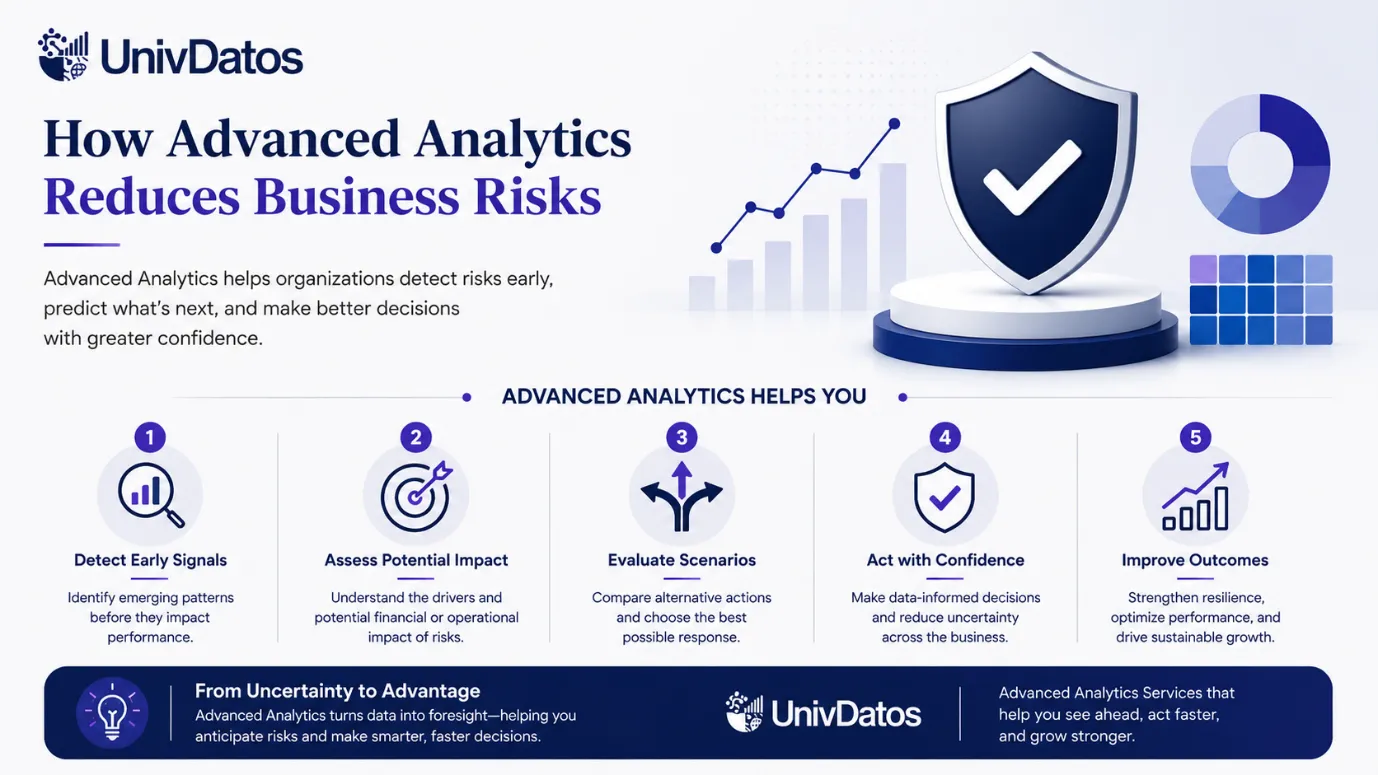
Advanced Analytics uses forecasting, statistical modeling, segmentation, scenario analysis, and optimization to help organizations understand what may happen next and how they should respond. Unlike traditional reporting, which mainly explains past performance, it helps leaders assess emerging risks and make more informed decisions under uncertainty.
The objective is not to predict every outcome perfectly. It is to identify possible problems earlier, understand what is driving them, and evaluate the available options before acting.
Moving Beyond Historical Reporting
Most business reports are designed to answer a familiar question: What happened?
They may show that revenue declined, costs increased, customer churn rose, or production slowed. While this information is important, it often arrives after the business has already been affected.
Leaders usually need to know more:
Is the change temporary or part of a wider trend?
Which customers, products, locations, or processes are most exposed?
What is likely to happen if no action is taken?
Which response offers the best balance of cost, risk, and opportunity?
Predictive Analytics helps estimate likely outcomes based on historical and current patterns. Prescriptive Analytics goes a step further by helping decision-makers compare possible actions and understand their potential trade-offs.
Together, these capabilities turn data from a record of past performance into a practical tool for managing future uncertainty.
Where Advanced Analytics Reduces Risk
Demand and revenue planning
Poor forecasts can lead to excess inventory, missed sales, underused capacity, and unnecessary costs.
Sales and revenue data can be analyzed across customers, products, regions, and channels to identify changing demand patterns. Forecasting models can then estimate how those patterns may develop under different conditions.
For example, overall sales may still appear stable while order frequency, average transaction value, or conversion rates begin to weaken. Sales Analytics can reveal these changes before they significantly affect revenue.
The purpose is not simply to produce a forecast. It is to understand the assumptions behind it, the range of possible outcomes, and the factors most likely to influence the result.
Customer and market exposure
Customer behavior is rarely uniform. Some customers are highly sensitive to price, others are more likely to leave after a service issue, and some may respond better to particular channels or offers.
Customer Behavior Analytics can help identify these differences by examining purchasing patterns, engagement, product preferences, and churn indicators. This allows organizations to focus retention efforts, improve segmentation, and avoid treating all customers in the same way.
Marketing teams can also use analytics to compare campaign performance, acquisition costs, conversion, and customer value. This reduces the risk of continuing to invest in activities that generate engagement but limited commercial value.
Operational disruption
Operational risks often begin as small exceptions: rising downtime, slower throughput, increasing defects, recurring delivery delays, or growing dependence on a limited number of suppliers.
Operational Analytics helps organizations identify these patterns across production, inventory, logistics, service levels, and resource utilization.
In industrial environments, Manufacturing Analytics can support production planning, quality monitoring, downtime analysis, and predictive maintenance. By detecting recurring issues earlier, teams can act before they develop into larger operational or financial losses.
Planning and investment decisions
Some risks arise because leaders must choose between several reasonable options without knowing which one will perform best.
Scenario analysis allows organizations to test how changes in demand, pricing, costs, capacity, staffing, or sourcing may affect future outcomes. A business might compare the impact of increasing inventory, adding production capacity, changing suppliers, or reallocating a sales budget.
This creates a more structured decision process. Assumptions become visible, trade-offs can be discussed, and management can assess how different choices may perform under changing conditions.
The Model Is Only Part of the Answer
Advanced analytics does not create value simply because a model is technically sophisticated.
The analysis must reflect how the business actually operates. The data must be relevant, assumptions must be realistic, and the outputs must be understandable to the people responsible for acting on them.
This is why Advanced Analytics Consulting should begin with a clear business question rather than a preferred tool or algorithm.
A useful analytics initiative should clarify:
Which decision needs to improve
What risk the organization is trying to manage
Which data is available
What factors influence the outcome
How the insight will be used
Who will take action
The best solution is not always the most complex one. In many cases, a clear forecast, practical segmentation model, or well-designed scenario analysis can create more value than an advanced model that users do not understand or trust.
Building a Practical Analytics Approach
Organizations should begin with a risk that is recurring, measurable, and important to the business. Suitable examples include demand volatility, customer churn, production downtime, supplier performance, cost escalation, and forecasting errors.
The next step is to assess data readiness. Historical, transactional, operational, and planning data should be reviewed for accuracy, completeness, and relevance. Weak data can create a false sense of confidence, even when the model itself appears accurate.
A focused pilot can then be used to test the approach. The result should be evaluated not only for technical performance but also for business usefulness. Decision-makers should understand what the analysis indicates, why the outcome may occur, and what they can do in response.
Models should also be reviewed over time. Customer behavior, market conditions, and operational processes change. Forecasts and analytical assumptions must evolve with them.
How UnivDatos Supports Advanced Analytics
UnivDatos provides Advanced Analytics Services that help organizations identify performance drivers, forecast outcomes, evaluate scenarios, and improve business decisions.
Our support can include predictive analytics, demand forecasting, customer segmentation, behavioural analysis, scenario modeling, optimization, and prescriptive decision support.
We begin with the business problem, assess the available data, select an appropriate analytical method, and validate the assumptions with relevant stakeholders. Our focus is not simply on producing models. It is on making the results understandable, practical, and useful to the people responsible for making decisions.
Final Perspective
Business uncertainty cannot be eliminated. It can, however, be understood and managed more effectively.
Advanced Analytics helps organizations identify emerging signals, estimate possible outcomes, and compare alternative responses before risks become more difficult or expensive to manage.
Its real value does not come from model complexity. It comes from giving leaders more time, better options, and greater confidence when making important decisions.
Explore UnivDatos’ Advanced Analytics Services to identify where forecasting, predictive modeling, segmentation, or scenario analysis can help reduce business risk.
Frequently Asked Questions
1. How much historical data is needed for predictive analytics?
The requirement depends on the business question, the frequency of the data, and the amount of variation in the process being studied. Some use cases can begin with limited data, while seasonal forecasting or complex behavioral models may require a longer history.
2. How should leaders interpret a predictive forecast?
A forecast should be treated as a range of possible outcomes rather than a guaranteed result. Leaders should review the assumptions, confidence range, key drivers, and conditions that could cause the outcome to change.
3. When is scenario analysis more useful than a single forecast?
Scenario analysis is useful when outcomes depend on uncertain variables such as demand, pricing, cost, supply availability, or capacity. It allows leaders to compare several plausible futures rather than relying on one expected result.
4. What happens when market conditions change after a model is deployed?
Models should be monitored and reviewed regularly. Significant changes in customer behaviour, operations, or market conditions may require assumptions, variables, or model parameters to be updated.
5. How can an organization measure whether analytics has reduced risk?
The impact can be measured through business outcomes such as improved forecast accuracy, lower inventory variance, reduced downtime, better customer retention, faster response times, or fewer costly exceptions.