
For years, enterprises have focused on digitizing processes, improving data availability, and automating repetitive tasks. The next stage of transformation is about making those processes more intelligent.
Organizations today are not only looking to automate work. They want systems that can understand information, identify patterns, support decisions, and adapt to changing business conditions.
This is where AI Solutions are helping enterprises move from rule-based automation toward intelligent, adaptive operations.
Modern AI combines data, machine learning, automation, and generative capabilities to help businesses improve productivity, enhance customer experiences, and make faster, more informed decisions.
The objective is not simply to replace manual activities. It is to help employees and business functions operate with better insights, greater speed, and improved accuracy.
From Automation to Intelligent Operations
Traditional automation follows predefined rules. It works well for repetitive and predictable processes but often struggles when situations require judgment, interpretation, or adaptation.
AI changes this approach.
Instead of only executing instructions, AI-powered systems can analyze information, recognize patterns, generate recommendations, and support complex workflows.
For example, a traditional system may process a customer request based on predefined conditions. An AI-enabled system can understand the context of the request, analyze previous interactions, and recommend the most appropriate response.
This shift, from rule-based automation to intelligent decision support—is why enterprises are increasingly investing in Enterprise AI Solutions.
Why Enterprises Are Investing in AI
The adoption of AI is being driven by several business challenges:
Increasing volumes of business data
Growing operational complexity
Higher customer expectations
Pressure to improve productivity
Need for faster decision-making
Many organizations already have large amounts of data across customer systems, operational platforms, documents, and internal applications. The challenge is converting that information into useful actions.
AI helps bridge this gap by enabling organizations to analyze information faster, automate routine activities, and support employees with relevant insights.
How AI Is Transforming Enterprise Functions
Improving Customer Experiences
Customer expectations are changing rapidly. Businesses need to provide faster, more personalized, and more consistent interactions across channels.
AI can analyze customer interactions, identify behavioral patterns, automate responses, and support personalized recommendations.
For example, AI-powered systems can help organizations understand customer intent, prioritize service requests, identify potential churn risks, and improve engagement strategies.
These capabilities allow companies to move from reactive customer service toward more proactive relationship management.
Increasing Operational Efficiency
Many enterprise processes involve repetitive tasks, manual reviews, and information movement between systems.
AI automation services help organizations streamline these workflows by reducing manual effort and improving process consistency.
Examples include:
Automated document processing
Intelligent data extraction
Workflow recommendations
Exception identification
Employee productivity assistants
By handling routine activities, AI allows teams to focus more on analysis, problem-solving, and strategic work.
Supporting Better Business Decisions
Modern decisions often require analyzing large amounts of structured and unstructured information.
AI can help organizations identify patterns, forecast outcomes, and generate insights that may not be obvious through traditional analysis.
Combined with analytics capabilities, AI/ML development services can support use cases such as demand forecasting, risk analysis, customer segmentation, operational optimization, and performance improvement.
The value comes from helping leaders understand not only what happened, but also what may happen next and what actions should be considered.
Improving Knowledge Management
Enterprises generate enormous amounts of internal knowledge through documents, reports, emails, policies, and operational records.
Generative AI is changing how employees access and use this information.
Generative AI development services can help organizations build intelligent assistants that summarize information, answer internal questions, generate content, and improve knowledge accessibility.
Instead of spending significant time searching for information, employees can interact with systems that help them find relevant answers faster.
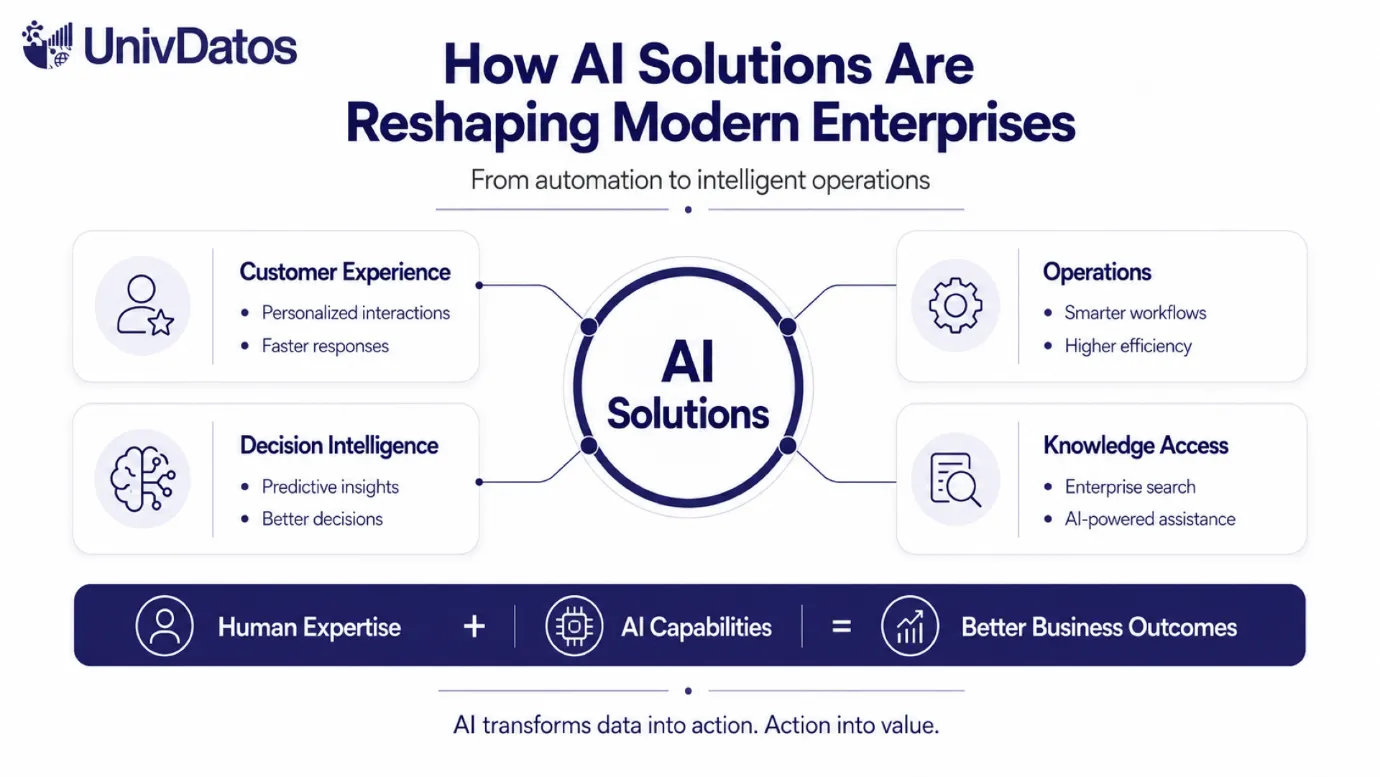
AI is creating value across the enterprise by improving customer interactions, optimizing operations, strengthening decision-making, and making organizational knowledge more accessible.
The Rise of AI Agents in Enterprise Workflows
The next evolution of enterprise AI is moving beyond individual automation tasks toward AI agents.
Unlike traditional automation, AI agents can understand objectives, break down tasks, use available information, and complete multi-step workflows with limited human intervention.
For example:
A procurement AI agent can analyze suppliers, compare options, and support sourcing decisions.
A sales AI agent can research prospects, summarize customer information, and support outreach.
A finance AI agent can assist with reporting, analysis, and variance explanations.
Organizations exploring AI agent development services and custom AI agent development are looking to create more adaptive workflows where AI works alongside employees rather than operating as a standalone tool.
Building Enterprise AI Requires More Than Technology
Successful AI adoption is not only about selecting the right model or platform.
Organizations must also address:
Data quality and availability
Integration with existing systems
Security and governance
Human oversight
Business adoption
A technically advanced solution may deliver limited value if employees do not trust the outputs or if the AI system is disconnected from existing workflows.
This is why AI consulting services play an important role in identifying suitable use cases, assessing readiness, defining implementation approaches, and ensuring AI aligns with business objectives.
How UnivDatos Supports Enterprise AI Transformation
UnivDatos provides AI Solutions that help organizations apply artificial intelligence to real business challenges.
Our approach combines business understanding, analytics expertise, AI development capabilities, and integration support to help enterprises build practical AI applications.
Services can include AI strategy, AI/ML development, workflow automation, generative AI applications, AI agents, data-driven solutions, and AI integration with existing enterprise systems.
Rather than implementing AI for technology adoption alone, UnivDatos focuses on identifying where AI can create measurable business value, whether through improved productivity, better decisions, enhanced customer experiences, or more efficient operations.
Final Perspective
AI is becoming a core capability for modern enterprises.
The organizations gaining the most value are not simply those experimenting with AI. They are the ones identifying meaningful business problems, integrating AI into existing workflows, and creating solutions that employees can actually use.
AI Solutions are reshaping enterprises by making operations more intelligent, decisions more informed, and workflows more adaptive.
The future of enterprise AI will not be defined by automation alone. It will be defined by how effectively organizations combine human expertise with intelligent systems to create better business outcomes.
Explore UnivDatos’ AI Solutions to identify opportunities where artificial intelligence can improve your enterprise operations.
Frequently Asked Questions
1. What are AI Solutions for enterprises?
AI Solutions help organizations use artificial intelligence technologies to automate processes, analyze information, improve decision-making, and create more intelligent business workflows.
2. How are AI Solutions different from traditional automation?
Traditional automation follows predefined rules, while AI-powered solutions can analyze information, identify patterns, learn from data, and support decisions in more complex situations.
3. What are AI agents, and how are businesses using them?
AI agents are intelligent systems that can understand objectives, perform multi-step tasks, use available information, and support workflows such as customer service, procurement, sales, and reporting.
4. How can businesses identify the right AI use cases?
Organizations should begin with business problems rather than technology. The best AI opportunities usually involve repetitive processes, large volumes of data, decision complexity, or areas where faster insights can create measurable value.
5. Does implementing AI require replacing existing systems?
Not necessarily. Through AI integration services, organizations can connect AI capabilities with existing applications, databases, analytics platforms, and business workflows.
6. How can UnivDatos support AI adoption?
UnivDatos helps organizations identify AI opportunities, develop practical AI applications, integrate AI into existing environments, and create solutions aligned with business objectives.