
Regional Collaboration among Governments and Corporations to accelerate the CCUS Adoption in the Asia Pacific Region!
Author: Himanshu Patni
December 16, 2023
APAC is the largest contributor of greenhouse emission gas with China and India being among the top emitters. Also, China alone contributes around 28% of global carbon emissions. Therefore, the economies of the region are taking important steps to deal with carbon emissions more effectively. Regional collaborations between governments both bilateral and multilateral and supply chain collaboration between corporations are the latest trend in the region to provide pace to the regional carbon capture capacity. Australia and Singapore, Australia and Japan, Japan and Indonesia, Australia, and China, and Malaysia, have collaboration between governments, industry, and academics.
Access sample report (including graphs, charts, and figures) – https://univdatos.com/get-a-free-sample-form-php/?product_id=44562
In addition to this, there is a growing consensus across the region that CCUS regulatory frameworks are needed for long-term legal certainty. Currently, only Australia has a full fledge complete carbon capture utilization storage regulations. Further, Asia Pacific has more than 1,300 emitter companies and more than 20 potential hubs. Currently, there are nine CCUS facilities operating in the region, mainly in China and Australia, focused on sequestration emissions from natural gas processing and the chemical sector.
The CCUS value chain overlaps with the upstream oil and gas industry, where the region has many advantages—mature local supply chains; efficiencies in wells delivery; established operational, maintenance, and health, safety, and environmental (HSE) practices; and proven track records from state-owned and independent oil companies.
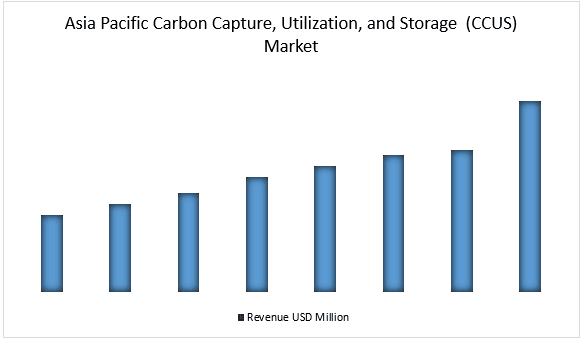
Asia Pacific Carbon Capture, Utilization, and Storage Market Revenue (2020-2028)- USD Mn
For a detailed analysis of the Global Carbon Capture, Utilization, and Storage Market browse through – https://univdatos.com/report/ccus-market/
· By technology, the market is bifurcated into wireless smart home technology and wired smart technology. Among these, wireless smart home technology captured the majority share of the smart home market in 2021. The major share of the wireless smart home technology can be attributed to the capabilities and features offered such as mobile connectivity, connectivity regardless of location, and more by protocols such as ZigBee, Wi-Fi, Bluetooth, Z Wave, and others.
· Based on source, the market is segmented into oil and gas, power generation, chemicals, heavy industries, and hydrogen. Power generation caters for an extensive share of the market and is anticipated to grow at an influential CAGR in the forecasted period as well. Fossil fuels provide most of the world’s electricity, and power generation is the largest emitter of carbon in the entire energy sector creating almost 40% of global energy-related emissions according to IEA. Therefore, the demand for carbon capture technologies becomes more competitive in the power system owing to their flexibility, reliability, and carbon intensity being fully utilized.
Global Carbon Capture, Utilization, and Storage Market Segmentation
Market Insight, by Technology
· Pre-Combustion Capture
· Oxy-Fuel Combustion Capture
· Post-Combustion Capture
Market Insights, by Source
· Oil & Gas
· Power Generation
· Chemicals
· Heavy Industries
· Hydrogen
Market Insights, by End-User
· Biological
· Mineralisation
· Food Processing
Market Insight, by Region
· North America
o U.S.
o Canada
o Rest of North America
· Europe
o Germany
o UK
o France
o Norway
o Spain
o Rest of Europe
· APAC
o China
o Japan
o India
o Rest of APAC
· Rest of the World
Top Company Profiles
· Fluor Corporation
· ExxonMobil Corporation
· Linde plc
· Royal Dutch Shell
· Mitsubishi Heavy Industries, Ltd
· JGC Holdings Corporation
· Equinor ASA
· Schlumberger Limited
· Aker Carbon Capture
· Carbon Clean Solutions Limited
Get a Callback
Related News
Subscribe to our newsletters
By submitting this form, I understand that my data will be processed by Univdatos as indicated above and described in the Privacy Policy. *