
- Home
- About Us
- Industry
- Services
- Reading
- Contact Us
Two-Wheeler Market Seen Soaring 2.6% Growth to Reach USD 29.6 Million by 2030, Projects UnivDatos
Author: Vikas Kumar
July 26, 2024
Key Highlights of the Report:
- Growing population and urbanization, have increased demand for affordable and accessible two-wheelers which propelled the growth of the two-wheeler market.
- According to the World Bank, currently, more than half of the world’s population lives in cities, and by 2045, the global urban population will have increased by 1.5 times to 6 billion, this led to the increase in demand for two-wheelers.
- The world’s population is predicted to expand by about 2 billion people during the next 30 years, from the present 8 billion to 9.7 billion in 2050, and might peak at approximately 10.4 billion in mid-2080.
- Hero Moto Corp. and Bharat Petroleum Corporation Limited (BPCL) have announced a partnership to expand and improve charging methods for electric mopeds and motorbikes throughout India.
- The Minister of Heavy Industries Mahendra Nath Pandey unveiled a new initiative to encourage the nation’s sale of electric two-wheelers and Rs 500 crore is being allotted for the Electric Mobility Promotion Scheme (EMPS), 2024.
According to a new report by UnivDatos, the Two-Wheeler Market, is expected to reach USD 29.6 Million in 2030 by growing at a CAGR of 2.6%. The two-wheeler market is one of the world’s largest and most diverse, offering a wide range of options to meet a variety of consumer wants and preferences. It is dominated by big companies including Hero MotoCorp, Bajaj Auto, TVS Motor Company, and Honda Motorcycle and Scooter India. Two-wheelers are used in a variety of applications including daily life and industry. Commuting is probably the most prevalent application, as two-wheelers are a practical and cost-effective form of transportation in overflowing cities. Many individuals use two-wheelers for delivery services, which allows for speedy and effective transportation of goods as well as Two-wheelers are frequently utilized in rural areas for agricultural activities such as crop transportation or field navigation.
Unlock Insights into the India Two-Wheeler Market – https://univdatos.com/reports/india-two-wheeler-market-2?popup=report-enquiry
The report suggests that the growing population and urbanization are one of the major factors that bolstered the growth of the two-wheeler market. The expanding population all over the world has had a key role in the expansion of the two-wheeler sector. As more people move to cities in search of greater economic prospects, there is an increased demand for economical and convenient modes of transportation. Two-wheelers, particularly motorcycles and scooters, have become popular among many people in densely populated areas where traffic congestion is an everyday occurrence. With the expanding population putting a strain on current transportation infrastructure, two-wheelers provide a viable alternative for getting through congested streets swiftly and efficiently. For instance, the global population is expected to grow by 2 billion over the next 30 years, reaching 9.7 billion in 2050 and potentially peaking at 10.4 billion in mid-2080.
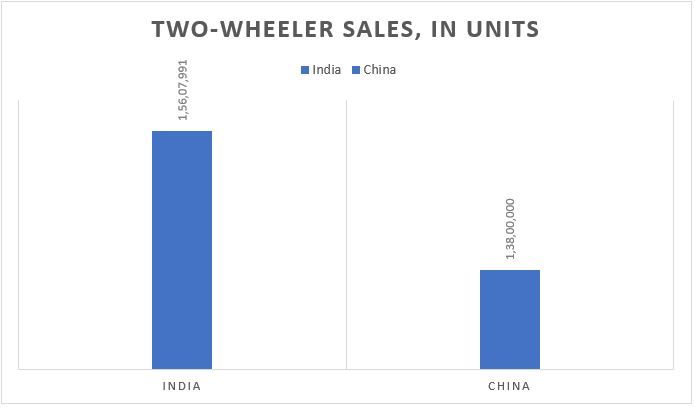
Fig 1: Two-Wheeler Sales in FY 2022.
Apart from this, ongoing technological advancements including advanced ABS (Anti-lock Braking System), digital instrument clusters, and advanced suspension systems positively impact the market’s growth.
An increase in the discretionary income of consumers
One of the key factors propelling the nation’s two-wheeler industry is the growing middle class, which has more purchasing power. An increasing proportion of Indian consumers are becoming financially competent of purchasing personal vehicles as the country’s economic prospects continue to improve. Two-wheelers are seen by the middle class, who frequently own their first cars, as an economical and useful option. The two-wheeler’s reduced operational expenses (maintenance and fuel) and initial purchase price when compared to four-wheelers are driving up the rate of product adoption. The middle class is becoming more and more able to purchase more luxurious, feature-rich two-wheelers that provide cutting-edge innovations, improved safety features, and more fuel efficiency, which is driving the market’s growth
Furthermore, this group is catered to by the availability of multiple financing options, such as customized loan packages, low-interest rate schemes, and zero-down-payment plans. This facilitates the completion of a purchase, increasing sales volume and industry revenue.
- In October 2023, NXP expanded the digital cluster reference platform for Two-Wheel EV Vehicles.
- In November 2022, Bajaj Auto, the world’s most valued two and three-wheeler manufacturer, recently unveiled the all-new Pulsar P150 in India. This very agile bike features a modern, athletic design that matches its strong and smooth 150cc engine, providing riders with a motorcycle that is both attractive and enjoyable to ride.
- In July 2022, Honda Motorcycle and Scooter India (HMSI) recently announced an exclusive agreement with Kyndryl to accelerate the IT and security transformation journey throughout HMSI’s production units.
Conclusion:
The global 2-wheeler market continues to show strong growth driven by rising demand in developing markets, increasing urbanization, and a growing preference for affordable and fuel-efficient personal mobility solutions. Key trends shaping the market include the rise of electric 2-wheelers, advancements in connected and autonomous technologies, and a focus on sustainability and emissions reduction.
While mature markets like Europe and North America have seen relatively flat or declining 2-wheeler sales, high-growth regions like Asia-Pacific, led by India and ASEAN countries, are expected to be the primary growth engines going forward. Manufacturers are investing heavily in new product development, manufacturing capacity, and distribution networks to capture this rising demand.The competitive landscape remains fragmented, with a mix of established players and new entrants vying for market share. Strategies are centered around offering differentiated products, enhancing customer experiences, and expanding into adjacent mobility services. As the industry continues to evolve, companies that can successfully navigate technological shifts, changing customer preferences, and regulatory environments will be well-positioned to capitalize on the significant long-term potential of the global 2-wheeler market.
Get a Callback