- Home
- About Us
- Industry
- Services
- Reading
- Contact Us
Middle East & Africa Conversational AI Market: Current Analysis and Forecast (2025-2033)
Emphasis By Component (Platform and Service), By Type (Chatbot and Intelligent Virtual Assistant), By Deployment (On-Premise and Cloud), By Industry (Retail and E-commerce, Healthcare & Lifesciences, Travel & Hospitality, BFSI, IT and Telecom, and Others), By Country (Saudi Arabia, UAE, Egypt, South Africa, Turkey, Israel, and the Rest of Middle East & Africa)
Geography:
Industry:
Last Updated:
Feb 2026
Middle East & Africa Conversational AI Market Size & Forecast
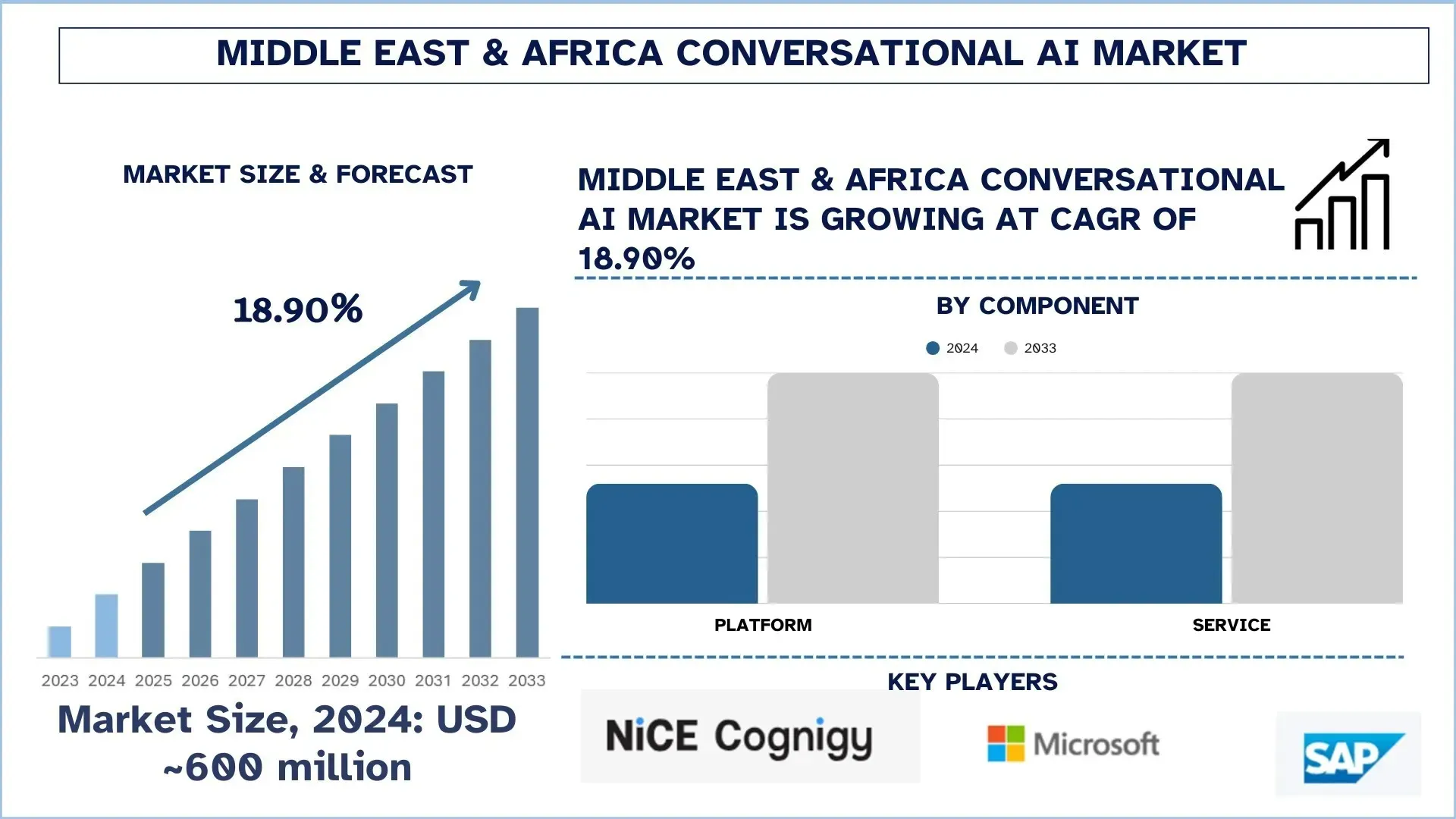
The Middle East & Africa Conversational AI Market was valued at USD 600 million in 2024 and is expected to grow at a strong CAGR of around 18.90% during the forecast period (2025- 2033F). Government-led digital service delivery & national AI programs, and Contact-center modernization with a shift to CCaaS are some of the key factors driving the market growth.
Middle East & Africa Conversational AI Market Analysis
The conversational artificial intelligence sector in the Middle East and Africa is transitioning out of exploration to mass implementation as businesses and governments hasten the pace of delivering digital-based services. The GCC has had the highest adoption rates, with national AI strategies, digital government requirements, and massive platform investments reducing the time to procurement, and is proliferating within the major African markets as the mobile-first engagement turns into the default customer interface. The expectations of the omnichannel (web, app, WhatsApp, social, IVR) and the increasing volumes of contacts and the necessity to address multilingual audiences, namely Arabic (with its dialects), English, and French, in particular, shape demand. Meanwhile, the AI stack in the region is coming of age: increased Arabic-capable models, better speech recognition, and increased access to regional cloud zones and data centers are making production-grade deployments possible. Consequently, conversational AI is becoming more of a front-line customer care, sales enablement, collections, and citizen services layer.
Middle East & Africa Conversational AI Market Trends
This section discusses the key market trends that are influencing the various segments of the Middle East & Africa Conversational AI market, as found by our team of research experts.
Data-sovereignty-driven deployment for onshore clouds & regional data centers:
The need for data sovereignty is driving conversational AI implementations into MEA, where architectures are being designed to push to onshore cloud regions, in-country data centers, and strictly controlled cross-border data flows. Since assistants deal with regulated interactions, banking questions, telecom identity verification, medical advice, and government services, an organization is more and more demanding that customer transcripts, embeddings, and model logs stay inside national borders or licensed jurisdiction. This has direct technology consequences: choosing cloud regions to comply with the residency policies, implementing local connections to contact-center systems, and implementing the pattern of hybridisation to store sensitive data on-site but execute less sensitive orchestration in regional clouds. The response of vendors is to increase regional availability zones, introduce sovereign cloud offerings, and provide customer-controlled keys and retention policies. To buyers, sovereignty needs further enhanced governance: model access controls, auditability, red-teaming, and third-party risk assessment are made procurement gatekeepers. The outcome is increased speed in investing in local infrastructure and more conversational AI stacks that are local-first.
Key Market Segmentation:
This section provides an analysis of the key trends in each segment of the Middle East & Africa Conversational AI market report, along with forecasts at the country and regional levels for 2025-2033.
The Platform segment has shown promising growth in the Conversational AI Market.
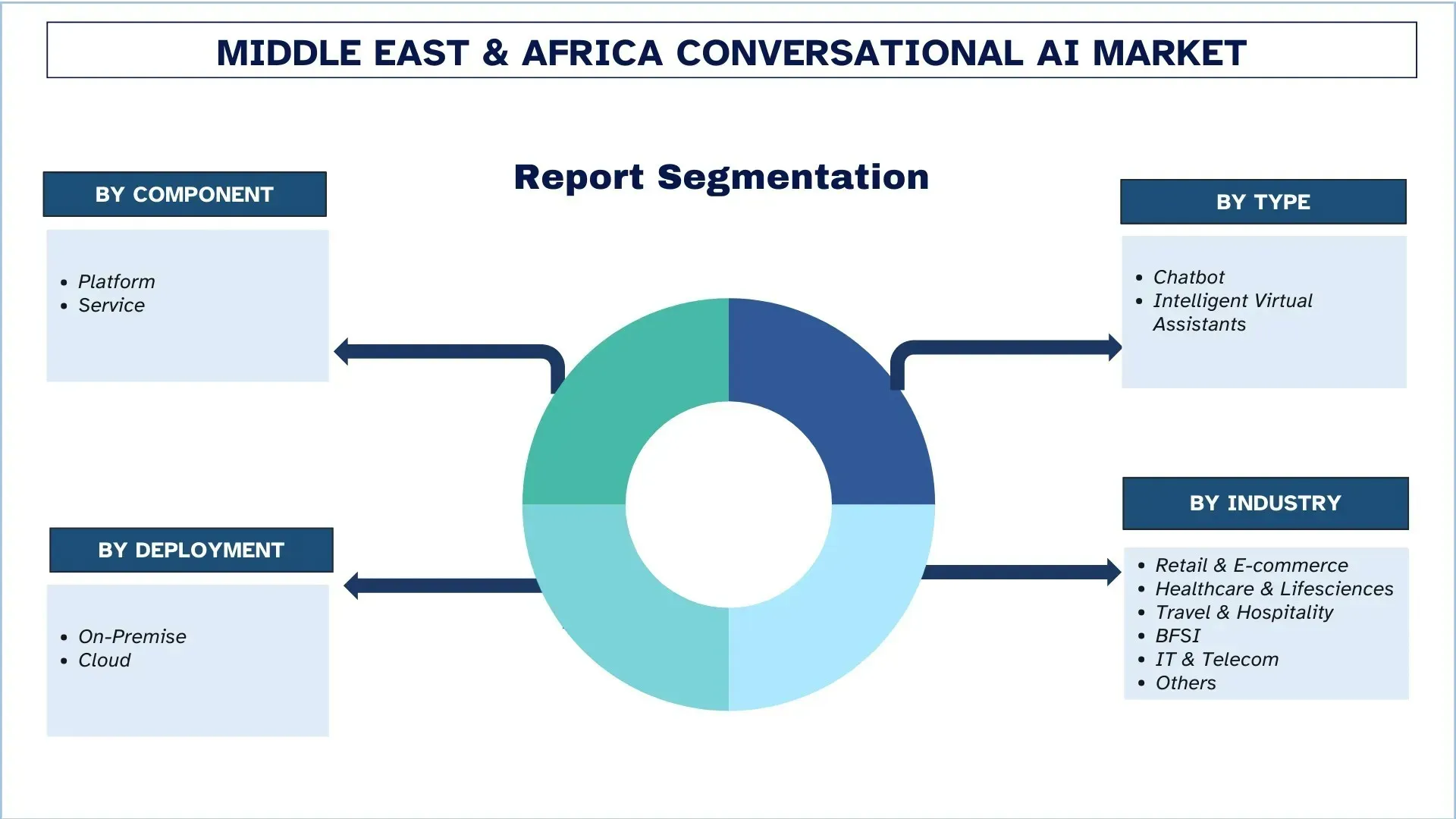
Based on component, the Middle East & Africa Conversational AI market is bifurcated into platform and services. The platform segment has commanded a large market share, backed by the enterprise preference for scalable, subscription-based software that may be deployed across numerous channels (web, mobile applications, WhatsApp, and voice/IVR) and may be integrated with existing CRM and contact-center overlays. BFSI, telecom, and government large organizations are focusing on standardized platforms to support governance capabilities, like analytics, monitoring, security controls, and multilingual model support (in particular, Arabic and regional dialects). Moreover, the hyperscaler growth and the rising accessibility of regional cloud zones are simplifying the deployment of platforms and making them simpler and quicker to get to work, supporting the platform-based purchasing choices.
The chatbots category held a significant share of the Middle East & Africa Conversational AI Market.
According to type, the Middle East market in conversational AI has been divided into chatbots and intelligent virtual assistants. Chatbots have occupied a significant market share among them. This leadership is guided by their comparatively reduced deployment expenses, quicker deployment times, and high appropriateness of large volume customer support in businesses including banking, telecommunication, retail, and government services. Another common use of chatbots in many organizations marks the first step to automation, where they are used to respond to common questions, track orders, register complaints, and schedule appointments. Simultaneously, voice systems are becoming popular as virtual assistants become more sophisticated and multilingual to suit more nuanced, complex interactions and voices.
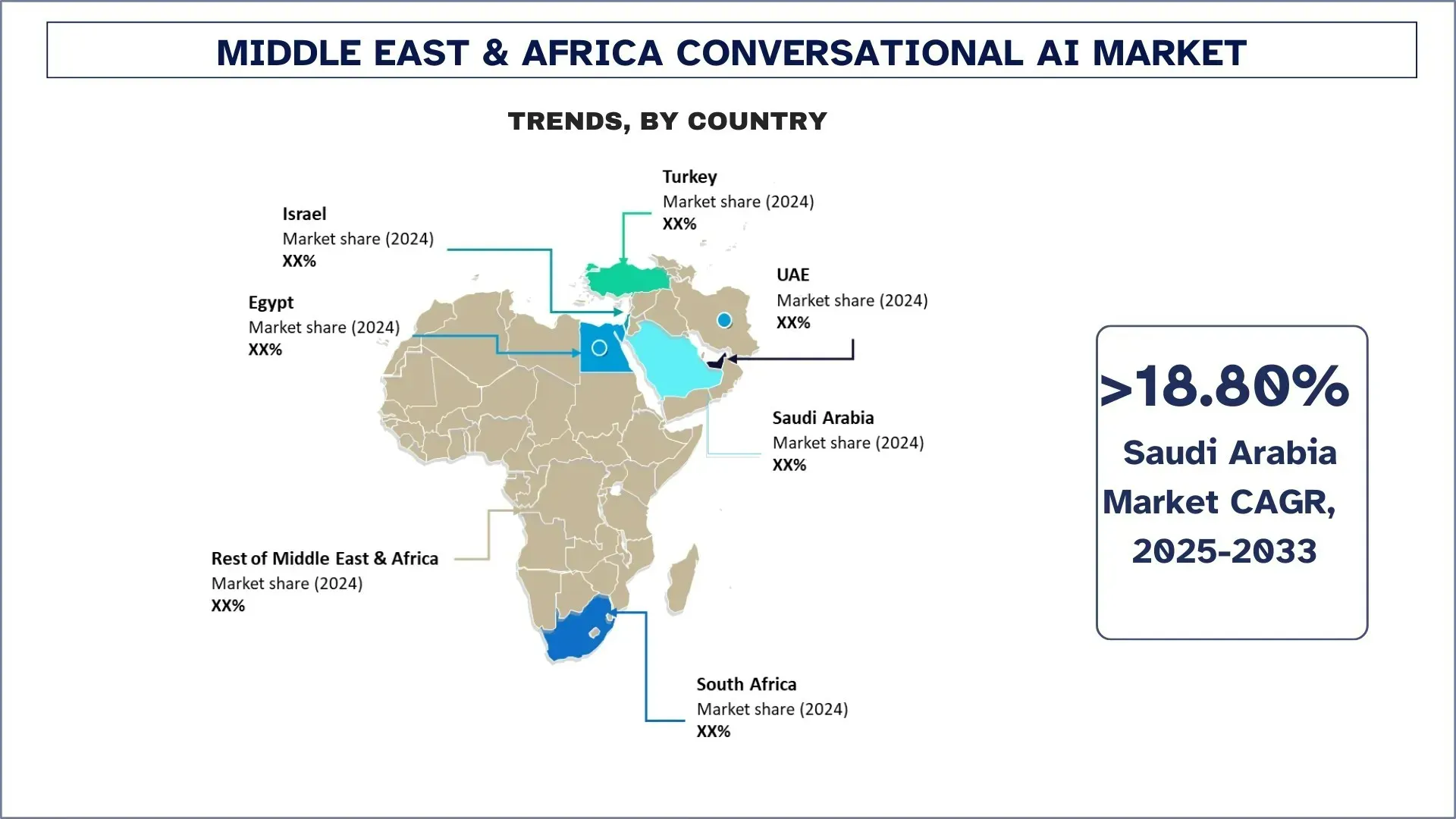
Saudi Arabia is expected to grow at a considerable rate during the forecast period.
The conversational AI market in Saudi Arabia is on a booming trend as the programs of Vision 2030 are accelerating the digitalization of government, smart-city, and the transformation of customer experience in the private sector. Banks, telecom, e-commerce, and government services have the greatest adoption of chat and voice assistants to manage a large number of inquiries, facilitate self-service transactions, and assist in the productivity of the agent. The Arabic-first demand and requirements, i.e., Modern Standard Arabic and dialect support, are shaping the market, necessitating that the language models be localized, speech recognition, and the UX be culturally aligned. The identity and sovereign options of deploying clouds that are in-country, tightly controlled, and increasingly in-country cloud regions are also making their impact on deployment decisions and are growing in popularity as cloud regions, identity, and CRM platforms and contact-centers are explored with increased attention to their security requirements.
Middle East & Africa Conversational AI Industry Competitive Landscape:
The Middle East & Africa Conversational AI market is competitive, with several global and international market players. The key players are adopting different growth strategies to enhance their market presence, such as partnerships, agreements, collaborations, new product launches, geographical expansions, and mergers and acquisitions.
Top Middle East & Africa Conversational AI Companies
Some of the major players in the market are Alphabet Inc, Amazon.com Inc., Cognigy GmbH, International Business Machines Corp, Microsoft Corp, Oracle Corp, SAP SE, Kore.ai, Zoom Video Communications Inc, and Conversica.
Middle East & Africa Conversational AI Market Report Coverage
Report Attribute | Details |
Base year | 2024 |
Forecast period | 2025-2033 |
Growth momentum | Accelerate at a CAGR of 18.90% |
Market size 2024 | USD 600 Million |
Country analysis | Saudi Arabia, UAE, Egypt, South Africa, Turkey, Israel, and the Rest of the Middle East & Africa |
Major contributing Country | Saudi Arabia is expected to dominate the market during the forecast period. |
Companies profiled | Alphabet Inc, Amazon.com Inc., Cognigy GmbH, International Business Machines Corp, Microsoft Corp, Oracle Corp, SAP SE, Kore.ai, Zoom Video Communications Inc, and Conversica. |
Report Scope | Market Trends, Drivers, and Restraints; Revenue Estimation and Forecast; Segmentation Analysis; Demand and Supply Side Analysis; Competitive Landscape; Company Profiling |
Segments Covered | by Component, by Type, by Deployment, by Industry, by Country |
Reasons to Buy the Middle East & Africa Conversational AI Market Report:
The study includes market sizing and forecasting analysis confirmed by authenticated key industry experts.
The report briefly reviews overall industry performance at a glance.
The report covers an in-depth analysis of prominent industry peers, primarily focusing on key business financials, type portfolios, expansion strategies, and recent developments.
Detailed examination of drivers, restraints, key trends, and opportunities prevailing in the industry.
The study comprehensively covers the market across different segments.
Deep dive Country-level analysis of the industry.
Customization Options:
The Middle East & Africa CONVERSATIONAL AI market can further be customized as per requirements or any other market segment. Besides this, UnivDatos understands that you may have your own business needs; hence, feel free to contact us to get a report that completely suits your requirements.
Table of Content
Research Methodology for the Middle East & Africa Conversational AI Market Analysis (2023-2033)
We analyzed the historical market, estimated the current market, and forecasted the future market of the Middle East & Africa Conversational AI market to assess its application in major countries. We conducted exhaustive secondary research to gather historical market data and estimate the current market size. To validate these insights, we carefully reviewed numerous findings and assumptions. Additionally, we conducted in-depth primary interviews with industry experts across the Conversational AI value chain. After validating market figures through these interviews, we used both top-down and bottom-up approaches to forecast the overall market size. We then employed market breakdown and data triangulation methods to estimate and analyze the market size of industry segments and sub-segments.
Market Engineering
We employed data triangulation techniques to finalize the overall market estimation and derive precise statistical numbers for each segment and sub-segment of the Middle East & Africa Conversational AI market. We split the data into several segments and sub-segments by analyzing various parameters and trends, by Component, by Type, by Deployment, by Industry, and by country within the Middle East & Africa Conversational AI market.
The Main Objective of the Middle East & Africa Conversational AI Market Study
The study identifies current and future trends in the Middle East & African Conversational AI market, providing strategic insights for investors. It highlights Country-level market attractiveness, enabling industry participants to tap into untapped markets and gain a first-mover advantage. Other quantitative goals of the studies include:
Market Size Analysis: Assess the current forecast and market size of the Middle East & Africa Conversational AI market and its segments in terms of value (USD).
Middle East & Africa Conversational AI Market Segmentation: Segments in the study include areas by Component, by Type, by Deployment, by Industry, and by
Regulatory Framework & Value Chain Analysis: Examine the regulatory framework, value chain, customer behavior, and competitive landscape of the Middle East & Africa Conversational AI industry.
Country Analysis: Conduct a detailed Country analysis for key areas such as Saudi Arabia, UAE, Egypt, South Africa, Turkey, Israel, and the Rest of the Middle East & Africa.
Company Profiles & Growth Strategies: Company profiles of the Middle East & Africa Conversational AI market and the growth strategies adopted by the market players to sustain the fast-growing market.
Frequently Asked Questions FAQs
Q1: What is the Middle East & Africa Conversational AI market’s current market size and growth potential?
The Middle East & Africa Conversational AI market was valued at 600 million in 2024 and is expected to grow at a CAGR of 18.90% during the forecast period (2025-2033).
Q2: Which segment has the largest share of the Middle East & Africa Conversational AI market by Component?
The platform segment has commanded a large market share, driven by enterprise preference for scalable, subscription-based software that can be deployed across multiple channels (web, mobile applications, WhatsApp, and voice/IVR) and integrated with existing CRM and contact center overlays.
Q3: What are the driving factors for the growth of the Middle East & Africa Conversational AI market?
• Government-led digital service delivery & national AI programs: Public-sector digitization mandates and national AI roadmaps are accelerating adoption of conversational AI for citizen services (e.g., multilingual virtual assistants for portals, healthcare, immigration, utilities), creating strong enterprise confidence and budget pull-through.
• Contact-center modernization with a shift to CCaaS: Organizations are upgrading legacy contact centers to cloud-based CCaaS platforms, making it easier to embed conversational AI across voice and chat channels, integrate with CRM/workforce tools, and scale automation without heavy on-prem infrastructure.
Q4: What are the emerging technologies and trends in the Middle East & Africa Conversational AI market?
• Shift from “chatbots” to agentic conversational AI: Buyers are moving beyond scripted bots toward AI agents that can handle multi-step tasks end-to-end (authenticate users, retrieve account data, create tickets, process requests, trigger workflows) with better context retention, tool-use, and escalation to human agents when needed.
• Data-sovereignty-driven deployment for onshore clouds & regional data centers: Increasing preference for in-country hosting and regionally anchored deployments is shaping architecture choices—driving demand for localized model hosting, private/onshore cloud options, and tighter integration with regional data centers to meet compliance and latency requirements.
Q5: What are the key challenges in the Middle East & Africa Conversational AI market?
• Data privacy, localization, and cross-border transfer constraints: Regulatory requirements around where data can reside and how it can be processed complicate model training, logging, analytics, and vendor selection—often requiring localized deployments, stricter governance, and tailored contractual/security controls.
• Limited skilled manpower availability: Shortages of experienced conversational designers, NLP/LLM engineers, MLOps talent, and bilingual (Arabic/French/English) domain specialists can slow implementation, increase reliance on external vendors, and create challenges in ongoing tuning, evaluation, and operational support.
Q6: Which country dominates the Middle East & Africa Conversational AI market?
The market of Conversational AI in Saudi Arabia is thriving at an impressive pace due to the massive investments in clouds, Digital Vision 2030, and the focus of companies on enhanced customer service.
Q7: Who are the key players in the Middle East & Africa Conversational AI market?
Some of the top Conversational AI companies in the Middle East & Africa include:
• Alphabet Inc
• Amazon.com Inc.
• Cognigy GmbH
• International Business Machines Corp
• Microsoft Corp
• Oracle Corp
• SAP SE
• Kore.ai
• Zoom Video Communications Inc
• Conversica
Q8: What are the opportunities for companies within the Middle East & Africa Conversational AI market?
• Higher adoption by the banking sector: Banks across MEA are accelerating conversational AI adoption to improve customer onboarding, balance and transaction inquiries, card and fraud support, loan eligibility checks, and proactive servicing—while reducing call-center load.
• Rising demand from managed services and implementation partners: As enterprises move from pilots to scaled deployments, demand is growing for partners who can design, integrate, and operate conversational AI end-to-end—covering use-case discovery, CRM/CCaaS integration, model tuning, governance, monitoring, and continuous improvement.
Q9: How are consumer preferences shaping product development in the Middle East & Africa Conversational AI market?
Consumer preferences in MEA are pushing vendors to build multilingual, culturally aligned conversational AI optimized for mobile-first channels like WhatsApp and voice. Users expect faster resolution, human-like personalization, and seamless handoff to agents, driving richer context, secure authentication, and localized deployment options.
Related Reports
Customers who bought this item also bought





Artificial Intelligence Prompt Marketplace Market: Current Analysis and Forecast (2025-2033)
Emphasis on Type (Text Prompts, Image Prompts, Audio Prompts, and Video Prompts); Application (Content Creation & Copywriting, Marketing & Advertising, Education & eLearning, Software Development, Entertainment & Media Production, Graphic & UX Design, Gaming & Virtual Environments, Customer Support & Virtual Assistance, and Others); and Region/Country
December 8, 2025

Brazil Big Data Analytics Market: Current Analysis and Forecast (2025-2033)
Emphasis By Organization Size (Small and Medium Enterprises (SMEs) and Large Enterprises), By End-User Vertical (IT and Telecom Sector, BFSI, Retail and Consumer Goods, Manufacturing, Health and Life Sciences, Government, And Others), By Region (North Brazil, Northeast Brazil, Central-West Brazil, Southeast Brazil, and South Brazil)
October 2, 2025

AI Watermarking Market: Current Analysis and Forecast (2025-2033)
Emphasis on Component (Software, Hardware, and Services); Deployment Mode (On-Premises and Cloud-Based); Watermark Type (Visible Watermark, Invisible Watermark, and Hybrid Watermark); Application (Media & Entertainment, Government, Healthcare, IT & Telecommunication, and Others), and Region/Country
September 30, 2025

Retrieval Augmented Generation Market: Current Analysis and Forecast (2025-2033)
Emphasis on Deployment (Cloud and On-Premises); Application (Customer Support & Chatbots, Content Generation, Search Engine Enhancement, Healthcare Information Retrieval, and Others); End-Users (IT & Telecom, BFSI, Healthcare, Retail & E-commerce, Education, and Others); and Region/Country
May 27, 2025