- Home
- About Us
- Industry
- Services
- Reading
- Contact Us
Middle East & Africa Precision Farming Market: Current Analysis and Forecast (2025-2033)
Emphasis By Offering (Hardware, Software, and Services), By Application (Yield Monitoring, Field Mapping, Crop Scouting, Inventory Management, Weather Tracking & Forecasting, and Others), By Country (Saudi Arabia, UAE, Egypt, South Africa, Turkey, Israel, and the Rest of Middle East & Africa)
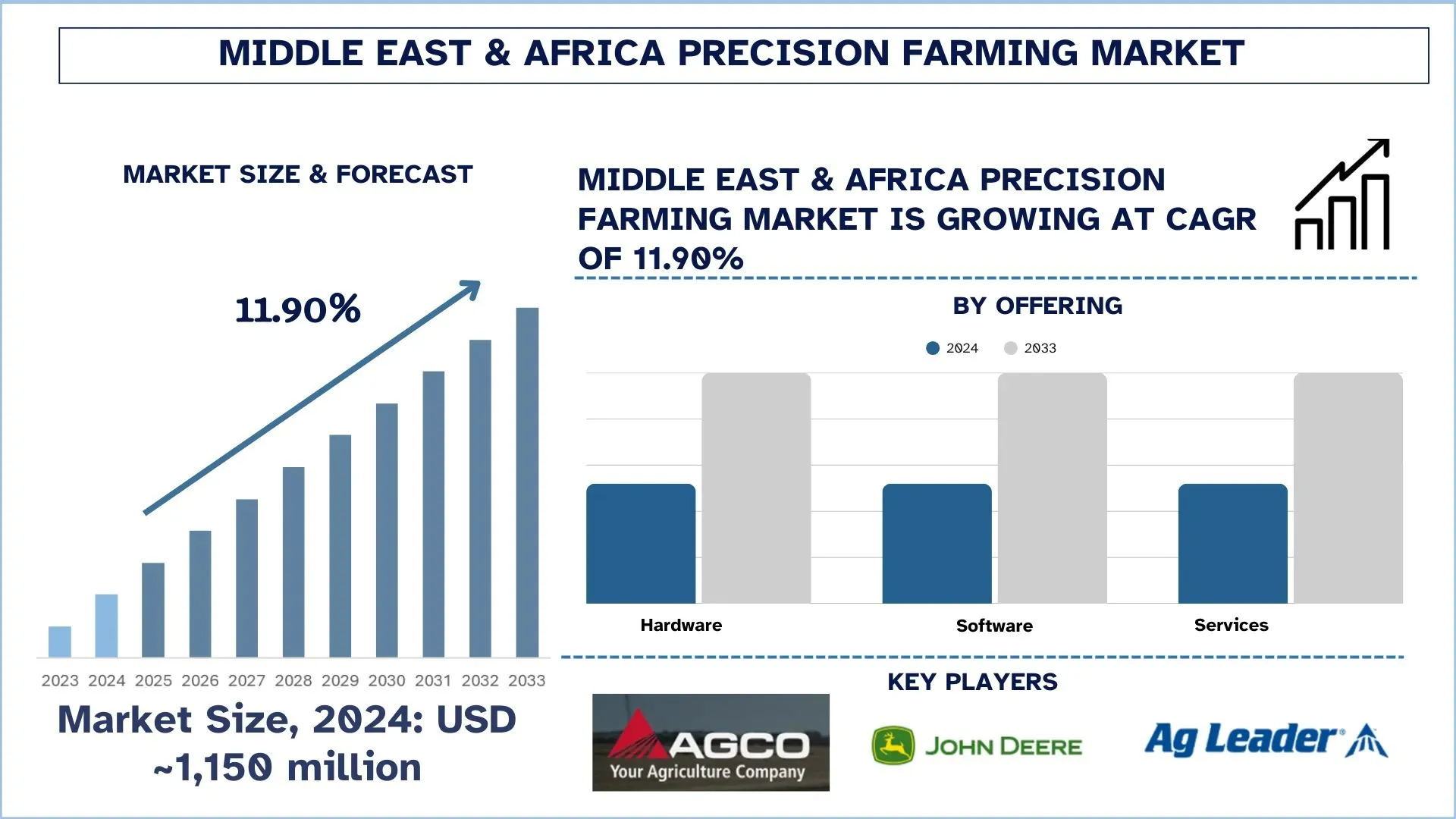
Middle East & Africa Precision Farming Market Size & Forecast
The Middle East & Africa Precision Farming Market was valued at USD 1,150 million in 2024 and is expected to grow at a strong CAGR of around 11.90% during the forecast period (2025- 2033F). Pressure to boost yields underwater and climate constraints, and an Active government push for digital agriculture and smart farming are some of the key factors supporting the market rise.
Middle East & Africa Precision Farming Market Analysis
The Middle East and African market of precision farming is on a growth path as governments, agribusiness, and technology seek to know how to increase their yields in the face of an unending water stress, fractured land tenures, and precipitation instability. The investments in satellite connection, rural broadband, and IoT networks are speeding up, which allows implementing soil sensors, GPS-guided machines, drones, and farm-management systems. Gulf nations are testing high-technology, capital-intensive horticulture and sheltered cultivation systems, whereas major African economies are trying digitally empowered smallholder programs, input-credit applications, and advisory apps. Due to declining hardware costs and greater access to cloud-based analytics, precision agriculture is becoming a niche practice on farms with export orientations. It is poised to become a pillar of local food security strategies.
Middle East & Africa Precision Farming Market Trends
This section discusses the key market trends that are influencing the various segments of the Middle East & Africa Precision Farming market, as found by our team of research experts.
Intensifying focus on water-smart, sensor-based irrigation:
Water shortages and climatic instability throughout the Middle East and Africa are accelerating the transition to sensor-based, water-efficient irrigation as a fundamental component of precision agriculture. Growers are moving to the use of soil-moisture probes, weather stations, and flow meters that are connected to automated drip and pivot systems to ensure that the amount of water applied to the crop is well-calculated in accordance with the needs of the crop. These are all linked solutions that allow real-time monitoring of the field conditions, remote control of valves and pumps, and scheduling of irrigation based on the data. The outcome is increased water-use efficiency, more sustainable yields, and less energy and fertilizer wastage due to over-irrigating. In the context of governments and agribusiness, sensor-based irrigation helps in national water strategies as well as enhances the profitability of farmers. With the reduction in the cost of hardware and the increase in interconnectedness, the adoption is likely to expand beyond large, commercialized farms to medium and organized smallholder enterprises.
Key Market Segmentation:
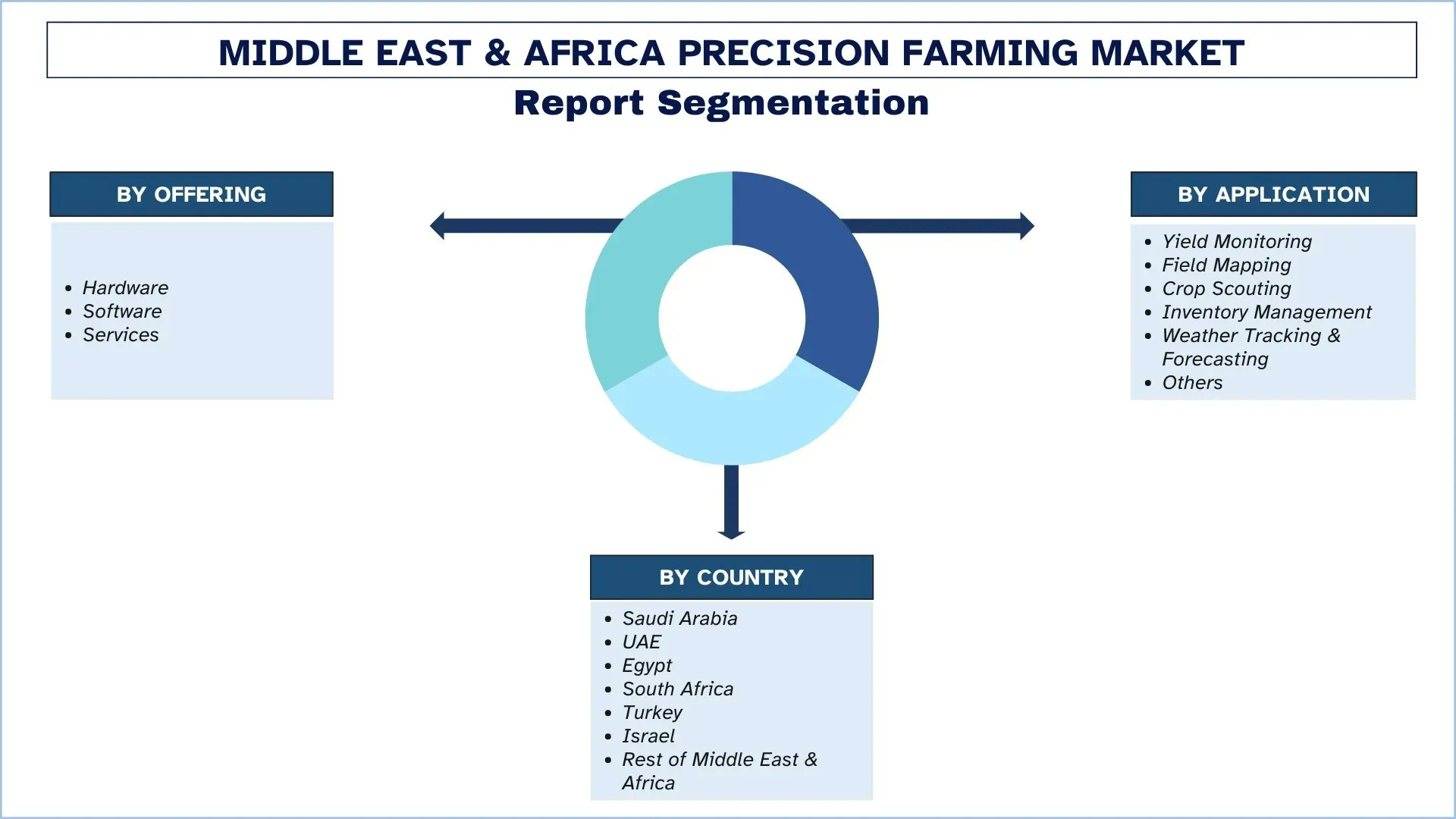
This section provides an analysis of the key trends in each segment of the Middle East & Africa Precision Farming market report, along with forecasts at the country and regional levels for 2025-2033.
The Hardware segment has shown promising growth in the Precision Farming Market.
Based on offering, the Middle East & Africa Precision Farming market is segmented into hardware, software, and services. Of these, the hardware category has held a notable market share. Increasing investment in smart irrigation and fertigation to solve endemic water scarcity and more extensive use of GPS guidance, auto steering, and variable rate application equipment that enhances input efficiency are driving hardware expansion. Farmers, however, are moving towards the use of soil and crop sensors, weather stations, and IoT gateways that enable real-time monitoring of their fields as drones and satellite devices assist in scanning larger farms. Purchases are quickening up through government food-security programs, grants of modernization, and demonstration farms. The decreasing sensor prices, enhanced connectivity in rural areas, and improved dealer and after-sales support further boost adoption on a cross-seasonal basis.
The Yield Monitoring category held a significant share of the Middle East & Africa Precision Farming Market.
In accordance with the field of application, the Middle East and Africa precision farming market is divided into yield monitoring, field mapping, crop scouting, inventory management, weather tracking and forecasting, etc. Of them, yield monitoring has enjoyed the largest market share. The main reason for this dominance is the increasing demand to be able to increase crop productivity, better resource use, and optimize profitability of the areas that have unfavorable climatic and soil conditions. Yield monitoring can help farmers have real-time information on the performance of crops, the variability that occurs within the fields, and make sound decisions regarding the application of fertilizers, irrigation, and pest management, with a resultant increase in the overall efficiency and sustainability of the farm.
Saudi Arabia is expected to grow at a considerable rate during the forecast period.
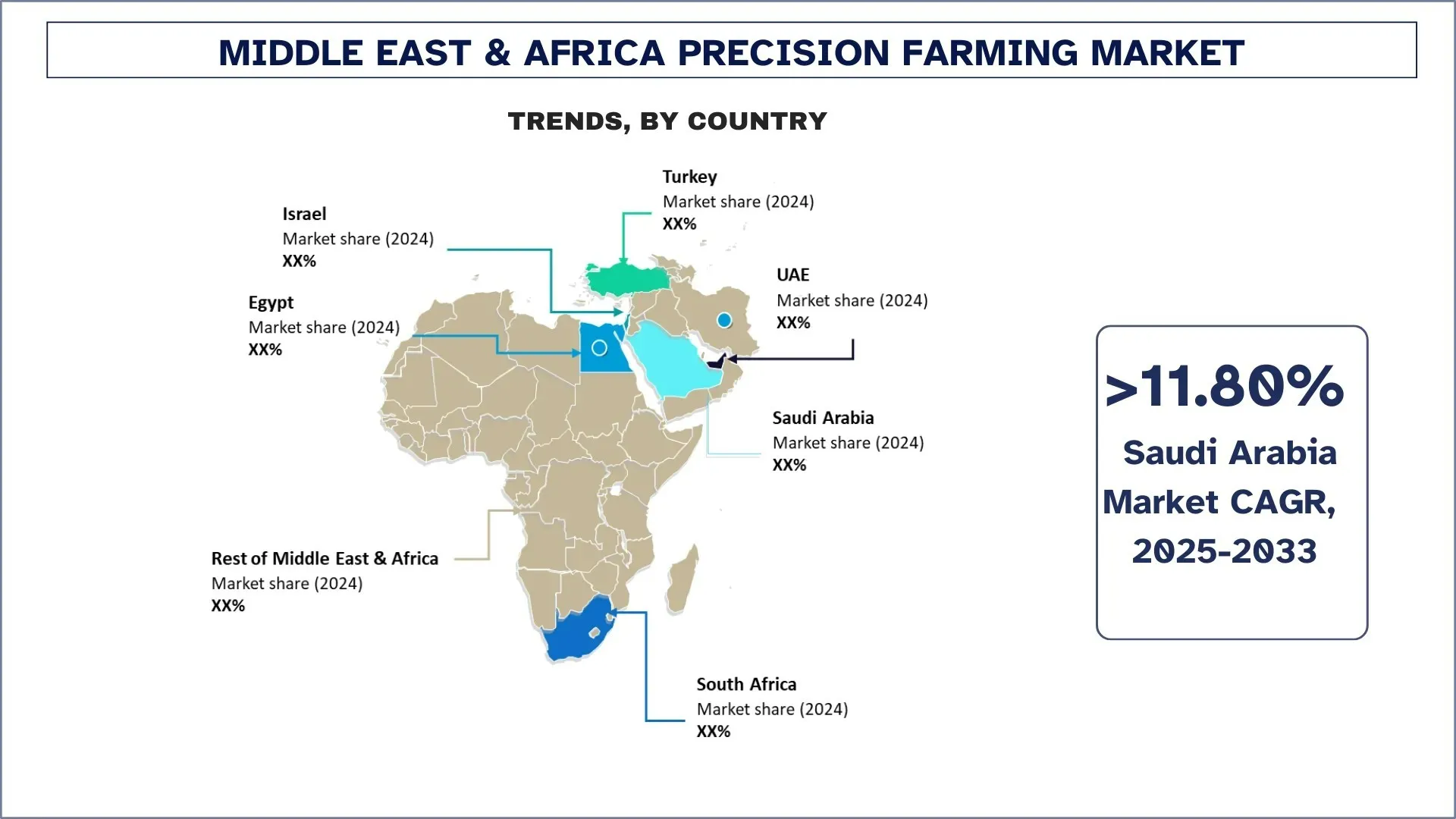
The market of precision farming in Saudi Arabia is growing, and it is highly promising due to the interest of the government in the issue of food security and the need to make agriculture more sustainable. Investments in new technologies, e.g., GPS-based machinery, soil moisture sensors, and automated irrigation systems, are also assisting local farms to become more efficient in water usage and enhance their crop production in dry conditions. Other components that encourage adoption are increasing farm digitization, good subsidies, and corporate alliances with international precision agriculture technology vendors. Real-time monitoring of data and making decisions is becoming a reality due to the growth of agrotech startups and the rise of rural connectivity. Consequently, precision farming solutions are observed as much-needed implementations to improve productivity and lower the input expenses within the Kingdom's agricultural industry.
Middle East & Africa Precision Farming Industry Competitive Landscape:
The Middle East & Africa Precision Farming market is competitive, with several global and international market players. The key players are adopting different growth strategies to enhance their market presence, such as partnerships, agreements, collaborations, new product launches, geographical expansions, and mergers and acquisitions.
Top Middle East & Africa Precision Farming Companies
Some of the major players in the market are Trimble Inc., AGCO Corporation, Deere & Company, Raven Industries, Topcon Positioning Systems, AG Leader Technology, CNH Industrial N.V., Hexagon Agriculture, Sentera, and Taranis.
Middle East & Africa Precision Farming Market Report Coverage
Report Attribute | Details |
Base year | 2024 |
Forecast period | 2025-2033 |
Growth momentum | Accelerate at a CAGR of 11.90% |
Market size 2024 | USD 1,150 Million |
Country analysis | Saudi Arabia, UAE, Egypt, South Africa, Turkey, Israel, and the Rest of the Middle East & Africa |
Major contributing Country | Saudi Arabia is expected to dominate the market during the forecast period. |
Companies profiled | Trimble Inc., AGCO Corporation, Deere & Company, Raven Industries, Topcon Positioning Systems, AG Leader Technology, CNH Industrial N.V., Hexagon Agriculture, Sentera, and Taranis. |
Report Scope | Market Trends, Drivers, and Restraints; Revenue Estimation and Forecast; Segmentation Analysis; Demand and Supply Side Analysis; Competitive Landscape; Company Profiling |
Segments Covered | by Offering, by Application, by Country |
Reasons to Buy the Middle East & Africa Precision Farming Market Report:
The study includes market sizing and forecasting analysis confirmed by authenticated key industry experts.
The report briefly reviews overall industry performance at a glance.
The report covers an in-depth analysis of prominent industry peers, primarily focusing on key business financials, type portfolios, expansion strategies, and recent developments.
Detailed examination of drivers, restraints, key trends, and opportunities prevailing in the industry.
The study comprehensively covers the market across different segments.
Deep dive Country-level analysis of the industry.
Customization Options:
The Middle East & Africa Precision Farming market can further be customized as per requirements or any other market segment. Besides this, UnivDatos understands that you may have your own business needs; hence, feel free to contact us to get a report that completely suits your requirements.
Table of Content
Research Methodology for the Middle East & Africa Precision Farming Market Analysis (2023-2033)
We analyzed the historical market, estimated the current market, and forecasted the future market of the Middle East & Africa Precision Farming market to assess its application in major countries. We conducted exhaustive secondary research to gather historical market data and estimate the current market size. To validate these insights, we carefully reviewed numerous findings and assumptions. Additionally, we conducted in-depth primary interviews with industry experts across the Precision Farming value chain. After validating market figures through these interviews, we used both top-down and bottom-up approaches to forecast the overall market size. We then employed market breakdown and data triangulation methods to estimate and analyze the market size of industry segments and sub-segments.
Market Engineering
We employed data triangulation techniques to finalize the overall market estimation and derive precise statistical numbers for each segment and sub-segment of the Middle East & Africa Precision Farming market. We split the data into several segments and sub-segments by analyzing various parameters and trends, by offering, by Application, and by country within the Middle East & Africa Precision Farming market.
The Main Objective of the Middle East & Africa Precision Farming Market Study
The study identifies current and future trends in the Middle East & African Precision Farming market, providing strategic insights for investors. It highlights Country-level market attractiveness, enabling industry participants to tap into untapped markets and gain a first-mover advantage. Other quantitative goals of the studies include:
Market Size Analysis: Assess the current forecast and market size of the Middle East & Africa Precision Farming market and its segments in terms of value (USD).
Middle East & Africa Precision Farming Market Segmentation: Segments in the study include areas by Offering, by Application, and by
Regulatory Framework & Value Chain Analysis: Examine the regulatory framework, value chain, customer behavior, and competitive landscape of the Middle East & Africa Precision Farming industry.
Country Analysis: Conduct a detailed Country analysis for key areas such as Saudi Arabia, UAE, Egypt, South Africa, Turkey, Israel, and the Rest of the Middle East & Africa.
Company Profiles & Growth Strategies: Company profiles of the Middle East & Africa Precision Farming market and the growth strategies adopted by the market players to sustain the fast-growing market.
Frequently Asked Questions FAQs
Q1: What is the Middle East & Africa Precision Farming market’s current market size and growth potential?
The Middle East & Africa Precision Farming market was valued at 1,150 million in 2024 and is expected to grow at a CAGR of 11.90% during the forecast period (2025-2033).
Q2: Which segment has the largest share of the Middle East & Africa Precision Farming market by Offering?
The hardware category has held a notable market share. Increasing investment in smart irrigation and fertigation to solve endemic water scarcity and more extensive use of GPS guidance, auto steering, and variable rate application equipment that enhances input efficiency are driving hardware expansion.
Q3: What are the driving factors for the growth of the Middle East & Africa Precision Farming market?
• Pressure to boost yields under water and climate constraints: Increasing water scarcity, erratic rainfall, and higher heat stress are pushing growers to adopt precision tools that improve productivity while minimizing input waste.
• Active government push for digital agriculture and smart farming: National food security agendas and modernization programs are encouraging adoption through initiatives that support farm digitization, technology pilots, and smart irrigation deployment.
Q4: What are the emerging technologies and trends in the Middle East & Africa Precision Farming market?
• Intensifying focus on water-smart, sensor-based irrigation: Farms are deploying soil-moisture sensors, weather stations, and automated irrigation controls to optimize watering schedules and improve water-use efficiency.
• Growing role of software, AI, and mobile apps on top of hardware: Platforms are increasingly turning data from sensors, drones, and machinery into actionable recommendations, improving decision-making, traceability, and overall farm management.
Q5: What are the key challenges in the Middle East & Africa Precision Farming market?
• High capital costs and limited access to affordable finance: The upfront cost of precision equipment and data services can be prohibitive, and financing options are often limited, especially for smaller and mid-sized farms.
• Gaps in infrastructure, training, and technical support: Connectivity issues, lack of skilled operators, and limited after-sales/service ecosystems can slow implementation, reduce ROI confidence, and hinder wider adoption.
Q6: Which country dominates the Middle East & Africa Precision Farming market?
The market of Precision Farming in Saudi Arabia is thriving at an impressive pace due to the massive investments in clouds, digital vision 2030, and the construction of hyperscale campuses and colocation centers.
Q7: Who are the key players in the Middle East & Africa Precision Farming market?
Some of the top Precision Farming companies in the Middle East & Africa include:
• Trimble Inc.
• AGCO Corporation
• Deere & Company
• Raven Industries
• Topcon Positioning Systems
• AG Leader Technology
• CNH Industrial N.V.
• Hexagon Agriculture
• Sentera
• Taranis
Q8: What are the opportunities for companies within the Middle East & Africa Precision Farming market?
• Scaling drones, robots, and automated equipment for commercial farms: Large and export-oriented farms are increasingly positioned to adopt drones for crop monitoring and spraying, robotics for targeted field operations, and automated machinery to improve consistency, reduce labor dependence, and increase operational efficiency.
• Platform-based services that bundle data, advisory, and financing: Integrated platforms that combine farm data capture, analytics-driven recommendations, agronomy advisory, and embedded finance/credit can lower adoption barriers, improve ROI visibility, and accelerate precision farming uptake across both commercial and organized mid-sized farms.
Q9: How are consumer preferences shaping product development in the Middle East & Africa Precision Farming market?
Farmers increasingly prefer affordable, easy-to-use solutions that deliver measurable water savings and yield gains. This is pushing vendors to develop modular, mobile-first platforms combining sensors, irrigation automation, analytics, and localized advisory, with flexible pricing, bundled services, and stronger after-sales support.
Related Reports
Customers who bought this item also bought