Azotobacter-based Biofertilizer Market: Current Analysis and Forecast (2025-2033)
Emphasis on Product Type (Liquid; Carrier-based {powder or granules}); Crop Type (Cereals and grains; Oilseeds and pulses; Fruits and vegetables; and Others); Application (Soil treatment; Seed treatment; and Foliar application); and Region/Country
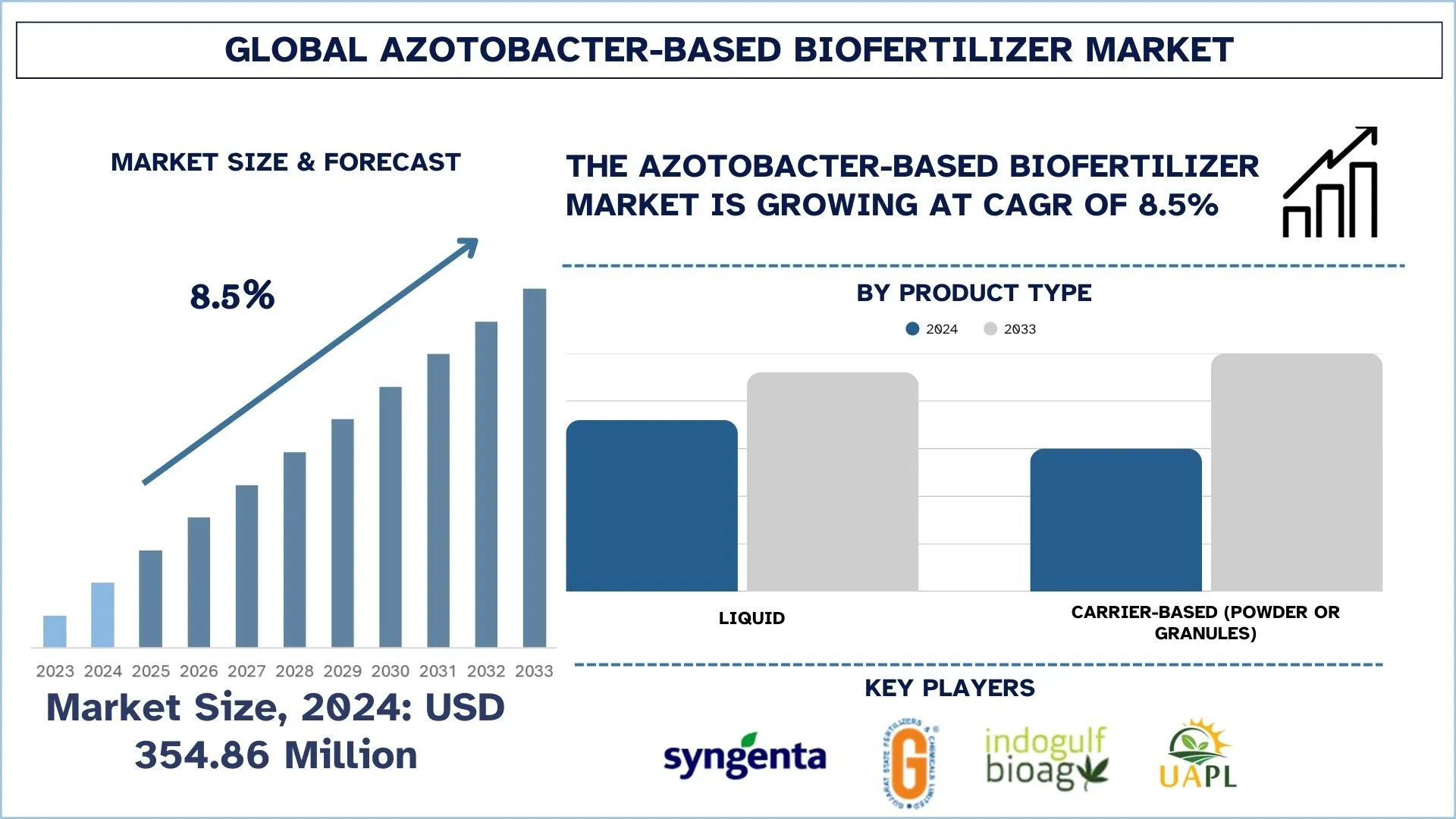
Global Azotobacter-based Biofertilizer Market Size & Forecast
The Global Azotobacter-Based Biofertilizer Market was valued at USD 354.86 million in 2024 and is expected to grow at a strong CAGR of around 8.5% during the forecast period (2025-2033F), driven by the rising demand for sustainable and eco-friendly agricultural inputs as farmers shift away from chemical fertilizers.
Azotobacter-based Biofertilizer Market Analysis
Azotobacter-based biofertilizer is a microorganic product that consists of advantageous azotobacter species, which are naturally able to fix the atmospheric nitrogen and transform it into a form that can be used by plants. These free-living bacteria increase soil fertility as well as promote root growth and enhance nutrient uptake without forming a symbiosis.
The azotobacter-based biofertilizer market is expanding due to increasing demand for environmentally friendly, sustainable biofertilizers that enhance soil fertility without chemical fertilizers. Azotobacter gives the soil an improved ability to fix nitrogen; it improves the growth of roots and boosts crop yields, and is growingly popular among farmers who are interested in more affordable gains in productivity. The increase in awareness of the existing soil health and degradation, the government programs in favor of biofertilizers, and the rise in organic and regenerative farming methods further contribute to market adoption.
Global Azotobacter-based Biofertilizer Market Trends
This section discusses the key market trends that are influencing the various segments of the global Azotobacter-based Biofertilizer market, as found by our team of research experts.
Increasing use of IoT and AI for soil health and microbial efficiency monitoring
The growing adoption of IoT and AI to monitor the health of soil and microbial efficiency is a significant area of forthcoming trend in the Azotobacter-based biofertilizer market. Highly developed IoT equipment will allow tracking the condition of the soil in real-time (nitrogen availability, organic matter presence, and microbial activity essential to the performance of the Azotobacter). Analytics that leverage AI to analyze this data optimize biofertilizer use, forecast microorganism efficiency, and ensure improved nitrogen fixation outcomes. With farmers and agritech companies using precision farming equipment, the demand for Azotobacter-based biofertilizers, supported by smart monitoring tools, is set to increase.
Azotobacter-based Biofertilizer Industry Segmentation
This section provides an analysis of the key trends in each segment of the global Azotobacter-based Biofertilizer market report, along with forecasts at the global, regional, and country levels for 2025-2033.
The Liquid Segment Dominates the Global Azotobacter-based Biofertilizer Market
Based on the product type category, the market is categorised into liquid and carrier-based (powder or granules). Among these, the liquid formulations currently hold the largest market share because they are easier to handle, uniformly applied, faster in nutrient delivery, and enable better compatibility with new irrigation systems, including drip and foliar spraying. Their use by big farmers and commercial growers adds to their superiority even more. However, the carrier-based (powder or granules) products are expected to witness faster growth in the coming years owing to prolonged shelf life, reduced costs of production, convenience of storage and transportation, and rising usage in the new markets.
The Soil Treatment Segment Dominates the Global Azotobacter-based Biofertilizer Market.
Based on the application category, the market is segmented into soil treatment, seed treatment, and foliar application. Among these, soil treatment holds the largest market share, as it is widely applied in all types of major crops to improve soil health, increase nutrient availability, and ensure long-term productivity. The application of azotobacter-based biofertilizer for soil treatment is one of the pillars that are relied on by farmers in order to increase crop yields and ensure a sustainable farming system. However, the foliar application is expected to grow the fastest in the coming years as it can be used to provide instant nutrient uptake, rapid remedy of deficiency, and increase crop resistance at critical periods of development. The foliar solutions have been popular in precision agriculture because of their high efficiency, less wastage, and their compatibility with modern spray technologies.

Asia-Pacific holds the largest market share in the global Azotobacter-based Biofertilizer market
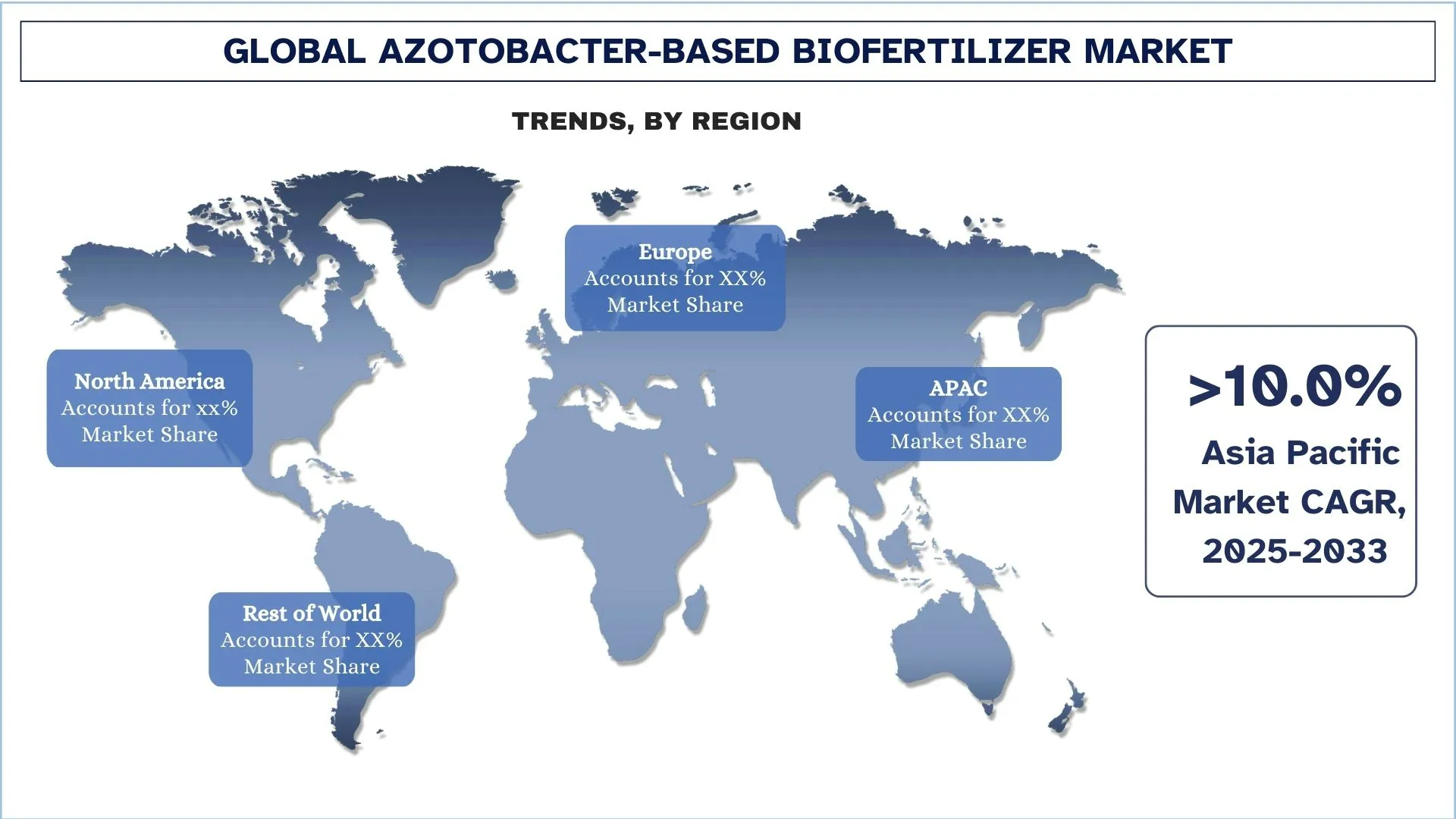
In the Asia-Pacific region, nations, including China, India, Indonesia, and Vietnam, are experiencing strong demand for Azotobacter-based biofertilizers due to the rapid growth of sustainable farming systems and the need to enhance soil productivity in intensively cultivated regions. The increasing trend of the region towards greener inputs, with government regulations to minimize the dependence on chemicals as fertilizers, has enhanced the adoption of the azotobacter-based biofertilizers in various types of crops. Also, the growing interest among consumers in chemical-free food and the growing accessibility of modern distribution channels have also facilitated the availability of biofertilizers among farmers. The availability of a number of upcoming biofertilizer manufacturers and the active research institute further helps APAC dominate the market.
India held a Dominant share of the Asia-Pacific Azotobacter-based Biofertilizer Market in 2024
India dominates the Asia-Pacific Azotobacter-based biofertilizer market. The agriculture-dependent country, heavy reliance on nitrogen-fixing inputs, and government efforts to market biofertilizers via subsidies, training, and national campaigns on soil health are the driving forces behind this leadership. There also exists a big network of domestic biofertilizer manufacturing industry in India, and therefore, products can be easily found at low prices. The growing demand for organic farming, renewed interest in the management of soil fertility, and the abandonment of chemical fertilizers are some other factors that enhance India's status as a major market for Azotobacter-based biofertilizers in the Asia-Pacific region.
For instance, in February 2023, Punjab became the first Indian state to establish a dedicated bio-fertilizer laboratory in Rashtriya Krishi Vigyan Yojana in Hoshiarpur.
Azotobacter-based Biofertilizer Industry Competitive Landscape
The global azotobacter-based biofertilizer market is competitive, with several global and international market players. The key players are adopting different growth strategies to enhance their market presence, such as partnerships, agreements, collaborations, geographical expansions, and mergers and acquisitions.
Top Azotobacter-based Biofertilizer Market Companies
Some of the major players in the market are Syngenta Group, Gujarat State Fertilizers & Chemicals Limited, IFFCO, Indogulf BioAg LLC (Biotech Division of Indogulf Company), IPL Biologicals Limited, Unisun Agro Private Ltd., Lallemand Inc., Katyayani Organics, Peptech Biosciences Ltd., and Green Vision Life Sciences.
Recent Developments in the Azotobacter-based Biofertilizer Market
In August 2025, BioConsortia secured USD 15 million in financing to accelerate the global launch of its nitrogen-fixing biofertilizer product, showcasing investor confidence in microbial biofertilizer technologies.
In February 2025, Syngenta and Ceres Biotics announced a global partnership that introduced VIXERAN, an Azotobacter salinestris–based biostimulant designed to help farmers reduce synthetic nitrogen use. The collaboration aimed to support more sustainable fertilization practices and expand access to advanced biological solutions worldwide.
Global Azotobacter-based Biofertilizer Market Report Coverage
Report Attribute | Details |
Base year | 2024 |
Forecast period | 2025-2033 |
Growth momentum | Accelerate at a CAGR of 8.5% |
Market size 2024 | USD 354.86 million |
Regional analysis | North America, Europe, APAC, Rest of the World |
Major contributing region | The Asia-Pacific region is expected to dominate the market during the forecast period. |
Key countries covered | U.S., Canada, Germany, U.K., Spain, Italy, France, China, Japan, and India. |
Companies profiled | Syngenta Group, Gujarat State Fertilizers & Chemicals Limited, IFFCO, Indogulf BioAg LLC (Biotech Division of Indogulf Company), IPL Biologicals Limited, Unisun Agro Private Ltd., Lallemand Inc., Katyayani Organics, Peptech Biosciences Ltd., and Green Vision Life Sciences. |
Report Scope | Market Trends, Drivers, and Restraints; Revenue Estimation and Forecast; Segmentation Analysis; Demand and Supply Side Analysis; Competitive Landscape; Company Profiling |
Segments Covered | By Product Type, By Crop Type, By Application, and By Region/Country |
Reasons to Buy the Azotobacter-based Biofertilizer Market Report:
The study includes market sizing and forecasting analysis confirmed by authenticated key industry experts.
The report briefly reviews overall industry performance at a glance.
The report covers an in-depth analysis of prominent industry peers, primarily focusing on key business financials, type portfolios, expansion strategies, and recent developments.
Detailed examination of drivers, restraints, key trends, and opportunities prevailing in the industry.
The study comprehensively covers the market across different segments.
Deep dive regional level analysis of the industry.
Customization Options:
The Global Azotobacter-based Biofertilizer Market can further be customized as per the requirements or any other market segment. Besides this, UnivDatos understands that you may have your own business needs; hence, feel free to contact us to get a report that completely suits your requirements.
Table of Content
Research Methodology for the Global Azotobacter-based Biofertilizer Market Analysis (2023-2033)
We analyzed the historical market, estimated the current market, and forecasted the future market of the global azotobacter-based biofertilizer market to assess its application in major regions worldwide. We conducted exhaustive secondary research to gather historical market data and estimate the current market size. To validate these insights, we carefully reviewed numerous findings and assumptions. Additionally, we conducted in-depth primary interviews with industry experts across the azotobacter-based biofertilizer value chain. After validating market figures through these interviews, we used both top-down and bottom-up approaches to forecast the overall market size. We then employed market breakdown and data triangulation methods to estimate and analyze the market size of industry segments and sub-segments.
Market Engineering
We employed the data triangulation technique to finalize the overall market estimation and derive precise statistical numbers for each segment and sub-segment of the global azotobacter-based biofertilizer market. We split the data into several segments and sub-segments by analyzing various parameters and trends, including product type, crop type, application, and regions within the global azotobacter-based biofertilizer market.
The Main Objective of the Global Azotobacter-based Biofertilizer Market Study
The study identifies current and future trends in the global azotobacter-based biofertilizer market, providing strategic insights for investors. It highlights regional market attractiveness, enabling industry participants to tap into untapped markets and gain a first-mover advantage. Other quantitative goals of the studies include:
Market Size Analysis: Assess the current and forecast market size of the global azotobacter-based biofertilizer market and its segments in terms of value (USD).
Azotobacter-based Biofertilizer Market Segmentation: Segments in the study include areas of product type, crop type, application, and region.
Regulatory Framework & Value Chain Analysis: Examine the regulatory framework, value chain, customer behavior, and competitive landscape of the azotobacter-based biofertilizer industry.
Regional Analysis: Conduct a detailed regional analysis for key areas such as Asia Pacific, Europe, North America, and the Rest of the World.
Company Profiles & Growth Strategies: Company profiles of the azotobacter-based biofertilizer market and the growth strategies adopted by the market players to sustain the fast-growing market.
Frequently Asked Questions FAQs
Q1: What is the global azotobacter-based biofertilizer market’s current market size and growth potential?
As of 2024, the global azotobacter-based biofertilizer market is valued at USD 354.86 million. The market shows strong growth potential and is expected to expand at a CAGR of 8.5% between 2025 and 2033, driven by the increasing adoption of sustainable agriculture practices.
Q2: Which segment has the largest share of the global azotobacter-based biofertilizer market by product type category?
The liquid azotobacter-based biofertilizer segment holds the largest share of the global market. Its rapid absorption rate, ease of application, and higher microbial efficiency contribute to its dominance.
Q3: What are the driving factors for the growth of the global azotobacter-based biofertilizer market?
Top growth drivers of the azotobacter-based biofertilizer market include:
• A rising shift toward sustainable and organic farming practices
• Growing concerns over soil degradation caused by chemical fertilizers
• Government incentives, subsidies, and awareness programs promoting biofertilizers
Q4: What are the emerging technologies and trends in the global azotobacter-based biofertilizer market?
Emerging trends in the azotobacter-based biofertilizer market include:
• Increasing use of IoT and AI for soil health and microbial efficiency monitoring
• Rising private-sector investments and R&D in microbial technologies
Q5: What are the key challenges in the global azotobacter-based biofertilizer market?
Key challenges in the azotobacter-based biofertilizer market include:
• Lack of awareness among farmers
• Shorter shelf life and storage sensitivity of microbial products
Q6: Which region dominates the global azotobacter-based biofertilizer market?
Asia-Pacific region currently dominates the global azotobacter-based biofertilizer market, supported by advanced farming practices, strong awareness of sustainable agriculture, and widespread use of biological inputs.
Q7: Who are the key competitors in the global azotobacter-based biofertilizer market?
Top players in the azotobacter-based biofertilizer industry include:
• Syngenta Group
• Gujarat State Fertilizers & Chemicals Limited
• IFFCO
• Indogulf BioAg LLC (Biotech Division of Indogulf Company)
• IPL Biologicals Limited
• Unisun Agro Private Ltd.
• Lallemand Inc.
• Katyayani Organics
• Peptech Biosciences Ltd.
• Green Vision Life Sciences
Q8: What are the major investment opportunities in the global azotobacter-based biofertilizer market?
Rising demand for organic farming inputs, expanding R&D in microbial technologies, and supportive government policies are creating strong investment opportunities across large-scale production facilities, advanced microbial strain development, and technology-enabled distribution networks.
Q9: What regulatory frameworks and quality standards impact the production and commercialization of azotobacter-based biofertilizers?
Regulatory bodies across major markets mandate strict microbial quality standards, registration processes, and labeling requirements. Compliance with national biofertilizer guidelines, organic certification standards, and environmental safety regulations is essential for manufacturers to scale and commercialize products effectively.
Related Reports
Customers who bought this item also bought


Next Generation Sequencing (NGS) in Agrigenomics Market: Current Analysis and Forecast (2025-2033)
Emphasis on Product (Kits & Consumables, Instruments, and Others); Technique (DNA Extraction & Purification, DNA/RNA Sequencing, Genotyping, Marker Assistance Selection, and Others); Application (Plant Genomics, Animal Genomics, Microbial Genomics, Food Safety Testing, and Others); and Region/Country
Middle East & Africa Micro Irrigation Systems Market: Current Analysis and Forecast (2025-2033)
Emphasis By Irrigation Systems (Drip Irrigation Systems, Sprinkler Irrigation Systems, Center Pivot Irrigation Systems, Subsurface Drip Irrigation Systems, and Boom Irrigation Systems), by Application (Plantation Crops, Orchard Crops, Vineyard, Field Crops, Greenhouse Crops, and Others), By Country (Saudi Arabia, UAE, Egypt, South Africa, Turkey, Israel, and the Rest of Middle East & Africa)

Middle East & Africa Precision Farming Market: Current Analysis and Forecast (2025-2033)
Emphasis By Offering (Hardware, Software, and Services), By Application (Yield Monitoring, Field Mapping, Crop Scouting, Inventory Management, Weather Tracking & Forecasting, and Others), By Country (Saudi Arabia, UAE, Egypt, South Africa, Turkey, Israel, and the Rest of Middle East & Africa)

Azotobacter-based Biofertilizer Market: Current Analysis and Forecast (2025-2033)
Emphasis on Product Type (Liquid; Carrier-based {powder or granules}); Crop Type (Cereals and grains; Oilseeds and pulses; Fruits and vegetables; and Others); Application (Soil treatment; Seed treatment; and Foliar application); and Region/Country