Next Generation Sequencing (NGS) in Agrigenomics Market: Current Analysis and Forecast (2025-2033)
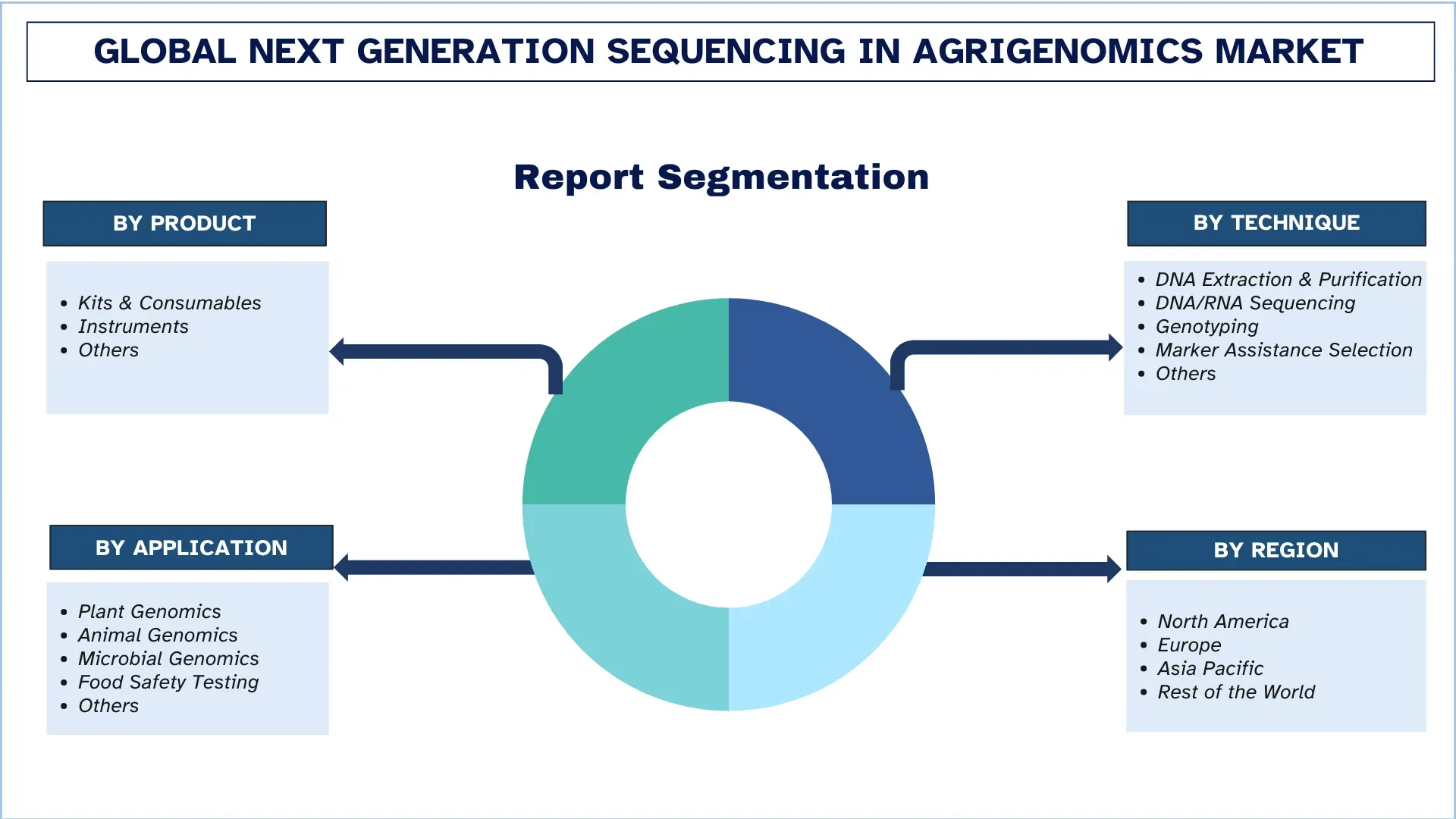
Emphasis on Product (Kits & Consumables, Instruments, and Others); Technique (DNA Extraction & Purification, DNA/RNA Sequencing, Genotyping, Marker Assistance Selection, and Others); Application (Plant Genomics, Animal Genomics, Microbial Genomics, Food Safety Testing, and Others); and Region/Country
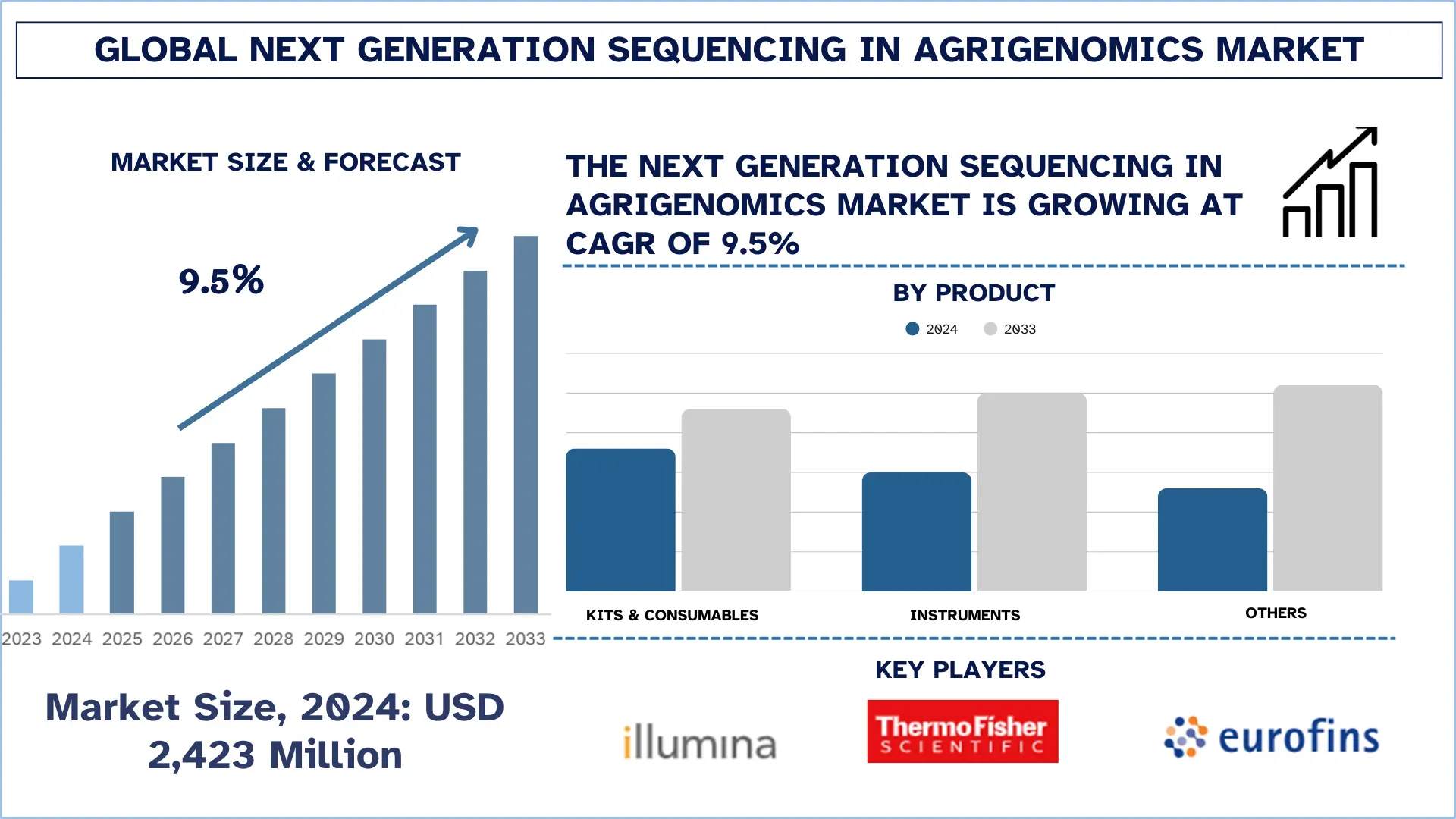
Global Next Generation Sequencing (NGS) in Agrigenomics Market Size & Forecast
The global Next Generation Sequencing (NGS) in Agrigenomics Market was valued at USD 2,423 million in 2024 and is expected to grow at a strong CAGR of around 9.5% during the forecast period (2025-2033F), driven by increasing adoption of genomic technologies in crop improvement, livestock breeding, and sustainable agriculture initiatives worldwide.
Next Generation Sequencing (NGS) in Agrigenomics Market Analysis
In Agrigenomics, Next Generation sequencing (NGS) is the use of high-throughput DNA and RNA sequencing methods to examine the genetic composition of plants and animals in order to improve agriculture. It enables rapid, precise, and cost-effective sequencing of complete genomes, helping scientists identify genetic differences associated with desirable traits such as high yield, disease and drought resistance, and enhanced nutritional quality.
The Next Generation Sequencing (NGS) in the Agrigenomics market is advancing rapidly as the world becomes more interested in food security, sustainable agriculture, and climate-resilient crops. The growth of the population, as well as the declining size of arable land, is compelling governments and agribusinesses to embrace advanced genomic technology with an aim of ensuring increased productivity and quality of crops. The extensive use of NGS in agrigenomics is further supported by strong public and private investments into agricultural biotechnology.
Global Next Generation Sequencing (NGS) in Agrigenomics Market Trends
This section discusses the key market trends that are influencing the various segments of the global Next Generation Sequencing (NGS) in Agrigenomics market, as found by our team of research experts.
Growing adoption of cloud-based genomic data management solutions
The increasing use of cloud-based genomic data management systems is becoming an emerging trend in the NGS in agrigenomics market, owing to the large volume of data produced by high-throughput sequencing. The use of Agricultural genomics projects for crop enhancement, animal breeding, and microbial sequencing requires scalable storage, high-performance computing, and secure data transfer among geographically dispersed research teams. Cloud computing also allows real-time work, state-of-the-art bioinformatics workflows, analytics with AI, and low-capital infrastructural work. Also, they facilitate regulatory adherence, data provenience, and association with exact agriculture instruments, hastening the process of uncovering traits, genomic, and data-driven choices in contemporary agriculture research.
Next Generation Sequencing (NGS) in Agrigenomics Industry Segmentation
This section provides an analysis of the key trends in each segment of the global Next Generation Sequencing (NGS) in Agrigenomics market report, along with forecasts at the global, regional, and country levels for 2025-2033.
The Kits & Consumables Segment Dominates the Global Next Generation Sequencing (NGS) in Agrigenomics Market
Based on the product category, the market is categorized into kits & consumables, instruments, and others. Among these, the kits & consumables segment holds the largest market share in the Next Generation Sequencing (NGS) in the Agrigenomics market because they are used recurrently in sample preparation, library building, and sequencing processes, and are required in all sequencing runs. Their constant use in research laboratories, breeding programs, and commercial testing leads to consistent income generation as opposed to a single purchase of the instruments. However, the instruments segment is projected to see substantial growth in the future with the support of technology, automation, falling prices of equipment, and higher usage of high-throughput sequencing platforms by agricultural biotechnology companies, as well as research institutes broadening their genomic in-house.
The Plant Genomics Segment Dominates the Global Next Generation Sequencing (NGS) in Agrigenomics Market.
Based on the application category, the market is segmented into plant genomics, animal genomics, microbial genomics, food safety testing, and others. Among these, the plant genomics segment holds the largest market share in the Next Generation Sequencing (NGS) in the Agrigenomics market, due to the high demand for yield, disease-resistance, and climate-resistance crop varieties to overcome the challenges of global food security. Massive crop improvement programs by the government and massive sequencing projects add to its leadership. However, the animal genomics business sector is projected to experience a huge future growth, guided by the increased need for better livestock productivity, disease resistance, and quality characteristics in dairy and meat production, as well as the use of genomic selection technology in commercial breeding companies across the globe.
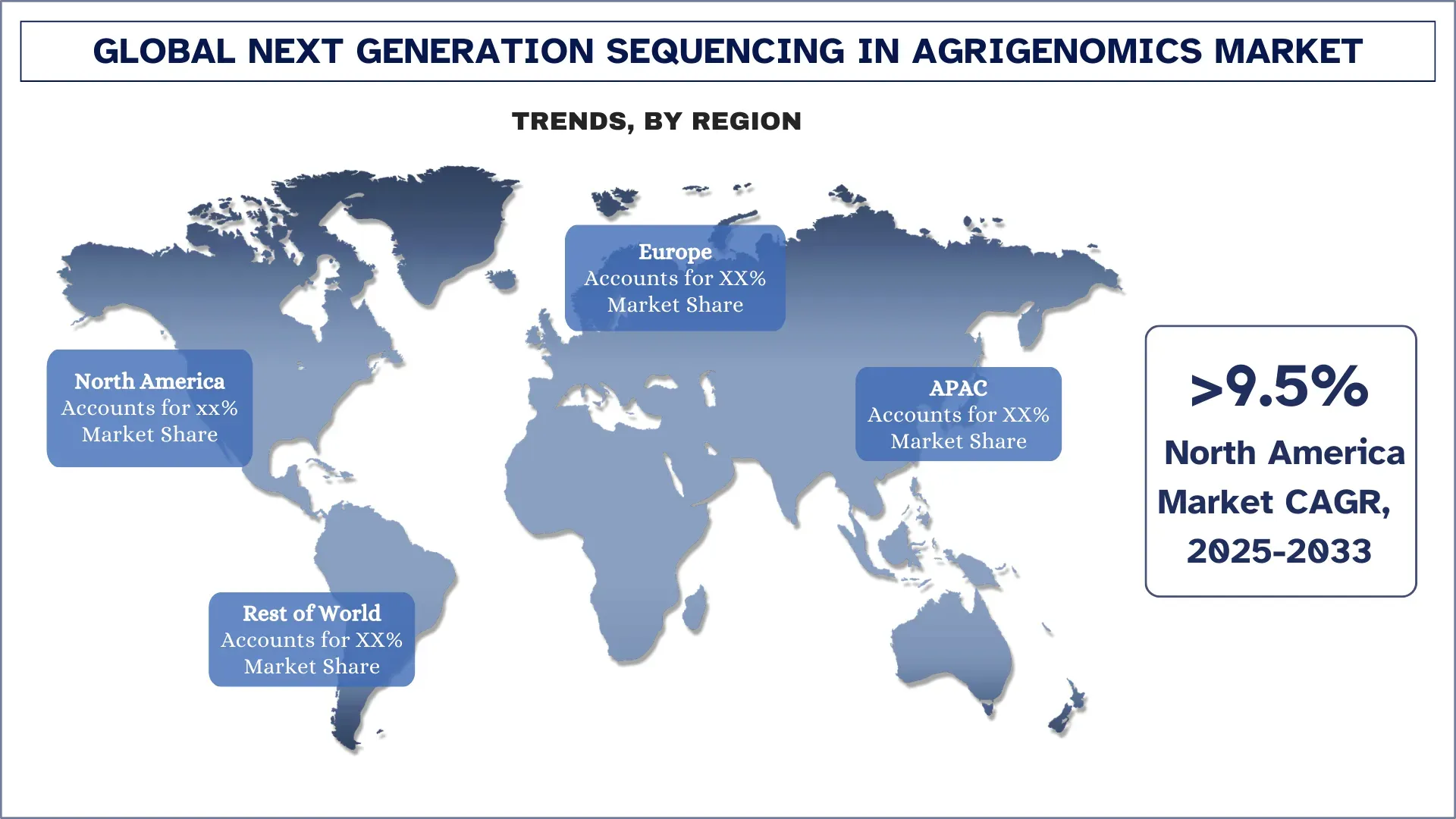
The Asia-Pacific region is the Fastest-Growing region in the Global Next Generation Sequencing (NGS) in Agrigenomics market
Asia-Pacific is the fastest-growing region in the global Next Generation Sequencing (NGS) in Agrigenomics market because of the growing food security issues, growing levels of population, and the growing need to enhance the productivity of agriculture. In the region, governments are aggressively investing in agricultural biotechnology, breeding programs, and genomic studies that will help in increasing crop production and resilience to climate. The increase in the use of sophisticated sequencing methods in nations like China, India, Japan, and Australia is boosting the growth of the market. Also, the enhancement of research facilities, the increase in partnerships between the government and commercial agritech companies, and the provision of favorable policies are also fueling faster uptake of NGS-based agrigenomics applications.
China held a Dominant share of the Asia-Pacific Next Generation Sequencing (NGS) in Agrigenomics Market in 2024
China held the dominant share of the Asia-Pacific Next Generation Sequencing (NGS) in Agrigenomics market in 2024, as it had a solid market base in large-scale agricultural production and considered domestic biotechnology innovation as its high priority. China has significantly invested in genomics, seed technology, and new breeding programs that can be used to advance crop quality and resilience to adverse weather conditions. There is active implementation of high-throughput sequencing solutions to crop improvement and livestock genomics by government-supported research institutes and top-line agricultural universities. Besides, the emphasis of China on minimizing seed dependence on imports and enhancing the level of food self-sufficiency has contributed to the rapid adoption of the latest NGS technologies within the Chinese agrigenomics system.
Next Generation Sequencing (NGS) in Agrigenomics Industry Competitive Landscape
The global Next Generation Sequencing (NGS) in Agrigenomics market is competitive, with several global and international market players. The key players are adopting different growth strategies to enhance their market presence, such as partnerships, agreements, collaborations, geographical expansions, and mergers and acquisitions.
Top Next Generation Sequencing (NGS) in Agrigenomics Market Companies
Some of the major players in the market are Illumina, Inc., Thermo Fisher Scientific Inc., Eurofins Genomics, PacBio, Novogene, Twist Bioscience, Genotypic Technology Pvt. Ltd., SciGenom Labs Pvt. Ltd., Daicel Arbor Biosciences, and LGC Genomics Limited.
Recent Developments in the Next Generation Sequencing (NGS) in Agrigenomics Market
In October 2024, Twist Bioscience launched its FlexPrep™ Ultra-High Throughput library preparation kit, which was designed to enable scalable and cost-effective next-generation sequencing (NGS) workflows for agrigenomics and population genomics research. The new kit used a proprietary enzyme and streamlined workflow to support high-throughput sample processing, accelerating the adoption of NGS over traditional microarray methods in agricultural genomics studies.
In October 2024, Illumina introduced its MiSeq i100 Series benchtop next-generation sequencing (NGS) systems, which were designed to make NGS more accessible and efficient for a wide range of research applications, including agrigenomics. The new sequencers offered faster run times, simplified workflows, and room-temperature reagent storage, enabling more labs to apply NGS in studies of crop and livestock genomes.
In April 2024, Eurofins Genomics AgriGenomics Europe and Gencove announced that they had formed a collaboration to provide a complete low-pass whole genome sequencing (lpWGS) solution in Europe, combining Gencove’s data analytics platform with Eurofins’ sequencing and genotyping capabilities. The partnership was aimed at delivering high-throughput, cost-effective sequencing and advancing genotyping applications for plant breeders, livestock selectors, and other agrigenomics researchers.
Global Next Generation Sequencing (NGS) in Agrigenomics Market Report Coverage
Details | |
Base year | 2024 |
Forecast period | 2025-2033 |
Growth momentum | Accelerate at a CAGR of 9.5% |
Market size 2024 | USD 2,423 million |
Regional analysis | North America, Europe, APAC, Rest of the World |
Major contributing region | The North America region is expected to dominate the market during the forecast period. |
Key countries covered | U.S., Canada, Germany, U.K., Spain, Italy, France, China, Japan, and India. |
Companies profiled | Illumina, Inc., Thermo Fisher Scientific Inc., Eurofins Genomics, PacBio, Novogene, Twist Bioscience, Genotypic Technology Pvt. Ltd., SciGenom Labs Pvt. Ltd., Daicel Arbor Biosciences, and LGC Genomics Limited. |
Report Scope | Market Trends, Drivers, and Restraints; Revenue Estimation and Forecast; Segmentation Analysis; Demand and Supply Side Analysis; Competitive Landscape; Company Profiling |
Segments Covered | By Product, By Technique, By Application, and By Region/Country |
Reasons to Buy the Next Generation Sequencing (NGS) in Agrigenomics Market Report:
The study includes market sizing and forecasting analysis confirmed by authenticated key industry experts.
The report briefly reviews overall industry performance at a glance.
The report covers an in-depth analysis of prominent industry peers, primarily focusing on key business financials, type portfolios, expansion strategies, and recent developments.
Detailed examination of drivers, restraints, key trends, and opportunities prevailing in the industry.
The study comprehensively covers the market across different segments.
Deep dive regional-level analysis of the industry.
Customization Options:
The global Next Generation Sequencing (NGS) in Agrigenomics Market can further be customized as per the requirements or any other market segment. Besides this, UnivDatos understands that you may have your own business needs; hence, feel free to contact us to get a report that completely suits your requirements.
Table of Content
Research Methodology for the Global Next Generation Sequencing (NGS) in Agrigenomics Market Analysis (2023-2033)
We analyzed the historical market, estimated the current market, and forecasted the future market of the global Next Generation Sequencing (NGS) in Agrigenomics market to assess its application in major regions worldwide. We conducted exhaustive secondary research to gather historical market data and estimate the current market size. To validate these insights, we carefully reviewed numerous findings and assumptions. Additionally, we conducted in-depth primary interviews with industry experts across the Next Generation Sequencing (NGS) in Agrigenomics value chain. After validating market figures through these interviews, we used both top-down and bottom-up approaches to forecast the overall market size. We then employed market breakdown and data triangulation methods to estimate and analyze the market size of industry segments and sub-segments.
Market Engineering
We employed the data triangulation technique to finalize the overall market estimation and derive precise statistical numbers for each segment and sub-segment of the global Next Generation Sequencing (NGS) in Agrigenomics market. We split the data into several segments and sub-segments by analyzing various parameters and trends, including product, technique, application, and regions within the global Next Generation Sequencing (NGS) in Agrigenomics market.
The Main Objective of the Global Next Generation Sequencing (NGS) in Agrigenomics Market Study
The study identifies current and future trends in the global Next Generation Sequencing (NGS) in Agrigenomics market, providing strategic insights for investors. It highlights regional market attractiveness, enabling industry participants to tap into untapped markets and gain a first-mover advantage. Other quantitative goals of the studies include:
Market Size Analysis: Assess the current and forecast market size of the global Next Generation Sequencing (NGS) in Agrigenomics market and its segments in terms of value (USD).
Next Generation Sequencing (NGS) in Agrigenomics Market Segmentation: Segments in the study include areas of product, technique, application, and region.
Regulatory Framework & Value Chain Analysis: Examine the regulatory framework, value chain, customer behavior, and competitive landscape of the Next Generation Sequencing (NGS) in Agrigenomics industry.
Regional Analysis: Conduct a detailed regional analysis for key areas such as Asia Pacific, Europe, North America, and the Rest of the World.
Company Profiles & Growth Strategies: Company profiles of the Next Generation Sequencing (NGS) in Agrigenomics market and the growth strategies adopted by the market players to sustain the fast-growing market.
Frequently Asked Questions FAQs
Q1: What is the global Next Generation Sequencing (NGS) in Agrigenomics market’s current market size and growth potential?
As of 2024, the global Next Generation Sequencing (NGS) in Agrigenomics market size is USD 2,423 million. The market is projected to grow at a strong CAGR of 9.5% between 2025 and 2033. Market growth is driven by increasing adoption of genomic technologies in crop improvement, livestock breeding, and sustainable agriculture initiatives worldwide.
Q2: Which segment has the largest share of the global Next Generation Sequencing (NGS) in Agrigenomics market by product category?
The kits & consumables segment accounts for the largest market share due to recurring demand in sample preparation, library construction, and sequencing workflows. Continuous usage across research laboratories and commercial breeding programs supports steady revenue generation.
Q3: What are the driving factors for the growth of the global Next Generation Sequencing (NGS) in Agrigenomics market?
Top growth drivers of the Next Generation Sequencing (NGS) in Agrigenomics market include:
• Rising global food demand and pressure to enhance agricultural productivity.
• Growing adoption of precision breeding and genomic selection techniques
• Strong public and private investments in agricultural biotechnology research
Q4: What are the emerging technologies and trends in the global Next Generation Sequencing (NGS) in Agrigenomics market?
Emerging trends in the Next Generation Sequencing (NGS) in Agrigenomics market include:
• Growing adoption of cloud-based genomic data management solutions.
• Growing focus on sustainable and regenerative agriculture practices
Q5: What are the key challenges in the global Next Generation Sequencing (NGS) in Agrigenomics market?
Key challenges in the Next Generation Sequencing (NGS) in Agrigenomics market include:
• High initial investment costs for advanced sequencing instruments
• Complexity in analyzing and managing large-scale genomic datasets
Q6: Which region dominates the global Next Generation Sequencing (NGS) in Agrigenomics market?
North America dominates the global market due to its advanced research infrastructure, strong funding for agricultural biotechnology, early adoption of genomic technologies, and the presence of leading sequencing technology providers and agrigenomics companies.
Q7: Who are the key competitors in the global Next Generation Sequencing (NGS) in Agrigenomics market?
Top players in the Next Generation Sequencing (NGS) in Agrigenomics industry include:
• Illumina, Inc.
• Thermo Fisher Scientific Inc.
• Eurofins Genomics
• PacBio
• Novogene
• Twist Bioscience
• Genotypic Technology Pvt. Ltd.
• SciGenom Labs Pvt. Ltd.
• Daicel Arbor Biosciences
• LGC Genomics Limited
Q8: What are the major investment opportunities in the NGS in Agrigenomics market?
High-growth opportunities exist in precision breeding platforms, AI-integrated bioinformatics solutions, livestock genomics, and emerging agricultural markets. Increasing demand for sustainable crop improvement and climate-resilient varieties is creating strong long-term investment potential.
Q9: How is technological innovation influencing competitive dynamics in the NGS in Agrigenomics industry?
Advancements in high-throughput sequencing, automation, cloud-based genomic analysis, and gene-editing integration are reshaping the competitive landscape. Companies investing in end-to-end genomic solutions and scalable data platforms are gaining a strategic advantage in commercialization and global expansion.
Related Reports
Customers who bought this item also bought
Next Generation Sequencing (NGS) in Agrigenomics Market: Current Analysis and Forecast (2025-2033)
Emphasis on Product (Kits & Consumables, Instruments, and Others); Technique (DNA Extraction & Purification, DNA/RNA Sequencing, Genotyping, Marker Assistance Selection, and Others); Application (Plant Genomics, Animal Genomics, Microbial Genomics, Food Safety Testing, and Others); and Region/Country
Middle East & Africa Micro Irrigation Systems Market: Current Analysis and Forecast (2025-2033)
Emphasis By Irrigation Systems (Drip Irrigation Systems, Sprinkler Irrigation Systems, Center Pivot Irrigation Systems, Subsurface Drip Irrigation Systems, and Boom Irrigation Systems), by Application (Plantation Crops, Orchard Crops, Vineyard, Field Crops, Greenhouse Crops, and Others), By Country (Saudi Arabia, UAE, Egypt, South Africa, Turkey, Israel, and the Rest of Middle East & Africa)
Middle East & Africa Precision Farming Market: Current Analysis and Forecast (2025-2033)
Emphasis By Offering (Hardware, Software, and Services), By Application (Yield Monitoring, Field Mapping, Crop Scouting, Inventory Management, Weather Tracking & Forecasting, and Others), By Country (Saudi Arabia, UAE, Egypt, South Africa, Turkey, Israel, and the Rest of Middle East & Africa)
Azotobacter-based Biofertilizer Market: Current Analysis and Forecast (2025-2033)
Emphasis on Product Type (Liquid; Carrier-based {powder or granules}); Crop Type (Cereals and grains; Oilseeds and pulses; Fruits and vegetables; and Others); Application (Soil treatment; Seed treatment; and Foliar application); and Region/Country