Middle East & Africa Micro Irrigation Systems Market: Current Analysis and Forecast (2025-2033)
Emphasis By Irrigation Systems (Drip Irrigation Systems, Sprinkler Irrigation Systems, Center Pivot Irrigation Systems, Subsurface Drip Irrigation Systems, and Boom Irrigation Systems), by Application (Plantation Crops, Orchard Crops, Vineyard, Field Crops, Greenhouse Crops, and Others), By Country (Saudi Arabia, UAE, Egypt, South Africa, Turkey, Israel, and the Rest of Middle East & Africa)
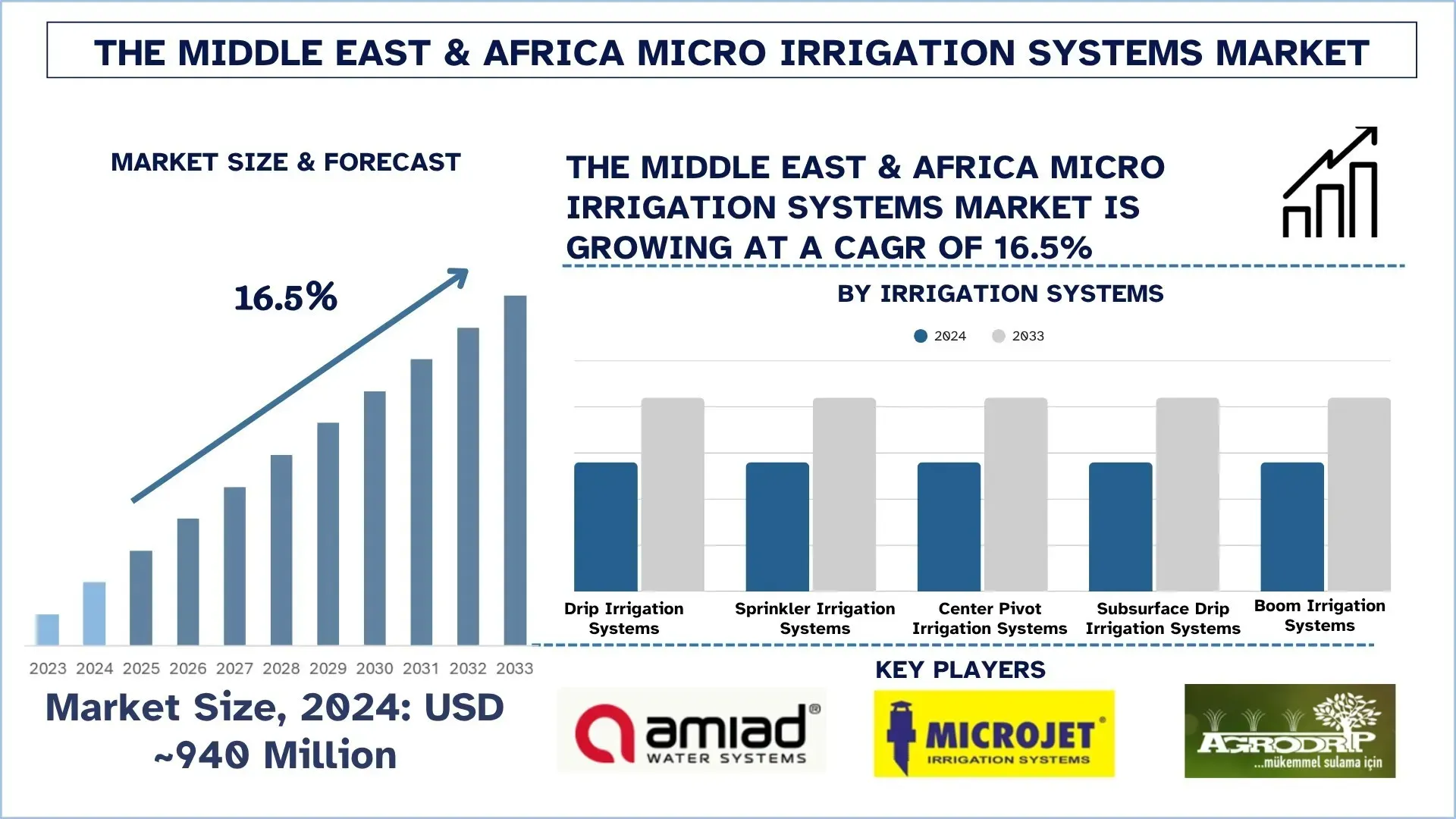
Middle East & Africa Micro Irrigation Systems Market Size & Forecast
The Middle East & Africa Micro Irrigation Systems Market was valued at USD 940 million in 2024 and is expected to grow at a strong CAGR of around 16.50% during the forecast period (2025- 2033F). Intensifying Water Stress Across Arid Zones and Government-Led Agricultural Modernization Programs are some of the key factors supporting the market rise.
Middle East & Africa Micro Irrigation Systems Market Analysis
The micro irrigation systems market in the Middle East and Africa (MEA) is experiencing gradual growth, which is attributed to the rise of focus on water-saving agricultural activities and the sustainability of the use of resources in the region. With the dry conditions in the Middle East, the unpredictable nature of rainfall in various countries of Africa, there is an upward shift towards older irrigation techniques to precision irrigation techniques, including drip and sprinkler. The transition is also factored by the government efforts of food security, farming productivity, and effective use of water. Also, the growing commercial agriculture, greenhouse farming, and the production of high-value crops are augmenting the need for controlled irrigation systems. Due to the need of farmers to enhance the quality of yields at the lowest input cost, micro irrigation is becoming a vital prerequisite of modern agriculture in the advanced Gulf economies, as well as the burgeoning African markets.
In 2025, Saudi Arabia and the Netherlands signed an agreement of USD 114 million with the aim to develop and localize modern technologies in the environmental, water, and agricultural fields.
Middle East & Africa Micro Irrigation Systems Market Trends
This section discusses the key market trends that are influencing the various segments of the Middle East & Africa Micro Irrigation Systems market, as found by our team of research experts.
Integration of Smart Irrigation Technologies:
Due to the necessity to be precise, efficient, and optimize the resources, the integration of smart irrigation technologies can be described as an emerging transformational trend in the Middle East and Africa micro irrigation systems market. The high-tech tools of soil moisture sensors, controller-controlled by the weather, and IoT-controlled monitoring systems are allowing the farmer to make real-time irrigation decisions based on data. These technologies help control the amount of water used according to crop needs, soil characteristics, and climate change, thereby reducing water and energy waste. Smart irrigation is being integrated with digital farm management systems in regions with harsh climates, especially in the Middle East, to improve operational efficiency and crop performance. Also, the pricing of sensors is falling, and the widespread adoption of smartphones is getting more affordable even in the African third-world markets. Through this, not only is smart irrigation enhancing the agricultural production, but it is also contributing to the sustainable water management practices in the region.
Key Market Segmentation:
This section provides an analysis of the key trends in each segment of the Middle East & Africa Micro Irrigation Systems market, along with forecasts at the country and regional levels for 2025-2033.
The Drip Irrigation Category has shown promising growth in the Micro Irrigation Systems Market.
The Middle East and Africa market under micro irrigation systems is segmented into drip irrigation systems, sprinkler irrigation systems, center pivot irrigation systems, subsurface drip irrigation systems, and boom irrigation systems depending on the irrigation systems. The drip irrigation segment has been one of them, with a large market share. This supremacy is mainly due to the fact that it has better water-use efficiency, accurate nutrient application, and its use in a broad spectrum of crops where water is limited, especially in arid areas. The drip systems are becoming preferred in the greenhouse farming and horticulture industry because of their capability to reduce the loss of evaporation and enhance yield quality. In addition, favorable government policies, increased awareness among the farmers, and access to low-priced drip solutions are also enhancing the dominance of the segment in the Middle Eastern and African markets.
The Plantation Crops category held a significant share of the Middle East & Africa Micro Irrigation Systems Market.
The Middle East & Africa Micro Irrigation Market, according to the application, has segments such as plantation crops, orchard crops, vineyard, field crops, greenhouse crops, and others. Among these, the plantation crops have been the biggest part of the market. The large area of domestication of crops like sugarcane in the African region and localized plantation crops like the date palms in the Middle East are some of the determining factors of the increased market share. These crops need the implementation of controlled and effective water application because of the prolonged growth period and high economic value. There are also the water scarcity and the necessity to improve the reliability of yield, which promotes the use of micro irrigation systems in the territories of plantation farming.
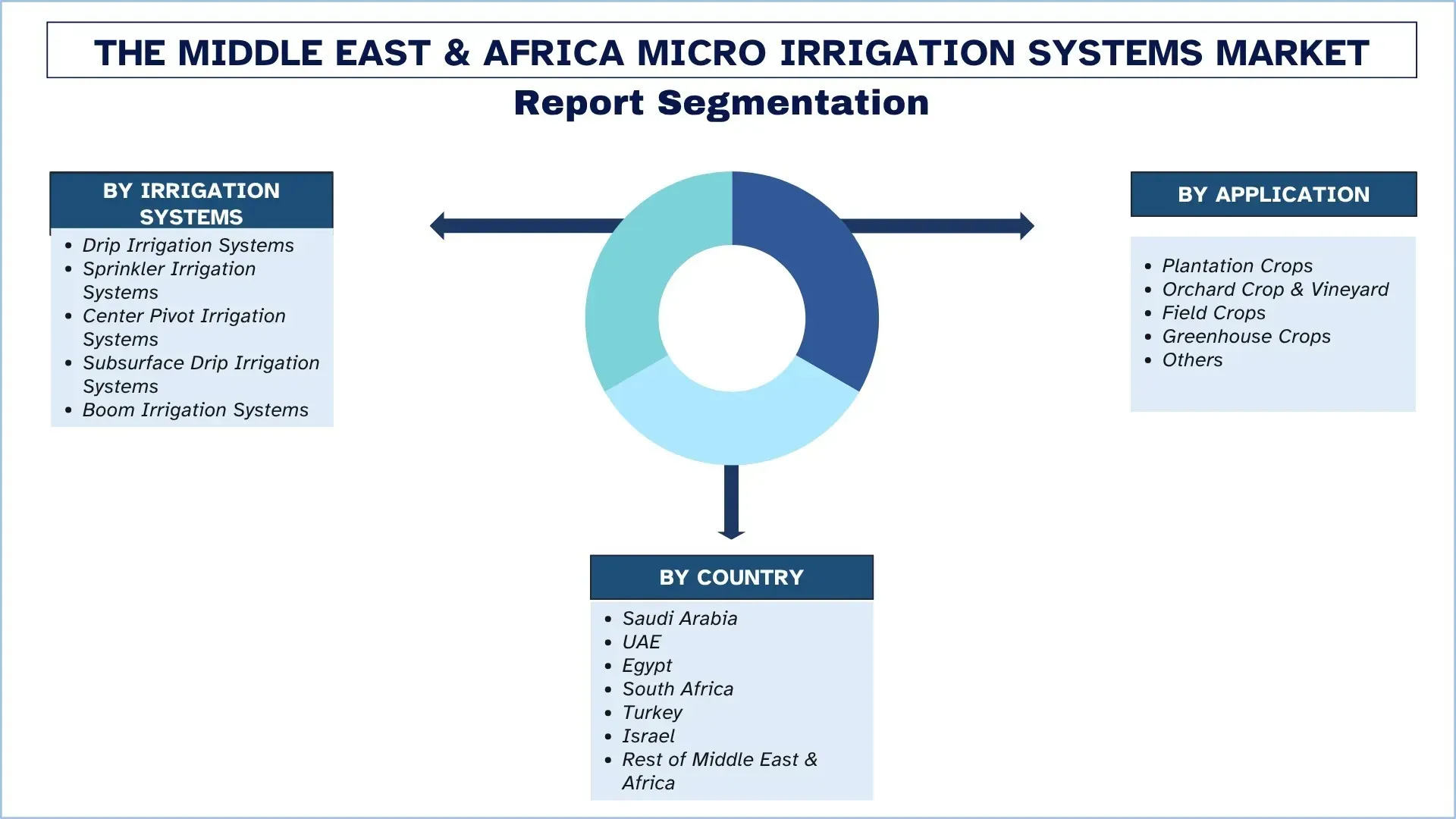
The UAE is expected to grow at a considerable rate during the forecast period.
The market of the UAE micro irrigation system is experiencing unprecedented growth, and it is becoming the fastest-growing industry in the Middle East and Africa. With the arid climatic conditions and scarcity of freshwater, there has been a growing need for farmers to embrace the use of precision irrigation like drip and micro-sprinkler irrigation systems that will enable them to utilize maximum use of the fresh water available and maximize crop output. Smart irrigation systems can be integrated with the use of intelligent sensors and automated controllers based on the IoT, which will provide the opportunity to monitor the situation in real-time and use the available resources optimally. Adoption is also being accelerated by government efforts, incentives to sustainable agricultural practices, and investments in climate-resilient agricultural practices. This market expansion indicates that the UAE endeavors to have modern, efficient, and sustainable agricultural solutions.
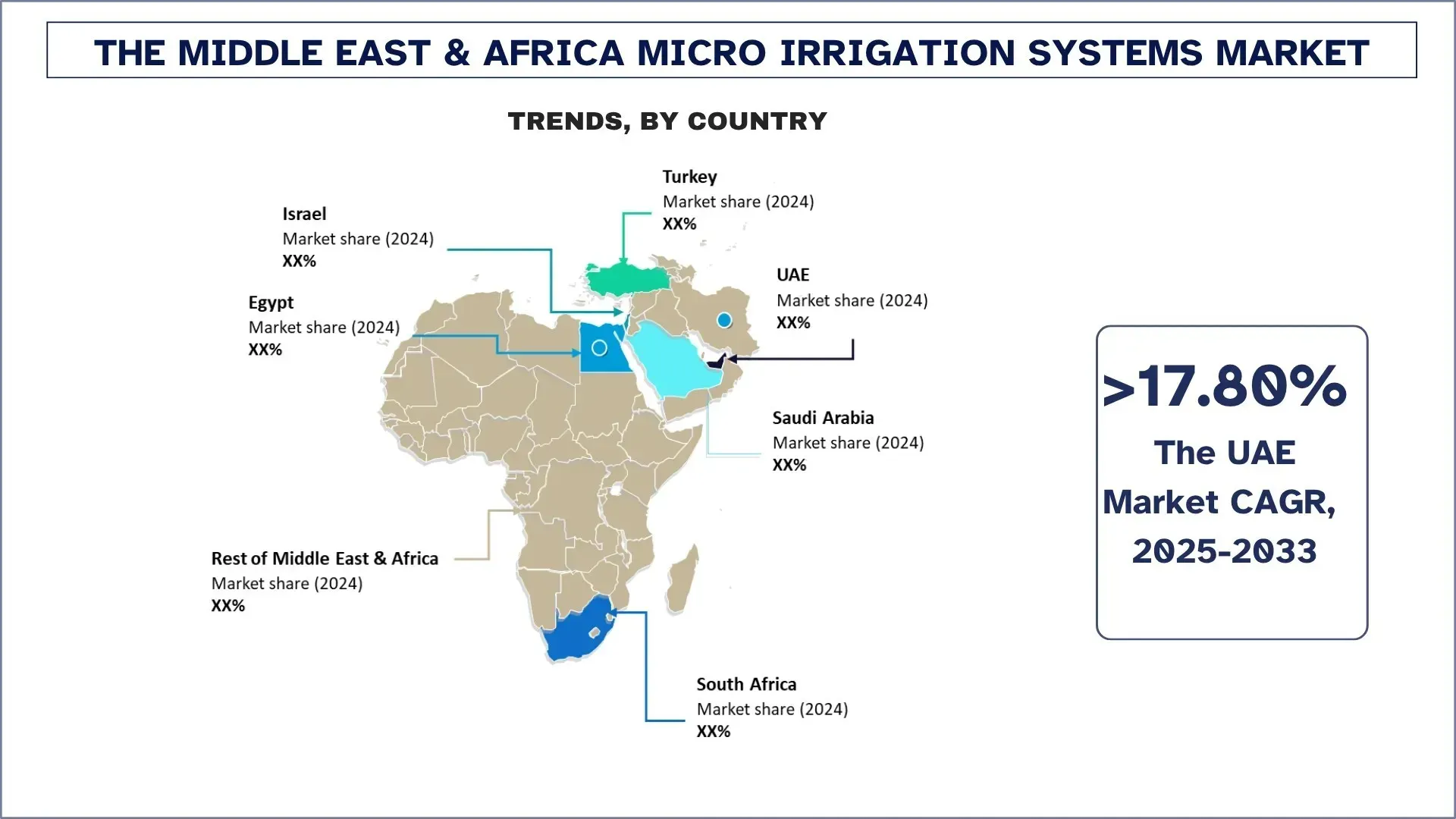
Middle East & Africa Micro Irrigation Systems Industry Competitive Landscape:
The Middle East & Africa Micro Irrigation Systems market is competitive, with several global and international market players. The key players are adopting different growth strategies to enhance their market presence, such as partnerships, agreements, collaborations, new product launches, geographical expansions, and mergers and acquisitions.
Top Middle East & Africa Micro Irrigation Systems Companies
Some of the major players in the market are Goldenkey, Amiad Water Systems Ltd., Metzer Group, Microjet, Alkhorayef, Agrodrip Sulama Sistemleri San. Tic. Ltd. Şti, Antelco (en-AU), DAYU Equipment Development Group, Deere & Company, and Elgo Irrigation Ltd.
Middle East & Africa Micro Irrigation Systems Market Report Coverage
Details | |
Base year | 2024 |
Forecast period | 2025-2033 |
Growth momentum | Accelerate at a CAGR of 16.50% |
Market size 2024 | USD 940 Million |
Country analysis | Saudi Arabia, UAE, Egypt, South Africa, Turkey, Israel, and the Rest of the Middle East & Africa |
Major contributing Country | Saudi Arabia is expected to dominate the market during the forecast period. |
Companies profiled | Goldenkey, Amiad Water Systems Ltd., Metzer Group, Microjet, Alkhorayef, Agrodrip Sulama Sistemleri San. Tic. Ltd. Şti, Antelco (en-AU), DAYU Equipment Development Group, Deere & Company, and Elgo Irrigation Ltd. |
Report Scope | Market Trends, Drivers, and Restraints; Revenue Estimation and Forecast; Segmentation Analysis; Demand and Supply Side Analysis; Competitive Landscape; Company Profiling |
Segments Covered | By Irrigation Systems, by Application, by Country |
Reasons to Buy the Middle East & Africa Micro Irrigation Systems Market Report:
The study includes market sizing and forecasting analysis confirmed by authenticated key industry experts.
The report briefly reviews overall industry performance at a glance.
The report covers an in-depth analysis of prominent industry peers, primarily focusing on key business financials, type portfolios, expansion strategies, and recent developments.
Detailed examination of drivers, restraints, key trends, and opportunities prevailing in the industry.
The study comprehensively covers the market across different segments.
Deep dive Country-level analysis of the industry.
Customization Options:
The Middle East & Africa Micro Irrigation Systems Market can be customized as per requirements or any other market segment. Besides this, UnivDatos understands that you may have your own business needs; hence, feel free to contact us to get a report that completely suits your requirements.
Table of Content
Research Methodology for the Middle East & Africa Micro Irrigation Systems Market Analysis (2023-2033)
We analyzed the historical market, estimated the current market, and forecasted the future market of the Middle East & Africa Micro Irrigation Systems market to assess its application in major countries. We conducted exhaustive secondary research to gather historical market data and estimate the current market size. To validate these insights, we carefully reviewed numerous findings and assumptions. Additionally, we conducted in-depth primary interviews with industry experts across the Micro Irrigation Systems value chain. After validating market figures through these interviews, we used both top-down and bottom-up approaches to forecast the overall market size. We then employed market breakdown and data triangulation methods to estimate and analyze the market size of industry segments and sub-segments.
Market Engineering
We employed data triangulation techniques to finalize the overall market estimation and derive precise statistical numbers for each segment and sub-segment of the Middle East & Africa Micro Irrigation Systems market. We split the data into several segments and sub-segments by analyzing various parameters and trends, by Irrigation Systems, by Application, and by country within the Middle East & Africa Micro Irrigation Systems market.
The Main Objective of the Middle East & Africa Micro Irrigation Systems Market Study
The study identifies current and future trends in the Middle East & African Micro Irrigation Systems market, providing strategic insights for investors. It highlights Country-level market attractiveness, enabling industry participants to tap into untapped markets and gain a first-mover advantage. Other quantitative goals of the studies include:
Market Size Analysis: Assess the current forecast and market size of the Middle East & Africa Micro Irrigation Systems market and its segments in terms of value (USD).
Middle East & Africa Micro Irrigation Systems Market Segmentation: Segments in the study include areas by Irrigation Systems, by Application, and by
Regulatory Framework & Value Chain Analysis: Examine the regulatory framework, value chain, customer behavior, and competitive landscape of the Middle East & Africa Micro Irrigation Systems industry.
Country Analysis: Conduct a detailed Country analysis for key areas such as Saudi Arabia, UAE, Egypt, South Africa, Turkey, Israel, and the Rest of the Middle East & Africa.
Company Profiles & Growth Strategies: Company profiles of the Middle East & Africa Micro Irrigation Systems market and the growth strategies adopted by the market players to sustain the fast-growing market.
Frequently Asked Questions FAQs
Q1: What is the Middle East & Africa Micro Irrigation Systems market’s current market size and growth potential?
The Middle East & Africa Micro Irrigation Systems market was valued at 940 million in 2024 and is expected to grow at a CAGR of 16.50% during the forecast period (2025-2033).
Q2: Which segment has the largest share of the Middle East & Africa Micro Irrigation Systems market by Irrigation Systems?
The drip irrigation segment has held a large market share. This supremacy is mainly due to its higher water-use efficiency, accurate nutrient application, and use across a broad spectrum of crops where water is limited, especially in arid areas.
Q3: What are the driving factors for the growth of the Middle East & Africa Micro Irrigation Systems market?
• Intensifying water stress across arid zones: Increasing water scarcity in arid and semi-arid regions of the Middle East and Africa is compelling farmers to adopt efficient irrigation methods, such as drip and micro-sprinkler systems, to optimize water use and sustain agricultural output.
• Government-led agricultural modernization programs: National initiatives and subsidies promoting precision agriculture, water conservation, and sustainable farming practices are incentivizing farmers and agribusinesses to invest in modern micro irrigation systems.
Q4: What are the emerging technologies and trends in the Middle East & Africa Micro Irrigation Systems market?
• Integration of smart irrigation technologies: IoT-enabled sensors, automated controllers, and data-driven water management tools allow real-time irrigation decisions, improving efficiency, reducing wastage, and enhancing crop productivity.
• Shift toward turnkey irrigation solutions: Farmers and large-scale agribusinesses are increasingly opting for complete end-to-end irrigation packages, including system design, installation, automation, and after-sales support, to simplify operations and reduce technical complexity.
Q5: What are the key challenges in the Middle East & Africa Micro Irrigation Systems market?
• High initial investment and limited financing access: The upfront cost of installing modern micro irrigation systems can be a barrier for smallholder farmers, especially where financing options are limited.
• Technical awareness and maintenance constraints: Lack of training, limited knowledge of advanced irrigation technologies, and inadequate local maintenance support can hinder system efficiency and long-term adoption across the region.
Q6: Which country dominates the Middle East & Africa Micro Irrigation Systems market?
The market of Saudi Arabia micro irrigation systems is growing at a constant rate because of a severe water shortage and the concern over sustainable agriculture development in the country.
Q7: Who are the key players in the Middle East & Africa Micro Irrigation Systems market?
Some of the top Micro Irrigation Systems companies in the Middle East & Africa include:
• Goldenkey
• Amiad Water Systems Ltd.
• Metzer Group
• Microjet
• Alkhorayef
• Agrodrip Sulama Sistemleri San. Tic. Ltd. Şti
• Antelco (en-AU)
• DAYU Equipment Development Group
• Deere & Company
• Elgo Irrigation Ltd
Q8: What are the opportunities for companies within the Middle East & Africa Micro Irrigation Systems market?
• Untapped smallholder farming segment in Africa: A large portion of small-scale farmers across Africa remains underserved with modern irrigation solutions. Targeting this segment presents significant growth potential by increasing productivity, reducing water stress, and enabling climate-resilient farming practices.
• Rising investments in sustainable agriculture projects: Growing funding from governments, international development agencies, and private investors in climate-smart and water-efficient agricultural initiatives is driving adoption of micro irrigation technologies, creating opportunities for vendors to expand their market presence and offer advanced, turnkey solutions.
Q9: How are consumer preferences shaping product development in the Middle East & Africa Micro Irrigation Systems market?
Consumer preferences in the Middle East & Africa are driving the development of efficient, easy-to-install, and smart irrigation solutions. Farmers increasingly favor turnkey systems, IoT-enabled monitoring, and water-saving technologies, prompting suppliers to design user-friendly, sustainable, and high-performance products.
Related Reports
Customers who bought this item also bought





Next Generation Sequencing (NGS) in Agrigenomics Market: Current Analysis and Forecast (2025-2033)
Emphasis on Product (Kits & Consumables, Instruments, and Others); Technique (DNA Extraction & Purification, DNA/RNA Sequencing, Genotyping, Marker Assistance Selection, and Others); Application (Plant Genomics, Animal Genomics, Microbial Genomics, Food Safety Testing, and Others); and Region/Country
Middle East & Africa Micro Irrigation Systems Market: Current Analysis and Forecast (2025-2033)
Emphasis By Irrigation Systems (Drip Irrigation Systems, Sprinkler Irrigation Systems, Center Pivot Irrigation Systems, Subsurface Drip Irrigation Systems, and Boom Irrigation Systems), by Application (Plantation Crops, Orchard Crops, Vineyard, Field Crops, Greenhouse Crops, and Others), By Country (Saudi Arabia, UAE, Egypt, South Africa, Turkey, Israel, and the Rest of Middle East & Africa)
Middle East & Africa Precision Farming Market: Current Analysis and Forecast (2025-2033)
Emphasis By Offering (Hardware, Software, and Services), By Application (Yield Monitoring, Field Mapping, Crop Scouting, Inventory Management, Weather Tracking & Forecasting, and Others), By Country (Saudi Arabia, UAE, Egypt, South Africa, Turkey, Israel, and the Rest of Middle East & Africa)

Azotobacter-based Biofertilizer Market: Current Analysis and Forecast (2025-2033)
Emphasis on Product Type (Liquid; Carrier-based {powder or granules}); Crop Type (Cereals and grains; Oilseeds and pulses; Fruits and vegetables; and Others); Application (Soil treatment; Seed treatment; and Foliar application); and Region/Country