AI in Physical Security Market: Current Analysis and Forecast (2025-2033)
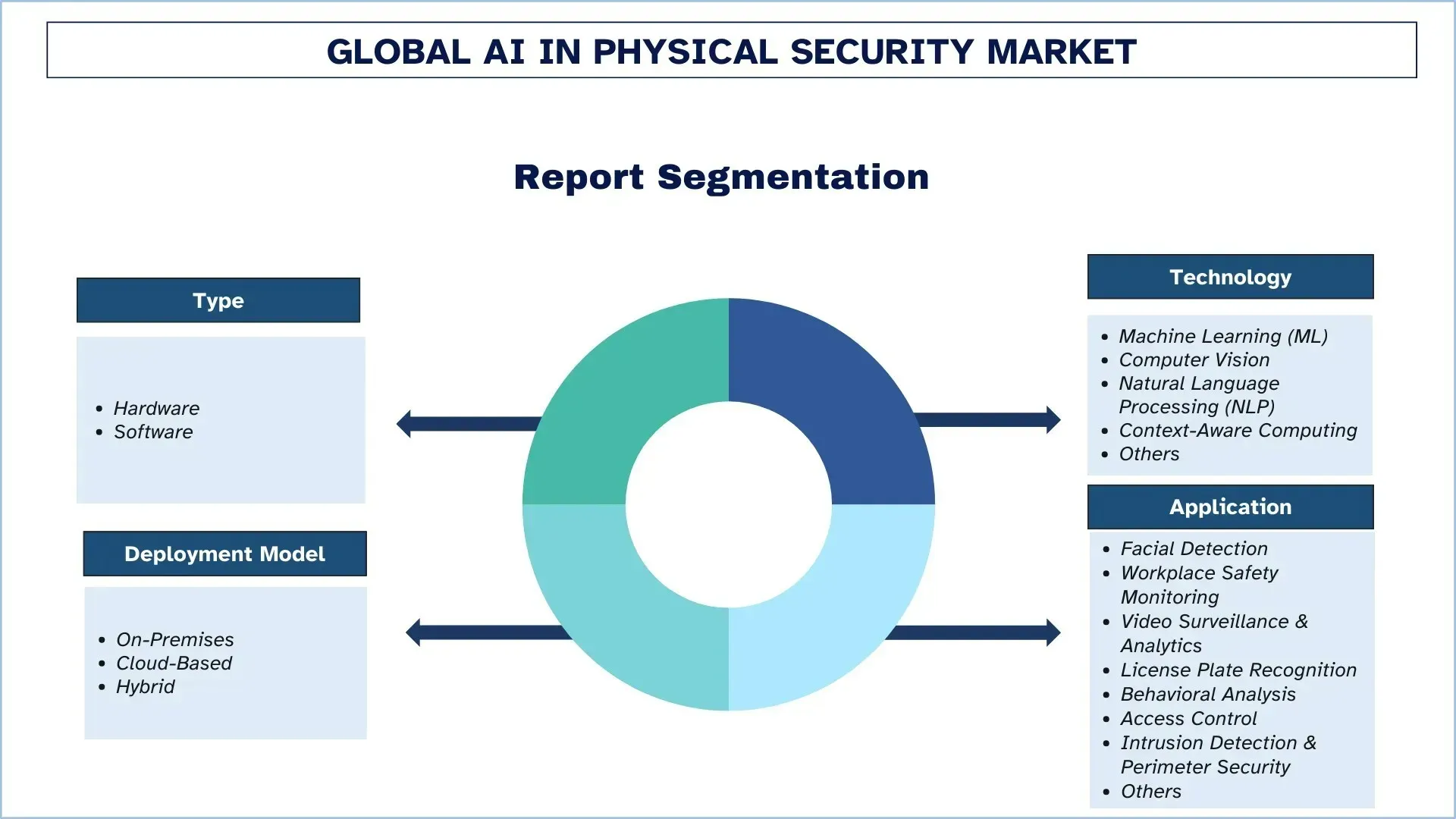
Emphasis on Type (Hardware and Software); Technology (Machine Learning (ML), Computer Vision, Natural Language Processing (NLP), Context-Aware Computing, and Others); Deployment Model (On-Premises, Cloud-Based, and Hybrid); Application (Facial Detection, Workplace Safety Monitoring, Video Surveillance & Analytics, License Plate Recognition, Behavioral Analysis, Access Control, Intrusion Detection & Perimeter Security, and Others); End-User Industry (Government & Defense, Retail, BFSI, Manufacturing, Healthcare, Transportation & Logistics, Energy & Utilities, and Others); and Region/Country
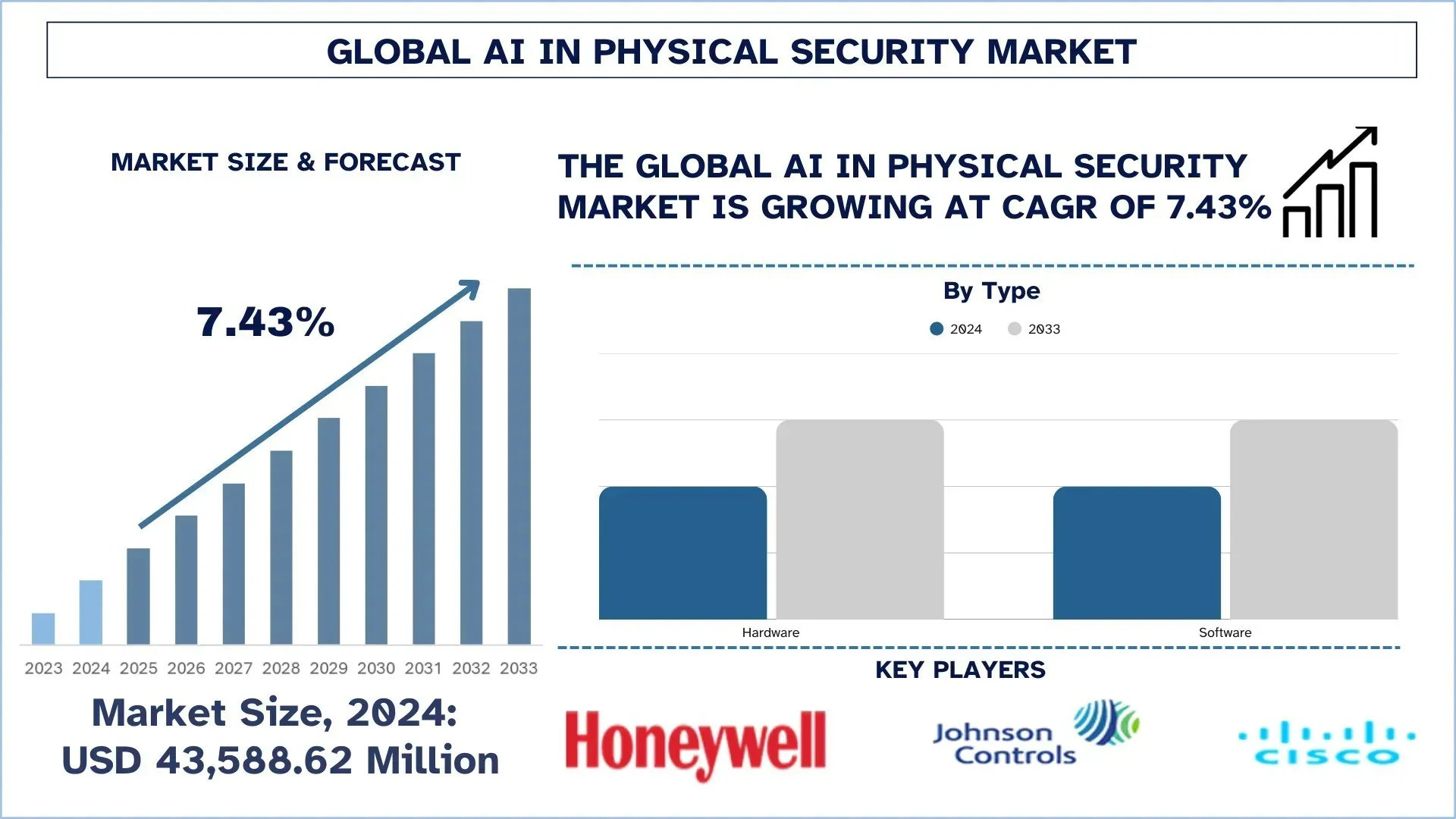
Global AI in Physical Security Market Size & Forecast
The Global AI In Physical Security Market was valued at USD 43,588.62 million in 2024 and is expected to grow at a steady CAGR of around 7.43% during the forecast period (2025-2033F), driven by growing enterprise focus on operational intelligence, reduction of false alarms through AI automation, declining costs of AI-enabled cameras and sensors, integration of IoT with security systems, and rising investments in critical infrastructure protection are further driving the growth of the AI in physical security market.
AI in Physical Security Market Analysis
AI in the physical security market is experiencing exponential growth as companies adopt intelligent technologies to strengthen safety, monitoring, and threat-detection capabilities. The integration of artificial intelligence with video surveillance, access control, and intrusion detection systems provides real-time analytics, automated alerts, and improved decision-making across security operations. Along with this, the growing concerns regarding crime, terrorism, and infrastructure protection are further accelerating demand for advanced security solutions globally. In addition, expanding smart city initiatives, rapid urbanization, and increasing investments in cloud-based and edge AI technologies are strengthening market adoption. Moreover, continuous innovation in computer vision, machine learning, and data analytics is supporting the development of optimized, scalable physical security systems. For instance, in September 2025, Verkada introduced the AF64 Access Station Pro, an AI-based access control device featuring facial recognition, integrated camera analytics, and multi-credential authentication to improve secure and intelligent entry management.
Global AI in Physical Security Market Trends
This section discusses the key market trends that are influencing the various segments of the global AI in physical security market, as found by our team of research experts.
Structural Transformation Toward Decentralized Edge AI Processing Architectures
The structural transformation toward decentralized edge AI processing architectures is changing the AI in the physical security market. Companies are deploying AI capabilities directly at the edge, within cameras and on-site devices, rather than relying solely on centralized cloud or data center processing. For instance, in September 2025, Verkada introduced the AF64 Access Station Pro, an AI-based access control device featuring facial recognition, integrated camera analytics, and multi-credential authentication to improve secure and intelligent entry management. Additionally, Edge AI provides real-time video analytics, faster threat detection, and immediate response without latency from network transmission. Furthermore, it also reduces bandwidth consumption and lowers cloud storage costs by processing and filtering data locally. This decentralized architecture further strengthens data privacy and regulatory compliance, as sensitive footage can remain on-site.
AI in Physical Security Industry Segmentation
This section provides an analysis of the key trends in each segment of the global AI in physical security market report, along with forecasts at the global, regional, and country levels for 2025-2033.
The Hardware Segment Dominates the Global AI in Physical Security Market
Based on the type, the market is categorized into hardware and software. Hardware holds the largest share in the AI in physical security market in 2024 because surveillance cameras, sensors, access control devices, and edge computing systems require significant upfront investment and large-scale deployment across commercial and public infrastructure. Along with this, governments and companies are investing in physical surveillance networks, driving strong hardware sales. For example, in September 2024 at GSX, Johnson Controls launched an AI-driven security system as part of its worldwide security portfolio. The company provides advanced video surveillance and access control solutions, including an edge AI license plate recognition camera with built-in analytics. This move strengthened hardware capabilities and advanced real-time analytics, along with intelligent software-driven security solutions. However, software is showing the fastest growth due to rising demand for advanced analytics, facial recognition, behavior detection, and cloud-based video management platforms. Furthermore, continuous AI algorithm upgrades, subscription-based models, remote monitoring capabilities, and integration with smart city ecosystems are accelerating software adoption across sectors.
The Computer Vision Segment Dominates the Global AI in Physical Security Market.
Based on technology, the market is categorized into machine learning (ML), computer vision, natural language processing (NLP), context aware computing, and others. In 2024, computer vision holds the largest share of the AI in the physical security market, as surveillance systems are primarily video-based and depend on facial recognition, object detection, license plate recognition, intrusion detection, and crowd monitoring applications. Also, large-scale deployment of CCTV networks and smart city surveillance infrastructure notably contributed to its leading revenue share. Meanwhile, machine learning is showing the fastest growth due to rising demand for predictive analytics, anomaly detection, behavioral analysis, and adaptive threat identification. Moreover, the growing integration of cloud platforms, edge computing, and real-time data processing is further accelerating ML adoption across advanced security systems.
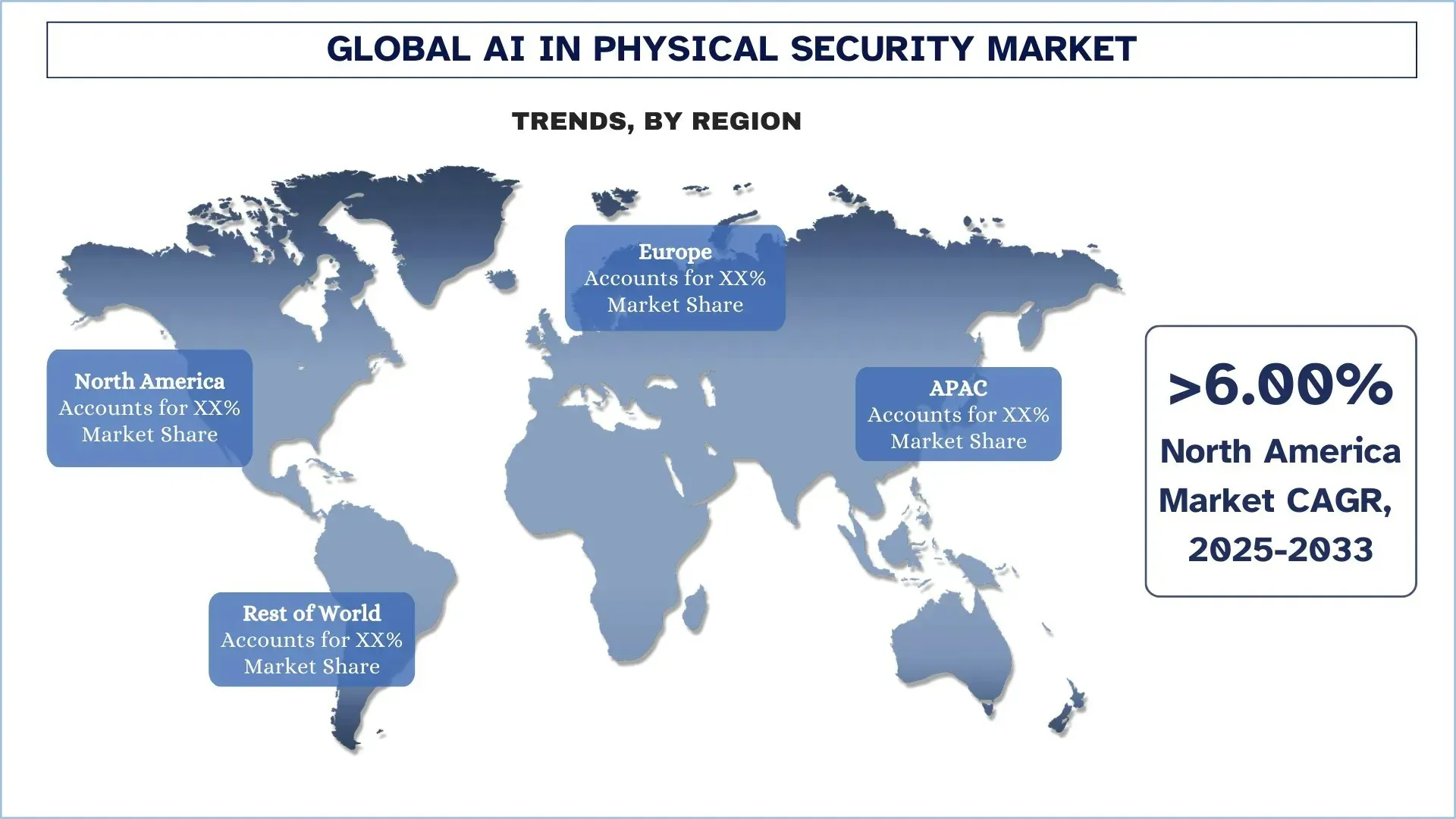
North America holds the largest market share in the global AI in Physical Security market
North America leads the AI in physical security market in 2024 because of early adoption of advanced surveillance technologies, a strong presence of leading AI and security solution providers, and significant investments in smart infrastructure and public safety systems. In addition, government initiatives for homeland security, border control, and critical infrastructure have further increased demand. High cybersecurity awareness, strict regulatory compliance, and widespread use of AI-based video analytics in commercial enterprises have accelerated market growth. Furthermore, the region has seen collaborations and partnerships that have strengthened its position in the global AI in physical security market. For example, in September 2025, Dataminr and Genetec collaborated to incorporate real-time AI-driven threat intelligence into physical security platforms.
U.S. held a Dominant share of the North America AI in Physical Security Market in 2024
The United States dominated the AI in physical security market in 2024 because of strong federal and state-level investments in law enforcement modernization, border surveillance, and counterterrorism infrastructure. Alongside this, the country benefits from advanced research ecosystems, high adoption of AI-driven video analytics, and widespread deployment of smart building security systems across companies. On the contrary, the presence of top technology innovators and the integration of AI with IoT, cloud, and edge computing further strengthen the country's position in the market. For example, in March 2025, Flock Safety raised USD 275 million in funding to increase its AI-driven surveillance technology, improve manufacturing processes, and fast-track research and development to support the country's public safety infrastructure. Furthermore, growing concerns over public safety, mass shootings, and cyber-physical threats continue to boost investments regionally.
AI in Physical Security Industry Competitive Landscape
The global AI in physical security market is competitive, with several global and international market players. The key players are adopting different growth strategies to enhance their market presence, such as partnerships, agreements, collaborations, geographical expansions, and mergers and acquisitions.
Top AI in Physical Security Market Companies
Some of the major players in the market include Honeywell International, Inc., Johnson Controls, Cisco Systems, Inc., Avigilon (Motorola Solutions, Inc.), KEENFINITY, Genetec Inc., Hangzhou Hikvision Digital Technology Co., Ltd., Axis Communications AB (Canon Inc.), Siemens, and Dahua Technology Co., Ltd.
Recent Developments in the AI in Physical Security Market
In November 2025, RealSense announced a strategic investment partnership with dormakaba to accelerate development of AI-powered biometric access control technologies for airports, data centers, and other critical infrastructure environments.
In January 2025, Spot AI launched the Remote Security Agent, an AI-driven video monitoring system combining cameras with intelligent agents to detect threats, reduce false alarms, and strengthen protection across enterprise facilities.
Global AI in Physical Security Market Report Coverage
Report Attribute | Details |
Base year | 2024 |
Forecast period | 2025-2033 |
Growth momentum | Accelerate at a CAGR of 7.43% |
Market size 2024 | USD 43,588.62 million |
Regional analysis | North America, Europe, APAC, Rest of the World |
Major contributing region | The North America region is expected to dominate the market during the forecast period. |
Key countries covered | U.S., Canada, Germany, U.K., Spain, Italy, France, China, Japan, and India. |
Companies profiled | Honeywell International, Inc., Johnson Controls, Cisco Systems, Inc., Avigilon (Motorola Solutions, Inc.), KEENFINITY, Genetec Inc., Hangzhou Hikvision Digital Technology Co., Ltd., Axis Communications AB (Canon Inc.), Siemens, and Dahua Technology Co., Ltd. |
Report Scope | Market Trends, Drivers, and Restraints; Revenue Estimation and Forecast; Segmentation Analysis; Demand and Supply Side Analysis; Competitive Landscape; Company Profiling |
Segments Covered | By Type, By Technology, By Deployment Model, By Application, By End-User Industry, and By Region/Country |
Reasons to Buy the AI in Physical Security Market Report:
The study includes market sizing and forecasting analysis confirmed by authenticated key industry experts.
The report briefly reviews overall industry performance at a glance.
The report covers an in-depth analysis of prominent industry peers, primarily focusing on key business financials, type portfolios, expansion strategies, and recent developments.
Detailed examination of drivers, restraints, key trends, and opportunities prevailing in the industry.
The study comprehensively covers the market across different segments.
Deep dive regional-level analysis of the industry.
Customization Options:
The global AI in physical security market can further be customized as per the requirements or any other market segment. Besides this, UnivDatos understands that you may have your own business needs; hence, feel free to contact us to get a report that completely suits your requirements.
Table of Content
Research Methodology for the Global AI in Physical Security Market Analysis (2023-2033)
We analyzed the historical market, estimated the current market, and forecasted the future market of the global AI in physical security market to assess its application in major regions worldwide. We conducted exhaustive secondary research to gather historical market data and estimate the current market size. To validate these insights, we carefully reviewed numerous findings and assumptions. Additionally, we conducted in-depth primary interviews with industry experts across the AI in physical security value chain. After validating market figures through these interviews, we used both top-down and bottom-up approaches to forecast the overall market size. We then employed market breakdown and data triangulation methods to estimate and analyze the market size of industry segments and sub-segments.
Market Engineering
We employed the data triangulation technique to finalize the overall market estimation and derive precise statistical numbers for each segment and sub-segment of the global AI in physical security market. We split the data into several segments and sub-segments by analyzing various parameters and trends, including type, technology, deployment model, application, end-user industry, and regions within the global AI in physical security market.
The Main Objective of the Global AI in Physical Security Market Study
The study identifies current and future trends in the global AI in physical security market, providing strategic insights for investors. It highlights regional market attractiveness, enabling industry participants to tap into untapped markets and gain a first-mover advantage. Other quantitative goals of the studies include:
Market Size Analysis: Assess the current and forecast market size of the global AI in physical security market and its segments in terms of value (USD).
AI in Physical Security Market Segmentation: Segments in the study include areas of type, technology, deployment model, application, end-user industry, and region.
Regulatory Framework & Value Chain Analysis: Examine the regulatory framework, value chain, customer behavior, and competitive landscape of AI in the physical security industry.
Regional Analysis: Conduct a detailed regional analysis for key areas such as Asia Pacific, Europe, North America, and the Rest of the World.
Company Profiles & Growth Strategies: Company profiles of the AI in the physical security market and the growth strategies adopted by the market players to sustain the fast-growing market.
Frequently Asked Questions FAQs
Q1: What is the current size of the global AI in the physical security market, and what is its growth potential?
As of 2024, the global AI in physical security market was valued at approximately USD 43,588.62 million and is projected to grow at a CAGR of 7.43% from 2025 to 2033. Market growth is driven by the increasing adoption of AI-powered surveillance, rising security threats, and growing investments in smart infrastructure and automated security technologies worldwide.
Q2: Which segment has the largest share of global AI in the physical security market by type?
The hardware segment holds the largest share in the global AI in physical security market. This dominance is primarily due to the widespread deployment of AI-enabled cameras, sensors, biometric devices, and edge computing hardware in surveillance systems, access control solutions, and smart monitoring infrastructure.
Q3: What are the driving factors for the growth of the global AI in physical security market?
Top growth drivers of the AI in physical security market include:
• Rising Global Crime, Terrorism, and Civil Unrest are Driving Increased Adoption of AI-based Physical Security Solutions
• Increasing demand for automated security systems to reduce human error
• Transition From Passive Surveillance to Intelligent Monitoring
Q4: What are the emerging technologies and trends in the global AI in physical security market?
Emerging trends in the AI in physical security market include:
• Increasing adoption of decentralized edge AI processing architectures
• Expansion of advanced video analytics for operational intelligence
Q5: What are the key challenges in the global AI in physical security market?
Key challenges in the AI for physical security market include data privacy regulations, ethical concerns about surveillance, and algorithmic bias in AI systems. Additionally, high implementation costs and integration complexities with existing security infrastructure may limit adoption in some regions.
Q6: Which region dominates the global AI in physical security market?
North America currently dominates the AI in physical security market, driven by strong technology adoption, high security spending, and the presence of major industry players. Increasing investments in smart city initiatives, critical infrastructure protection, and advanced surveillance systems further strengthen the region’s market leadership.
Q7: Who are the key competitors in the global AI in physical security market?
Top players in the AI in physical security industry include:
• Honeywell International, Inc.
• Johnson Controls
• Cisco Systems, Inc.
• Avigilon (Motorola Solutions, Inc.)
• KEENFINITY
• Genetec Inc.
• Hangzhou Hikvision Digital Technology Co., Ltd.
• Axis Communications AB (Canon Inc.)
• Siemens
• Dahua Technology Co., Ltd.
Q8: What are the key investment opportunities in the global AI in physical security market?
Key investment opportunities in the AI in physical security market lie in AI-powered video analytics, facial recognition technologies, intelligent surveillance systems, and edge AI-enabled security devices. Growing demand for smart city infrastructure, critical infrastructure protection, and automated threat detection solutions is creating new avenues for technology providers, system integrators, and investors.
Q9: How is artificial intelligence transforming modern physical security systems?
Artificial intelligence is transforming physical security by enabling real-time threat detection, automated surveillance monitoring, behavioral analytics, and predictive risk assessment. AI-powered systems can analyze large volumes of video and sensor data, reduce human intervention, and improve response times, enabling organizations to move from reactive security to proactive, intelligent security management.
Related Reports
Customers who bought this item also bought



AI in Physical Security Market: Current Analysis and Forecast (2025-2033)
Emphasis on Type (Hardware and Software); Technology (Machine Learning (ML), Computer Vision, Natural Language Processing (NLP), Context-Aware Computing, and Others); Deployment Model (On-Premises, Cloud-Based, and Hybrid); Application (Facial Detection, Workplace Safety Monitoring, Video Surveillance & Analytics, License Plate Recognition, Behavioral Analysis, Access Control, Intrusion Detection & Perimeter Security, and Others); End-User Industry (Government & Defense, Retail, BFSI, Manufacturing, Healthcare, Transportation & Logistics, Energy & Utilities, and Others); and Region/Country

Middle East & Africa Conversational AI Market: Current Analysis and Forecast (2025-2033)
Emphasis By Component (Platform and Service), By Type (Chatbot and Intelligent Virtual Assistant), By Deployment (On-Premise and Cloud), By Industry (Retail and E-commerce, Healthcare & Lifesciences, Travel & Hospitality, BFSI, IT and Telecom, and Others), By Country (Saudi Arabia, UAE, Egypt, South Africa, Turkey, Israel, and the Rest of Middle East & Africa)

Artificial Intelligence in Asset Management Market: Current Analysis and Forecast (2025-2033)
Emphasis on Technology (Machine Learning (ML), Natural Language Processing (NLP), and Others); Deployment Model (On-premises, Cloud-based, and Hybrid); Application (Portfolio optimization, Conversational platform, Risk & compliance, Data analysis, Process automation, and Others); and Region/Country

Artificial Intelligence Prompt Marketplace Market: Current Analysis and Forecast (2025-2033)
Emphasis on Type (Text Prompts, Image Prompts, Audio Prompts, and Video Prompts); Application (Content Creation & Copywriting, Marketing & Advertising, Education & eLearning, Software Development, Entertainment & Media Production, Graphic & UX Design, Gaming & Virtual Environments, Customer Support & Virtual Assistance, and Others); and Region/Country