Southeast Asia SUV Market: Current Analysis and Forecast (2025-2033)
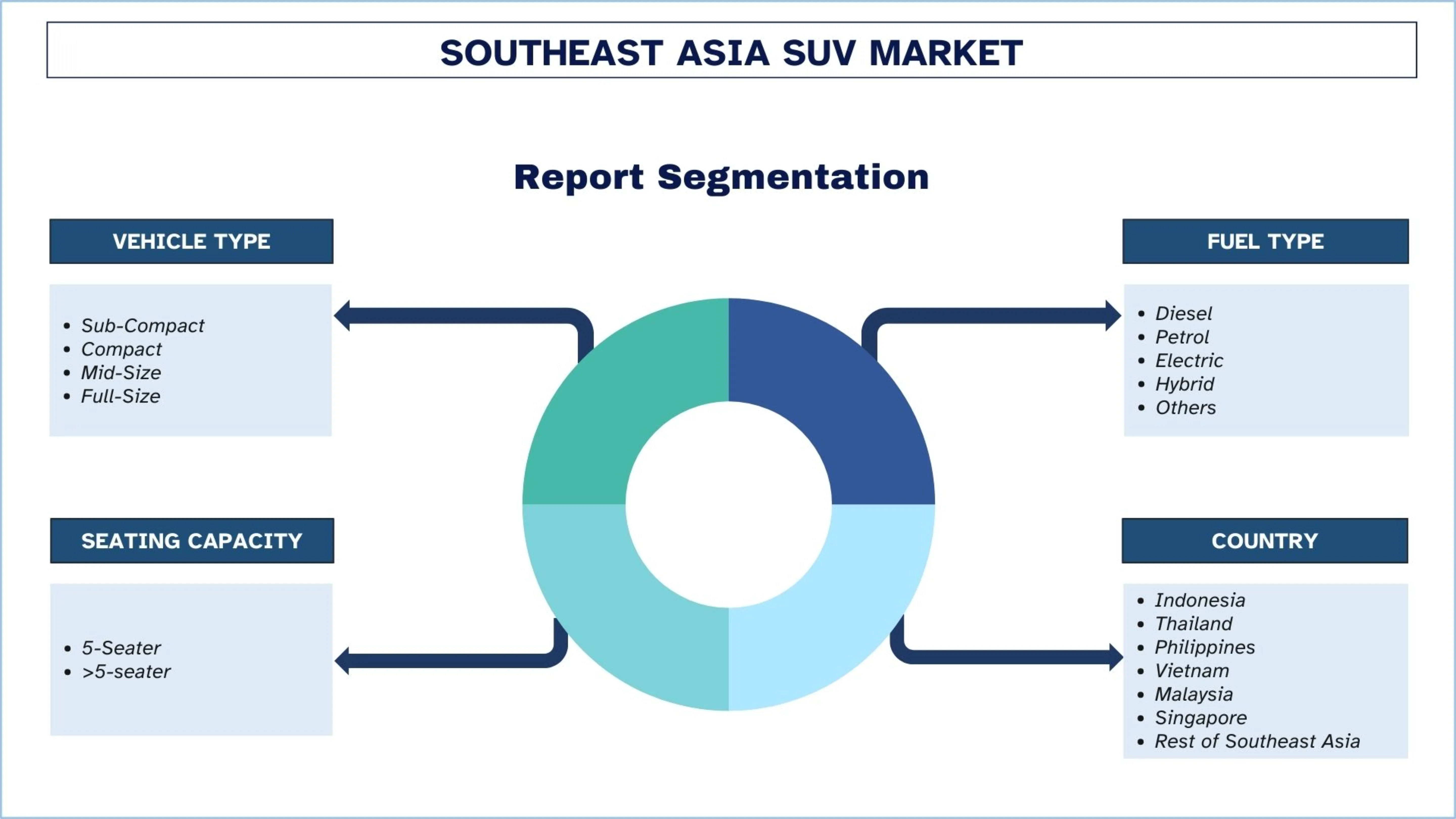
Emphasis on Vehicle Type (Sub-Compact, Compact, Mid-Size, Full-Size); Fuel Type (Diesel, Petrol, Electric, Hybrid, Others); Seating Capacity (5-Seater, >5-seater); and Country.
Southeast Asia SUV Market Size & Forecast
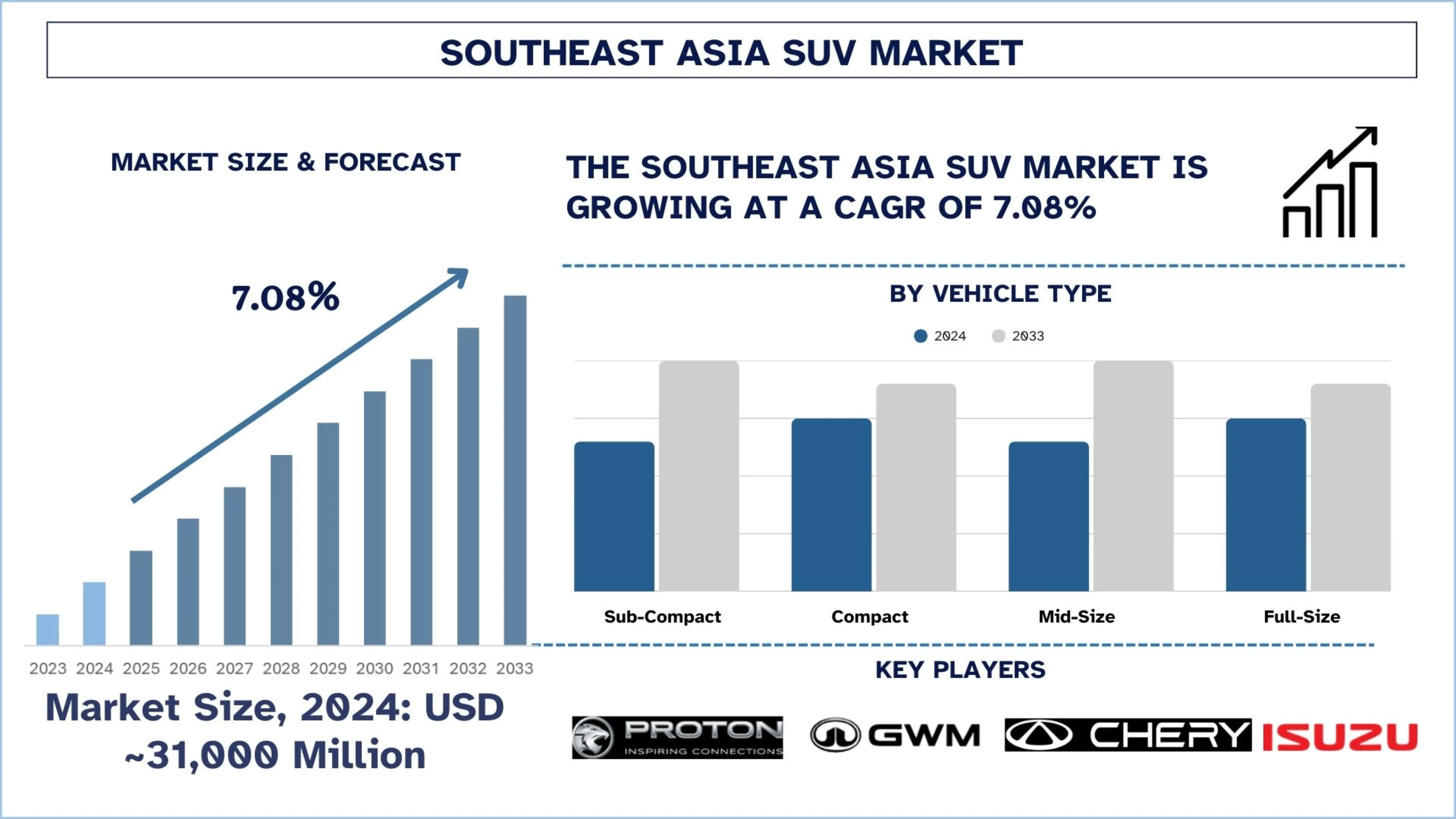
The Southeast Asia SUV Market was valued at ~USD 31,000 million in 2024 and is expected to grow at a strong CAGR of approximately 7.08% during the forecast period (2025-2033F), driven by the rising disposable incomes and rapid urbanization.
Southeast Asia SUV Market Analysis
An SUV is a passenger car designed to provide comfort, dynamics, ease of use, and greater ground clearance, driving position, and capability to cope with diverse road conditions. It is typically used for individual mobility, family transportation, and light off-road or multi-terrain use.
To drive growth in Southeast Asia, manufacturers are focusing on platform localization, cost-effective manufacturing, and the development of new sub-compact and compact SUVs suited to urban density and price-conscious consumers. Additionally, electrified models, such as hybrid and electric SUVs, are being introduced gradually in metropolitan areas, supported by incentives and charging networks. Moreover, online retailing, leasing, and sub-ownership systems are being embraced to reach a broader customer base, and variants and feature sets, including built-in infotainment and safety systems, are used to differentiate offerings in a competitive market.
For instance, on December 24, 2025, building on the OMODA 5’s 5-star rating in 2024, Chery presented two new SUV models for safety assessment under the New Car Assessment Program for Southeast Asian Countries (ASEAN NCAP): the iCAUR V23 and the TIGGO 7 Plug-in Hybrid Electric Vehicle (PHEV). This initiative underscores the brand's ongoing commitment to regional vehicle safety standards.
Southeast Asia SUV Market Trends
This section discusses the key market trends influencing the various segments of the Southeast Asian SUV market, as identified by our research team.
Increasing Adoption of Hybrid Powertrains
The shift toward hybrid powertrains is also a significant trend in the Southeast Asian SUV market, as buyers are less concerned with vehicle range and more interested in fuel efficiency. Also, the hybrids offer a viable pathway between the traditional ICE (Internal Combustion Engine) market and full electrification, particularly in markets with uneven charging-network coverage. Moreover, the government policies that favor fuel development and increase fuel costs are driving the uptake of hybrid cars. This trend enables manufacturers to achieve emission-reduction goals while maintaining performance and driving convenience for urban and long-distance use.
For instance, on December 4, 2025, Geely Auto unveiled a full lineup of new-energy products, including all-electric SUV GEELY EX5, the Thailand showcase of the new plug-in hybrid SUV GEELY STARRAY EM-i, and the GEELY EX2, which launched in Thailand during the event. As a B-segment electric urban model, the GEELY EX2 is engineered for modern city mobility, integrating smart technologies with user-centric features. The five-seat cabin achieves an 85% interior space utilization rate, featuring a fully flat rear floor and 36 storage compartments—including a 70-liter front trunk—ensuring comfort and convenience for daily commuting.
Southeast Asia SUV Industry Segmentation
This section provides an analysis of the key trends in each segment of the Southeast Asia SUV market, along with forecasts at the country level for 2025-2033.
The compact SUV market held the dominant share of the SUV market in 2024.
Based on vehicle type, the market is segmented into sub-compact, compact, mid-size, and full-size. Among these, the compact SUV market held the largest share in 2024. This is mainly due to the combination of affordability, fuel efficiency, and functionality for urban and semi-urban customers. Their smaller footprint makes them suitable for congested cities without compromising ground clearance or perceived safety, thereby facilitating faster adoption. With this segment, companies can rapidly scale volumes and efficiently localize production, thereby enhancing market penetration. On August 5, 2024, Mitsubishi Motors Corporation (hereafter, Mitsubishi Motors) announced that its all-new Xforce1 compact SUV has earned a maximum five-star rating in the 2024 ASEAN NCAP2, a comprehensive safety performance assessment for new vehicles in the ASEAN region.
The electric SUV market is expected to grow at a significant CAGR during the forecast period (2025-2033).
Based on fuel type, the Southeast Asian SUV market is segmented into diesel, petrol, electric, and others. Among these, the electric SUV market is expected to grow at a significant CAGR during the forecast period (2025-2033). Electric SUVs are emerging as a significant growth driver, with governments in Southeast Asia launching incentives, emissions policies, and EV strategies. The increasing fuel prices and growing environmental awareness are driving consumers and fleet operators toward electric options. This segment enables companies to prepare for long-term growth and align with policy support and future mobility trends. For example, on October 29, 2025, Cycle & Carriage Singapore announced the launch of Leapmotor in Singapore, introducing the Leapmotor C10, a mid-size electric sport utility vehicle (SUV) designed to offer customers a thoughtfully engineered and accessible electric vehicle (EV) experience. This marks the third market entry for Leapmotor in Southeast Asia, following Thailand and Malaysia.
Thailand held a dominant share of the Southeast Asian SUV market in 2024
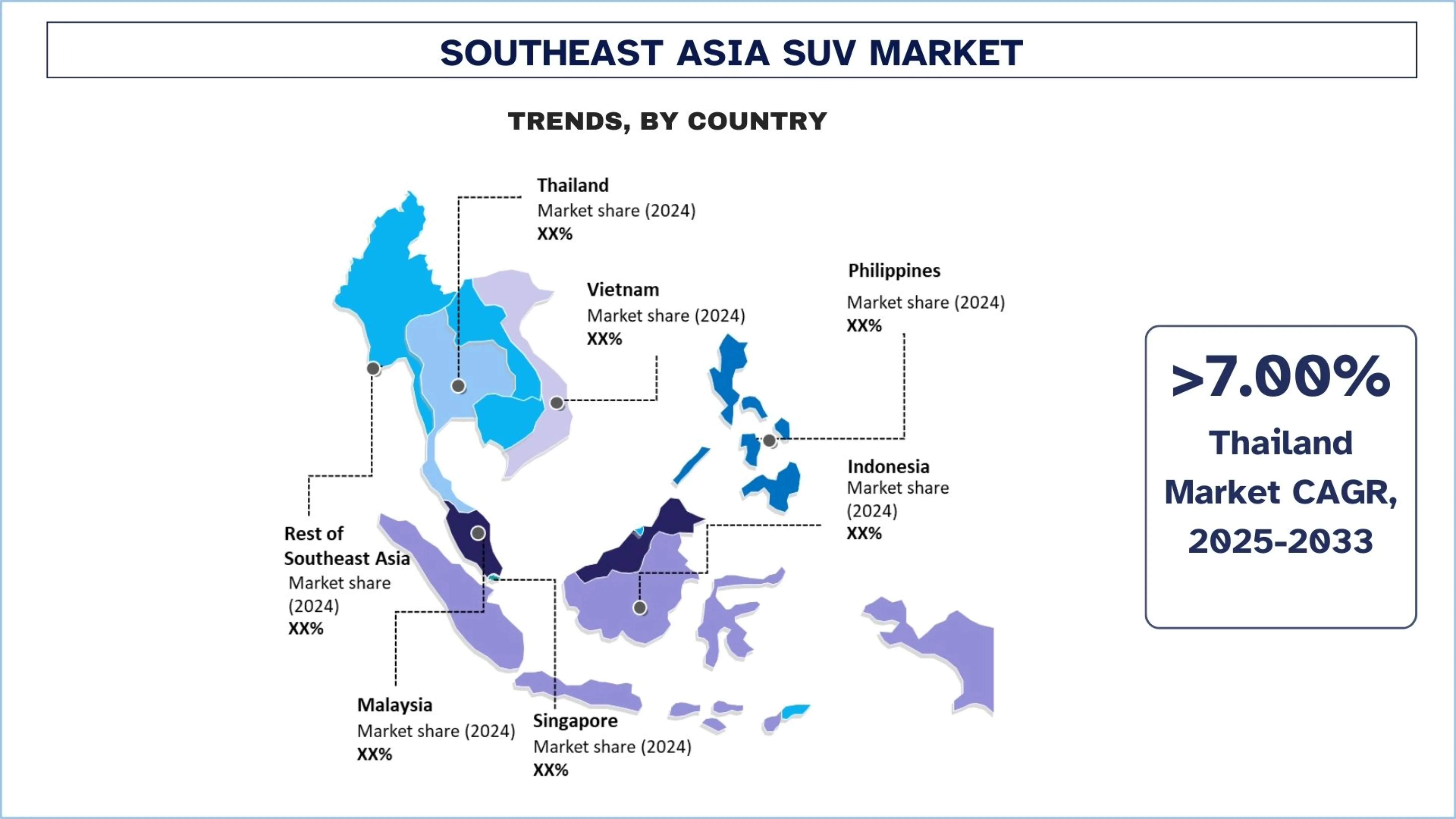
Thailand held a dominant share of the Southeast Asia SUV market as a regional automotive manufacturing and export hub. The robust manufacturing capacity, well-established supply chains, and favorable industrial policies underpin the consistent adoption of SUVs. In addition, the market for compact and mid-size SUVs is strong, and state policies accelerate the transition to electric and hybrid SUVs. Additionally, Thailand's export-based ecosystem facilitates businesses in expanding their regional operations and enhancing competitiveness.
For instance, on February 14, 2025, Mazda Motor Corporation (Mazda) and Mazda Sales (Thailand) Co., Ltd. (Mazda Thailand) announced their plan to strengthen Auto Alliance (Thailand) Co., Ltd., Mazda’s manufacturing base in Thailand, through investing 5 billion Thai baht (~USD 143 million) and developing it as a manufacturing hub for new compact SUVs with an annual production capacity of 100,000 units by leveraging the strengths of the local supply chain that the company has cultivated in Thailand to date.
Southeast Asia SUV Industry Competitive Landscape
The Southeast Asia SUV market is competitive, with several global and international market players. The key players are adopting different growth strategies to enhance their market presence, such as partnerships, agreements, collaborations, new product launches, geographical expansions, and mergers and acquisitions.
Top Southeast Asia SUV Companies
Some of the major players in the market are PROTON Holdings Berhad’s Group of Companies, GREAT WALL MOTOR SALES MALAYSIA SDN. BHD, Chery Auto Malaysia Sdn Bhd, ISUZU Motors Asia (Thailand) Co., Ltd. (ISUZU MOTORS LIMITED), Mitsubishi Motors Corporation, Hyundai Motor Company, Nissan, BYD Auto Co., Ltd., TOYOTA MOTOR CORPORATION, and Mazda Motor Corporation.
Recent Developments in the Southeast Asia SUV Market
On July 24, 2025, BYD introduced its all-electric compact SUV, the BYD ATTO 2, marketed as the BYD Yuan UP in China at a launch event in Kuala Lumpur, Malaysia. The move underscores the automaker's continued push to expand its footprint in Southeast Asia's growing EV market.
On December 31, 2024, XPENG launched in Indonesia in early 2025 with the introduction of the advanced G6 mid-size SUV, and X9 ultra-smart large 7-seater MPV, offering Indonesian consumers choices from high-performance and business/family premium MPV with sustainable mobility.
On February 14, 2024, National carmaker PROTON introduced its first SUV, the Proton X70, in 2018, a year after its partnership with GEELY. This milestone marked a turning point for the brand, sparking a revitalisation and steering it back to profitability. Since then, the company has continued to thrive. Fast forward seven years, and PROTON launched two more SUVs, each with subsequent updates, maintaining their relevance in the market ever since. The Proton X50, Malaysia’s favourite B-segment SUV and PROTON’s best-selling SUV, achieved a total of 23,647 units sold last year
Southeast Asia SUV Market Report Coverage
Report Attribute | Details |
Base year | 2024 |
Forecast period | 2025-2033 |
Growth momentum | Accelerate at a CAGR of 7.08% |
Market size 2024 | ~USD 31,000 million |
Country analysis | Indonesia, Thailand, Philippines, Vietnam, Malaysia, Singapore, Rest of Southeast Asia |
Major contributing Country | Vietnam is expected to grow at the highest CAGR during the forecasted period. |
Companies profiled | PROTON Holdings Berhad’s Group of Companies, GREAT WALL MOTOR SALES MALAYSIA SDN. BHD, Chery Auto Malaysia Sdn Bhd, ISUZU Motors Asia (Thailand) Co., Ltd. (ISUZU MOTORS LIMITED), Mitsubishi Motors Corporation, Hyundai Motor Company, Nissan, BYD Auto Co., Ltd., TOYOTA MOTOR CORPORATION, and Mazda Motor Corporation. |
Report Scope | Market Trends, Drivers, and Restraints; Revenue Estimation and Forecast; Segmentation Analysis; Demand and Supply Side Analysis; Competitive Landscape; Company Profiling |
Segments Covered | By Vehicle Type, By Fuel Type, By Seating Capacity, By Country |
Reasons to Buy the Southeast Asia SUV Market Report:
The study includes market sizing and forecasting analysis confirmed by authenticated key industry experts.
The report briefly reviews overall industry performance at a glance.
The report covers an in-depth analysis of prominent industry peers, primarily focusing on key business financials, product portfolios, expansion strategies, and recent developments.
Detailed examination of drivers, restraints, key trends, and opportunities prevailing in the industry.
The study comprehensively covers the market across different segments.
Customization Options:
The Southeast Asia SUV market can further be customized as per requirements or any other market segment. Besides this, UnivDatos understands that you may have your own business needs; hence, feel free to contact us to get a report that completely suits your requirements.
Table of Content
Research Methodology for the Southeast Asia SUV Market Analysis (2023-2033)
We analyzed the historical market, estimated the current market, and forecasted the future market of the Southeast Asian SUV market to assess its application in major countries. We conducted exhaustive secondary research to gather historical market data and estimate the current market size. To validate these insights, we carefully reviewed numerous findings and assumptions. Additionally, we conducted in-depth primary interviews with industry experts across the Southeast Asian SUV value chain. After validating market figures through these interviews, we used both top-down and bottom-up approaches to forecast the overall market size. We then employed market breakdown and data triangulation methods to estimate and analyze the market size of industry segments and sub-segments.
Market Engineering
We employed the data triangulation technique to finalize the overall market estimation and derive precise statistical numbers for each segment and sub-segment of the Southeast Asia SUV market. We split the data into several segments and sub-segments by analyzing various parameters and trends, including vehicle type, fuel type, seating capacity, and country within the Southeast Asian SUV market.
The Main Objective of the Southeast Asia SUV Market Study
The study identifies current and future trends in the Southeast Asia SUV market, providing strategic insights for investors. It highlights market attractiveness, enabling industry participants to tap into untapped markets and gain a first-mover advantage. Other quantitative goals of the studies include:
Market Size Analysis: Assess the current and forecast market size of the Southeast Asia SUV market and its segments in terms of value (USD).
Southeast Asia SUV Market Segmentation: Segments in the study include areas of vehicle type, fuel type, seating capacity, and country.
Regulatory Framework & Value Chain Analysis: Examine the regulatory framework, value chain, customer behavior, and competitive landscape of the Southeast Asia SUV industry.
Country Analysis: Conduct a detailed country analysis for key areas such as Indonesia, Thailand, the Philippines, Vietnam, Malaysia, Singapore, and the Rest of Southeast Asia.
Company Profiles & Growth Strategies: Company profiles of the Southeast Asia SUV market and the growth strategies adopted by the market players to sustain the fast-growing market.
Frequently Asked Questions FAQs
Q1: What is the Southeast Asia SUV market’s current market size and growth potential?
The Southeast Asia SUV market was valued at ~USD 31,000 million in 2024 and is projected to expand at a CAGR of 7.08% from 2025 to 2033. Growth is supported by rising vehicle ownership, urbanization, and increasing preference for compact and crossover SUVs across key ASEAN economies.
Q2: Which segment has the largest share of the Southeast Asia SUV market by vehicle type?
The compact SUVs dominate the market due to their optimal balance of affordability, fuel efficiency, and suitability for urban driving conditions. Their strong acceptance among middle-income consumers makes them the volume-driving segment across the region.
Q3: What are the driving factors for the growth of the Southeast Asia SUV market?
Market growth is driven by rising middle-class income, rapid urbanization, improving road infrastructure, increasing availability of vehicle financing, and a clear consumer shift from sedans toward higher-riding SUVs with better safety perception.
Q4: What are the emerging technologies and trends in the Southeast Asia SUV market?
Key trends include growing adoption of electric and hybrid SUVs, increasing demand for sub-compact and crossover models, higher localization of manufacturing, and rising integration of connected features and advanced safety technologies.
Q5: What are the key challenges in the Southeast Asia SUV market?
Major challenges include price sensitivity in mass-market segments, uneven EV charging infrastructure, regulatory complexity across countries, rising input costs, and intense competition leading to margin pressure for manufacturers.
Q6: Which country dominates the Southeast Asia SUV market?
Thailand dominates the market as a regional automotive manufacturing and export hub. Strong production capabilities, established supply chains, and supportive industrial policies underpin steady SUV adoption.
Q7: Who are the key players in the Southeast Asia SUV market?
Leading companies in the Southeast Asia SUV market include:
• PROTON Holdings Berhad’s Group of Companies
• GREAT WALL MOTOR SALES MALAYSIA SDN. BHD
• Chery Auto Malaysia Sdn Bhd
• ISUZU Motors Asia (Thailand) Co., Ltd. (ISUZU MOTORS LIMITED)
• Mitsubishi Motors Corporation
• Hyundai Motor Company
• Nissan
• BYD Auto Co., Ltd.
• TOYOTA MOTOR CORPORATION
• Mazda Motor Corporation
Q8: Which Southeast Asia countries offer the highest growth opportunities for SUV manufacturers and investors?
Vietnam and the Philippines offer the highest growth potential due to rising disposable incomes, increasing first-time vehicle ownership, and expanding urban infrastructure. These markets present strong opportunities for compact, affordable, and electrified SUV models.
Q9: How is electrification influencing the future of the Southeast Asia SUV market?
Electrification is reshaping the SUV market through government incentives, emission regulations, and rising fuel costs. Electric and hybrid SUVs are gaining traction in urban centers, positioning them as a key long-term growth segment for manufacturers and investors.
Related Reports
Customers who bought this item also bought


Micro Mobility Data Analytics Market: Current Analysis and Forecast (2026-2034)
Emphasis on Component (Software / Platform, Services); Analytics Type (Descriptive, Predictive, Prescriptive); Application (Fleet Management, Route Optimization, Demand Forecasting, Rider Behavior Analysis); End-User (Micro Mobility Operators, City Governments/Smart Cities, Transit Agencies); Deployment Mode (Cloud-Based, On-Premises); and Region/Country
Middle East & Africa Automotive Composites Market: Current Analysis and Forecast (2025-2033)
Emphasis By Material Type (Carbon Fiber Composites, Glass Fiber Composites, Natural Fiber Composites, Hybrid Composites, and Others), by Vehicle Type (Passenger Cars, Light Commercial Vehicles, Heavy Commercial Vehicles, Electric Vehicles, and Others), By End-User (OEM and Aftermarket), By Country (Saudi Arabia, UAE, Egypt, South Africa, Turkey, Israel, and the Rest of Middle East & Africa)
Southeast Asia Two-wheeler E-Axle Market: Current Analysis and Forecast (2025-2033)
Emphasis on Type (Hub Motor E-Axle, Mid Drive E-Axle, Integrated E-Axle); Application (Electric Scooters, Electric Motorcycles, Cargo & Delivery Bikes, Shared Mobility Fleets); and Country.
Truck Trailer Landing Gear Market: Current Analysis and Forecast (2025-2033)
Emphasis on Operation (Manual Truck Landing Gear and Automatic Truck Landing Gear); Lifting Capacity (Less Than 20,000 LBS, 20,000 LBS to 50,000 LBS, and More than 50,000 LBS); Sales Channel (OEM and Aftermarket); and Region/Country