Africa Mobile Money Market: Current Analysis and Forecast (2025-2033)
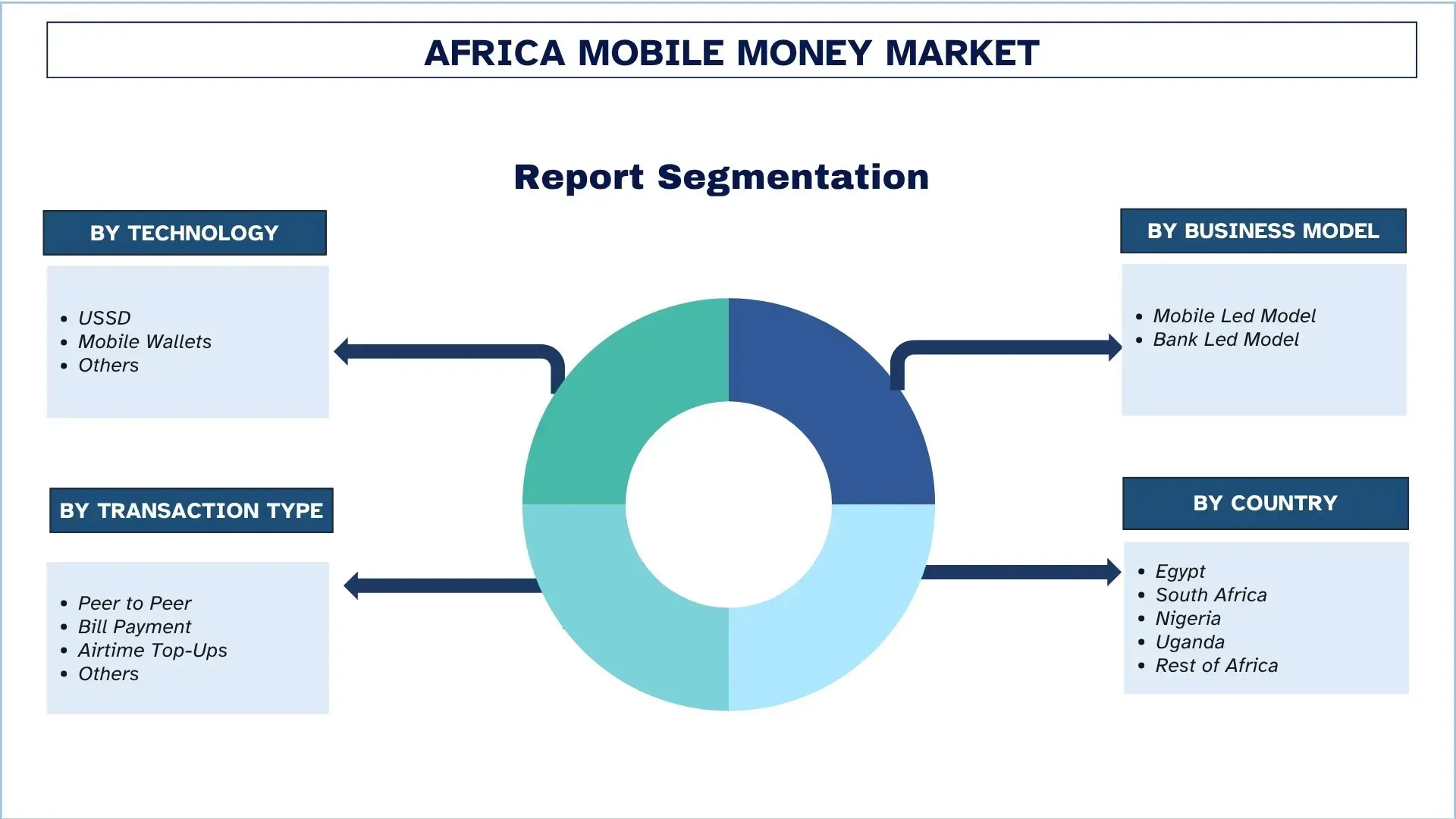
Emphasis By Technology (USSD, Mobile Wallets, and Others), By Business Model (Mobile Led Model, and Bank Led Model), By Transaction Type (Peer to Peer, Bill Payment, Airtime Top-Ups, Others), By Country (Egypt, South Africa, Nigeria, Uganda, Rest of Africa)
Africa Mobile Money Market Size & Forecast
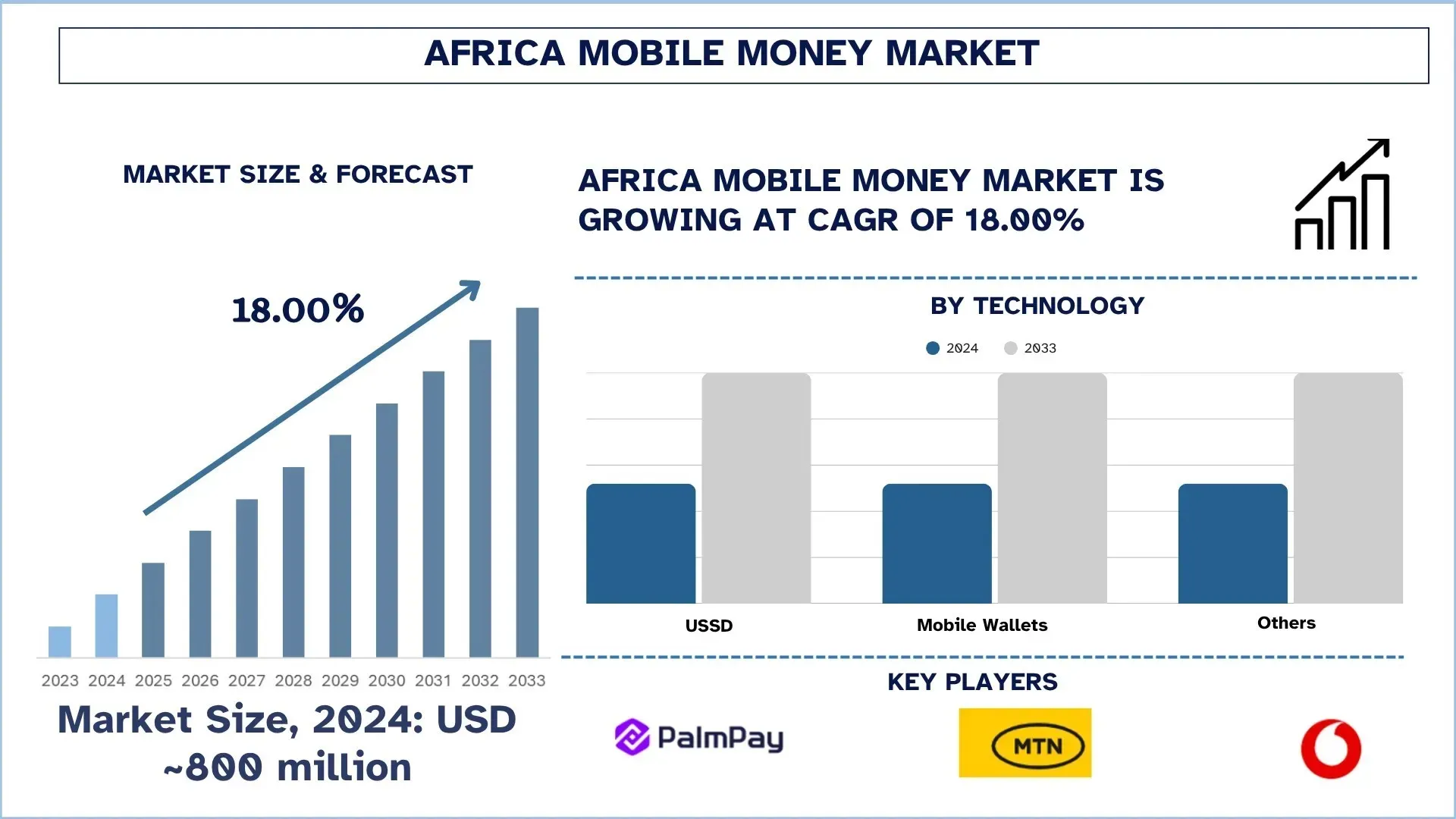
The Africa Mobile Money Market was valued at USD 800 million in 2024 and is expected to grow at a strong CAGR of around 18.00% during the forecast period (2025- 2033). Cheaper smartphones + wider 4G/5G reach are pulling more people into mobile wallets, and Policy tailwinds for inclusion and faster payments are some of the key factors supporting the market rise.
Africa Mobile Money Market Analysis
The African mobile money market has been growing at a notable rate with the rising smartphone penetration, better mobile network, as well as the demand for available financial services. Mobile money services have not only been limited to simple transactions but have also been able to offer a multifarious array of services, including loans, savings, and insurance, and have revolutionized how people and business conduct their finances. The distinct opportunity in Africa is its huge, young, and mobile population that has accepted the concept of mobile wallets and digital payments as part of their lives. Moreover, the growth of mobile money services is further promoted through alliances of telecom operators, fintech players, and regulatory authorities, which creates an enabling innovation within the industry.
Africa Mobile Money Market Trends
This section discusses the key market trends that are influencing the various segments of the Africa Mobile Money market, as found by our team of research experts.
Wallets are evolving into financial super-apps:
The digital wallet is changing the mobile money market in Africa radically as it is turning into a financial super-app. These services are not only increasing the number of transactions but also providing complete services like payments, lending, insurance, and e-commerce that allow its users a smooth financial experience. This revolution is transforming the nature of interactions between individuals and businesses, and financial inclusion opens new possibilities. These platforms are reaching underserved populations across the continent by leveraging mobile-first technologies, inexpensive smartphones, and expanding network infrastructure. Consumer empowerment is not the only reason why the emergence of mobile money super-apps is contributing to economic growth, entrepreneurship, and cross-border trade. Since the sector is still evolving, it is likely to change the direction of the African financial landscape, as it can make it more open and reachable.
Key Market Segmentation:
This section provides an analysis of the key trends in each segment of the Africa Mobile Money market report, along with forecasts at the country and regional levels for 2025-2033.
USSD has shown promising growth in the Mobile Money Market.
Based on technology, the African mobile money market is segmented into USSD, Mobile wallet, and others. Among these, USSD has the highest market share owing to its wide access, particularly in regions where the internet is either limited or absent. USSD enables users to transact banking operations with basic feature phones, which is why the tool is critical to financial inclusion, especially in rural and underserved communities. It is an extremely important facilitator of mobile money services because of its simplicity, low-cost infrastructure, and its use without the need for an internet connection. Furthermore, mobile network operators and financial institutions have adopted USSD, which has further dominated the African market.
The Mobile Led Model category held a significant share of the African Mobile Money Market.
According to the business model, there are two divisions of the African mobile money market: the Mobile Led Model and the Bank Led Model. Among these, the Mobile Led Model has had a significant market share among the two. This is mainly due to the large penetration of mobile network providers and their ability to offer accessible financial services to underserved and remote populations. The Mobile Led Model is more flexible, quicker to adopt, and less costly in terms of transaction costs, hence being more effective, particularly in areas where there are limited banking systems. Its accessibility and convenience still enhance financial inclusion in the African continent.
Egypt is expected to grow at a considerable rate during the forecast period.
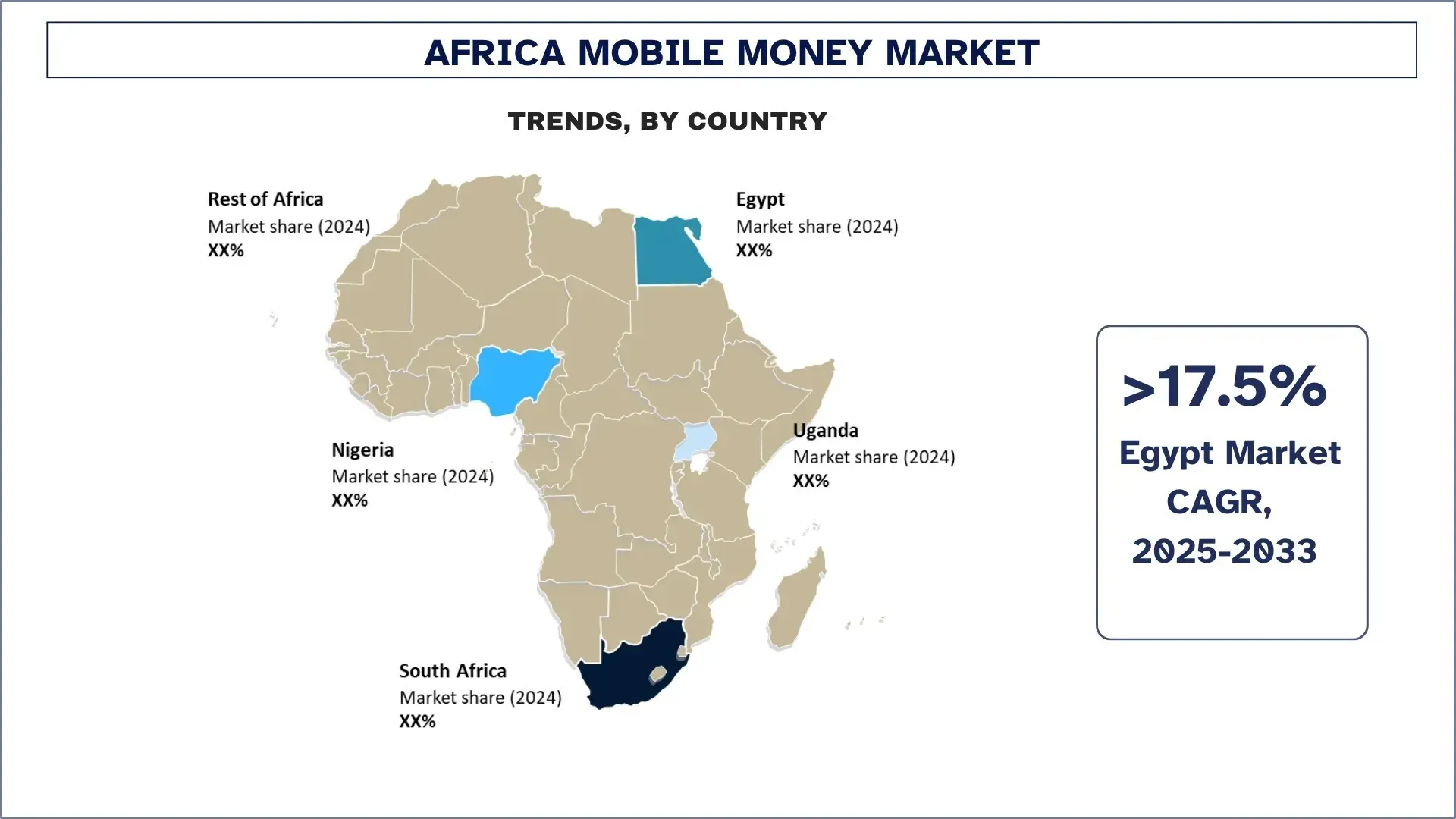
The mobile money market in Egypt is growing satisfactorily as smartphone usage increases, government digitalization initiatives, and the processes of financial inclusion. Telecom operators and fintech startups are growing wallet services, a system that facilitates payments, transfers, and savings via mobile systems. The regulatory environment by the Central Bank of Egypt remains trusting and innovative to encourage both domestic and foreign investment. Despite cash still being the leading payment method, the changing tastes of consumers and acceptance by merchants are driving the use of digital payments faster. Egypt is also establishing itself as a regional powerhouse of mobile financial services in North Africa, with a young and technology-oriented population and a favorable business environment.
Africa Mobile Money Industry Competitive Landscape:
The Africa Mobile Money market is competitive, with several global and international market players. The key players are adopting different growth strategies to enhance their market presence, such as partnerships, agreements, collaborations, new product launches, geographical expansions, and mergers and acquisitions.
Top Africa Mobile Money Companies
Some of the major players in the market are MTN, Orange, M-Pesa, Safaricom PLC, Airtel Money, Wave Mobile Money Inc., PalmPay, and VugaPay.
Africa Mobile Money Market Report Coverage
Report Attribute | Details |
Base year | 2024 |
Forecast period | 2025-2033 |
Growth momentum | Accelerate at a CAGR of 18.00% |
Market size 2024 | USD 800 Million |
Country analysis | Egypt, South Africa, Nigeria, Uganda, and the Rest of Africa |
Major contributing Country | Egypt is expected to dominate the market during the forecast period. |
Companies profiled | MTN, Orange, M-Pesa, Safaricom PLC, Airtel Money, Wave Mobile Money Inc., PalmPay, and VugaPay. |
Report Scope | Market Trends, Drivers, and Restraints; Revenue Estimation and Forecast; Segmentation Analysis; Demand and Supply Side Analysis; Competitive Landscape; Company Profiling |
Segments Covered | by Technology, By Business Model, By Transaction Type, by Country |
Reasons to Buy the Africa Mobile Money Market Report:
The study includes market sizing and forecasting analysis confirmed by authenticated key industry experts.
The report briefly reviews overall industry performance at a glance.
The report covers an in-depth analysis of prominent industry peers, primarily focusing on key business financials, type portfolios, expansion strategies, and recent developments.
Detailed examination of drivers, restraints, key trends, and opportunities prevailing in the industry.
The study comprehensively covers the market across different segments.
Deep dive Country-level analysis of the industry.
Customization Options:
The Africa Mobile Money Market can further be customized as per requirements or any other market segment. Besides this, UnivDatos understands that you may have your own business needs; hence, feel free to contact us to get a report that completely suits your requirements.
Table of Content
Research Methodology for the Africa Mobile Money Market Analysis (2023-2033)
We analyzed the historical market, estimated the current market, and forecasted the future market of the Africa Mobile Money market to assess its application in major countries. We conducted exhaustive secondary research to gather historical market data and estimate the current market size. To validate these insights, we carefully reviewed numerous findings and assumptions. Additionally, we conducted in-depth primary interviews with industry experts across the Mobile Money value chain. After validating market figures through these interviews, we used both top-down and bottom-up approaches to forecast the overall market size. We then employed market breakdown and data triangulation methods to estimate and analyze the market size of industry segments and sub-segments.
Market Engineering
We employed data triangulation techniques to finalize the overall market estimation and derive precise statistical numbers for each segment and sub-segment of the Africa Mobile Money market. We split the data into several segments and sub-segments by analyzing various parameters and trends, by Technology, By Business Model, By Transaction Type, and by country within the Africa Mobile Money market.
The Main Objective of the Africa Mobile Money Market Study
The study identifies current and future trends in the African Mobile Money market, providing strategic insights for investors. It highlights Country-level market attractiveness, enabling industry participants to tap into untapped markets and gain a first-move advantage. Other quantitative goals of the studies include:
Market Size Analysis: Assess the current forecast and market size of the Africa Mobile Money market and its segments in terms of value (USD).
Africa Mobile Money Market Segmentation: Segments in the study include areas by Technology, By Business Model, By Transaction Type, and by
Regulatory Framework & Value Chain Analysis: Examine the regulatory framework, value chain, customer behavior, and competitive landscape of the Africa Mobile Money industry.
Country Analysis: Conduct a detailed Country analysis for key areas such as Egypt, South Africa, Nigeria, Uganda, and the Rest of Africa.
Company Profiles & Growth Strategies: Company profiles of the Africa Mobile Money market and the growth strategies adopted by the market players to sustain the fast-growing market.
Frequently Asked Questions FAQs
Q1: What is the Africa Mobile Money market’s current market size and growth potential?
The Africa Mobile Money Market was valued at 800 million in 2024 and is expected to grow at a CAGR of 18.00% during the forecast period (2025-2033).
Q2: Which segment has the largest share of the Africa Mobile Money market by Technology?
The African Mobile Money Market has been dominated by USSD. The segment has the highest market share owing to its wide access, particularly in regions where the internet is either limited or absent.
Q3: What are the driving factors for the growth of the Africa Mobile Money market?
• Expanding Smartphone Access and Network Coverage: The availability of affordable smartphones and wider 4G/5G deployment is enabling millions of Africans to access mobile wallets, boosting financial inclusion.
• Policy Momentum for Digital Payments: Governments and regulators across Africa are promoting mobile money adoption through supportive policies, interoperability frameworks, and instant payment systems that enhance user trust and transaction speed.
Q4: What are the emerging technologies and trends in the Africa Mobile Money market?
• Rise of Financial Super-Apps: Mobile wallets are rapidly transforming into integrated digital ecosystems, offering services such as savings, lending, insurance, and cross-border payments on a single platform.
• Fintech as a Growth Catalyst for Telecoms: Telecom operators are leveraging mobile money services as a key revenue driver, deepening customer engagement and diversifying income beyond voice and data.
Q5: What are the key challenges in the Africa Mobile Money market?
• Currency Volatility and Regulatory Compliance: Frequent exchange rate fluctuations and tightening regulatory requirements increase operational costs and risk exposure for service providers.
• Affordability and Market Competition: Price-sensitive users and intense rivalry in the lower-income segment are putting pressure on transaction fees and profit margins, challenging long-term sustainability.
Q6: Which country dominates the Africa Mobile Money market?
Egypt has held a sizeable market share due to factors such as a bigger population, rising urban centers, focus towards enhancing security and preventive measures for the criminal activities using the Mobile Money.
Q7: Who are the key players in the Africa Mobile Money market?
Some of the top Mobile Money companies in Africa include:
• MTN
• Orange
• M-Pesa
• Safaricom PLC
• Airtel Money
• Wave Mobile Money Inc.
• PalmPay
• VugaPay
• Others
Q8: What are the opportunities for companies within the Africa Mobile Money market?
• Cross-Border SME Payments and Trade Enablement: The African Continental Free Trade Area (AfCFTA) is creating demand for seamless digital payment solutions that support small and medium enterprises in cross-border trade. Mobile money platforms can play a critical role by simplifying remittances, settlements, and currency conversion across markets.
• Merchant Digitization through Device Partnerships: Collaborations between fintechs, handset makers, and telecom operators are driving digital payment acceptance among small merchants. Affordable smartphones and preloaded wallet apps accelerate cashless transactions and expanding merchant ecosystems.
Q9: How are consumer preferences shaping product development in the Africa Mobile Money market?
Evolving consumer preferences for convenience, security, and integrated services are driving mobile money providers to design user-friendly apps, offer instant payments, and expand into savings, lending, and micro-insurance solutions.
Related Reports
Customers who bought this item also bought


Southeast Asia Automotive Financing Market: Current Analysis and Forecast (2025-2033)
Emphasis on Vehicle Condition (New Vehicle, Used Vehicle); Provider Type (OEM Captive Finance, Banks, Credit Unions, Non-Bank Financial Institutions (NBFIs), Others); Vehicle Type (Passenger Vehicle, Commercial Vehicle, Two-Wheeler); Financing Type (Loan, Leasing, Hire Purchase, Others); and Country.

Liability Insurance Market: Current Analysis and Forecast (2025-2033)
Emphasis on Coverage Type (General Liability, Professional Liability, Employer's Liability, Cyber Liability, and Others); Distribution Channel (Brokers, Agents, Direct Sales, Online Platforms, and Bancassurance); End-User (Corporate, Self-Employed, Non-Profit Organizations, Small and Medium Enterprises, and Government Entities); and Region/Country
Middle East & Africa Venture Capital Market: Current Analysis and Forecast (2025-2033)
Emphasis By Type (Local Investor and International Investor), By Industry (Real Estate, Financial Services, Food & Beverages, Healthcare, Transportation & Logistics, IT, Education, and Others), By Country (Saudi Arabia, UAE, Egypt, South Africa, Turkey, Israel, and the Rest of Middle East & Africa)

Alternative Financing Market: Current Analysis and Forecast (2025-2033)
Emphasis on Finance Type (Peer-To-Peer Lending, Crowdfunding, Invoice Financing, and Others); End-User (Individual Consumers, Small & Medium Enterprises {SME's}, Large Enterprises, and Others); and Region/Country