Alternative Financing Market: Current Analysis and Forecast (2025-2033)
Emphasis on Finance Type (Peer-To-Peer Lending, Crowdfunding, Invoice Financing, and Others); End-User (Individual Consumers, Small & Medium Enterprises {SME's}, Large Enterprises, and Others); and Region/Country
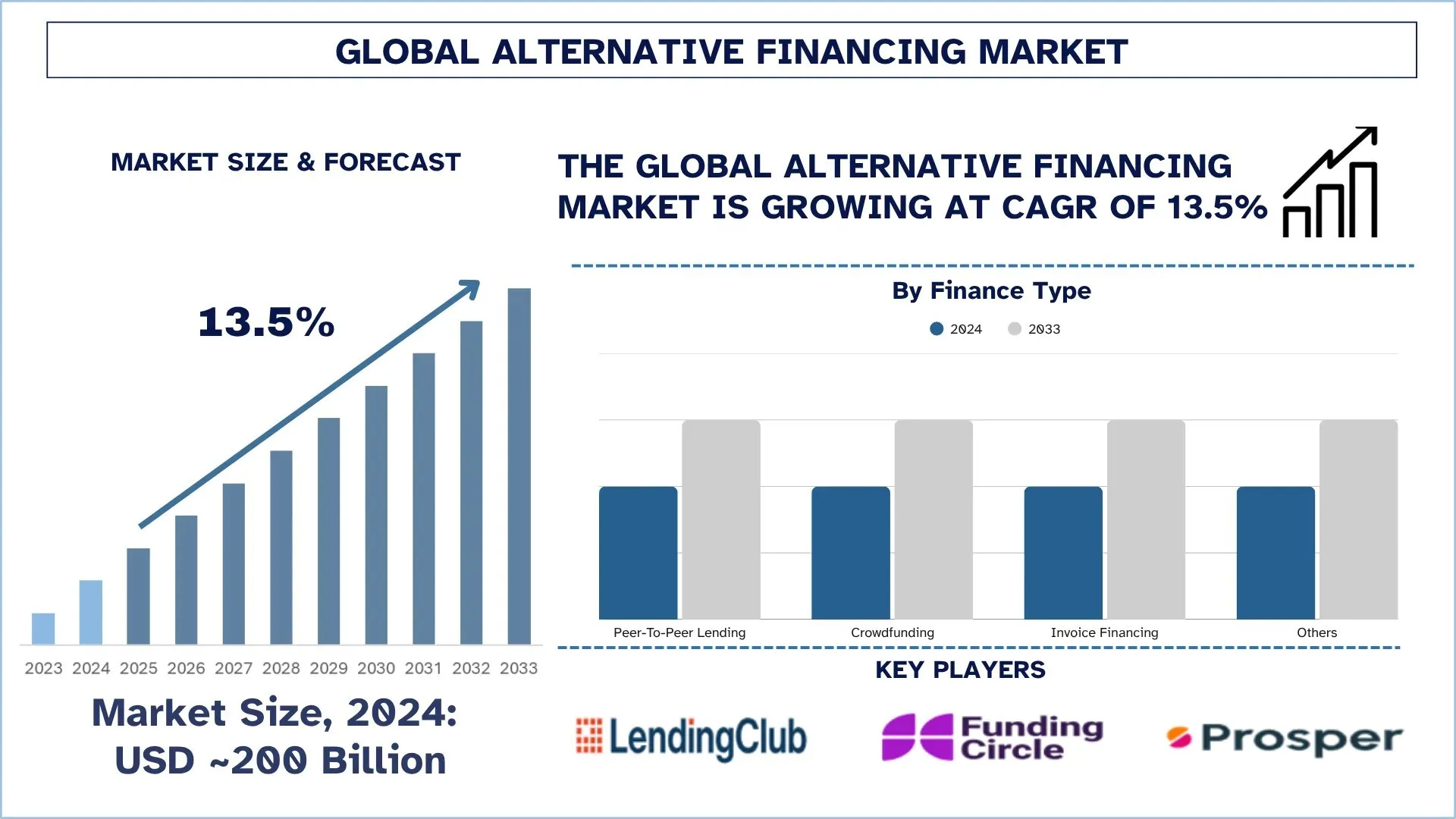
Global Alternative Financing Market Size & Forecast
The Global Alternative Financing Market was valued at USD ~200 billion in 2024 and is expected to grow at a strong CAGR of around 13.5% during the forecast period (2025-2033), driven by the increasing digitalization, rising demand for quick and accessible funding, growth of fintech innovations, regulatory support for non-traditional lending, and expanding global entrepreneurship ecosystems.
Alternative Financing Market Analysis
Alternative financing, referred to as marketplace lending, peer-to-peer lending, and P2P lending. These loans take place through online platforms that use technology to bring together borrowers underserved by traditional lending institutions, with loan investors seeking attractive yield-generating investments. The lending model grew out of small-balance, peer-to-peer unsecured consumer loans financed by individual investors.
The alternative financing market is significantly transforming global financial systems by offering accessible, technology-driven funding options that differ from traditional banking. Growing demand from small and medium-sized enterprises (SMEs), startups, and consumers seeking flexible and faster access to capital is fueling market growth. Digital innovation, including the integration of AI-based credit scoring, blockchain-based security, and data-driven underwriting, is improving platform efficiency and transparency. Furthermore, rising financial inclusion initiatives and the growth of online financial platforms are expanding the customer base across developing economies. As traditional banks maintain strict lending standards, new alternative lenders are emerging to address crucial financing gaps, support startups, and foster growth in the global digital economy.
Global Alternative Financing Market Trends
This section discusses the key market trends that are influencing the various segments of the global alternative financing market, as found by our team of research experts.
The Rising Shift from Traditional Financial Services Towards Alternative and Digital Financing
The rising shift from traditional financial services toward alternative and digital financing is one of the most notable trends in the global alternative financing market. Traditional banks, due to their strict lending criteria, manual processes, and limited accessibility, are increasingly being replaced or complemented by fintech-driven platforms providing fast, flexible, and convenient services. Consumers and businesses are transforming toward online lending, crowdfunding, and peer-to-peer (P2P) platforms that provide instant credit decisions, lower interest rates, and minimal paperwork. This change is driven by technological innovation, increasing internet access, and the rising demand for personalized financial services. For example, the Cornerstone Advisor 2025 study showed that in the US, over USD 2 trillion in deposits have moved from traditional banks to fintech-led savings and lending platforms. This shift is sped up by the emergence of alternative financing lenders like SoFi, LendingClub, and Upstart, which utilize AI and data analytics to evaluate creditworthiness beyond traditional metrics, thus fueling market growth.
Alternative Financing Industry Segmentation
This section provides an analysis of the key trends in each segment of the global alternative financing market report, along with forecasts at the global, regional, and country levels for 2025-2033.
The Peer-To-Peer Lending Segment Dominates the Global Alternative Financing Market
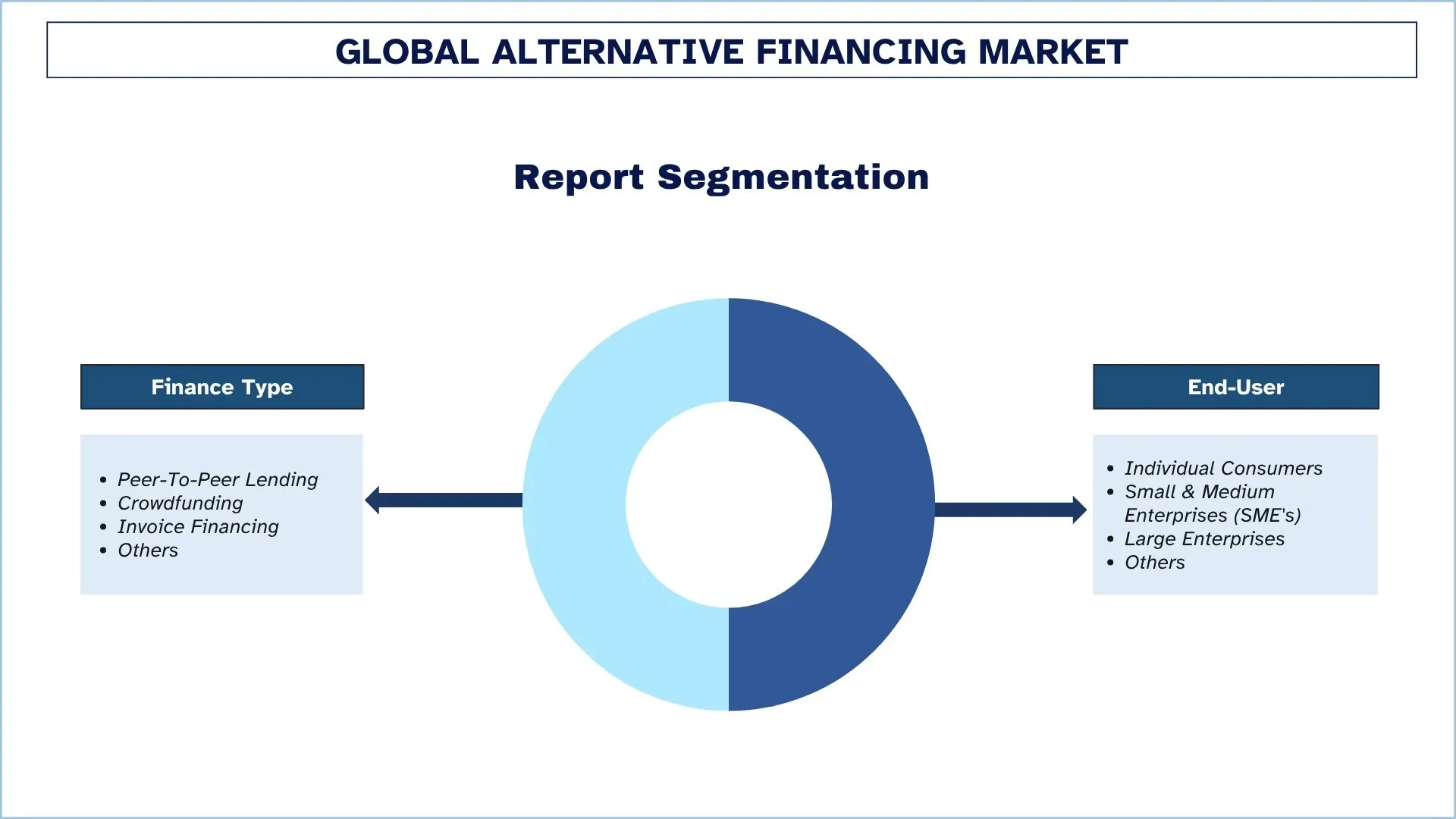
Based on the finance type, the market is categorized into peer-to-peer lending, crowdfunding, invoice financing, and others. Among these, the peer-to-peer (P2P) lending segment holds the largest share of the alternative financing market due to its capability to provide quick, accessible, and affordable funding compared to traditional banking systems. P2P platforms enable direct connection between borrowers and investors, eliminating intermediaries and reducing administrative expenses. This results in competitive interest rates and higher returns, boosting market growth. However, the invoice financing segment is showing the fastest growth rate in the alternative financing market due to the increasing need for quick liquidity among small and medium enterprises (SMEs). Governments in countries such as India and the UK support invoice and supply chain financing to help SMEs and strengthen business ecosystems, which further boost market growth.
The Individual Consumers Segment Dominates the Global Alternative Financing Market.
Based on the end-user category, the market is categorized into individual consumers, small & medium enterprises (SME's), large enterprises, and others. Among these, the individual consumer segment holds the largest share of the alternative financing market because of the rising demand for fast, convenient, and accessible personal loans. Alternative financing platforms, unlike traditional banks, offer quicker approvals, require less documentation, and provide more flexible repayment options. This approach attracts a diverse group of consumers and further drives market growth. However, the small and medium enterprises (SMEs) segment is experiencing the fastest growth because of limited access to traditional bank credit and the increasing demand for flexible funding options. The rise of fintech platforms and digital credit assessment tools has further made the lending process easier, allowing SMEs to secure funds efficiently, which further drives the growth of the market.
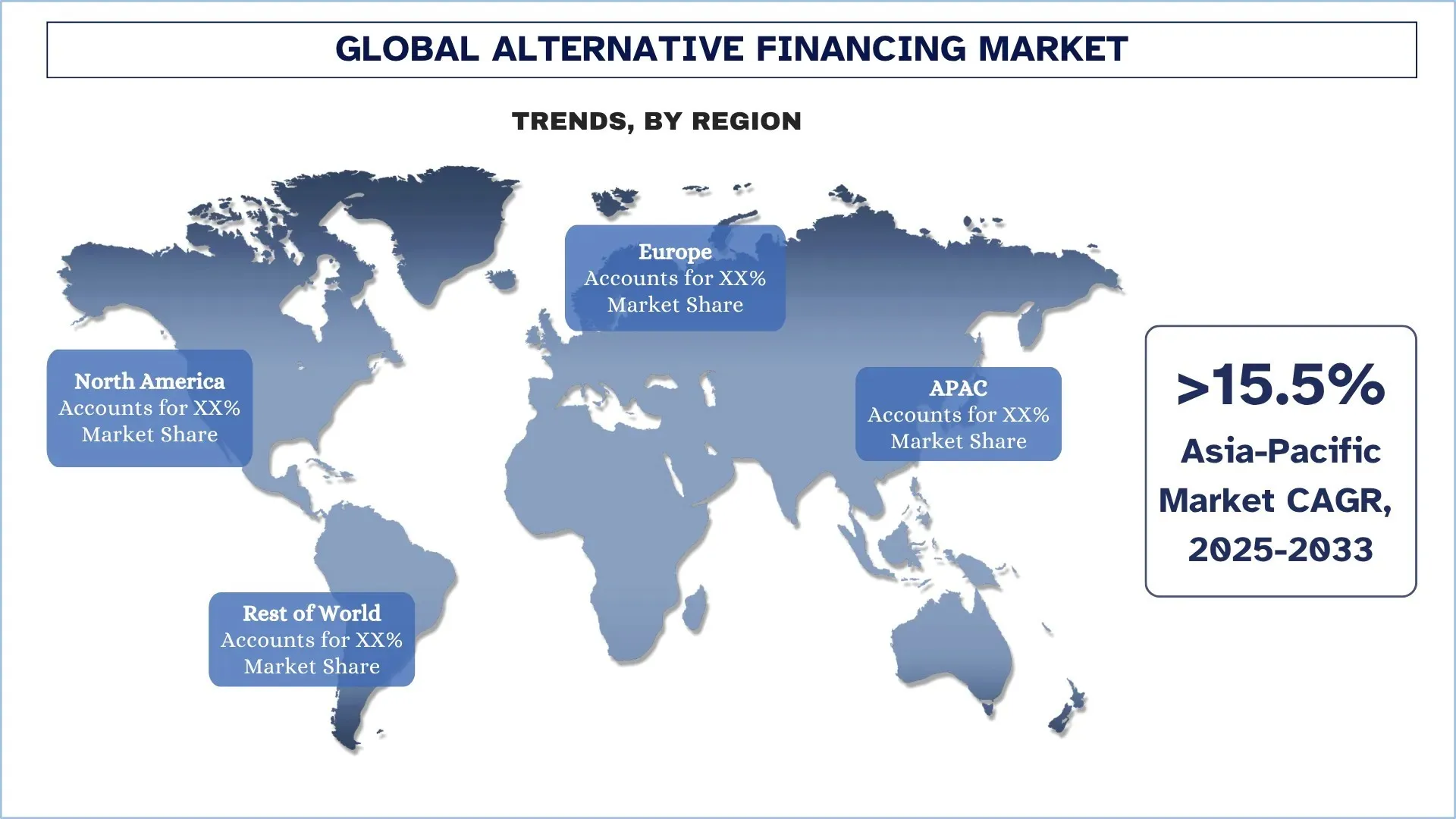
North America holds the largest market share in the global alternative financing market
North America dominates the alternative financing market due to its well-established financial infrastructure, high fintech adoption, and supportive regulatory environment. The region hosts a large number of established alternative lending platforms and peer-to-peer marketplaces that fulfill the demand of both individual and business borrowers. Strong digital connectivity, widespread use of online payment systems, and high consumer awareness have boosted the shift toward non-traditional financing solutions. Additionally, favorable government policies and regulatory clarity, especially in the U.S. and Canada, are promoting innovation and investment in digital lending and crowdfunding platforms. Furthermore, the rising adoption of technologies like AI, blockchain, and data analytics has improved credit evaluation and risk management, strengthening the region's position in the market.
The U.S. held a Dominant share of the North America Alternative Financing Market in 2024
The U.S. dominated the alternative financing market due to its well-established fintech ecosystem, strong digital infrastructure, and an innovation-friendly financial landscape. The country serves as a hub for numerous alternative lending and crowdfunding platforms that serve a variety of borrower segments, from individuals seeking personal loans to startups and small businesses that need growth capital. The country's regulatory framework, supported by agencies such as the Federal Reserve, Consumer Financial Protection Bureau (CFPB), and Small Business Administration (SBA), promotes innovation while balancing financial stability. Widespread smartphone penetration and digital payment adoption have boosted the popularity of peer-to-peer lending, Buy Now Pay Later (BNPL), and online small business lending. Furthermore, the integration of AI, big data, and blockchain technologies has enabled precise credit scoring and automated loan processing. Thus, the combination of technological leadership, a strong entrepreneurial base, and expanding fintech partnerships strengthens the U.S. position in the global alternative financing market.
Alternative Financing Industry Competitive Landscape
The global alternative financing market is competitive, with several global and international market players. The key players are adopting different growth strategies to enhance their market presence, such as partnerships, agreements, collaborations, geographical expansions, and mergers and acquisitions.
Top Alternative Financing Market Companies
Some of the major players in the market are LendingClub Bank, Funding Circle Ltd., Prosper Funding LLC., Fundbox, Inc., Ant Group CO., Ltd., Bluevine Inc., OnDeck (Enova International), Indiegogo, Inc., Social Finance, LLC., and GoFundMe Inc.
Recent Developments in the Alternative Financing Market
In July 2025, BlackRock completed its acquisition of HPS Investment Partners to build a unified private financing platform and scale its alternative-credit capabilities globally. This acquisition is expected to enhance BlackRock's operational efficiency.
In May 2025, Saarathi Finance raised USD 53.45 million in equity funding to bridge credit gaps for micro and nano-businesses in underserved Indian regions. This investment is expected to increase the demand for alternative financing in the Asia-Pacific region.
Global Alternative Financing Market Report Coverage
Report Attribute | Details |
Base year | 2024 |
Forecast period | 2025-2033 |
Growth momentum | Accelerate at a CAGR of 13.5% |
Market size 2024 | USD ~200 billion |
Regional analysis | North America, Europe, APAC, Rest of the World |
Major contributing region | The North America region is expected to dominate the market during the forecast period. |
Key countries covered | U.S., Canada, Germany, U.K., Spain, Italy, France, China, Japan, and India. |
Companies profiled | LendingClub Bank, Funding Circle Ltd., Prosper Funding LLC., Fundbox, Inc., Ant Group CO., Ltd., Bluevine Inc., OnDeck (Enova International), Indiegogo, Inc., Social Finance, LLC., and GoFundMe Inc. |
Report Scope | Market Trends, Drivers, and Restraints; Revenue Estimation and Forecast; Segmentation Analysis; Demand and Supply Side Analysis; Competitive Landscape; Company Profiling |
Segments Covered | By Finance Type, By End-User, and By Region/Country |
Reasons to Buy the Alternative Financing Market Report:
The study includes market sizing and forecasting analysis confirmed by authenticated key industry experts.
The report briefly reviews overall industry performance at a glance.
The report covers an in-depth analysis of prominent industry peers, primarily focusing on key business financials, type portfolios, expansion strategies, and recent developments.
Detailed examination of drivers, restraints, key trends, and opportunities prevailing in the industry.
The study comprehensively covers the market across different segments.
Deep dive regional level analysis of the industry.
Customization Options:
The global alternative financing market can further be customized as per the requirements or any other market segment. Besides this, UnivDatos understands that you may have your own business needs; hence, feel free to contact us to get a report that completely suits your requirements.
Table of Content
Research Methodology for the Global Alternative Financing Market Analysis (2023-2033)
We analyzed the historical market, estimated the current market, and forecasted the future market of the global alternative financing market to assess its application in major regions worldwide. We conducted exhaustive secondary research to gather historical market data and estimate the current market size. To validate these insights, we carefully reviewed numerous findings and assumptions. Additionally, we conducted in-depth primary interviews with industry experts across the alternative financing value chain. After validating market figures through these interviews, we used both top-down and bottom-up approaches to forecast the overall market size. We then employed market breakdown and data triangulation methods to estimate and analyze the market size of industry segments and sub-segments.
Market Engineering
We employed the data triangulation technique to finalize the overall market estimation and derive precise statistical numbers for each segment and sub-segment of the global alternative financing market. we split the data into several segments and sub-segments by analyzing various parameters and trends, including finance type, end-user, and regions within the global alternative financing market.
The Main Objective of the Global Alternative Financing Market Study
The study identifies current and future trends in the global alternative financing market, providing strategic insights for investors. It highlights regional market attractiveness, enabling industry participants to tap into untapped markets and gain a first-mover advantage. Other quantitative goals of the studies include:
Market Size Analysis: Assess the current and forecast market size of the global alternative financing market and its segments in terms of value (USD).
Alternative Financing Market Segmentation: Segments in the study include areas of finance type, end-user, and region.
Regulatory Framework & Value Chain Analysis: Examine the regulatory framework, value chain, customer behavior, and competitive landscape of the alternative financing industry.
Regional Analysis: Conduct a detailed regional analysis for key areas such as Asia Pacific, Europe, North America, and the Rest of the World.
Company Profiles & Growth Strategies: Company profiles of the alternative financing market and the growth strategies adopted by the market players to sustain the fast-growing market.
Frequently Asked Questions FAQs
Q1: What is the global alternative financing market’s current market size and growth potential?
As of 2024, the global alternative financing market size is approximately USD ~200 billion. The market is projected to expand at a CAGR of around 13.5% from 2025 to 2033, driven by the increasing adoption of digital lending platforms and the growing need for accessible capital among small businesses and startups.
Q2: Which segment has the largest share of the global alternative financing market by finance type category?
The peer-to-peer (P2P) lending segment accounts for the largest share of the global alternative financing market. Its popularity stems from the ability to connect borrowers and investors directly, enabling faster approvals, lower costs, and flexible lending models. Many enterprises also adopt on-premises financial platforms to ensure better data control, enhanced security, and compliance with regulatory standards.
Q3: What are the driving factors for the growth of the global alternative financing market?
Top growth drivers of the alternative financing market include:
• Increased demand for access to capital among startups and SMEs.
• Expansion of small and medium-sized enterprises (SMEs) worldwide.
• Rise of the gig economy, encouraging flexible income and lending options.
Q4: What are the emerging technologies and trends in the global alternative financing market?
Emerging trends in the alternative financing market include:
• Shifts from traditional financial services to digital and alternative financing platforms.
• Growing adoption of digitalization and virtualization, supported by Industry 4.0 technologies such as AI, blockchain, and cloud computing.
Q5: What are the key challenges in the global alternative financing market?
Key challenges in the alternative financing market include:
• Complex regulatory environment, especially for cross-border financing activities.
• High risk of credit default due to limited credit histories and non-traditional lending models.
Q6: Which region dominates the global alternative financing market?
North America dominates the global alternative financing market, driven by a robust fintech ecosystem, favorable regulatory frameworks, and a high digital adoption rate. The region’s leadership is also driven by the presence of key market players and the rapid expansion of peer-to-peer and crowdfunding platforms.
Q7: Who are the key competitors in the global alternative financing market?
Top players in the alternative financing industry include:
• LendingClub Bank
• Funding Circle Ltd.
• Prosper Funding LLC.
• Fundbox, Inc.
• Ant Group CO., Ltd.
• Bluevine Inc.
• OnDeck (Enova International)
• Indiegogo, Inc.
• Social Finance, LLC.
• GoFundMe Inc.
Q8: What are the key investment opportunities in the alternative financing market?
Investors are increasingly eyeing opportunities in AI-powered credit assessment tools, blockchain-based lending platforms, and ESG-focused financing models. The rising adoption of digital financial ecosystems and the growing demand for cross-border alternative lending provide significant investment potential. Market participants focusing on these areas can achieve strong returns and gain a competitive edge in the evolving fintech landscape.
Q9: How are mergers, acquisitions, and partnerships shaping the alternative financing industry?
Mergers, acquisitions, and strategic collaborations are playing a crucial role in driving innovation and market consolidation. Leading companies are acquiring fintech startups to integrate advanced analytics, automation, and secure payment technologies. These moves strengthen their product portfolios, enhance geographical presence, and accelerate the adoption of alternative lending and crowdfunding platforms worldwide.
Related Reports
Customers who bought this item also bought



Southeast Asia Automotive Financing Market: Current Analysis and Forecast (2025-2033)
Emphasis on Vehicle Condition (New Vehicle, Used Vehicle); Provider Type (OEM Captive Finance, Banks, Credit Unions, Non-Bank Financial Institutions (NBFIs), Others); Vehicle Type (Passenger Vehicle, Commercial Vehicle, Two-Wheeler); Financing Type (Loan, Leasing, Hire Purchase, Others); and Country.

Liability Insurance Market: Current Analysis and Forecast (2025-2033)
Emphasis on Coverage Type (General Liability, Professional Liability, Employer's Liability, Cyber Liability, and Others); Distribution Channel (Brokers, Agents, Direct Sales, Online Platforms, and Bancassurance); End-User (Corporate, Self-Employed, Non-Profit Organizations, Small and Medium Enterprises, and Government Entities); and Region/Country
Middle East & Africa Venture Capital Market: Current Analysis and Forecast (2025-2033)
Emphasis By Type (Local Investor and International Investor), By Industry (Real Estate, Financial Services, Food & Beverages, Healthcare, Transportation & Logistics, IT, Education, and Others), By Country (Saudi Arabia, UAE, Egypt, South Africa, Turkey, Israel, and the Rest of Middle East & Africa)

Alternative Financing Market: Current Analysis and Forecast (2025-2033)
Emphasis on Finance Type (Peer-To-Peer Lending, Crowdfunding, Invoice Financing, and Others); End-User (Individual Consumers, Small & Medium Enterprises {SME's}, Large Enterprises, and Others); and Region/Country