Aircraft Nacelle and Thrust Reverser Market: Current Analysis and Forecast (2025-2033)
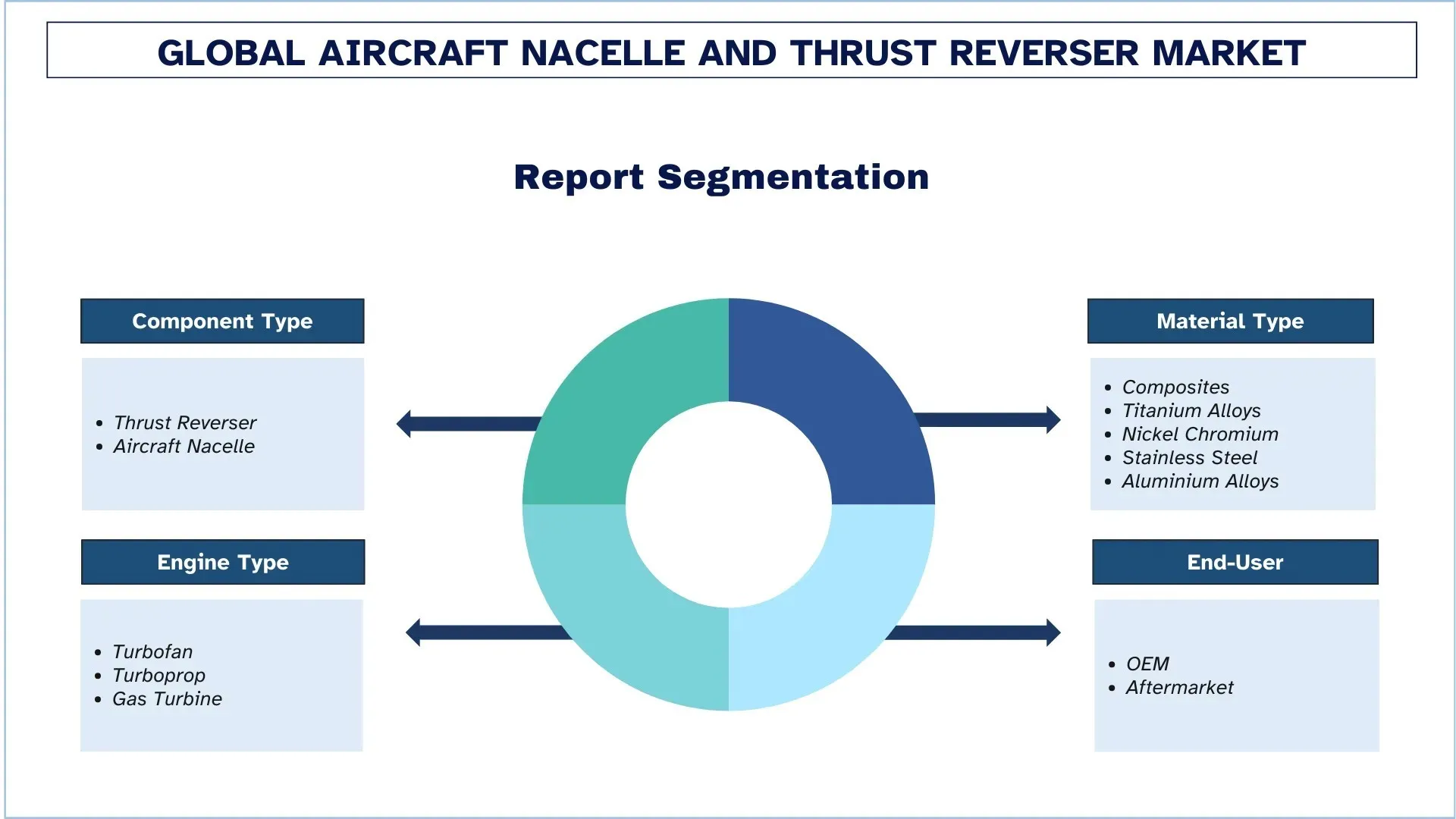
Emphasis on Component Type (Thrust Reverser and Aircraft Nacelle); Material Type (Composites, Titanium Alloys, Nickel Chromium, Stainless Steel, Aluminum Alloys); Engine Type (Turbofan, Turboprop, and Gas Turbine); End-User (OEM and Aftermarket); and Region/Country
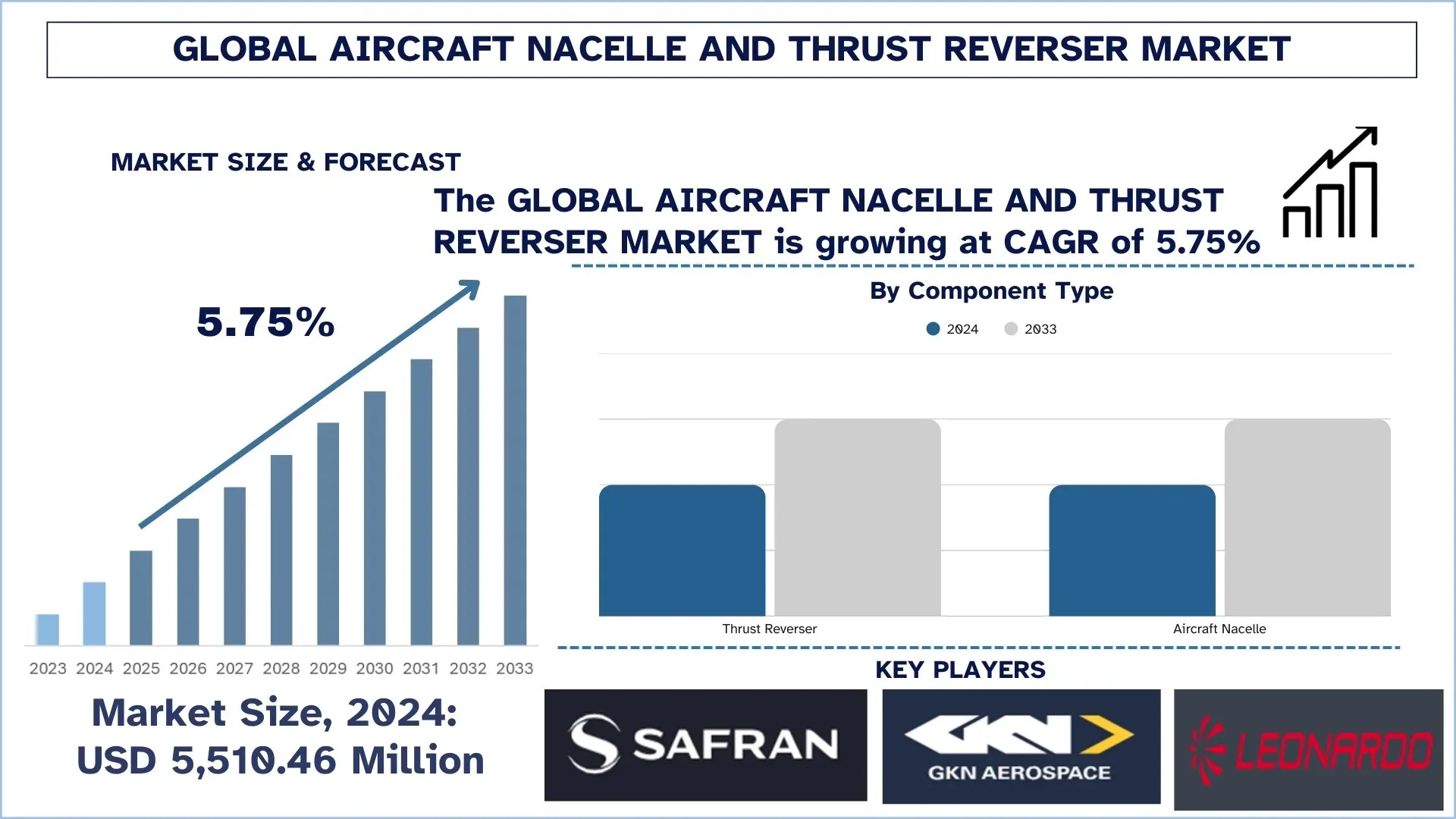
Global Aircraft Nacelle and Thrust Reverser Market Size & Forecast
The Global Aircraft Nacelle and Thrust Reverser Market was valued at USD 5,510.46 million in 2024 and is expected to grow at a CAGR of around 5.75% during the forecast period (2025–2033F), driven by the increasing demand for fuel-efficient, environmentally sustainable aircraft, along with advancements in lightweight materials and noise reduction technologies.
Aircraft Nacelle and Thrust Reverser Market Analysis
The Aircraft Nacelle and Thrust Reverser market is growing steadily globally, owing to the increased demand for fuel-saving and environmentally friendly aircraft. The growing attention to emissions reduction and aircraft performance is driving research into sophisticated nacelle and thrust reverser systems. These are the vital elements that have been in place to accommodate engines and provide safe deceleration during landing, and they are becoming more advanced through the incorporation of lightweight materials, improved aerodynamics, and noise-reduction technologies. Also, the increase in demand for air travel and the development of global fleets are accelerating market growth. The transition of the industry to electric and hybrid propulsion systems can also be discussed as an opportunity, with new designs of nacelles and thrust reversers that need to be updated to accommodate new technologies. Besides, the incorporation of AI and predictive maintenance systems is improving the reliability and efficiency of these systems to make their operations smooth and safer. The future of the market is determined by technological development and the growing demand for sustainability in aviation.
Global Aircraft Nacelle and Thrust Reverser Market Trends
This section discusses the key market trends that are influencing the various segments of the global aircraft nacelle and thrust reverser market, as found by our team of research experts.
Integration of Smart Technologies
The use of smart technologies is a major trend in the global Aircraft Nacelle and Thrust Reverser market. These technologies, such as digital monitoring systems, sensors, and predictive maintenance tools, are helping to improve the performance, efficiency, and reliability of nacelle and thrust reverser components. By using real-time data collection and analytics, these smart systems enable continuous monitoring of critical parameters, such as temperature, pressure, and vibrations, during aircraft operations. This allows early detection of possible problems or performance degradation, enabling proactive maintenance and minimizing unplanned downtime. Predictive analytics: AI and machine learning can be used to predict component failures or maintenance needs, reducing operational disruptions and enhancing safety. This trend is having an impact on airlines and aircraft operators, allowing them to optimize fleet management decisions, thereby increasing component lifecycles and reducing the cost of maintenance. Overall, smart technologies are making nacelle and thrust reverser systems more efficient, reliable, and cost-effective components in modern aircraft.
Aircraft Nacelle and Thrust Reverser Industry Segmentation
This section provides an analysis of the key trends in each segment of the global aircraft nacelle and thrust reverser market report, along with forecasts at the global, regional, and country levels for 2025-2033.
The Aircraft Nacelle Market Dominates the Aircraft Nacelle and Thrust Reverser Market
Based on component type, the global Aircraft Nacelle and Thrust Reverser market is segmented into Thrust Reversers and Aircraft Nacelles. In 2024, the Aircraft Nacelles segment is anticipated to hold the largest market share and maintain its dominance throughout the forecast period. This is mainly because of the growing demand for lightweight and fuel-efficient nacelles, which are part of accommodating and safeguarding aircraft engines with minimum drag and overall aircraft behavior. The use of nacelles enhances aerodynamics, noise reduction, and strict environmental standards, and thus, it is a major concern in aircraft design. The Thrust Reversers segment is, however, the one that is expected to expand at the quickest rate because of the increasing demand for efficient and reliable deceleration systems. This component, with the development of the thrust reverser technology, including the noise suppression and better safety measures, is being incorporated into the new aircraft models and retrofit programs, which is driving its fast market growth.
The Composites Material Type Segment held the Largest Market Share in the Aircraft Nacelle and Thrust Reverser Market.
Based on material type, the global Aircraft Nacelle and Thrust Reverser market is segmented into Composites, Titanium Alloys, Nickel Chromium, Stainless Steel, and Aluminum Alloys. In 2024, the Composites segment is expected to hold the largest market share and continue to dominate throughout the forecast period. This is mostly because there has been increasing demand for lightweight materials that are of high strength and durability, which is important in cutting airplane weight and enhancing fuel economy. Composites and especially carbon fiber reinforced polymers (CFRP) are becoming popular due to their high strength-to-weight ratio, resistance to corrosion, and endurance in harsh conditions. They are an excellent choice in the nacelle and thrust reverser applications. The Aluminum Alloys segment is expected to continue increasing as well because they are cost-effective, easy to produce, and are capable of offering sufficient strength to some aircraft models. The Titanium Alloys and Nickel Chromium are segments that are bound to experience tremendous growth, due to their superior heat resistance, superior performance, and capability to withstand the specific high-performance conditions encountered in high-speed and high-altitude environments. The Stainless Steel segment, though the share is less, would remain stable in terms of demand because of its strength, resistance to corrosion, and cost-effectiveness in some of the aerospace applications.
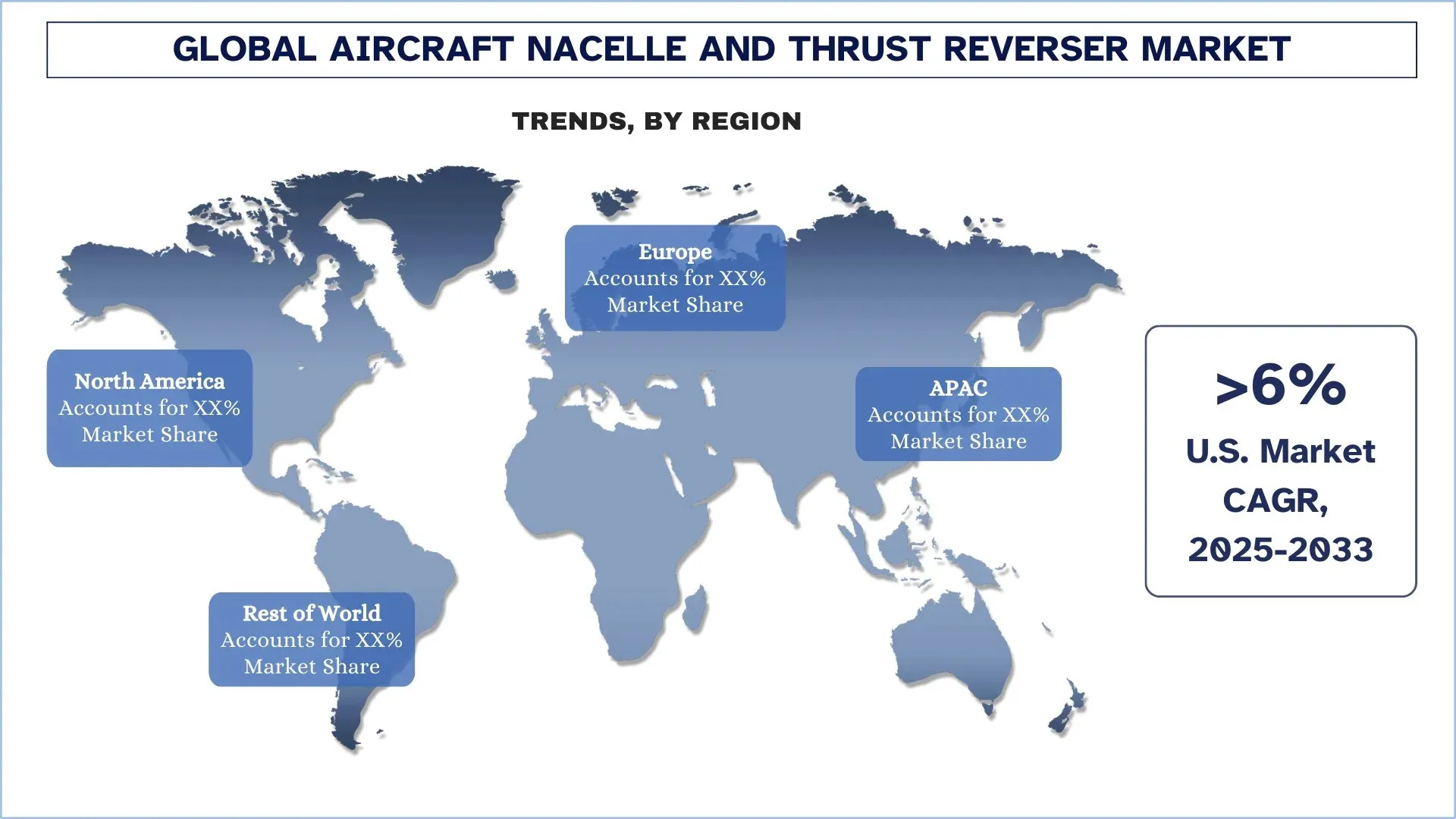
North America Dominated the Global Aircraft Nacelle and Thrust Reverser Market
North America is expected to hold the largest market share and continue its dominance throughout the forecast period. This is mainly because major aircraft manufacturers exist and because there are many commercial and military aircraft operators within the region. The strong emphasis on technological developments, fuel efficiency, and sustainability, as well as the well-developed aftermarket industry, are other factors contributing to North America's leading position in the market. Also, the well-developed investment into the aerospace R&D and the existence of major players in the OEM and aftermarket segment, as well as an increasing need for upgrades and retrofitting of the fleets, further establish the market dominance of North America.
U.S. held a dominant Share of the North America Aircraft Nacelle and Thrust Reverser Market in 2024
The aircraft nacelle and thrust reversers industry in the U.S. is supported by a robust aerospace industrial base that incorporates high-performance material, digital engineering, and real-time fleet information, facilitating the optimization of aircraft design, manufacture, and lifecycle maintenance of OEMs and airline operators around the globe. This is supported by close coordination through engine manufacturers, airframers, Tier-1 suppliers, and MRO providers, where knowledge on in-service performance, digital twins, and predictive maintenance feed into next-generation nacelle aerodynamics, acoustics, and reverser reliability, and a self-reinforcing circle of innovation and export development. The U.S. is the indispensable technology, content, and solution nexus to the nacelle and thrust reverser ecosystem due to institutional support of defense and civil programs, certification leadership, and global alliances.
Aircraft Nacelle and Thrust Reverser Industry Competitive Landscape
The global aircraft nacelle and thrust reverser market is competitive, with several global and international market players. The key players are adopting different growth strategies to enhance their market presence, such as partnerships, agreements, collaborations, new product launches, geographical expansions, and mergers and acquisitions.
Top Aircraft Nacelle and Thrust Reverser Companies
Some of the major players in the market are Safran S.A., GKN Aerospace, Leonardo S.p.A., The NORDAM Group LLC, Spirit AeroSystems, Inc., Aernnova, Collins Aerospace, ST Engineering, The Boeing Company, and Daher.
Recent Developments in the Aircraft Nacelle and Thrust Reverser Market
In March 2025, AAR CORP. signed a multi-year service contract with Cebu Pacific Air to repair, maintain, and overhaul the engines of the A320 fleet of the company, which has CFM56-5B engines.
In November 2024, GKN Aerospace supplied the first two C-27J nacelles to Leonardo Aircraft, showing that the company had regained its supply chain and production capacity.
In April 2023, Spirit AeroSystems entered into a unique collaboration deal with ST Engineering Commercial Aerospace division to offer plane engine nacelle MRO services in Middle East nations, such as Qatar, UAE, Jordan, Saudi Arabia, Kuwait, and Oman.
Global Aircraft Nacelle and Thrust Reverser Market Report Coverage
Report Attribute | Details |
Base year | 2024 |
Forecast period | 2025-2033 |
Growth momentum | Accelerate at a CAGR of 5.75% |
Market size 2024 | USD 5,510.46 Million |
Regional analysis | North America, Europe, APAC, Rest of the World |
Major contributing region | North America is expected to dominate the market during the forecast period. |
Key countries covered | U.S., Canada, Germany, U.K., Spain, Italy, France, China, Japan, and India |
Companies profiled | Safran S.A., GKN Aerospace, Leonardo S.p.A., The NORDAM Group LLC, Spirit AeroSystems, Inc., Aernnova, Collins Aerospace, ST Engineering, The Boeing Company, and Daher |
Report Scope | Market Trends, Drivers, and Restraints; Revenue Estimation and Forecast; Segmentation Analysis; Demand and Supply Side Analysis; Competitive Landscape; Company Profiling |
Segments Covered | By Component Type; By Material Type, By Engine Type, By End-User, and By Region/Country |
Reasons to Buy the Aircraft Nacelle and Thrust Reverser Market Report:
The study includes market sizing and forecasting analysis confirmed by authenticated key industry experts.
The report briefly reviews overall industry performance at a glance.
The report covers an in-depth analysis of prominent industry peers, primarily focusing on key business financials, type portfolios, expansion strategies, and recent developments.
Detailed examination of drivers, restraints, key trends, and opportunities prevailing in the industry.
The study comprehensively covers the market across different segments.
Deep dive regional-level analysis of the industry.
Customization Options:
The Global Aircraft Nacelle and Thrust Reverser Market can further be customized as per the requirements or any other market segment. Besides this, UnivDatos understands that you may have your own business needs; hence, feel free to contact us to get a report that completely suits your requirements.
Table of Content
Research Methodology for the Global Aircraft Nacelle and Thrust Reverser Market Analysis (2023-2033)
We analyzed the historical market, estimated the current market, and forecasted the future market of the global aircraft nacelle and thrust reverser market to assess its application in major regions worldwide. We conducted exhaustive secondary research to gather historical market data and estimate the current market size. To validate these insights, we carefully reviewed numerous findings and assumptions. Additionally, we conducted in-depth primary interviews with industry experts across the aircraft nacelle and thrust reverser value chain. After validating market figures through these interviews, we used both top-down and bottom-up approaches to forecast the overall market size. We then employed market breakdown and data triangulation methods to estimate and analyze the market size of industry segments and sub-segments.
Market Engineering
We employed the data triangulation technique to finalize the overall market estimation and derive precise statistical numbers for each segment and sub-segment of the global aircraft nacelle and thrust reverser market. We split the data into several segments and sub-segments by analyzing various parameters and trends, including component type, material type, engine type, end-user, and regions within the global aircraft nacelle and thrust reverser market.
The Main Objective of the Global Aircraft Nacelle and Thrust Reverser Market Study
The study identifies current and future trends in the global aircraft nacelle and thrust reverser market, providing strategic insights for investors. It highlights regional market attractiveness, enabling industry participants to tap into untapped markets and gain a first-mover advantage. Other quantitative goals of the studies include:
Market Size Analysis: Assess the current market size and forecast the market size of the global aircraft nacelle and thrust reverser market and its segments in terms of value (USD).
Aircraft Nacelle and Thrust Reverser Market Segmentation: Segments in the study include areas of component type, material type, engine type, end-user, and regions.
Regulatory Framework & Value Chain Analysis: Examine the regulatory framework, value chain, customer behavior, and competitive landscape of the aircraft nacelle and thrust reverser industry.
Regional Analysis: Conduct a detailed regional analysis for key areas such as Asia Pacific, Europe, North America, and the Rest of the World.
Company Profiles & Growth Strategies: Company profiles of the aircraft nacelle and thrust reverser market and the growth strategies adopted by the market players to sustain the fast-growing market.
Frequently Asked Questions FAQs
Q1: What is the global aircraft nacelle and thrust reverser current market size and its growth potential?
The global aircraft nacelle and thrust reverser market was valued at USD 5,510.46 million in 2024 and is expected to grow at a CAGR of 5.75% during the forecast period (2025-2033).
Q2: Which segment has the largest share of the global aircraft nacelle and thrust reverser market by component type?
The Aircraft Nacelles segment is anticipated to hold the largest market share due to the growing demand for lightweight, fuel-efficient nacelles, which help accommodate and safeguard aircraft engines while minimizing drag and improving overall aircraft performance.
Q3: What are the driving factors for the growth of the global aircraft nacelle and thrust reverser market?
• Demand for Fuel Efficiency and Environmental Sustainability
• Growth in Global Air Travel
• Technological Advancements in Materials and Design
Q4: What are the emerging technologies and trends in the global aircraft nacelle and thrust reverser market?
• Integration of Smart Technologies
• Focus on Noise Reduction
Q5: What are the key challenges in the global aircraft nacelle and thrust reverser market?
• High Development and Maintenance Costs
• Stringent Regulatory Standards
Q6: Which region dominates the global aircraft nacelle and thrust reverser market?
North America is expected to hold the largest market share because major aircraft manufacturers are based in the region, and there are many commercial and military aircraft operators.
Q7: Who are the key players in the global aircraft nacelle and thrust reverser market?
Some of the key companies include:
• Safran S.A.
• GKN Aerospace
• Leonardo S.p.A.
• The NORDAM Group LLC
• Spirit AeroSystems, Inc.
• Aernnova
• Collins Aerospace
• ST Engineering
• The Boeing Company
• Daher
Q8: How do certification and regulatory standards influence adoption in the global Aircraft Nacelle and Thrust Reverser market?
• Airworthiness Requirements: Stringent FAA, EASA, and other aviation authority regulations drive adoption of nacelle and thrust reverser systems with proven safety records, traceable materials, and extensive qualification testing.
• Harmonized Standards: Alignment of certification norms across regions encourages OEMs and operators to favor platforms with globally recognized nacelle and reverser approvals, simplifying cross-border fleet deployment.
• Environmental & Noise Compliance: Emission and noise regulations accelerate adoption of low-drag, acoustically optimized nacelles and efficient thrust reverser designs that help airlines meet evolving sustainability and community noise constraints.
Q9: How do OEM–supplier relationships and risk-sharing models shape customer adoption of Aircraft Nacelle and Thrust Reverser solutions?
• Risk-Sharing Partnerships: Long-term, risk-sharing agreements between engine OEMs, airframers, and nacelle suppliers support co-investment in advanced designs and de-risk adoption for airlines.
• Line-Fit Selection: Being selected as line-fit equipment on major aircraft programs increases trust and uptake, as operators prefer nacelle and reverser systems already integrated, certified, and supported by the OEM.
• Commonality & Fleet Standardization: Collaboration on common nacelle architectures across engine variants enables airlines to standardize fleets, simplifying training, maintenance, and spare parts management.
Related Reports
Customers who bought this item also bought



Aeroderivative Sensor Market: Current Analysis and Forecast (2025-2033)
Emphasis on Sensor Type (Temperature Sensors, Pressure Sensors, Vibration Sensors, Flame Sensors, and Others); Service Provider (OEMs and Aftermarket); End-User (Industrial, Marine, Aerospace & Defense, Power & Energy, and Oil & Gas); and Region/Country
Kamikaze Drone Market: Current Analysis and Forecast (2026-2034)
Emphasis on Type (Fixed-wing System and Rotary-wing System); Range (Short range(10-20km), Medium range(20-100km), and Long range(>100km)); Platform (Ground based, Airborne, and Naval); Autonomy (Man in the loop and Fully Autonomous); and Region/Country
Counter-Unmanned Aerial System Market: Current Analysis and Forecast (2025-2033)
Emphasis on Platform (Ground-Based Systems, Airborne Systems, and Naval / Maritime Systems); Technology (Radar, RF, EO/IR, Laser, Kinetic, and Others); End-Use (Defense & Military, Homeland Security & Law Enforcement, Critical Infrastructure, and Commercial & Industrial); and Region/Country

Middle East & Africa Turboprop Aircraft Market: Current Analysis and Forecast (2025-2033)
Emphasis By Aircraft Type (Light Turboprop Aircraft, Medium Turboprop Aircraft, and Heavy Turboprop Aircraft), by End-User (Government & Defense, Commercial Operators, and Private Operators), By Country (Saudi Arabia, UAE, Egypt, South Africa, Turkey, Israel, and the Rest of Middle East & Africa)