Space DC-DC Converter Market: Current Analysis and Forecast (2025-2033)
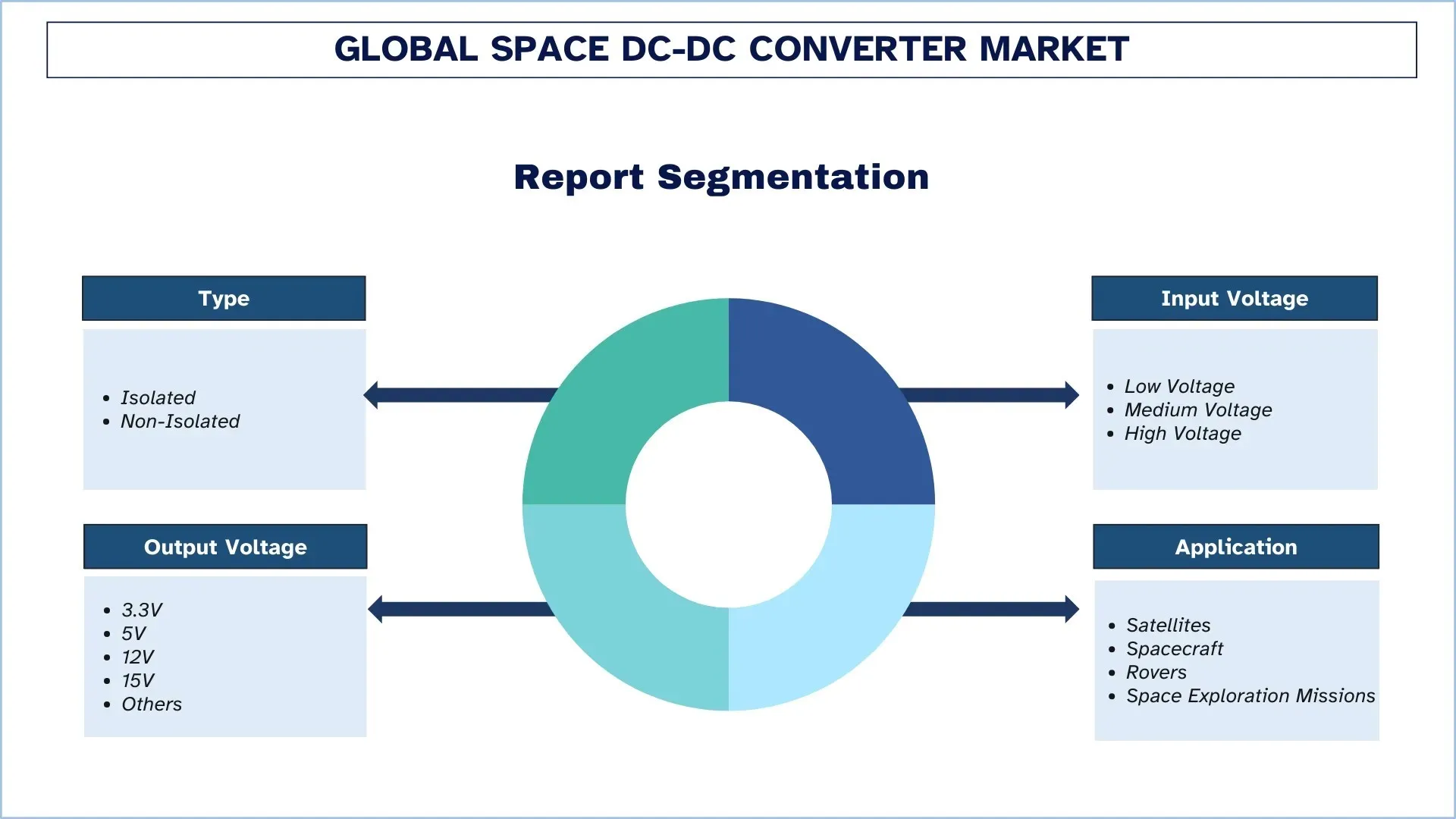
Emphasis on Type (Isolated and Non-Isolated); Input Voltage (Low Voltage, Medium Voltage, and High Voltage); Output Voltage (3.3V, 5V, 12V, 15V, and Others); Application (Satellites, Spacecraft, Rovers, Space Exploration Missions); End-User (Government Space Agencies, Commercial Space Companies, Research Organizations); and Region/Country
Global Space DC-DC Converter Market Size & Forecast
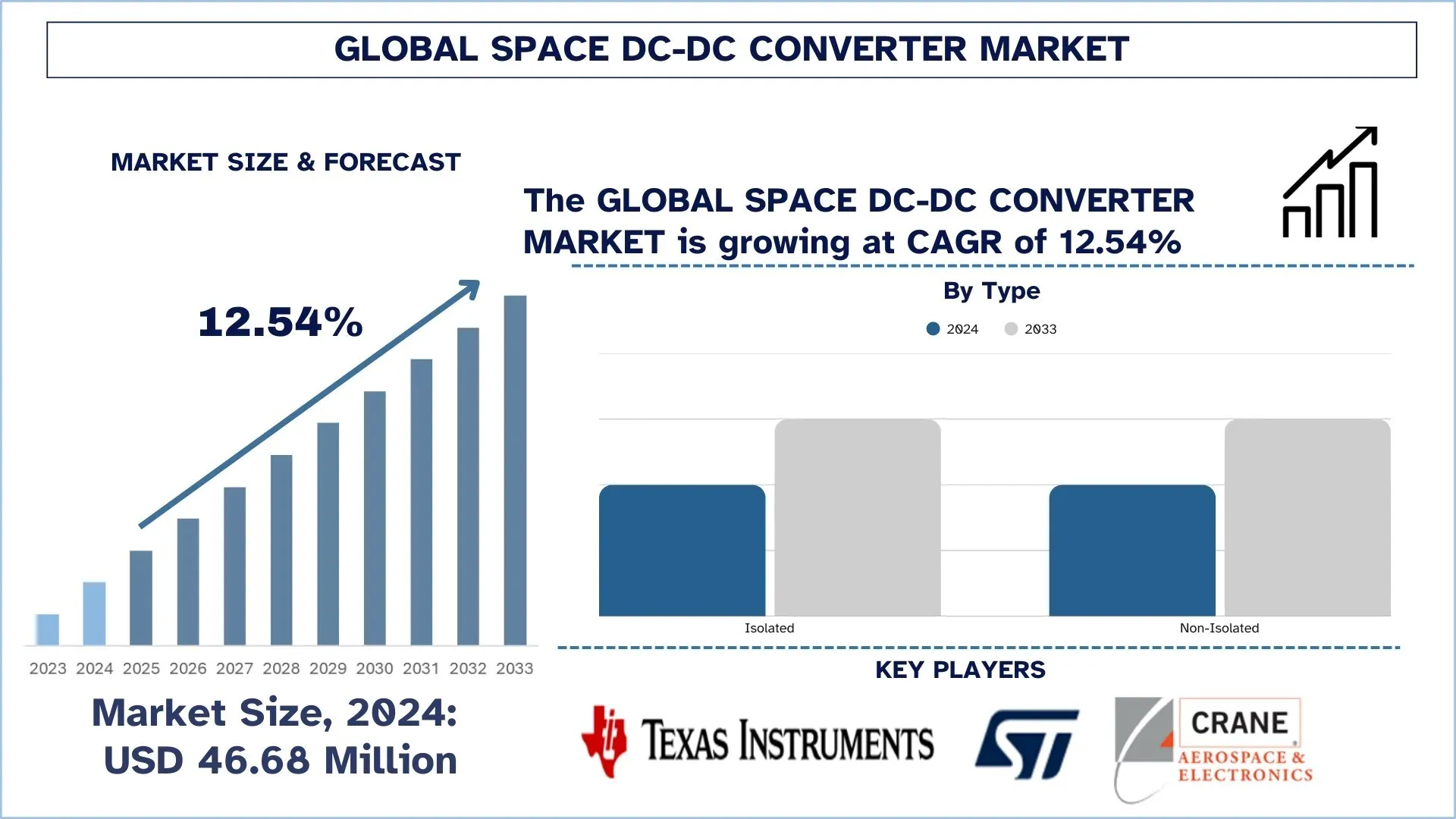
The Global Space DC-DC Converter Market was valued at USD 46.68 million in 2024 and is expected to grow at a CAGR of around 12.54% during the forecast period (2025–2033F), driven by the expansion of satellite construction, the growth of mega-constellations, and increasing government and commercial interest in deep-space exploration.
Space DC-DC Converter Market Analysis
Space systems are becoming more sophisticated, and current missions demand precise, reliable power conversion across a wide range of orbits and payloads. High launch rates, growing satellite constellations, and increasing government and commercial space programs are major growth drivers in the space DC-DC converter market, as spacecraft electronics are becoming more digital, high-power, and densely integrated. Space-grade DC-DC converters, being the critical path between solar arrays, batteries, and delicate avionics, are considered by satellite makers and agencies as the focus of on-orbit reliability, payload performance, and mission life. This is also supported by the fact that the bulky, low-efficiency legacy designs are being replaced by smaller-radius, radiation-tolerant, high-efficiency converters, which enhance SWaP, simplify thermal management, and free up power budget to add more payload. Expanding the market also implies the strategic adoption of wide-bandgap semiconductors, digital control, and advanced packaging to support radially harsh environments, transient, and thermal fluctuations, and provide real-time telemetry and health monitoring. Meanwhile, NewSpace, smallsats, and deep-space exploration are compelling power architectures to become smarter, more modular, and future-ready.
Global Space DC-DC Converter Market Trends
This section discusses the key market trends that are influencing the various segments of the global space DC-DC converter market, as found by our team of research experts.
Adoption of Wide Bandgap Semiconductors (SiC & GaN)
One of the major trends in the space DC-DC converter market is the transition to wide bandgap semiconductors such as SiC and GaN. This is because these semiconductors have high breakdown voltage, high switching rates, and better thermal characteristics than conventional silicon devices. This enables space power converters to achieve greater efficiency, power content, and switching rate, which is particularly important in satellites and probes where size, weight, and cooling capacity are severely limited. SiC MOSFETs in high-voltage stages (like solar array regulators and electric propulsion power processing units) and GaN FETs in high-frequency lower-voltage DC-DC stages feeding digital and RF payload electronics are becoming common. SiC and GaN both can be radiation tolerant, and a number of space-grade product lines and reference designs by large power and semiconductor vendors are now LEO, GEO, and deep-space qualified or undergoing qualification, which further confirms this shift in next-generation space power architectures.
Space DC-DC Converter Industry Segmentation
This section provides an analysis of the key trends in each segment of the global space DC-DC converter market report, along with forecasts at the global, regional, and country levels for 2025-2033.
The Non-Isolated Segment Dominates the Space DC-DC Converter Market
Based on type, the global space DC-DC converter market is segmented into Isolated and Non-Isolated converters. In 2024, the Non-Isolated segment is anticipated to hold the largest market share and maintain its lead over the forecast period. Since these converters are high-efficiency, small, and cost-effective point-of-load regulators suitable for satellite payloads, smallsats, and constellation platforms, they are common where isolation is not required and help maximize SWaP and power density. Such devices are finding application in digital control architectures, FPGA and ASIC-based subsystems, and in high-throughput payloads of high-rate communications, where precise voltage control and rapid transient response, as well as simplified layout, are of design concern. The Isolated segment, however, will see the highest growth rate due to the reason that it is critical in the electric power subsystems and power distribution units, where galvanic isolation, fault containment, and radiation tolerance are necessary in the mission reliability and safeguarding of delicate avionics.
The Low Voltage Segment held the Largest Market Share in the Space DC-DC Converter Market.
Based on input voltage, the global space DC-DC converter market is segmented into low-voltage, medium-voltage, and high-voltage converters. In 2024, the Low Voltage segment is anticipated to hold the largest market share and continue its dominance over the forecast period. This is mainly because a high proportion of satellite avionics, digital electronics, processors, FPGAs, and communications subsystems use low-voltage buses, which require accurate, efficient point-of-load regulation. These converters provide precise voltage regulation, high power, and very high transient response, which are useful in the areas of miniaturized electronics and constellation platforms. The Medium Voltage and High Voltage markets, in their turn, will experience vigorous growth due to their application in primary power conditioning on larger solar arrays and power distribution networks when efficient step-down capabilities, isolation features, and extensive reliability can be essential in long-term and high-power missions.
North America Dominated the Global Space DC-DC Converter Market
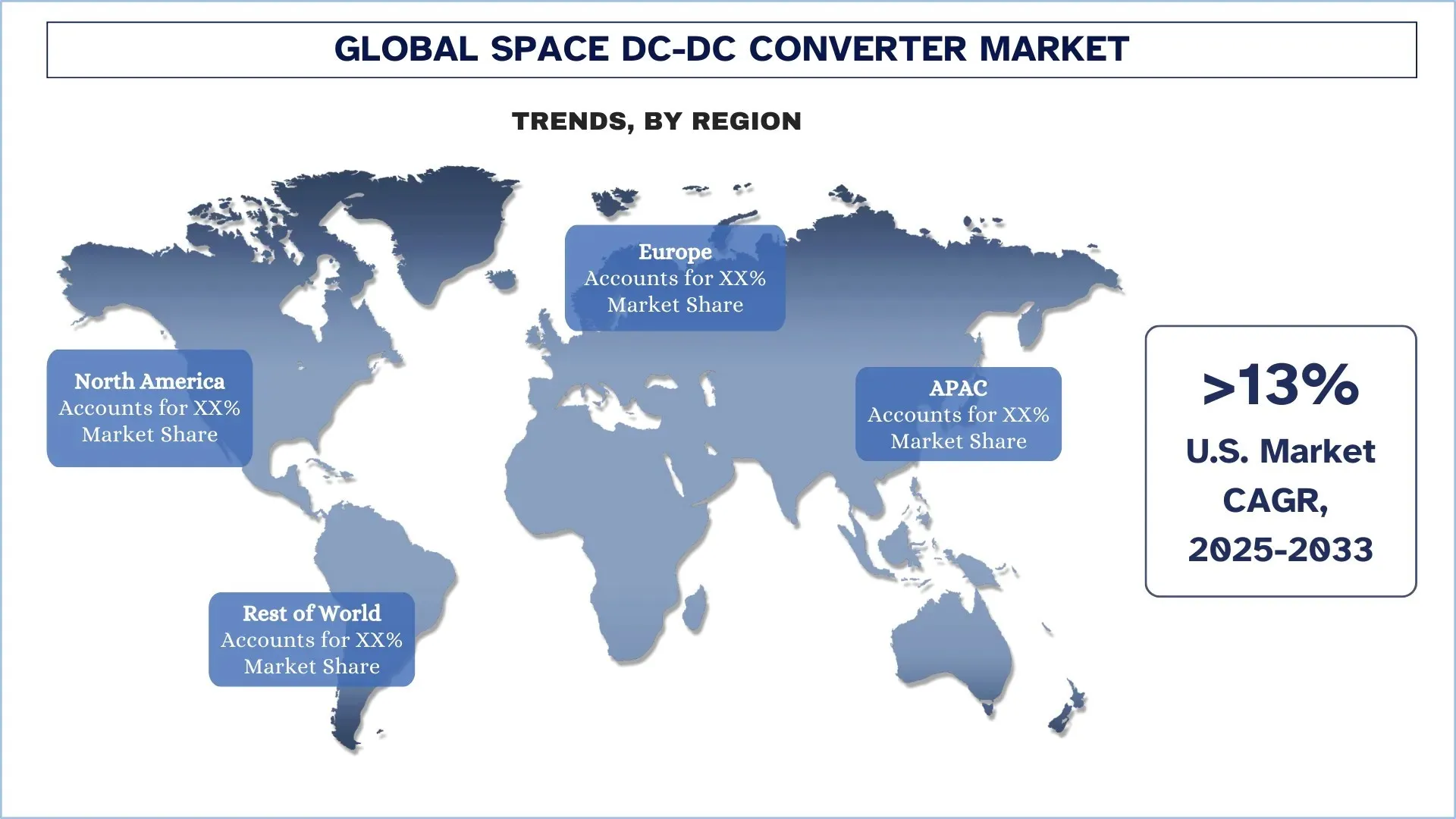
North America has led the global DC-DC converter market. Their development is facilitated by robust space and defense manufacturing infrastructure, especially in the United States and Canada. This area is the home of most of the key satellite manufacturers, launch services, and space electronics suppliers in the world, which have increased demand for space-qualified power conversion solutions. With the increasing government missions and commercial constellations, there is a demand to go beyond radiofrequency-tolerant, low-efficiency DC-DC converters and have radiation-tolerant, high-efficiency DC-DC converters able to support digital payloads, electric propulsion, and more sophisticated power structures. The rapid development of smallsats and deep space exploration also increases the pace at which compact, lightweight, highly reliable converters that can last years in hostile radiation and thermal conditions are adopted. Meanwhile, local developments in innovation, increased power density, and the use of wide-bandgap semiconductors are redefining converter design to make converters more efficient, reduce mass, and increase available power to payloads. With an increasing number of agencies and commercial operators focusing on more capable satellites and ambitious science missions, North America remains at the forefront of adopting more advanced DC-DC converter technologies, so it remains one of the most powerful and technologically advanced markets of space power electronics in the world.
U.S. held a dominant Share of the North America Space DC-DC Converter Market in 2024
The DC-DC converter market in the U.S. is propelled by a high launch rate, robust government spending, and leadership in commercial New Space programs. NASA, Department of Defense, and prime contractors, including Lockheed Martin, Northrop Grumman, and Boeing, generate a consistent demand for radiation-hardened and high-reliability power solutions in both LEO, GEO, and deep space missions. Simultaneously, SpaceX, Project Kuiper of Amazon, and a rich small-satellite ecosystem drive the demand for small, highly efficient converters that can accommodate mass production. The trends in the use of wide bandgap devices, digital-controlled and smart health monitoring, are front-runners in the U.S. semiconductor and power module vendors, making the country a leading innovator and exporter of space-grade DC-DC technology.
Space DC-DC Converter Industry Competitive Landscape
The global space DC-DC converter market is competitive, with several global and international market players. The key players are adopting different growth strategies to enhance their market presence, such as partnerships, agreements, collaborations, new product launches, geographical expansions, and mergers and acquisitions.
Top Space DC-DC Converter Companies
Some of the major players in the market are Texas Instruments Incorporated, STMicroelectronics, Crane Aerospace & Electronics, Infineon Technologies AG, Vicor Corporation, Advanced Energy, EPC Space LLC, Modular Devices, Inc., Renesas Electronics Corporation, and Microchip Technology Inc.
Recent Developments in the Space DC-DC Converter Market
In May 2024, Microchip Technology introduced its LEO-optimized Radiation Tolerant RT Isolated DC to DC Power Converters LE50-28 series with a power output of 50W. Power Converters are applied in Cube Satellites and IoT systems in the 5G Communication field. It has nine models with single- and triple-output voltages ranging from 3.3 to 28 V. This line of products is used to power small satellites.
In February 2024, VPT, Inc., a company within HEICO, announced the VSC100-2800S DC-DC converter for space commercial off-the-shelf (COTS) applications. This is an element of the VSC Series, which is designed for public satellites and NASA Class D missions. This line of products complements the company's radiation-hardened hybrid SV/SVL Series and offers a compromise between cost and performance for radiation-tolerant satellite systems.
Global Space DC-DC Converter Market Report Coverage
Report Attribute | Details |
Base year | 2024 |
Forecast period | 2025-2033 |
Growth momentum | Accelerate at a CAGR of 12.54% |
Market size 2024 | USD 46.68 Million |
Regional analysis | North America, Europe, APAC, Rest of the World |
Major contributing region | North America is expected to dominate the market during the forecast period. |
Key countries covered | U.S., Canada, Germany, U.K., Spain, Italy, France, China, Japan, and India |
Companies profiled | Texas Instruments Incorporated, STMicroelectronics, Crane Aerospace & Electronics, Infineon Technologies AG, Vicor Corporation, Advanced Energy, EPC Space LLC, Modular Devices, Inc., Renesas Electronics Corporation, and Microchip Technology Inc. |
Report Scope | Market Trends, Drivers, and Restraints; Revenue Estimation and Forecast; Segmentation Analysis; Demand and Supply Side Analysis; Competitive Landscape; Company Profiling |
Segments Covered | By Type, By Input Voltage, By Output Voltage, By Application, By End-User, and By Region/Country |
Reasons to Buy the Space DC-DC Converter Market Report:
The study includes market sizing and forecasting analysis confirmed by authenticated key industry experts.
The report briefly reviews overall industry performance at a glance.
The report covers an in-depth analysis of prominent industry peers, primarily focusing on key business financials, type portfolios, expansion strategies, and recent developments.
Detailed examination of drivers, restraints, key trends, and opportunities prevailing in the industry.
The study comprehensively covers the market across different segments.
Deep dive regional-level analysis of the industry.
Customization Options:
The global space DC-DC converter market can further be customized as per the requirements or any other market segment. Besides this, UnivDatos understands that you may have your own business needs; hence, feel free to contact us to get a report that completely suits your requirements.
Table of Content
Research Methodology for the Global Space DC-DC Converter Market Analysis (2023-2033)
We analyzed the historical market, estimated the current market, and forecasted the future market of the global space DC-DC converter market to assess its application in major regions worldwide. We conducted exhaustive secondary research to gather historical market data and estimate the current market size. To validate these insights, we carefully reviewed numerous findings and assumptions. Additionally, we conducted in-depth primary interviews with industry experts across the space DC-DC converter value chain. After validating market figures through these interviews, we used both top-down and bottom-up approaches to forecast the overall market size. We then employed market breakdown and data triangulation methods to estimate and analyze the market size of industry segments and sub-segments.
Market Engineering
We employed the data triangulation technique to finalize the overall market estimation and derive precise statistical numbers for each segment and sub-segment of the global space DC-DC converter market. We split the data into several segments and sub-segments by analyzing various parameters and trends, including type, input voltage, output voltage, application, end-user, and regions within the global space DC-DC converter market.
The Main Objective of the Global Space DC-DC Converter Market Study
The study identifies current and future trends in the global space DC-DC converter market, providing strategic insights for investors. It highlights regional market attractiveness, enabling industry participants to tap into untapped markets and gain a first-mover advantage. Other quantitative goals of the studies include:
Market Size Analysis: Assess the current market size and forecast the market size of the global space DC-DC converter market and its segments in terms of value (USD).
Space DC-DC Converter Market Segmentation: Segments in the study include areas of type, input voltage, output voltage, application, end-user, and regions.
Regulatory Framework & Value Chain Analysis: Examine the regulatory framework, value chain, customer behavior, and competitive landscape of the space DC-DC converter industry.
Regional Analysis: Conduct a detailed regional analysis for key areas such as Asia Pacific, Europe, North America, and the Rest of the World.
Company Profiles & Growth Strategies: Company profiles of the space DC-DC converter market and the growth strategies adopted by the market players to sustain the fast-growing market.
Frequently Asked Questions FAQs
Q1: What is the global space DC-DC converter current market size and its growth potential?
The global space DC-DC converter market was valued at USD 46.68 million in 2024 and is expected to grow at a CAGR of 12.54% during the forecast period (2025-2033).
Q2: Which segment has the largest share of the global space DC-DC converter market by Type?
The non-isolated segment will dominate, as compact, efficient, low-cost point-of-load regulators maximize SWaP and power density where isolation is unnecessary.
Q3: What are the driving factors for the growth of the global space DC-DC converter market?
Rising Satellite Launches & Small-Sat Proliferation
Growth in Deep-Space Exploration & Science Missions
Shift Towards Higher Voltage Power Bus Architectures
Q4: What are the emerging technologies and trends in the global space DC-DC converter market?
Adoption of Wide Bandgap Semiconductors (SiC & GaN)
Increased Use of AI and Digital Control
Q5: What are the key challenges in the global space DC-DC converter market?
Extreme Reliability and Radiation Hardness
High Development Cost and Long Qualification Cycles
Q6: Which region dominates the global space DC-DC converter market?
North America has dominated the space DC-DC converter market due to robust government and commercial space programs.
Q7: Who are the key players in the global space DC-DC converter market?
Some of the key companies include:
Texas Instruments Incorporated
STMicroelectronics
Crane Aerospace & Electronics
Infineon Technologies AG
Vicor Corporation
Advanced Energy
EPC Space LLC
Modular Devices, Inc.
Renesas Electronics Corporation
Microchip Technology Inc.
Q8: How do rising satellite mega-constellations influence demand for space DC-DC converters globally?
Higher Satellite Volumes: Mega-constellations require thousands of spacecraft, each needing multiple precise DC-DC power rails.
SWaP Optimization: Constellation platforms favor compact, lightweight, high-efficiency converters to maximize size, weight, and power (SWaP).
Standardization & Cost: Repeated designs across fleets drive demand for standardized, cost-effective, and easily scalable converter families
Q9: How do space qualification and reliability requirements impact global space DC-DC converter development?
Rigorous Testing: Standards for radiation, vibration, vacuum, and temperature extremes mandate extensive screening and qualification.
Long Mission Lifetimes: Converters must deliver high reliability over many years without maintenance or replacement in orbit.
Design Complexity & Cost: Meeting stringent reliability goals increases design complexity, documentation, and non-recurring engineering costs.
Related Reports
Customers who bought this item also bought


Aeroderivative Sensor Market: Current Analysis and Forecast (2025-2033)
Emphasis on Sensor Type (Temperature Sensors, Pressure Sensors, Vibration Sensors, Flame Sensors, and Others); Service Provider (OEMs and Aftermarket); End-User (Industrial, Marine, Aerospace & Defense, Power & Energy, and Oil & Gas); and Region/Country

Kamikaze Drone Market: Current Analysis and Forecast (2026-2034)
Emphasis on Type (Fixed-wing System and Rotary-wing System); Range (Short range(10-20km), Medium range(20-100km), and Long range(>100km)); Platform (Ground based, Airborne, and Naval); Autonomy (Man in the loop and Fully Autonomous); and Region/Country
Counter-Unmanned Aerial System Market: Current Analysis and Forecast (2025-2033)
Emphasis on Platform (Ground-Based Systems, Airborne Systems, and Naval / Maritime Systems); Technology (Radar, RF, EO/IR, Laser, Kinetic, and Others); End-Use (Defense & Military, Homeland Security & Law Enforcement, Critical Infrastructure, and Commercial & Industrial); and Region/Country

Middle East & Africa Turboprop Aircraft Market: Current Analysis and Forecast (2025-2033)
Emphasis By Aircraft Type (Light Turboprop Aircraft, Medium Turboprop Aircraft, and Heavy Turboprop Aircraft), by End-User (Government & Defense, Commercial Operators, and Private Operators), By Country (Saudi Arabia, UAE, Egypt, South Africa, Turkey, Israel, and the Rest of Middle East & Africa)