India Short-Haul Aircraft Market: Current Analysis and Forecast (2025-2033)
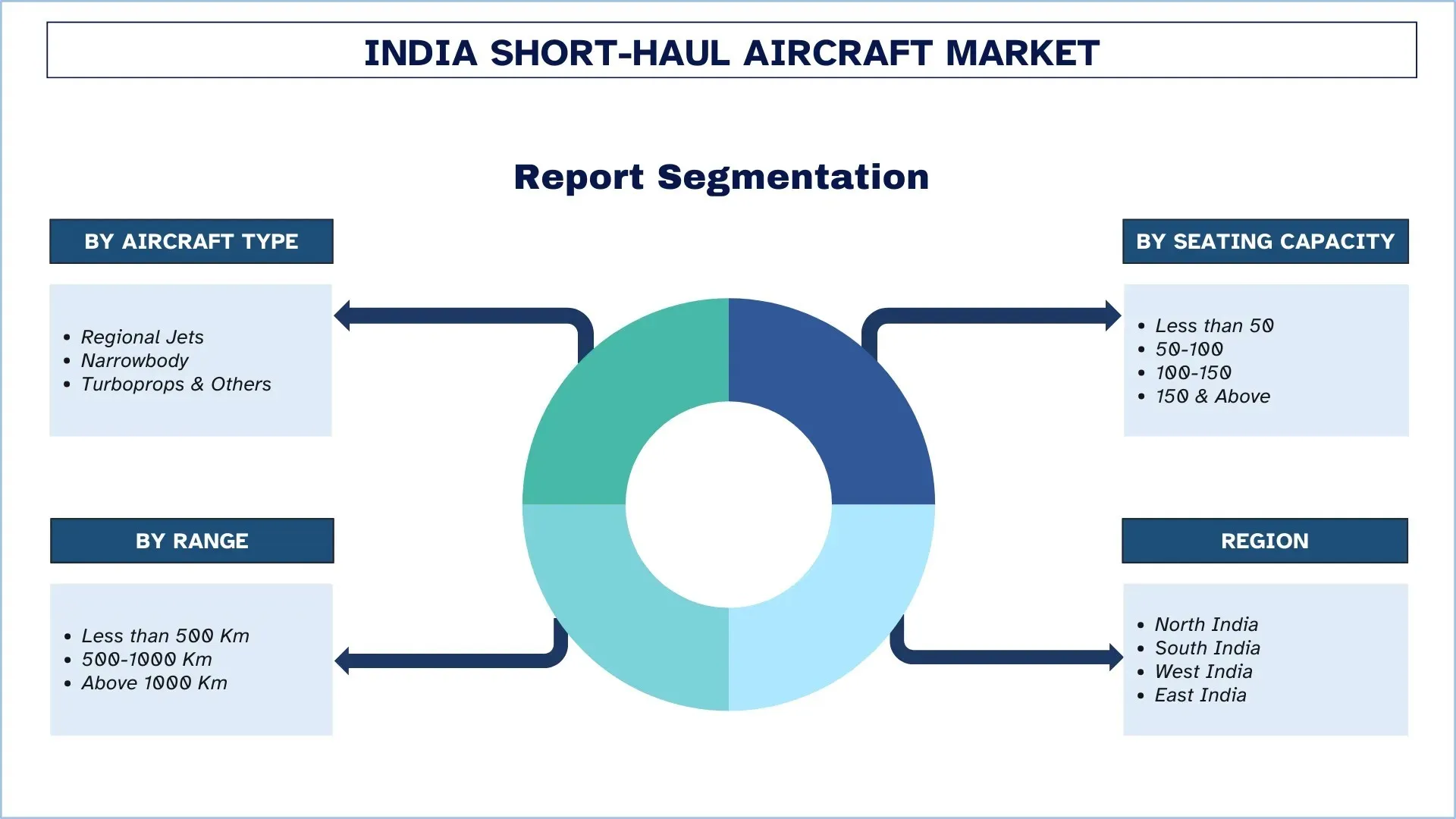
Emphasis on Aircraft Type (Regional Jets, Narrowbody, Turboprops & Others); by Seating Capacity (Less than 50, 50-100, 100-150, and 150 & above); by Range (Less than 500 km, 500-1000 km, and above 1000 km); and Region (North, East, West, South)
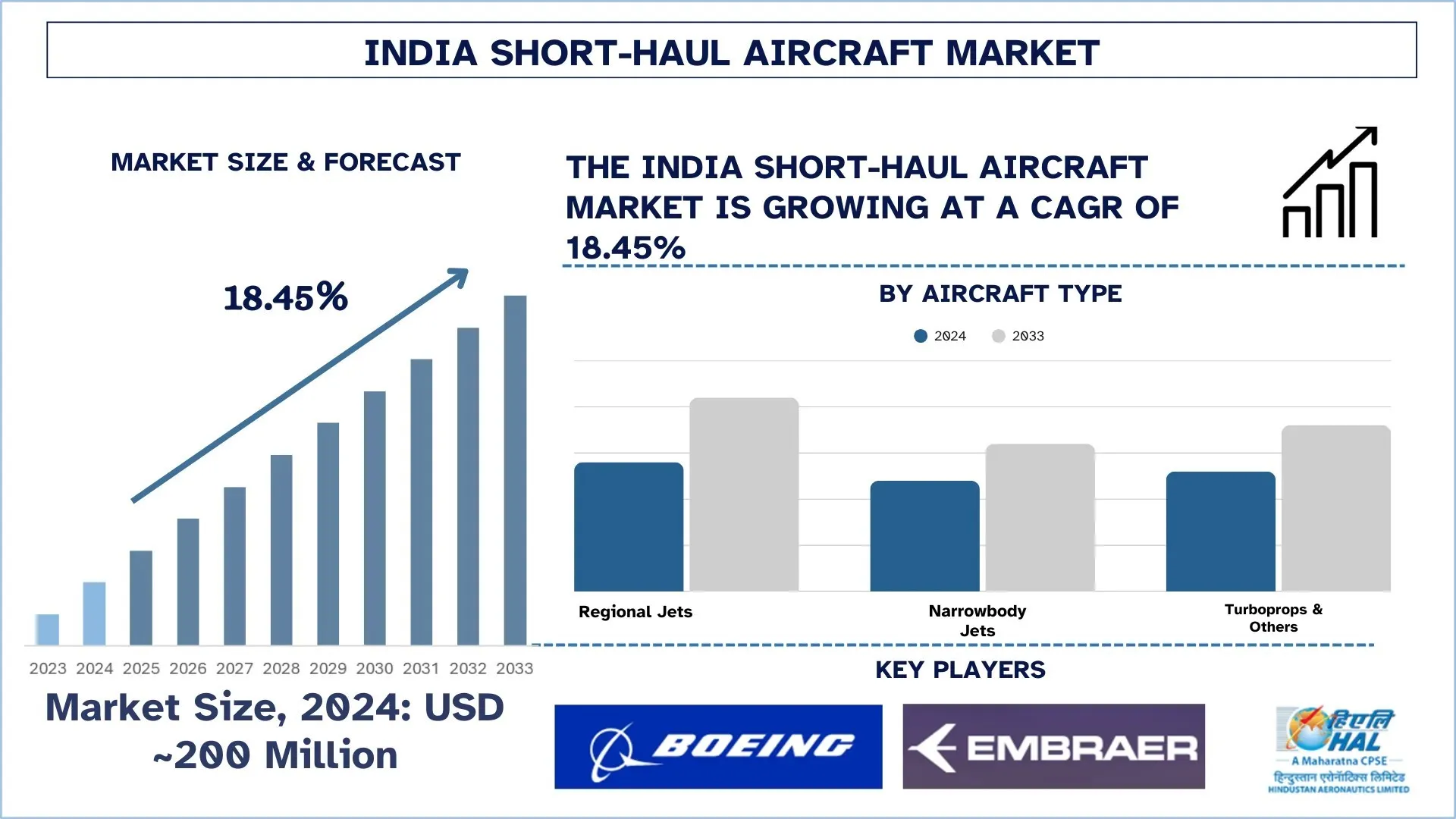
India Short-Haul Aircraft Market Size & Forecast
The India Short-Haul Aircraft market was valued at USD ~200 million in 2024 and is expected to grow to a strong CAGR of around 18.45% during the forecast period (2025-2033F), owing to sustained domestic passenger growth, government-led regional connectivity, and the addition of new routes.
Short-Haul Aircraft Market Analysis
The short-haul aircraft market in India includes aircraft that are mainly utilized on domestic and near international flights, usually less than -2-3 hours, between metros and tier-1/2/3 cities, and in high-frequency services. Single aisle narrowbodies dominate the portion of trunk routes, which are supplemented by regional aircraft (turboprops and smaller jets) where demand is weaker, or the airport infrastructure is limited. Several factors support market momentum, such as high growth in domestic travel, growing urbanization and disposable incomes, growing airline network depth, and ongoing airport development in states. Slot constraints at large airports also influence capacity, forcing carriers to move to more extensive utilization, shorter turnaround, and gauge optimization to achieve maximum use of the seats and stay schedule reliable.
India Short-Haul Aircraft Market Trends
This section discusses the key market trends that are influencing the various segments of the India Short-Haul Aircraft market, as found by our team of research experts.
Upgrading on high-density domestic corridors:
High-density domestic up-gauging is an emerging fleet and network trend in the short-haul market in India. On trunk routes like metro-to-metro and metro-to-large tier-1, the rate of demand growth is exceeding the capacity of airports to introduce proportionate new slots. Airlines are reacting by using bigger narrowbodies and more compact cabin designs to raise the number of seats per move and unit economics. Bigger-gauge planes also contribute to carriers' peak-hour capacity, lowering the operating cost per seat, and better utilizing limited gate and runway capacity- especially at busy hubs. Operationally, to enable schedule reliability, up-gauging helps to cluster frequencies in which the turnaround infrastructure would be stretched and still preserves connectivity waves in the hub-and-spoke networks. To lessors and OEMs, this moves near-term demand towards high-density single-aisle versions, and it puts a premium on performance, quick turn times, and a high level of dispatch reliability on short-cycle operations.
Short-Haul Aircraft Industry Segmentation
This section provides an analysis of the key trends in each segment of the India Short-Haul Aircraft market report, along with forecasts at the regional and state levels for 2025-2033.
The regional Jets segment held the dominant share of the India Short-Haul Aircraft Market in 2024.
Based on aircraft type, the Indian Short-haul aircraft market is segmented into regional jets, narrowbody, turboprops, and others. Among them, the major market share has been held by regional jets. This leadership is nurtured by the fact that they can serve thin and medium density routes relatively profitably, especially between tier-2 and tier-3 cities, where the demand is still young, and frequencies are important. The regional jets also have better block times, overtaking the turboprops on longer short-haul routes, and retain right-sized capacity over the narrowbodies, which aid airlines in safeguarding yields and enhancing load factors. They are highly suited to the emerging network requirements in India due to their operational flexibility, i.e., good climb performance, compatibility with a broad spectrum of airport infrastructure, and potential to be used in multi-sector day-to-day operation. Moreover, regional jets are commonly employed to offer feeder connectivity service to major hubs, which enhances hub-and-spoke economics and facilitates network expansion in general.
The 50-100 seating capacity segment is expected to grow with a significant CAGR during the forecast period (2025-2033).
The market of the Indian short-haul aircraft is divided into Less than 50, 50-100, 100-150, and 150 and above based on seating capacity. Among them, the 50-100 has been the greatest market share holder. Due to a high demand for high-frequency regional connectivity, where airlines require the appropriate balance of capacity and cost per seat, this dominance is motivated. Planes in this range can be used profitably in Tier-2 and Tier-3 flights, shorter runways, and high utilization with short turnaround times. They are also compatible with the developing UDAN-like network planning and feeder traffic to metro hubs.
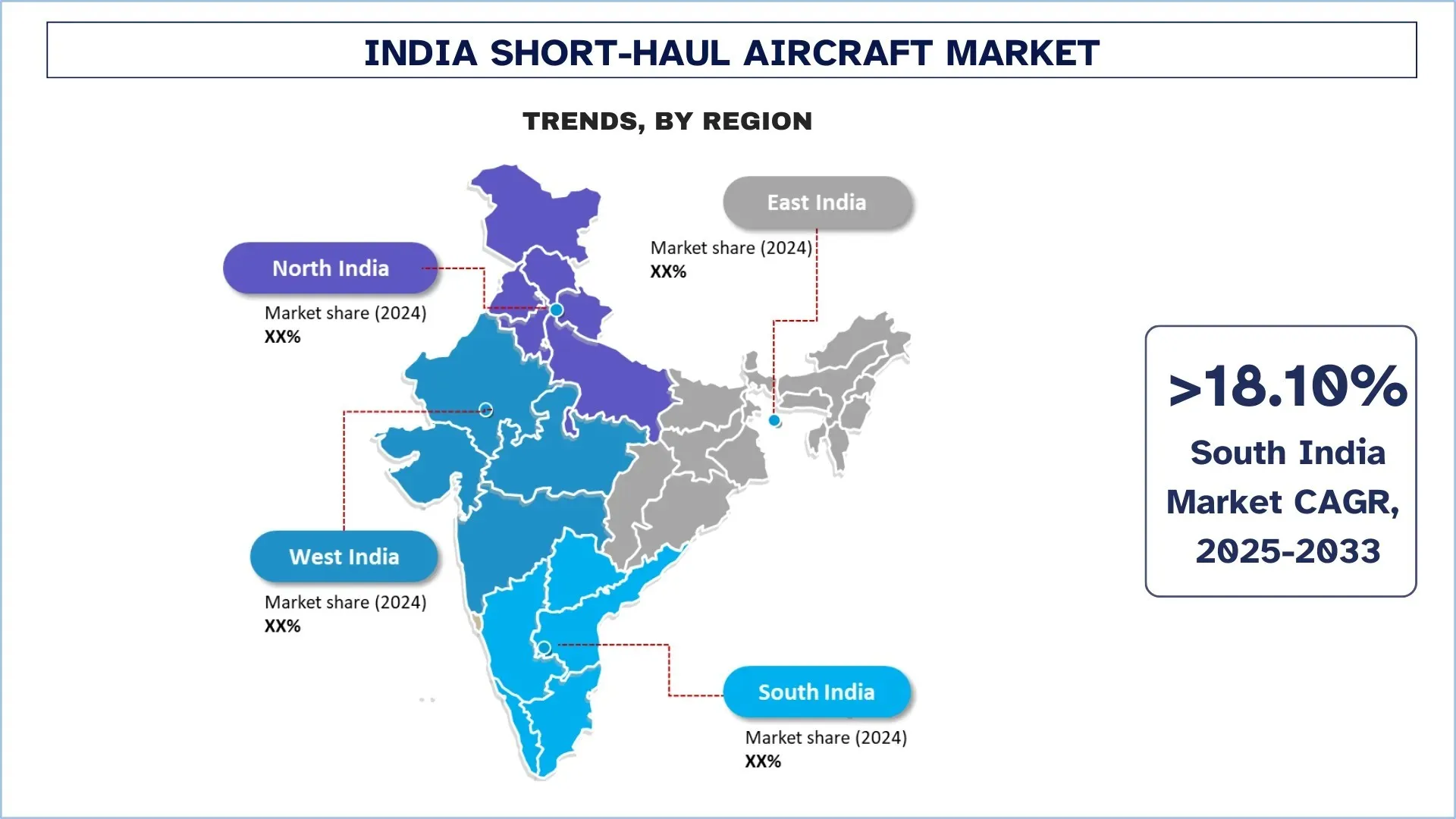
South India held a notable market share of the Short-Haul Aircraft Market in 2024.
The short-haul aircraft market in South India is facilitated by high demand in intercity travel in key hubs like Bengaluru, Hyderabad, Chennai, and Kochi due to the presence of a high number of business travelers, movement related to education, and tourism. Trunk routes are anchored by high-frequency connectivity to the metros of Mumbai, Delhi, and other metros, and trunk routes are extended to tier-2/3 cities within Tamil Nadu, Karnataka, Kerala, Telangana, and Andhra Pradesh to enhance the regional network. The region has a relatively strong airport infrastructure and a variety of operationally viable secondary airports, which can be used to increase the use and reduce turnaround. There is also the short-haul growth through international near routes to the Middle East and Sri Lanka, which supplements aircraft deployment economics and the entire year demand.
Short-Haul Aircraft Industry Competitive Landscape
The India Short-Haul Aircraft market is competitive, with several global and international market players. The key players are adopting different growth strategies to enhance their market presence, such as partnerships, agreements, collaborations, new product launches, geographical expansions, and mergers and acquisitions.
Top India Short-Haul Aircraft Companies
Some of the major players in the market are Airbus, Boeing, ATR, Embraer, De Havilland Canada, Hindustan Aeronautics Limited (HAL), United Aircraft Corporation / Yakovlev, Textron Aviation, and Pilatus Aircraft.
India Short-Haul Aircraft Market Report Coverage
Report Attribute | Details |
Base year | 2024 |
Forecast period | 2025-2033 |
Growth momentum | Accelerate at a CAGR of 18.45% |
Market size 2024 | USD ~200 million |
Regional analysis | North India, South India, East India, and West India |
Major contributing region | South India is expected to grow at the highest CAGR during the forecasted period. |
Companies profiled | Airbus, Boeing, ATR, Embraer, De Havilland Canada, Hindustan Aeronautics Limited (HAL), United Aircraft Corporation / Yakovlev, Textron Aviation, and Pilatus Aircraft |
Report Scope | Market Trends, Drivers, and Restraints; Revenue Estimation and Forecast; Segmentation Analysis; Demand and Supply Side Analysis; Competitive Landscape; Company Profiling |
Segments Covered | By Aircraft Type, By Seating Capacity, By Range, By Region/Country |
Reasons to Buy the India Short-Haul Aircraft Market Report:
The study includes market sizing and forecasting analysis confirmed by authenticated key industry experts.
The report briefly reviews overall industry performance at a glance.
The report covers an in-depth analysis of prominent industry peers, primarily focusing on key business financials, type portfolios, expansion strategies, and recent developments.
Detailed examination of drivers, restraints, key trends, and opportunities prevailing in the industry.
The study comprehensively covers the market across different segments.
Deep dive regional-level analysis of the industry.
Customization Options:
The India Short-Haul Aircraft Market can further be customized as per the requirements or any other market segment. Besides this, UnivDatos understands that you may have your own business needs; hence, feel free to contact us to get a report that completely suits your requirements.
Table of Content
Research Methodology for the India Short-Haul Aircraft Market Analysis (2023-2033)
We analyzed the historical market, estimated the current market, and forecasted the future market of the India Short-Haul Aircraft market to assess its application in major regions in India. We conducted exhaustive secondary research to gather historical market data and estimate the current market size. To validate these insights, we carefully reviewed numerous findings and assumptions. Additionally, we conducted in-depth primary interviews with industry experts across the Short-Haul Aircraft value chain. After validating market figures through these interviews, we used both top-down and bottom-up approaches to forecast the overall market size. We then employed market breakdown and data triangulation methods to estimate and analyze the market size of industry segments and sub-segments.
Market Engineering
We employed the data triangulation technique to finalize the overall market estimation and derive precise statistical numbers for each segment and sub-segment of the India-Short-Haul Aircraft market. We split the data into several segments and sub-segments by analyzing various parameters and trends, including By Aircraft Type, By Seating Capacity, By Range, and regions within the India Short-Haul Aircraft market.
The Main Objective of the India Short-Haul Aircraft Market Study
The study identifies current and future trends in the India Short-Haul Aircraft market, providing strategic insights for investors. It highlights regional market attractiveness, enabling industry participants to tap into untapped markets and gain a first-mover advantage. Other quantitative goals of the studies include:
Market Size Analysis: Assess the current market size and forecast the market size of the India Short-Haul Aircraft market and its segments in terms of value (USD).
Short-Haul Aircraft Market Segmentation: Segments in the study include areas By Aircraft Type, By Seating Capacity, By Range, and regions.
Regulatory Framework & Value Chain Analysis: Examine the regulatory framework, value chain, customer behavior, and competitive landscape of the Short-Haul Aircraft industry.
Regional Analysis: Conduct a detailed regional analysis for key areas such as North India, South India, East India, and West India.
Company Profiles & Growth Strategies: Company profiles of the Short-Haul Aircraft market and the growth strategies adopted by the market players to sustain in the fast-growing market.
Frequently Asked Questions FAQs
Q1: What is the India Short-Haul Aircraft market’s current market size and growth potential?
The India Short-Haul Aircraft market was valued at USD ~200 million in 2024 and is expected to grow at a CAGR of 18.45% during the forecast period (2025-2033). Sustained domestic passenger growth, government-led regional connectivity, and the addition of new routes are some of the key drivers supporting the market rise.
Q2: Which segment has the largest share of the India Short-Haul Aircraft market by aircraft type?
Regional jets have held a notable market share because they can serve thin and medium density routes relatively profitably, especially between tier-2 and tier-3 cities, where the demand is still young, and frequencies are important.
Q3: What are the driving factors for the growth of the India Short-Haul Aircraft market?
The growth of the India Short-Haul Aircraft market is driven by sustained domestic passenger traffic growth, government-led regional connectivity programs that are adding new routes, and ongoing airport capacity expansion—including greenfield airports—that is enabling higher volumes of domestic flying.
Q4: What are the emerging technologies and trends in the India Short-Haul Aircraft market?
Key trends include capacity and product upgrades on high-density domestic corridors, along with fleet scale-up supported by large narrowbody orderbooks that improve availability, frequency, and network depth across short-haul routes.
Q5: What are the key challenges in the India Short-Haul Aircraft market?
Major challenges include near-term capacity constraints caused by global supply-chain disruptions affecting aircraft deliveries and spares, as well as cost pressure from airfare dynamics and rising maintenance expenses that can strain airline profitability and fleet utilization.
Q6: Which region dominates the India Short-Haul Aircraft market?
South India dominates the India short-haul aircraft market, led by strong business and leisure travel demand, high-frequency metro connectivity, and robust airport infrastructure across Bengaluru, Chennai, Hyderabad, and Kochi. Dense intercity routes and thriving tourism support consistently high load factors and capacity deployment.
Q7: Who are the key players in the India Short-Haul Aircraft market?
Some of the leading companies in the India Short-Haul Aircraft Industry include:
• Airbus
• Boeing
• ATR
• Embraer
• De Havilland Canada
• Hindustan Aeronautics Limited (HAL)
• United Aircraft Corporation / Yakovlev
• Textron Aviation
• Pilatus Aircraft
• Others
Q8: How can businesses and investors tap into growth opportunities in the India Short-Haul Aircraft market?
Key opportunities include accelerated Tier-2/3 network buildout to serve underpenetrated regional demand and improve connectivity, along with increasing access to lower-cost aircraft financing and leasing options that can support faster fleet induction and route expansion while easing upfront capital requirements.
Q9: What are the future investment trends in the India Short-Haul Aircraft industry?
Future investment in India’s short-haul aircraft industry will prioritize narrowbody fleet additions, regional route expansion, and airport-linked capacity growth. Capital will increasingly flow into leasing platforms, MRO ecosystems, and digital operations to improve utilization, reliability, and unit economics amid sustained demand.
Related Reports
Customers who bought this item also bought





Aeroderivative Sensor Market: Current Analysis and Forecast (2025-2033)
Emphasis on Sensor Type (Temperature Sensors, Pressure Sensors, Vibration Sensors, Flame Sensors, and Others); Service Provider (OEMs and Aftermarket); End-User (Industrial, Marine, Aerospace & Defense, Power & Energy, and Oil & Gas); and Region/Country

Kamikaze Drone Market: Current Analysis and Forecast (2026-2034)
Emphasis on Type (Fixed-wing System and Rotary-wing System); Range (Short range(10-20km), Medium range(20-100km), and Long range(>100km)); Platform (Ground based, Airborne, and Naval); Autonomy (Man in the loop and Fully Autonomous); and Region/Country

Counter-Unmanned Aerial System Market: Current Analysis and Forecast (2025-2033)
Emphasis on Platform (Ground-Based Systems, Airborne Systems, and Naval / Maritime Systems); Technology (Radar, RF, EO/IR, Laser, Kinetic, and Others); End-Use (Defense & Military, Homeland Security & Law Enforcement, Critical Infrastructure, and Commercial & Industrial); and Region/Country
Middle East & Africa Turboprop Aircraft Market: Current Analysis and Forecast (2025-2033)
Emphasis By Aircraft Type (Light Turboprop Aircraft, Medium Turboprop Aircraft, and Heavy Turboprop Aircraft), by End-User (Government & Defense, Commercial Operators, and Private Operators), By Country (Saudi Arabia, UAE, Egypt, South Africa, Turkey, Israel, and the Rest of Middle East & Africa)