Manga Market: Current Analysis and Forecast (2025-2033)
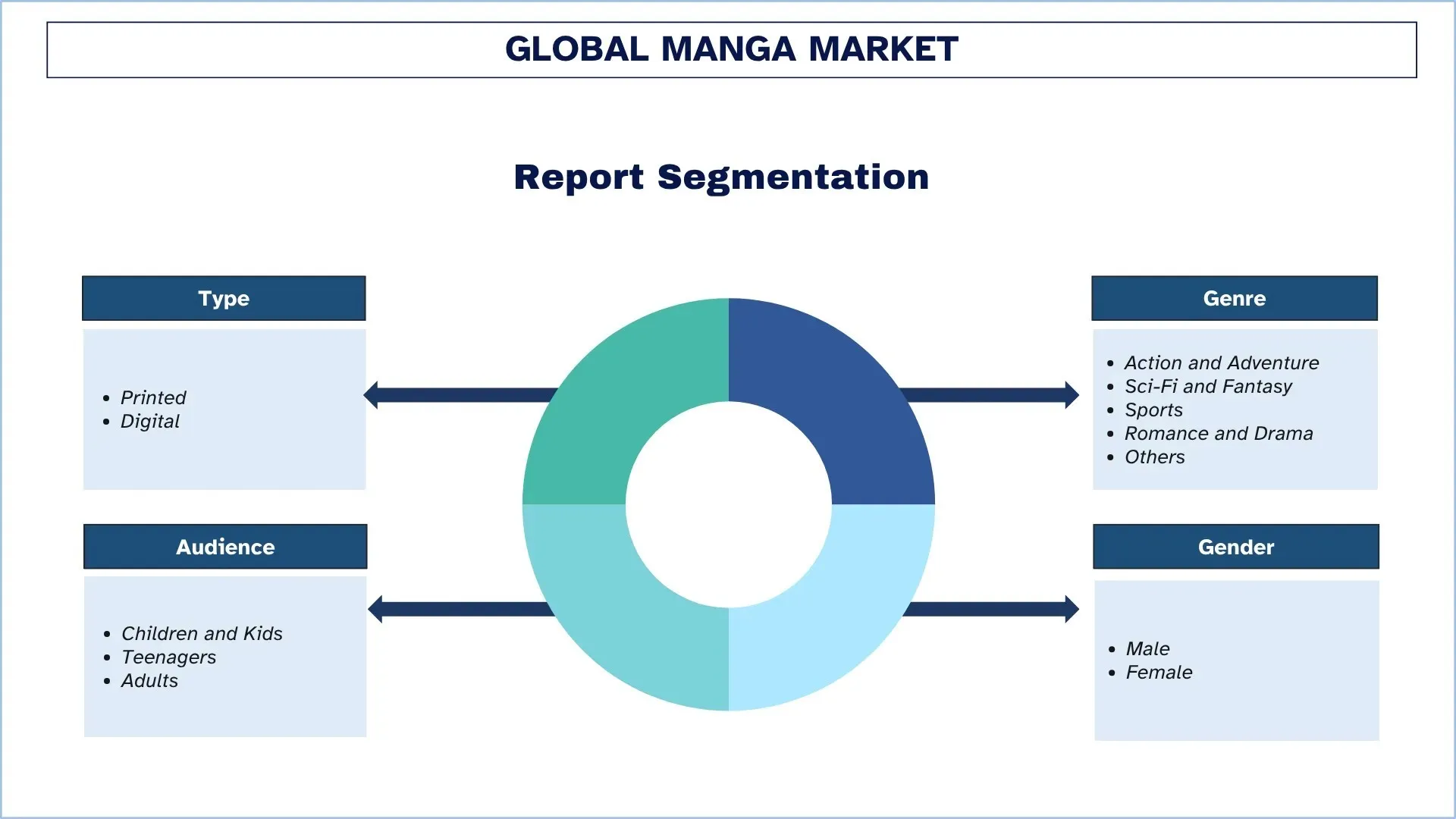
Emphasis on Type (Printed and Digital); Genre (Action and Adventure, Sci-Fi and Fantasy, Sports, Romance and Drama, and Others); Audience (Children and Kids, Teenagers, and Adults); Gender (Male and Female); Distribution Channel (Online and Offline); and Region/Country
Global Manga Market Size & Forecast
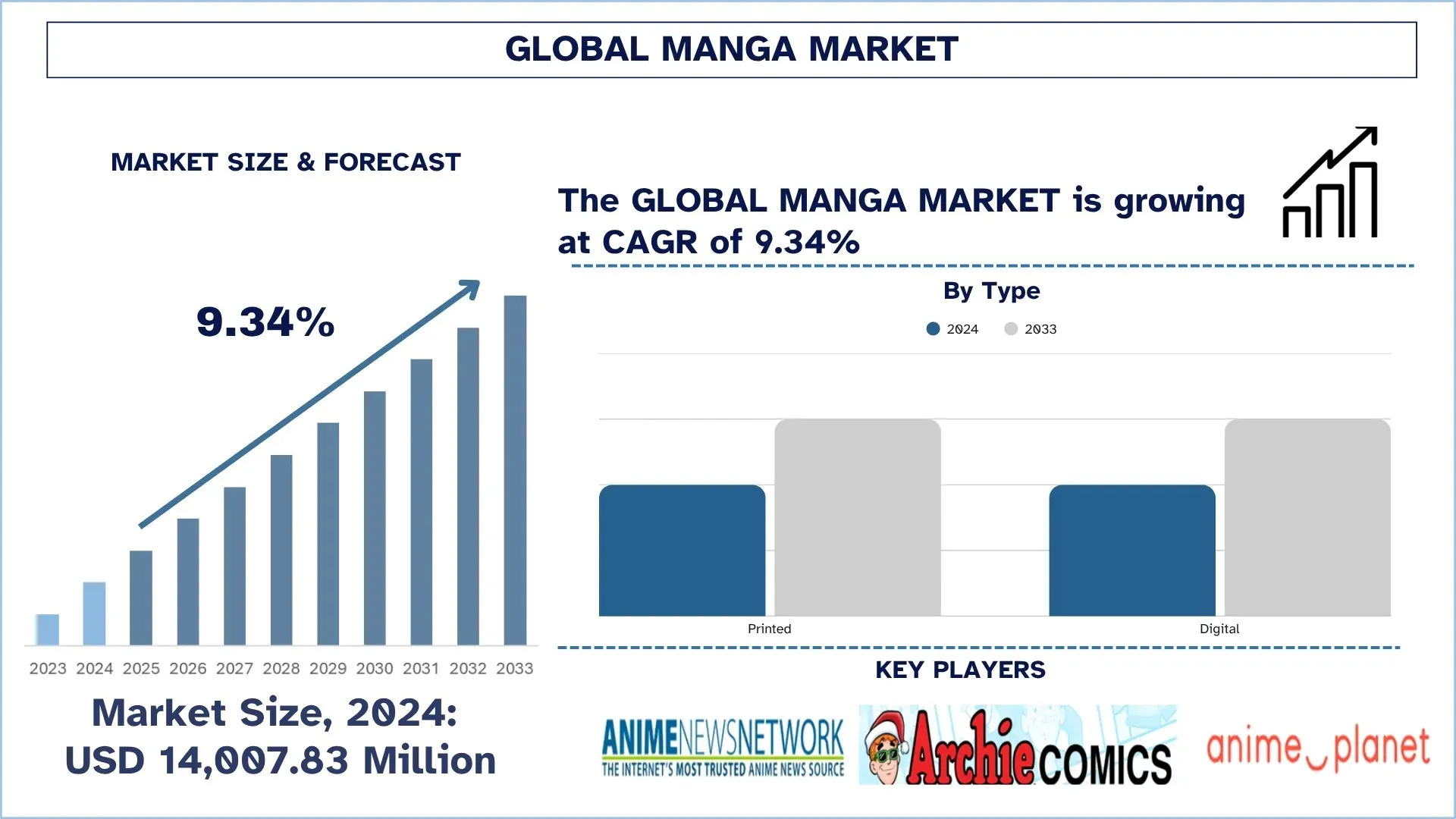
The Global Manga Market was valued at USD 14,007.83 million in 2024 and is expected to grow at a CAGR of around 9.34% during the forecast period (2025–2033F), driven by the rapid digitalization of content distribution, the powerful cross-media partnerships of anime adaptations, and the accelerating globalization of Japanese pop culture.
Manga Market Analysis
The Global Manga Market is gaining significant momentum worldwide due to the increasing globalization of Japanese pop culture, the rise in digital publishing platforms, and a growing base of international fans. Manga, as a unique comic art form, is now becoming widely acknowledged as a major segment of the publishing and entertainment industries worldwide that draws from a wide demographic audience outside the region of publication. This growth is further sped up by the adaptation of popular manga series into anime, into live-action movies, and merchandise, which is, in turn, driving new readers back to the source material. The growth of the market involves strategic translation, localized release, and the introduction of webcomics and webtoons, which utilize the traditional manga style to make the medium more accessible and enjoyable for the world than ever before.
Global Manga Market Trends
This section discusses the key market trends that are influencing the various segments of the global manga market, as found by our team of research experts.
The Rise of the Digital-First and Subscription Model
The swift shift to all-you-can-read subscriptions and a digital-first distribution method is one of the key trends that influence manga consumption. Both publishers and readers are moving to subscription-based models where access to large catalogs can be accessed monthly at a fixed fee, as opposed to just buying books separately on a volume basis only. The strategy offers readers a low-cost and low-risk method to browse new genres and titles, and increases discoverability and interest considerably. This plan implies providing the readers with a low-risk and affordable discovery method of new genres and new titles, which significantly enhances discoverability and reader interest. Platforms such as VIZ Media's Shonen Jump subscription platform and platforms built into larger ecosystems, such as Kindle Unlimited, offer a "Netflix-for-manga" experience that delivers incredible value and utility to readers who may be priced out of collecting extensive physical series. This trend is gaining tremendous momentum, as it aligns with the consumption habits of modern media, where access is now more important than ownership, and digital lifestyles must be integrated or not. It generates sustained fan loyalty for the reader, repeating revenue for the publishers, and reduces the attractiveness of illegal scanlation sites by offering a much better and legitimate alternative. Leading publishers are responding by offering more of their back catalogs and new series via these models, both creating more direct relationships with consumers and ensuring the long-term digital sustainability of the industry.
Manga Industry Segmentation
This section provides an analysis of the key trends in each segment of the global manga market report, along with forecasts at the global, regional, and country levels for 2025-2033.
The Printed Segment Dominates the Manga Market
Based on type, the global manga market is segmented into printed and digital. In 2024, the Printed segment is anticipated to hold the largest market share and continue its dominance throughout the forecast period. This is primarily due to the anchoring cultural tradition of purchasing physical tankobon volumes in Japan (his home, by far, and still the epicenter of the business) and the great collector's mentality of fans worldwide, who value physical ownership and the quality of the print. However, the Digital segment is estimated to have the highest growth rate as a result of the convenience factor of smartphones and tablets, easy access to mammoth catalog facilities through subscription services, and the relative ease and affordability of digital volumes, which are especially attractive to international readers and younger demographics.
The Action and Adventure Segment held the Largest Market Share in the Manga Market.
Based on genre, the global manga market is segmented into Action and Adventure, Sci-Fi and Fantasy, Sports, Romance and Drama, and Others. In 2024, the Action and Adventure segment is anticipated to hold the largest market share. The domination is propelled by the genre's resonance with the demographics of manga's most prolific consumer base: teenagers and young adults. The signature elements of the genre (high-stakes plots, dynamic and visually spectacular artwork, intense combat sequences, and universal themes of heroism, perseverance, and camaraderie) add to a highly engaging and addictive reading experience. Its strength is further reinforced by the overwhelming success and cultural influence of long-running shonen titles like One Piece, Jujutsu Kaisen, and My Hero Academia, which not only sell out in immense amounts but also attract new international fans thanks to their highly popular anime adaptations.
Asia Pacific Dominated the Global Manga Market
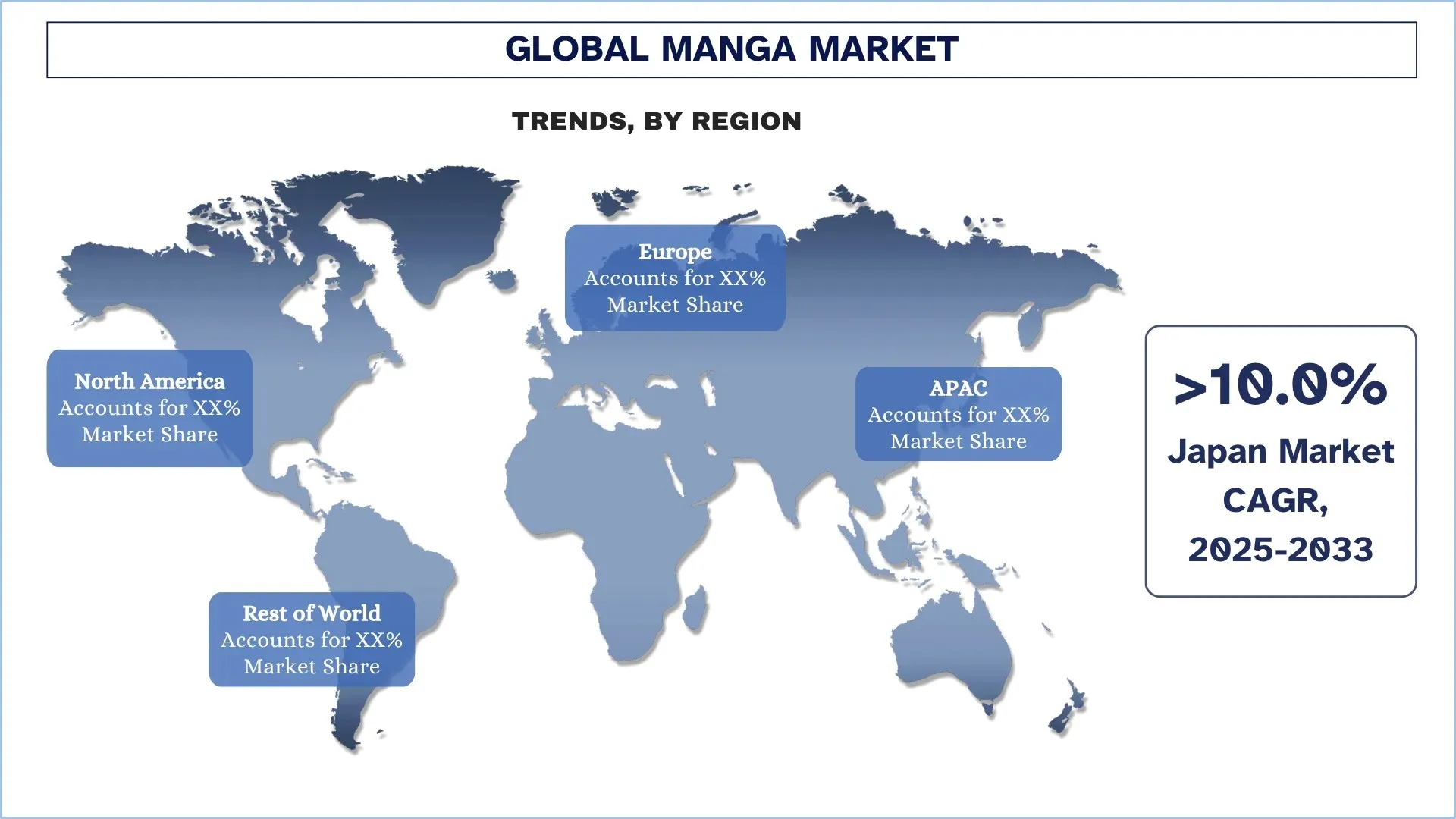
The Asia-Pacific region, led by Japan, is expected to dominate the market with the largest share and is projected to maintain this position throughout the forecast period. Japan's dominance of the global manga market is a direct product of both its status as the native and production center for manga, and has been backed up by an ingrained reading culture where manga has been an ubiquitous part of everyday life and is read by all sectors of society at all levels. This ecosystem is supported by an extremely developed publishing infrastructure, including a system of weekly and monthly anthology magazines, major publishing houses such as Shueisha and Kodansha, and a dense network of distribution channels that range from convenience stores to specialized bookstores. The country still remains the unquestioned source of original content, develops new generations of artists, and creates iconic series that set the global trends.
Japan held a dominant Share of the Asia Pacific Manga Market in 2024
The dominance of the Japanese manga market is driven by the strong cultural ecosystem of manga as a mainstream medium used by all age groups, supported by a specific industrial model of serial anthology magazines that test and nurture new talent. This is enhanced by a potent cross-media work partnership, where a successful manga is adapted into anime, video games, and merchandise, creating a self-perpetuating loop of international publicity and revenue. This is institutionalized, coupled with strategic digital globalization via official avenues, such that Japan is the requisite content creation focal point of the industry for the rest of the world.
Manga Industry Competitive Landscape
The global manga market is competitive, with several global and international market players. The key players are adopting different growth strategies to enhance their market presence, such as partnerships, agreements, collaborations, new product launches, geographical expansions, and mergers and acquisitions.
Top Manga Companies
Some of the major players in the market are Anime News Network LLC, Archie Comic Publications, Inc., Anime-Planet, Futabasha Publishers Ltd., GOOD SMILE COMPANY, KODANSHA USA PUBLISHING, Seven Seas Entertainment, Inc., Shueisha Inc., Yen Press, and VIZ Media, LLC.
Recent Developments in the Manga Market
In July 2025, at San Diego Comic-Con 2025, Kodansha Ltd. announced a new line of print manga licenses to appear in Spring 2026 and adjustments to their program, the Kodansha Print Club.
In July 2025, Seven Seas Entertainment, Inc. licensed a number of new manga series, including I Have a Secret by Yoru Sumino and Zui Nieki, DOGGO by Ryuki Onuma and Hikari Komaru, and The Babe at My Back Has Her Eye on Me, with an assortment of genres, such as coming-of-age supernatural drama and light-hearted romance.
In July 2025, VIZ Media LLC announced a co-production of the manga Hirayasumi, which received high critical acclaim, and an anime adaptation in collaboration with Shogakukan-Shueisha Productions Co., Ltd.
Global Manga Market Report Coverage
Report Attribute | Details |
Base year | 2024 |
Forecast period | 2025-2033 |
Growth momentum | Accelerate at a CAGR of 9.34% |
Market size 2024 | USD 14,007.83 Million |
Regional analysis | North America, Europe, APAC, Rest of the World |
Major contributing region | Asia Pacific is expected to dominate the market during the forecast period. |
Key countries covered | U.S., Canada, Germany, U.K., Spain, Italy, France, China, Japan, and India |
Companies profiled | Anime News Network LLC, Archie Comic Publications, Inc., Anime-Planet, Futabasha Publishers Ltd., GOOD SMILE COMPANY, KODANSHA USA PUBLISHING, Seven Seas Entertainment, Inc., Shueisha Inc., Yen Press, and VIZ Media, LLC |
Report Scope | Market Trends, Drivers, and Restraints; Revenue Estimation and Forecast; Segmentation Analysis; Demand and Supply Side Analysis; Competitive Landscape; Company Profiling |
Segments Covered | By Type; By Genre, By Audience, By Gender, By Distribution Channel; By Region/Country |
Reasons to Buy the Manga Market Report:
The study includes market sizing and forecasting analysis confirmed by authenticated key industry experts.
The report briefly reviews overall industry performance at a glance.
The report covers an in-depth analysis of prominent industry peers, primarily focusing on key business financials, type portfolios, expansion strategies, and recent developments.
Detailed examination of drivers, restraints, key trends, and opportunities prevailing in the industry.
The study comprehensively covers the market across different segments.
Deep dive regional-level analysis of the industry.
Customization Options:
The global manga market can further be customized as per the requirements or any other market segment. Besides this, UnivDatos understands that you may have your own business needs; hence, feel free to contact us to get a report that completely suits your requirements.
Table of Content
Research Methodology for the Global Manga Market Analysis (2023-2033)
We analyzed the historical market, estimated the current market, and forecasted the future market of the global manga market to assess its application in major regions worldwide. We conducted exhaustive secondary research to gather historical market data and estimate the current market size. To validate these insights, we carefully reviewed numerous findings and assumptions. Additionally, we conducted in-depth primary interviews with industry experts across the manga value chain. After validating market figures through these interviews, we used both top-down and bottom-up approaches to forecast the overall market size. We then employed market breakdown and data triangulation methods to estimate and analyze the market size of industry segments and sub-segments.
Market Engineering
We employed the data triangulation technique to finalize the overall market estimation and derive precise statistical numbers for each segment and sub-segment of the global manga market. We split the data into several segments and sub-segments by analyzing various parameters and trends, including type, genre, audience, gender, distribution channel, and regions within the global manga market.
The Main Objective of the Global Manga Market Study
The study identifies current and future trends in the global manga market, providing strategic insights for investors. It highlights regional market attractiveness, enabling industry participants to tap into untapped markets and gain a first-mover advantage. Other quantitative goals of the studies include:
Market Size Analysis: Assess the current market size and forecast the market size of the global manga market and its segments in terms of value (USD).
Manga Market Segmentation: Segments in the study include areas of type, genre, audience, gender, distribution channel, and regions.
Regulatory Framework & Value Chain Analysis: Examine the regulatory framework, value chain, customer behavior, and competitive landscape of the manga industry.
Regional Analysis: Conduct a detailed regional analysis for key areas such as Asia Pacific, Europe, North America, and the Rest of the World.
Company Profiles & Growth Strategies: Company profiles of the manga market and the growth strategies adopted by the market players to sustain the fast-growing market.
Frequently Asked Questions FAQs
Q1: What is the global manga current market size and its growth potential?
The global manga market was valued at USD 14,007.83 million in 2024 and is expected to grow at a CAGR of 9.34% during the forecast period (2025-2033).
Q2: Which segment has the largest share of the global manga market by type?
The Printed segment is anticipated to hold the largest market share and continue its dominance throughout the forecast period. This is primarily due to the anchoring cultural tradition of purchasing physical tankobon volumes in Japan (his home, by far, and still the epicenter of the business) and the great collector's mentality of fans worldwide, who value physical ownership and the quality of the print.
Q3: What are the driving factors for the growth of the global manga market?
• Digitalization and Global Accessibility: The proliferation of digital platforms and subscription services (e.g., Shonen Jump+, Manga Plus) has democratized global access. This eliminates logistical delays and import costs of physical copies, allowing international readers to access new chapters simultaneously with their Japanese release, significantly expanding the addressable market.
• Cross-Media Synergy and the Anime Boom: The adaptation of popular manga into high-production-value anime on global streaming platforms (Netflix, Crunchyroll) acts as a powerful, continuous marketing engine. These adaptations serve as the primary discovery funnel for new, global audiences, who are then driven back to purchase and read the original source manga.
• Globalization of Japanese Pop Culture: There is a growing worldwide acceptance and mainstreaming of manga as a legitimate form of literature and entertainment. This is fueled by strategic localization, its inclusion in libraries and educational curricula, and a diminishing cultural barrier, attracting a broader and more diverse demographic beyond traditional anime fans.
Q4: What are the emerging technologies and trends in the global manga market?
• The Rise of the Digital-First and Subscription Model: The shift towards all-you-can-read subscription services and one-click digital purchases is the dominant trend. This model favors discovery and caters to the tech-savvy younger demographic, and provides a more stable, recurring revenue stream for publishers compared to traditional per-volume sales.
• Diversification of Content and Audiences: The market is seeing sustained growth in genres targeting adults (seinen/josei) and female readers (shōjo), moving beyond the traditional dominance of shōnen for young males. This includes the rising global popularity of sub-genres like Boys' Love (BL), indicating a maturing and diversifying consumer base.
• The Influence of Webcomics and Webtoons: The success of the vertical-scroll, full-color webtoon format is influencing the manga industry. This encourages experimentation with digital-native formats, creating a new competitive landscape, and introducing manga aesthetics to a broader webcomic audience.
Q5: What are the key challenges in the global manga market?
• Piracy and Illegal Scanlation Sites: The market faces significant revenue loss from widespread piracy. Illegal "scanlation" sites often provide free, faster, but unlicensed translations, undermining official digital and physical sales and posing a major threat to publishers' and creators' royalties.
• Dependence on Physical Sales in the Domestic Market: While digital is growing globally, the industry's core in Japan remains heavily reliant on physical anthology magazines and tankōbon sales. This creates structural vulnerability to changing retail landscapes and shifting consumer preferences towards digital media worldwide.
• Cultural Localization and Niche Appeal: While globalization is a driver, effectively localizing content without losing cultural nuance remains a challenge. Some genres and humor are deeply rooted in Japanese culture and may not resonate universally, potentially limiting the market expansion of certain titles outside of core action/fantasy genres.
Q6: Which region dominates the global manga market?
The Asia-Pacific region is expected to dominate the market with the largest market share and continue to dominate the entire forecast period. This has been primarily driven by Japan's position as the native production hub of manga, a deeply ingrained reading culture across generations, and the widespread early adoption of both print and digital manga formats across countries like China and South Korea. The region benefits from well-established publishing infrastructures, dense physical distribution networks, and the synergistic ecosystem of anime adaptations that continuously drive manga consumption and reinforce its cultural significance.
Q7: Who are the key players in the global manga market?
Some of the key companies include:
• Anime News Network LLC
• Archie Comic Publications, Inc.
• Anime-Planet
• Futabasha Publishers Ltd.
• GOOD SMILE COMPANY
• KODANSHA USA PUBLISHING
• Seven Seas Entertainment, Inc.
• Shueisha Inc.
• Yen Press
• VIZ Media, LLC
Q8: How does globalization influence collaboration and market expansion in the Manga industry?
• Cross-Cultural Adaptations: Partnerships between Japanese publishers and global entertainment companies lead to localized manga content tailored for regional audiences.
• Co-Production Agreements: International studios collaborate with Japanese creators on manga-inspired animation and digital adaptations, enhancing brand visibility.
• Global Distribution Channels: Digital stores, streaming services, and online communities facilitate global access to manga titles, boosting revenue and cultural exchange.
Q9: What role does digitalization play in enhancing Manga operations and value?
• Digital Publishing Platforms: The rise of web-based and mobile manga platforms allows creators to reach global audiences instantly, increasing accessibility and monetization opportunities.
• AI-Assisted Creation Tools: Digital illustration and AI tools streamline workflows, assist with translation and coloring, and reduce production time without compromising artistic quality.
• Data-Driven Insights: Analytics from digital platforms help publishers understand reader behavior, enabling personalized recommendations and strategic content development.
Related Reports
Customers who bought this item also bought





In-Game Advertising Market: Current Analysis and Forecast (2025-2033)
Emphasis on Type (Static Ads, Dynamic Ads, and Advergaming); Device (Mobile/Tablet and PC/Laptop); and Region/Country

Middle East & Africa Digital Out-of-Home (DOOH) Advertising Market: Current Analysis and Forecast (2025-2033)
Emphasis By Type ((Billboards/LED Screens, Street Furniture (ATM Kiosks, Pedestrian panels, Mall Ad Panels) and Transit)), by End User (Retail, Real Estate, Financial Services, Government, Automotive, and Others), By Country (Saudi Arabia, UAE, Egypt, South Africa, Turkey, Israel, and the Rest of Middle East & Africa)

Southeast Asia Cloud Gaming Market: Current Analysis and Forecast (2025-2033)
Emphasis on Device Type (Smartphones, Tablets, Gaming Consoles, PCs & Laptops, Smart TVs, Head-Mounted Displays, Others); Offering (Infrastructure, Gaming Platform Services); Solution Type (Video Streaming, File Streaming); and Country.
Manga Market: Current Analysis and Forecast (2025-2033)
Emphasis on Type (Printed and Digital); Genre (Action and Adventure, Sci-Fi and Fantasy, Sports, Romance and Drama, and Others); Audience (Children and Kids, Teenagers, and Adults); Gender (Male and Female); Distribution Channel (Online and Offline); and Region/Country