Southeast Asia Liquid Sodium Silicate Market: Current Analysis and Forecast (2025-2033)
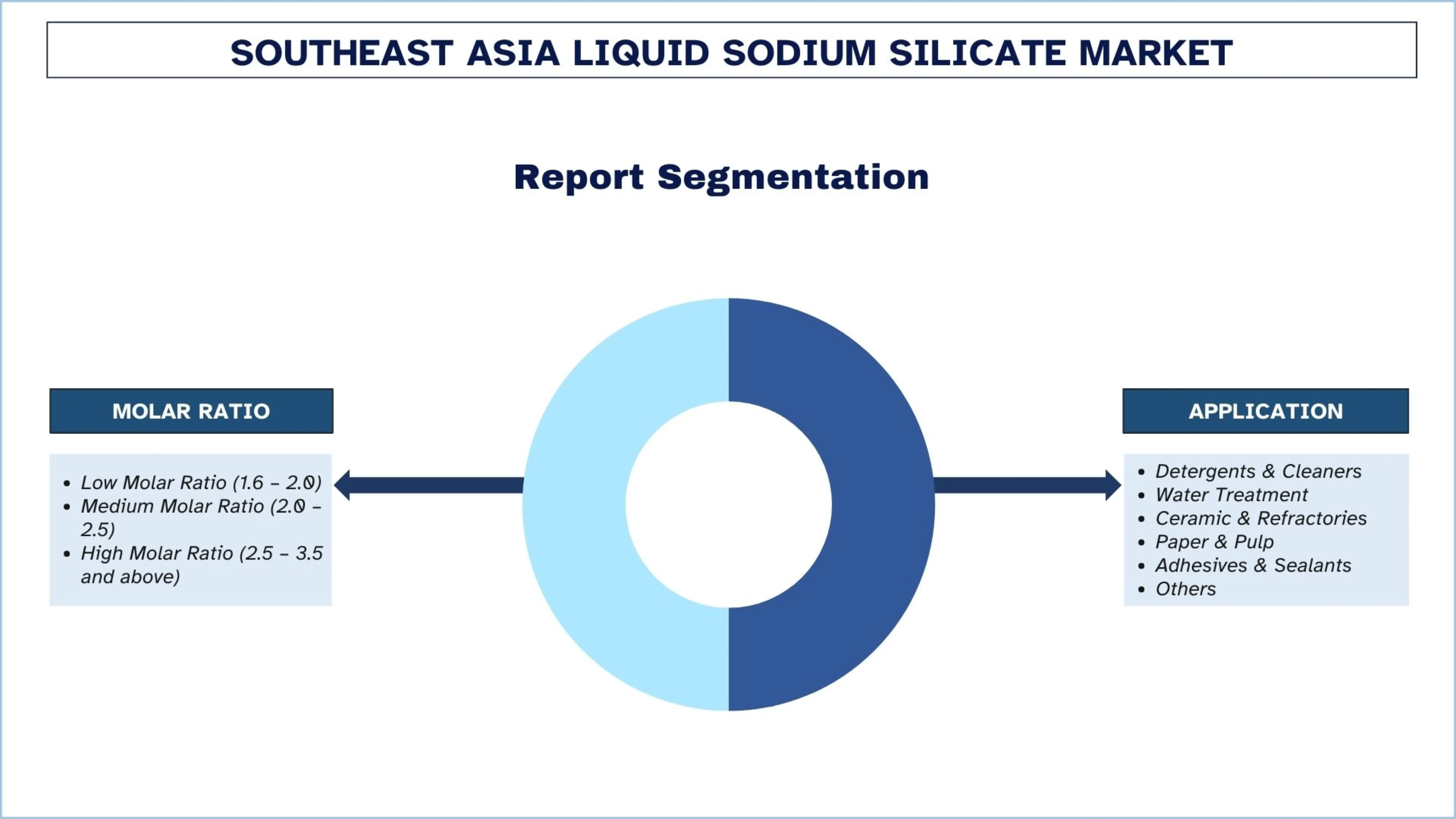
Emphasis on Molar Ratio (Low Molar Ratio (1.6 – 2.0), Medium Molar Ratio (2.0 – 2.5), High Molar Ratio (2.5 – 3.5 and above)); Application (Detergents & Cleaners, Water Treatment, Ceramic & Refractories, Paper & Pulp, Adhesives & Sealants, Others); and Country.
Southeast Asia Liquid Sodium Silicate Market Size & Forecast
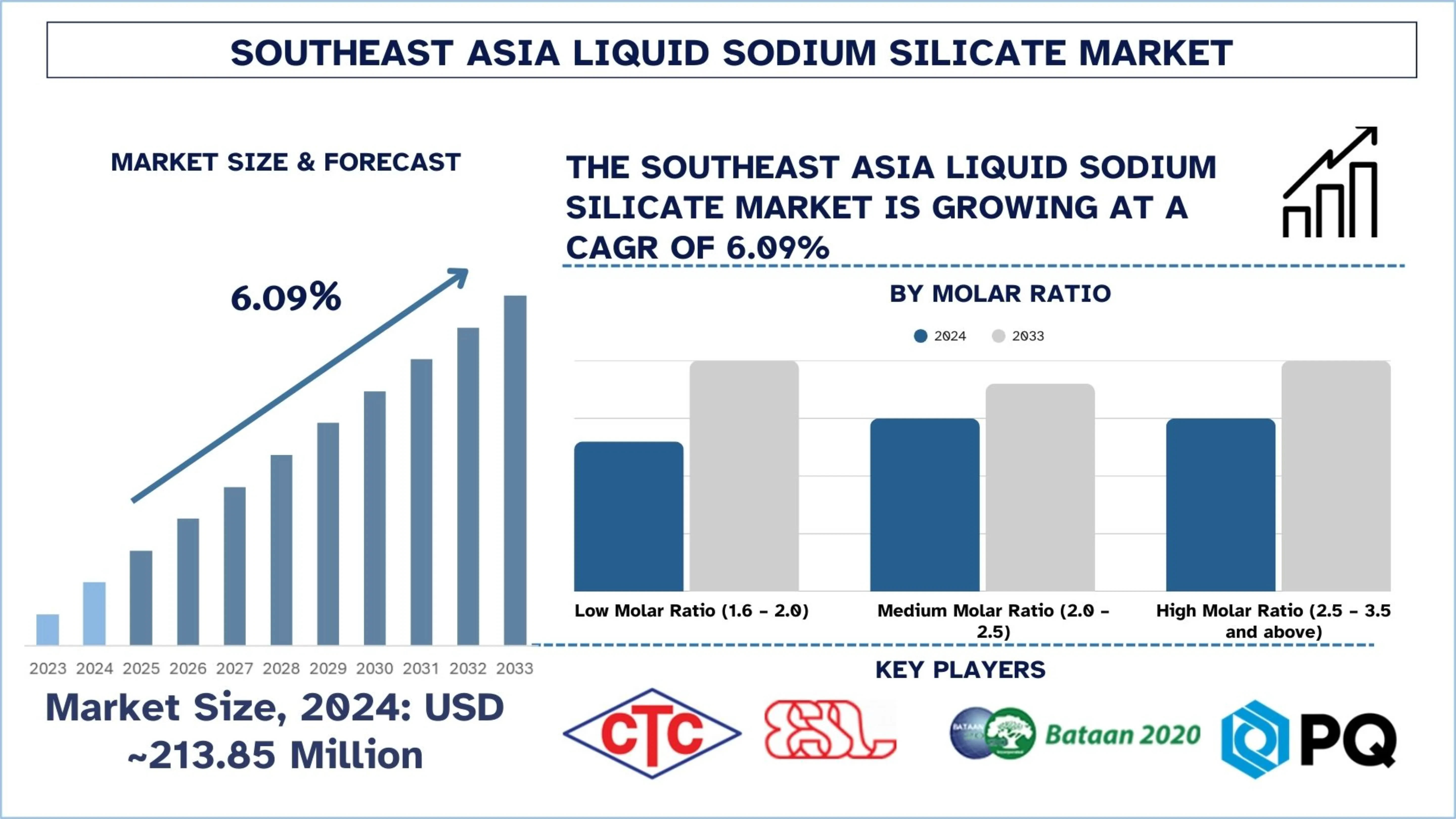
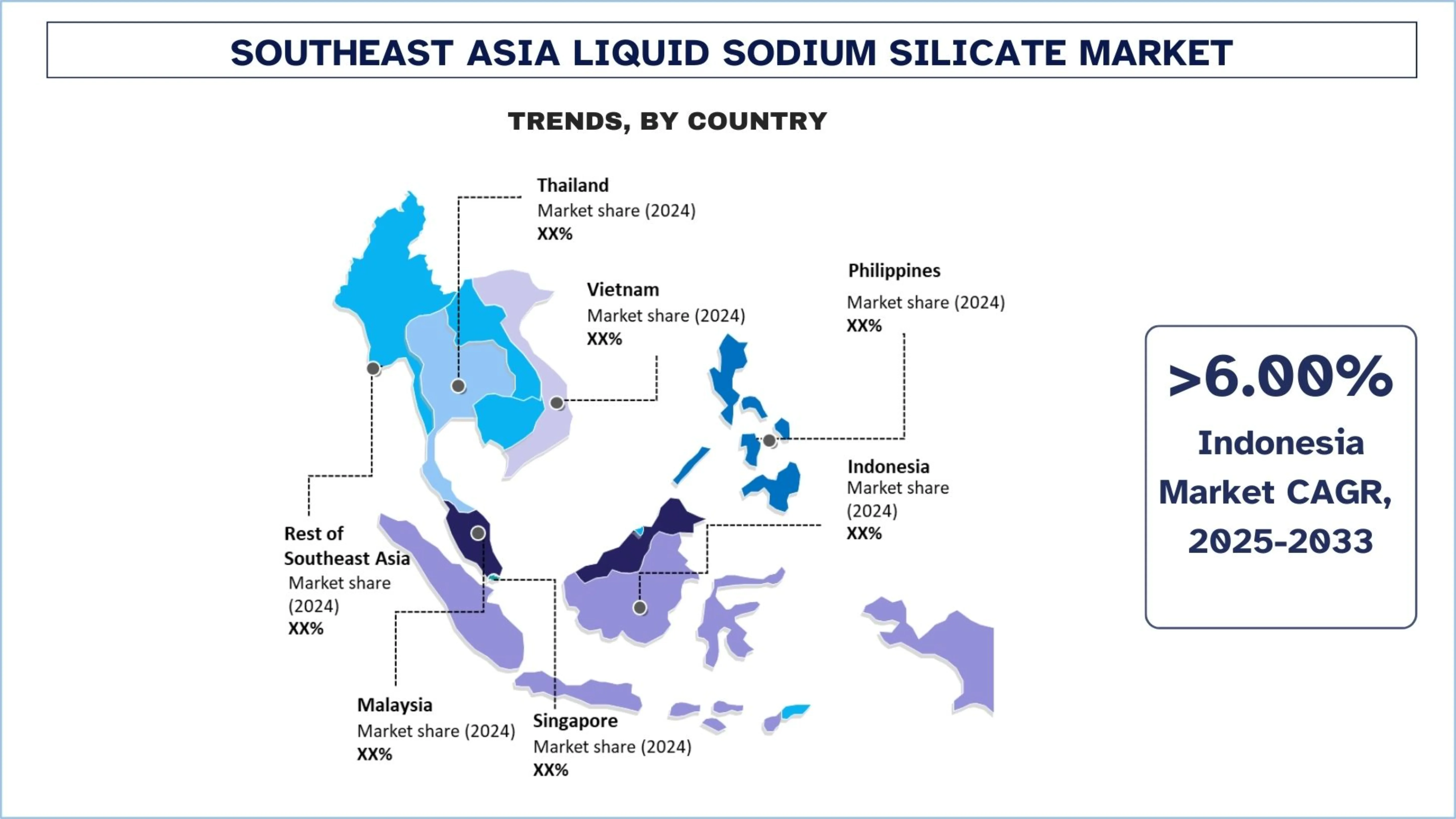
The Southeast Asia Liquid Sodium Silicate Market was valued at USD 213.85 million in 2024 and is expected to grow at a strong CAGR of around 6.09% during the forecast period (2025-2033F), driven by rapid growth in construction and infrastructure projects.
Southeast Asia Liquid Sodium Silicate Market Analysis
Liquid sodium silicate is a solution of silica and sodium oxide in water, commonly referred to as water glass. This is widely used for its binding, sealing, and dispersing properties in industrial, construction, and detergent applications.
To realize growth in Southeast Asia, manufacturers are targeting increased local production capacity; end-use industries are emphasizing molar-ratio-specific grades; and distribution networks in the region are being reinforced to facilitate faster delivery and cost control. There is a growing focus on medium- and high-molar-ratio products supplied to meet the needs of construction chemicals, water treatment, and pulp and paper, and investments in energy-efficient production processes and compliance with sustainability standards are enhancing operational efficiency and market expansion in Southeast Asian countries.
Southeast Asia Liquid Sodium Silicate Market Trends
This section discusses the key market trends that are influencing the various segments of the Southeast Asia Liquid Sodium Silicate market, as found by our team of research experts.
Localization of Production to Reduce Import Dependence
The decentralization of liquid sodium silicate production is also becoming a significant trend, as companies focus on reducing imports and enhancing supply chain integrity. The proximity of the manufacturing plants enables reductions in logistics costs, delivery lead times, and vulnerability to international price volatility. This is especially significant in Southeast Asia, where the growing industrial sector requires a constant and timely supply. Local production also facilitates greater customization of molar ratios to local country-specific and application-specific needs. Moreover, the regional expansion of the capacity region is emerging as a strategic concern for market players.
Southeast Asia Liquid Sodium Silicate Industry Segmentation
This section provides an analysis of the key trends in each segment of the Southeast Asia Liquid Sodium Silicate market, along with forecasts at the country level for 2025-2033.
The medium molar ratio (2.0 – 2.5) segment dominated the market share in 2024.
Based on the molar ratio, the market is segmented into low molar ratio (1.6 – 2.0), medium molar ratio (2.0 – 2.5), and high molar ratio (2.5 – 3.5 and above). Among these, the medium molar ratio (2.0 – 2.5) segment held the dominant share in 2024. This is primarily because it is adaptable to a range of high-volume applications, including detergents, construction additives, paper processing, and water treatment. It has a balanced alkalinity and binding characteristics that enable manufacturers to standardize production and facilitate diverse end-use industries, thereby enhancing capacity utilization and margin stability. Moreover, this flexibility will expedite adoption among industrial buyers seeking a cost-effective, multipurpose chemical solution.
The water treatment segment is expected to grow with a significant CAGR during the forecast period (2025-2033).
Based on the application, the Southeast Asian Liquid Sodium Silicate market is segmented into detergents & cleaners, water treatment, ceramic & refractories, paper & pulp, adhesives & sealants, and others. Among these, the water treatment segment is expected to grow at a significant CAGR during the forecast period (2025-2033). The Southeast Asian governments and industries are increasing wastewater treatment capacity to address urbanization and environmental compliance. The use of liquid sodium silicate as a key input chemical is increasing in applications for corrosion control, pH management, and sludge treatment. Moreover, public and industrial investment is consistent, ensuring that demand is visible over the long term, thereby motivating suppliers to scale up their operations and enter into long-term contracts. On November 18, 2025, Hitachi Asia Ltd. and its partners, Meralco Energy, Inc. (MSERV) and Toshiba Plant System & Services Corporation, Philippines (TPSC), have been elevating wastewater management standards at the Cupang Water Reclamation Facility (WRF) in Muntinlupa City for Maynilad Water Services, Inc. This project will enhance wastewater treatment capabilities and ensure compliance with the latest standards set under the Department of Environment and Natural Resources (DENR) Administrative Order No. 2021-19 (DAO2021-19) opens in a new tab.
Indonesia held a dominant share of the Southeast Asian Liquid Sodium Silicate market in 2024
The Southeast Asian liquid sodium silicate market is dominated by Indonesia, owing to its large population and strong demand for the product in detergents and household cleaning products. The speed of urbanization and the constant development of infrastructure drive the consumption in the construction-related business, such as cement additives and binders. The steady demand is also supported by the growth of industrial production, such as pulp and paper and ceramics production. The increase in investments in municipal and industrial water treatment facilities is opening up more consumption avenues. The supply of raw materials and the rising industrial infrastructure also contribute to Indonesia being a consistent and vast market to adopt liquid sodium silicate.
On November 21, 2024, PQ, a global producer of sodium silicate, specialty silica, and their derivatives, announced that it had successfully completed the expansion of its silica production facility in Pasuruan, Indonesia.
The project was completed on time and on budget, and expanded the facility with the addition of a state-of-the-art micronizer. The additional equipment significantly increases PQ's production capacity and helps the company meet the growing demand for high-quality silica in the Asian market. The expanded facility will also enable PQ to launch innovative new products to meet the specific needs of customers in the paints and coatings, personal care, and pharmaceutical markets.
Southeast Asia Liquid Sodium Silicate Industry Competitive Landscape
The Southeast Asia Liquid Sodium Silicate market is competitive, with several global and international market players. The key players are adopting different growth strategies to enhance their market presence, such as partnerships, agreements, collaborations, new product launches, geographical expansions, and mergers and acquisitions.
Top Southeast Asia Liquid Sodium Silicate Companies
Some of the major players in the market are C THAI GROUP, Eastern Silicate Co., Ltd., Bataan 2020, Inc., PQ Corporation, DMG Chemical Co., Ltd. (Duc Minh Co., Ltd.), Oriental Silicas Corporation, Tokuyama Corporation, W. R. Grace & Co., Nippon Chemical Industrial CO., LTD., Occidental Petroleum Corporation (OxyChem).
Recent Developments in the Southeast Asia Liquid Sodium Silicate Market
In January 2025, PQ, a leading global producer of silicates, silicas, and derivative products, announced that it had completed the acquisition of the specialty silicate business of the Sibelco Group, currently operated in the Lödöse plant in Sweden.
In June 2024, Tokuyama Corporation (Japan) announced plans to build a polysilicon manufacturing plant for semiconductor use in Vietnam. The announcement was made at the Vietnam – Japan Cooperation Forum held on April 28 in Hanoi, co-chaired by Vietnamese Prime Minister Pham Minh Chinh and Japanese Prime Minister Ishiba Shigeru.
Southeast Asia Liquid Sodium Silicate Market Report Coverage
Report Attribute | Details |
Base year | 2024 |
Forecast period | 2025-2033 |
Growth momentum | Accelerate at a CAGR of 6.09% |
Market size 2024 | USD 213.85 Million |
Country analysis | Indonesia, Thailand, Philippines, Vietnam, Malaysia, Singapore, Rest of Southeast Asia |
Major contributing Country | Vietnam is expected to grow at the highest CAGR during the forecasted period. |
Companies profiled | C THAI GROUP, Eastern Silicate Co., Ltd., Bataan 2020, Inc., PQ Corporation, DMG Chemical Co., Ltd. (Duc Minh Co., Ltd.), Oriental Silicas Corporation, Tokuyama Corporation, W. R. Grace & Co., Nippon Chemical Industrial CO., LTD., Occidental Petroleum Corporation (OxyChem) |
Report Scope | Market Trends, Drivers, and Restraints; Revenue Estimation and Forecast; Segmentation Analysis; Demand and Supply Side Analysis; Competitive Landscape; Company Profiling |
Segments Covered | By Molar Ratio, By Application, By Country |
Reasons to Buy the Southeast Asia Liquid Sodium Silicate Market Report:
The study includes market sizing and forecasting analysis confirmed by authenticated key industry experts.
The report briefly reviews overall industry performance at a glance.
The report covers an in-depth analysis of prominent industry peers, primarily focusing on key business financials, product portfolios, expansion strategies, and recent developments.
Detailed examination of drivers, restraints, key trends, and opportunities prevailing in the industry.
The study comprehensively covers the market across different segments.
Customization Options:
The Southeast Asia Liquid Sodium Silicate market can further be customized as per requirements or any other market segment. Besides this, UnivDatos understands that you may have your own business needs; hence, feel free to contact us to get a report that completely suits your requirements.
Table of Content
Research Methodology for the Southeast Asia Liquid Sodium Silicate Market Analysis (2023-2033)
We analyzed the historical market, estimated the current market, and forecasted the future market of the Southeast Asian Liquid Sodium Silicate market to assess its application in major countries. We conducted exhaustive secondary research to gather historical market data and estimate the current market size. To validate these insights, we carefully reviewed numerous findings and assumptions. Additionally, we conducted in-depth primary interviews with industry experts across the Southeast Asian Liquid Sodium Silicate value chain. After validating market figures through these interviews, we used both top-down and bottom-up approaches to forecast the overall market size. We then employed market breakdown and data triangulation methods to estimate and analyze the market size of industry segments and sub-segments.
Market Engineering
We employed the data triangulation technique to finalize the overall market estimation and derive precise statistical numbers for each segment and sub-segment of the Southeast Asia Liquid Sodium Silicate market. We split the data into several segments and sub-segments by analyzing various parameters and trends, including molar ratio, application, and country within the Southeast Asian Liquid Sodium Silicate market.
The Main Objective of the Southeast Asia Liquid Sodium Silicate Market Study
The study identifies current and future trends in the Southeast Asia Liquid Sodium Silicate market, providing strategic insights for investors. It highlights market attractiveness, enabling industry participants to tap into untapped markets and gain a first-mover advantage. Other quantitative goals of the studies include:
Market Size Analysis: Assess the current and forecast market size of the Southeast Asia Liquid Sodium Silicate market and its segments in terms of value (USD).
Southeast Asia Liquid Sodium Silicate Market Segmentation: Segments in the study include areas of molar ratio, application, and country.
Regulatory Framework & Value Chain Analysis: Examine the regulatory framework, value chain, customer behavior, and competitive landscape of the Southeast Asia Liquid Sodium Silicate industry.
Country Analysis: Conduct a detailed country analysis for key areas such as Indonesia, Thailand, the Philippines, Vietnam, Malaysia, Singapore, and the Rest of Southeast Asia.
Company Profiles & Growth Strategies: Company profiles of the Southeast Asia Liquid Sodium Silicate market and the growth strategies adopted by the market players to sustain in the fast-growing market.
Frequently Asked Questions FAQs
Q1: What is the Southeast Asia Liquid Sodium Silicate market’s current market size and growth potential?
The Southeast Asia Liquid Sodium Silicate market was valued at USD 213.85 Million in 2024 and is projected to expand at a CAGR of 6.09% from 2025 to 2033. Growth is supported by expanding detergent consumption, rising construction activity, increasing water treatment investments, and steady industrialization across ASEAN economies.
Q2: Which segment has the largest share of the Southeast Asia Liquid Sodium Silicate market by molar ratio?
The medium molar ratio (2.0–2.5) segment dominates the market due to its wide applicability across detergents, construction chemicals, paper & pulp, and water treatment. Its balanced performance and cost efficiency drive higher adoption among industrial users.
Q3: What are the driving factors for the growth of the Southeast Asia Liquid Sodium Silicate market?
Major growth drivers include rapid urbanization, expanding construction and infrastructure projects, rising detergent consumption, and increasing investments in water and wastewater treatment facilities. Industrialization and cost advantages over alternative binders further support market growth.
Q4: What are the emerging technologies and trends in the Southeast Asia Liquid Sodium Silicate market?
The market is witnessing increased demand for high-molar-ratio grades, localization of manufacturing, and adoption of energy-efficient production processes. Sustainability compliance and use in green construction materials are also emerging as key trends.
Q5: What are the key challenges in the Southeast Asia Liquid Sodium Silicate market?
Key challenges include volatility in raw material prices, high energy consumption during production, and environmental regulations related to alkaline chemical discharge. Intense price competition among regional manufacturers also impacts margins.
Q6: Which country dominates the Southeast Asia Liquid Sodium Silicate market?
Indonesia dominates the Southeast Asia Liquid Sodium Silicate market due to its large detergent manufacturing base, strong construction activity, and expanding industrial sector. The country’s population size and infrastructure investments sustain high consumption levels.
Q7: Who are the key players in the Southeast Asia Liquid Sodium Silicate market?
Leading companies in the Southeast Asia Liquid Sodium Silicate market include:
• C THAI GROUP
• Eastern Silicate Co., Ltd.
• Bataan 2020, Inc.
• PQ Corporation
• DMG Chemical Co., Ltd. (Duc Minh Co., Ltd.)
• Oriental Silicas Corporation
• Tokuyama Corporation
• W. R. Grace & Co.
• Nippon Chemical Industrial CO., LTD.
• Occidental Petroleum Corporation (OxyChem)
Q8: What are the most profitable applications of liquid sodium silicate in Southeast Asia?
Detergents & cleaners account for the largest revenue share, while water treatment and construction chemicals are the fastest-growing applications. These segments offer long-term volume stability and higher growth potential for suppliers.
Q9: Why is Southeast Asia an attractive region for liquid sodium silicate manufacturers and investors?
Southeast Asia offers strong demand fundamentals driven by industrial growth, infrastructure development, and favorable manufacturing costs. Rising environmental investments and expanding consumer markets make the region strategically attractive for capacity expansion.
Related Reports
Customers who bought this item also bought
India Anisole Market: Current Analysis and Forecast (2026-2034)
Emphasis on Grade Type (Up To 99.5% and Above 99.5%); Application (Pharmaceuticals, Agrochemicals, Perfumes & Fragrances, Dyes, and Others); and Region/States
Southeast Asia Waterproofing Chemicals Market: Current Analysis and Forecast (2025-2033)
Emphasis on Product Type (Bituminous Membrane, Cementitious Coatings, Acrylic Coatings, Polyurethane (PU) Coatings, Elastomeric Coatings, and Others); End Use Industry (Commercial Sector, Residential Sector, Infrastructure Sector, Industrial Sector, and Others); and Country.
Sodium Percarbonate Market: Current Analysis and Forecast (2025-2033)
Emphasis on Type (Coated, Uncoated, and Tablet); Application (Detergent Agents, Cleaning Agents, Bleaching Agents, Water Treatments, and Others); End-Use (Household Cleaning, Laundry, Industrial Cleaning, Textile Industry, Chemical Industry, Papermaking Industry, Food Industry, and Others); and Region/Country
Sodium Hexametaphosphate Market: Current Analysis and Forecast (2025-2033)
Emphasis on Grade (Food-Grade and Technical-Grade); Form (Granular, Powder, and Glass Plates); Application (Water Treatment, Food Additives, Detergents & Cleaning Agents, Ceramics & Construction, Oil & Gas, and Others); and Region/Country