Southeast Asia Polyurethane Market: Current Analysis and Forecast (2025-2033)
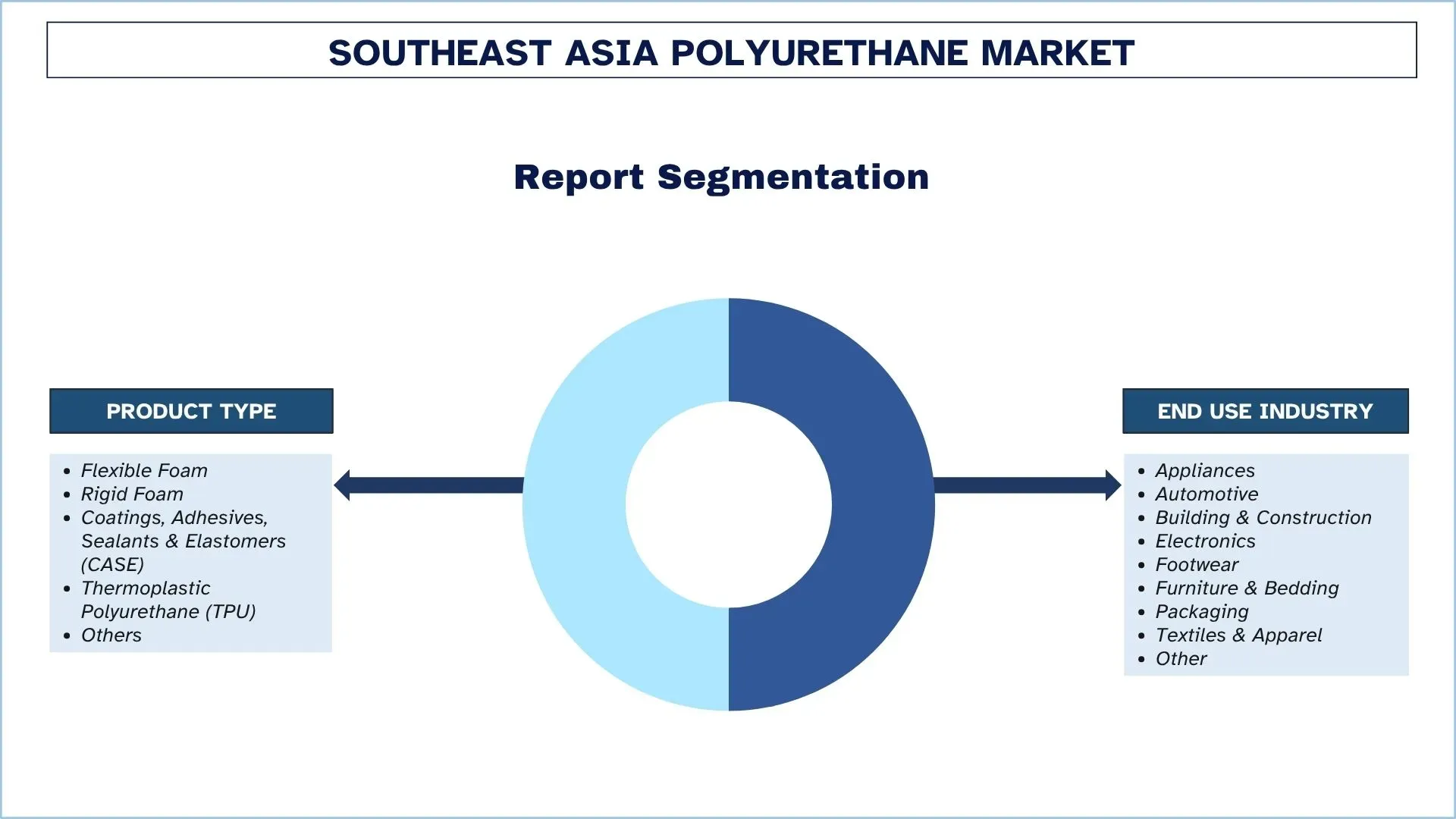
Emphasis on Product Type (Flexible Foam, Rigid Foam, Coatings, Adhesives, Sealants & Elastomers (CASE), Thermoplastic Polyurethane (TPU), and Others); End Use Industry (Appliances, Automotive, Building & Construction, Electronics, Footwear, Furniture & Bedding, Packaging, Textiles & Apparel, and Other); and Country.
Southeast Asia Polyurethane Market Size & Forecast
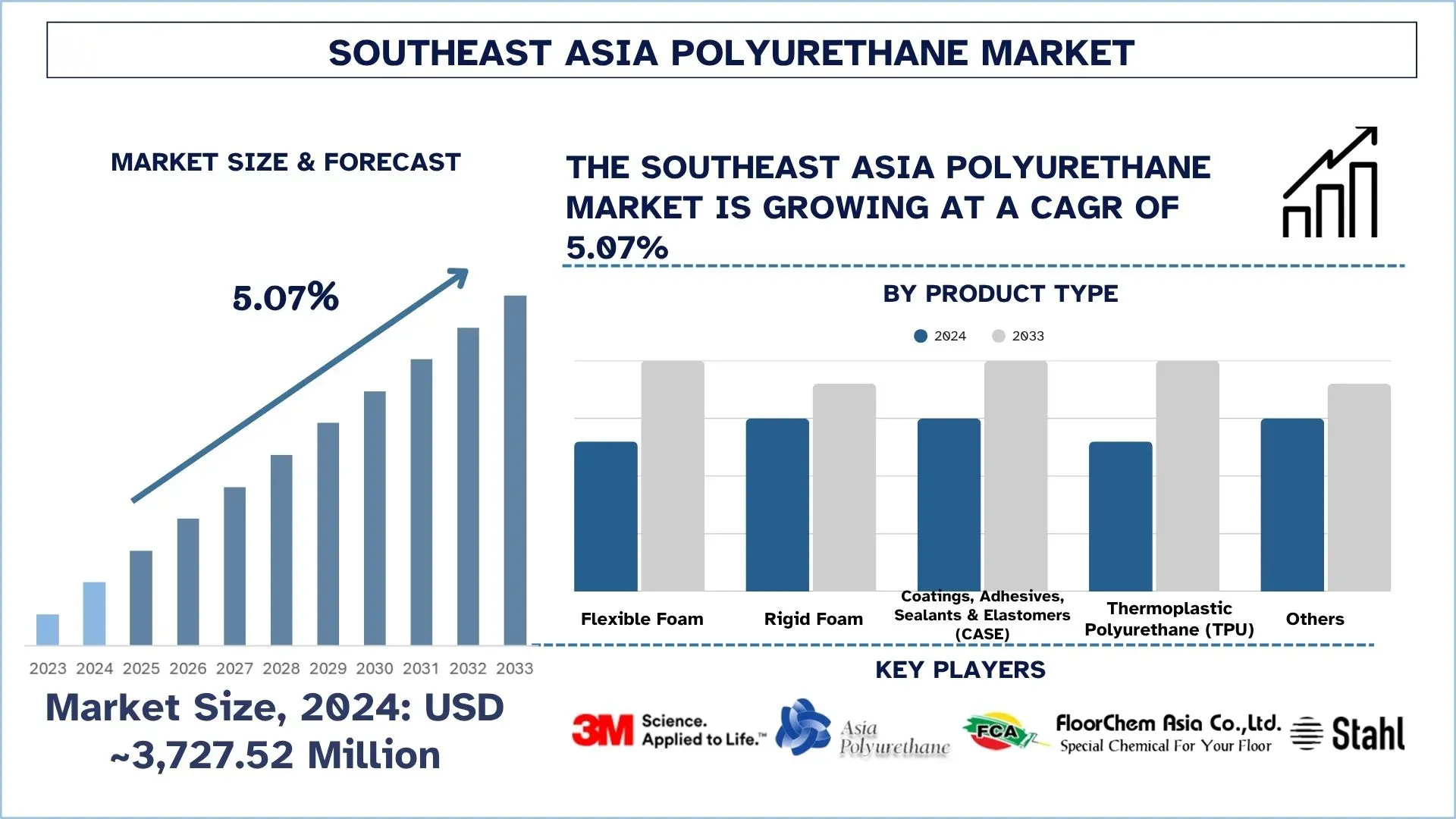
The Southeast Asia Polyurethane Market was valued at USD 3,727.52 million in 2024 and is expected to grow at a strong CAGR of around 5.07% during the forecast period (2025-2033F), driven by government initiatives supporting industrialization and the adoption of eco-friendly materials.
Southeast Asia Polyurethane Market Analysis
Polyurethane is an artificial resin characterized by its durability, plasticity, and thermal insulation properties. Its lightweight structure and chemical resistance have made it find wide application in furniture, construction, automotive, and footwear.
In the Southeast Asian market, manufacturers are localizing production, establishing system houses, and investing in automation to address the growing demand in the region. Furthermore, companies are implementing low-energy-use and bio-based polyurethane technologies as part of their efforts to meet sustainability requirements and develop specialized formulations for construction, automotive interiors, and consumer products. Moreover, companies are expanding their market presence through new manufacturing plants, which are combined with smart manufacturing procedures and digital monitoring, helping to optimize production costs and enhance the performance of materials, thereby leading to competitiveness in both domestic and overseas markets.
On May 2, 2025, South Korea’s Dongsung Chemical inaugurated a polyurethane (PU) production plant in Karawang, Indonesia, representing a key step in expanding its global materials presence. The advanced 81,000-square-meter plant will annually produce 67,000 tons of PU-based materials such as prepolymers, polyester polyols, and polyurethane resins, tripling the company's previous output across China, Korea, and Vietnam.
Built with advanced automation and robust storage capacity, the facility enhances supply chain resilience and is expected to generate approximately USD 150 million in annual revenue. Positioned near key logistics hubs, it will serve growing markets across Southeast Asia, the Americas, and Europe.
Southeast Asia Polyurethane Market Trends
This section discusses the key market trends that are influencing the various segments of the Southeast Asia Polyurethane market, as found by our team of research experts.
Shift Toward Green Polyurethane
The increased environmental regulations and consumer demands for sustainable materials are driving the Southeast Asian producers towards bio-based and recyclable polyurethane solutions. Also, companies are investing in low-emission and renewable raw materials to ensure they meet the green building requirements and minimize carbon footprints. Moreover, the rising regulatory transition, which is also cost-effective in the long term, will promote its use in the construction, furniture, and automotive industries. Due to this, green polyurethane is becoming one of the trends that will help meet the targets of the circular economy and contribute to the development of regional competitiveness.
On October 15, 2024, Stahl, the world leader in specialty coatings for flexible materials, announced the opening of a new state-of-the-art facility for the manufacturing of polyurethane dispersions (PUD) in Singapore. This strategic expansion is designed to better serve the growing demand in the Asian and South Pacific regions. The new facility underscores Stahl’s commitment to sustainability and innovation, while also supporting the company’s environmental, social, and governance (ESG) goals.
Southeast Asia Polyurethane Industry Segmentation
This section provides an analysis of the key trends in each segment of the Southeast Asia Polyurethane market, along with forecasts at the country level for 2025-2033.
The flexible foam polyurethane market dominated the market share in 2024.
Based on product type, the market is segmented into flexible foam, rigid foam, coatings, adhesives, sealants & elastomers (CASE), thermoplastic polyurethane (TPU), and others. Among these, the flexible foam polyurethane market held the dominant share in 2024. This is mainly because its demand is in the furniture, bedding, and car seats industries. The growth of living standards and demand for comfort-oriented consumer products is driving mass production in ASEAN countries. The flexible foam is versatile, lightweight, and cost-efficient, thus becoming indispensable to manufacturers seeking to grow in both local and international markets.
The building & construction segment is expected to grow with a significant CAGR during the forecast period (2025-2033).
Based on end use industry, the Southeast Asian Polyurethane market is segmented into appliances, automotive, building & construction, electronics, footwear, furniture & bedding, packaging, textiles & apparel, and other. Among these, the building & construction segment is expected to grow at a significant CAGR during the forecast period (2025-2033). The consumption of polyurethane is increasing due to the construction boom in Southeast Asia, which is fueled by urban housing development, infrastructure projects, and smart city initiatives. The rigid PU foams are finding more applications in thermal insulation, waterproofing, and energy-saving buildings. The sustainability and adherence to the demands of green building also remain concerns for this sector, which encourages investment in high-performance PU materials. On July 19, 2024, Otis Indonesia began modernizing 39 units, including replacing 25 escalators, eight elevators, and modernizing six escalators of Millennium Mall. To provide a smoother, quieter, and more comfortable ride, the existing machine belts in several of the elevators will be replaced with Otis’ Gen2® patented polyurethane-coated steel flat belts that significantly decrease vibration.
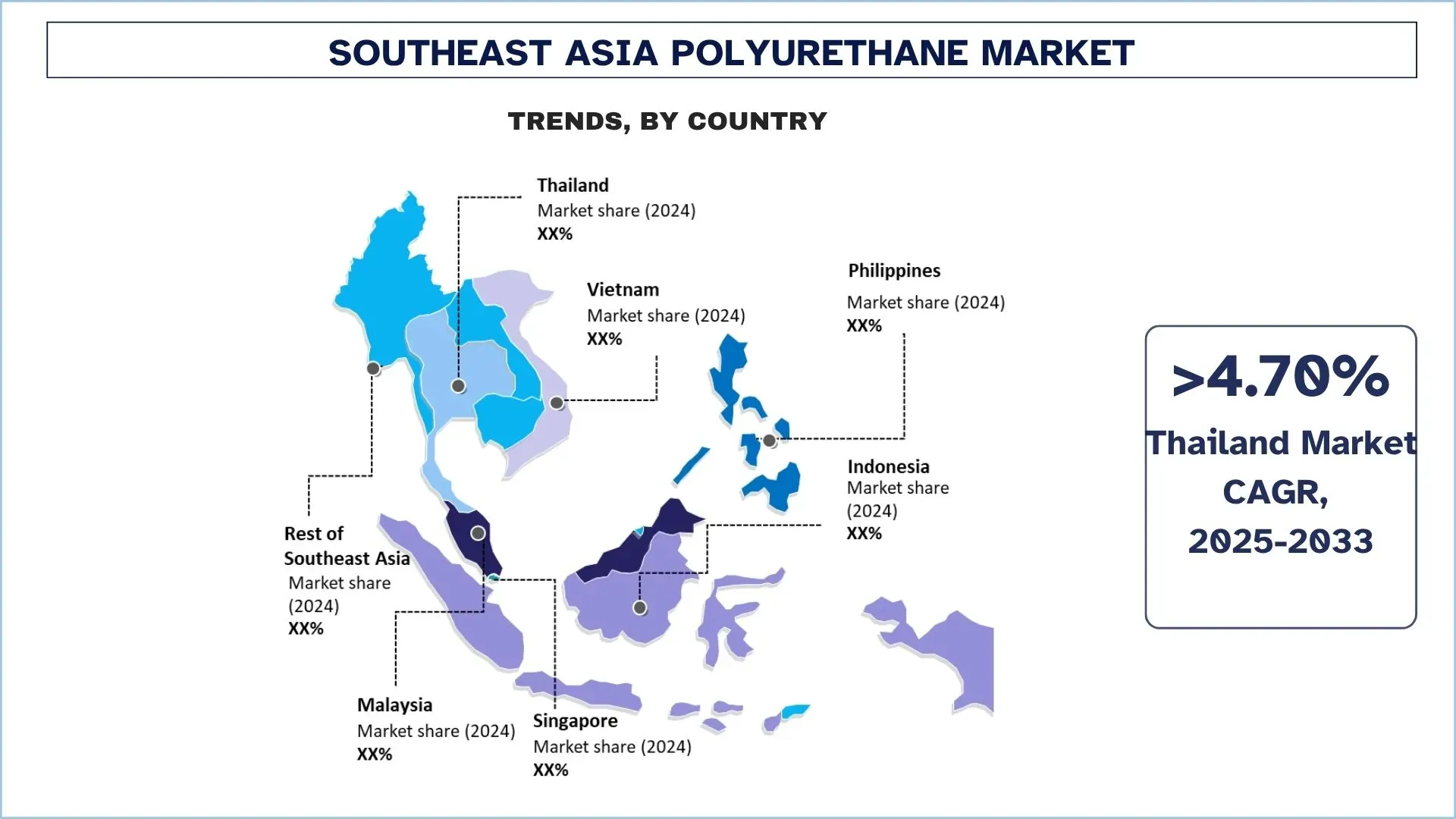
Thailand held a dominant share of the Southeast Asian Polyurethane market in 2024
The construction, automotive, and furniture industries are also driving demand for polyurethane in Thailand, which has led to a significant increase in the polyurethane market. The use of rigid and flexible PU foams is being driven by government incentives for using energy-efficient buildings and the expansion of industrial parks. Furthermore, major manufacturers are also automating their production processes and developing environmentally friendly formulations, thereby enhancing the quality and compliance of their products with green standards. Moreover, the increased urbanization and infrastructure development, particularly in smart cities and industrial belts, are generating a long-term demand for insulation and a permanent need for long-lasting PU products. Therefore, Thailand is emerging as a regional hub of polyurethane innovation and a leading exporter of polyurethane in Southeast Asia.
On July 21, 2023, Dow Thailand Group, the leading global materials science company, launched the new polyurethane flooring adhesive technology DIAMONDLOCK™ to the Thailand market. The product is versatile for use with various flooring substrates, easy to cure and handle, flexible, non-flammable, user-friendly, and with non-detectable Volatile Organic Compounds (VOCs). It can be used with less volume, covering a larger surface area while perfectly answering the architectural requirements of today’s green buildings by being LEED certified. It won a 2020 bronze Edison Award and is now ready to be commercialized in Thailand.
Southeast Asia Polyurethane Industry Competitive Landscape
The Southeast Asia Polyurethane market is competitive, with several global and international market players. The key players are adopting different growth strategies to enhance their market presence, such as partnerships, agreements, collaborations, new product launches, geographical expansions, and mergers and acquisitions.
Top Southeast Asia Polyurethane Companies
Some of the major players in the market are 3M, Asia Polyurethane, FloorChem Asia Co.,Ltd., Pearl Polyurethane, Stahl Holdings B.V., Tosoh Asia Pte. Ltd., NewTec Group, Wansern Foam Industry Sdn. Bhd., Growchem Sdn Bhd, PU (THAILAND) CO., LTD.
Recent Developments in the Southeast Asia Polyurethane Market
- On June 22, 2025, Pearl Polyurethane Systems, a Dubai-headquartered provider of polyurethane (PU) insulation solutions, announced a plan to boost capacity at its first Southeast Asia plant in Dong Nai province, an industrial hub in southern Vietnam. The move came less than a year after the plant’s inauguration in October 2024 in An Phuoc Industrial Park, Long Thanh district. The Pearl Vietnam factory is the company’s fifth global production site. The additional production line will go on stream next month, increasing the plant’s total annual capacity to 20,000 tons of PU systems.
Southeast Asia Polyurethane Market Report Coverage
Details | |
Base year | 2024 |
Forecast period | 2025-2033 |
Growth momentum | Accelerate at a CAGR of 5.07% |
Market size 2024 | USD 3,727.52 Million |
Country analysis | Indonesia, Thailand, Philippines, Vietnam, Malaysia, Singapore, Rest of Southeast Asia |
Major contributing Country | Vietnam is expected to grow at the highest CAGR during the forecasted period. |
Companies profiled | 3M, Asia Polyurethane, FloorChem Asia Co.,Ltd., Pearl Polyurethane, Stahl Holdings B.V., Tosoh Asia Pte. Ltd., NewTec Group, Wansern Foam Industry Sdn. Bhd., Growchem Sdn Bhd, PU (THAILAND) CO., LTD. |
Report Scope | Market Trends, Drivers, and Restraints; Revenue Estimation and Forecast; Segmentation Analysis; Demand and Supply Side Analysis; Competitive Landscape; Company Profiling |
Segments Covered | By Product Type, By End Use Industry, By Country |
Reasons to Buy the Southeast Asia Polyurethane Market Report:
- The study includes market sizing and forecasting analysis confirmed by authenticated key industry experts.
- The report briefly reviews overall industry performance at a glance.
- The report covers an in-depth analysis of prominent industry peers, primarily focusing on key business financials, product portfolios, expansion strategies, and recent developments.
- Detailed examination of drivers, restraints, key trends, and opportunities prevailing in the industry.
- The study comprehensively covers the market across different segments.
Customization Options:
The Southeast Asia Polyurethane market can further be customized as per requirements or any other market segment. Besides this, UnivDatos understands that you may have your own business needs; hence, feel free to contact us to get a report that completely suits your requirements.
Table of Content
Research Methodology for the Southeast Asia Polyurethane Market Analysis (2023-2033)
We analyzed the historical market, estimated the current market, and forecasted the future market of the Southeast Asian Polyurethane market to assess its application in major countries. We conducted exhaustive secondary research to gather historical market data and estimate the current market size. To validate these insights, we carefully reviewed numerous findings and assumptions. Additionally, we conducted in-depth primary interviews with industry experts across the Southeast Asian Polyurethane value chain. After validating market figures through these interviews, we used both top-down and bottom-up approaches to forecast the overall market size. We then employed market breakdown and data triangulation methods to estimate and analyze the market size of industry segments and sub-segments.
Market Engineering
We employed the data triangulation technique to finalize the overall market estimation and derive precise statistical numbers for each segment and sub-segment of the Southeast Asia Polyurethane market. We split the data into several segments and sub-segments by analyzing various parameters and trends, including product type, end use industry, and country within the Southeast Asian Polyurethane market.
The Main Objective of the Southeast Asia Polyurethane Market Study
The study identifies current and future trends in the Southeast Asia Polyurethane market, providing strategic insights for investors. It highlights market attractiveness, enabling industry participants to tap into untapped markets and gain a first-mover advantage. Other quantitative goals of the studies include:
Market Size Analysis: Assess the current and forecast market size of the Southeast Asia Polyurethane market and its segments in terms of value (USD).
Southeast Asia Polyurethane Market Segmentation: Segments in the study include areas of product type, end use industry, and country.
Regulatory Framework & Value Chain Analysis: Examine the regulatory framework, value chain, customer behavior, and competitive landscape of the Southeast Asia Polyurethane industry.
Country Analysis: Conduct a detailed country analysis for key areas such as Indonesia, Thailand, the Philippines, Vietnam, Malaysia, Singapore, and the Rest of Southeast Asia.
Company Profiles & Growth Strategies: Company profiles of the Southeast Asia Polyurethane market and the growth strategies adopted by the market players to sustain in the fast-growing market.
Frequently Asked Questions FAQs
Q1: What is the Southeast Asia Polyurethane market’s current market size and growth potential?
The Southeast Asia Polyurethane market was valued at USD 3,727.52 Million in 2024 and is projected to expand at a CAGR of 5.07% from 2025 to 2033. This growth is fueled by rising demand across construction, automotive, and furniture sectors, coupled with increased investments in local manufacturing and green polyurethane solutions.
Q2: Which segment has the largest share of the Southeast Asia Polyurethane market by product type?
The flexible foam dominates the market owing to its wide use in furniture, bedding, automotive interiors, and packaging applications. Its cost-effectiveness and versatility continue to make it the preferred choice among manufacturers and end users.
Q3: What are the driving factors for the growth of the Southeast Asia Polyurethane market?
Major growth drivers include expanding construction projects, growing automotive and electronics production, lifestyle upgrades, and a shift toward sustainable polyurethane materials. Supportive government policies and foreign investments in industrial development are further accelerating market adoption.
Q4: What are the emerging technologies and trends in the Southeast Asia Polyurethane market?
The market is witnessing a shift toward bio-based and recyclable polyurethane, integration of smart insulation materials in urban infrastructure, and adoption of advanced production technologies for energy efficiency. Digital monitoring and process automation are also becoming critical trends across manufacturing plants.
Q5: What are the key challenges in the Southeast Asia Polyurethane market?
Key challenges include volatile raw material prices, dependency on imports for chemical precursors, lack of large-scale recycling systems, and regulatory pressures on carbon emissions. Addressing these issues is vital for ensuring sustainable market expansion.
Q6: Which country dominates the Southeast Asia Polyurethane market?
Thailand leads the regional market due to its strong industrial base, robust construction sector, and expanding automotive manufacturing. The country also benefits from a favorable business environment and proximity to key chemical suppliers.
Q7: Who are the key players in the Southeast Asia Polyurethane market?
Leading companies in the Southeast Asia Polyurethane market include:
• 3M
• Asia Polyurethane
• FloorChem Asia Co.,Ltd.
• Pearl Polyurethane
• Stahl Holdings B.V.
• Tosoh Asia Pte. Ltd.
• NewTec Group
• Wansern Foam Industry Sdn. Bhd.
• Growchem Sdn Bhd
• PU (THAILAND) CO., LTD.
Q8: What investment and expansion activities are shaping the future of the Southeast Asia Polyurethane market?
The market is seeing increased investment in new manufacturing facilities and system houses across Thailand, Vietnam, and Malaysia. Companies are expanding local production to reduce import dependency and meet growing regional demand, supported by government incentives and industrial corridor development.
Q9: How is sustainability influencing polyurethane production in Southeast Asia?
Sustainability is driving innovation in the region’s polyurethane industry through the adoption of bio-based polyols, recyclable foams, and low-emission manufacturing processes. Producers are aligning with global green standards to attract eco-conscious industries and investors.
Related Reports
Customers who bought this item also bought
India Anisole Market: Current Analysis and Forecast (2026-2034)
Emphasis on Grade Type (Up To 99.5% and Above 99.5%); Application (Pharmaceuticals, Agrochemicals, Perfumes & Fragrances, Dyes, and Others); and Region/States
Southeast Asia Waterproofing Chemicals Market: Current Analysis and Forecast (2025-2033)
Emphasis on Product Type (Bituminous Membrane, Cementitious Coatings, Acrylic Coatings, Polyurethane (PU) Coatings, Elastomeric Coatings, and Others); End Use Industry (Commercial Sector, Residential Sector, Infrastructure Sector, Industrial Sector, and Others); and Country.
Sodium Percarbonate Market: Current Analysis and Forecast (2025-2033)
Emphasis on Type (Coated, Uncoated, and Tablet); Application (Detergent Agents, Cleaning Agents, Bleaching Agents, Water Treatments, and Others); End-Use (Household Cleaning, Laundry, Industrial Cleaning, Textile Industry, Chemical Industry, Papermaking Industry, Food Industry, and Others); and Region/Country
Sodium Hexametaphosphate Market: Current Analysis and Forecast (2025-2033)
Emphasis on Grade (Food-Grade and Technical-Grade); Form (Granular, Powder, and Glass Plates); Application (Water Treatment, Food Additives, Detergents & Cleaning Agents, Ceramics & Construction, Oil & Gas, and Others); and Region/Country