Waste-Fibre Trays Market: Current Analysis and Forecast (2025-2033)
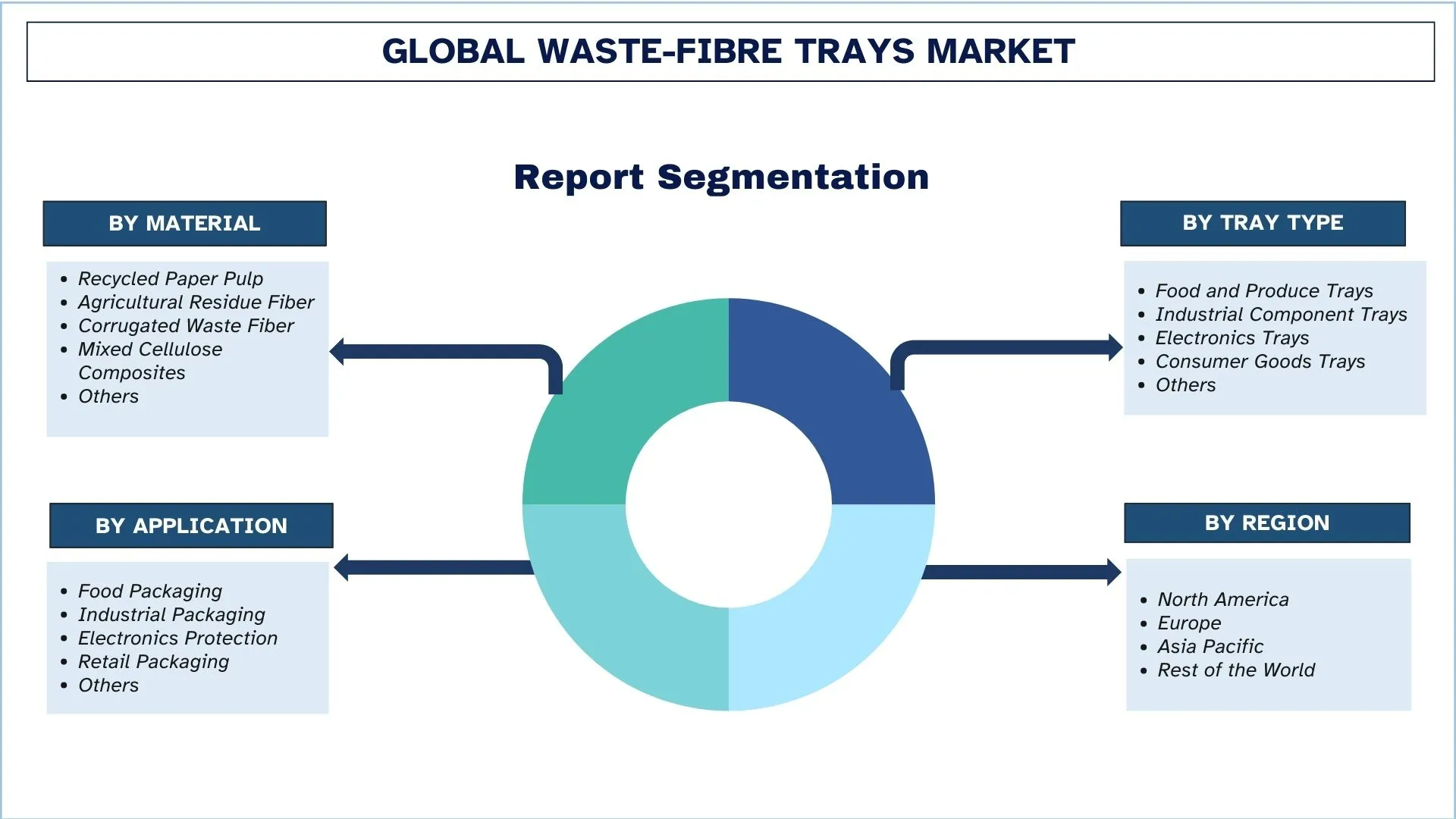
Emphasis on Material (Recycled Paper Pulp, Agricultural Residue Fiber, Corrugated Waste Fiber, Mixed Cellulose Composites, and Others); Tray Type (Food and Produce Trays, Industrial Component Trays, Electronics Trays, Consumer Goods Trays, and Others); Application (Food Packaging, Industrial Packaging, Electronics Protection, Retail Packaging, and Others); and Region/Country
Global Waste-Fibre Trays Market Size & Forecast
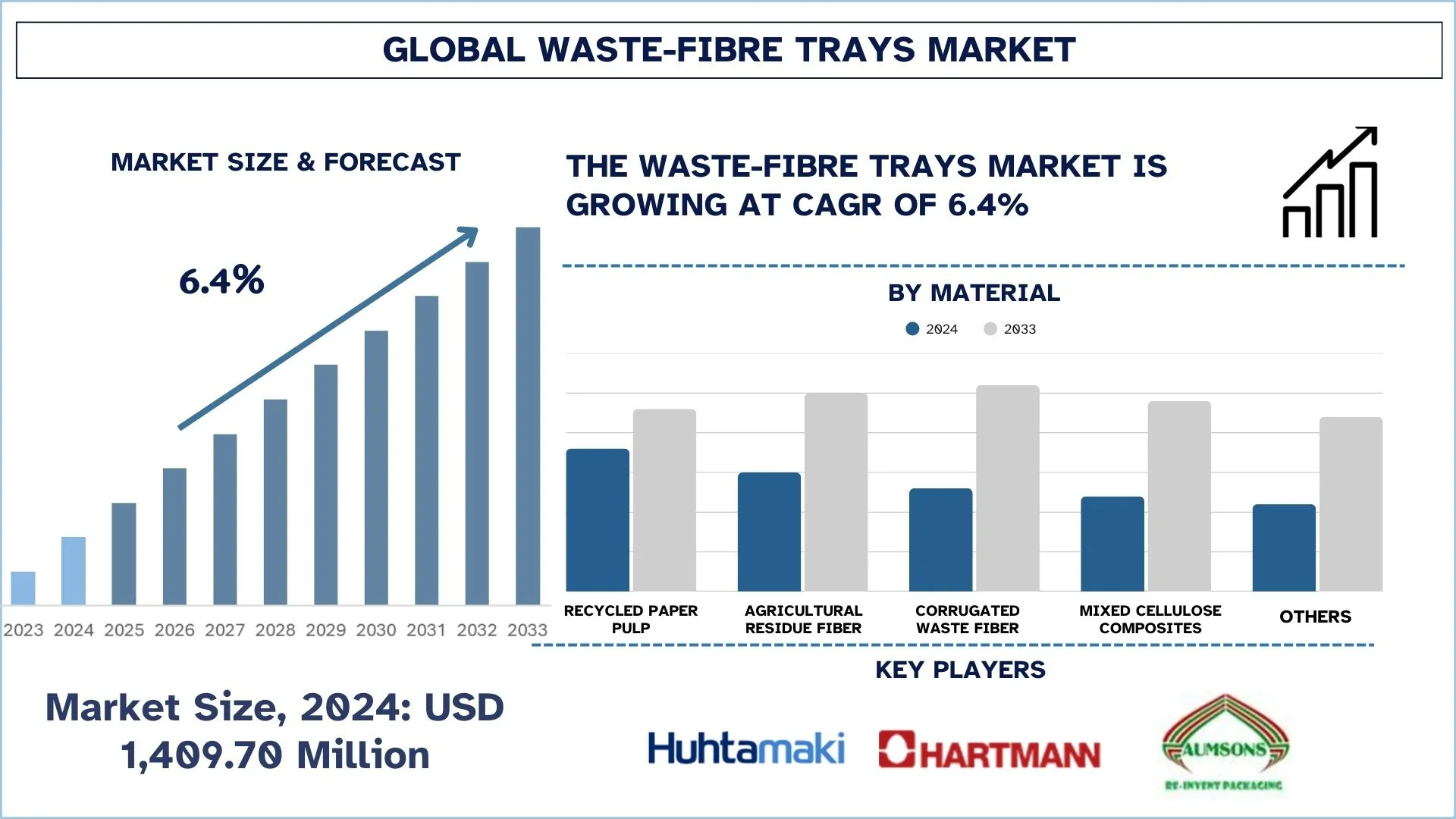
The global waste-fibre trays Market was valued at USD 1,409.70 million in 2024 and is expected to grow to a strong CAGR of around 6.4% during the forecast period (2025-2033F), driven by rising demand for sustainable and biodegradable packaging as industries shift away from single-use plastics.
Waste-Fibre Trays Market Analysis
The waste-fibre trays are sustainable packaging products that are made using recycled paper, cardboard, or other post-consumer and post-industrial fibrous waste products. These trays are made from molded fibre or pulp-forming, which makes them biodegradable, recyclable, and also compostable.
The waste-fibre trays market is growing significantly due to the increasing concern about environmental issues and tightening global restrictions on single-use plastic packaging. Companies in the food service, retail, and consumer goods industries are moving towards biodegradable and recyclable packaging to achieve sustainability goals and consumer demands. Increased demand for eco-friendly food packaging, fast-growing ready-to-eat and takeaway service businesses, and corporate ESG requirements are further driving the waste-fibre trays market.
Global Waste-Fibre Trays Market Trends
This section discusses the key market trends that are influencing the various segments of the global waste-fibre trays market, as found by our team of research experts.
Food & beverage sector dominance
The presence of food and beverages as an emerging industry in the waste-fibre trays market is due to the wide application of the trays in the fresh produce, bakery goods, eggs, ready meals, and takeaway containers, where the question of sustainability is becoming a matter of concern. The trays offer bio-degradable, recyclable, and compostable solutions to plastics in line with stringent environmental standards and consumer need to have environmentally friendly packages. As supermarkets, quick-service restaurants, and food delivery services grow worldwide, protective, moisture-resistant, and visually appealing fiber tray demands are soaring, placing the food and beverage segment as the largest and fastest-growing application segment in such a market.
Waste-Fibre Trays Industry Segmentation
This section provides an analysis of the key trends in each segment of the global waste-fibre trays market report, along with forecasts at the global, regional, and country levels for 2025-2033.
The Recycled Paper Pulp Segment dominates the Global Waste-Fibre Trays market
Based on the material category, the market is categorized into recycled paper pulp, agricultural residue fiber, corrugated waste fiber, mixed cellulose composites, and others. Out of these, the recycled paper pulp segment has the largest market share at present because of its cost-effectiveness, well-developed recycling infrastructure, and acceptance by consumers, and because it can satisfy the performance needs of the packaging applications. It enjoys higher sustainability requirements and simpler scalability requirements than other fiber sources. However, the agricultural residue fiber segment is expected to witness the fastest growth, driven by rising demand for eco-friendly materials, increased utilization of crop residues (like bagasse and straw), supportive environmental regulations, and growing investments in circular economy solutions, especially in the Asia-Pacific and Latin American regions.
The Food and Produce Trays Segment dominates the Global Waste-Fibre Trays market.
Based on the tray type category, the market is categorized into food and produce trays, industrial component trays, electronics trays, consumer goods trays, and others. Among these, the food and produce trays segment holds the largest market share because they are in high demand among food production industries, increase consumer interest in sustainable packaging, and are subject to strict worldwide food safety and recyclability standards. Fruits, vegetables, meat, and ready-to-eat items are commonly used to fill these trays, thus becoming one of the prevailing segments. However, Electronics Trays are expected to grow rapidly as producers will give sustainable, protective packaging options to substitute plastics and foams due to the expansion of e-commerce, increased production of electronics, and the implementation of tougher environmental regulations in North America, Europe, and the Asia-Pacific region.
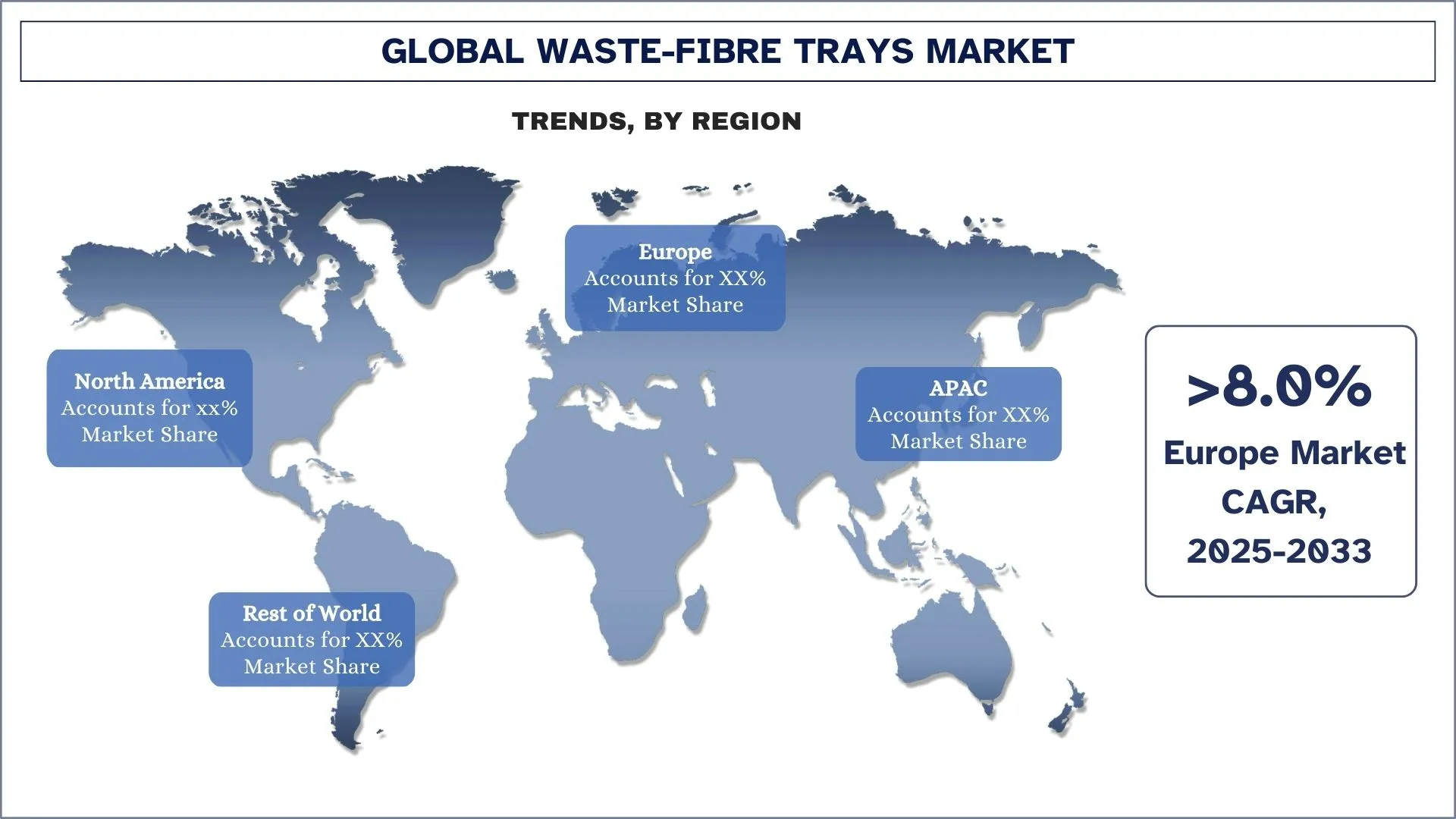
The Europe region is expected to Grow Fastest in the Global Waste-Fibre Trays Market
It is projected that Europe will develop at the most rapid pace in the waste-fibre trays sector, as it has a high level of regulatory environment and high levels of sustainability. The strong policies of the European Union, such as the Single-Use Plastics Directive, Packaging and Packaging Waste Regulation, and Extended Producer Responsibility schemes, are forcing manufacturers to switch to recyclable and biodegradable materials instead of plastics. Consumer eco-awareness, strong recycling systems, and substantial investments in the development of a circular economy are also high in Europe, leading to demand for fiber-based packaging. Moreover, major economies such as Germany, France, and the UK are rapidly replacing plastic trays with molded fiber alternatives in the food, retail, and e-commerce industries, thereby strengthening regional packaging sustainability innovation.
For instance, in June 2025, Coveris, a leading European packaging manufacturer, launched a new board-based MAP tray solution that reduced plastic usage by up to 90% for the meat, fish, and poultry packaging sector while retaining product shelf-life and recyclability. The BarrierFresh MAP trays combined sustainably sourced board with an advanced barrier film and were introduced as a sustainable alternative to traditional rigid plastic trays for chilled food applications.
Germany held a Dominant share of the Europe Waste-Fibre Trays Market in 2024
Germany dominated the market share of the European waste-fibre trays market due to its leading packaging manufacturing base, recycling infrastructure, and the use of sustainable materials. Strict environmental laws are favoring the use of environmentally friendly packaging in the country, and this has enhanced the replacement of plastics with fibre-based trays in the food service and retail industry. The market is further supported by the high demand for ready-to-eat food, fresh produce, and meat packaging segments. Also, the existence of large packaging manufacturers, product innovation, and consumer consciousness on sustainability has reaffirmed the dominant role of Germany in the Europe region.
Waste-Fibre Trays Industry Competitive Landscape
The global waste-fibre trays market is competitive, with several global and international market players. The key players are adopting different growth strategies to enhance their market presence, such as partnerships, agreements, collaborations, geographical expansions, and mergers and acquisitions.
Top Waste-Fibre Trays Market Companies
Some of the major players in the market are Huhtamäki Oyj, Brødrene Hartmann A/S, Cirkla Inc, ThermoFibre, BIONOVA Packaging Solutions Pvt. Ltd., Aumsons Packaging, Boora Pulp Packers, Hotpack Global, Ecolution Packaging, and Fibreform Containers, Inc.
Recent Developments in the Waste-Fibre Trays Market
In May 2025– M&S Food announced the launch of a renewable paper fibre tray for ready meals.
In January 2025– Cirkla, which is a global leader in sustainable packaging, has launched the world’s first molded fiber Modified Atmosphere Packaging (MAP) trays, reducing plastic waste by approximately 85%.
In January 2024– Sealed Air launched its first biobased, industrial compostable protein packaging tray under the CRYOVAC® brand at IPPE 2024, offering a sustainable alternative to traditional expanded polystyrene (EPS) trays. The compostable tray, made from USDA-certified biobased resin and tested to meet existing food processing requirements, was introduced at the International Product & Processing Expo in Atlanta.
Global Waste-Fibre Trays Market Report Coverage
Report Attribute | Details |
Base year | 2024 |
Forecast period | 2025-2033 |
Growth momentum | Accelerate at a CAGR of 6.4% |
Market size 2024 | USD 1,409.70 Million |
Regional analysis | North America, Europe, APAC, Rest of the World |
Major contributing region | Asia-Pacific is expected to dominate the market during the forecast period. |
Key countries covered | U.S., Canada, Germany, U.K., Spain, Italy, France, China, Japan, and India |
Companies profiled | Huhtamäki Oyj, Brødrene Hartmann A/S, Cirkla Inc, ThermoFibre, BIONOVA Packaging Solutions Pvt. Ltd., Aumsons Packaging, Boora Pulp Packers, Hotpack Global, Ecolution Packaging, and Fibreform Containers, Inc. |
Report Scope | Market Trends, Drivers, and Restraints; Revenue Estimation and Forecast; Segmentation Analysis; Demand and Supply Side Analysis; Competitive Landscape; Company Profiling |
Segments Covered | By Material, By Tray Type, By Application, By Region/Country |
Reasons to Buy the Waste-Fibre Trays Market Report:
The study includes market sizing and forecasting analysis confirmed by authenticated key industry experts.
The report briefly reviews overall industry performance at a glance.
The report covers an in-depth analysis of prominent industry peers, primarily focusing on key business financials, type portfolios, expansion strategies, and recent developments.
Detailed examination of drivers, restraints, key trends, and opportunities prevailing in the industry.
The study comprehensively covers the market across different segments.
Deep dive regional level analysis of the industry.
Customization Options:
The global Waste-Fibre Trays market can further be customized as per the requirements or any other market segment. Besides this, UnivDatos understands that you may have your own business needs, hence feel free to contact us to get a report that completely suits your requirements.
Table of Content
Research Methodology for the Global Waste-Fibre Trays Market Analysis (2023-2033)
We analyzed the historical market, estimated the current market, and forecasted the future market of the global waste-fibre trays market to assess its application in major regions worldwide. We conducted exhaustive secondary research to gather historical market data and estimate the current market size. To validate these insights, we carefully reviewed numerous findings and assumptions. Additionally, we conducted in-depth primary interviews with industry experts across the waste-fibre trays value chain. After validating market figures through these interviews, we used both top-down and bottom-up approaches to forecast the overall market size. We then employed market breakdown and data triangulation methods to estimate and analyze the market size of industry segments and sub-segments.
Market Engineering
We employed the data triangulation technique to finalize the overall market estimation and derive precise statistical numbers for each segment and sub-segment of the global waste-fibre trays market. We split the data into several segments and sub-segments by analyzing various parameters and trends, including material, tray type, application, and regions within the global waste-fibre trays market.
The Main Objective of the Global Waste-Fibre Trays Market Study
The study identifies current and future trends in the global waste-fibre trays market, providing strategic insights for investors. It highlights regional market attractiveness, enabling industry participants to tap into untapped markets and gain a first-mover advantage. Other quantitative goals of the studies include:
Market Size Analysis: Assess the current and forecast market size of the global waste-fibre trays market and its segments in terms of value (USD).
Waste-Fibre Trays Market Segmentation: Segments in the study include areas of material, tray type, application, and region.
Regulatory Framework & Value Chain Analysis: Examine the regulatory framework, value chain, customer behavior, and competitive landscape of the waste-fibre trays industry.
Regional Analysis: Conduct a detailed regional analysis for key areas such as Asia Pacific, Europe, North America, and the Rest of the World.
Company Profiles & Growth Strategies: Company profiles of the waste-fibre trays market and the growth strategies adopted by the market players to sustain the fast-growing market.
Frequently Asked Questions FAQs
Q1: What is the global waste-fibre trays market’s current market size and growth potential?
The global waste-fibre trays market is currently valued at around USD 1,409.70 million and is expected to witness steady growth, driven by increasing demand for sustainable and biodegradable packaging solutions worldwide.
Q2: Which segment has the largest share of the global waste-fibre trays market by material category?
The recycled paper pulp segment accounts for the largest share of the global waste-fibre trays market due to its cost-effectiveness, recyclability, and wide acceptance across food and consumer packaging applications.
Q3: What are the driving factors for the growth of the global waste-fibre trays market?
Driving factors for the growth of the global waste-fibre trays market include:
• Rising adoption of recycled fiber and eco-friendly materials
• Environmental regulations restricting plastics
• Growing consumer preference for sustainable packaging
Q4: What are the emerging technologies and trends in the global waste-fibre trays market?
Emerging trends in the waste-fibre trays market include:
• Food & beverage sector dominance
• Digital and customizable packaging
Q5: What are the key challenges in the global waste-fibre trays market?
Key challenges in the global waste-fibre trays market include:
• Raw material supply and quality variability
• High manufacturing and processing costs
Q7: Who are the key competitors in the global waste-fibre trays market?
Top players in the waste-fibre trays industry include:
• HuhtamäkiOyj
• Brødrene Hartmann A/S
• CirklaInc
• ThermoFibre
• BIONOVA Packaging Solutions Pvt. Ltd.
• Aumsons Packaging
• Boora Pulp Packers
• Hotpack Global
• Ecolution Packaging
• Fibreform Containers, Inc.
Q8: What investment opportunities exist in the global waste-fibre trays market?
The market presents strong investment opportunities in capacity expansion, advanced moulded fibre technologies, and sustainable packaging innovations. High-growth regions such as Asia-Pacific and increasing demand from food, healthcare, and e-commerce packaging sectors further enhance long-term returns.
Q9: What is the future outlook of the global waste-fibre trays market over the forecast period?
The waste-fibre trays market is expected to witness consistent growth, supported by tightening environmental regulations, increasing corporate sustainability commitments, and the rising replacement of plastic trays with fibre-based alternatives across multiple end-use industries.
Related Reports
Customers who bought this item also bought



India Anisole Market: Current Analysis and Forecast (2026-2034)
Emphasis on Grade Type (Up To 99.5% and Above 99.5%); Application (Pharmaceuticals, Agrochemicals, Perfumes & Fragrances, Dyes, and Others); and Region/States

Southeast Asia Waterproofing Chemicals Market: Current Analysis and Forecast (2025-2033)
Emphasis on Product Type (Bituminous Membrane, Cementitious Coatings, Acrylic Coatings, Polyurethane (PU) Coatings, Elastomeric Coatings, and Others); End Use Industry (Commercial Sector, Residential Sector, Infrastructure Sector, Industrial Sector, and Others); and Country.

Sodium Percarbonate Market: Current Analysis and Forecast (2025-2033)
Emphasis on Type (Coated, Uncoated, and Tablet); Application (Detergent Agents, Cleaning Agents, Bleaching Agents, Water Treatments, and Others); End-Use (Household Cleaning, Laundry, Industrial Cleaning, Textile Industry, Chemical Industry, Papermaking Industry, Food Industry, and Others); and Region/Country

Sodium Hexametaphosphate Market: Current Analysis and Forecast (2025-2033)
Emphasis on Grade (Food-Grade and Technical-Grade); Form (Granular, Powder, and Glass Plates); Application (Water Treatment, Food Additives, Detergents & Cleaning Agents, Ceramics & Construction, Oil & Gas, and Others); and Region/Country