Southeast Asia Waterproofing Chemicals Market: Current Analysis and Forecast (2025-2033)
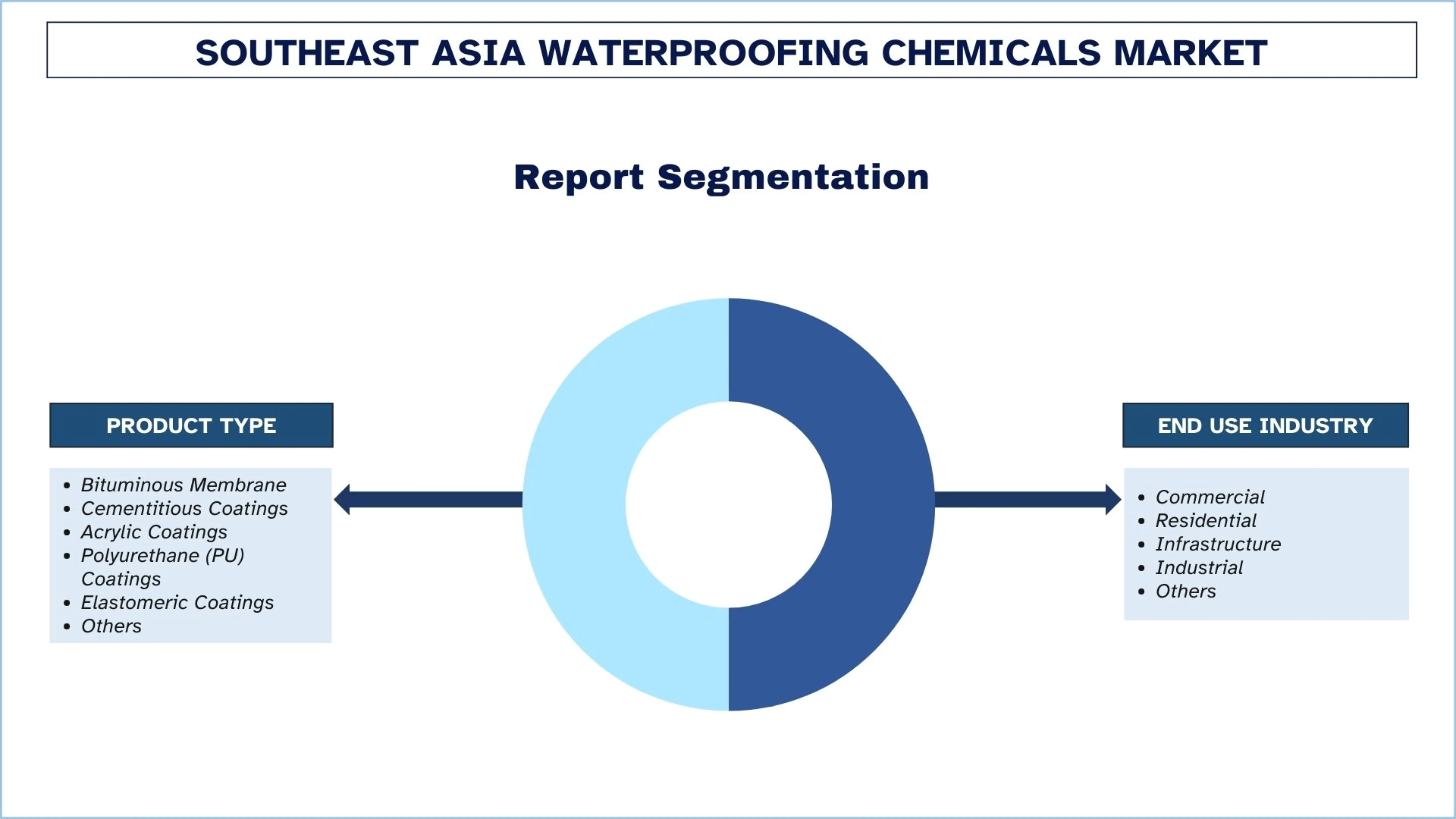
Emphasis on Product Type (Bituminous Membrane, Cementitious Coatings, Acrylic Coatings, Polyurethane (PU) Coatings, Elastomeric Coatings, and Others); End Use Industry (Commercial Sector, Residential Sector, Infrastructure Sector, Industrial Sector, and Others); and Country.
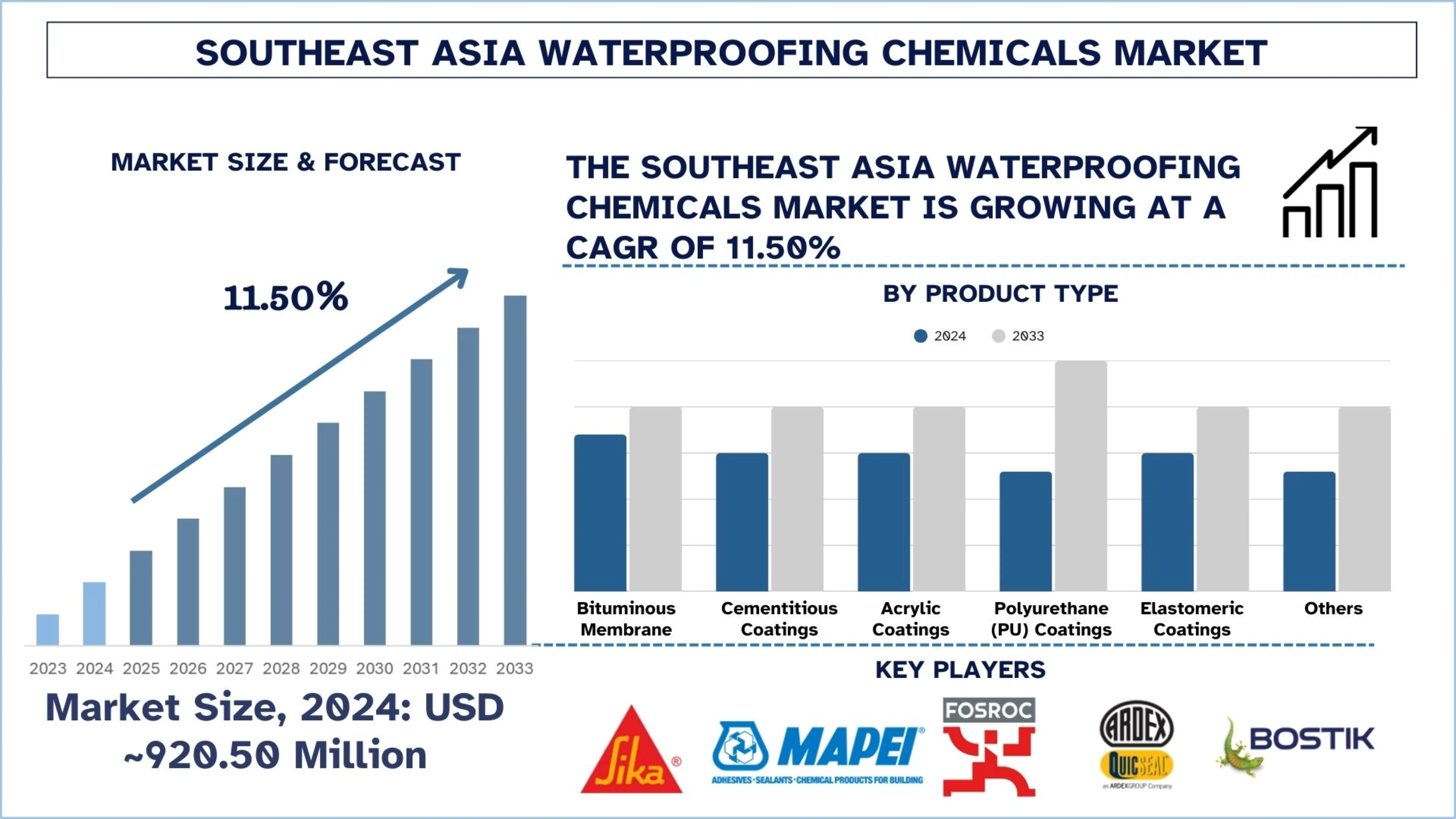
Southeast Asia Waterproofing Chemicals Market Size & Forecast
The Southeast Asia Waterproofing Chemicals market was valued at ~USD 920.50 million in 2024 and is expected to grow at a strong CAGR of around 11.50% during the forecast period (2025-2033F), driven by rapid urbanization and infrastructure expansion.
Southeast Asia Waterproofing Chemicals Market Analysis
Waterproofing chemicals are specialized construction materials designed to prevent water from entering structures and infrastructure. These are membranes, coatings, sealants, and admixtures that help in improving structural durability, water resistance, and lifecycle performance.
The growing use of modern waterproofing chemicals is driving a structural shift toward performance-based specifications across Southeast Asia. Developers' focus has been shifting toward long-term asset protection, which is driving demand for highly durable, environmentally acceptable formulations. Adding to this, the presence of localized manufacturing enhances the resilience of supply chains and the competitiveness in prices of emerging economies. Also, the focus on applicator training and technical support is an indication of the growing significance of proper installation in ensuring product operability and minimizing liability risks. Moreover, the rising green building standards will be a fundamental factor in project approvals.
For example, on March 2, 2026, Ducol Organics & Colours Limited, a rapidly growing chemical manufacturing company with over three decades of industry presence, announced a strategic partnership with Malaysia-based Qualibit Chemicals & Industries Sdn. Bhd. to expand its waterproofing and construction chemicals business across Southeast Asia. The collaboration will see Ducol supply waterproofing systems manufactured through its subsidiary Bitumag to Qualibit’s established ASEAN manufacturing and market network, with scope to extend the partnership to products and capabilities from future strategic acquisitions in the waterproofing and construction chemicals sector, subject to mutual alignment.
For example, on September 4, 2024, the Mapei training session was successfully held with the participation of Mapei members from the APAC region and Mapei Vietnam as well. This training session focused on Mapei's tiling and waterproofing product line and was carefully prepared to equip the Mapei team with the necessary skills and knowledge to provide customers with the best service and the most accurate information about Mapei's products.
Southeast Asia Waterproofing Chemicals Market Trends
This section discusses the key market trends that are influencing the various segments of the Southeast Asia Waterproofing Chemicals market, as found by our team of research experts.
Smart Coatings and High-Performance Materials
The increased use of smart coating and high-performance waterproofing materials is also becoming a powerful growth trend in Southeast Asia. Durability, crack-bridging, UV resistance, and increased lifecycle performance are becoming increasing concerns to developers and infrastructure authorities to lower the cost of maintenance. Also, the developed polyurethane, elastomeric, and hybrid systems are more adhesive and flexible, making them especially applicable in the region's tropical climate. In major commercial and infrastructural projects, specification-based procurement is driving demand toward technologically improved systems. Moreover, the shift to performance-based solutions featuring traditional materials is accelerating the penetration of premium products and the expansion of value across the entire market. For instance, on January 25, 2023, Bostik unveiled smart waterproofing solutions SEAL & BLOCK in Malaysia. SEAL&BLOCK gives the installer all the solutions to waterproof and protect the building at all levels, from the basement to the roof.
Southeast Asia Waterproofing Chemicals Industry Segmentation
This section provides an analysis of the key trends in each segment of the Southeast Asia Waterproofing Chemicals market, along with forecasts at the country level for 2025-2033.
The cementitious coatings waterproofing chemicals market is expected to grow at a significant CAGR during the forecast period (2025-2033).
Based on product type, the market is segmented into bituminous membrane, cementitious coatings, acrylic coatings, polyurethane (PU) coatings, elastomeric coatings, and others. Among these, the cementitious coatings waterproofing chemicals market is expected to grow at a significant CAGR during the forecast period (2025-2033). This is because it is economical, easy to use, and adhesive to common concrete substrates in Southeast Asia. Their use in residential and infrastructure projects is also very high, as they perform well in wet conditions, basements, and water-holding structures. This segment is fueling the market due to the establishment of mid-income housing and civic infrastructure projects, with developers shifting focus to low-cost yet cost-effective waterproofing solutions. For instance, on January 16, 2025, Sika opened two state-of-the-art plants in Singapore and in Xi'an, Northwest China. The newly built plant in Singapore specializes in the production of mortars, while the Xi'an facility manufactures a full range of Sika products, including tile adhesives, cementitious waterproofing, and flooring solutions. With both plants, Sika will be able to respond better to local market demands while significantly reducing logistical distances.
The residential segment is expected to grow with a significant CAGR during the forecast period (2025-2033).
Based on end use industry, the Southeast Asian Waterproofing Chemicals market is segmented into commercial, residential, infrastructure, industrial, and others. Among these, the residential segment held the dominant share in 2024. This segment is driven by high urbanization and population growth, which leads to massive housing construction in Southeast Asian market economies. In addition, low-cost housing programs and residential real estate development boost the demand for roofing, bathroom, and foundation waterproofing equipment. This continuous flow of residential developments gives it a constant-volume demand, which is the main source of revenue for manufacturers.
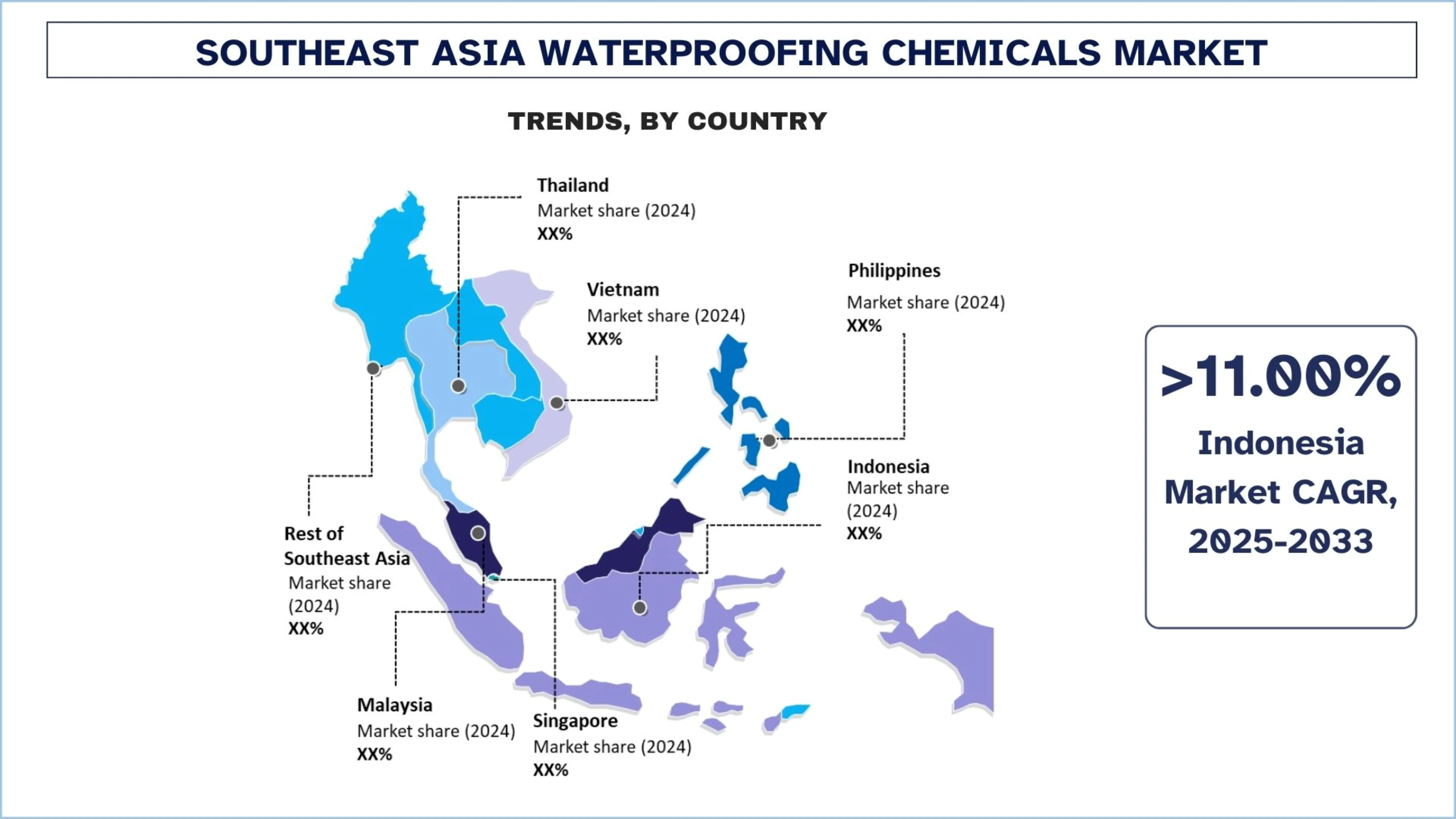
Indonesia held a dominant share of the Southeast Asian Waterproofing Chemicals market in 2024
Indonesia held a dominant share in the market in Southeast Asia owing to a large population in the country and a continuous shift in construction towards residential and infrastructure. The development projects by the government, including transport corridors and urban housing, are some of the drivers of steady demand for waterproofing chemicals. Also, the country's tropical climate, complete with high rainfall and humidity, is a structural requirement for moisture protection. Additionally, the rapid urbanization in Tier-2 and Tier-3 cities adds to the construction backlog. Furthermore, strong volume consumption and continuous infrastructure improvements make Indonesia the revenue center in this region. For example, on January 15, 2026, IMCD Group, a global leading partner for the distribution and formulation of speciality chemicals and ingredients, opened a new Construction Laboratory in Indonesia, thus building a full technical centre of expertise for coatings and construction in Southeast Asia. In coatings, this includes decorative paints, industrial metal coatings, wood, plastic, and automotive coatings. In construction, the focus spans dry mix mortars, flooring resins and waterproofing systems, concrete blocks, bricks and masonry, as well as joint fillers, sealants and ready-to-use renders.
Southeast Asia Waterproofing Chemicals Industry Competitive Landscape
The Southeast Asia Waterproofing Chemicals market is competitive, with several global and international market players. The key players are adopting different growth strategies to enhance their market presence, such as partnerships, agreements, collaborations, new product launches, geographical expansions, and mergers and acquisitions.
Top Southeast Asia Waterproofing Chemicals Companies
Some of the major players in the market are Sika AG, Mapei Group, Fosroc, Inc. (Saint-Gobain), ARDEX-QUICSEAL SINGAPORE PTE. LTD. (ARDEX Group), Bostik (Arkema), Flowcrete Group Ltd., OYH Overseas Development Group Co., Ltd, TOA Paint (Thailand) Public Company Limited, Nippon Paint (NIPSEA Group), BASF.
Recent Developments in the Southeast Asia Waterproofing Chemicals Market
On February 10, 2025, Saint-Gobain completed the acquisition of FOSROC, a leading global construction chemicals player with a strong geographic footprint in India, the Middle East, and Asia-Pacific in particular. FOSROC provides a wide range of technical solutions for the construction industry, including admixtures and additives for concrete and cement, adhesives and sealants, waterproofing solutions, concrete repair solutions, and flooring.
In January 2025, Oriental Yuhong achieved a major milestone with the successful launch of trial production at its brand-new Malaysia production base. This facility represents a key step in the company’s Southeast Asian expansion, offering advanced water-based coatings, mortars, and other premium building materials. Equipped with state-of-the-art technology and cutting-edge production lines, the facility is designed to deliver high-quality, efficient solutions to support the local construction industries in Malaysia and Singapore. This move underscores Oriental Yuhong’s unwavering commitment to innovation, quality, and sustainability in the building materials sector.
On July 10, 2024, Tremco Incorporated announced the grand opening of the largest manufacturing plant in Asia, located in the UMW High Value Manufacturing Park, Serendah, Malaysia. This new plant highlights Malaysia's pivotal role in the regional construction industry, as produce high-quality construction chemical products for export to over 18 countries, including Greater China, North Asia, and the Pacific. Specializing in six critical segments: waterproofing, roofing, and others.
Southeast Asia Waterproofing Chemicals Market Report Coverage
Details | |
Base year | 2024 |
Forecast period | 2025-2033 |
Growth momentum | Accelerate at a CAGR of 11.50% |
Market size 2024 | |
Country analysis | Indonesia, Thailand, Philippines, Vietnam, Malaysia, Singapore, Rest of Southeast Asia |
Major contributing Country | Singapore is expected to grow at the highest CAGR during the forecasted period. |
Companies profiled | Sika AG, Mapei Group, Fosroc, Inc. (Saint-Gobain), ARDEX-QUICSEAL SINGAPORE PTE. LTD. (ARDEX Group), Bostik (Arkema), Flowcrete Group Ltd., OYH Overseas Development Group Co., Ltd, TOA Paint (Thailand) Public Company Limited, Nippon Paint (NIPSEA Group), BASF |
Report Scope | Market Trends, Drivers, and Restraints; Revenue Estimation and Forecast; Segmentation Analysis; Demand and Supply Side Analysis; Competitive Landscape; Company Profiling |
Segments Covered | By Product Type, By End Use Industry, By Country |
Reasons to Buy the Southeast Asia Waterproofing Chemicals Market Report:
The study includes market sizing and forecasting analysis confirmed by authenticated key industry experts.
The report briefly reviews overall industry performance at a glance.
The report covers an in-depth analysis of prominent industry peers, primarily focusing on key business financials, product portfolios, expansion strategies, and recent developments.
Detailed examination of drivers, restraints, key trends, and opportunities prevailing in the industry.
The study comprehensively covers the market across different segments.
Customization Options:
The Southeast Asia Waterproofing Chemicals market can further be customized as per requirements or any other market segment. Besides this, UnivDatos understands that you may have your own business needs; hence, feel free to contact us to get a report that completely suits your requirements.
Table of Content
Research Methodology for the Southeast Asia Waterproofing Chemicals Market Analysis (2023-2033)
We analyzed the historical market, estimated the current market, and forecasted the future market of the Southeast Asian Waterproofing Chemicals market to assess its application in major countries. We conducted exhaustive secondary research to gather historical market data and estimate the current market size. To validate these insights, we carefully reviewed numerous findings and assumptions. Additionally, we conducted in-depth primary interviews with industry experts across the Southeast Asian Waterproofing Chemicals value chain. After validating market figures through these interviews, we used both top-down and bottom-up approaches to forecast the overall market size. We then employed market breakdown and data triangulation methods to estimate and analyze the market size of industry segments and sub-segments.
Market Engineering
We employed the data triangulation technique to finalize the overall market estimation and derive precise statistical numbers for each segment and sub-segment of the Southeast Asia Waterproofing Chemicals market. We split the data into several segments and sub-segments by analyzing various parameters and trends, including product type, end use industry, and country within the Southeast Asian Waterproofing Chemicals market.
The Main Objective of the Southeast Asia Waterproofing Chemicals Market Study
The study identifies current and future trends in the Southeast Asia Waterproofing Chemicals market, providing strategic insights for investors. It highlights market attractiveness, enabling industry participants to tap into untapped markets and gain a first-mover advantage. Other quantitative goals of the studies include:
Market Size Analysis: Assess the current and forecast market size of the Southeast Asia Waterproofing Chemicals market and its segments in terms of value (USD).
Southeast Asia Waterproofing Chemicals Market Segmentation: Segments in the study include areas of product type, end use industry, and country.
Regulatory Framework & Value Chain Analysis: Examine the regulatory framework, value chain, customer behavior, and competitive landscape of the Southeast Asia Waterproofing Chemicals industry.
Country Analysis: Conduct a detailed country analysis for key areas such as Indonesia, Thailand, the Philippines, Vietnam, Malaysia, Singapore, and the Rest of Southeast Asia.
Company Profiles & Growth Strategies: Company profiles of the Southeast Asia Waterproofing Chemicals market and the growth strategies adopted by the market players to sustain in the fast-growing market.
Frequently Asked Questions FAQs
Q1: What is the Southeast Asia Waterproofing Chemicals market’s current market size and growth potential?
The Southeast Asia Waterproofing Chemicals market was valued at ~USD 920.50 Million in 2024 and is projected to expand at a CAGR of 11.50% from 2025 to 2033. This growth is driven by rapid urbanization, expanding residential construction, infrastructure modernization programs, and increasing adoption of high-performance waterproofing systems across ASEAN economies.
Q2: Which segment has the largest share of the Southeast Asia Waterproofing Chemicals market by product type?
Bituminous Membrane dominates the market due to its cost-effectiveness, strong water resistance properties, and widespread application in roofing and infrastructure projects. Its affordability and proven durability make it highly preferred in price-sensitive developing markets across the region.
Q3: What are the driving factors for the growth of the Southeast Asia Waterproofing Chemicals market?
Major growth drivers include large-scale infrastructure investments, rising residential housing demand, tropical climatic conditions requiring moisture protection, increasing foreign direct investment in real estate, and stricter building quality regulations promoting durable construction materials.
Q4: What are the emerging technologies and trends in the Southeast Asia Waterproofing Chemicals market?
The market is witnessing increased adoption of liquid-applied systems, polyurethane-based coatings, elastomeric membranes, and low-VOC sustainable formulations. Smart coatings with enhanced crack-bridging and UV-resistant properties are gaining traction, especially in commercial and infrastructure projects.
Q5: What are the key challenges in the Southeast Asia Waterproofing Chemicals market?
Key challenges include price sensitivity in emerging economies, volatility in raw material costs (especially petrochemical derivatives), competition from unorganized local manufacturers, regulatory differences across ASEAN countries, and skilled labor shortages affecting application quality.
Q6: Which country dominates the Southeast Asia Waterproofing Chemicals market?
Indonesia leads the regional market due to its large population base, strong residential and infrastructure development pipeline, and high demand for durable waterproofing systems in tropical climatic conditions.
Q7: Who are the key players in the Southeast Asia Waterproofing Chemicals market?
Leading companies in the Southeast Asia Waterproofing Chemicals market include:
• Sika AG
• Mapei Group
• Fosroc, Inc. (Saint-Gobain)
• ARDEX-QUICSEAL SINGAPORE PTE. LTD. (ARDEX Group)
• Bostik (Arkema)
• Flowcrete Group Ltd.
• OYH Overseas Development Group Co., Ltd
• TOA Paint (Thailand) Public Company Limited
• Nippon Paint (NIPSEA Group)
• BASF
Q8: What investment opportunities exist in the Southeast Asia Waterproofing Chemicals market for new entrants and investors?
Key opportunities lie in expanding localized manufacturing, developing eco-friendly and high-performance formulations, targeting Tier-2 and Tier-3 cities, and forming strategic partnerships with EPC contractors and real estate developers. Premium product penetration and infrastructure expansion present attractive ROI potential.
Q9: How is sustainability influencing product development in the Southeast Asia Waterproofing Chemicals market?
Sustainability is driving demand for low-VOC, solvent-free, and energy-efficient waterproofing systems aligned with green building certifications. Manufacturers are increasingly focusing on environmentally compliant formulations to meet regulatory standards and developer sustainability goals.
Related Reports
Customers who bought this item also bought
India Anisole Market: Current Analysis and Forecast (2026-2034)
Emphasis on Grade Type (Up To 99.5% and Above 99.5%); Application (Pharmaceuticals, Agrochemicals, Perfumes & Fragrances, Dyes, and Others); and Region/States
Southeast Asia Waterproofing Chemicals Market: Current Analysis and Forecast (2025-2033)
Emphasis on Product Type (Bituminous Membrane, Cementitious Coatings, Acrylic Coatings, Polyurethane (PU) Coatings, Elastomeric Coatings, and Others); End Use Industry (Commercial Sector, Residential Sector, Infrastructure Sector, Industrial Sector, and Others); and Country.
Sodium Percarbonate Market: Current Analysis and Forecast (2025-2033)
Emphasis on Type (Coated, Uncoated, and Tablet); Application (Detergent Agents, Cleaning Agents, Bleaching Agents, Water Treatments, and Others); End-Use (Household Cleaning, Laundry, Industrial Cleaning, Textile Industry, Chemical Industry, Papermaking Industry, Food Industry, and Others); and Region/Country
Sodium Hexametaphosphate Market: Current Analysis and Forecast (2025-2033)
Emphasis on Grade (Food-Grade and Technical-Grade); Form (Granular, Powder, and Glass Plates); Application (Water Treatment, Food Additives, Detergents & Cleaning Agents, Ceramics & Construction, Oil & Gas, and Others); and Region/Country