Activated Alumina Market: Current Analysis and Forecast (2025-2033)
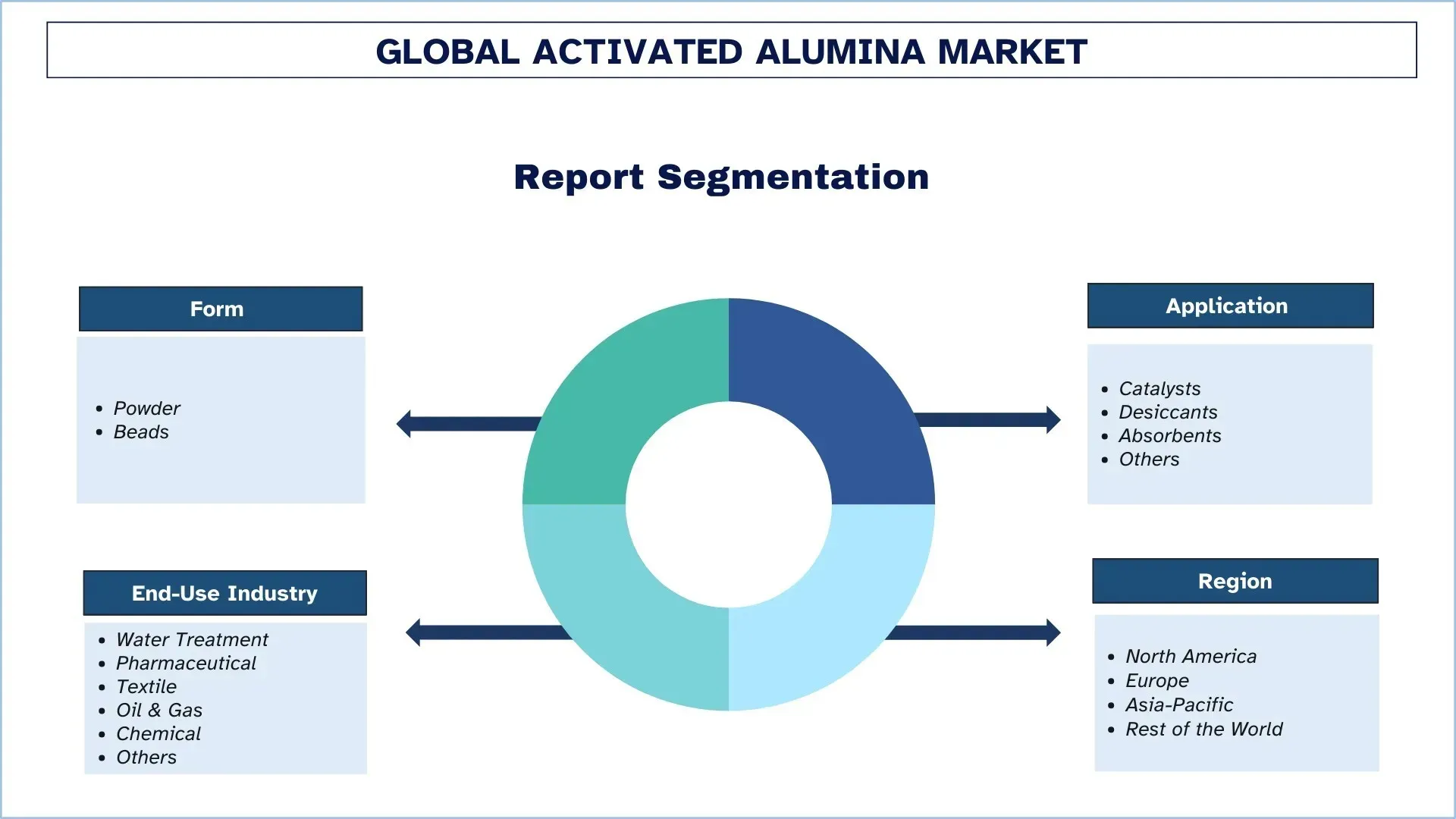
Emphasis on Form (Powder and Beads); End-Use Industry (Water Treatment, Pharmaceutical, Textile, Oil & Gas, Chemical, and Others); Application (Catalysts, Desiccants, Absorbents, and Others); and Region/Country
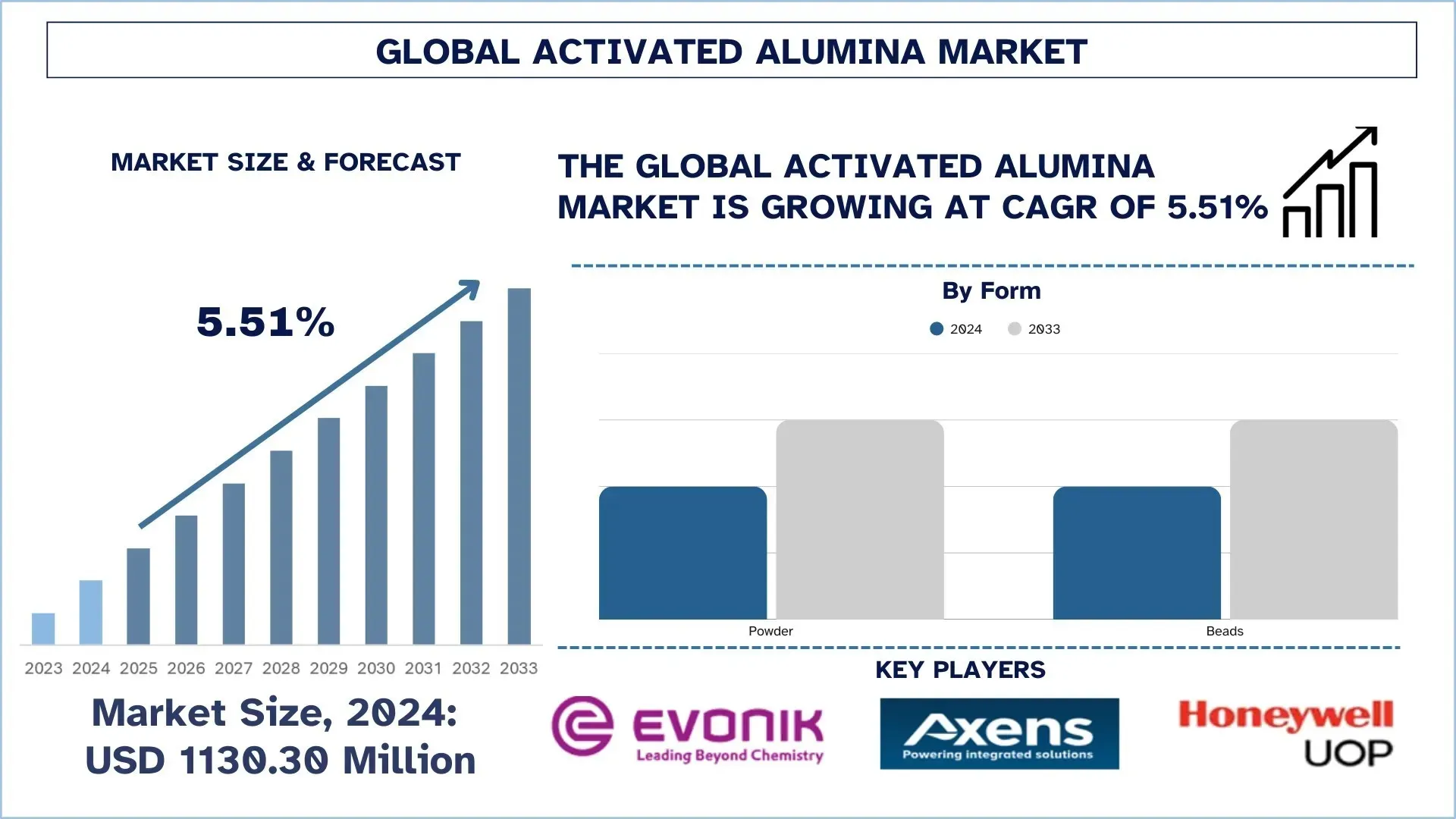
Global Activated Alumina Market Size & Forecast
The Global Activated Alumina Market was valued at USD 1,130.30 million in 2024 and is expected to grow at a steady CAGR of 5.51% during the forecast period (2025-2033F), driven by the sustainability-focused production, technological innovations such as advanced filtration and nanotechnology, rising pharmaceutical and air‑purification applications, and increasing demand for high-purity alumina in industrial and catalyst technologies.
Activated Alumina Market Analysis
The activated alumina market is steadily growing due to its wide use in water treatment, moisture control, and industrial processing. It is mainly used to remove harmful substances such as fluoride, arsenic, and excess moisture from water and air. The growing population, urban expansion, and increased industrial activity have increased the demand for clean water and effective purification techniques. Activated alumina remains a favored choice due to its durability, reusability, and long-term effectiveness. Additionally, stringent government regulations on water quality and increased investments in treatment infrastructure are driving market growth in both developing and developed areas worldwide.
Global Activated Alumina Market Trends
This section discusses the key market trends that are influencing the various segments of the global activated alumina market, as found by our team of research experts.
Shift Toward Customized Grades
The shift toward customized grades is a key trend in the activated alumina market, driven by customer demand for materials tailored to specific performance needs rather than standard products. Customized grades improve process performance, selectivity, and lifecycle cost, helping industries meet strict regulatory standards and reduce operational downtime. Manufacturers are developing application-specific grades with optimized surface areas, pore structures, particle sizes, and chemical properties to improve adsorption efficiency for targeted uses such as advanced water purification, gas dehydration, catalyst support, and pharmaceutical processes. This trend is especially strong in high-value sectors such as electronics, pharmaceuticals, and energy, which require ultra-high purity and precise adsorbent characteristics. Providers offering technical support and formulation expertise gain a competitive advantage as buyers prioritize performance and reliability over commodity pricing.
Activated Alumina Industry Segmentation
This section provides an analysis of the key trends in each segment of the global activated alumina market report, along with forecasts at the global, regional, and country levels for 2025-2033.
The Beads Segment Dominates the Global Activated Alumina Market
Based on the form, the market is categorized into powder and beads. Among these, beads hold the largest share of the activated alumina market because of their uniform particle size, high mechanical strength, and low attrition, which provide reliable performance in continuous operations. Their spherical shape improves flow distribution, minimizes pressure drops, and facilitates efficient regeneration in fixed-bed adsorption systems. These benefits make beads suitable for large-scale uses such as water treatment, air drying, and gas purification. Furthermore, beads tend to last longer and are easier to handle than other forms, boosting operational efficiency and reducing maintenance costs, factors that promote their widespread use in industrial and municipal sectors worldwide.
The Water Treatment Segment Dominates the Global Activated Alumina Market.
Based on the end-use industry, the market is categorized into water treatment, pharmaceutical, textile, oil & gas, chemical, and others. Among these, water treatment accounts for the largest share of the activated alumina market due to growing concerns about drinking water safety and contamination by fluoride, arsenic, and heavy metals. Factors such as rapid urbanization, population increase, and industrial wastewater discharge have increased the need for effective purification solutions. Activated alumina is highly preferred due to its high adsorption capacity, chemical stability, and reusability, making it suitable for both municipal and industrial uses. Furthermore, stringent government regulations on water quality and rising investments in water infrastructure and sanitation have further increased market demand and growth.
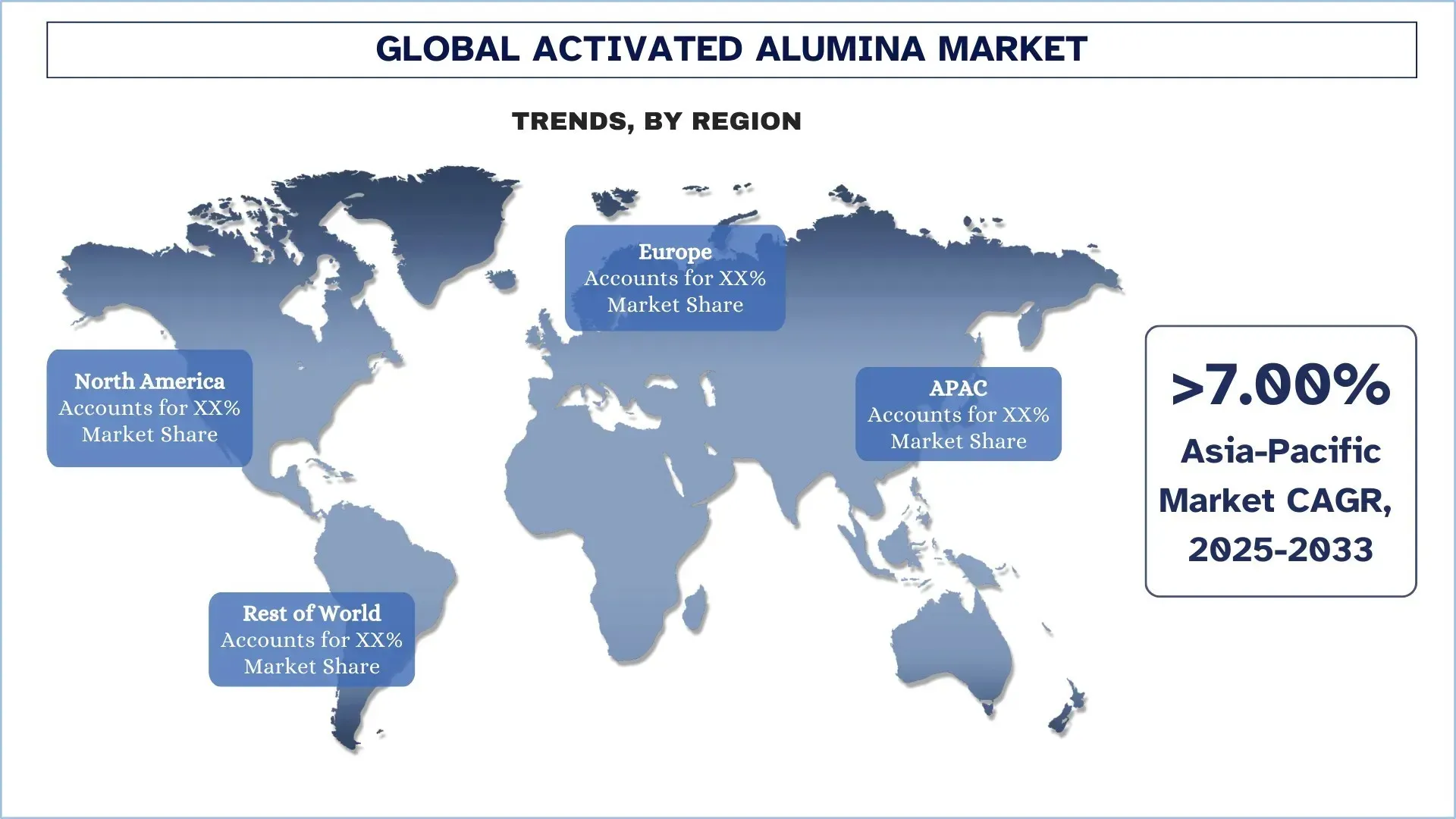
Asia-Pacific holds the largest market share in the global activated alumina market
Asia Pacific holds the largest market share in the activated alumina market because of rapid industrialization, large-scale water treatment investments, and the growth of the chemical, oil, and gas industries across emerging economies. The increasing population, urbanization, and groundwater contamination have increased the need for solutions to remove fluoride and arsenic. Supportive government initiatives that promote clean water access, wastewater management, and environmental compliance are further fueling market growth. Furthermore, the availability of low-cost labor, raw materials, and manufacturing infrastructure enables competitive production. Strong export activity, rising foreign investment, and the adoption of industrial drying and purification technologies strengthen the position of the region in the global market.
China held a Dominant share of the Asia-Pacific Activated Alumina Market in 2024
China leads the activated alumina market, driven by its massive chemical manufacturing base, extensive water treatment requirements, and strong presence in oil, gas, and refining industries. Large-scale industrial output and urban population growth have increased demand for durable adsorbents, which are used in purification and drying processes. The country benefits from abundant raw materials, cost-efficient production, and vertically integrated supply chains. Furthermore, supportive environmental regulations, continuous infrastructure development, and export-oriented manufacturing have strengthened the position of China as the largest producer and consumer of activated alumina worldwide across global industrial applications.
Activated Alumina Industry Competitive Landscape
The global activated alumina market is competitive, with several global and international market players. The key players are adopting various growth strategies to enhance their market presence, including partnerships, agreements, collaborations, geographic expansions, and mergers and acquisitions.
Top Activated Alumina Market Companies
Some of the major players in the market are Evonik Industries, Axens, Honeywell International Inc., HengYe Inc., Delta Adsorbents, BASF, JALON, Zeochem, AGC CHEMICALS PVT. LTD., and Bee Chems.
Recent Developments in the Activated Alumina Market
In June 2024, Hindalco acquired 100% of US-based AluChem Companies, Inc. for USD 125 million, expanded its specialty alumina footprint, gained North American facilities, and boosted its high-tech materials portfolio.
In 2024, Alcoa entered into a binding agreement to acquire Alumina Limited in an all-stock transaction, aimed at strengthening its bauxite and alumina leadership and creating long-term shareholder value.
Global Activated Alumina Market Report Coverage
Report Attribute | Details |
Base year | 2024 |
Forecast period | 2025-2033 |
Growth momentum | Accelerate at a CAGR of 5.51% |
Market size 2024 | USD 1,130.30 million |
Regional analysis | North America, Europe, APAC, Rest of the World |
Major contributing region | The Asia-Pacific region is expected to dominate the market during the forecast period. |
Key countries covered | U.S., Canada, Germany, U.K., Spain, Italy, France, China, Japan, and India. |
Companies profiled | Evonik Industries, Axens, Honeywell International Inc., HengYe Inc., Delta Adsorbents, BASF, JALON, Zeochem, AGC CHEMICALS PVT. LTD., and Bee Chems. |
Report Scope | Market Trends, Drivers, and Restraints; Revenue Estimation and Forecast; Segmentation Analysis; Demand and Supply Side Analysis; Competitive Landscape; Company Profiling |
Segments Covered | By Form, By End-Use Industry, By Application, and By Region/Country |
Reasons to Buy the Activated Alumina Market Report:
The study includes market sizing and forecasting analysis confirmed by authenticated key industry experts.
The report briefly reviews overall industry performance at a glance.
The report covers an in-depth analysis of prominent industry peers, primarily focusing on key business financials, type portfolios, expansion strategies, and recent developments.
Detailed examination of drivers, restraints, key trends, and opportunities prevailing in the industry.
The study comprehensively covers the market across different segments.
Deep dive regional level analysis of the industry.
Customization Options:
The global activated alumina market can further be customized as per the requirements or any other market segment. Besides this, UnivDatos understands that you may have your own business needs; hence, feel free to contact us to get a report that completely suits your requirements.
Table of Content
Research Methodology for the Global Activated Alumina Market Analysis (2023-2033)
We analyzed the historical market, estimated the current market, and forecasted the future market of the global activated alumina market to assess its application in major regions worldwide. We conducted exhaustive secondary research to gather historical market data and estimate the current market size. To validate these insights, we carefully reviewed numerous findings and assumptions. Additionally, we conducted in-depth primary interviews with industry experts across the activated alumina value chain. After validating market figures through these interviews, we used both top-down and bottom-up approaches to forecast the overall market size. We then employed market breakdown and data triangulation methods to estimate and analyze the market size of industry segments and sub-segments.
Market Engineering
We employed the data triangulation technique to finalize the overall market estimation and derive precise statistical numbers for each segment and sub-segment of the global activated alumina market. We split the data into several segments and sub-segments by analyzing various parameters and trends, including form, end-use industry, application, and regions within the global Activated alumina market.
The Main Objective of the Global Activated Alumina Market Study
The study identifies current and future trends in the global activated alumina market, providing strategic insights for investors. It highlights regional market attractiveness, enabling industry participants to tap into untapped markets and gain a first-mover advantage. Other quantitative goals of the studies include:
Market Size Analysis: Assess the current and forecast market size of the global activated alumina market and its segments in terms of value (USD).
Activated Alumina Market Segmentation: Segments in the study include areas of form, end-use industry, application, and region.
Regulatory Framework & Value Chain Analysis: Examine the regulatory framework, value chain, customer behavior, and competitive landscape of the activated alumina industry.
Regional Analysis: Conduct a detailed regional analysis for key areas such as Asia Pacific, Europe, North America, and the Rest of the World.
Company Profiles & Growth Strategies: Company profiles of the activated alumina market and the growth strategies adopted by the market players to sustain the fast-growing market.
Frequently Asked Questions FAQs
Q1: What is the global activated alumina market’s current market size and growth potential?
As of 2024, the global activated alumina market was valued at USD 1,130.30 million and is expected to grow at a CAGR of 5.51% from 2025 to 2033, driven by rising demand across water treatment, oil & gas, and industrial applications.
Q2: Which segment has the largest share of the global activated alumina market by form?
The beads segment dominated the global activated alumina market due to its high surface area, superior adsorption efficiency, uniform particle size, and widespread use in water purification and gas drying applications.
Q3: What are the driving factors for the growth of the global activated alumina market?
Top growth drivers of the activated alumina market include:
• Water Purification and Treatment Needs
• Expanding Oil and Gas Industry
• Rising Use in the Healthcare Sector
Q4: What are the emerging technologies and trends in the global activated alumina market?
Emerging trends in the activated alumina market include:
• The development of customized grades for specific end-use industries
• Growing adoption of high-efficiency and sustainable adsorbents
• Increasing R&D focused on performance optimization
Q5: What are the key challenges in the global activated alumina market?
The activated alumina market faces challenges such as high production and processing costs, energy-intensive manufacturing, and competition from alternative adsorbent materials, which may impact pricing and adoption in cost-sensitive markets.
Q6: Which region dominates the global activated alumina market?
Asia-Pacific dominated the global activated alumina market due to rapid industrialization, expanding water treatment infrastructure, rising energy demand, and strong manufacturing presence in countries such as China and India.
Q7: Who are the key competitors in the global activated alumina market?
Top players in the activated alumina industry include:
• Evonik Industries
• Axens
• Honeywell International Inc.
• HengYe Inc.
• Delta Adsorbents
• BASF
• JALON
• Zeochem
• AGC CHEMICALS PVT. LTD.
• Bee Chems
Q8: What are the major end-use industries driving demand for activated alumina?
Key end-use industries for activated alumina include water and wastewater treatment, oil & gas processing, chemicals, pharmaceuticals, food & beverages, and air drying applications, with water treatment accounting for the largest share.
Q9: How is sustainability influencing product development in the activated alumina market?
Sustainability is driving manufacturers to develop energy-efficient production processes, recyclable adsorbents, and longer-life activated alumina products, helping industries reduce operational costs and environmental impact.
Related Reports
Customers who bought this item also bought



India Anisole Market: Current Analysis and Forecast (2026-2034)
Emphasis on Grade Type (Up To 99.5% and Above 99.5%); Application (Pharmaceuticals, Agrochemicals, Perfumes & Fragrances, Dyes, and Others); and Region/States
Southeast Asia Waterproofing Chemicals Market: Current Analysis and Forecast (2025-2033)
Emphasis on Product Type (Bituminous Membrane, Cementitious Coatings, Acrylic Coatings, Polyurethane (PU) Coatings, Elastomeric Coatings, and Others); End Use Industry (Commercial Sector, Residential Sector, Infrastructure Sector, Industrial Sector, and Others); and Country.
Sodium Percarbonate Market: Current Analysis and Forecast (2025-2033)
Emphasis on Type (Coated, Uncoated, and Tablet); Application (Detergent Agents, Cleaning Agents, Bleaching Agents, Water Treatments, and Others); End-Use (Household Cleaning, Laundry, Industrial Cleaning, Textile Industry, Chemical Industry, Papermaking Industry, Food Industry, and Others); and Region/Country
Sodium Hexametaphosphate Market: Current Analysis and Forecast (2025-2033)
Emphasis on Grade (Food-Grade and Technical-Grade); Form (Granular, Powder, and Glass Plates); Application (Water Treatment, Food Additives, Detergents & Cleaning Agents, Ceramics & Construction, Oil & Gas, and Others); and Region/Country