India Anisole Market: Current Analysis and Forecast (2026-2034)
Emphasis on Grade Type (Up To 99.5% and Above 99.5%); Application (Pharmaceuticals, Agrochemicals, Perfumes & Fragrances, Dyes, and Others); and Region/States
India Anisole Market Size & Forecast
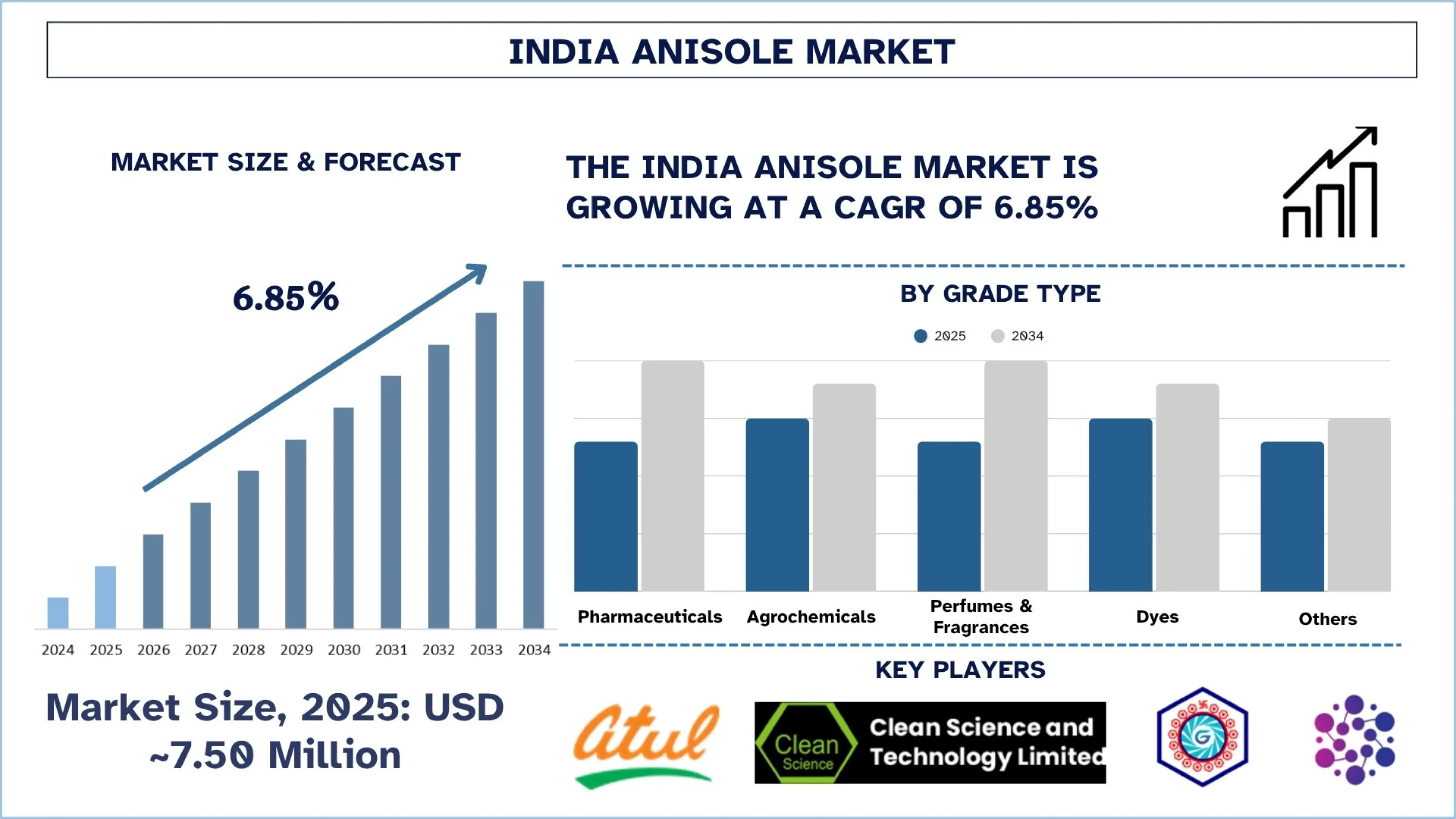
The India Anisole Market was valued at ~USD 7.50 million in 2025 and is expected to grow at a strong CAGR of around 6.85% during the forecast period (2026-2034F), driven by rising pharmaceutical intermediate demand from domestic API manufacturing.
India Anisole Market Analysis
Anisole is a chemical compound called methoxybenzene, an aromatic ether, which is constituted by a methoxy molecule attached to a benzene ring. Also, it is a clear liquid possessing a bland aromatic smell and is commonly used as an intermediate in pharmaceutical, agrochemical, perfume, and specialty chemical production.
In India, producers are increasingly integrating anisole production with downstream aromatic intermediate production to enhance cost-effectiveness, reduce reliance on raw materials, and improve supply chain sustainability. To meet the quality demands of the pharmaceutical and agrochemical industries, production plants are integrating process optimization, purer distillation systems, and the use of captive raw materials. Adding to this, capacity utilization is increasing as demand rises for active pharmaceutical ingredients, crop protection chemicals, and fragrance formulations, and as export-oriented production expands, with foreign countries sourcing through Indian specialty chemical clusters. Moreover, industrial players are shifting their focus to compliance with environmental handling standards, improved solvent recovery systems, and product consistency to cater to both local and foreign consumers. Furthermore, the government-backed chemical infrastructure development and policy support for pharmaceutical manufacturing are further improving investment support in integrated aromatic intermediate production across India. For example, on March 3, 2026, Minister of Chemicals and Fertilizers Jagat Prakash Nadda told that the budgetary provision of INR 13 thousand crore (USD 1,404.5 million) for BioPharma SHAKTI and three dedicated Chemical Parks is a strategic bet on India’s future. Also, the Free Trade Agreements are a gateway for Viksit Bharat and will open new opportunities for Indian industries to expand globally. The Minister noted that India became the Pharmacy of the World through generics and pointed out that 40% of medicines globally will be biologics by 2035.
India Anisole Market Trends
This section discusses the key market trends that are influencing the various segments of the India Anisole market, as found by our team of research experts.
Increasing Focus on Specialty Chemical Value Chains
The anisole market in India is shifting towards domestic sourcing of chemical intermediates, as downstream industries strive to reduce their reliance on imports and enhance supply security. Also, manufacturers of pharmaceuticals, agrochemicals, and specialty chemicals are shifting towards locally manufactured anisole to mitigate global price fluctuations, logistics challenges, and external supply constraints. This trend is reinforcing domestic procurement chains and promoting greater integration between raw-material suppliers and intermediate producers. Furthermore, domestic sourcing offers industrial purchasers shorter delivery cycles, higher quality, and cost savings. As India's specialty chemical manufacturing base continues to evolve, local anisole supply is becoming a strategic consideration for stable manufacturing planning and long-term industrial competitiveness.
For example, on April 2, 2026, Cabot Sanmar, a joint venture (JV) between Cabot Corporation, USA, and The Sanmar Group, India, announced an investment of USD 25 million to expand its plant at Mettur in Salem district in the state. The investment is for enhancing fumed silica manufacturing capacity, which is used in multiple applications, including pharmaceuticals, food, paints and coatings, personal care, and crop protection. The brownfield expansion is expected to be commissioned in the fourth quarter of CY2027.
Anisole Industry Segmentation
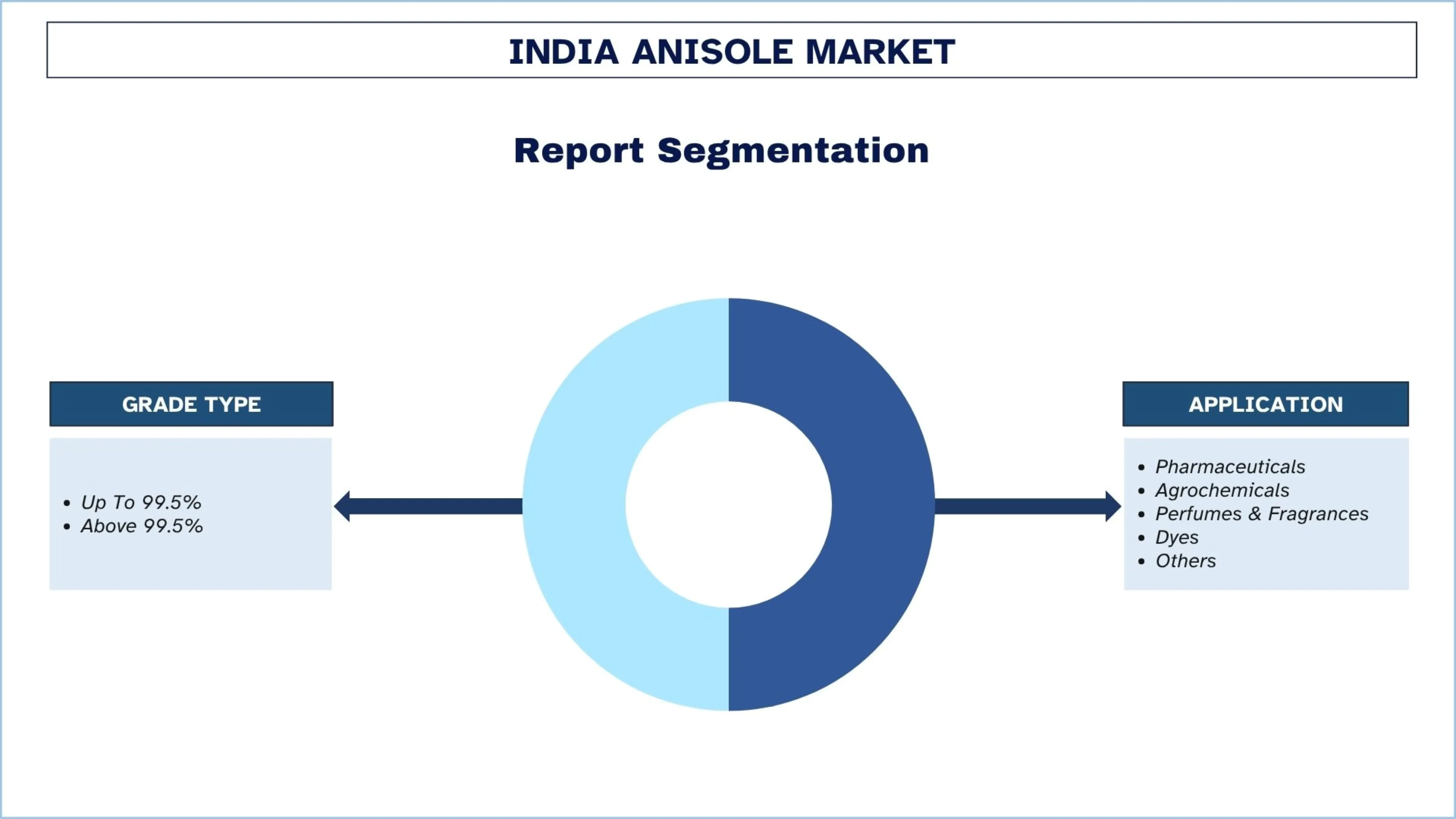
This section provides an analysis of the key trends in each segment of the India Anisole market report, along with forecasts at the regional and state levels for 2026-2034.
The above 99.5% segment held the dominant share of the Anisole Market in 2025.
Based on the grade type, the market is segmented into up to 99.5% and above 99.5%. Among these, the above 99.5% segment held the largest share of the Indian anisole market in 2025 because high-purity material is increasingly in demand in pharmaceutical and specialty chemical synthesis, where reaction accuracy and purity directly influence product quality. Also, companies are moving towards stricter purity production systems to support regulated downstream use and enhance their capability to produce to export-grade standards. This enhances value creation, promotes process improvements, and increases the use of anisole in the production of high-value chemicals.
The agrochemicals are expected to grow with a significant CAGR during the forecast period (2026-2034.
Based on the application, the market is segmented into pharmaceuticals, agrochemicals, perfumes & fragrances, dyes, and others. Among these, the agrochemicals segment is expected to grow with a significant CAGR during the forecast period (2026-2034). This is mainly due to India's steady increase in the production of pesticides, herbicides, and crop protection intermediates to cater to both local and export markets. The adoption of anisole as a valuable aromatic intermediate in various synthetic routes is also positive, prompting chemical manufacturers to align production with agrochemical demand cycles. Moreover, the relationship is establishing a consistent volume of demand and enhancing production planning at the specialty chemical facilities. For example, on April 1, 2026, the total production of Agrochemicals during 2025-26 (up to February 2026) is 2,61,099 MT. Total estimated demand is 74,266 MT, of which around 42,000 MT is required during Kharif 2026. There are three types of agro-chemicals: insecticides, herbicides, and fungicides. India is one of the largest producers of agrochemicals.
North India is expected to grow with a significant CAGR during the forecast period (2026-2034).
North India is expected to grow with a significant CAGR during the forecast period (2026-2034). Due to the expansion of the pharmaceutical processing industry, the growth of chemical trading networks, and rising consumption of specialty intermediates in industrial centers, North India is becoming a key demand-driven region in the anisole market. The region is experiencing increased demand for procurement from drug formulation facilities, agrochemical blending facilities, and distributors of fine chemicals for various downstream industries. Adding to this, due to the lower manufacturing concentration than in western India, companies are expanding their distribution presence to enhance market access and supply responsiveness. Moreover, states developing chemical infrastructure are slowly seeing industrial demand shift towards local consumption of high-purity anisole. This provides new suppliers with an opportunity to increase their market penetration in the region and sustain market growth. For example, on April 5, 2026, in a step towards strengthening its position as a pharmaceutical manufacturing hub, the UP State Industrial Development Authority (UPSIDA) signed a strategic MoU with the Jawaharlal Nehru Port Authority (JNPA). The agreement aims to transform the upcoming Lalitpur Pharma Park into a globally connected export hub by integrating it with multimodal logistics networks. The MoU, signed by UPSIDA CEO Vijay Kiran Anand and JNPA chairman Gaurav Dayal, seeks to provide seamless connectivity between industrial regions in North India and international markets. The partnership would enable faster, safer, and cost-effective movement of pharmaceutical goods, boosting UP's export capabilities.
India Anisole Industry Competitive Landscape
The India Anisole market is competitive, with several global and international market players. The key players are adopting different growth strategies to enhance their market presence, such as partnerships, agreements, collaborations, new product launches, geographical expansions, and mergers and acquisitions.
Top India Anisole Companies
Some of the major players in the market are Atul Ltd, Clean Science and Technology Limited., Gunjal Industries, Manas Petro Chem, Modi Chemical, Stratechem (I) Pvt. Ltd., Central Drug House, Otto Chemie Pvt. Ltd., and others.
Recent Developments in the India Anisole Market
On October 8, 2025, IFF, a global leader in flavors, fragrances, food ingredients, health, and biosciences, announced plans to build a new scent creative center in Mumbai, India. The site, strategically located in the city’s Powai neighborhood, is expected to be fully operational by the first half of 2026. With India’s fragrance market projected to maintain steady growth, the new creative center will strengthen IFF’s ability to win with customers by delivering leading fragrance innovation.
India Anisole Market Report Coverage
Details | |
Base year | 2025 |
Forecast period | 2026-2034 |
Growth momentum | Accelerate at a CAGR of 6.85% |
Market size 2025 | USD ~7.50 million |
Regional analysis | North India, South India, East India, and West India |
Major contributing region | North India is expected to grow at the highest CAGR during the forecasted period. |
Companies profiled | Atul Ltd, Clean Science and Technology Limited, Gunjal Industries, Manas Petro Chem, Modi Chemical, Stratechem (I) Pvt. Ltd., Central Drug House, Otto Chemie Pvt. Ltd., and others. |
Report Scope | Market Trends, Drivers, and Restraints; Revenue Estimation and Forecast; Segmentation Analysis; Demand and Supply Side Analysis; Competitive Landscape; Company Profiling |
Segments Covered | By Grade Type, By Application, By Region |
Reasons to Buy the India Anisole Market Report:
The study includes market sizing and forecasting analysis confirmed by authenticated key industry experts.
The report briefly reviews overall industry performance at a glance.
The report covers an in-depth analysis of prominent industry peers, primarily focusing on key business financials, type portfolios, expansion strategies, and recent developments.
Detailed examination of drivers, restraints, key trends, and opportunities prevailing in the industry.
The study comprehensively covers the market across different segments.
Deep dive regional level analysis of the industry.
Customization Options:
The India Anisole Market can further be customized as per the requirements or any other market segment. Besides this, UnivDatos understands that you may have your own business needs; hence, feel free to contact us to get a report that completely suits your requirements.
Table of Content
Research Methodology for the India Anisole Market Analysis (2024-2034)
We analyzed the historical market, estimated the current market, and forecasted the future market of the India Anisole market to assess its application in major regions in India. We conducted exhaustive secondary research to gather historical market data and estimate the current market size. To validate these insights, we carefully reviewed numerous findings and assumptions. Additionally, we conducted in-depth primary interviews with industry experts across the Anisole value chain. After validating market figures through these interviews, we used both top-down and bottom-up approaches to forecast the overall market size. We then employed market breakdown and data triangulation methods to estimate and analyze the market size of industry segments and sub-segments.
Market Engineering
We employed the data triangulation technique to finalize the overall market estimation and derive precise statistical numbers for each segment and sub-segment of the India-Anisole market. We split the data into several segments and sub-segments by analyzing various parameters and trends, including grade type, application, and regions within the India Anisole market.
The Main Objective of the India Anisole Market Study
The study identifies current and future trends in the India Anisole market, providing strategic insights for investors. It highlights regional market attractiveness, enabling industry participants to tap into untapped markets and gain a first-mover advantage. Other quantitative goals of the studies include:
Market Size Analysis: Assess the current market size and forecast the market size of the India Anisole market and its segments in terms of value (USD).
Anisole Market Segmentation: Segments in the study include areas of grade type, application, and regions.
Regulatory Framework & Value Chain Analysis: Examine the regulatory framework, value chain, customer behavior, and competitive landscape of the Anisole industry.
Regional Analysis: Conduct a detailed regional analysis for key areas such as North India, South India, East India, and West India.
Company Profiles & Growth Strategies: Company profiles of the Anisole market and the growth strategies adopted by the market players to sustain in the fast-growing market.
Frequently Asked Questions FAQs
Q1: What is the India Anisole market’s current market size and growth potential?
The India Anisole market was valued at USD ~7.50 million in 2025 and is expected to grow at a CAGR of 6.85% during the forecast period (2026-2034). This steady growth is supported by rising demand from pharmaceutical intermediates, agrochemical production, and specialty chemical manufacturing, along with increasing domestic sourcing of aromatic intermediates across industrial value chains.
Q2: Which segment has the largest share of the India Anisole market by application?
The pharmaceutical segment holds the largest share in the India anisole market due to the widespread use of anisole as an intermediate in active pharmaceutical ingredient synthesis, anisic derivatives, and specialty medicinal compounds. High-purity anisole demand remains particularly strong in regulated pharmaceutical manufacturing.
Q3: What are the driving factors for the growth of the India Anisole market?
Major growth drivers include expanding pharmaceutical manufacturing, increasing agrochemical output, rising fragrance and specialty chemical demand, and stronger domestic production of aromatic intermediates. Industrial cluster development in western India and growing export opportunities are also contributing to sustained market expansion.
Q4: What are the emerging technologies and trends in the India Anisole market?
Key trends include integration of anisole production with downstream specialty chemicals, adoption of high-purity distillation systems, process optimization for yield improvement, solvent recovery systems, and increasing focus on environmentally compliant aromatic chemical manufacturing.
Q5: What are the key challenges in the India Anisole market?
The market faces challenges such as volatility in phenol and methanol prices, environmental compliance costs, competition from imported aromatic intermediates, handling risks associated with flammable chemicals, and limited public disclosure of production capacities among mid-scale domestic manufacturers.
Q6: Which region dominates the India Anisole market?
West India dominates the market, particularly Gujarat and Maharashtra, due to strong chemical manufacturing infrastructure, raw material availability, integrated specialty chemical clusters, port connectivity, and concentration of pharmaceutical and agrochemical intermediate production.
Q7: Who are the key players in the India Anisole market?
Some of the leading companies in the India Anisole Industry include:
• Atul Ltd
• Clean Science and Technology Limited.
• Gunjal Industries
• Manas Petro Chem
• Modi Chemical
• Stratechem (I) Pvt. Ltd.
• Central Drug House
• Otto Chemie Pvt. Ltd.
• Others
Q8: What opportunities exist for investors and manufacturers in the India anisole market?
Opportunities include capacity expansion in high-purity anisole, downstream derivative manufacturing, import substitution, export-oriented specialty chemical production, and integration with pharmaceutical and agrochemical value chains in emerging industrial regions.
Q9: How is competitive intensity shaping strategic decisions in the India anisole market?
Competitive intensity in the India anisole market is increasingly influenced by purity standards, downstream integration, pricing efficiency, and supply reliability. Manufacturers are strengthening competitive positioning through captive raw material use, process optimization, and alignment with pharmaceutical and agrochemical demand. For investors and industry participants, competitive intelligence is becoming important to track capacity expansion, regional manufacturing shifts, export potential, and emerging opportunities across high-value specialty chemical applications.
Related Reports
Customers who bought this item also bought
India Anisole Market: Current Analysis and Forecast (2026-2034)
Emphasis on Grade Type (Up To 99.5% and Above 99.5%); Application (Pharmaceuticals, Agrochemicals, Perfumes & Fragrances, Dyes, and Others); and Region/States
Southeast Asia Waterproofing Chemicals Market: Current Analysis and Forecast (2025-2033)
Emphasis on Product Type (Bituminous Membrane, Cementitious Coatings, Acrylic Coatings, Polyurethane (PU) Coatings, Elastomeric Coatings, and Others); End Use Industry (Commercial Sector, Residential Sector, Infrastructure Sector, Industrial Sector, and Others); and Country.
Sodium Percarbonate Market: Current Analysis and Forecast (2025-2033)
Emphasis on Type (Coated, Uncoated, and Tablet); Application (Detergent Agents, Cleaning Agents, Bleaching Agents, Water Treatments, and Others); End-Use (Household Cleaning, Laundry, Industrial Cleaning, Textile Industry, Chemical Industry, Papermaking Industry, Food Industry, and Others); and Region/Country
Sodium Hexametaphosphate Market: Current Analysis and Forecast (2025-2033)
Emphasis on Grade (Food-Grade and Technical-Grade); Form (Granular, Powder, and Glass Plates); Application (Water Treatment, Food Additives, Detergents & Cleaning Agents, Ceramics & Construction, Oil & Gas, and Others); and Region/Country