Southeast Asia Sorting and Grading Machines Market: Current Analysis and Forecast (2025-2033)
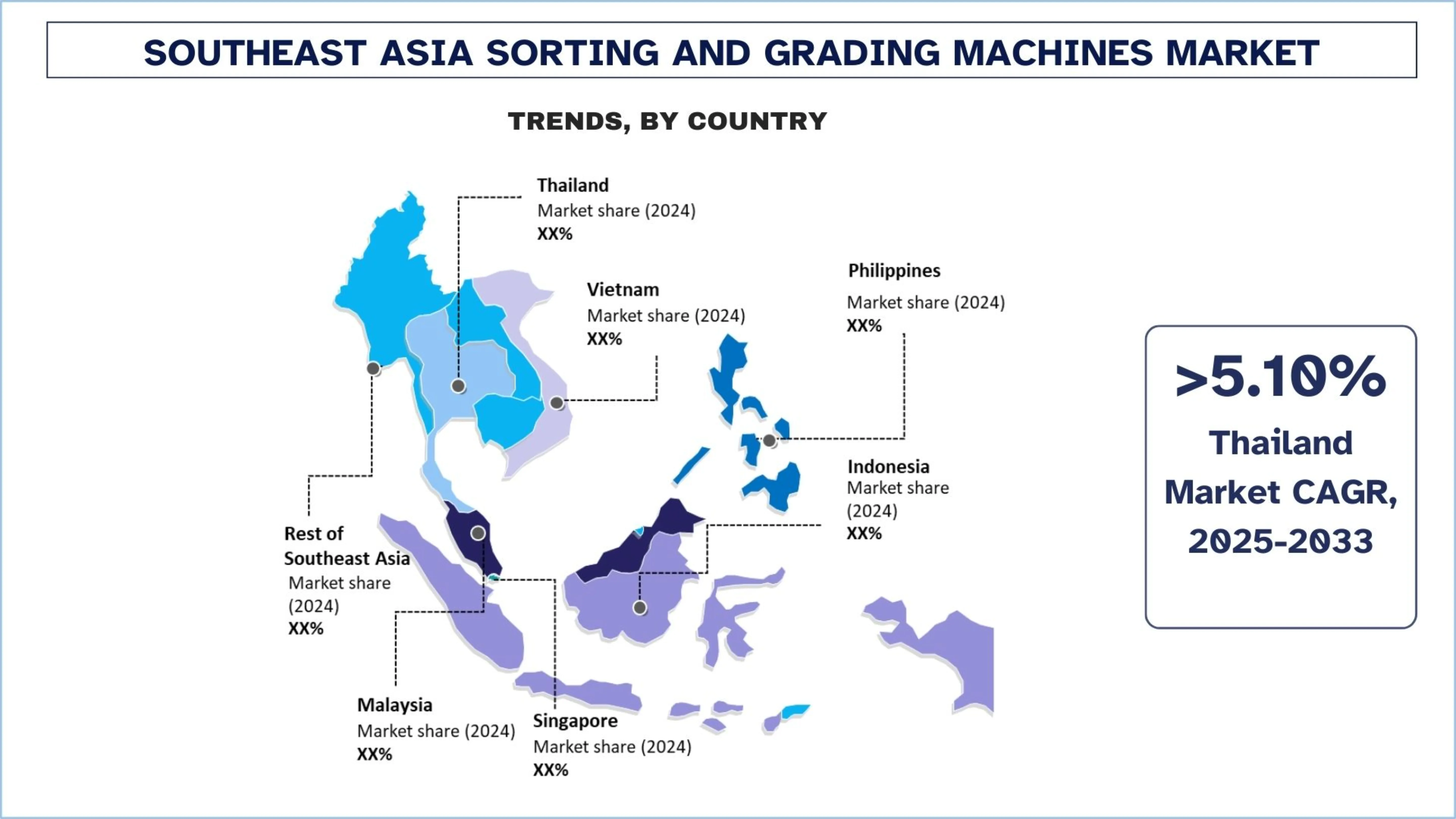
Emphasis on Machine Type (Optical Sorting, Weight-Based Grading, Size-Based Grading, and Others); Technology (Camera/Vision-Based Systems, AI and Machine Learning, Sensor-Based Systems, and Others); End-Use Industry (Agriculture & Food Processing, Recycling & Waste Management, Mining & Minerals, Pharmaceuticals, and Others); Sales Channel (Direct Sales and Indirect Sales); and Country.
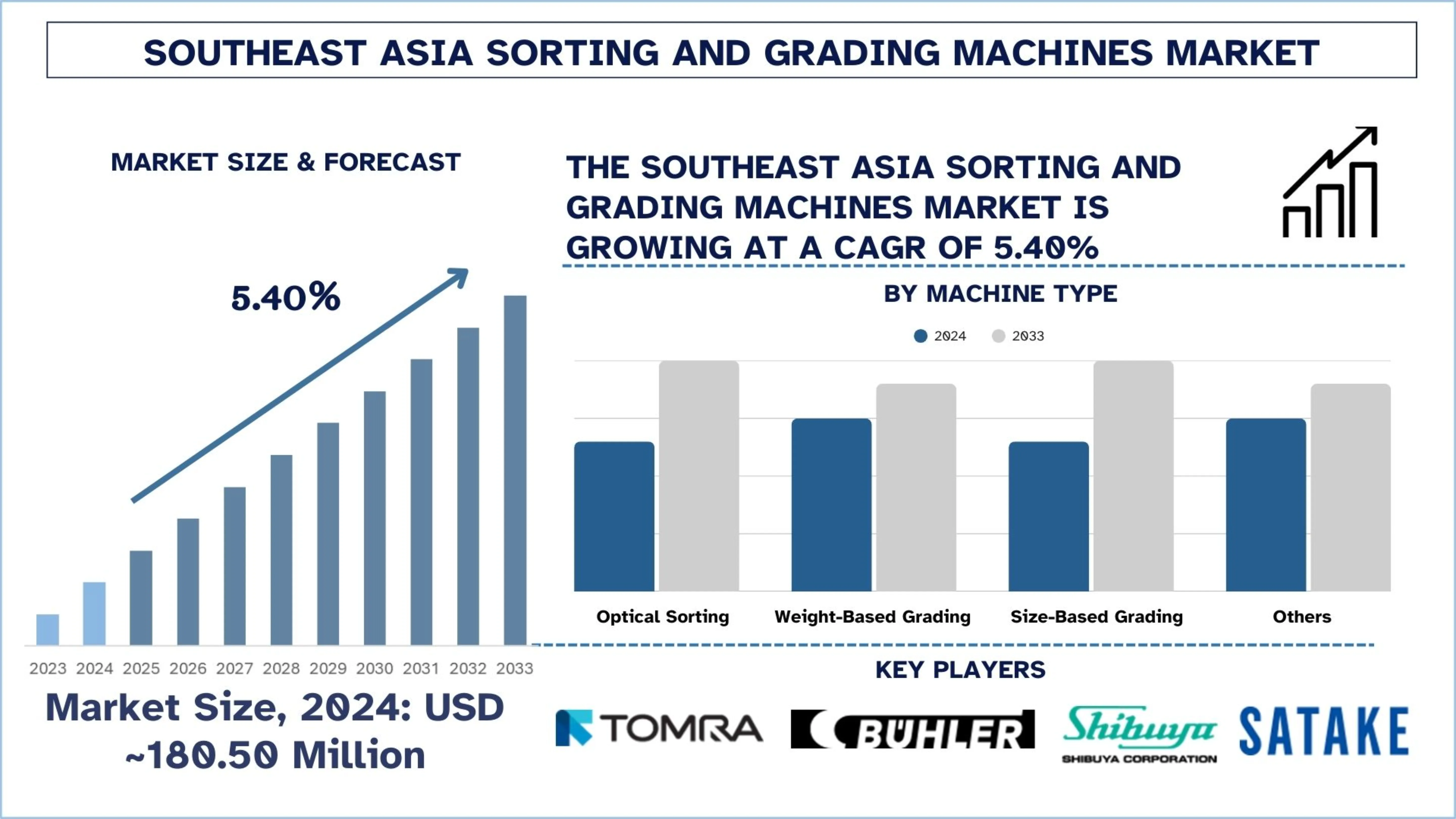
Southeast Asia Sorting and Grading Machines Market Size & Forecast
The Southeast Asia Sorting and Grading Machines Market was valued at ~USD 180.50 million in 2024 and is expected to grow at a strong CAGR of approximately 5.40% during the forecast period (2025-2033F), driven by rising demand for processed and packaged foods, increasing agricultural exports, and stricter quality and safety regulations.
Southeast Asia Sorting and Grading Machines Market Analysis
Sorting and grading machines are automated systems used to sort products by size, weight, color, shape, or material composition. These machines are widely used to enhance product quality consistency, processing efficiency, and industry-wide consistency.
The implementation of sorting and grading machines in food processing, agriculture, and recycling is being used to automate quality control and support growth in Southeast Asia. The increase in the number of processors that are introducing vision-based and sensor-driven systems to manage higher volumes, while still maintaining product export quality. Also, it is increasingly integrated with digital monitoring, data analytics, and line automation to maximize yields and minimize waste. Moreover, the shift toward centralized processing plants and export-oriented production models, which demand uniform and traceable output, also facilitates market adoption.
For example, on May 1, 2025, Dematic, a global leader in supply chain automation, announced the launch of its latest next-generation sorting technology to Enhance Logistics Efficiency Across Southeast Asia, the Silky Crossbelt sorter. Designed and manufactured in China, leveraging Dematic’s extensive global expertise in sorting solutions, the Silky Crossbelt sorter was specifically created for the unique logistical requirements of the APAC market.
Southeast Asia Sorting and Grading Machines Market Trends
This section discusses the key market trends that are influencing the various segments of the Southeast Asia Sorting and Grading Machines market, as found by our team of research experts.
Shift Toward Fully Automated and High-speed Sorting Lines
The shift toward fully automated, high-speed sorting lines is a significant trend, as processors focus on maximizing throughput and operational efficiency. The automated lines will minimize the need for manual labor and provide a high level of grading accuracy at high volumes. Also, the high-speed systems enable processors to meet increasing export and domestic demand without increasing floor space. Moreover, this is further enhanced by integration with digital controls and real-time monitoring to optimize the lines and ensure quality. This is gaining momentum in extensive, export-oriented facilities in Southeast Asia. For example, on May 28, 2025, SPX Express (SPX), a trusted regional logistics provider enabling businesses with efficient and reliable deliveries, signed a strategic collaboration agreement with Frasers Property Vietnam to develop its newest automated sorting centre in Hung Yen province. When completed in 2027, the state-of-the-art industrial space in Frasers Property Vietnam’s Industrial Centre Yen My will be SPX’s largest automated sorting centre in Southeast Asia. Spanning 170,000 sqm, the sorting centre will boost operational efficiency, enhance service reliability, and support the expected demand growth of businesses and shoppers from the region.
Southeast Asia Sorting and Grading Machines Industry Segmentation
This section provides an analysis of the key trends in each segment of the Southeast Asia Sorting and Grading Machines market, along with forecasts at the country level for 2025-2033.
The optical sorting market held the dominant share of the Sorting and Grading Machines market in 2024.
Based on machine type, the market is segmented into optical sorting, weight-based grading, size-based grading, and others. Among these, the optical sorting market held the largest share in 2024. This is because food processors and exporters in Southeast Asia will require greater accuracy, consistency, and adherence to international quality standards. The yield and waste are directly improved by the ability to detect color, defects, and foreign materials at high speeds. Therefore, this drives processors to invest in high-end optical systems, which accelerates adoption in agriculture, food processing, and recycling. For example, in January 2025, Bühler launched its new SPARK Pro optical sorter, designed to improve wheat cleaning and increase yields in flour mills. The new milling machine will focus on the needs of the milling sector in Southeast Asia, where wheat quality is likely to be driven by weather variability and grain supply volatility.
The recycling & waste management segment is expected to grow at a significant CAGR during the forecast period (2025-2033).
Based on end-use industry, the market is segmented into agriculture & food processing, recycling & waste management, mining & minerals, pharmaceuticals, and others. Among these, the recycling & waste management segment is expected to grow at a significant CAGR during the forecast period (2025-2033). The expansion in recycling and waste management is driven by the use of sorting machines, as governments are becoming more stringent in environmental regulations and investing in material recovery facilities. Also, the enhanced material purity and yield through automated sorting are essential to plastics, metal, and e-waste recycling. This widening range of applications spreads revenue among equipment manufacturers outside food processing.
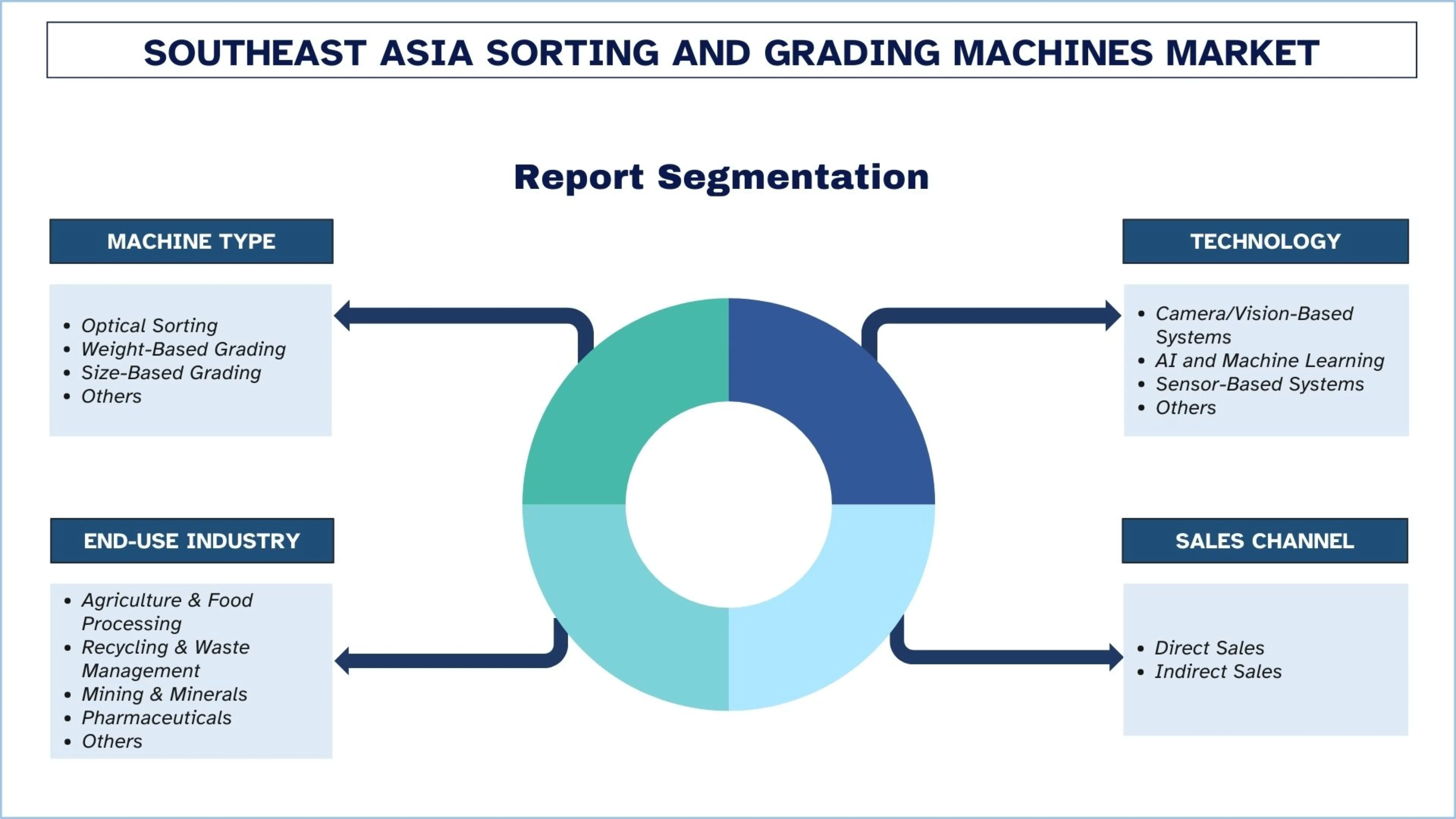
Thailand held a dominant share of the Southeast Asian Sorting and Grading Machines market in 2024
The market for sorting and grading machines in Thailand is driven by a well-established agri-food processing industry and its status as a leading exporter of rice, fruits, and seafood. There is a growing trend toward using new sorting technologies in export-oriented processors to meet high-quality, safety, and traceability requirements. Also, there are government programs that favor smart farming and food-processing automation, which continue to boost equipment investment. The scale of large-scale processors and contract farming models requires high-capacity systems. The increase in labor costs also contributes to the move to automated grading solutions.
On June 3, 2025, Duravant, a global automation solutions provider, announced the launch of Duravant Thailand, offering comprehensive support and integrated solutions across food sorting and handling, protein processing, packaging equipment, and material handling. At Propak Asia 2025, Duravant will showcase this unified offering through its operating companies, PPM Technologies, Key Technology, Mespack, and the newly acquired Pattyn at booth P30.
Southeast Asia Sorting and Grading Machines Industry Competitive Landscape
The Southeast Asia Sorting and Grading Machines market is competitive, with several global and international market players. The key players are adopting different growth strategies to enhance their market presence, such as partnerships, agreements, collaborations, new product launches, geographical expansions, and mergers and acquisitions.
Top Southeast Asia Sorting and Grading Machines Companies
Some of the major players in the market are TOMRA Systems ASA, Bühler Group, SHIBUYA CORPORATION, Satake Corporation, Sesotec GmbH, Anhui Vsee Optoelectronic Technology Co., Ltd., Anhui Jiexun Optoelectronic Technology Co., Ltd. (ANYSORT), Duravant, and others.
Recent Developments in the Southeast Asia Sorting and Grading Machines Market
On July 29, 2024, BEST Inc., a leading integrated smart supply chain and logistics solutions provider in China and Southeast Asia, announced the deployment of its eleven advanced Dimensioning, Weighing, and Scanning (DWS) systems in its largest sorting center in Southeast Asia, located in U10 Shah Alam, Malaysia (KULHUB). The total investment in these systems amounts to nearly 10 million Malaysian Ringgit (~USD 2.1 million).
Southeast Asia Sorting and Grading Machines Market Report Coverage
Report Attribute | Details |
Base year | 2024 |
Forecast period | 2025-2033 |
Growth momentum | Accelerate at a CAGR of 5.40% |
Market size 2024 | ~USD 180.50 million |
Country analysis | Indonesia, Thailand, Philippines, Vietnam, Malaysia, Singapore, Rest of Southeast Asia |
Major contributing Country | Vietnam is expected to grow at the highest CAGR during the forecasted period. |
Companies profiled | TOMRA Systems ASA, Bühler Group, SHIBUYA CORPORATION, Satake Corporation, Sesotec GmbH, Anhui Vsee Optoelectronic Technology Co., Ltd., Anhui Jiexun Optoelectronic Technology Co., Ltd. (ANYSORT), Duravant, and others |
Report Scope | Market Trends, Drivers, and Restraints; Revenue Estimation and Forecast; Segmentation Analysis; Demand and Supply Side Analysis; Competitive Landscape; Company Profiling |
Segments Covered | By Machine Type, By Technology, By End-Use Industry, By Sales Channel, By Country |
Reasons to Buy the Southeast Asia Sorting and Grading Machines Market Report:
The study includes market sizing and forecasting analysis confirmed by authenticated key industry experts.
The report briefly reviews overall industry performance at a glance.
The report covers an in-depth analysis of prominent industry peers, primarily focusing on key business financials, product portfolios, expansion strategies, and recent developments.
Detailed examination of drivers, restraints, key trends, and opportunities prevailing in the industry.
The study comprehensively covers the market across different segments.
Customization Options:
The Southeast Asia Sorting and Grading Machines market can further be customized as per requirements or any other market segment. Besides this, UnivDatos understands that you may have your own business needs; hence, feel free to contact us to get a report that completely suits your requirements.
Table of Content
Research Methodology for the Southeast Asia Sorting and Grading Machines Market Analysis (2023-2033)
We analyzed the historical market, estimated the current market, and forecasted the future market of the Southeast Asian Sorting and Grading Machines market to assess its application in major countries. We conducted exhaustive secondary research to gather historical market data and estimate the current market size. To validate these insights, we carefully reviewed numerous findings and assumptions. Additionally, we conducted in-depth primary interviews with industry experts across the Southeast Asia Sorting and Grading Machines value chain. After validating market figures through these interviews, we used both top-down and bottom-up approaches to forecast the overall market size. We then employed market breakdown and data triangulation methods to estimate and analyze the market size of industry segments and sub-segments.
Market Engineering
We employed the data triangulation technique to finalize the overall market estimation and derive precise statistical numbers for each segment and sub-segment of the Southeast Asia Sorting and Grading Machines market. We split the data into several segments and sub-segments by analyzing various parameters and trends, including machine type, technology, end-use industry, sales channel, and country within the Southeast Asian Sorting and Grading Machines market.
The Main Objective of the Southeast Asia Sorting and Grading Machines Market Study
The study identifies current and future trends in the Southeast Asia Sorting and Grading Machines market, providing strategic insights for investors. It highlights market attractiveness, enabling industry participants to tap into untapped markets and gain a first-mover advantage. Other quantitative goals of the studies include:
Market Size Analysis: Assess the current and forecast market size of the Southeast Asia Sorting and Grading Machines market and its segments in terms of value (USD).
Southeast Asia Sorting and Grading Machines Market Segmentation: Segments in the study include areas of machine type, technology, end-use industry, sales channel, and country.
Regulatory Framework & Value Chain Analysis: Examine the regulatory framework, value chain, customer behavior, and competitive landscape of the Southeast Asia Sorting and Grading Machines industry.
Country Analysis: Conduct a detailed country analysis for key areas such as Indonesia, Thailand, the Philippines, Vietnam, Malaysia, Singapore, and the Rest of Southeast Asia.
Company Profiles & Growth Strategies: Company profiles of the Southeast Asia Sorting and Grading Machines market and the growth strategies adopted by the market players to sustain the fast-growing market.
Frequently Asked Questions FAQs
Q1: What is the Southeast Asia Sorting and Grading Machines market’s current market size and growth potential?
The Southeast Asia Sorting and Grading Machines market was valued at ~USD 180.50 million in 2024 and is projected to expand at a CAGR of 5.40% from 2025 to 2033. Growth is supported by rising food processing activity, export-driven agriculture, and increasing adoption of automated quality inspection systems across the region.
Q2: Which segment has the largest share of the Southeast Asia Sorting and Grading Machines market by machine type?
Optical sorting machines hold the largest market share due to their high accuracy, speed, and ability to meet export-quality standards. Their widespread use in food processing, agriculture, and recycling applications continues to drive dominance.
Q3: What are the driving factors for the growth of the Southeast Asia Sorting and Grading Machines market?
Market growth is driven by rising agricultural and food exports, increasing labor shortages, stricter quality and food safety regulations, and growing demand for automation. Technological advancements in vision systems and sensors further improve efficiency and return on investment.
Q4: What are the emerging technologies and trends in the Southeast Asia Sorting and Grading Machines market?
Key trends include the adoption of AI and machine learning, the integration of camera and vision-based systems, the shift toward fully automated high-speed sorting lines, and the increased use of multi-sensor technologies for higher precision and yield optimization.
Q5: What are the key challenges in the Southeast Asia Sorting and Grading Machines market?
Major challenges include high initial capital investment, limited technical expertise in emerging markets, dependency on imported components, and after-sales service constraints in remote regions. These factors can slow adoption among small and mid-sized processors.
Q6: Which country dominates the Southeast Asia Sorting and Grading Machines market?
Thailand dominates the regional market due to its strong agri-food processing base, export-oriented production, and early adoption of automated sorting technologies. Government support for food processing modernization further strengthens its leadership position.
Q7: Who are the key players in the Southeast Asia Sorting and Grading Machines market?
Leading companies in the Southeast Asia Sorting and Grading Machines market include:
• TOMRA Systems ASA
• Bühler Group
• SHIBUYA CORPORATION
• Satake Corporation
• Sesotec GmbH
• Anhui Vsee Optoelectronic Technology Co., Ltd.
• Anhui Jiexun Optoelectronic Technology Co., Ltd. (ANYSORT)
• Duravant
• Others
Q8: How are sorting and grading machines helping food processors improve profitability in Southeast Asia?
Sorting and grading machines help processors reduce product rejection, minimize waste, and improve yield consistency. Automation lowers labor dependency while ensuring compliance with export quality standards, directly improving operational margins and scalability.
Q9: Why is Southeast Asia considered a high-growth region for sorting and grading machine manufacturers?
Southeast Asia offers strong growth potential due to expanding food exports, rapid industrialization, rising automation adoption, and increasing foreign investment. Countries like Vietnam and Indonesia are emerging as high-CAGR markets with long-term demand for advanced sorting technologies.
Related Reports
Customers who bought this item also bought





Middle East & Africa Rough Terrain Crane Market: Current Analysis and Forecast (2025-2033)
Emphasis By Payload Capacity (Up to 25 Tons, 26-74 Tons, 75-100 Tons, and Above 100 Tons), by Application (Construction, Utility, and Others), By Country (Saudi Arabia, UAE, Egypt, South Africa, Turkey, Israel, and the Rest of Middle East & Africa)

Smart Industrial Fence System Market: Current Analysis and Forecast (2025-2033)
Emphasis on Type (Chain Link Fences, Electric Fences, Privacy Fences, Automatic Gates, Barbed Wire Fences, and Others); Technology (IoT, AI, RFID, and Others); Application (Perimeter Security, Access Control, Intrusion Detection, and Others); End-User (Automotive, Manufacturing, Transportation, Government, Construction, and Others); and Region/Country

Southeast Asia Sorting and Grading Machines Market: Current Analysis and Forecast (2025-2033)
Emphasis on Machine Type (Optical Sorting, Weight-Based Grading, Size-Based Grading, and Others); Technology (Camera/Vision-Based Systems, AI and Machine Learning, Sensor-Based Systems, and Others); End-Use Industry (Agriculture & Food Processing, Recycling & Waste Management, Mining & Minerals, Pharmaceuticals, and Others); Sales Channel (Direct Sales and Indirect Sales); and Country.

Zero Turn Mower Market: Current Analysis and Forecast (2025-2033)
Emphasis on Propulsion (Gasoline and Electric); Cutting Width (Less than 50 inches, 50 to 60 inches, and More than 60 inches); Application (Residential and Commercial); and Region/Country