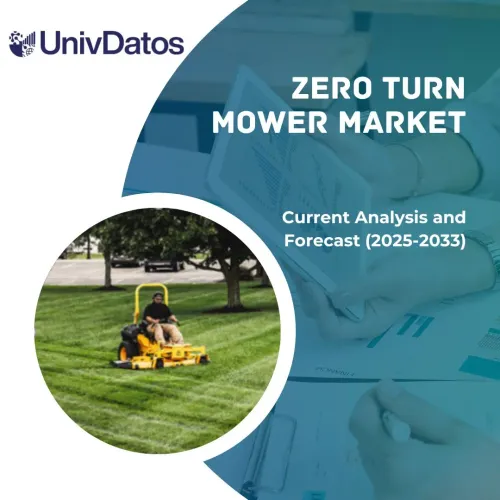
Zero Turn Mower Market: Current Analysis and Forecast (2025-2033)
Emphasis on Propulsion (Gasoline and Electric); Cutting Width (Less than 50 inches, 50 to 60 inches, and More than 60 inches); Application (Residential and Commercial); and Region/Country
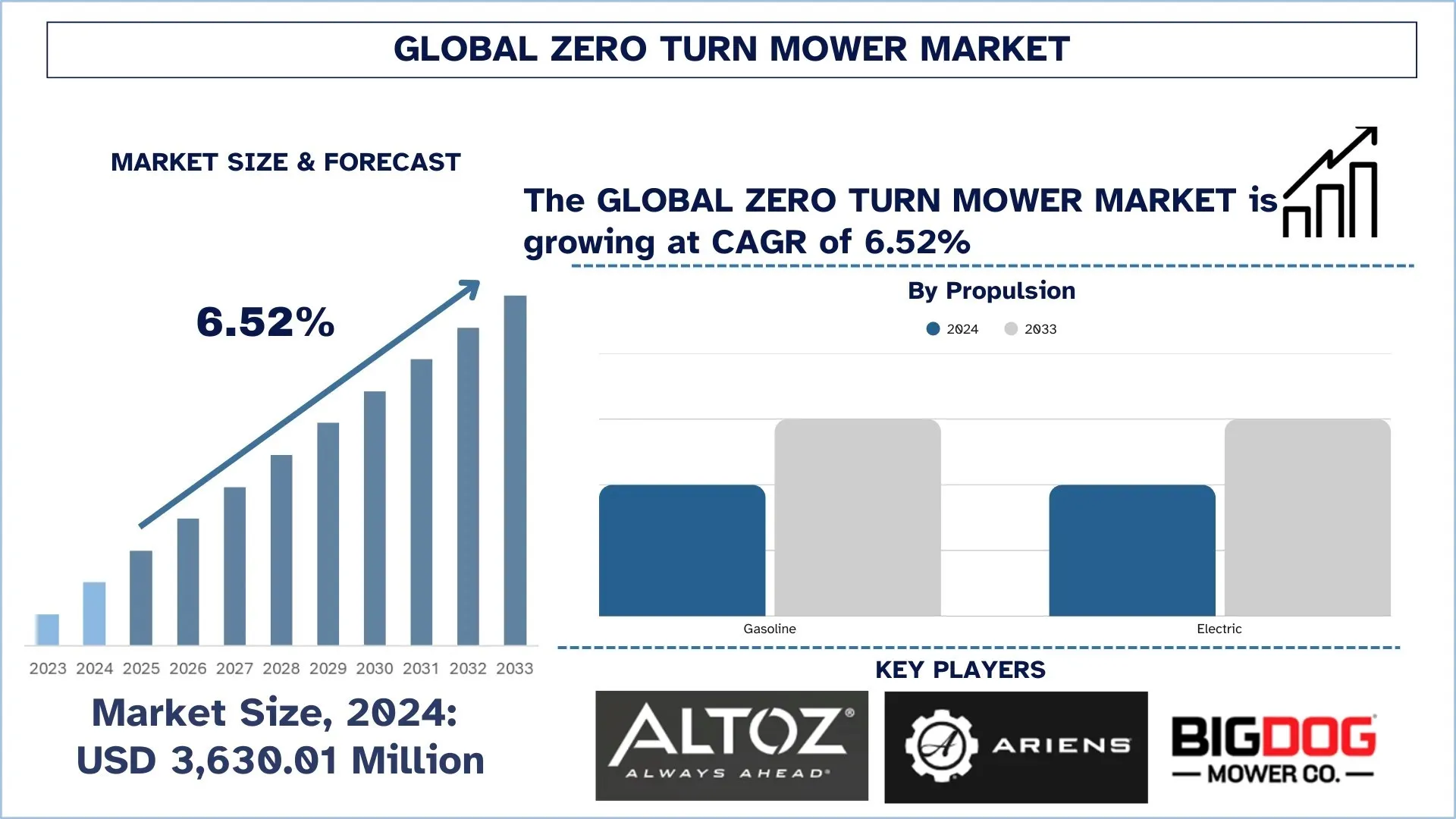
Global Zero Turn Mower Market Size & Forecast
The Global Zero Turn Mower Market was valued at USD 3,630.01 million in 2024 and is expected to grow at a CAGR of around 6.52% during the forecast period (2025–2033F), driven by increasing demand for efficient lawn maintenance solutions, expansion of residential lawns and commercial landscaping services, and the need for time-saving, high-productivity mowing equipment across various end-user segments.
Zero Turn Mower Market Analysis
The market of zero-turn mowers is in full development due to the high demand for efficient and high-performance equipment for lawn care in residential, commercial, and industrial markets. Being one of the most sophisticated types of lawnmowers, the zero-turn mowers are greatly appreciated for their high maneuverability, speed, and accuracy, as well as suitability for large and complex landscapes. The rising interest in landscaping efficiency, as well as the rise in the use of the outdoor space, is also playing a role in the market demand segment. Moreover, the emergence of green consumers has also led to an increase in the demand for electric-powered zero-turn mowers that have zero emissions and less maintenance than conventional gas-powered mowers. These innovations are further supported by the ongoing cutting-edge technologies, such as smart sensors and telematics systems, which may provide real-time control, route optimization, and performance tracking. The combination of these technologies with zero-turn mowers makes them efficient, safer, and easier to use, and satisfies the requirements of homeowners and professional landscapers. With the continuous introduction of autonomous features and AI-based mowing systems, the market is shifting towards more intelligent and automated systems, which are expected to be more productive and precise, pushing the limits of lawn care.
Global Zero Turn Mower Market Trends
This section discusses the key market trends that are influencing the various segments of the global zero-turn mower market, as found by our team of research experts.
Shift toward electric, battery-powered, and low-emission ZTRs
The move to electric, battery-powered, and zero-emission mowers that are low-turn is being compelled by increasing environmental regulations, escalating fuel prices, and rising consumer environmental consciousness. Commercial landscapers, city officials, and home users are under pressure to minimize emissions and noise, especially in urban and suburban areas where limitations on loud equipment are becoming increasingly widespread. Battery technology has now reached an advanced level that today modern electric zero-turn mowers can have competitive run time and cut rate, along with the added advantage of instant torque, less noise production, and much lower maintenance because of the minimum number of moving components, and the lack of an engine oil or fuel system. This may reduce total operating costs over the life cycle, although initial prices may be higher than traditional gasoline models. To fleet operators, the capability to charge overnight, not to deal with fuel, and the capability to sell green services to environmentally conscious consumers solidifies this change and quickens its adoption.
Zero Turn Mower Industry Segmentation
This section provides an analysis of the key trends in each segment of the global zero-turn mower market report, along with forecasts at the global, regional, and country levels for 2025-2033.
The Gasoline Segment Dominates the Zero Turn Mower Market
Based on propulsion type, the global zero-turn mower market is segmented into Gasoline and Electric. In 2024, the Gasoline segment is expected to hold the largest market share and maintain its dominance throughout the forecast period. This is mainly because gasoline-powered zero-turn mowers have long been in use and are associated with high power, long life, and performance on large, demanding lawns. Gasoline mowers are still favored by commercial landscapers and homeowners with large plots that require high cutting power and reliability. Nevertheless, the Electric segment is expected to grow the fastest as consumers shift toward environmentally friendly, low-maintenance solutions. Electric zero-turn mowers have a few benefits, such as zero emissions, reduced noise generation, and reduced maintenance costs, and therefore, these are very attractive to environmentally sensitive consumers. With improvements in battery technology, increasing run-time and charging speed, the Electric segment is likely to gain a larger share of the market, at least in residential and small-to-medium-scale commercial applications.
The 50 to 60 inches Segment held the Largest Market Share in the Zero Turn Mower Market.
Based on cutting width, the global zero-turn mower market is segmented into Less than 50 inches, 50 to 60 inches, and More than 60 inches. In 2024, the 50 to 60 inches segment is anticipated to hold the largest market share and continue its dominance throughout the forecast period. The main reason behind this is that mowers within this category are the right compromise of both maneuverability and cutting capacity, which makes them suitable for residential lawns as well as commercial landscape projects. Such models have become very popular because they are very versatile, efficient, and flexible to use on medium and large-sized properties. However, the fastest growth will be the Less than 50 inches segment, which should be encouraged by the increasing popularity of small compact and easy-to-use mowers in small residential lawns. The smaller models are popular because of their increased maneuverability and compact size, which are attractive to homeowners with limited storage or a smaller lawn. The market for More than 60 inches is expected to experience consistent growth, and this is mainly due to commercial landscapers and large estates that need high cutting capacity to be effective and productive. These bigger mowers have huge time-saving benefits, hence suitability in large-scale operations.
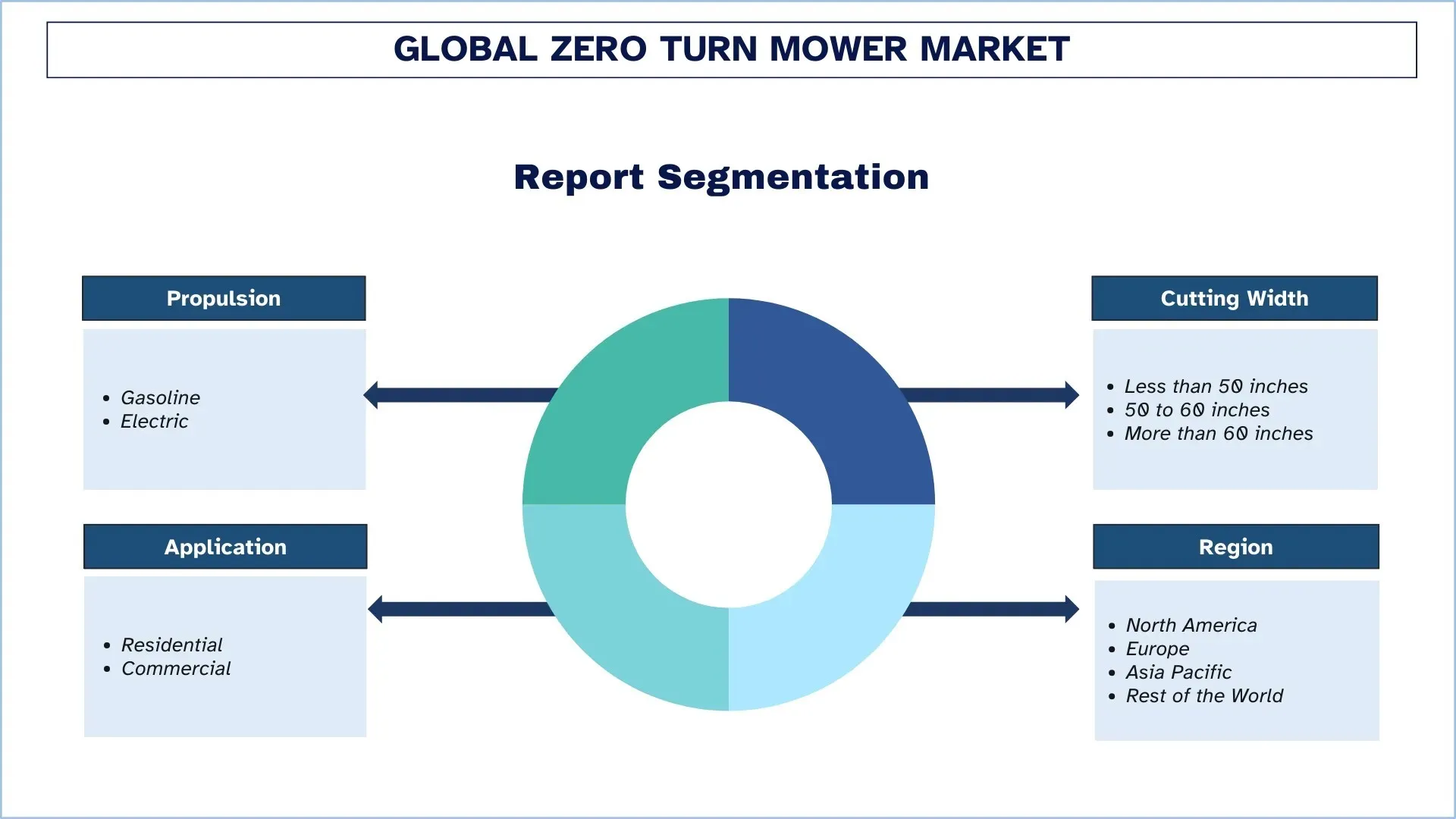
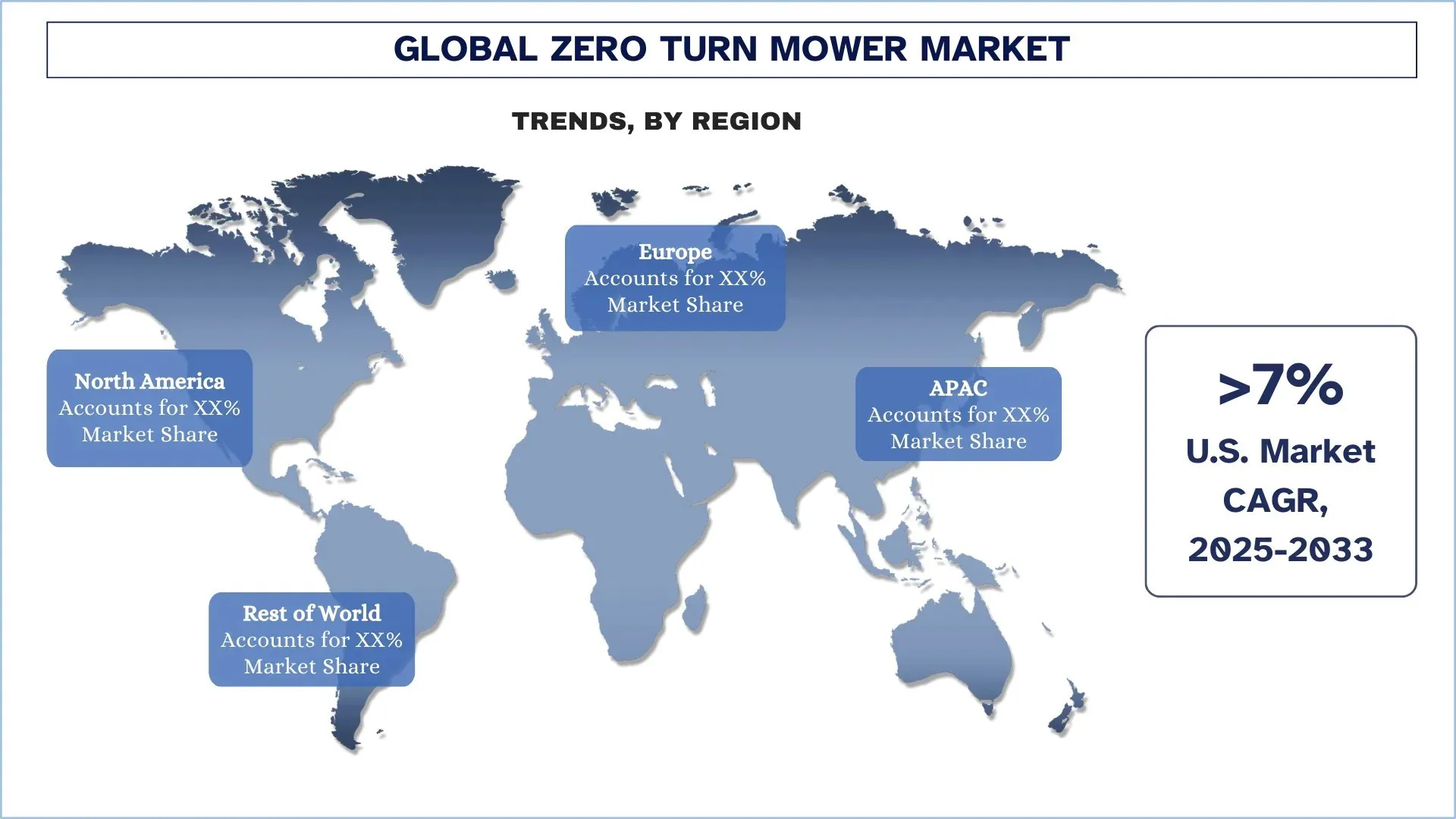
North America Dominated the Global Zero Turn Mower Market
North America currently dominates overall demand and revenue share. This leadership is mainly motivated by the fact that the region has massive residential lawns, a high proportion of home ownership, and the culture of maintaining a lawn and garden. The US market, specifically, makes a significant percentage of volume sales with customers purchasing high-performance, time-saving mowing machines and commercial landscaping firms. Well-established distribution networks further enhance market penetration, the presence of top manufacturers, and increased disposable incomes. The commercial uses, like golf courses, sports fields, parks, and municipal grounds management, also play a significant role in regional development. Also, the introduction of new technologies, such as electric and battery-powered zero-turn mowers, smart maneuvers, and features that are comfortable to operate, can maintain the leading position of North America.
U.S. held a dominant Share of the North America Zero Turn Mower Market in 2024
The U.S. controlled the market of zero-turn mowers in North America because of the large residential lawns, golf courses, and sports fields, and the commercial landscaping industry was well established. The desire of consumers to use time-saving, high-productivity equipment favors the increased use of zero-turn mowers by homeowners and professional landscapers. Moreover, the availability of major manufacturers, widespread networks of dealers, ready access to financing, and accelerated availability of new features, including business-grade engines, comfortable seating, and zero-emission electric models, further support the dominance of the United States in this regional market.
Zero Turn Mower Industry Competitive Landscape
The global zero-turn mower market is competitive, with several global and international market players. The key players are adopting different growth strategies to enhance their market presence, such as partnerships, agreements, collaborations, new product launches, geographical expansions, and mergers and acquisitions.
Top Zero Turn Mower Companies
Some of the major players in the market are Altoz, Ariens, BigDog® Mower Co., Briggs & Stratton, Deere & Company, Husqvarna AB, Kubota Canada Ltd., MTD Inc., Robert Bosch Power Tools GmbH, and Spartan Mowers & UTVs.
Recent Developments in the Zero Turn Mower Market
In January 2025, KUBOTA Corporation introduced a Smart Autonomous Zero-Turn Mower. This mower uses cooperative technology that allows multiple units to operate together, enabling efficient execution of larger tasks while using smaller machines for residential purposes.
In October 2024, Deere & Company increased its residential zero-turn mower inventory by introducing the Z380R Electric ZTrak Zero-Turn Mower. The Z380R has a bigger cutting deck (54 inches) that has more mowing capacity and coverage. It is designed to work longer, with dual batteries that offer prolonged performance, and it can cut up to 3.5 acres, depending on conditions.
Global Zero Turn Mower Market Report Coverage
Report Attribute | Details |
Base year | 2024 |
Forecast period | 2025-2033 |
Growth momentum | Accelerate at a CAGR of 6.52% |
Market size 2024 | USD 3,630.01 Million |
Regional analysis | North America, Europe, APAC, Rest of the World |
Major contributing region | North America is expected to dominate the market during the forecast period. |
Key countries covered | U.S., Canada, Germany, U.K., Spain, Italy, France, China, Japan, and India |
Companies profiled | Altoz, Ariens, BigDog® Mower Co., Briggs & Stratton, Deere & Company, Husqvarna AB, Kubota Canada Ltd., MTD Inc., Robert Bosch Power Tools GmbH, and Spartan Mowers & UTVs. |
Report Scope | Market Trends, Drivers, and Restraints; Revenue Estimation and Forecast; Segmentation Analysis; Demand and Supply Side Analysis; Competitive Landscape; Company Profiling |
Segments Covered | By Propulsion, By Cutting Width, By Application, and By Region/Country |
Reasons to Buy the Zero Turn Mower Market Report:
The study includes market sizing and forecasting analysis confirmed by authenticated key industry experts.
The report briefly reviews overall industry performance at a glance.
The report covers an in-depth analysis of prominent industry peers, primarily focusing on key business financials, type portfolios, expansion strategies, and recent developments.
Detailed examination of drivers, restraints, key trends, and opportunities prevailing in the industry.
The study comprehensively covers the market across different segments.
Deep dive regional-level analysis of the industry.
Customization Options:
The global zero-turn mower market can further be customized as per the requirements or any other market segment. Besides this, UnivDatos understands that you may have your own business needs; hence, feel free to contact us to get a report that completely suits your requirements.
Table of Content
Research Methodology for the Global Zero Turn Mower Market Analysis (2023-2033)
We analyzed the historical market, estimated the current market, and forecasted the future market of the global zero-turn mower market to assess its application in major regions worldwide. We conducted exhaustive secondary research to gather historical market data and estimate the current market size. To validate these insights, we carefully reviewed numerous findings and assumptions. Additionally, we conducted in-depth primary interviews with industry experts across the zero-turn mower value chain. After validating market figures through these interviews, we used both top-down and bottom-up approaches to forecast the overall market size. We then employed market breakdown and data triangulation methods to estimate and analyze the market size of industry segments and sub-segments.
Market Engineering
We employed the data triangulation technique to finalize the overall market estimation and derive precise statistical numbers for each segment and sub-segment of the global zero-turn mower market. We split the data into several segments and sub-segments by analyzing various parameters and trends, including propulsion, cutting width, application, and regions within the global zero-turn mower market.
The Main Objective of the Global Zero Turn Mower Market Study
The study identifies current and future trends in the global zero-turn mower market, providing strategic insights for investors. It highlights regional market attractiveness, enabling industry participants to tap into untapped markets and gain a first-mover advantage. Other quantitative goals of the studies include:
Market Size Analysis: Assess the current market size and forecast the market size of the global zero-turn mower market and its segments in terms of value (USD).
Zero Turn Mower Market Segmentation: Segments in the study include areas of propulsion, cutting width, application, and regions.
Regulatory Framework & Value Chain Analysis: Examine the regulatory framework, value chain, customer behavior, and competitive landscape of the zero-turn mower industry.
Regional Analysis: Conduct a detailed regional analysis for key areas such as Asia Pacific, Europe, North America, and the Rest of the World.
Company Profiles & Growth Strategies: Company profiles of the zero-turn mower market and the growth strategies adopted by the market players to sustain the fast-growing market.
Frequently Asked Questions FAQs
Q1: What is the global zero-turn mower current market size and its growth potential?
The global zero-turn mower market was valued at USD 3,630.01 million in 2024 and is expected to grow at a CAGR of 6.52% during the forecast period (2025-2033).
Q2: Which segment has the largest share of the global zero-turn mower market by Propulsion?
The Gasoline segment is expected to hold the largest market due to its association with high power, long life, and performance on large, demanding lawns.
Q3: What are the driving factors for the growth of the global zero-turn mower market?
• Rising demand for efficient lawn maintenance & landscaping services
• Growth in residential lawn care and the premium homeownership segment
• Technological advancements in engines, batteries, and comfort features
Q4: What are the emerging technologies and trends in the global zero-turn mower market?
• Shift toward electric, battery-powered, and low-emission ZTRs
• Integration of smart, connected, and autonomous features
Q5: What are the key challenges in the global zero-turn mower market?
• High initial purchase cost and maintenance complexity
• Need for skilled operators and reliable service networks
Q6: Which region dominates the global zero-turn mower market?
North America dominated the zero-turn mower market due to the extensive presence of large residential lawns, a highly developed commercial landscaping sector, and high rates of mechanization in lawn care.
Q7: Who are the key players in the global zero-turn mower market?
Some of the key companies include:
• Altoz
• Ariens
• BigDog® Mower Co.
• Briggs & Stratton
• Deere & Company
• Husqvarna AB
• Kubota Canada Ltd.
• MTD Inc
• Robert Bosch Power Tools GmbH
• Spartan Mowers & UTVs
Q8: How is the transition to electric and hybrid technologies influencing the global zero-turn mower market?
• Product Innovation: Growing demand for quieter, low-maintenance solutions is accelerating the development of battery-powered and hybrid zero-turn mowers for both residential and commercial users.
• Operating Cost Benefits: Lower fuel and maintenance costs of electric models make them attractive for landscaping contractors looking to optimize lifecycle costs and fleet efficiency.
• Sustainability Goals: Government incentives, green procurement policies, and corporate ESG targets support the adoption of low-emission zero-turn mowers, strengthening the market for advanced electric platforms.
Q9: How do landscaping trends and infrastructure development drive demand for zero-turn mowers worldwide?
• Urbanization & Commercial Spaces: Expansion of parks, campuses, sports facilities, and commercial complexes increases the need for high-productivity turf maintenance equipment.
• Residential Landscaping: Rising preference for well-maintained lawns and outdoor living spaces, especially in North America and parts of Europe and APAC, supports strong homeowner demand for zero-turn mowers.
• Professional Landscaping Services: Growth of organized landscaping and groundskeeping service providers boosts purchases of commercial-grade zero-turn mowers with higher durability, comfort, and productivity.
Related Reports
Customers who bought this item also bought





Middle East & Africa Rough Terrain Crane Market: Current Analysis and Forecast (2025-2033)
Emphasis By Payload Capacity (Up to 25 Tons, 26-74 Tons, 75-100 Tons, and Above 100 Tons), by Application (Construction, Utility, and Others), By Country (Saudi Arabia, UAE, Egypt, South Africa, Turkey, Israel, and the Rest of Middle East & Africa)
Smart Industrial Fence System Market: Current Analysis and Forecast (2025-2033)
Emphasis on Type (Chain Link Fences, Electric Fences, Privacy Fences, Automatic Gates, Barbed Wire Fences, and Others); Technology (IoT, AI, RFID, and Others); Application (Perimeter Security, Access Control, Intrusion Detection, and Others); End-User (Automotive, Manufacturing, Transportation, Government, Construction, and Others); and Region/Country

Southeast Asia Sorting and Grading Machines Market: Current Analysis and Forecast (2025-2033)
Emphasis on Machine Type (Optical Sorting, Weight-Based Grading, Size-Based Grading, and Others); Technology (Camera/Vision-Based Systems, AI and Machine Learning, Sensor-Based Systems, and Others); End-Use Industry (Agriculture & Food Processing, Recycling & Waste Management, Mining & Minerals, Pharmaceuticals, and Others); Sales Channel (Direct Sales and Indirect Sales); and Country.
Zero Turn Mower Market: Current Analysis and Forecast (2025-2033)
Emphasis on Propulsion (Gasoline and Electric); Cutting Width (Less than 50 inches, 50 to 60 inches, and More than 60 inches); Application (Residential and Commercial); and Region/Country