- Home
- About Us
- Industry
- Services
- Reading
- Contact Us
Proximity Marketing Market: Current Analysis and Forecast (2025-2033)
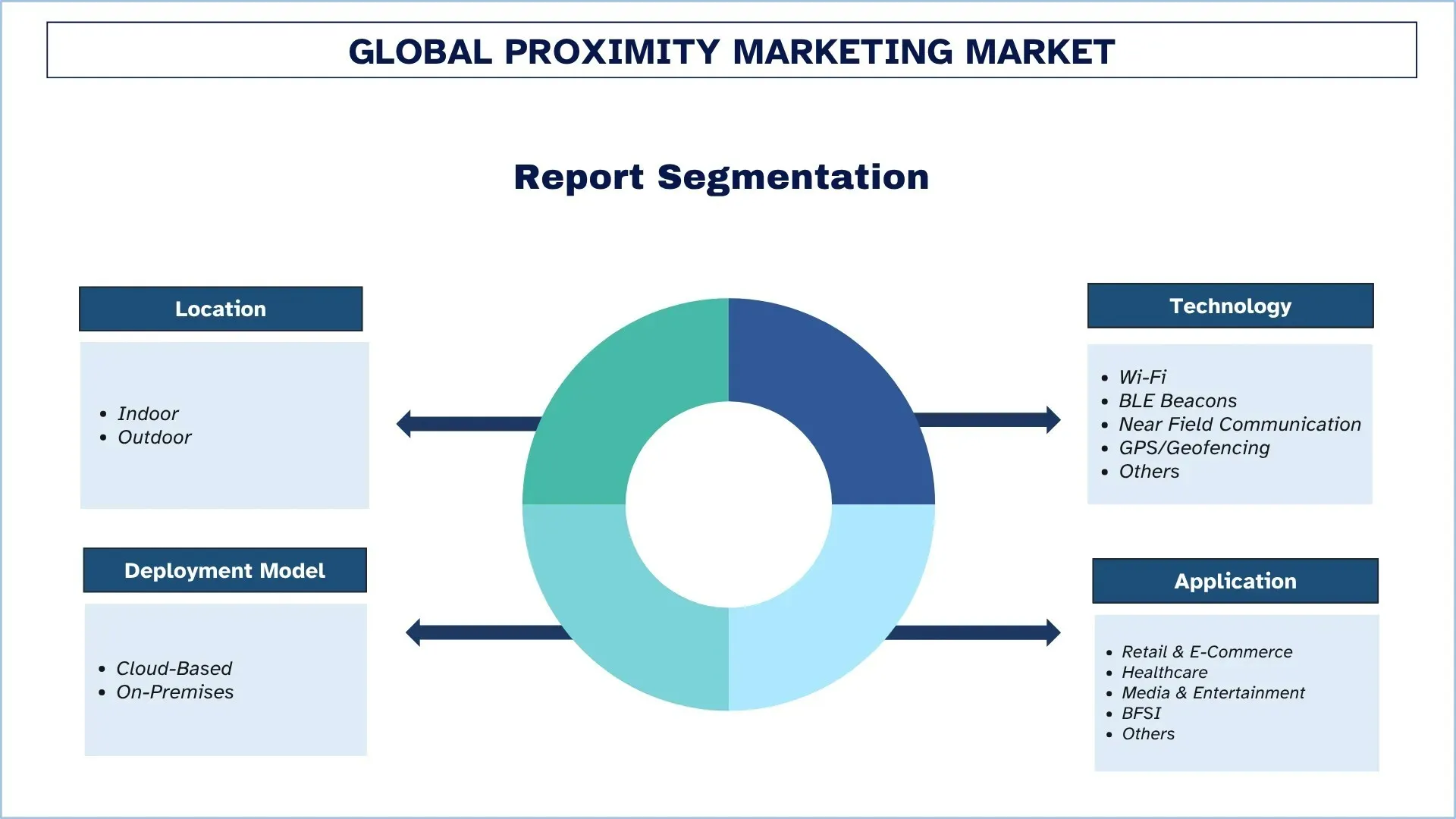
Emphasis on Location (Indoor and Outdoor); Deployment Model (Cloud-Based and On-Premises); Technology (Wi-Fi, BLE Beacons, Near Field Communication, GPS/Geofencing, and Others); Application (Retail & E-Commerce, Healthcare, Media & Entertainment, BFSI, and Others); and Region/Country
Global Proximity Marketing Market Size & Forecast
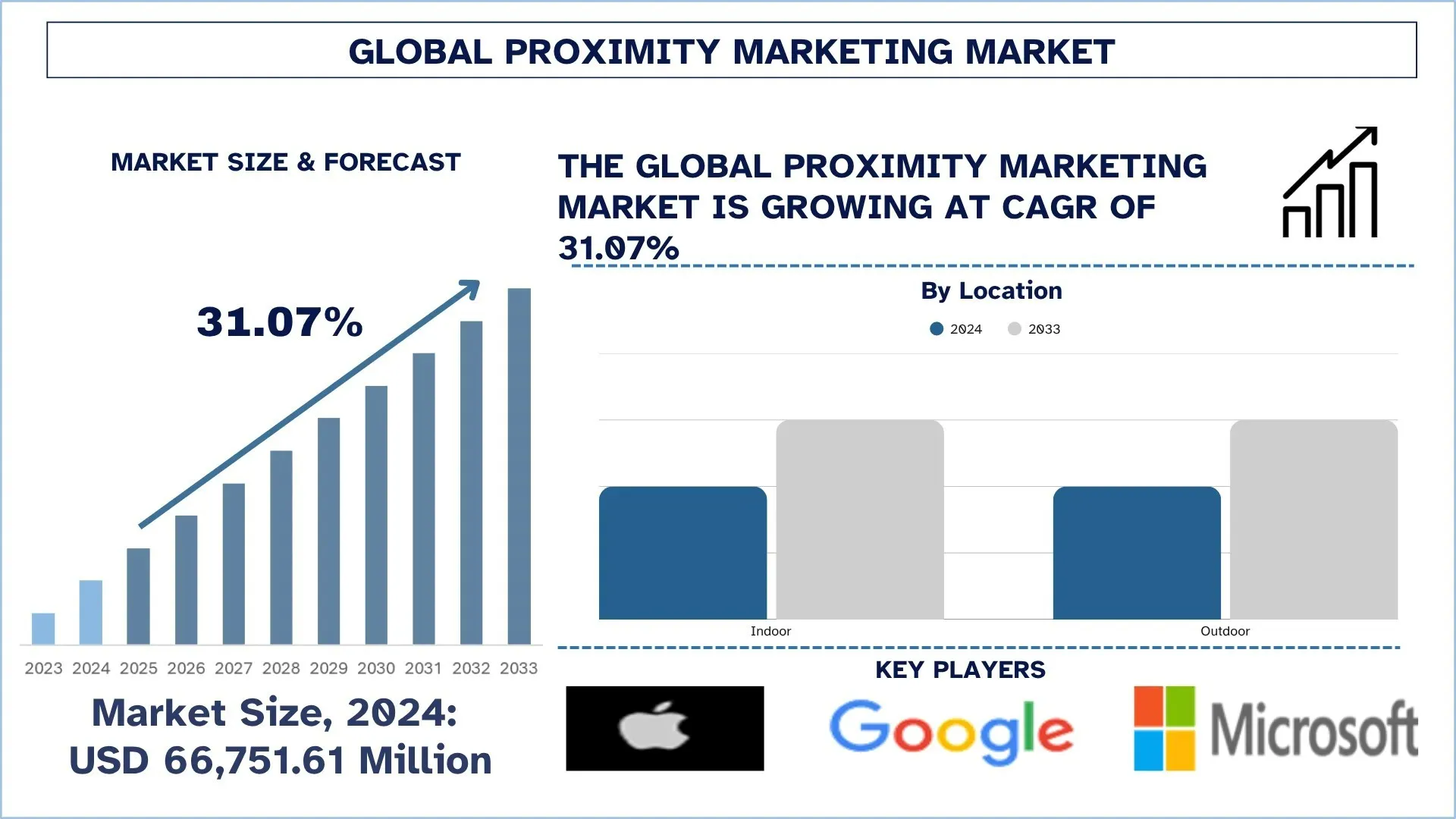
The Global Proximity Marketing Market was valued at USD 66,751.61 million in 2024 and is expected to grow at a strong CAGR of around 31.07% during the forecast period (2025-2033F), driven by growing consumer demand for hyperlocal offers, increased use of geofencing in apps, rising popularity of wearable devices, and enhanced data monetization strategies by businesses.
Proximity Marketing Market Analysis
The proximity marketing market is growing strongly, driven by the growing use of smartphones, the widespread adoption of mobile internet, and increasing demand for personalized customer experience engagement. Businesses across different sectors, such as retail, healthcare, transportation, and entertainment, are increasingly utilizing proximity technologies such as Bluetooth Low Energy (BLE) beacons, Wi-Fi, NFC, and geofencing to deliver real-time, location-based promotions and information. The incorporation of Artificial Intelligence (AI), Machine Learning (ML), and data analytics continues to improve campaign precision, offering highly personalized marketing experiences. Cloud-based solutions are gaining popularity due to their scalability and ease of deployment, allowing businesses to run large-scale campaigns efficiently. Furthermore, ongoing investments and collaborations among telecom operators, technology providers, and advertising platforms are accelerating innovation and market expansion.
Global Proximity Marketing Market Trends
This section discusses the key market trends that are influencing the various segments of the global proximity marketing market, as found by our team of research experts.
Integration of AI and Machine Learning
The integration of Artificial Intelligence (AI) and Machine Learning (ML) is revolutionizing the proximity marketing industry by facilitating smarter, data-driven, and highly personalized customer experiences. AI algorithms analyze a large amount of location-based data, customer behavior, and purchase patterns to deliver highly targeted and contextually relevant messages. Machine learning models continually refine campaign performance by predicting customer intent and optimizing content delivery in real-time. This allows businesses to boost engagement, cut marketing costs, and enhance customer satisfaction. Furthermore, AI-based analytics can identify the best times and locations to deliver offers, while sentiment analysis provides brands with deeper insights into consumer preferences. The growing integration of AI with beacons, sensors, and IoT devices enables hyperlocal marketing with greater precision. As more businesses adopt automation and predictive marketing tools, AI and ML are becoming vital for fostering innovation, boosting efficiency, and delivering measurable results in the global proximity marketing industry.
Proximity Marketing Industry Segmentation
This section provides an analysis of the key trends in each segment of the global proximity marketing market report, along with forecasts at the global, regional, and country levels for 2025-2033.
The Outdoor Segment Dominates the Global Proximity Marketing Market
Based on the location, the market is categorized into indoor and outdoor. Among these, the outdoor segment dominates the proximity marketing market due to its extensive use across high-traffic areas such as retail stores, transportation hubs, and stadiums. Using GPS, Wi-Fi, and geofencing technologies, it enables brands to reach consumers in real time beyond store premises, boosting visibility and engagement. However, the indoor segment is experiencing the fastest growth as retailers, airports, and healthcare facilities adopt beacon and Wi-Fi-based systems for personalized engagement. Advancements in AI and IoT are enhancing precision, lowering costs, and driving the widespread adoption of indoor proximity solutions, making it the most dynamic area of market expansion.
The Cloud-Based Segment Dominates the Global Proximity Marketing Market.
Based on the deployment model, the market is categorized into cloud-based and on-premises. Among these, the cloud-based segment leads the proximity marketing market because of its scalability, cost-effectiveness, and easy deployment. It allows businesses to run campaigns, analyze customer data, and target promotions remotely without significant infrastructure investment. The increasing adoption of SaaS and centralized data management bolsters its dominance. Meanwhile, the on-premises segment is growing quickly as organizations seek better data security, customization, and compliance with privacy laws. Sectors like banking, healthcare, and retail favor on-premises solutions for more control over sensitive information. Improvements in edge computing and local servers are boosting performance, promoting the faster adoption of on-premises proximity marketing technologies.
North America holds the largest market share in the global proximity marketing market
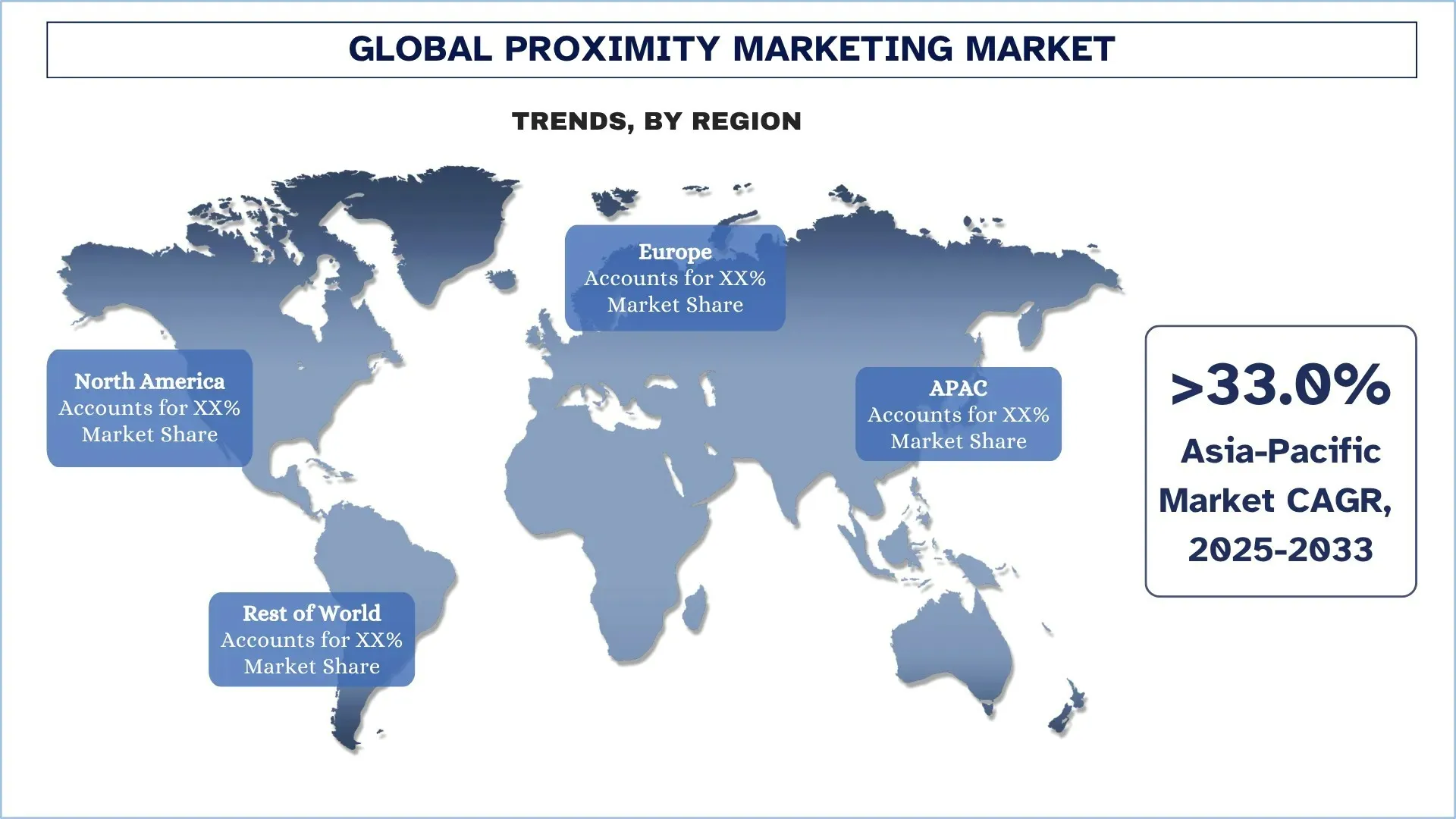
North America dominates the proximity marketing market because of its advanced digital infrastructure, widespread smartphone use, and early adoption of proximity technologies. The region is home to major tech companies and marketing platforms like Google, Apple, and Infillion, which are continually developing proximity-based advertising solutions. The region's strong retail and e-commerce sectors, combined with high consumer engagement through mobile apps, further boost market growth. Furthermore, the widespread use of IoT, AI, and analytics tools improves targeting accuracy and campaign effectiveness, thereby propelling market growth. Supportive regulations and strong investment in digital advertising also strengthen the region's position in the global proximity marketing market.
U.S. held a Dominant share of the North America Proximity Marketing Market in 2024
The United States dominated the proximity marketing market, driven by its highly competitive retail environment and rapid digital transformation across industries. Enterprises are using proximity technologies to connect online and offline consumer experiences, utilizing tools such as AI-based geolocation, beacon networks, and advanced analytics to develop context-aware marketing campaigns. The country’s tech-focused consumer habits, supported by large smartphone usage and high app engagement, create a prime environment for adoption. Startups and marketing technology firms are drawing substantial venture capital to develop privacy-conscious, hyperlocal advertising solutions. Also, collaboration among technology developers, retailers, and data platforms is expanding the use of proximity marketing in smart cities, logistics, and entertainment venues, further supporting market development.
Proximity Marketing Industry Competitive Landscape
The global proximity marketing market is competitive, with several global and international market players. The key players are adopting different growth strategies to enhance their market presence, such as partnerships, agreements, collaborations, geographical expansions, and mergers and acquisitions.
Top Proximity Marketing Market Companies
Some of the major players in the market are Apple Inc., Google LLC., Microsoft, HID Global Corporation (ASSA ABLOY group), InMarket Media, LLC (Channel Mix), Shopkick, Inc. (Trax), Infillion, Mapsted Corp., Happiest Minds, and Radius Networks, Inc.
Recent Developments in the Proximity Marketing Market
In February 2025, Infillion announced the acquisition of MediaMath, strengthening its programmatic and location-intelligence capabilities, reinforcing its role in delivering data-driven, proximity-based advertising solutions.
In September 2023,” Yes&”, a full-service marketing and advertising agency, announced the acquisition of Beacon Digital Marketing, a New York-based digital agency, enhancing its ability to create targeted, location-aware marketing strategies within proximity marketing.
Global Proximity Marketing Market Report Coverage
Report Attribute | Details |
Base year | 2024 |
Forecast period | 2025-2033 |
Growth momentum | Accelerate at a CAGR of 31.07% |
Market size 2024 | USD 66,751.61million |
Regional analysis | North America, Europe, APAC, Rest of the World |
Major contributing region | The North America region is expected to dominate the market during the forecast period. |
Key countries covered | U.S., Canada, Germany, U.K., Spain, Italy, France, China, Japan, and India. |
Companies profiled | Apple Inc., Google LLC., Microsoft, HID Global Corporation (ASSA ABLOY group), InMarket Media, LLC (Channel Mix), Shopkick, Inc. (Trax), Infillion, Mapsted Corp., Happiest Minds, and Radius Networks, Inc. |
Report Scope | Market Trends, Drivers, and Restraints; Revenue Estimation and Forecast; Segmentation Analysis; Demand and Supply Side Analysis; Competitive Landscape; Company Profiling |
Segments Covered | By Location, By Deployment Model, By Technology, By Application, and By Region/Country |
Reasons to Buy the Proximity Marketing Market Report:
The study includes market sizing and forecasting analysis confirmed by authenticated key industry experts.
The report briefly reviews overall industry performance at a glance.
The report covers an in-depth analysis of prominent industry peers, primarily focusing on key business financials, type portfolios, expansion strategies, and recent developments.
Detailed examination of drivers, restraints, key trends, and opportunities prevailing in the industry.
The study comprehensively covers the market across different segments.
Deep dive regional level analysis of the industry.
Customization Options:
The global proximity marketing market can further be customized as per the requirements or any other market segment. Besides this, UnivDatos understands that you may have your own business needs; hence, feel free to contact us to get a report that completely suits your requirements.
Table of Content
Research Methodology for the Global Proximity Marketing Market Analysis (2023-2033)
We analyzed the historical market, estimated the current market, and forecasted the future market of the global proximity marketing market to assess its application in major regions worldwide. We conducted exhaustive secondary research to gather historical market data and estimate the current market size. To validate these insights, we carefully reviewed numerous findings and assumptions. Additionally, we conducted in-depth primary interviews with industry experts across the proximity marketing value chain. After validating market figures through these interviews, we used both top-down and bottom-up approaches to forecast the overall market size. We then employed market breakdown and data triangulation methods to estimate and analyze the market size of industry segments and sub-segments.
Market Engineering
We employed the data triangulation technique to finalize the overall market estimation and derive precise statistical numbers for each segment and sub-segment of the global proximity marketing market. We split the data into several segments and sub-segments by analyzing various parameters and trends, including location, deployment model, technology, application, and regions within the global proximity marketing market.
The Main Objective of the Global Proximity Marketing Market Study
The study identifies current and future trends in the global proximity marketing market, providing strategic insights for investors. It highlights regional market attractiveness, enabling industry participants to tap into untapped markets and gain a first-mover advantage. Other quantitative goals of the studies include:
Market Size Analysis: Assess the current and forecast market size of the global proximity marketing market and its segments in terms of value (USD).
Proximity Marketing Market Segmentation: Segments in the study include areas of location, deployment model, technology, application, and region.
Regulatory Framework & Value Chain Analysis: Examine the regulatory framework, value chain, customer behavior, and competitive landscape of the proximity marketing industry.
Regional Analysis: Conduct a detailed regional analysis for key areas such as Asia Pacific, Europe, North America, and the Rest of the World.
Company Profiles & Growth Strategies: Company profiles of the proximity marketing market and the growth strategies adopted by the market players to sustain the fast-growing market.
Frequently Asked Questions FAQs
Q1: What is the global proximity marketing market’s current market size and growth potential?
As of 2024, the global proximity marketing market is valued at USD 66,751.61 million and is projected to grow at an impressive CAGR of 31.07% from 2025 to 2033, driven by increasing mobile adoption, advanced beacon technology, and demand for location-based marketing solutions.
Q2: Which segment has the largest share of the global proximity marketing market by location category?
The outdoor segment currently dominates the global proximity marketing market, as businesses increasingly use location-based strategies to engage customers in public spaces, retail areas, and event venues.
Q3: What are the driving factors for the growth of the global proximity marketing market?
Top growth drivers of the proximity marketing market include:
• Rising smartphone and mobile device penetration.
• Technological advancements in beacon and Bluetooth Low Energy (BLE) systems.
• Growing focus on omnichannel marketing strategies.
Q4: What are the emerging technologies and trends in the global proximity marketing market?
Emerging trends in the proximity marketing market include:
• Integration of AI and machine learning for predictive and personalized campaigns.
• Hyper-personalized, location-based customer engagement strategies.
Q5: What are the key challenges in the global proximity marketing market?
Key challenges in the proximity marketing market include:
• Data privacy and security concerns impacting consumer trust.
• High implementation and maintenance costs for beacon networks and location-based systems.
Q6: Which region dominates the global proximity marketing market?
North America dominates the market due to its well-established retail ecosystem, advanced technological infrastructure, and high adoption of mobile and digital marketing solutions.
Q7: Who are the key competitors in the global proximity marketing market?
Top players in the proximity marketing industry include:
• Apple Inc.
• Google LLC.
• Microsoft
• HID Global Corporation (ASSA ABLOY group)
• InMarket Media, LLC (Channel Mix)
• Shopkick, Inc. (Trax)
• Infillion
• Mapsted Corp.
• Happiest Minds
• Radius Networks, Inc.
Q8: What is the return on investment (ROI) and effectiveness of proximity marketing campaigns for businesses?
Proximity marketing campaigns deliver measurable results by increasing foot traffic, conversion rates, and customer engagement. Businesses implementing location-based targeting and personalized offers often see significant improvements in sales performance and brand loyalty, making it a high-impact marketing strategy.
Q9: How is technological innovation shaping the future of the proximity marketing industry?
Emerging technologies such as AI, IoT, machine learning, and advanced BLE beacons are transforming the market. These innovations enable real-time analytics, predictive customer targeting, and more interactive, personalized experiences, driving wider adoption and positioning proximity marketing as a key tool in modern digital strategies.
Related Reports
Customers who bought this item also bought






Africa Business Process Outsourcing Market: Current Analysis and Forecast (2025-2033)
Emphasis By Service (Application, Finance & Accounting, Human Resources, KPO, Procurement & Supply Chain, Customer Service, And Others), By Application (BFSI, Healthcare, Manufacturing, IT & Telecommunication, Retail, and Others), By Country (Egypt, South Africa, Nigeria, Rest of Africa)
November 6, 2025

Graph Database Market: Current Analysis and Forecast (2025-2033)
Emphasis on Database Type (Property Graphs and RDF Graphs); Application (Fraud Detection and Risk Management, Customer Analytics, Recommendation Engine, Privacy and Risk Compliance, Knowledge Graphs, and Others); Industry Vertical (BFSI, Healthcare and Life Science, Retail and E-Commerce, IT and Telecom, Government and Public Sector, Transportation and Logistics, and Others); and Region/Country
November 5, 2025