- Home
- About Us
- Industry
- Services
- Reading
- Contact Us
Wet Bench Market: Current Analysis and Forecast (2025-2033)
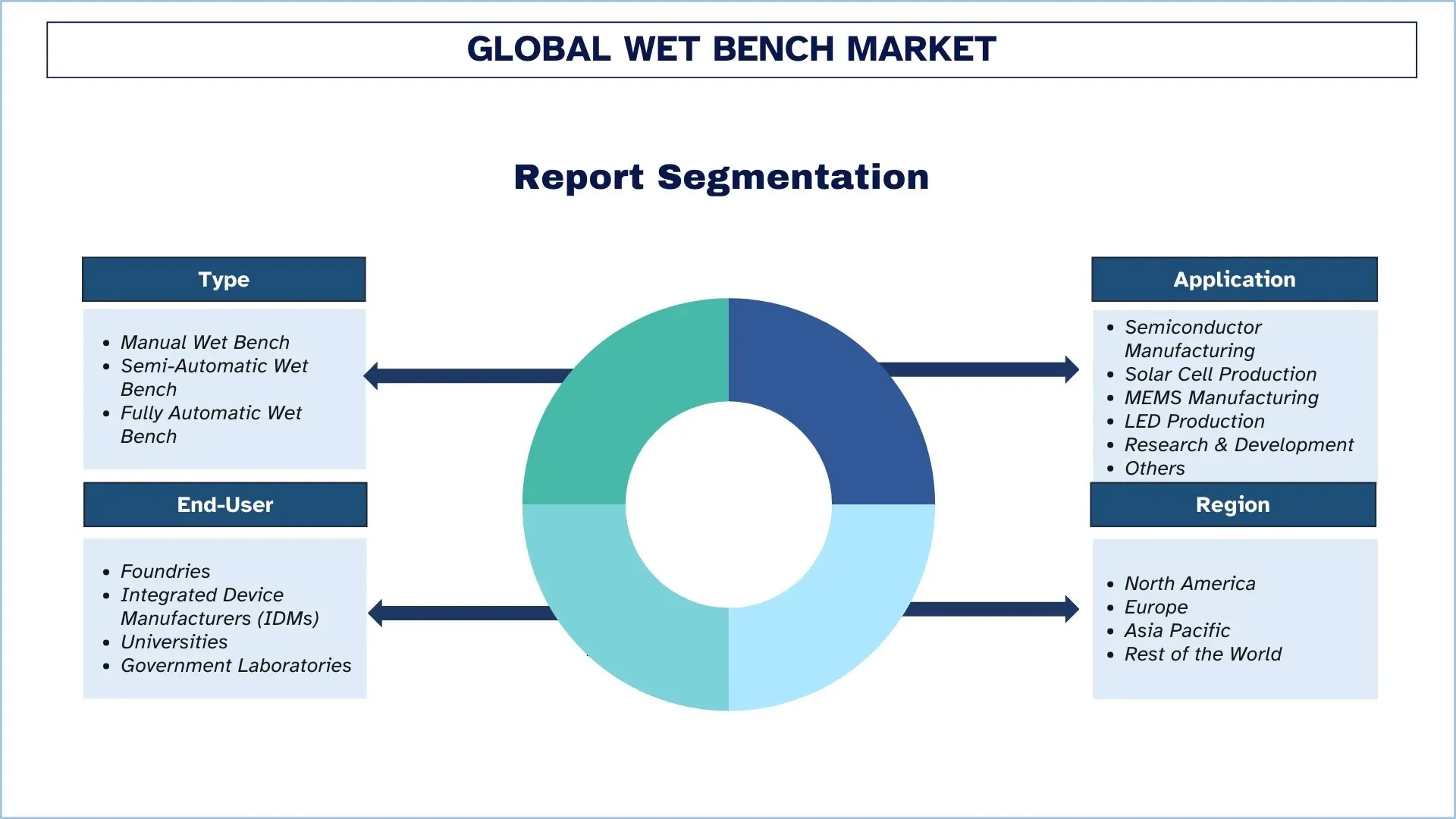
Emphasis on Type (Manual Wet Bench, Semi-Automatic Wet Bench, and Fully Automatic Wet Bench); Application (Semiconductor Manufacturing, Solar Cell Production, MEMS Manufacturing, LED Production, Research & Development, and Others); End-User (Foundries, Integrated Device Manufacturers (IDMs), Research Institutes, Universities, and Government Laboratories); and Region/Country
Global Wet Bench Market Size & Forecast
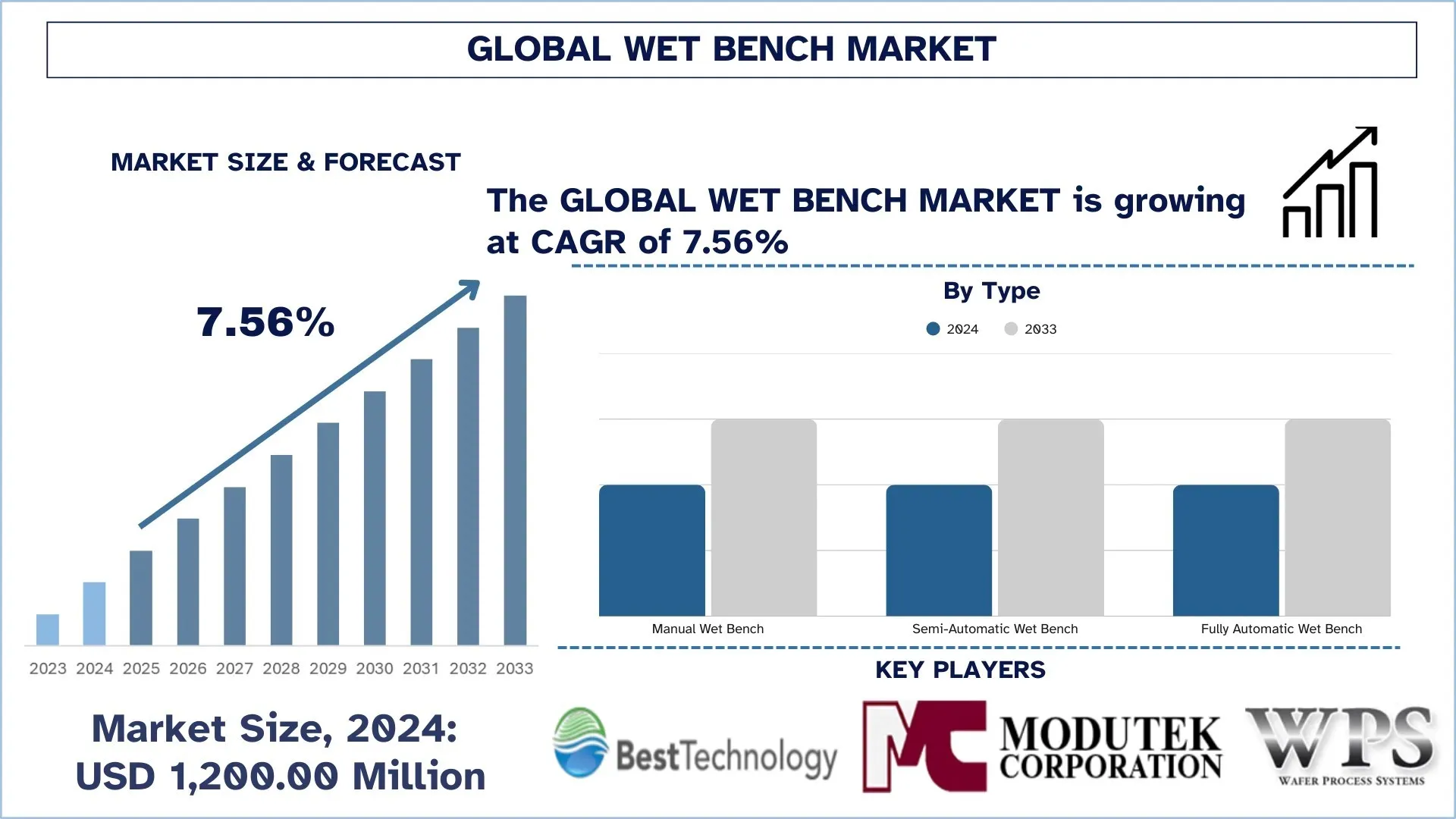
The global wet bench market was valued at USD 1,200.00 million in 2024 and is expected to grow at a steady CAGR of approximately 7.56% over the forecast period (2025-2033F), driven by rising semiconductor fab capacity additions, increasing sensitivity of advanced-node devices to contamination, and growing adoption of automation.
Wet Bench Market Analysis
The global wet bench market is experiencing continuous growth, with the growing semiconductor fabrication and increasing cleanliness requirements across electronics and advanced manufacturing. Wet benches are widely adopted by facilities to facilitate wafer cleaning, etching, and surface preparation, while enhancing process repeatability and minimizing the risk of contamination. Also, higher chip demand, capacity expansions, and investment in high-tech manufacturing hubs are further boosting adoption. The manufacturers are introducing specialized designs, such as automated wet benches, single-wafer and batch applications, and chemical-resistant designs to aggressive chemistries. Simultaneously, competitive pricing, after-sales service, and tool customization are also emerging as major differentiators, as manufacturers vie to address the diverse needs of various processes and remain reliable and cost-effective over the long run across the globe.
Global Wet Bench Market Trends
This section discusses the key market trends that are influencing the various segments of the global wet bench market, as found by our team of research experts.
Growing Adoption of Automation and Reduced-Operator Wet Benches
There is a trend in the global wet bench market towards automated and reduced-operator systems due to the desire of semiconductor and advanced manufacturing facilities towards higher yield, tighter process repeatability, and reduced reliance on manual labor in their operation. As device designs are becoming increasingly sensitive to contamination and process variation, the wet cleaning and etch processes are becoming less manned, with wet cleaning and etch steps being replaced by robotic control of wafer handling, recipe-controlled management of chemicals used, and sensor-based monitoring. There is also this move, fueled by the need to maintain high-volume production with limited downtimes, where automation allows for minimizing operator errors, enhancing tool-to-tool accuracy, and enabling continuous processing due to the built-in alarms, traceability history, and fab host connectivity. Consequently, the equipment demand trend has shifted to dry-to-dry automated flow systems at the expense of manual benches, a standardized recipe, and scalable automation with throughput and footprint requirements. In July 2025, the ACM Research announced a considerable enhancement of its Ultra C wb wet bench cleaning equipment to attain high-level chip processing. The announcement highlights progress in process-control (e.g., greater uniformity and mitigation of by-products in wet etching), two areas of the broader transition to recipe-based, tightly controlled, wet processing with less variability and reliance on less manual intervention.
Wet Bench Industry Segmentation
This section provides an analysis of the key trends in each segment of the global wet bench market report, along with forecasts at the global, regional, and country levels for 2025-2033.
The Semi-Automatic Wet Bench Market Dominates the Global Wet Bench Market
Based on type, the market is categorized into manual wet bench, semi-automatic wet bench, and fully automatic wet bench. In 2024, semi-automatic wet benches hold the largest share of the global wet bench market. Semi-automatic wet benches provide a good trade-off between cost, control, and productivity to most fabs and electronics makers. They facilitate uniform chemical processing with lesser operator reliance and still provide the flexibility to tune processes across diverse applications. Moreover, semi-automatic systems are also favored by mid-scale facilities and capacity additions as they are simpler to integrate, moderate in size, and less expensive to initially invest in than fully automated platforms, which enables the development of segments. In the meantime, fully automatic wet benches are likely to experience the most significant growth over the forecast period due to increased wafer volumes and stricter contamination-control requirements. The recent trends are the growing use of Industry 4.0 practices, the increase in throughput demands, and the necessity to reduce human contact with dangerous chemistries, which makes the global demand for fully automatic wet bench solutions rise.
The Semiconductor Manufacturing Segment Dominates the Global Wet Bench Market.
Based on application, the market is categorized into semiconductor manufacturing, solar cell production, MEMS manufacturing, LED production, research & development, and others. In 2024, semiconductor manufacturing holds the largest share of the global wet bench market, with wet cleaning and chemical treatment processes necessary throughout wafer fabrication to remove particles, organic residues, and metallic contaminants. Wet benches are used in pre-diffusion, pre-deposition, post-etch, and surface preparation, enabling enhanced yield and stable device operation. Further, the ongoing capacity increase, development of technology nodes, and more rigorous demands for defect control are driving increased use of wet processing equipment in fabs, which is enhancing segment growth. Meanwhile, the research and development segment is projected to be the fastest-growing during the forecast period due to increasing investment in new substances, high-end packages, and next-generation device architectures. The increasing pilot lines, university laboratories, and corporate innovation centers, and the requirements to achieve flexible, configurable wet processing to implement frequent recipe changes, are driving the demand for wet benches in R&D settings around the globe.
Asia Pacific holds the largest market share in the global wet bench market
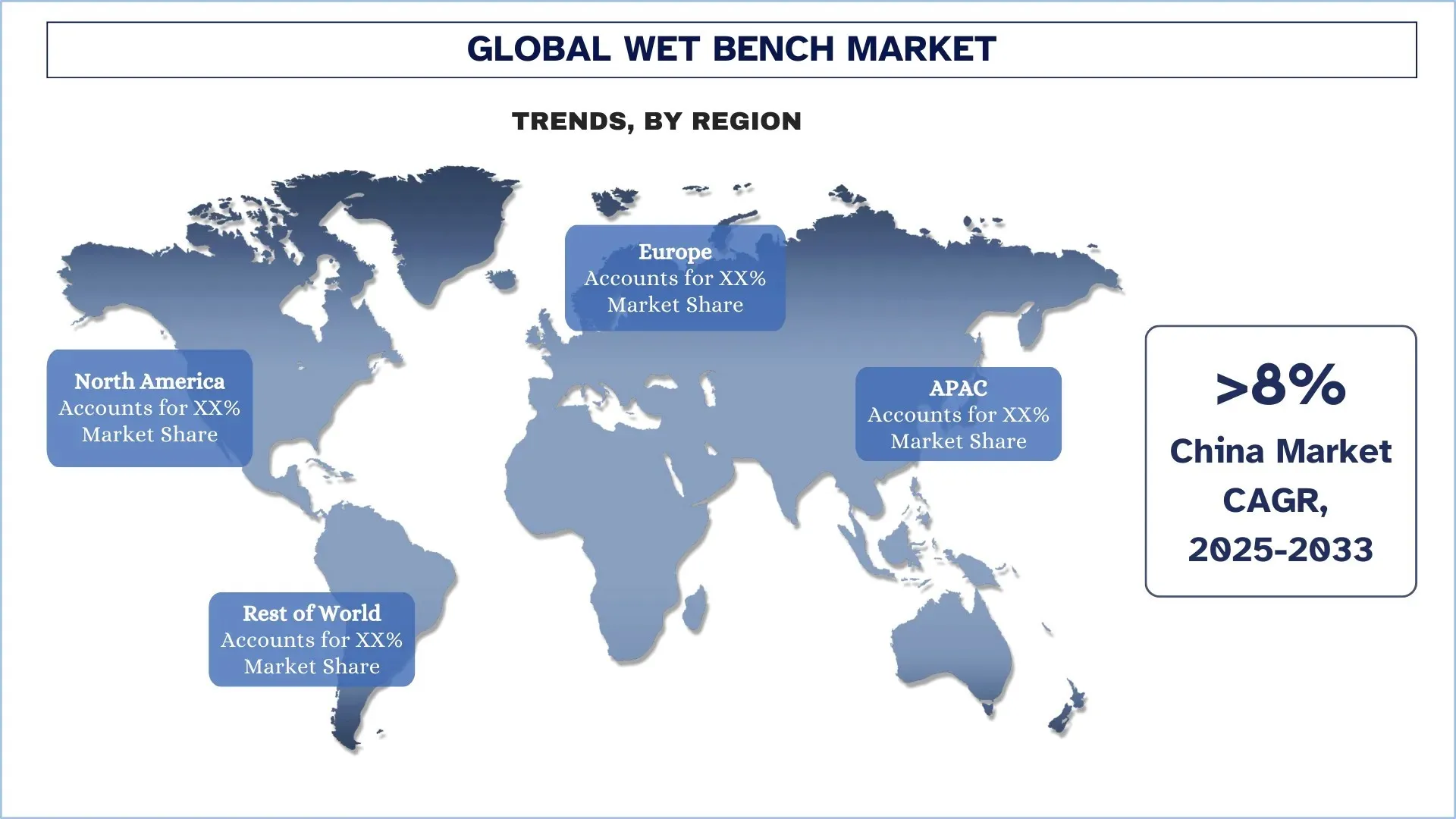
Asia-Pacific held the largest share of the global wet-bench market, supported by a strong concentration of semiconductor fabs and large-scale electronics and photovoltaic manufacturing in countries such as China, Taiwan, South Korea, and Japan. The high fab capacity additions, regular tool changes, and high yield and contamination-control standards also contribute to wet bench demand in the region. The record level of new equipment expenditure, driven by new investment cycles from major foundries and memory manufacturers, strengthens Asia Pacific's control over total semiconductor equipment spending and keeps fleets of wet-processing tools growing and upgrading. Also, the high, localized supply chains for chemicals, components, and fab services accelerate procurement and tool uptime, making adoption stronger than in other regions.
China held a Dominant share of the Asia-Pacific Wet Bench Market in 2024
China leads the wet-bench market in the Asia-Pacific region due to aggressive semiconductor capacity expansion, robust government-supported investments, and faster localization of chip-production equipment. The nation continues to add new fabrication plants and refurbish existing lines to accommodate logic, memory, and power devices, as well as high-technology packaging that involves extensive wet cleaning, etching, and surface preparation. The domestic foundries like SMIC are expanding capital spending, which is generating long-term demand for automated and high-throughput wet benches. Additionally, national self-sufficiency programs in semiconductor policy promote the purchase of state-of-the-art process equipment and the development of local equipment. These, in conjunction with increasing electronic manufacturing and supply chain expansion, make China the major contributor in the region in terms of wet bench equipment demand and future long-term growth.
Wet Bench Industry Competitive Landscape
The global wet bench market is competitive, with several global and international market players. The key players are adopting different growth strategies to enhance their market presence, such as partnerships, agreements, collaborations, geographical expansions, and mergers and acquisitions.
Top Wet Bench Market Companies
Some of the major players in the market are Best Technology Inc., Modutek Corporation, Wafer Process Systems, MT Systems Inc., Amerimade, SAT Group, BBF Technologies, Felcon Ltd, RENA Technologies GmbH, and AP&S.
Recent Developments in the Wet Bench Market
In September 2024, JST Manufacturing announced receiving a new order for its 300mm Ospray multi-chamber single-wafer wet processing system, noting that it was still needed in high precision, repeatability, and scalable wet-process stations in the advanced manufacturing lines.
In September 2025, RENA Technologies presented its semiconductor wet processing portfolio at SEMICON Taiwan 2025, including Revolution + compact automated wet bench platform - reflecting an increase of customer interest in automation-enhanced throughput and reduced-operator operation.
In August 2025, Modutek Corporation announced that it would exhibit new wet processing solutions at SEMICON India 2025 with a particular focus on automation, high precision control, and configurable wet process systems, indicating a growing demand from growing fabs and cleanroom systems.
Global Wet Bench Market Report Coverage
Report Attribute | Details |
Base year | 2024 |
Forecast period | 2025-2033 |
Growth momentum | Accelerate at a CAGR of 7.56% |
Market size 2024 | USD 1,200.00 million |
Regional analysis | North America, Europe, APAC, Rest of the World |
Major contributing region | Asia Pacific region is expected to dominate the market during the forecast period. |
Key countries covered | U.S., Canada, Germany, U.K., Spain, Italy, France, China, Japan, and India. |
Companies profiled | Best Technology Inc., Modutek Corporation, Wafer Process Systems, MT Systems Inc., Amerimade, SAT Group, BBF Technologies, Felcon Ltd, RENA Technologies GmbH, and AP&S |
Report Scope | Market Trends, Drivers, and Restraints; Revenue Estimation and Forecast; Segmentation Analysis; Demand and Supply Side Analysis; Competitive Landscape; Company Profiling |
Segments Covered | By Type, By Application, By End-User, and By Region/Country |
Reasons to Buy the Wet Bench Market Report:
The study includes market sizing and forecasting analysis confirmed by authenticated key industry experts.
The report briefly reviews overall industry performance at a glance.
The report covers an in-depth analysis of prominent industry peers, primarily focusing on key business financials, type portfolios, expansion strategies, and recent developments.
Detailed examination of drivers, restraints, key trends, and opportunities prevailing in the industry.
The study comprehensively covers the market across different segments.
Deep dive regional level analysis of the industry.
Customization Options:
The global wet bench market can further be customized as per the requirements or any other market segment. Besides this, UnivDatos understands that you may have your own business needs; hence, feel free to contact us to get a report that completely suits your requirements.
Table of Content
Research Methodology for the Global Wet Bench Market Analysis (2023-2033)
We analyzed the historical market, estimated the current market, and forecasted the future market of the global wet bench market to assess its application in major regions worldwide. We conducted exhaustive secondary research to gather historical market data and estimate the current market size. To validate these insights, we carefully reviewed numerous findings and assumptions. Additionally, we conducted in-depth primary interviews with industry experts across the wet bench value chain. After validating market figures through these interviews, we used both top-down and bottom-up approaches to forecast the overall market size. We then employed market breakdown and data triangulation methods to estimate and analyze the market size of industry segments and sub-segments.
Market Engineering
We employed the data triangulation technique to finalize the overall market estimation and derive precise statistical numbers for each segment and sub-segment of the global wet bench market. We split the data into several segments and sub-segments by analyzing various parameters and trends, including type, application, end-user, and regions within the global wet bench market.
The Main Objective of the Global Wet Bench Market Study
The study identifies current and future trends in the global wet bench market, providing strategic insights for investors. It highlights regional market attractiveness, enabling industry participants to tap into untapped markets and gain a first-mover advantage. Other quantitative goals of the studies include:
Market Size Analysis: Assess the current and forecast market size of the global wet bench market and its segments in terms of value (USD).
Wet Bench Market Segmentation: Segments in the study include areas of type, application, end-user, and region.
Regulatory Framework & Value Chain Analysis: Examine the regulatory framework, value chain, customer behavior, and competitive landscape of the wet bench industry.
Regional Analysis: Conduct a detailed regional analysis for key areas such as Asia Pacific, Europe, North America, and the Rest of the World.
Company Profiles & Growth Strategies: Company profiles of the wet bench market and the growth strategies adopted by the market players to sustain the fast-growing market.
Frequently Asked Questions FAQs
Q1: What is the global wet bench market’s current market size and growth potential?
As of 2024, the global wet bench market was valued at USD 1200.00 million and is expected to grow at a CAGR of 7.56% from 2025 to 2033, driven by rising semiconductor fab capacity additions, increasing sensitivity of advanced-node devices to contamination, and growing adoption of automation.
Q2: Which segment has the largest share of the global wet bench market by type?
The semi-automatic wet bench segment dominated the global market due to its balanced combination of cost efficiency, operational control, and productivity across a wide range of semiconductor and electronics manufacturing applications.
Q3: What are the driving factors for the growth of the global wet bench market?
Top growth drivers of the wet bench market include:
• Rising Semiconductor Fab Construction and Expansion
• Increasing Cleaning Needs for Advanced Nodes and Higher Yield Requirements
• Higher Wafer Throughput Demand Across Logic and Memory
Q4: What are the emerging technologies and trends in the global wet bench market?
Emerging trends in the wet bench market include:
• Growing Adoption of Automation and Reduced-Operator Wet Benches
• Shift Toward Lower Chemical and Water Consumption Tool Designs
Q5: What are the key challenges in the global wet bench market?
Key challenges in the global wet bench market are:
• Stricter Environmental Compliance for Chemical Handling and Waste Disposal
• High Ultrapure Water Consumption and Costly Wastewater Treatment
Q6: Which region dominates the global wet bench market?
Asia-Pacific held the largest share of the global wet-bench market, supported by a strong concentration of semiconductor fabs and large-scale electronics and photovoltaic manufacturing in countries such as China, Taiwan, South Korea, and Japan.
Q7: Who are the key competitors in the global wet bench market?
Top players in the Wet Bench industry include:
• Best Technology Inc.
• Modutek Corporation
• Wafer Process Systems
• MT Systems Inc.
• Amerimade
• SAT Group
• BBF Technologies
• Felcon Ltd
• RENA Technologies GmbH
• AP&S
Q8: How are equipment manufacturers innovating to address evolving process requirements in the wet bench market?
Manufacturers are introducing automated and reduced-operator wet benches, integrating robotic wafer handling, recipe-driven chemical control, and sensor-based monitoring systems to improve yield, minimize contamination, and enhance process repeatability for advanced semiconductor nodes.
Q9: How is semiconductor fab expansion influencing demand in the wet bench market?
New fab construction and capacity expansions are creating sustained demand for wet benches, as cleaning, etching, and surface preparation tools are essential at multiple stages of wafer processing, leading to early and large-scale equipment procurement during fab ramp-ups.
Related Reports
Customers who bought this item also bought





Neuromorphic Hardware Market: Current Analysis and Forecast (2025-2033)
Emphasis on Component (Processors, Memory and Storage, Sensors and Supporting Hardware, and Software and Tools); Deployment Mode (Edge Devices, On-Premises Data Centers, and Cloud-Based Platforms); Application (Image and Signal Processing, Natural Language Processing, Robotics and Autonomous Systems, Cybersecurity and Edge AI, Healthcare and Medical Imaging, Industrial Automation, and Others); and Region/Country
February 4, 2026
Unattended Ground Sensors (UGS) Market: Current Analysis and Forecast (2025-2033)
Emphasis on Sensor Type (Seismic Sensors, Acoustic Sensors, Magnetic Sensors, Infrared Sensors, and Others); Deployment (Fixed Systems, Portable Systems, Vehicle-Mounted Systems, and Others); Application (Military & Defense, Public Security, Environmental Monitoring, and Industrial Security); and Region/Country
December 5, 2025

Reed Sensor Market: Current Analysis and Forecast (2025-2033)
Emphasis on Type (Dry-Reed Sensor, Mercury-Wetted Reed Sensor, High Temperature Reed Sensor, High Voltage Reed Sensor, Ultra-Miniature, and Metal Detection Reed Sensor); Mount Type (Panel Mount, Screw Mount, Surface Mount, Thread Mount, and Others); Contact Position (Form A {SPST-NO}, Form B {SPST-NC}, and Form C {SPDT}); Application (Automotive & Transportation, Consumer Electronics, Telecommunications, Healthcare, Construction & Security, Robotics & Automation, and Others); and Region/Country
December 5, 2025