Unattended Ground Sensors (UGS) Market: Current Analysis and Forecast (2025-2033)
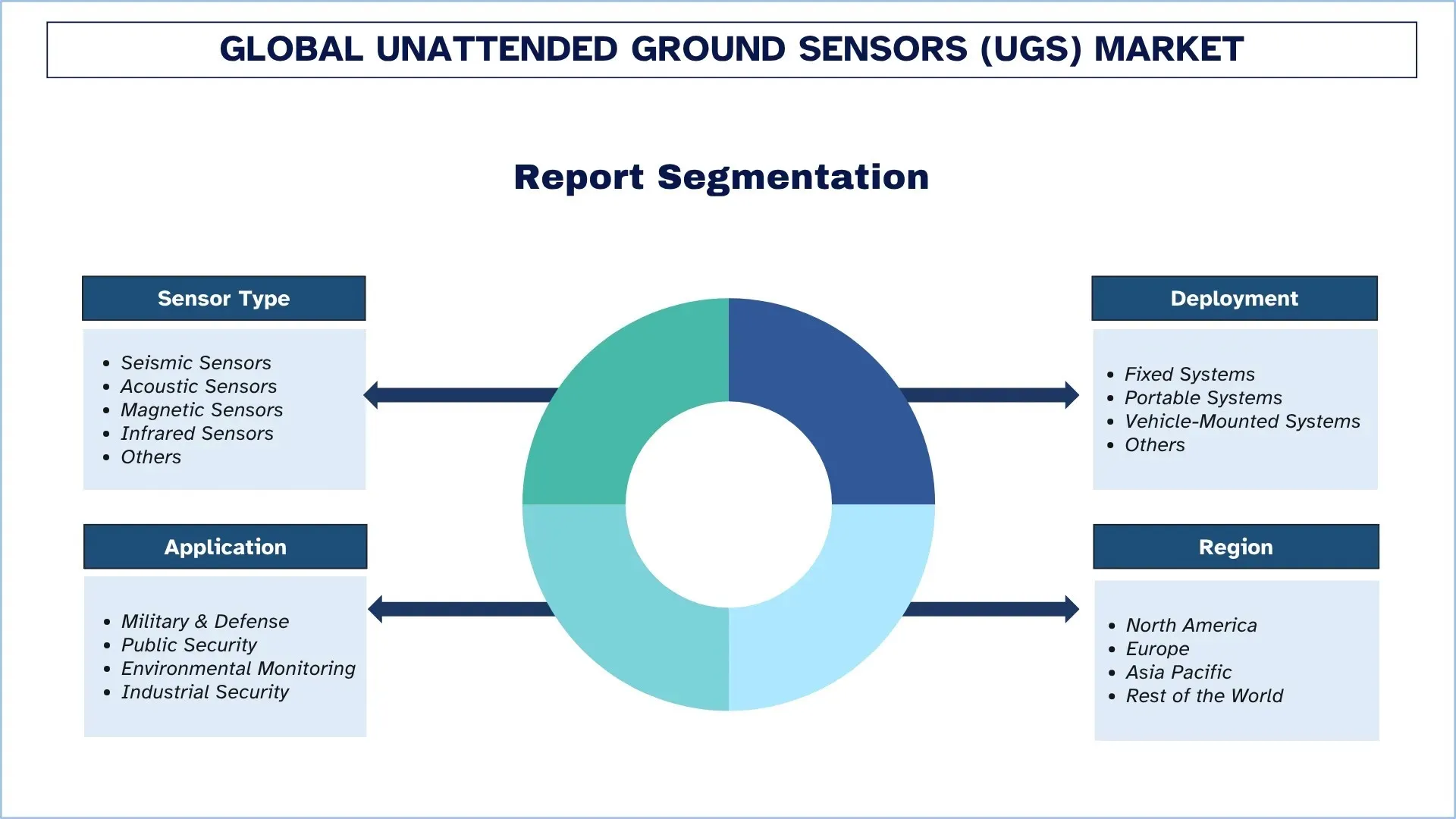
Emphasis on Sensor Type (Seismic Sensors, Acoustic Sensors, Magnetic Sensors, Infrared Sensors, and Others); Deployment (Fixed Systems, Portable Systems, Vehicle-Mounted Systems, and Others); Application (Military & Defense, Public Security, Environmental Monitoring, and Industrial Security); and Region/Country
Global Unattended Ground Sensors (UGS) Market Size & Forecast
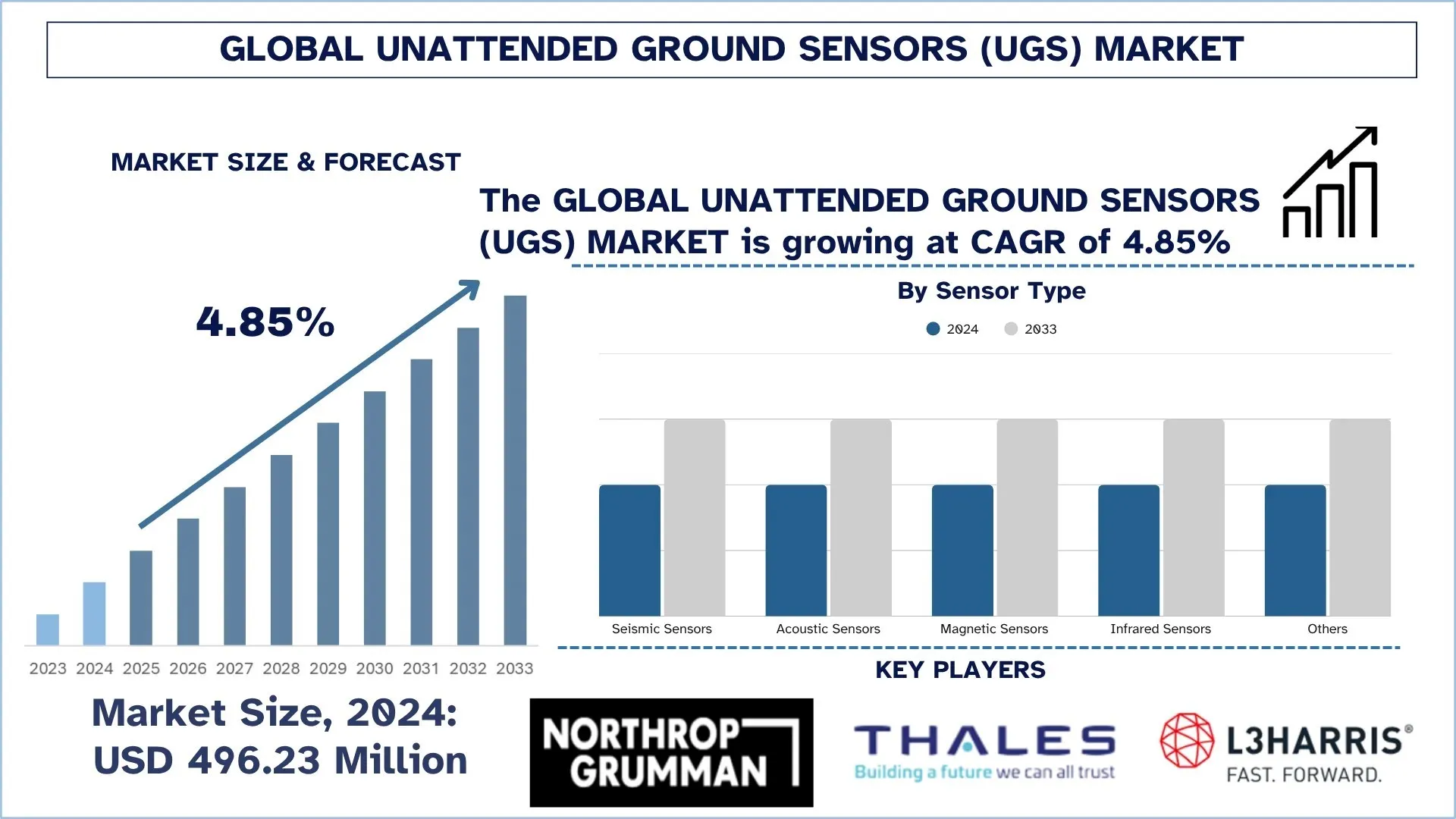
The Global Unattended Ground Sensors (UGS) Market was valued at USD 496.23 million in 2024 and is expected to grow at a CAGR of around 4.85% during the forecast period (2025–2033F), driven by a heightened focus on border protection and advanced threat detection, strengthened by defense modernization programs that prioritize sensor-rich operations.
Unattended Ground Sensors (UGS) Market Analysis
The increased interest in border protection and threat detection is driving the global market of Unattended Ground Sensors. This tremendous market growth is closely tied to the rising level of geopolitical tension, cross-border insurgencies, and the growing demand to close vast and distant national borders. In such a secure environment, the ability to achieve full coverage of a wide area with minimal manpower in continuous surveillance is paramount, and UGS networks will accomplish it without a hitch. The integrated sensor systems are of high value since they are the pillars that enable the centralization of the security forces' monitoring ecosystem to identify and categorize intrusions in real-time, thus overcoming the weaknesses of physical patrol loopholes and constrained methods of overseeing the environment. In addition, the adoption of UGS as a constituent element of integrated border management systems is also broadening its usage, as homeland security agencies implement these systems at the earliest opportunity to establish smart and responsive borders. The UGS market has the potential to experience long-term growth and establish itself as a powerhouse in the international defense and security sector, as the level of sophistication of threats and the potential of network technology continue to increase.
Global Unattended Ground Sensors (UGS) Market Trends
This section discusses the key market trends that are influencing the various segments of the global unattended ground sensors market, as found by our team of research experts.
The Rise of Miniaturization and Enhanced Power Efficiency
Among the trends affecting UGS deployment and capabilities is the rapid shift towards smaller, lighter, and longer-lasting sensors. Manufacturers and end-users are seeking systems with longer deployment times and more convenient hiding places, achieved through the massive scaling of sensor dimensions and the use of energy harvesting and low-power electronics enhancements. The trend provides military and security forces with a low-logistical-burden and low-risk approach to surveying wide regions over extended durations, adding much flexibility and effectiveness to the missions. Gadgets like the new micro-UGS platform can be deployed by one person and last for months rather than weeks, providing a "set-and-forget" effect that offers amazing tactical potential to troops who might be limited by supply chain issues. This is becoming a massive trend, as it aligns with the operational requirements of modern asymmetric warfare, where stealth and endurance now take precedence over sheer size, while sensor networks must be sustainable. It enhances the user's working capacity, reduces the overall cost of ownership for procurement agencies, and minimizes the sensor's vulnerability to identification and interference, resulting in a significantly smaller and more productive footprint. Major contractors are responding by investing substantial amounts of money in micro-electromechanical systems (MEMS) and enhanced battery technology, thereby developing more advanced products and ensuring the future applicability of UGS in future battlefield settings.
Unattended Ground Sensors (UGS) Industry Segmentation
This section provides an analysis of the key trends in each segment of the global unattended ground sensors market report, along with forecasts at the global, regional, and country levels for 2025-2033.
The Seismic Sensors Market Dominates the Unattended Ground Sensors (UGS) Market
Based on sensor type, the global Unattended Ground Sensors market is segmented into Seismic, Acoustic, Magnetic, Infrared, and Others. In 2024, the Seismic Sensors segment is anticipated to hold the largest market share and continue its dominance throughout the forecast period. This is mainly because they are reliable, consume less power, and are highly efficient in detecting personnel and vehicle movements through vibrations on the ground. They are highly secretive and can be easily employed in long-term covert surveillance missions due to their passive nature. Nonetheless, the Infrared Sensors segment is projected to be the fastest-growing segment due to the essential need to confirm and classify targets using thermal imaging to ensure 24/7 availability, regardless of weather conditions. This segment has also been enhanced by the development of thermal technology, which has resulted in cost reduction and performance improvement, and is becoming affordable for an increasing number of missions.
The Fixed Systems segment held the Largest Market Share in the Unattended Ground Sensors (UGS) Market.
Based on deployment, the global Unattended Ground Sensors market is segmented into Fixed Systems, Portable Systems, Vehicle-Mounted Systems, and Others. In 2024, the Fixed Systems segment is anticipated to hold the largest market share. Their dominance is driven by the long-duration and fixed missions (i.e., permanent border patrols and points of critical infrastructure (e.g., power plants, military bases) and protecting the perimeter of forward operating bases). These systems are designed to be reliable and durable, and are frequently ruggedized and equipped with long-life power sources. Their leadership is also enhanced through the established procurement programs within defense and homeland security organizations worldwide, which help protect national borders. Nevertheless, the Portable Systems segment will show the highest growth rate as the demand for fast deployment solutions to the tactical military units, special forces, and law enforcement activities grows. These systems are essential because of their convenience, light-weight design, and rapid construction and installation; thus, when speed and nimbleness are crucial in a dynamic and time-sensitive mission, they are indispensable.
North America Dominated the Global Unattended Ground Sensors (UGS) Market
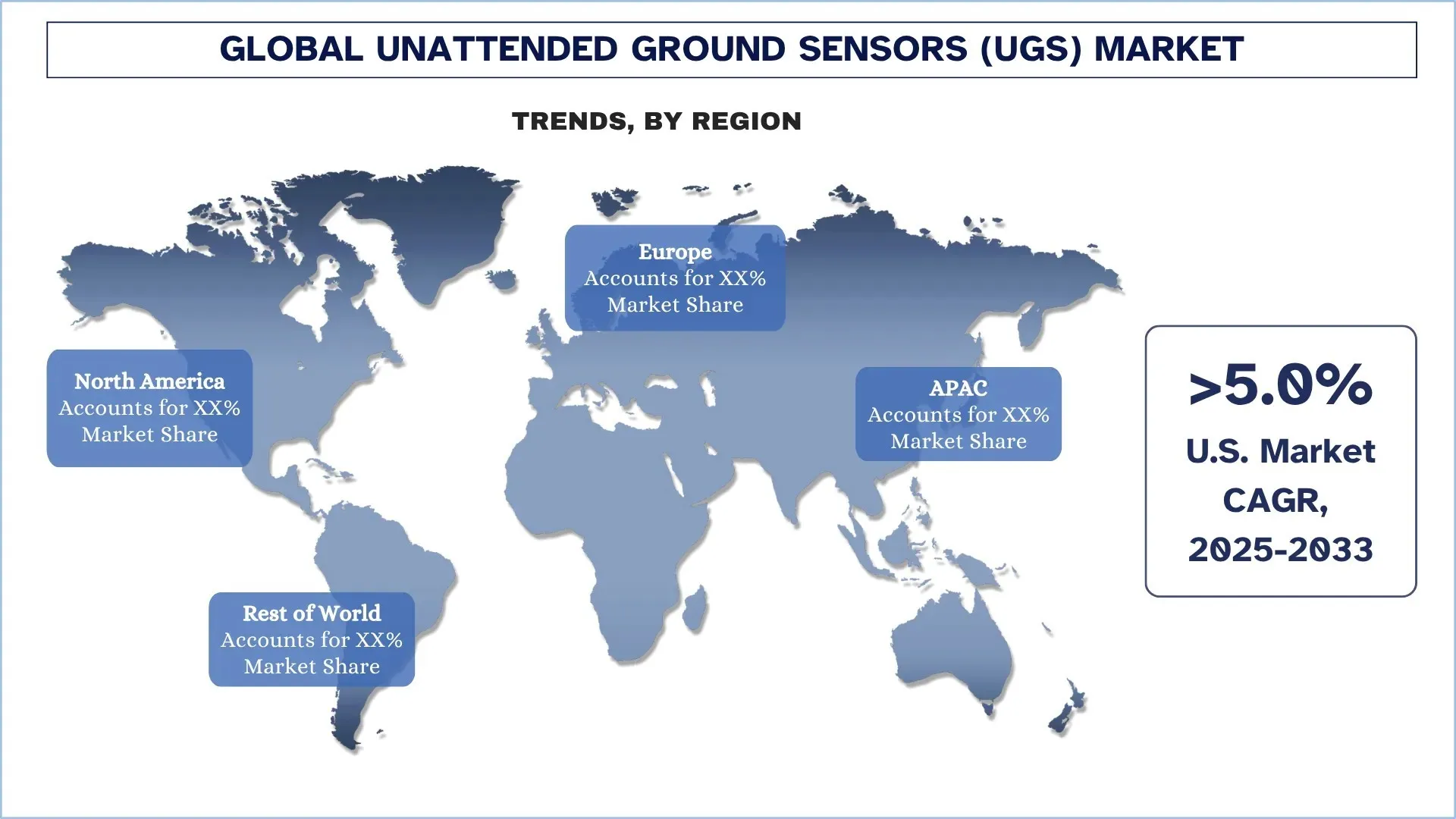
The North America region is anticipated to hold the largest market share in 2024 and is projected to maintain its dominant position throughout the forecast period. This leadership can be directly attributed to the large defense budgets in the region, particularly in the United States, the world's largest spender on military technology and a leader in the development and use of high-end ISR systems. The existence of large international defense contractors, active technological development, and priority programs for purchasing equipment to protect borders and provide capabilities to fight modern wars has created a robust UGS market ecosystem. The dominance of the region is also supported by the fact that military, homeland security, and critical infrastructure protection agencies have a strong need to enhance their situational awareness and perimeter security with networked sensor solutions.
U.S. held a dominant Share of the North America Unattended Ground Sensors (UGS) Market in 2024
The U.S. has commanded the North American unattended ground sensor market since it has a huge defense budget, highly developed technological powers, and much emphasis on the improvement of national security. The contributions to border protection, intelligence in battlefields, and the protection of the critical infrastructure are among the investments of significant importance of seismic, acoustic, infrared, and magnetic sensors that are widely used in the military and homeland security activities. The dominance of major defense contractors, the type of research and development programs, and the intense incorporation of AI-enabled situational awareness systems only support the U.S. leadership further. The country, in turn, continues to be the major market growth, innovation, and adoption engine within the region.
Unattended Ground Sensors (UGS) Industry Competitive Landscape
The global unattended ground sensors market is competitive, with several global and international market players. The key players are adopting different growth strategies to enhance their market presence, such as partnerships, agreements, collaborations, new product launches, geographical expansions, and mergers and acquisitions.
Top Unattended Ground Sensors (UGS) Companies
Some of the major players in the market are Northrop Grumman, Thales Defense & Security, Inc., L3Harris Technologies, Inc., Lockheed Martin Corporation, Textron Systems, BAE Systems, Elbit Systems Ltd, Saab AB, Rheinmetall AG, and Teledyne FLIR Defense Inc.
Recent Developments in the Unattended Ground Sensors (UGS) Market
In July 2023, L3Harris Technologies successfully made a massive acquisition of Aerojet Rocketdyne. This will position them better in the propulsion systems, missile defense, and hypersonics. L3Harris is also likely to enhance the product it offers with this acquisition, thanks to sensor technologies such as Unattended Ground Sensors (UGS), as it seeks to expand its footprint in the defense arena. This might result in more intrinsic and advanced defense solutions.
In May 2023, Elbit Systems declared the sale of its UGS system to a Middle Eastern client. Critical infrastructure is being safeguarded using the system against terrorist attacks.
In April 2023, Thales Group stated the creation of a high-quality, state-of-the-art UGS system, which will implement artificial intelligence to enhance target identification and tracking possibilities. This new system is designed to function well within an intricate environment, especially in an urban setting, which conventional systems may not manage.
Global Unattended Ground Sensors (UGS) Market Report Coverage
Report Attribute | Details |
Base year | 2024 |
Forecast period | 2025-2033 |
Growth momentum | Accelerate at a CAGR of 4.85% |
Market size 2024 | USD 496.23 Million |
Regional analysis | North America, Europe, APAC, Rest of the World |
Major contributing region | North America is expected to dominate the market during the forecast period. |
Key countries covered | U.S., Canada, Germany, U.K., Spain, Italy, France, China, Japan, and India |
Companies profiled | Northrop Grumman, Thales Defense & Security, Inc., L3Harris Technologies, Inc., Lockheed Martin Corporation, Textron Systems, BAE Systems, Elbit Systems Ltd, Saab AB, Rheinmetall AG, and Teledyne FLIR Defense Inc. |
Report Scope | Market Trends, Drivers, and Restraints; Revenue Estimation and Forecast; Segmentation Analysis; Demand and Supply Side Analysis; Competitive Landscape; Company Profiling |
Segments Covered | By Sensor Type; By Deployment; By Application; and By Region/Country |
Reasons to Buy the Unattended Ground Sensors (UGS) Market Report:
The study includes market sizing and forecasting analysis confirmed by authenticated key industry experts.
The report briefly reviews overall industry performance at a glance.
The report covers an in-depth analysis of prominent industry peers, primarily focusing on key business financials, type portfolios, expansion strategies, and recent developments.
Detailed examination of drivers, restraints, key trends, and opportunities prevailing in the industry.
The study comprehensively covers the market across different segments.
Deep dive regional-level analysis of the industry.
Customization Options:
The global unattended ground sensors market can further be customized as per the requirements or any other market segment. Besides this, UnivDatos understands that you may have your own business needs; hence, feel free to contact us to get a report that completely suits your requirements.
Table of Content
Research Methodology for the Global Unattended Ground Sensors (UGS) Market Analysis (2023-2033)
We analyzed the historical market, estimated the current market, and forecasted the future market of the global unattended ground sensors market to assess its application in major regions worldwide. We conducted exhaustive secondary research to gather historical market data and estimate the current market size. To validate these insights, we carefully reviewed numerous findings and assumptions. Additionally, we conducted in-depth primary interviews with industry experts across the unattended ground sensors value chain. After validating market figures through these interviews, we used both top-down and bottom-up approaches to forecast the overall market size. We then employed market breakdown and data triangulation methods to estimate and analyze the market size of industry segments and sub-segments.
Market Engineering
We employed the data triangulation technique to finalize the overall market estimation and derive precise statistical numbers for each segment and sub-segment of the global unattended ground sensors market. We split the data into several segments and sub-segments by analyzing various parameters and trends, including sensor type, deployment, application, and regions within the global unattended ground sensors market.
The Main Objective of the Global Unattended Ground Sensors (UGS) Market Study
The study identifies current and future trends in the global unattended ground sensors market, providing strategic insights for investors. It highlights regional market attractiveness, enabling industry participants to tap into untapped markets and gain a first-mover advantage. Other quantitative goals of the studies include:
Market Size Analysis: Assess the current market size and forecast the market size of the global unattended ground sensors market and its segments in terms of value (USD).
Unattended Ground Sensors (UGS) Market Segmentation: Segments in the study include areas of sensor type, deployment, application, and regions.
Regulatory Framework & Value Chain Analysis: Examine the regulatory framework, value chain, customer behavior, and competitive landscape of the unattended ground sensors industry.
Regional Analysis: Conduct a detailed regional analysis for key areas such as Asia Pacific, Europe, North America, and the Rest of the World.
Company Profiles & Growth Strategies: Company profiles of the unattended ground sensors market and the growth strategies adopted by the market players to sustain the fast-growing market.
Frequently Asked Questions FAQs
Q1: What is the global unattended ground sensors current market size and its growth potential?
The global unattended ground sensors market was valued at USD 496.23 million in 2024 and is expected to grow at a CAGR of 4.85% during the forecast period (2025-2033).
Q2: Which segment has the largest share of the global unattended ground sensors market by sensor type?
The Seismic Sensors segment is anticipated to hold the largest market share and continue its dominance throughout the forecast period. This is mainly because they are reliable, consume less power, and are highly efficient in detecting personnel and vehicle movements through vibrations on the ground. They are highly secretive and can be easily employed in long-term covert surveillance missions due to their passive nature.
Q3: What are the driving factors for the growth of the global unattended ground sensors market?
• Heightened focus on border protection and threat detection: Governments across multiple regions are increasing surveillance spending to address cross-border infiltration, trafficking, and irregular conflict, driving steady demand for unattended ground sensing systems.
• Defense modernization and the move toward sensor-rich operations: Military forces are transitioning to digitally connected, data-centric operations that require persistent ground sensing networks, boosting adoption of UGS within ISR and battlefield awareness programs.
• Rapid progress in sensing technologies and communications: Improvements in acoustic, seismic, magnetic, and infrared sensors, along with more reliable wireless connectivity, enhancing accuracy, durability, and integration capabilities.
Q4: What are the emerging technologies and trends in the global unattended ground sensors market?
• AI-enabled, networked sensor ecosystems: Developers are embedding machine learning, edge analytics, and IoT connectivity into UGS units to improve detection accuracy, automate classification, and reduce false alerts.
• Shrinking sensor size and improved energy efficiency: Manufacturers are creating smaller, lighter, low-power devices, including air-deployable options that offer easier installation and longer operating endurance.
• Growing outside traditional military contexts: Adoption is expanding into border policing, public-space surveillance, infrastructure security, and industrial monitoring, broadening market potential.
Q5: What are the key challenges in the global unattended ground sensors market?
• High investment requirements: Advanced sensor nodes, rugged hardware, secure communications, and system integration create significant upfront costs that limit adoption among budget-constrained organizations.
• Power and environmental limitations: Remote or harsh deployment areas often challenge battery life, weather resistance, and overall reliability, necessitating frequent maintenance and replacement.
• System complexity, false alarms, and security concerns: Distinguishing legitimate threats from environmental noise remains difficult, while interoperability issues and data security requirements add further complications.
Q6: Which region dominates the global unattended ground sensors market?
The North America region is anticipated to hold the largest market share in 2024 and is projected to maintain its dominant position throughout the forecast period. This leadership can be directly attributed to the large defense budgets in the region, particularly in the United States, the world's largest spender on military technology and a leader in the development and use of high-end ISR systems.
Q7: Who are the key players in the global unattended ground sensors market?
Some of the key companies include:
• Northrop Grumman
• Thales Defense & Security, Inc.
• L3Harris Technologies, Inc.
• Lockheed Martin Corporation
• Textron Systems
• BAE Systems
• Elbit Systems Ltd
• Saab AB
• Rheinmetall AG
• Teledyne FLIR Defense Inc.
Q8: How are policy frameworks and international security standards influencing global UGS deployments?
• Defense Procurement Standards: Countries adopt NATO/STANAG-like guidelines emphasizing reliability, cybersecurity, and interoperability for UGS systems.
• Export Control Regulations: Compliance with ITAR, EAR, and other export rules shapes how manufacturers sell UGS internationally.
• Border Security Policies: Harmonized security protocols across regions (EU, GCC, ASEAN) increase demand for standardized, cross-compliant UGS solutions.
Q9: How is globalization shaping collaboration and market expansion in the Unattended Ground Sensors (UGS) industry?
• Joint Defense Programs: Cross-border defense collaborations and multinational security initiatives encourage shared UGS development, interoperability standards, and technology exchange.
• International Supplier Networks: OEMs increasingly rely on global component sourcing, sensors, batteries, and communication chips, optimizing cost and performance.
• Export Partnerships: Countries with advanced UGS capabilities expand through structured export agreements, enabling penetration in Asia, the Middle East, and Eastern Europe.
Related Reports
Customers who bought this item also bought
Magnetoresistive RAM (MRAM) Market: Current Analysis and Forecast (2026-2034)
Emphasis on Type (Toggle MRAM and STT-MRAM); Application (Consumer Electronics, Automotive, Robotics, Aerospace & Defense, Enterprise Storage, and Others); and Region/Country
Ion Beam Etching System Market: Current Analysis and Forecast (2026-2034)
Emphasis on Type (Conventional Ion Beam Etching (IBE), Reactive Ion Beam Etching (RIBE), Focused Ion Beam (FIB) Systems, Automatic Ion Beam, and Others); Application (Semiconductor Manufacturing, Microelectronics & Data Storage, Photonics & Optoelectronics, MEMS (Micro-Electro-Mechanical Systems), Research & Metrology, and Others); End User (Semiconductor & Electronics, Aerospace & Defense, Healthcare & Medical Devices, Research Institutions, and Others); and Region/Country
25G Optical Module Market: Current Analysis and Forecast (2026-2034)
Emphasis on Product Type (SFP28, QSFP28, and CFP2); Application (Data Centers, Telecommunications, and Enterprise Networks); End-User (IT & Telecommunications, BFSI, Healthcare, Retail, and Others); and Region/Country
Power over Ethernet (PoE) Chipset Market: Current Analysis and Forecast (2025-2033)
Emphasis on Type (PoE Power Sourcing Equipment (PSE) Chipset and PoE Powered Devices (PD) Chipset); Standard (IEEE 802.3at Standard, IEEE 802.3bt Standard, and IEEE 802.3af Standard); Device (IP/Network Cameras, VoIP Phone, Ethernet Switch & Injector, Wireless Radio Access Point, Proximity Sensor, LED Lighting, and Others); End-use (Commercial, Industrial, and Residential); and Region/Country