Reed Sensor Market: Current Analysis and Forecast (2025-2033)
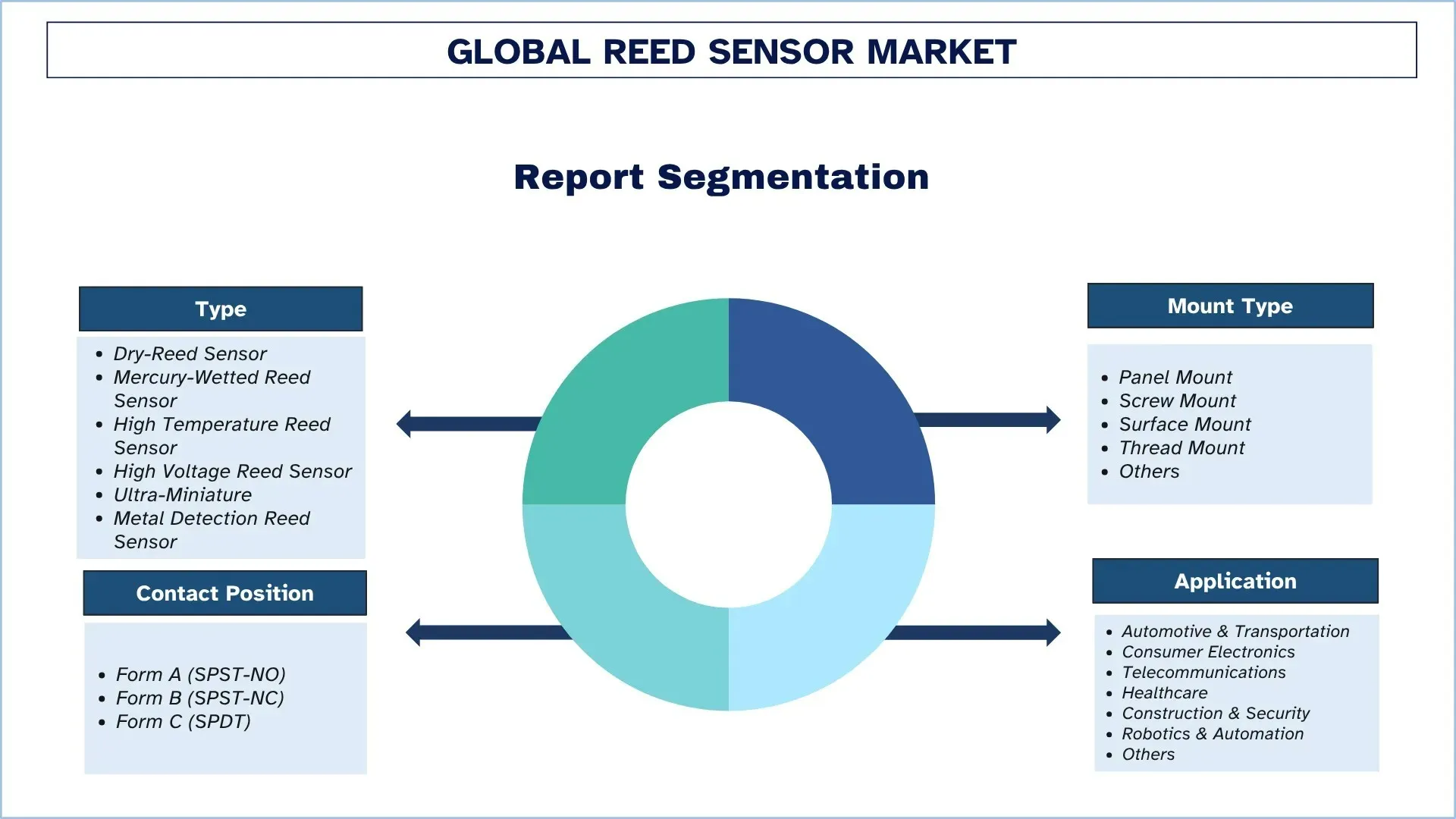
Emphasis on Type (Dry-Reed Sensor, Mercury-Wetted Reed Sensor, High Temperature Reed Sensor, High Voltage Reed Sensor, Ultra-Miniature, and Metal Detection Reed Sensor); Mount Type (Panel Mount, Screw Mount, Surface Mount, Thread Mount, and Others); Contact Position (Form A {SPST-NO}, Form B {SPST-NC}, and Form C {SPDT}); Application (Automotive & Transportation, Consumer Electronics, Telecommunications, Healthcare, Construction & Security, Robotics & Automation, and Others); and Region/Country
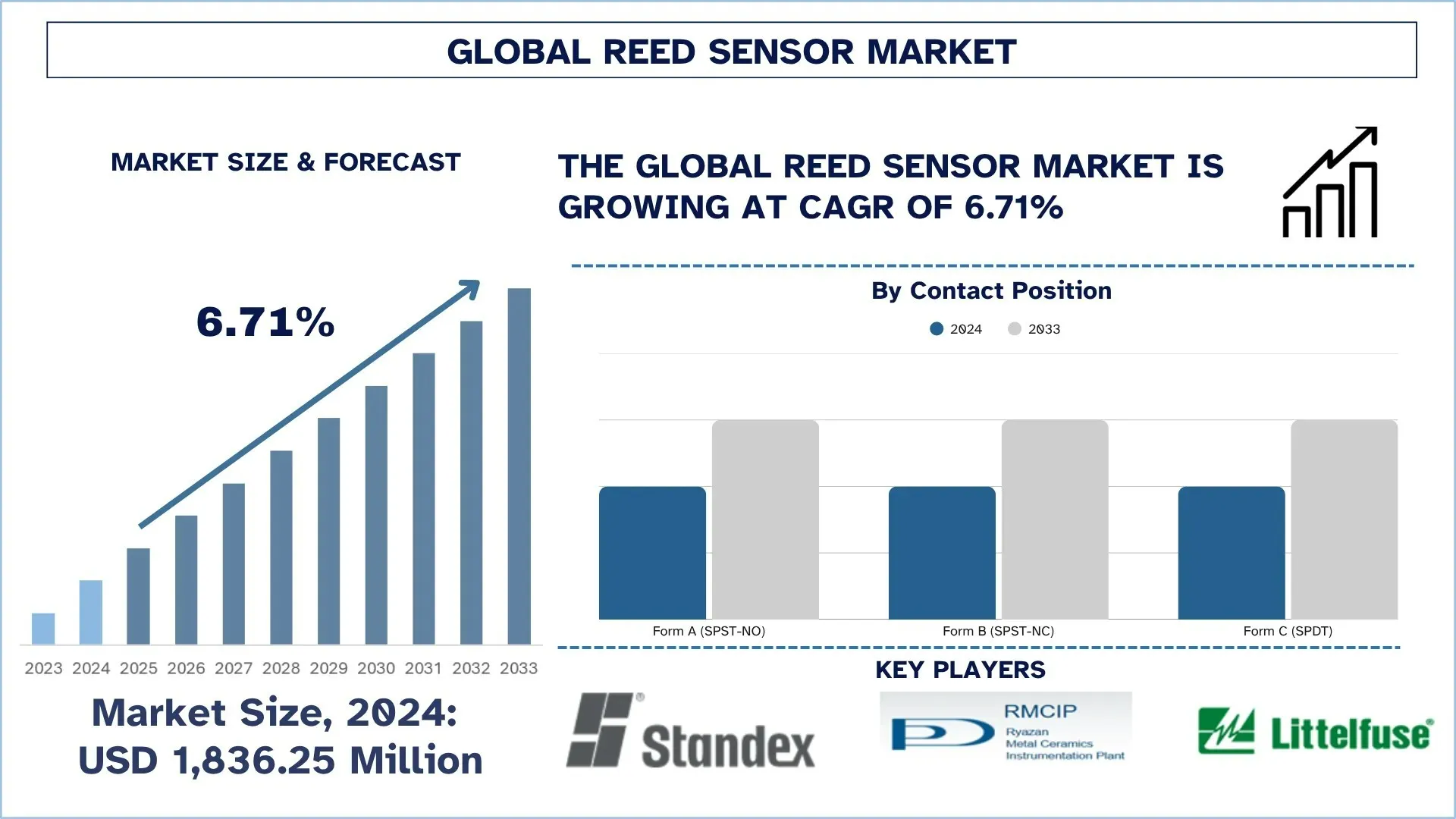
Global Reed Sensor Market Size & Forecast
The Global Reed Sensor Market was valued at USD 1,836.25 million in 2024 and is expected to grow at a strong CAGR of around 6.71% during the forecast period (2025-2033F), driven by increasing demand for smart home automation and IoT devices, rising adoption in automotive applications for safety and position sensing, and the expansion of industrial automation and robotics.
Reed Sensor Market Analysis
The global reed sensor market is steadily growing, driven by increased adoption in automotive, consumer electronics, industrial automation, and medical equipment. These sensors are appreciated for their dependability, low power consumption, and contactless operation, making them ideal for harsh and safety-critical conditions. Major automotive uses include brake fluid monitoring, door sensing, and transmission systems, which contribute substantially to revenue. Furthermore, growth in industrial automation and demand for smart appliances continues to boost the market. Innovation in miniaturization and higher investments in magnetic sensing technology are creating new opportunities. The development of metal-detection reed sensors and surface-mount versions is further fueling product innovation. Overall, the reed sensor market is set for significant expansion as industries prefer smaller, more durable, and energy-efficient sensing solutions.
Global Reed Sensor Market Trends
This section discusses the key market trends that are influencing the various segments of the global reed sensor market, as found by our team of research experts.
The Growing Trend of Automation Across Various Industries
The growing trend of automation across various industries has a significant impact on the reed sensor market. Factories and industrial facilities are increasingly implementing smart systems to improve efficiency, safety, and precision. Automated production lines, robotic systems, conveyor mechanisms, and material-handling equipment depend on reed sensors for precise position sensing, proximity detection, motion control, and safety interlocks. The growing shift towards Industry 4.0 among companies, including integrating robotics and IoT-based devices, is driving the demand for miniaturized, long-lasting, and energy-efficient reed sensors, thereby expanding the growth of the market. For instance, in February 2025, Apptronik secured USD 350 million to improve its production of humanoid robots for warehouses and manufacturing. These investments increase the demand for high-reliability sensors like reed sensors, which are important for position detection, safety, and system monitoring in automated and robotic systems.
Reed Sensor Industry Segmentation
This section provides an analysis of the key trends in each segment of the global reed sensor market report, along with forecasts at the global, regional, and country levels for 2025-2033.
The Dry-Reed Sensor Segment Dominates the Global Reed Sensor Market
Based on the type, the market is categorized into dry-reed sensor, mercury-wetted reed sensor, high temperature reed sensor, high voltage reed sensor, ultra-miniature, and metal detection reed sensor. Among these, dry reed sensors lead the market due to their simple design, high reliability, and cost-efficiency, making them perfect for widespread use in automotive systems, household appliances, security devices, and industrial equipment. Their sealed construction ensures a long lifespan and strong performance in tough environments, further supporting their leadership. However, metal detection reed sensors are showing the fastest growth as industries increasingly implement advanced safety, automation, and monitoring systems. These sensors are important for accurately detecting metal objects, which is vital in manufacturing, robotics, and material handling. Their expansion is driven by rising demand for automation, higher accuracy standards, and wider use in industrial safety systems.
The Panel Mount Segment Dominates the Global Reed Sensor Market.
Based on the mount type, the market is categorized into panel mount, screw mount, surface mount, thread mount, and others. Among these, the panel mount segment leads the reed sensor market due to its durable design, easy installation, and reliability in industrial and automotive applications. They are largely used in control panels, machinery, and vehicles where stable and secure sensor placement is essential. Meanwhile, the surface-mount segment is experiencing the fastest growth because of the rising demand for compact, lightweight, and easily integrable components in modern electronics. Their ability to be installed directly on PCBs makes them suitable for IoT devices, consumer electronics, and automation systems, thereby driving the growth of the market.
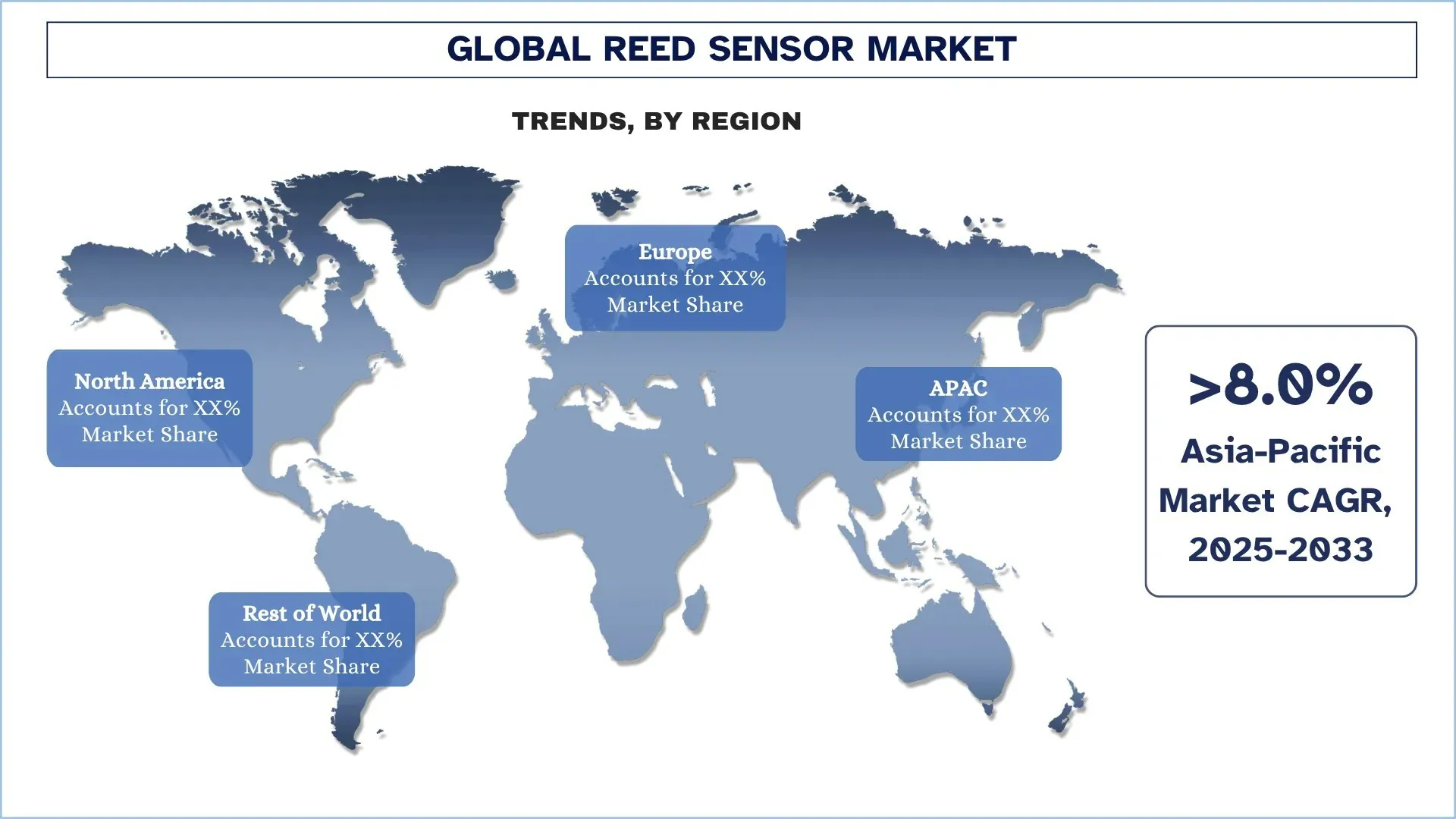
North America holds the largest market share in the global reed sensor market
North America leads the reed sensor market because of the presence of its major automotive, aerospace, and industrial automation companies, along with widespread use of advanced sensing technologies. Its strong automotive manufacturing sector significantly boosts demand for reed sensors in safety, position, and motion detection systems. Additionally, the increasing use of smart technologies, IoT devices, and robotics in industrial processes speeds up market growth. Supportive government programs that promote automation and energy-efficient solutions also help drive industry growth. Furthermore, investments from leading companies in research, development, and technological innovation improve sensor performance and reliability, thereby strengthening the region's position in the global reed sensor market.
U.S. held a Dominant share of the North America Reed Sensor Market in 2024
The United States leads the reed sensor market because of its strong focus on technological innovation and extensive manufacturing capacity. For example, in February 2023, Littelfuse, Inc., a U.S.-based company, launched an ultra-compact, overmolded reed switch tailored for space-limited applications. This underscores the nation's focus on sensor miniaturization and high-performance design in contemporary electronics and IoT devices. The growing applications in smart home systems, medical equipment, and renewable energy technologies have further improved their market presence, as these sectors increasingly rely on precise, energy-efficient, and durable sensing solutions to ensure automation, safety, and performance optimization. Furthermore, manufacturers are prioritizing precision engineering, miniaturization, and energy-efficient designs to meet the changing needs of both industry and consumers. Strategic partnerships between technology companies and research institutions are also fueling innovation, positioning the U.S. as a major driver of reed sensor development and global market competitiveness.
Reed Sensor Industry Competitive Landscape
The global reed sensor market is competitive, with several global and international market players. The key players are adopting different growth strategies to enhance their market presence, such as partnerships, agreements, collaborations, geographical expansions, and mergers and acquisitions.
Top Reed Sensor Market Companies
Some of the major players in the market are Standex International Corporation, Ryazan Metal Ceramics Instrumentation Plant JSC (RMCIP), Littelfuse, Inc., PIC Proximity Instrumentation Controls GmbH, Coto Technology, Inc. (The Dyson-Kissner-Moran Corporation), HSI Sensing (Genisco Filter Corporation), ZF Friedrichshafen AG, XURUI Electronics Co., Ltd., S.T.G. Switch Technology Gunther S.R.L. (Kyokuto Kaihatsu Kogyo), and Reed Switch Developments Corp.
Recent Developments in the Reed Sensor Market
In October 2025, Littelfuse, Inc. acquired Basler Electric Company for USD 350 million. This acquisition expands Littelfuse’s offering in control and protection systems, enabling broader access to customers and strengthening its capability to supply sensing and switching products.
In August 2024, Standex Detect announced its MK33 SMD Reed Switch Series, engineered for high-power switching within an ultra-compact footprint. The new series featured a surface-mount design, targeting applications in industrial automation, smart devices, and automotive modules.
Global Reed Sensor Market Report Coverage
Report Attribute | Details |
Base year | 2024 |
Forecast period | 2025-2033 |
Growth momentum | Accelerate at a CAGR of 6.71% |
Market size 2024 | USD 1,836.25 million |
Regional analysis | North America, Europe, APAC, Rest of the World |
Major contributing region | The North America region is expected to dominate the market during the forecast period. |
Key countries covered | U.S., Canada, Germany, U.K., Spain, Italy, France, China, Japan, and India. |
Companies profiled | Standex International Corporation, Ryazan Metal Ceramics Instrumentation Plant JSC (RMCIP), Littelfuse, Inc., PIC Proximity Instrumentation Controls GmbH, Coto Technology, Inc. (The Dyson-Kissner-Moran Corporation), HSI Sensing (Genisco Filter Corporation), ZF Friedrichshafen AG, XURUI Electronics Co., Ltd., S.T.G. Switch Technology Gunther S.R.L. (Kyokuto Kaihatsu Kogyo), and Reed Switch Developments Corp. |
Report Scope | Market Trends, Drivers, and Restraints; Revenue Estimation and Forecast; Segmentation Analysis; Demand and Supply Side Analysis; Competitive Landscape; Company Profiling |
Segments Covered | By Type, By Mount Type, By Contact Position, By Application, and By Region/Country |
Reasons to Buy the Reed Sensor Market Report:
The study includes market sizing and forecasting analysis confirmed by authenticated key industry experts.
The report briefly reviews overall industry performance at a glance.
The report covers an in-depth analysis of prominent industry peers, primarily focusing on key business financials, type portfolios, expansion strategies, and recent developments.
Detailed examination of drivers, restraints, key trends, and opportunities prevailing in the industry.
The study comprehensively covers the market across different segments.
Deep dive regional level analysis of the industry.
Customization Options:
The global reed sensor market can further be customized as per the requirements or any other market segment. Besides this, UnivDatos understands that you may have your own business needs; hence, feel free to contact us to get a report that completely suits your requirements.
Table of Content
Research Methodology for the Global Reed Sensor Market Analysis (2023-2033)
We analyzed the historical market, estimated the current market, and forecasted the future market of the global reed sensor market to assess its application in major regions worldwide. We conducted exhaustive secondary research to gather historical market data and estimate the current market size. To validate these insights, we carefully reviewed numerous findings and assumptions. Additionally, we conducted in-depth primary interviews with industry experts across the reed sensor value chain. After validating market figures through these interviews, we used both top-down and bottom-up approaches to forecast the overall market size. We then employed market breakdown and data triangulation methods to estimate and analyze the market size of industry segments and sub-segments.
Market Engineering
We employed the data triangulation technique to finalize the overall market estimation and derive precise statistical numbers for each segment and sub-segment of the global reed sensor market. We split the data into several segments and sub-segments by analyzing various parameters and trends, including type, mount type, contact position, application, and regions within the global reed sensor market.
The Main Objective of the Global Reed Sensor Market Study
The study identifies current and future trends in the global reed sensor market, providing strategic insights for investors. It highlights regional market attractiveness, enabling industry participants to tap into untapped markets and gain a first-mover advantage. Other quantitative goals of the studies include:
Market Size Analysis: Assess the current and forecast market size of the global reed sensor market and its segments in terms of value (USD).
Reed Sensor Market Segmentation: Segments in the study include areas of type, mount type, contact position, application, and region.
Regulatory Framework & Value Chain Analysis: Examine the regulatory framework, value chain, customer behavior, and competitive landscape of the reed sensor industry.
Regional Analysis: Conduct a detailed regional analysis for key areas such as Asia Pacific, Europe, North America, and the Rest of the World.
Company Profiles & Growth Strategies: Company profiles of the reed sensor market and the growth strategies adopted by the market players to sustain the fast-growing market.
Frequently Asked Questions FAQs
Q1: What is the global Reed Sensor market’s current market size and growth potential?
As of 2024, the global Reed Sensor market is valued at USD 1,836.25 million and is projected to grow at an impressive CAGR of 6.71% from 2025 to 2033, driven by rising automation and the expansion of electronic and automotive applications.
Q2: Which segment has the largest share of the global reed sensor market by type category?
The dry reed sensor segment currently dominates the global reed sensor market, due to its high reliability, low power consumption, and extensive use across automotive, industrial, and medical applications.
Q3: What are the driving factors for the growth of the global reed sensor market?
Top growth drivers of the reed sensor market include:
• Increasing production of electric vehicles (EVs).
• Expansion of smart home appliances.
• Rising demand for hermetically sealed switching solutions.
• Growing need for contactless sensing in automation.
• Surge in miniaturized electronic components.
Q4: What are the emerging technologies and trends in the global reed sensor market?
Emerging trends in the reed sensor market include:
• Rapid industrial automation across manufacturing facilities.
• Increasing adoption of miniaturized and advanced reed sensors.
• Integration of reed sensors into IoT-enabled devices and smart systems.
Q5: What are the key challenges in the global reed sensor market?
Key challenges in the reed sensor market include:
• Limited durability due to the sensor’s mechanical switching nature.
• Volatility in raw material prices is affecting production costs.
• Competition from alternative solid-state sensing technologies.
Q6: Which region dominates the global reed sensor market?
North America dominates the reed sensor market, supported by strong automotive production, high adoption of smart devices, and significant investment in industrial automation and robotics.
Q7: Who are the key competitors in the global reed sensor market?
Top players in the reed sensor industry include:
• Standex International Corporation
• Ryazan Metal Ceramics Instrumentation Plant JSC (RMCIP)
• Littelfuse, Inc.
• PIC Proximity Instrumentation Controls GmbH
• Coto Technology, Inc. (The Dyson-Kissner-Moran Corporation)
• HSI Sensing (Genisco Filter Corporation)
• ZF Friedrichshafen AG
• XURUI Electronics Co., Ltd.
• S.T.G. Switch Technology Gunther S.R.L. (Kyokuto Kaihatsu Kogyo)
• Reed Switch Developments Corp.
Q8: How are mergers, acquisitions, and strategic partnerships shaping the future of the reed sensor market?
Increasing M&A activities and collaborations among leading manufacturers are strengthening global production capabilities, expanding product portfolios, and accelerating technological innovation in magnetic sensing solutions.
Q9: What are the major end-use industries creating high demand for reed sensors globally?
Sectors such as automotive electronics, medical devices, industrial automation, consumer electronics, and smart infrastructure are generating strong demand for compact, durable, and energy-efficient reed sensing components.
Related Reports
Customers who bought this item also bought

Magnetoresistive RAM (MRAM) Market: Current Analysis and Forecast (2026-2034)
Emphasis on Type (Toggle MRAM and STT-MRAM); Application (Consumer Electronics, Automotive, Robotics, Aerospace & Defense, Enterprise Storage, and Others); and Region/Country

Ion Beam Etching System Market: Current Analysis and Forecast (2026-2034)
Emphasis on Type (Conventional Ion Beam Etching (IBE), Reactive Ion Beam Etching (RIBE), Focused Ion Beam (FIB) Systems, Automatic Ion Beam, and Others); Application (Semiconductor Manufacturing, Microelectronics & Data Storage, Photonics & Optoelectronics, MEMS (Micro-Electro-Mechanical Systems), Research & Metrology, and Others); End User (Semiconductor & Electronics, Aerospace & Defense, Healthcare & Medical Devices, Research Institutions, and Others); and Region/Country
25G Optical Module Market: Current Analysis and Forecast (2026-2034)
Emphasis on Product Type (SFP28, QSFP28, and CFP2); Application (Data Centers, Telecommunications, and Enterprise Networks); End-User (IT & Telecommunications, BFSI, Healthcare, Retail, and Others); and Region/Country

Power over Ethernet (PoE) Chipset Market: Current Analysis and Forecast (2025-2033)
Emphasis on Type (PoE Power Sourcing Equipment (PSE) Chipset and PoE Powered Devices (PD) Chipset); Standard (IEEE 802.3at Standard, IEEE 802.3bt Standard, and IEEE 802.3af Standard); Device (IP/Network Cameras, VoIP Phone, Ethernet Switch & Injector, Wireless Radio Access Point, Proximity Sensor, LED Lighting, and Others); End-use (Commercial, Industrial, and Residential); and Region/Country