Ion Beam Etching System Market: Current Analysis and Forecast (2026-2034)
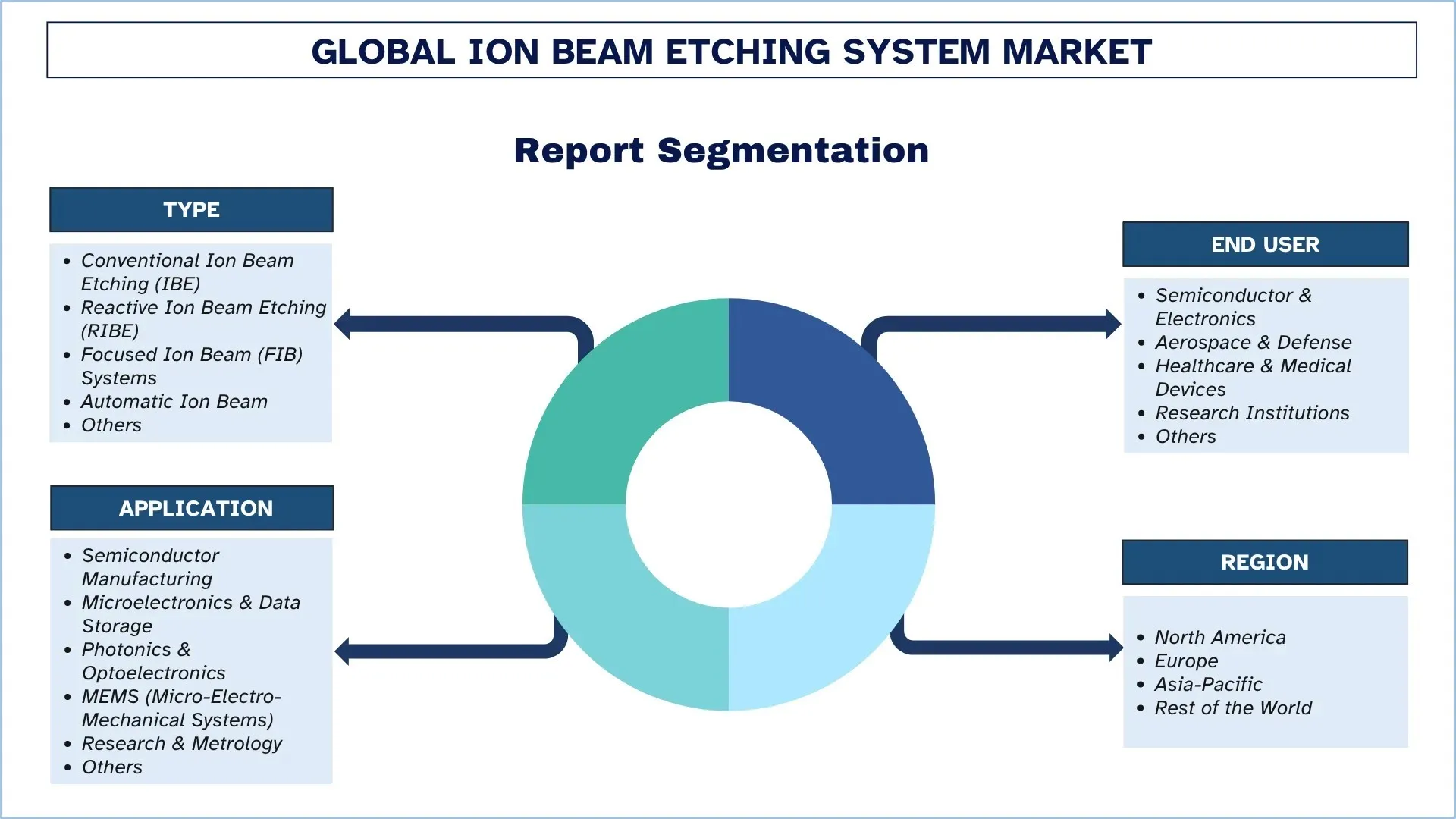
Emphasis on Type (Conventional Ion Beam Etching (IBE), Reactive Ion Beam Etching (RIBE), Focused Ion Beam (FIB) Systems, Automatic Ion Beam, and Others); Application (Semiconductor Manufacturing, Microelectronics & Data Storage, Photonics & Optoelectronics, MEMS (Micro-Electro-Mechanical Systems), Research & Metrology, and Others); End User (Semiconductor & Electronics, Aerospace & Defense, Healthcare & Medical Devices, Research Institutions, and Others); and Region/Country
Global Ion Beam Etching System Market Size & Forecast
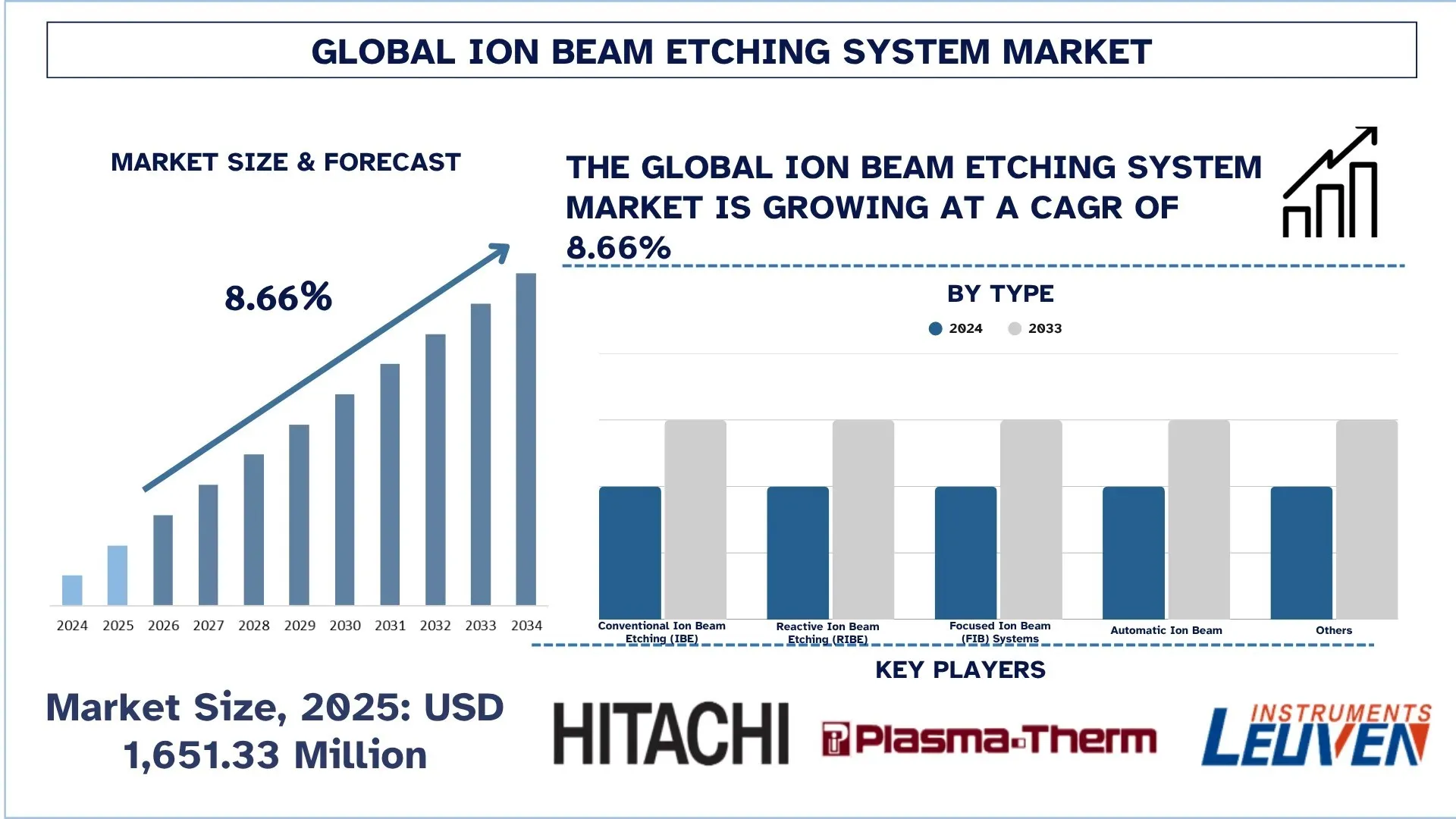
The global ion beam etching system market was valued at USD 1,651.33 million in 2025 and is expected to grow at a strong CAGR of around 8.66% during the forecast period (2026-2034F), driven by rising demand for advanced semiconductors, increasing adoption of MEMS and nano-scale devices, continuous technological advancements, and growing investments in precision fabrication and microelectronics manufacturing.
Ion Beam Etching System Market Analysis
The ion beam etching system market is growing steadily due to increasing demand for precise material processing in semiconductor and electronics manufacturing. These systems are widely used to create small and complex structures with high accuracy. Adding to this, the rise of advanced technologies such as artificial intelligence, 5G, and IoT is increasing the need for high-performance chips, which supports market growth. In addition, the growing use of MEMS and nano-scale devices is boosting demand for advanced etching solutions. Companies are also investing in research and forming partnerships to improve technology, making the market more competitive and driving continuous innovation across global industries.
For example, on September 16, 2025, scia Systems introduced the scia Cluster 200, a modular ion-beam and plasma-processing system that supports conventional ion beam etching (IBE), reactive ion beam etching (RIBE), and chemically assisted ion beam etching (CAIBE), providing high-throughput, scalable, and flexible processing for semiconductor, MEMS, and advanced-device manufacturing.
Global Ion Beam Etching System Market Trends
This section discusses the key market trends that are influencing the various segments of the global Ion beam etching system market, as found by our team of research experts.
Increasing Adoption of Microelectromechanical Systems and Nano-Scale Components
The growing use of microelectromechanical systems (MEMS) and nanoscale components is significantly impacting advanced manufacturing and microfabrication processes. These technologies enable the development of miniaturized, high-performance devices for sensors, actuators, and integrated electronic systems. Also, the growing demand for smart devices, automotive sensors, and Internet of Things (IoT) applications is accelerating MEMS adoption across industries. Besides this, nano-scale elements enable enhanced functionality, energy efficiency, and miniaturization of current electronics. With smaller, lighter, and more efficient devices becoming the focus of industries, manufacturers are turning to precision fabrication technologies to enable MEMS and nanoscale manufacturing, spurring innovation and expanding applications in electronics, healthcare, and industry.
For instance, on February 17, 2026, Intlvac supported next-generation innovation at Stanford University by supplying its Nanoquest II system to a nanofabrication facility, enabling precise development of nano-scale components, advanced materials, and MEMS devices, while enhancing research capabilities in microelectronics, sensors, and emerging technologies.
Ion Beam Etching System Industry Segmentation
This section provides an analysis of the key trends in each segment of the global Ion beam etching system market report, along with forecasts at the global, regional, and country levels for 2026-2034.
The Conventional Ion Beam Etching (IBE) Segment Dominates the Global Ion Beam Etching System Market
Based on the type, the ion beam etching system market is segmented into conventional ion beam etching (IBE), reactive ion beam etching (RIBE), focused ion beam (FIB) Systems, automatic ion beam, and others. In 2025, conventional ion beam etching (IBE) holds the largest share of the market due to its well-established technology, high precision, and wide adoption in semiconductor and microfabrication processes. Its dependability, ease of use, and compatibility with various materials contributed to the unified demand in the mature applications. In contrast, reactive ion beam etching (RIBE) is showing the fastest growth due to its superior selectivity, improved etch rates, and ability to handle complex, next-generation materials. In addition, the rising need for advanced devices, miniaturization, and high-performance electronics is driving the adoption of RIBE, with manufacturers seeking more efficient, flexible, and high-accuracy etching solutions across contemporary industries.
For instance, on September 17, 2024, scia Systems installed the scia Mill 200 ion beam etching system at Kiel University. This system allows the creation of high-precision structures in complex multilayer materials. It supports both IBE and RIBE processes and offers high selectivity and control, making it suitable for use in semiconductors and sensor fabrication.
Semiconductor Manufacturing Segment Dominates the Global Ion Beam Etching System Market.
Based on the application, the market is categorized into semiconductor manufacturing, microelectronics & data storage, photonics & optoelectronics, MEMS (micro-electro-mechanical systems), research & metrology, and others. In 2025, the market was led by semiconductor manufacturing, due to its extensive use of ion beam etching in integrated circuit fabrication, where high precision, uniformity, and scalability are critical. Also, its leading position is further enhanced by the constant demand for advanced chips driven by consumer electronics, data centers, and the automotive industry. Conversely, MEMS (Micro-Electro-Mechanical Systems) is growing at the most rapid rate as the number of sensors, IoT devices, and wearable technologies adopting the technology increases. The growing demand for miniaturized components and high-end sensing functions is driving the MEMS production, boosting the need for efficient and high-precision etching solutions.
Asia-Pacific holds the largest market share in the global Ion Beam Etching System market
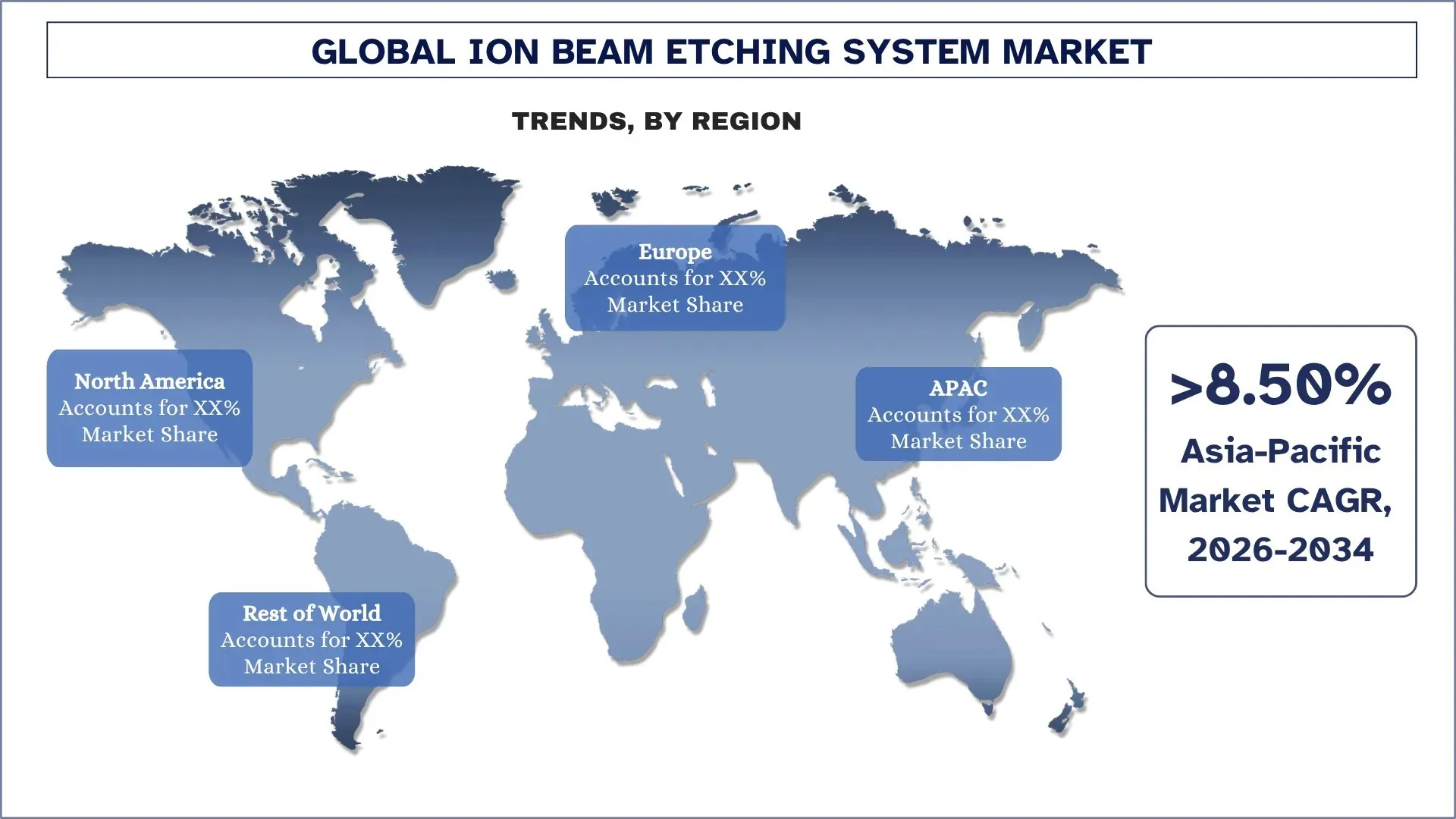
In 2025, the Asia-Pacific region holds the largest share of the market, supported by a strong concentration of semiconductor manufacturing hubs in countries such as China, Japan, South Korea, and Taiwan, which offer large-scale production and cost-effective manufacturing. Besides this, the region benefits from an established electronics supply chain, high consumer electronics demand, and substantial investments in semiconductor fabrication facilities. Furthermore, government initiatives, a skilled workforce, and rapid industrialization further fuel market growth, establishing Asia-Pacific as a leading global hub for manufacturing and exporting advanced electronic and semiconductor components.
China held a dominant share of the Asia-Pacific Ion Beam Etching System Market in 2025
In 2025, China holds the largest share of the market due to significant government investment and strategic initiatives such as Made in China 2025 to increase domestic semiconductor manufacturing. Also, the country benefits from a vast domestic electronics market, enabling high-volume production and swift technology adoption. In addition, significant investments in local equipment production and integrating the supply chain reduce dependence on imports. Besides this, the presence of numerous fabrication plants, cost advantages, and continuous capacity growth strengthen the position of China, making it an important driver of production scale, technological progress, and global market competitiveness.
For instance, in August 2025, China unveiled its first domestically-produced commercial electron beam lithography, the Xizhi, developed to overcome export policies, bolster domestic semiconductor capabilities, facilitate the design of high-precision chips, support quantum research, and eliminate its dependency on foreign equipment, which solidifies technological self-sufficiency and market dominance of the region.
Ion Beam Etching System Industry Competitive Landscape
The global Ion beam etching system market is competitive, with several global and international market players. The key players are adopting different growth strategies to enhance their market presence, such as partnerships, agreements, collaborations, geographical expansions, and mergers and acquisitions.
Top Ion Beam Etching System Market Companies
Some of the major players in the market are Hitachi High-Tech India Private Limited (Hitachi, Ltd.), Plasma-Therm, LEUVEN INSTRUMENTS, AJA International, Inc., Intlvac Thin Film Corporation, NANO-MASTER, INC., Veeco Instruments Inc. (Axcelis Technologies, Inc), Canon Anelva Corporation (Canon Inc.), Oxford Instruments (Quantum Design International, Inc.), and scia Systems GmbH (VON ARDENNE GmbH).
Recent Developments in the Ion Beam Etching System Market
On November 27, 2024, Hitachi High-Tech Corporation launched the DCR Etch System 9060 Series, which provides precise, atomic-level isotropic etching for advanced 3D semiconductor devices, improving productivity, lowering costs, and supporting next-generation manufacturing.
On February 23, 2026, scia Systems showcased its scia Mill ion beam etching systems, enabling high-precision semiconductor and photonic processing, improving throughput, supporting failure analysis, and addressing demand for advanced microfabrication and complex device applications.
Global Ion Beam Etching System Market Report Coverage
Report Attribute | Details |
Base year | 2025 |
Forecast period | 2026-2034 |
Growth momentum | Accelerate at a CAGR of 8.66% |
Market size 2025 | USD 1,651.33 million |
Regional analysis | North America, Europe, APAC, Rest of the World |
Major contributing region | North America is expected to grow with a high CAGR during the forecast period. |
Key countries covered | U.S., Canada, Germany, U.K., Spain, Italy, France, China, Japan, and India. |
Companies profiled | Hitachi High-Tech India Private Limited (Hitachi, Ltd.), Plasma-Therm, LEUVEN INSTRUMENTS, AJA International, Inc., Intlvac Thin Film Corporation, NANO-MASTER, INC., Veeco Instruments Inc. (Axcelis Technologies, Inc), Canon Anelva Corporation (Canon Inc.), Oxford Instruments (Quantum Design International, Inc.), and scia Systems GmbH (VON ARDENNE GmbH) |
Report Scope | Market Trends, Drivers, and Restraints; Revenue Estimation and Forecast; Segmentation Analysis; Demand and Supply Side Analysis; Competitive Landscape; Company Profiling |
Segments Covered | By Type, By Application, By End User, and By Region/Country |
Reasons to Buy the Ion Beam Etching System Market Report:
The study includes market sizing and forecasting analysis confirmed by authenticated key industry experts.
The report briefly reviews overall industry performance at a glance.
The report covers an in-depth analysis of prominent industry peers, primarily focusing on key business financials, type portfolios, expansion strategies, and recent developments.
Detailed examination of drivers, restraints, key trends, and opportunities prevailing in the industry.
The study comprehensively covers the market across different segments.
Deep dive regional level analysis of the industry.
Customization Options:
The global ion beam etching system market can further be customized as per the requirements or any other market segment. Besides this, UnivDatos understands that you may have your own business needs; hence, feel free to contact us to get a report that completely suits your requirements.
Table of Content
Research Methodology for the Global Ion Beam Etching System Market Analysis (2024-2034)
We analyzed the historical market, estimated the current market, and forecasted the future market of the global Ion beam etching system market to assess its application in major regions worldwide. We conducted exhaustive secondary research to gather historical market data and estimate the current market size. To validate these insights, we carefully reviewed numerous findings and assumptions. Additionally, we conducted in-depth primary interviews with industry experts across the Ion beam etching system value chain. After validating market figures through these interviews, we used both top-down and bottom-up approaches to forecast the overall market size. We then employed market breakdown and data triangulation methods to estimate and analyze the market size of industry segments and sub-segments.
Market Engineering
We employed the data triangulation technique to finalize the overall market estimation and derive precise statistical numbers for each segment and sub-segment of the global Ion beam etching system market. We split the data into several segments and sub-segments by analyzing various parameters and trends, including type, application, end user, and regions within the global Ion beam etching system market.
The Main Objective of the Global Ion Beam Etching System Market Study
The study identifies current and future trends in the global Ion beam etching system market, providing strategic insights for investors. It highlights regional market attractiveness, enabling industry participants to tap into untapped markets and gain a first-mover advantage. Other quantitative goals of the studies include:
Market Size Analysis: Assess the current and forecast market size of the global Ion beam etching system market and its segments in terms of value (USD).
Ion Beam Etching System Market Segmentation: Segments in the study include areas of type, application, end user, and region.
Regulatory Framework & Value Chain Analysis: Examine the regulatory framework, value chain, customer behavior, and competitive landscape of the Ion beam etching system industry.
Regional Analysis: Conduct a detailed regional analysis for key areas such as Asia Pacific, Europe, North America, and the Rest of the World.
Company Profiles & Growth Strategies: Company profiles of the Ion beam etching system market and the growth strategies adopted by the market players to sustain the fast-growing market.
Frequently Asked Questions FAQs
Q1: What is the current market size and growth potential of the global ion beam etching system market?
The global Ion beam etching system market is valued at USD 1,651.33 million in 2025, and is expected to grow at a strong CAGR of around 8.66%, driven by rising demand for semiconductors, advanced electronics, and precision microfabrication technologies.
Q2: Which segment has the largest share of the global ion beam etching system market by type category?
The conventional ion beam etching (IBE) segment currently leads the market, due to its high precision, reliability, and widespread adoption across semiconductor and microfabrication applications.
Q3: What are the driving factors for the growth of the global ion beam etching system market?
Key growth drivers include increasing demand for semiconductors, rising utilization of optoelectronics, and growing need for high-precision material processing.
Q4: What are the emerging technologies and trends in the global Ion beam etching system market?
Major trends include increasing adoption of MEMS and nano-scale components, and rising demand for miniaturized electronic devices.
Q5: What are the key challenges in the global Ion beam etching system market?
Major challenges include high capital investment, operational complexity, limited throughput compared to alternative etching technologies, and a shortage of skilled professionals for precision process control and maintenance.
Q6: Which region dominates the global Ion beam etching system market?
Asia-Pacific dominates the market due to strong semiconductor manufacturing capabilities, cost advantages, and significant investments in electronics production and fabrication facilities.
Q7: Who are the key competitors in the global Ion beam etching system market?
Top players in the Ion beam etching system industry include:
• Hitachi High-Tech India Private Limited (Hitachi, Ltd.)
• Plasma-Therm
• LEUVEN INSTRUMENTS
• AJA International, Inc.
• Intlvac Thin Film Corporation
• NANO-MASTER, INC.
• Veeco Instruments Inc. (Axcelis Technologies, Inc)
• Canon Anelva Corporation (Canon Inc.)
• Oxford Instruments (Quantum Design International, Inc.)
• scia Systems GmbH (VON ARDENNE GmbH)
Q8: What are the key investment opportunities in the global ion beam etching system market?
Investment opportunities are emerging in advanced semiconductor fabrication, MEMS manufacturing, and nano-scale device processing, supported by increasing demand for precision technologies and government-backed semiconductor initiatives.
Q9: How are strategic collaborations and partnerships shaping the ion beam etching system market?
Strategic collaborations between equipment manufacturers, research institutions, and technology providers are accelerating innovation, improving process efficiency, and enabling the development of next-generation etching solutions.
Related Reports
Customers who bought this item also bought

Magnetoresistive RAM (MRAM) Market: Current Analysis and Forecast (2026-2034)
Emphasis on Type (Toggle MRAM and STT-MRAM); Application (Consumer Electronics, Automotive, Robotics, Aerospace & Defense, Enterprise Storage, and Others); and Region/Country
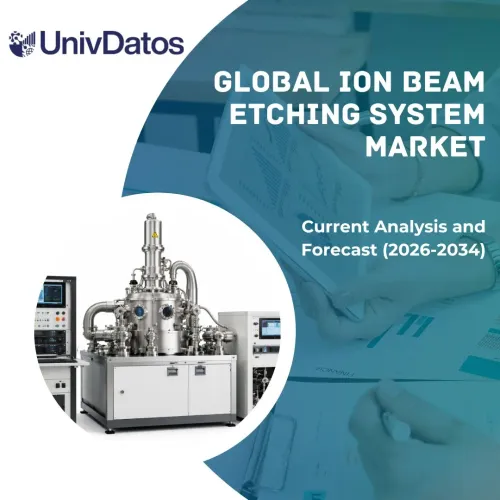
Ion Beam Etching System Market: Current Analysis and Forecast (2026-2034)
Emphasis on Type (Conventional Ion Beam Etching (IBE), Reactive Ion Beam Etching (RIBE), Focused Ion Beam (FIB) Systems, Automatic Ion Beam, and Others); Application (Semiconductor Manufacturing, Microelectronics & Data Storage, Photonics & Optoelectronics, MEMS (Micro-Electro-Mechanical Systems), Research & Metrology, and Others); End User (Semiconductor & Electronics, Aerospace & Defense, Healthcare & Medical Devices, Research Institutions, and Others); and Region/Country
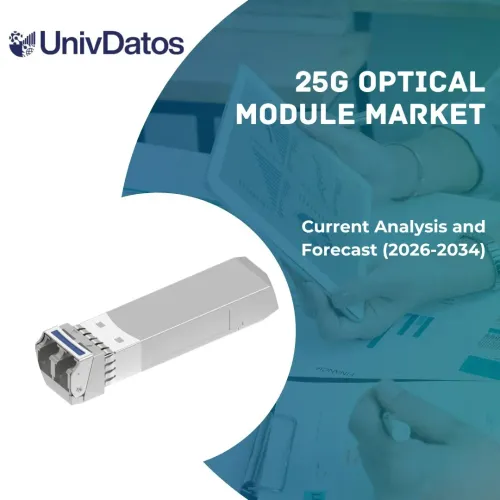
25G Optical Module Market: Current Analysis and Forecast (2026-2034)
Emphasis on Product Type (SFP28, QSFP28, and CFP2); Application (Data Centers, Telecommunications, and Enterprise Networks); End-User (IT & Telecommunications, BFSI, Healthcare, Retail, and Others); and Region/Country
Power over Ethernet (PoE) Chipset Market: Current Analysis and Forecast (2025-2033)
Emphasis on Type (PoE Power Sourcing Equipment (PSE) Chipset and PoE Powered Devices (PD) Chipset); Standard (IEEE 802.3at Standard, IEEE 802.3bt Standard, and IEEE 802.3af Standard); Device (IP/Network Cameras, VoIP Phone, Ethernet Switch & Injector, Wireless Radio Access Point, Proximity Sensor, LED Lighting, and Others); End-use (Commercial, Industrial, and Residential); and Region/Country