Magnetoresistive RAM (MRAM) Market: Current Analysis and Forecast (2026-2034)
Emphasis on Type (Toggle MRAM and STT-MRAM); Application (Consumer Electronics, Automotive, Robotics, Aerospace & Defense, Enterprise Storage, and Others); and Region/Country
Global Magnetoresistive RAM (MRAM) Market Size & Forecast
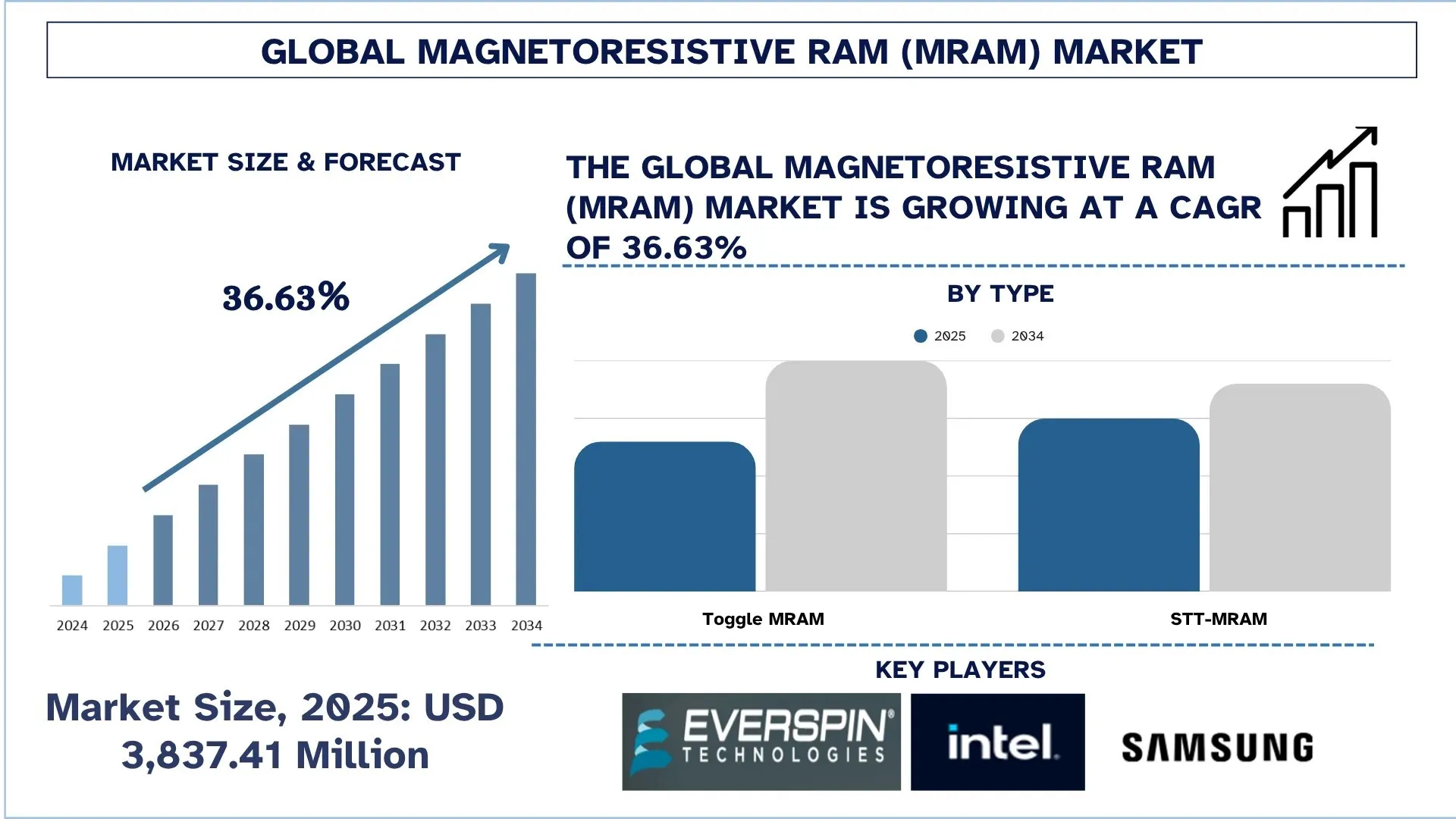
The Global Magnetoresistive RAM (MRAM) Market was valued at USD 3,837.41 million in 2025 and is expected to grow at a strong CAGR of around 36.63% during the forecast period (2026-2034F), driven by growing demand for high-speed, low-power non-volatile across automotive, enterprise, and embedded applications.
Magnetoresistive RAM (MRAM) Market Analysis
MRAM Magnetoresistive RAM (MRAM) is a promising new memory technology capable of giving electronic systems high-speed storage with very slow write limits and the capacity to retain information even after being turned off, a compromise between performance and permanence. It includes magnetic storage components that are set to provide rapid read and write services, minimal standby energy, and robust performance in harsh operating environments. The application of MRAM supports instant-on operation, reliable data storage, and efficient process operation whilst aiding device manufacturers in reducing power loss and reducing the memory architecture in smaller systems. These solutions are standalone and embedded memory configurations used to sustain a lean operation in automotive, industrial, consumer electronics, and data-centric worlds.
The major factors contributing to the growth include the growing demand for high-speed, low-power non-volatile memory, the increasing use of MRAM in automotive electronics and ADAS systems, and the growing use of high-performance memory in enterprise and embedded environments. Moreover, the fact that interlinked and intelligent devices demand an efficient manner of performance, durability, and energy efficiency is also supportive of the market demand. The other market drivers are innovations in STT-MRAM, greater integration with SoCs and microcontrollers, and wider adoption in AI, IoT, and edge computing systems.
Global Magnetoresistive RAM (MRAM) Market Trends
This section discusses the key market trends that are influencing the various segments of the global Magnetoresistive RAM (MRAM) market, as found by our team of research experts.
Growing Shift Toward STT-MRAM as the Leading Commercial Architecture
The significant technological development affecting MRAM market trends is the rising prevalence of the adoption of STT-MRAM as the dominant MRAM design for commercial purposes. Amongst other types of MRAM, STT-MRAM has gained greater market acceptance due to its effective combination of features such as high read/write speeds, low energy consumption, durability, and scalability in semiconductor devices. The application of the technology in embedded systems, automotive electronics, and industrial electronic devices makes it the most commercialized type in the larger scope of the MRAM segments. Semiconductor manufacturers are continuously optimizing product performances and production processes, making STT-MRAM technology more suitable for further commercialization. In March 2025, Everspin augmented its reliable memory products by introducing STT-MRAM in its high-performance portfolio for aerospace, automotive, and industrial applications. This demonstrates that vendors are expanding their STT-MRAM portfolios by increasing penetration in high-reliability and high-performance applications.
Magnetoresistive RAM (MRAM) Industry Segmentation
This section provides an analysis of the key trends in each segment of the global Magnetoresistive RAM (MRAM) market report, along with forecasts at the global, regional, and country levels for 2026-2034.
The STT-MRAM segment held a significant share during the forecast period (2026-2034).
Based on type, the Global Magnetoresistive RAM (MRAM) market is segmented into Toggle MRAM and STT-MRAM. In 2025, the STT-MRAM segment held a significant share of the market. This is largely because it has greater commercial maturity, is more scalable for advanced memory applications, and is more widely accepted in embedded and high-performance applications. It is so much more favored in that it provides a one-of-a-kind combination of speed, endurance, and consumes less power, and is applicable in automotive electronics, enterprise storage, and smart connected devices. It also gains greater industry acceptance through continued technological advancement that enhances density and integration in next-generation semiconductor platforms.
The Enterprise Storage Segment Dominates the Global Magnetoresistive RAM (MRAM) Market.
Based on application, the Global Magnetoresistive RAM (MRAM) market is segmented into Consumer Electronics, Automotive, Robotics, Aerospace & Defense, Enterprise Storage, and Others. In 2025, the Enterprise Storage segment held a significant share of the market. This has been mainly motivated by the increasing requirement for low-latency, high-speed, and non-volatile memory solutions in data-intensive storage applications. MRAM is becoming increasingly relevant to enterprise storage because it can provide faster data access, higher endurance, and enhanced reliability compared with standard memory in performance-critical applications. The need also exists in more sophisticated memory technologies that can enhance processing efficiency and reduce data bottlenecks in enterprise systems, reinforcing their market position.
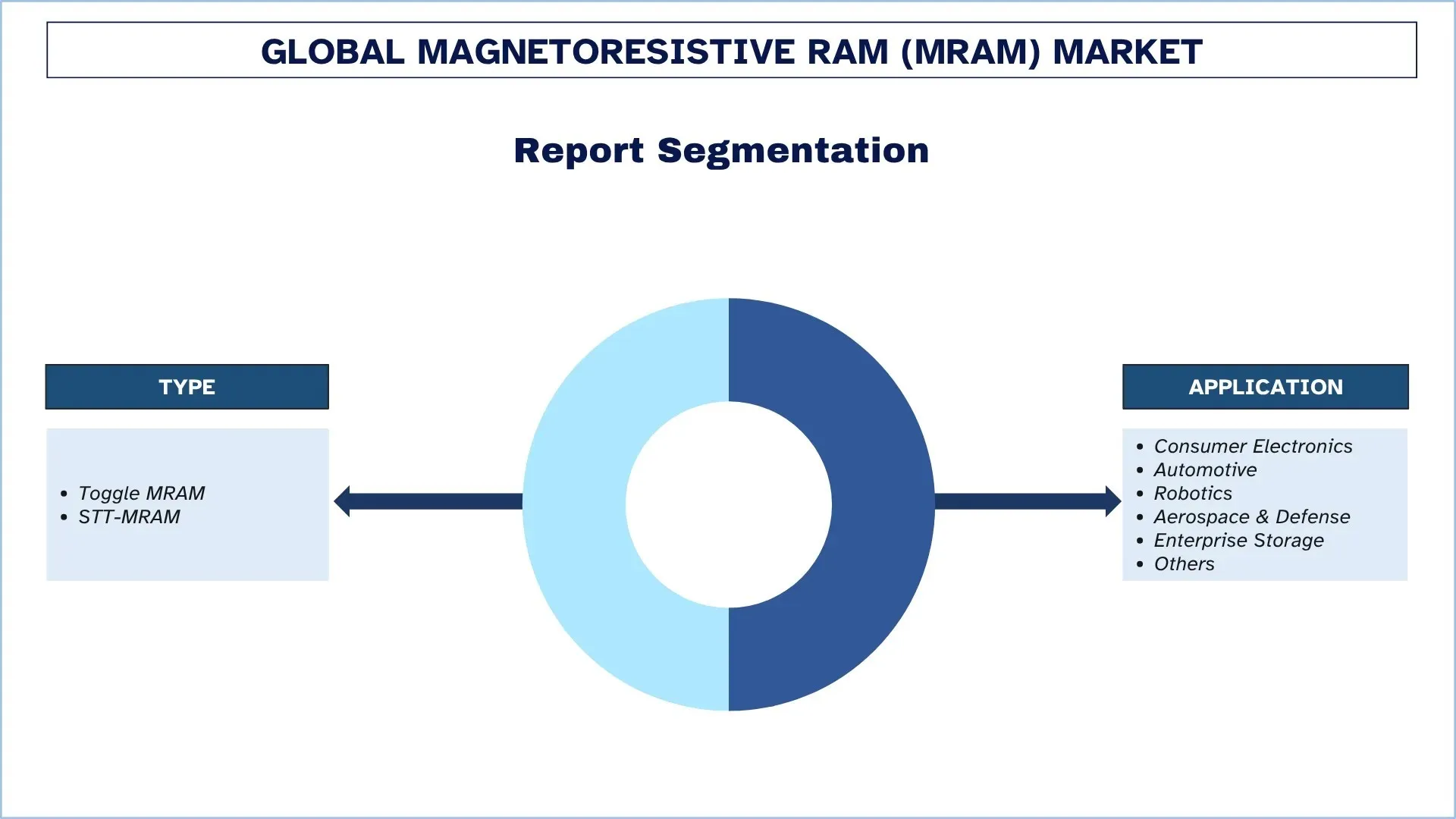
North America holds the largest market share in the global Magnetoresistive RAM (MRAM) market
In 2025, the market for Magnetoresistive Random Access Memory (MRAM) in North America will be highly driven by the region’s robust semiconductor industry, its adoption of cutting-edge memory technologies, and homegrown MRAM pioneers and technologists. The growth of the market in the region will be fueled by the increased requirement for fast, energy-efficient, and non-volatile memory in various industries such as the automobile, aerospace, defense, industrial, and edge computing sectors. Furthermore, the increasing focus on innovation within the embedded memory sector, futuristic computing systems, and critical storage solutions is driving the MRAM adoption rate in North America.
The United States held a dominant share of the North American Magnetoresistive RAM (MRAM) Market in 2025
The United States dominated the North America region in the MRAM market in 2025 due to its flourishing semiconductor industry, implementation of state-of-the-art non-volatile memory technology, and innovative MRAM solutions offered by major players such as Everspin and Avalanche Technology. Growing demand for speedy, reliable, and efficient memory in aerospace & defense, automotive, industrial, and edge computing industries is boosting market growth. Rising investments in domestic MRAM production, radiation-resistant memory, and embedded memory advancements are also boosting the prospects for the market in the United States. Furthermore, significant research and development activities, national-level strategic initiatives, and widespread deployment of specialized MRAM products are also contributing to the growing prominence of the United States in the global market. Due to the large number of memory technology developers and advanced manufacturing facilities in the country, along with defense-related innovations, the United States has been a primary driver of the global MRAM market.
Magnetoresistive RAM (MRAM) Industry Competitive Landscape
The global Magnetoresistive RAM (MRAM) market is competitive, with several global and international market players. The key players are adopting different growth strategies to enhance their market presence, such as partnerships, agreements, collaborations, geographical expansions, and mergers and acquisitions.
Top Magnetoresistive RAM (MRAM) Market Companies
Some of the major players in the market are Everspin Technologies Inc., Intel Corporation, Samsung, Toshiba Corporation, NXP Semiconductors, Western Digital Corporation, GlobalFoundries, Avalanche Technology Inc., Infineon Technologies AG, and NVE Corporation.
Recent Developments in the Magnetoresistive RAM (MRAM) Market
In November 2025, Everspin Technologies announced the expansion of its PERSYST MRAM line with the EM064LX HR and EM128LX HR devices, designed for demanding automotive, industrial, and aerospace applications. These 64Mb/128Mb chips feature AEC-Q100 Grade 1 qualification for -40°C to +125°C operation, 10-year data retention, and 48-hour burn-in.
In May 2025, TSMC announced the launch of a new design center in Europe focused on memory technologies for automotive applications, and began development of 5 nm MRAM process nodes (in addition to 22 nm, 16 nm, and 12 nm nodes).
In August 2024, Avalanche Technology announced the addition of 64Mb and 128Mb densities to the company’s Aerospace & Defense Gen 3 STT-MRAM product suite. The new Gen 3 STT-MRAM products provide features such as high reliability and optimized radiation resilience.
Global Magnetoresistive RAM (MRAM) Market Report Coverage
Report Attribute | Details |
Base year | 2025 |
Forecast period | 2026-2034 |
Growth momentum | Accelerate at a CAGR of 36.63% |
Market size 2025 | USD 3,837.41 million |
Regional analysis | North America, Europe, APAC, Rest of the World |
Major contributing region | The North America region is expected to dominate the market during the forecast period. |
Key countries covered | U.S., Canada, Germany, U.K., Spain, Italy, France, China, Japan, and India. |
Companies profiled | Everspin Technologies Inc., Intel Corporation, Samsung, Toshiba Corporation, NXP Semiconductors, Western Digital Corporation, GlobalFoundries, Avalanche Technology Inc., Infineon Technologies AG, and NVE Corporation |
Report Scope | Market Trends, Drivers, and Restraints; Revenue Estimation and Forecast; Segmentation Analysis; Demand and Supply Side Analysis; Competitive Landscape; Company Profiling |
Segments Covered | By Type, By Application, and By Region/Country |
Reasons to Buy the Magnetoresistive RAM (MRAM) Market Report:
The study includes market sizing and forecasting analysis confirmed by authenticated key industry experts.
The report briefly reviews overall industry performance at a glance.
The report covers an in-depth analysis of prominent industry peers, primarily focusing on key business financials, type portfolios, expansion strategies, and recent developments.
Detailed examination of drivers, restraints, key trends, and opportunities prevailing in the industry.
The study comprehensively covers the market across different segments.
Deep dive regional level analysis of the industry.
Customization Options:
The global Magnetoresistive RAM (MRAM) market can further be customized as per the requirements or any other market segment. Besides this, UnivDatos understands that you may have your own business needs; hence, feel free to contact us to get a report that completely suits your requirements.
Table of Content
Research Methodology for the Global Magnetoresistive RAM (MRAM) Market Analysis (2024-2034)
We analyzed the historical market, estimated the current market, and forecasted the future market of the global Magnetoresistive RAM (MRAM) market to assess its application in major regions worldwide. We conducted exhaustive secondary research to gather historical market data and estimate the current market size. To validate these insights, we carefully reviewed numerous findings and assumptions. Additionally, we conducted in-depth primary interviews with industry experts across the Magnetoresistive RAM (MRAM) value chain. After validating market figures through these interviews, we used both top-down and bottom-up approaches to forecast the overall market size. We then employed market breakdown and data triangulation methods to estimate and analyze the market size of industry segments and sub-segments.
Market Engineering
We employed the data triangulation technique to finalize the overall market estimation and derive precise statistical numbers for each segment and sub-segment of the global Magnetoresistive RAM (MRAM) market. We split the data into several segments and sub-segments by analyzing various parameters and trends, including type, application, and regions within the global Magnetoresistive RAM (MRAM) market.
The Main Objective of the Global Magnetoresistive RAM (MRAM) Market Study
The study identifies current and future trends in the global Magnetoresistive RAM (MRAM) market, providing strategic insights for investors. It highlights regional market attractiveness, enabling industry participants to tap into untapped markets and gain a first-mover advantage. Other quantitative goals of the studies include:
Market Size Analysis: Assess the current and forecast market size of the global Magnetoresistive RAM (MRAM) market and its segments in terms of value (USD).
Magnetoresistive RAM (MRAM) Market Segmentation: Segments in the study include areas of type, application, and region.
Regulatory Framework & Value Chain Analysis: Examine the regulatory framework, value chain, customer behavior, and competitive landscape of the Magnetoresistive RAM (MRAM) industry.
Regional Analysis: Conduct a detailed regional analysis for key areas such as Asia Pacific, Europe, North America, and the Rest of the World.
Company Profiles & Growth Strategies: Company profiles of the Magnetoresistive RAM (MRAM) market and the growth strategies adopted by the market players to sustain the fast-growing market.
Frequently Asked Questions FAQs
Q1: What is the current market size and growth potential of the global Magnetoresistive RAM (MRAM) market?
The global Magnetoresistive RAM (MRAM) market is valued at USD 3,837.41 million in 2025, driven by the rising demand for high-speed, low-power, and non-volatile memory solutions across automotive, industrial, aerospace, defense, and edge computing applications.
Q2: Which segment has the largest share of the global Magnetoresistive RAM (MRAM) market by Type?
The STT-MRAM segment currently leads the market, supported by the growing demand for high-endurance, high-speed, and energy-efficient non-volatile memory in embedded systems, automotive electronics, industrial devices, and enterprise storage applications.
Q3: What are the driving factors for the growth of the global Magnetoresistive RAM (MRAM) market?
Key growth drivers include the growing need for high-speed, low-power non-volatile memory, rising MRAM adoption in automotive electronics and ADAS systems, and the expanding use of MRAM in enterprise storage and other data-intensive applications.
Q4: What are the emerging technologies and trends in the global Magnetoresistive RAM (MRAM) market?
Major trends include the growing shift toward STT-MRAM, rising focus on MRAM for AI, IoT, and edge computing applications, and increasing interest in advanced memory solutions that offer faster performance, high endurance, and lower power consumption.
Q5: What are the key challenges in the global Magnetoresistive RAM (MRAM) market?
Major challenges include the high manufacturing costs of MRAM technology and complex integration and fabrication requirements, which can limit large-scale commercialization and increase adoption barriers for semiconductor manufacturers.
Q6: Which region dominates the global Magnetoresistive RAM (MRAM) market?
North America dominates the market due to its early adoption of advanced memory technologies, strong semiconductor manufacturing and R&D ecosystem, and the presence of key MRAM innovators and solution developers.
Q7: Who are the key competitors in the global Magnetoresistive RAM (MRAM) market?
Top players in the Magnetoresistive RAM (MRAM) industry include:
• Everspin Technologies Inc.
• Intel Corporation
• Samsung
• Toshiba Corporation
• NXP Semiconductors
• Western Digital Corporation
• GlobalFoundries
• Avalanche Technology Inc.
• Infineon Technologies AG
• NVE Corporation
Q8: What opportunities are emerging for new entrants and technology providers in this market?
Key opportunities include the expanding use of MRAM in aerospace and defense applications, where high reliability, endurance, and radiation resistance are critical, along with the emerging demand for MRAM in edge AI and energy-efficient smart devices that require fast, low-power, and non-volatile memory solutions.
Q9: How is digital transformation influencing the Magnetoresistive RAM (MRAM) market?
Digital transformation is increasing the demand for faster, more efficient, and highly reliable memory technologies across connected devices, industrial automation systems, smart vehicles, and edge computing platforms. As organizations adopt AI, IoT, and data-intensive digital infrastructures, the need for high-speed, low-power, and non-volatile memory is rising, which is supporting MRAM adoption. This transition is also encouraging semiconductor companies to develop application-specific MRAM solutions for automotive, enterprise storage, aerospace, and industrial use cases.
Related Reports
Customers who bought this item also bought


Magnetoresistive RAM (MRAM) Market: Current Analysis and Forecast (2026-2034)
Emphasis on Type (Toggle MRAM and STT-MRAM); Application (Consumer Electronics, Automotive, Robotics, Aerospace & Defense, Enterprise Storage, and Others); and Region/Country
Ion Beam Etching System Market: Current Analysis and Forecast (2026-2034)
Emphasis on Type (Conventional Ion Beam Etching (IBE), Reactive Ion Beam Etching (RIBE), Focused Ion Beam (FIB) Systems, Automatic Ion Beam, and Others); Application (Semiconductor Manufacturing, Microelectronics & Data Storage, Photonics & Optoelectronics, MEMS (Micro-Electro-Mechanical Systems), Research & Metrology, and Others); End User (Semiconductor & Electronics, Aerospace & Defense, Healthcare & Medical Devices, Research Institutions, and Others); and Region/Country
25G Optical Module Market: Current Analysis and Forecast (2026-2034)
Emphasis on Product Type (SFP28, QSFP28, and CFP2); Application (Data Centers, Telecommunications, and Enterprise Networks); End-User (IT & Telecommunications, BFSI, Healthcare, Retail, and Others); and Region/Country
Power over Ethernet (PoE) Chipset Market: Current Analysis and Forecast (2025-2033)
Emphasis on Type (PoE Power Sourcing Equipment (PSE) Chipset and PoE Powered Devices (PD) Chipset); Standard (IEEE 802.3at Standard, IEEE 802.3bt Standard, and IEEE 802.3af Standard); Device (IP/Network Cameras, VoIP Phone, Ethernet Switch & Injector, Wireless Radio Access Point, Proximity Sensor, LED Lighting, and Others); End-use (Commercial, Industrial, and Residential); and Region/Country