Carbon-Negative Concrete Market: Current Analysis and Forecast (2025-2033)
Emphasis By Product Type (Precast Carbon-Negative Concrete, Ready-Mix Carbon-Negative Concrete, Concrete Blocks, Panels, and Others), By Application (Residential, Commercial, Industrial, and Others), by End-User (Carbon Capture & Utilization, Mineralization, Bio-based Method, and Others), Region/Country (North America, Europe, Asia-Pacific, and Rest of the World)
Global Carbon-Negative Concrete Market Size & Forecast
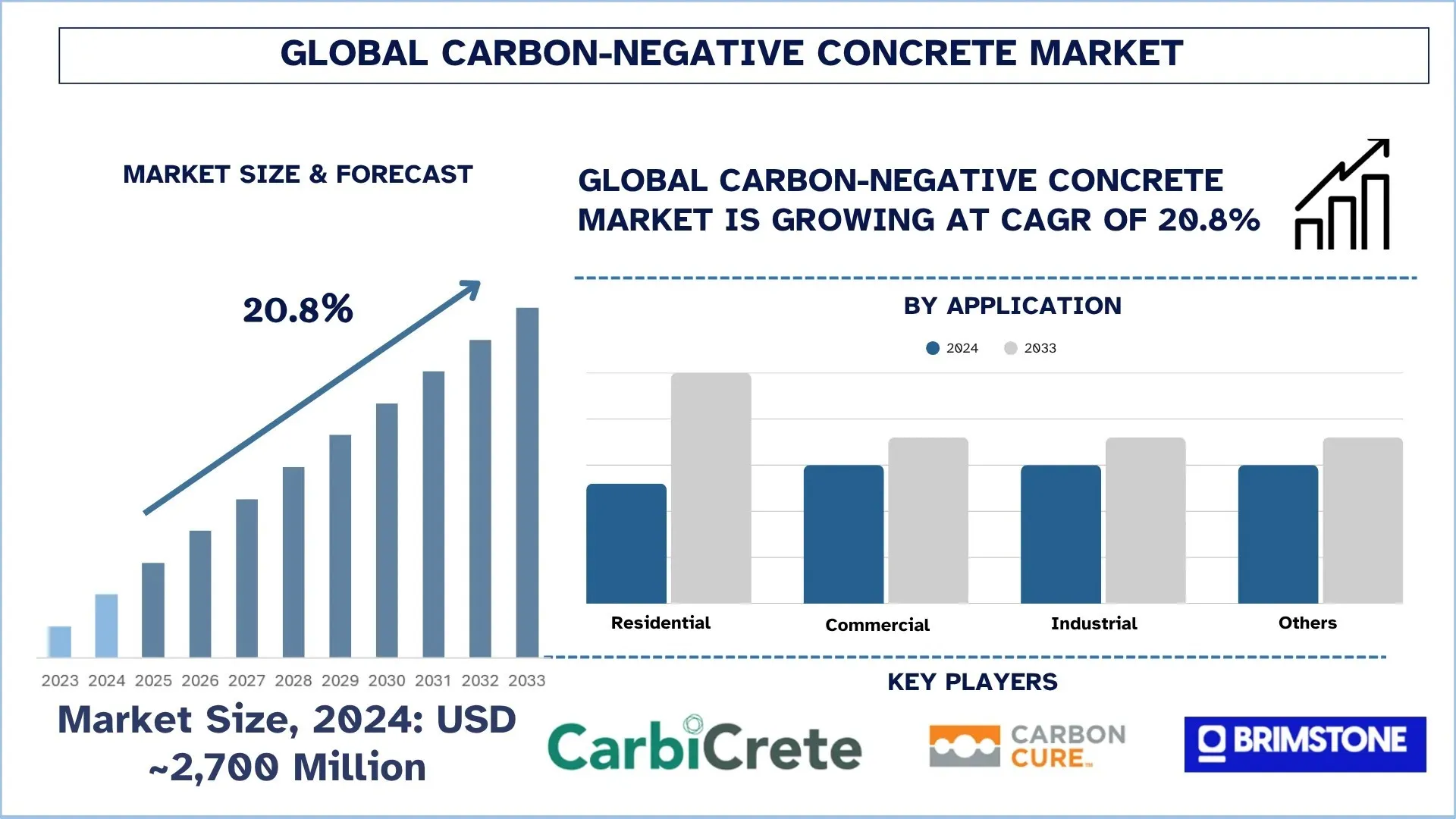
The global Carbon-Negative Concrete market was valued at USD 2,700 million in 2024 and is expected to grow to a strong CAGR of around 20.8% during the forecast period (2025-2033F). Rising Environmental Concerns and Government Regulations are some of the key drivers that are supporting the market rise of Global Carbon-Negative Concrete.
Carbon-Negative Concrete Market Analysis
The Global Carbon Negative Concrete Market is in a phase of rapid growth, owing to the ever-increasing necessity for environmentally friendly building materials in the global market. As climate change mitigation ranks high on the list of global priorities, the demand for carbon-negative concrete, which is known for its high level of carbon dioxide absorption, is witnessing a significant surge in demand. This type of concrete is also attracting significant attention in the market due to its high level of flame resistance, mold resistance, and insulation properties, which are making this material a viable option for those looking for a replacement for traditional concrete in green buildings and other environmentally friendly constructions. The regulatory environment in regions such as the EU, North America, and the Asia Pacific is in a state of flux, which is creating a fertile ground for bio-based building materials, which include carbon-negative concrete.
Global Carbon-Negative Concrete Market Trends
This section discusses the key market trends that are influencing the various segments of the global Carbon-Negative Concrete market, as found by our team of research experts.
Adoption of Green Building Practices:
Adoption of green building practices is an emerging trend in the construction sector, with the issue of sustainability remaining at the epicenter. The issue of climate change and the negative impact of traditional building materials on the environment have prompted many people, as well as businesses, to seek more sustainable alternatives. The adoption of green buildings, which focus on energy efficiency, the use of sustainable building materials, and reducing the emission of greenhouse gases, is an emerging trend in the building sector. The adoption of carbon-negative concrete in green buildings is an important step towards reducing the negative impact of the construction sector on the environment. The adoption of such building materials not only helps in reducing the negative impact on the environment but also enhances the well-being of the inhabitants. This is an important aspect of the achievement of global sustainability.
Carbon-Negative Concrete Industry Segmentation:
This section provides an analysis of the key trends in each segment of the global Carbon-Negative Concrete market report, along with forecasts at the global, regional, and country levels for 2025-2033.
The Ready-Mix Carbon-Negative Concrete Category has shown promising growth in the Carbon-Negative Concrete Market.
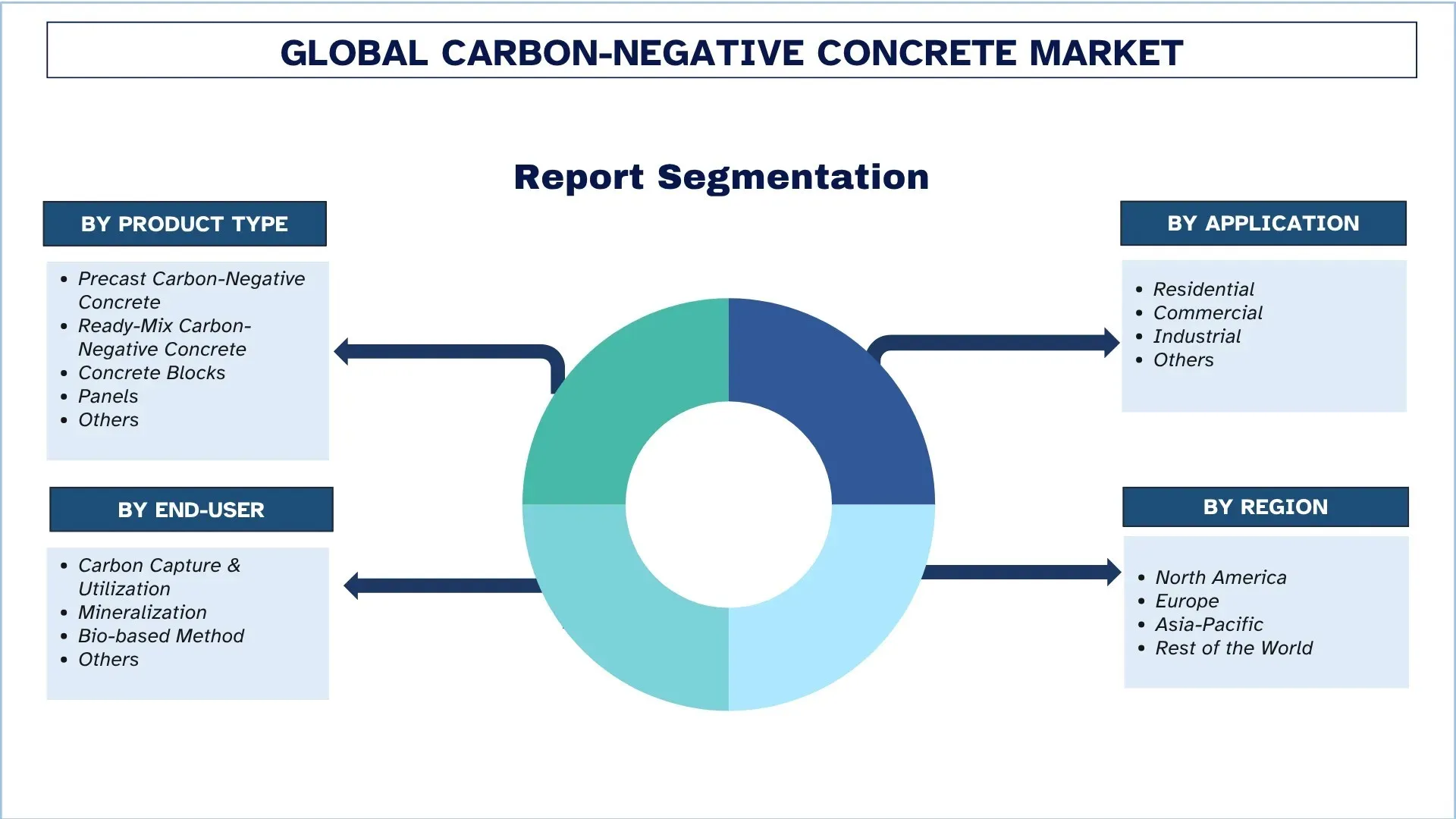
Based on product type, the Global carbon-negative concrete market is segmented into Precast Carbon-Negative Concrete, Ready-Mix Carbon-Negative Concrete, Concrete Blocks, Panels, and Others. Of all these, Ready Mix Carbon Negative Concrete has been the market leader in terms of market share. The segment is growing due to the convenience and cost-effectiveness associated with the use of the product on a large scale. Ready mix concrete is particularly favored for its on-site delivery, as well as the flexibility to customize the product according to the requirements of the project, thus saving time and costs for the project developers. Furthermore, the product is also suitable for implementation on a large scale, especially in the context of infrastructure development in rapidly growing cities as well as in emerging markets. The rising demand for sustainable building products is also fueling the growth of the Ready Mix Carbon Negative Concrete segment. The Precast Carbon Negative Concrete segment is also gaining traction due to the cost-effectiveness associated with the product.
Residential Dominates the Carbon-Negative Concrete Market.
On the basis of application, the Global Carbon Negative Concrete Market is classified into residential, commercial, industrial, and others. The residential segment has dominated the market in terms of share due to a growing demand for sustainable and eco-friendly construction in residential buildings. The factors that contribute to the growth of the market include a growing level of environmental awareness among residents, government incentives towards green building practices, and a growing trend towards energy-efficient homes. Further, the trend towards carbon-neutral construction and building codes is compelling the residential segment towards carbon-negative construction, thus making it a popular choice among builders and residents looking to reduce their ecological footprint.
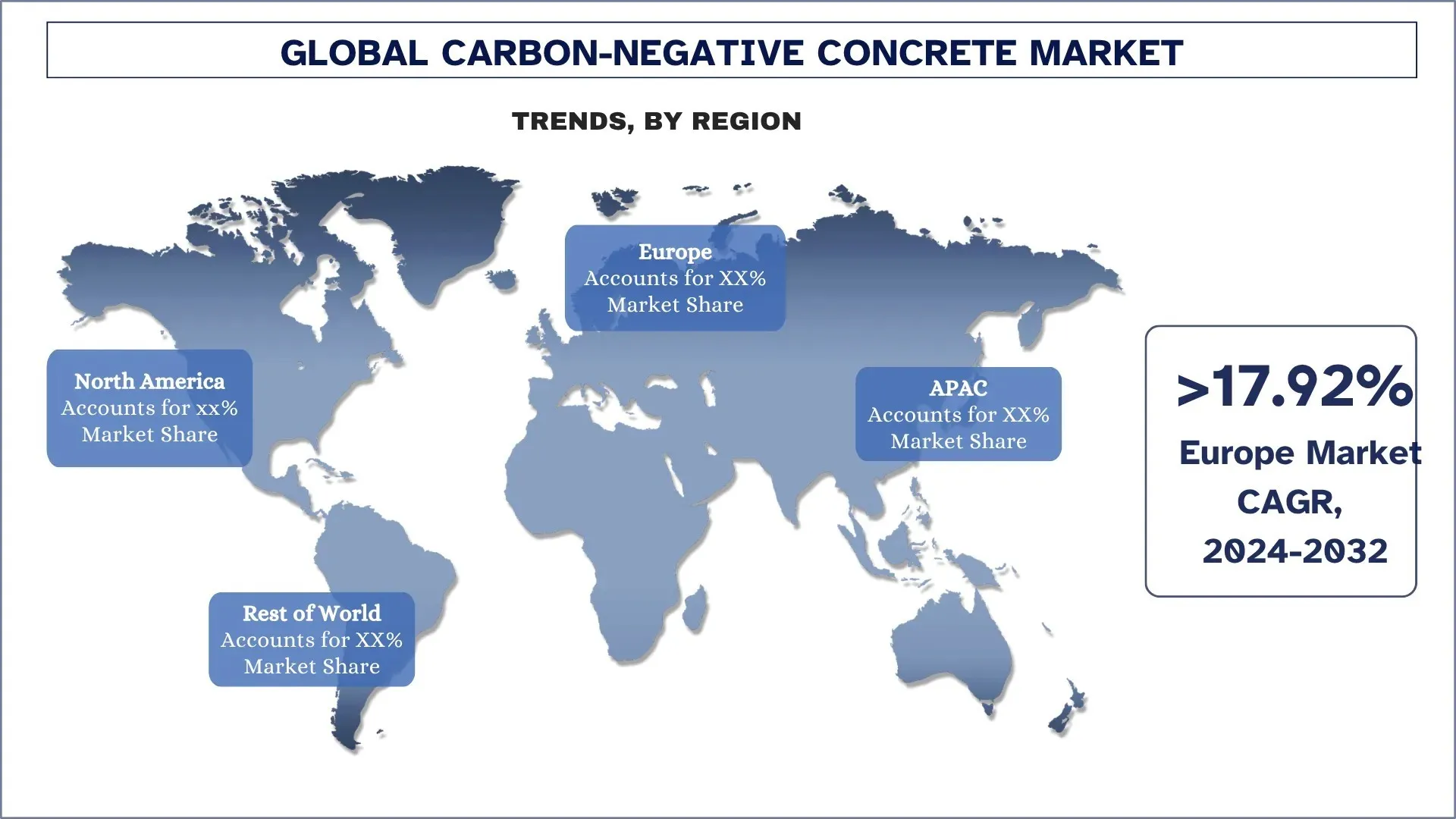
Europe is expected to grow at a considerable rate during the forecast period.
The European Carbon Negative Concrete market is growing significantly due to the increasing focus of European countries on sustainable construction practices. The European construction industry is heavily regulated regarding environmental protection and is committed to reducing greenhouse gas emissions. The focus of European countries is on sustainable construction practices, and the use of environmentally friendly materials is increasing in the European construction industry. The European Carbon Negative Concrete market is also growing due to government incentives and sustainability practices. The demand for carbon-negative concrete is increasing in residential and commercial construction due to the need for sustainable infrastructure. The European Union is committed to implementing the European Green Deal, which is also increasing the demand for carbon-negative concrete in the European construction industry. The focus of European countries is on sustainable infrastructure development, and the demand for environmentally sustainable construction practices is increasing in Europe.
Germany is expected to grow at a considerable rate during the forecast period.
Germany leads the European market for carbon-negative concrete in terms of market size. This is due to the high level of commitment to sustainability and mitigating climate change. Germany is a pioneer in green building practices and is also very strict about environmental protection. This has created a high demand for low-carbon and negative concrete. Germany is a robust construction market that is supported by government incentives and regulations such as the German Energy Transition (Energiewende), which promotes the use of green solutions such as negative concrete. Germany is also a pioneer in the use of modern technologies such as negative concrete in the construction sector.
Carbon-Negative Concrete Industry Competitive Landscape:
The global Carbon-Negative Concrete market is competitive, with several global and international market players. The key players are adopting different growth strategies to enhance their market presence, such as partnerships, agreements, collaborations, new product launches, geographical expansions, and mergers and acquisitions.
Top Carbon-Negative Concrete Companies
Some of the major players in the market are Novacret, CarbiCrete, Partanna, CarbonCure Technologies Inc., Hoffman Green Cement, Brimstone, Seratech Ltd, and Heidelberg Materials.
Recent Developments in the Carbon-Negative Concrete Market
In 2023, Finnish startup Carbonaide received USD 2 million (€1.8) to make carbon-neutral concrete manufacturing. This will help the company to scale its manufacturing in the coming years to offer carbon-neutral concrete with the rising demand from the different sectors.
In April 2025, Primekss launched PrīmX Pure, marketed as the world's first carbon-negative concrete flooring solution.
Global Carbon-Negative Concrete Market Report Coverage
Details | |
Base year | 2024 |
Forecast period | 2025-2033 |
Growth momentum | Accelerate at a CAGR of 20.8% |
Market size 2024 | USD 2,700 Million |
Regional analysis | North America, Europe, APAC, Rest of the World |
Major contributing region | Europe is expected to dominate the market during the forecast period. |
Key countries covered | U.S., Canada, Germany, U.K., Spain, Italy, France, China, Japan, South Korea, and India |
Companies profiled | Novacret, CarbiCrete, Partanna, CarbonCure Technologies Inc., Hoffman Green Cement, Brimstone, Seratech Ltd, and Heidelberg Materials. |
Report Scope | Market Trends, Drivers, and Restraints; Revenue Estimation and Forecast; Segmentation Analysis; Demand and Supply Side Analysis; Competitive Landscape; Company Profiling |
Segments Covered | by Product Type, By Application, By End-User, by Region/Country |
Reasons to Buy the Carbon-Negative Concrete Market Report:
The study includes market sizing and forecasting analysis confirmed by authenticated key industry experts.
The report briefly reviews overall industry performance at a glance.
The report covers an in-depth analysis of prominent industry peers, primarily focusing on key business financials, type portfolios, expansion strategies, and recent developments.
Detailed examination of drivers, restraints, key trends, and opportunities prevailing in the industry.
The study comprehensively covers the market across different segments.
Deep dive regional-level analysis of the industry.
Customization Options:
The global Carbon-Negative Concrete market can further be customized as per the requirements or any other market segment. Besides this, UnivDatos understands that you may have your own business needs; hence, feel free to contact us to get a report that completely suits your requirements.
Table of Content
Research Methodology for the Global Carbon-Negative Concrete Market Analysis (2023-2033)
We analyzed the historical market, estimated the current market, and forecasted the future market of the global Carbon-Negative Concrete market to assess its application in major regions worldwide. We conducted exhaustive secondary research to gather historical market data and estimate the current market size. To validate these insights, we carefully reviewed numerous findings and assumptions. Additionally, we conducted in-depth primary interviews with industry experts across the Carbon-Negative Concrete value chain. After validating market figures through these interviews, we used both top-down and bottom-up approaches to forecast the overall market size. We then employed market breakdown and data triangulation methods to estimate and analyze the market size of industry segments and sub-segments.
Market Engineering
We employed the data triangulation technique to finalize the overall market estimation and derive precise statistical numbers for each segment and sub-segment of the global Carbon-Negative Concrete market. We split the data into several segments and sub-segments by analyzing various parameters and trends, by Product Type, by Application, by End-User, and by regions within the global Carbon-Negative Concrete market.
The Main Objective of the Global Carbon-Negative Concrete Market Study
The study identifies current and future trends in the global Carbon-Negative Concrete market, providing strategic insights for investors. It highlights regional market attractiveness, enabling industry participants to tap into untapped markets and gain a first-mover advantage. Other quantitative goals of the studies include:
Market Size Analysis: Assess the current forecast and market size of the global Carbon-Negative Concrete market and its segments in terms of value (USD).
Carbon-Negative Concrete Market Segmentation: Segments in the study include areas by Product Type, By Application, By End-User, and by
Regulatory Framework & Value Chain Analysis: Examine the regulatory framework, value chain, customer behavior, and competitive landscape of the Carbon-Negative Concrete industry.
Regional Analysis: Conduct a detailed regional analysis for key areas such as Asia Pacific, Europe, North America, and the Rest of the World.
Company Profiles & Growth Strategies: Company profiles of the Carbon-Negative Concrete market and the growth strategies adopted by the market players to sustain the fast-growing market.
Frequently Asked Questions FAQs
Q1: What is the global Carbon-Negative Concrete market’s current market size and growth potential?
The global Carbon-Negative Concrete market was valued at USD 2,700 Million in 2024 and is expected to grow at a CAGR of 20.8% during the forecast period (2025-2033).
Q2: Which segment has the largest share of the global Carbon-Negative Concrete market by Product Type?
Ready Mix Carbon Negative Concrete has been the market leader in terms of market share. The segment is growing due to the convenience and cost-effectiveness associated with the use of the product on a large scale.
Q3: What are the driving factors for the growth of the global Carbon-Negative Concrete market?
• Rising Environmental Concerns: Growing awareness about the environmental impact of traditional construction materials, particularly cement, is driving the demand for carbon-negative concrete. The push to reduce carbon footprints in the building sector has made sustainable solutions like carbon-negative concrete essential for achieving climate goals.
• Government Regulations: Government initiatives, policies, and regulations aimed at reducing carbon emissions and promoting sustainability are supporting the adoption of carbon-negative concrete. Incentives, such as tax rebates and eco-certifications, are encouraging builders and developers to incorporate low-carbon materials in their projects.
Q4: What are the emerging technologies and trends in the global Carbon-Negative Concrete market?
• Adoption of Green Building Practices: As the demand for sustainable buildings rises, the adoption of green building practices is opening up significant opportunities for carbon-negative concrete. The material’s ability to reduce carbon emissions and enhance energy efficiency is in line with the global push for green infrastructure.
• Increased Investment in Sustainability: The growing emphasis on sustainability has led to increased investments in eco-friendly building technologies. Carbon-negative concrete, being a critical component of sustainable construction, is attracting significant funding from both private investors and the public sector, focused on long-term environmental goals.
Q5: What are the key challenges in the global Carbon-Negative Concrete market?
• High Production Costs: Despite the long-term environmental benefits, the initial production cost of carbon-negative concrete remains high. The price of raw materials and specialized production processes can deter some builders, especially those in price-sensitive markets or smaller-scale projects.
• Limited Availability of Raw Materials: The supply of sustainable raw materials such as industrial by-products, bio-based additives, and other ingredients for carbon-negative concrete remains limited. The lack of infrastructure to source and process these materials at scale presents a significant challenge to the widespread adoption of this sustainable alternative.
Q6: Which region dominates the global Carbon-Negative Concrete market?
The Europe region dominates the global Carbon-Negative Concrete market due to the rising demand for sustainable construction.
Q7: Who are the key players in the global Carbon-Negative Concrete market?
Some of the top Carbon-Negative Concrete companies include:
• Novacret
• CarbiCrete
• Partanna
• CarbonCure Technologies Inc.
• Hoffman Green Cement
• Brimstone
• Seratech Ltd
• Heidelberg Materials
• Others
Q8: What are the opportunities for companies within the Global Carbon-Negative Concrete market?
• Expansion in Emerging Markets: As infrastructure development accelerates in emerging economies, there is an increasing focus on incorporating sustainable building materials like carbon-negative concrete. The rising urbanization in regions like Southeast Asia and Sub-Saharan Africa presents new opportunities for the material’s adoption.
• Collaborations and Partnerships: Strategic partnerships between construction firms, technology developers, and government agencies are fostering the growth of the carbon-negative concrete market. These collaborations are aimed at scaling production, improving material quality, and promoting the widespread use of eco-friendly concrete solutions in construction projects.
Q9: How is Carbon-Negative Concrete enhancing the performance and sustainability of modern construction systems?
Carbon-negative concrete enhances modern construction by reducing carbon emissions and improving energy efficiency. Its ability to sequester CO₂ during production not only minimizes environmental impact but also boosts durability, thermal insulation, and resilience, promoting sustainable, high-performance building systems.
Related Reports
Customers who bought this item also bought


India Ultra High Performance Concrete (UHPC) Market: Current Analysis and Forecast (2026-2034)
Emphasis on Product Type (Reactive Powder Concrete (RPC), Slurry Infiltrated Fibrous Concrete (SIFCON), Compact Reinforced Composite (CRC), and Others); Application (Residential, Infrastructure, Commercial, and Others); and Region/States
Carbon-Negative Concrete Market: Current Analysis and Forecast (2025-2033)
Emphasis By Product Type (Precast Carbon-Negative Concrete, Ready-Mix Carbon-Negative Concrete, Concrete Blocks, Panels, and Others), By Application (Residential, Commercial, Industrial, and Others), by End-User (Carbon Capture & Utilization, Mineralization, Bio-based Method, and Others), Region/Country (North America, Europe, Asia-Pacific, and Rest of the World)
Porous Asphalt Market: Current Analysis and Forecast (2025-2033)
Emphasis on Product Type (Open-Graded Friction Course, Permeable Asphalt Pavement, Porous Asphalt Concrete, and Others); Additive Type (Polymers, Recycled Materials, Fibers, and Others); Application (Roadways, Parking Lots, Sidewalks, Driveways, and Others); and Region/Country
Middle East & Africa Sandstone Market: Current Analysis and Forecast (2025-2033)
Emphasis By Form (Tiles, Slabs, and Others), By Application (Building & Construction, Monument & Memorials, Paving, and Others), By Country (Saudi Arabia, UAE, Egypt, South Africa, Turkey, Israel, and the Rest of Middle East & Africa)