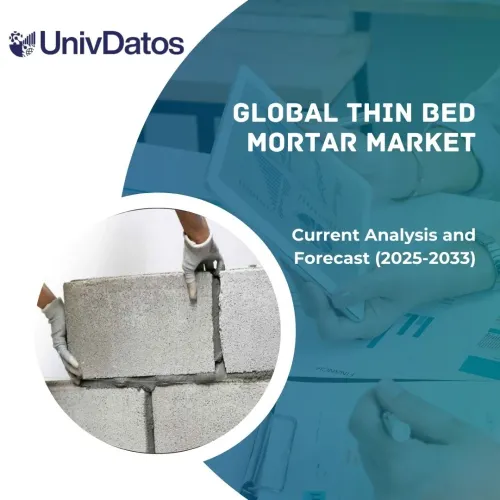
Thin Bed Mortar Market: Current Analysis and Forecast (2025-2033)
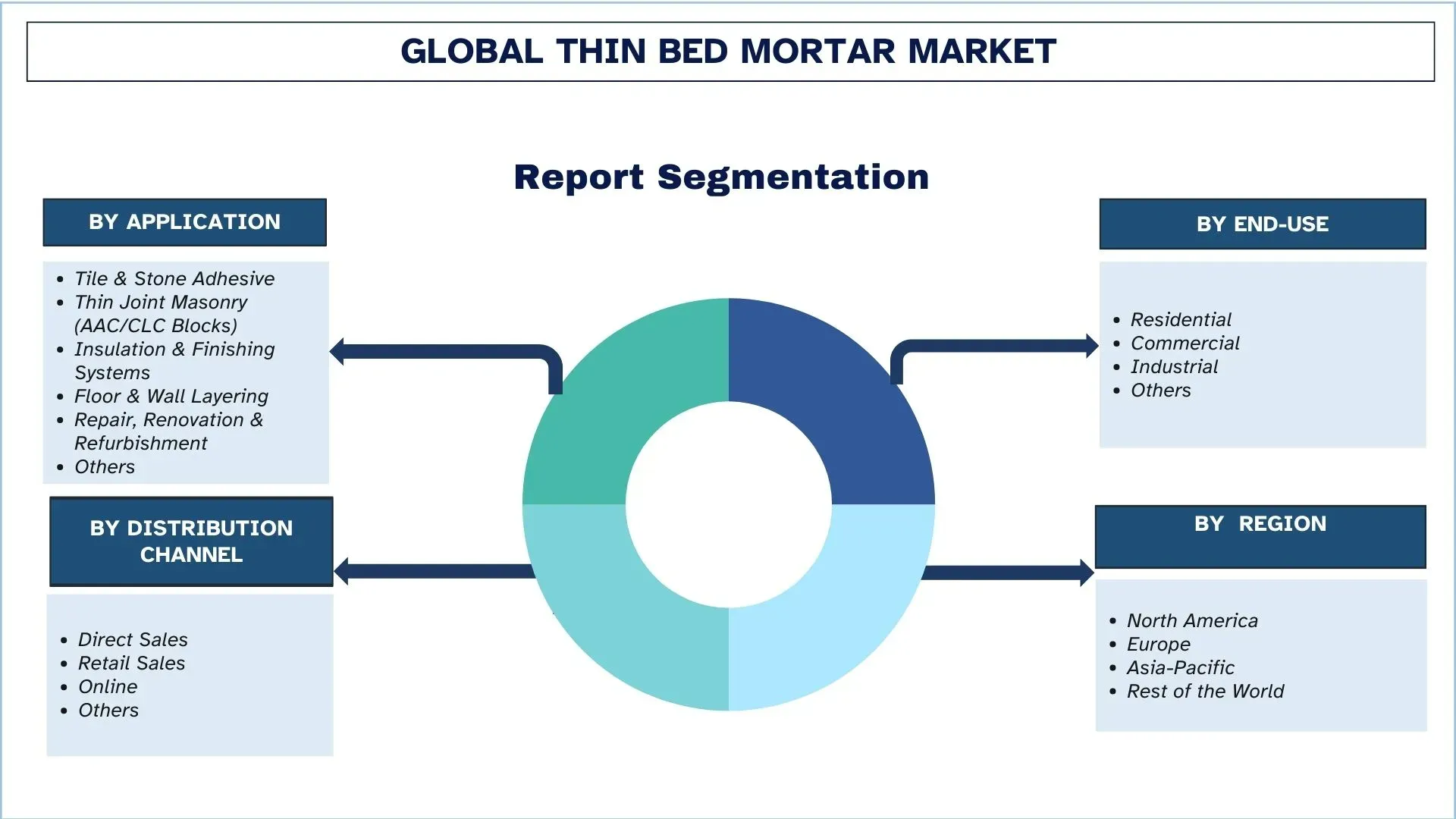
Emphasis on Application (Tile & Stone Adhesive, Thin Joint Masonry (AAC/CLC Blocks), Insulation & Finishing Systems, Floor & Wall Layering, Repair, Renovation & Refurbishment, and Others); End-Use (Residential, Commercial, Industrial, and Others); Distribution Channel (Direct Sales, Retail Sales, Online, and Others); and Region/Country
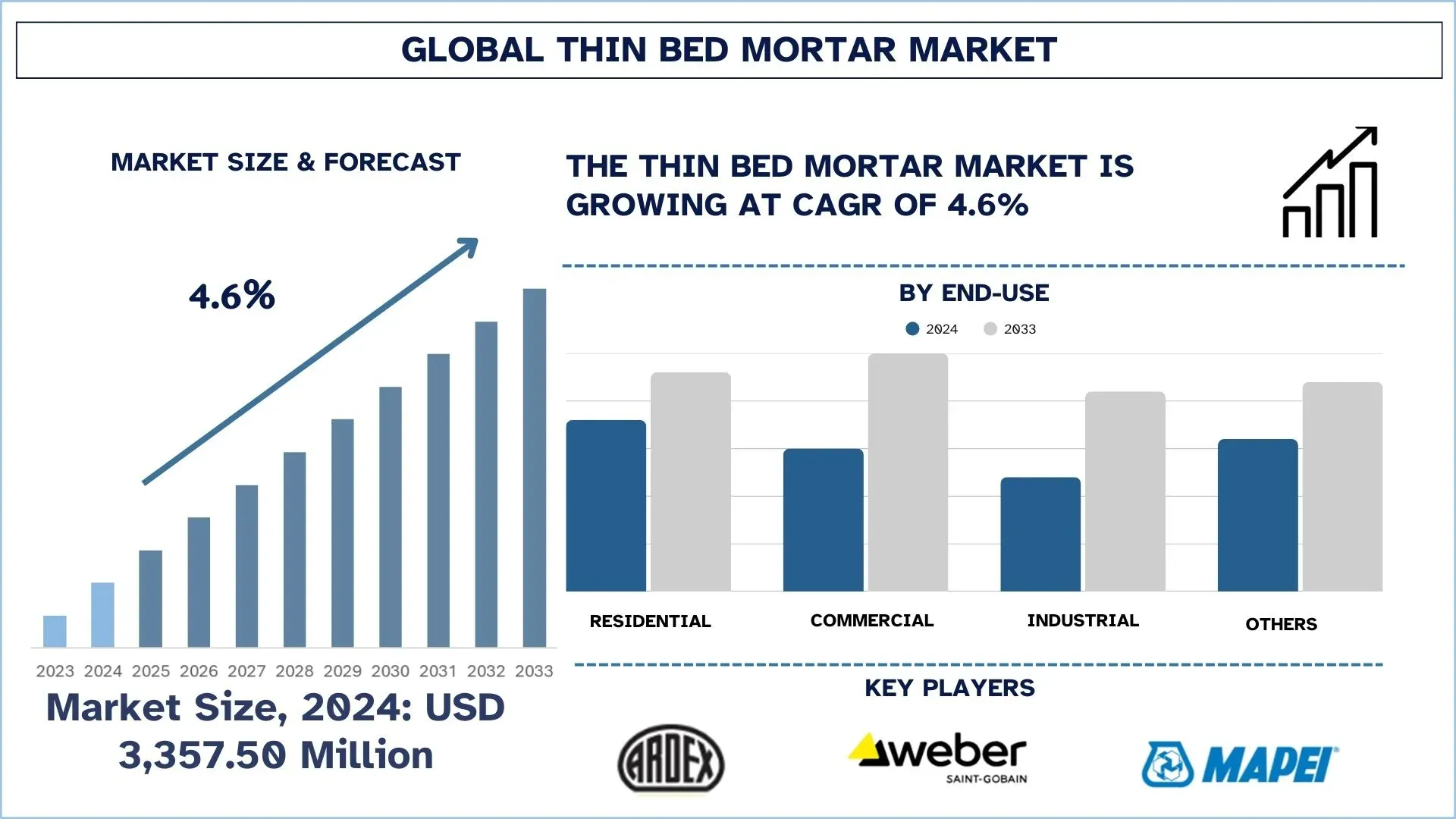
Global Thin Bed Mortar Market Size & Forecast
The global thin-bed mortar market was valued at USD 3,357.50 million in 2024 and is expected to grow at a strong CAGR of around 4.6% during the forecast period (2025-2033F), driven by the rapid expansion of global construction and renovation activities, supported by rising urbanization and infrastructure upgrades.
Thin Bed Mortar Market Analysis
Thin-bed mortar is a specially designed adhesive mortar that is used in laying tiles and stones, AAC/CLC blocks, and other building materials by the thin-layer method, usually between 2-6 mm. It is a construction material that gives high bond, cost-efficiency, and precision relative to the conventional thick-bed mortars. Thin-bed mortars usually have cement, polymers, fillers, and additives that make them more flexible, have greater adhesion strength, and are more workable and therefore are applicable in modern construction practice.
The thin-bed mortar industry is a growing market worldwide due to increased construction and renovation projects in residential, commercial, and industrial buildings. The growing use of large-format tiles, lightweight systems, and eco-friendly building materials is driving demand for high-performance thin-bed mortars. The economic growth in developing countries also favors market growth.
Global Thin Bed Mortar Market Trends
This section discusses the key market trends that are influencing the various segments of the global thin-bed mortar market, as found by our team of research experts.
Growing Use of Premixed and Ready-To-Use Mortars
The increasing popularity of premixed and ready-to-use mortars is an emerging trend in the market due to the necessity of more efficient, quicker, and more consistent methods of construction. These products remove the error of on-site mixing, save on the amount of labor, and provide uniform quality across the applications. They are convenient and therefore suitable in urban projects where space and skilled labor are constraints. Moreover, the enhanced formulations will have enhanced workability, adhesion, and durability, which will aid in their use in tiling, masonry, plastering, and repair works. With the current construction standards being increasingly more precise and more productive, the demand for premixed and ready-to-use mortars is growing in residential, commercial, and industrial fields.
Thin Bed Mortar Industry Segmentation
This section provides an analysis of the key trends in each segment of the global thin-bed mortar market report, along with forecasts at the global, regional, and country levels for 2025-2033.
The Tile & Stone Adhesive Segment dominates the Global Thin Bed Mortar Market
Based on the application category, the market is categorised into tile & stone adhesive, thin joint masonry (AAC/CLC blocks), insulation & finishing systems, floor & wall layering, repair, renovation & refurbishment, and others. Among these, the Tile & Stone Adhesive holds the largest market share, driven by the extensive use of thin-bed mortars for installing tiles in residential, commercial, and industrial buildings, the rapid urbanization process, and the increasing popularity of ceramic, porcelain, and large-format ceramic tiles. However, the thin Joint Masonry (AAC/CLC Blocks) is expected to witness the fastest growth due to the result of increased incorporation of lightweight, energy-saving walling systems in green building and government-financed low-cost housing developments. The growing demand for environmentally-friendly building materials and quicker construction methods will cause the further acceleration of the usage of thin joint mortars in the future.
The Residential Segment dominates the Global Thin Bed Mortar Market.
Based on the end-user category, the market is categorized into residential, commercial, industrial, and others. Among these, the residential segment holds the maximum market share because of the large number of tile jobs, flooring jobs, wall overlaying, and renovation jobs in residential areas, due to the fast urbanization and the high need for modern interiors. The high rate of remodeling of kitchens, bathrooms, and living areas also increases demand in this segment. However, the commercial segment is expected to grow the fastest in the future. This is backed by the growing commercial construction activities, including offices, hotels, retail areas, and public infrastructure, that will need durable, high-performance adhesives and mortars.
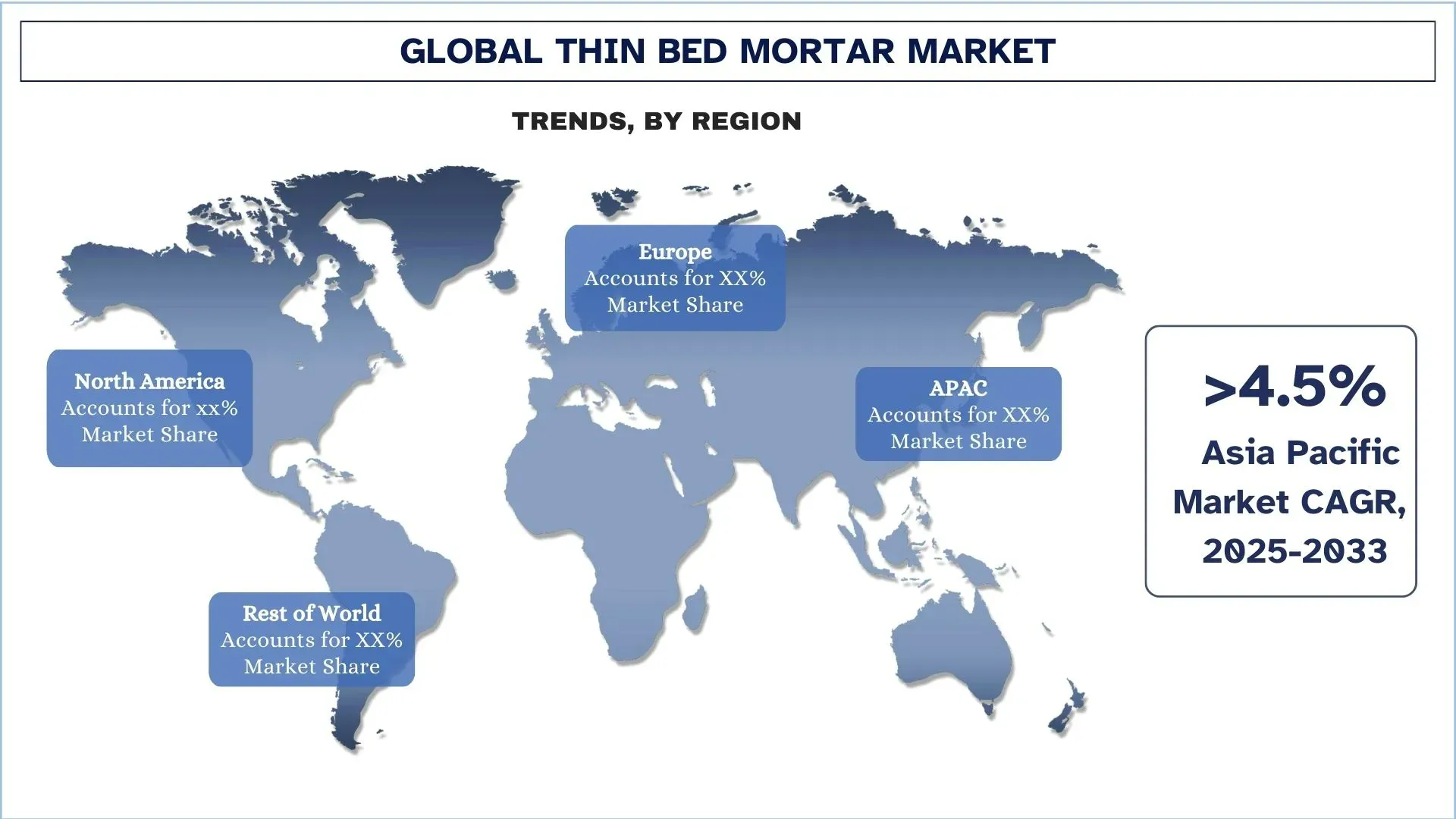
Asia-Pacific holds the largest market share in the global Thin Bed Mortar market
Asia-Pacific had the largest market share in the thin-bed mortar market because of the high rate of urbanization, residential construction, and construction of major infrastructures in the key economies of China, India, and Southeast Asian countries. The high demand for big-format tiles, AAC/CLC block construction, and energy-saving building materials further increased the use of thin-bed mortars. Additionally, affordable housing initiatives sponsored by the government, an increase in disposable incomes, and growing renovation also played a significant part. Moreover, a concentration of large construction chemical vendors and growing commercial property developments placed the Asia-Pacific as the biggest and most vibrant market for thin-bed mortar solutions.
For instance, in February 2025, Nuvoco Vistas Corp. Ltd., which is India’s fifth-largest cement group, expanded its footprint with the inauguration of its second state-of-the-art Ready-Mix Concrete (RMX) plant in Ranchi. Strategically located at Argora, Kanke Road, Bariatu, this plant reinforced Nuvoco's commitment to provide top-quality building materials to the Ranchi region.
China held a Dominant share of the Asia-Pacific Thin Bed Mortar Market in 2024
The Asia-Pacific thin-bed mortar market is dominated by China due to its unmatched scale of construction activity and the rapid adoption of high-tech construction technologies. The aggressive drive towards industrialized and modular buildings in the country resulted in a great demand for precision-based mortars that can be used in AAC blocks, facade systems, and massive installations of panels. The emphasis of China on urban regeneration, substituting the old buildings with new high-density cities, has also increased consumption. In addition, its intensive production in the local market of polymers, additives, and cement gave it an advantage in pricing and continuous supply to mortar manufacturers, further accelerating the market growth.
Thin Bed Mortar Industry Competitive Landscape
The global thin-bed mortar market is competitive, with several global and international market players. The key players are adopting different growth strategies to enhance their market presence, such as partnerships, agreements, collaborations, geographical expansions, and mergers and acquisitions.
Top Thin Bed Mortar Market Companies
Some of the major players in the market are Ardex Group, Saint-Gobain Group, MAPEI Inc., Sika Group, LATICRETE International, Inc., Cemex S.A.B de C.V, Cantillana (Holcim Ltd.), Custom Building Products, LLC, Katto Kft., and Nelissen Steenfabrieken.
Recent Developments in the Thin Bed Mortar Market
In April 2024, Holcim Philippines unveiled its Holcim-TectorCeram, a new tile adhesive specifically formulated for thin-bed applications. This polymer-modified drymix mortar complies with European standard EN 12004, ensuring superior performance for various tile types.
In February 2023, PCI Augsburg GmbH launched PCI Nanorapid, which was introduced as the world’s first deformable tile adhesive featuring CSA (Calcium Sulfoaluminate) technology. This innovative product was designed for thin-bed installation applications and provided installers with extended working and adjustment times while still maintaining rapid setting capabilities.
Global Thin Bed Mortar Market Report Coverage
Report Attribute | Details |
Base year | 2024 |
Forecast period | 2025-2033 |
Growth momentum | Accelerate at a CAGR of 4.6% |
Market size 2024 | USD 3,357.50 million |
Regional analysis | North America, Europe, APAC, Rest of the World |
Major contributing region | The Asia-Pacific region is expected to dominate the market during the forecast period. |
Key countries covered | U.S., Canada, Germany, U.K., Spain, Italy, France, China, Japan, and India. |
Companies profiled | Ardex Group, Saint-Gobain Group, MAPEI Inc., Sika Group, LATICRETE International, Inc., Cemex S.A.B de C.V, Cantillana (Holcim Ltd.), Custom Building Products, LLC, Katto Kft., and Nelissen Steenfabrieken |
Report Scope | Market Trends, Drivers, and Restraints; Revenue Estimation and Forecast; Segmentation Analysis; Demand and Supply Side Analysis; Competitive Landscape; Company Profiling |
Segments Covered | By Application, By End-Use, By Distribution Channel, and By Region/Country |
Reasons to Buy the Thin Bed Mortar Market Report:
The study includes market sizing and forecasting analysis confirmed by authenticated key industry experts.
The report briefly reviews overall industry performance at a glance.
The report covers an in-depth analysis of prominent industry peers, primarily focusing on key business financials, type portfolios, expansion strategies, and recent developments.
Detailed examination of drivers, restraints, key trends, and opportunities prevailing in the industry.
The study comprehensively covers the market across different segments.
Deep dive regional level analysis of the industry.
Customization Options:
The global thin-bed mortar market can further be customized as per the requirements or any other market segment. Besides this, UnivDatos understands that you may have your own business needs; hence, feel free to contact us to get a report that completely suits your requirements.
Table of Content
Research Methodology for the Global Thin Bed Mortar Market Analysis (2023-2033)
We analyzed the historical market, estimated the current market, and forecasted the future market of the global thin-bed mortar market to assess its application in major regions worldwide. We conducted exhaustive secondary research to gather historical market data and estimate the current market size. To validate these insights, we carefully reviewed numerous findings and assumptions. Additionally, we conducted in-depth primary interviews with industry experts across the thin-bed mortar value chain. After validating market figures through these interviews, we used both top-down and bottom-up approaches to forecast the overall market size. We then employed market breakdown and data triangulation methods to estimate and analyze the market size of industry segments and sub-segments.
Market Engineering
We employed the data triangulation technique to finalize the overall market estimation and derive precise statistical numbers for each segment and sub-segment of the global thin-bed mortar market. We split the data into several segments and sub-segments by analyzing various parameters and trends, including application, end-use, distribution channel, and regions within the global thin-bed mortar market.
The Main Objective of the Global Thin Bed Mortar Market Study
The study identifies current and future trends in the global thin-bed mortar market, providing strategic insights for investors. It highlights regional market attractiveness, enabling industry participants to tap into untapped markets and gain a first-mover advantage. Other quantitative goals of the studies include:
Market Size Analysis: Assess the current and forecast market size of the global thin-bed mortar market and its segments in terms of value (USD).
Thin Bed Mortar Market Segmentation: Segments in the study include areas of application, end-use, distribution channel, and region.
Regulatory Framework & Value Chain Analysis: Examine the regulatory framework, value chain, customer behavior, and competitive landscape of the thin-bed mortar industry.
Regional Analysis: Conduct a detailed regional analysis for key areas such as Asia Pacific, Europe, North America, and the Rest of the World.
Company Profiles & Growth Strategies: Company profiles of the thin-bed mortar market and the growth strategies adopted by the market players to sustain the fast-growing market.
Frequently Asked Questions FAQs
Q1: What is the global thin-bed mortar market’s current market size and growth potential?
As of 2024, the global thin-bed mortar market size is estimated at USD 3,357.50 million. The market is projected to grow at a robust CAGR of 4.6% from 2025 to 2033, driven by rising construction activities and increasing adoption of modern tile installation systems.
Q2: Which segment has the largest share of the global thin-bed mortar market by application category?
The tile and stone adhesive segment leads the market, supported by strong demand for tile flooring, wall finishes, and large-format tile installations in residential and commercial construction.
Q3: What are the driving factors for the growth of the global thin-bed mortar market?
Top growth drivers of the thin-bed mortar market include:
• Rising construction and renovation activities across sectors
• Growing adoption of tile and stone installations
• Shift toward lightweight and high-performance building materials.
Q4: What are the emerging technologies and trends in the global thin-bed mortar market?
Emerging trends in the thin-bed mortar market include:
• Increasing popularity of large and ultra-thin porcelain tiles
• Growing use of premixed and ready-to-use mortars.
Q5: What are the key challenges in the global thin-bed mortar market?
Key challenges in the thin-bed mortar market include:
• Fluctuating raw material prices
• Shortage of skilled labor
Q6: Which region dominates the global thin-bed mortar market?
Asia-Pacific dominates the thin-bed mortar market, supported by rapid urbanization, large-scale infrastructure projects, and strong demand for modern building materials across China, India, and Southeast Asia.
Q7: Who are the key competitors in the global thin-bed mortar market?
Top players in the thin-bed mortar industry include:
• Ardex Group
• Saint-Gobain Group
• MAPEI Inc.
• Sika Group
• LATICRETE International, Inc.
• Cemex S.A.B de C.V
• Cantillana (Holcim Ltd.)
• Custom Building Products, LLC
• Katto Kft
• Nelissen Steenfabrieken
Q8: What investment opportunities exist in the global thin-bed mortar market?
Investors can benefit from rising demand for advanced construction chemicals, expanding production capacities in emerging markets, and increasing adoption of polymer-modified and eco-friendly mortars. Companies entering early in high-growth regions like Asia-Pacific and the Middle East can secure strong competitive advantages.
Q9: What factors should businesses consider before expanding into the thin-bed mortar market?
Key considerations include regional construction demand, regulatory requirements, raw material availability, and competitive pricing pressures. Companies should also evaluate opportunities in green building materials and digital distribution channels to ensure long-term market growth.
Related Reports
Customers who bought this item also bought
India Ultra High Performance Concrete (UHPC) Market: Current Analysis and Forecast (2026-2034)
Emphasis on Product Type (Reactive Powder Concrete (RPC), Slurry Infiltrated Fibrous Concrete (SIFCON), Compact Reinforced Composite (CRC), and Others); Application (Residential, Infrastructure, Commercial, and Others); and Region/States
Carbon-Negative Concrete Market: Current Analysis and Forecast (2025-2033)
Emphasis By Product Type (Precast Carbon-Negative Concrete, Ready-Mix Carbon-Negative Concrete, Concrete Blocks, Panels, and Others), By Application (Residential, Commercial, Industrial, and Others), by End-User (Carbon Capture & Utilization, Mineralization, Bio-based Method, and Others), Region/Country (North America, Europe, Asia-Pacific, and Rest of the World)
Porous Asphalt Market: Current Analysis and Forecast (2025-2033)
Emphasis on Product Type (Open-Graded Friction Course, Permeable Asphalt Pavement, Porous Asphalt Concrete, and Others); Additive Type (Polymers, Recycled Materials, Fibers, and Others); Application (Roadways, Parking Lots, Sidewalks, Driveways, and Others); and Region/Country
Middle East & Africa Sandstone Market: Current Analysis and Forecast (2025-2033)
Emphasis By Form (Tiles, Slabs, and Others), By Application (Building & Construction, Monument & Memorials, Paving, and Others), By Country (Saudi Arabia, UAE, Egypt, South Africa, Turkey, Israel, and the Rest of Middle East & Africa)