In-Game Advertising Market: Current Analysis and Forecast (2025-2033)
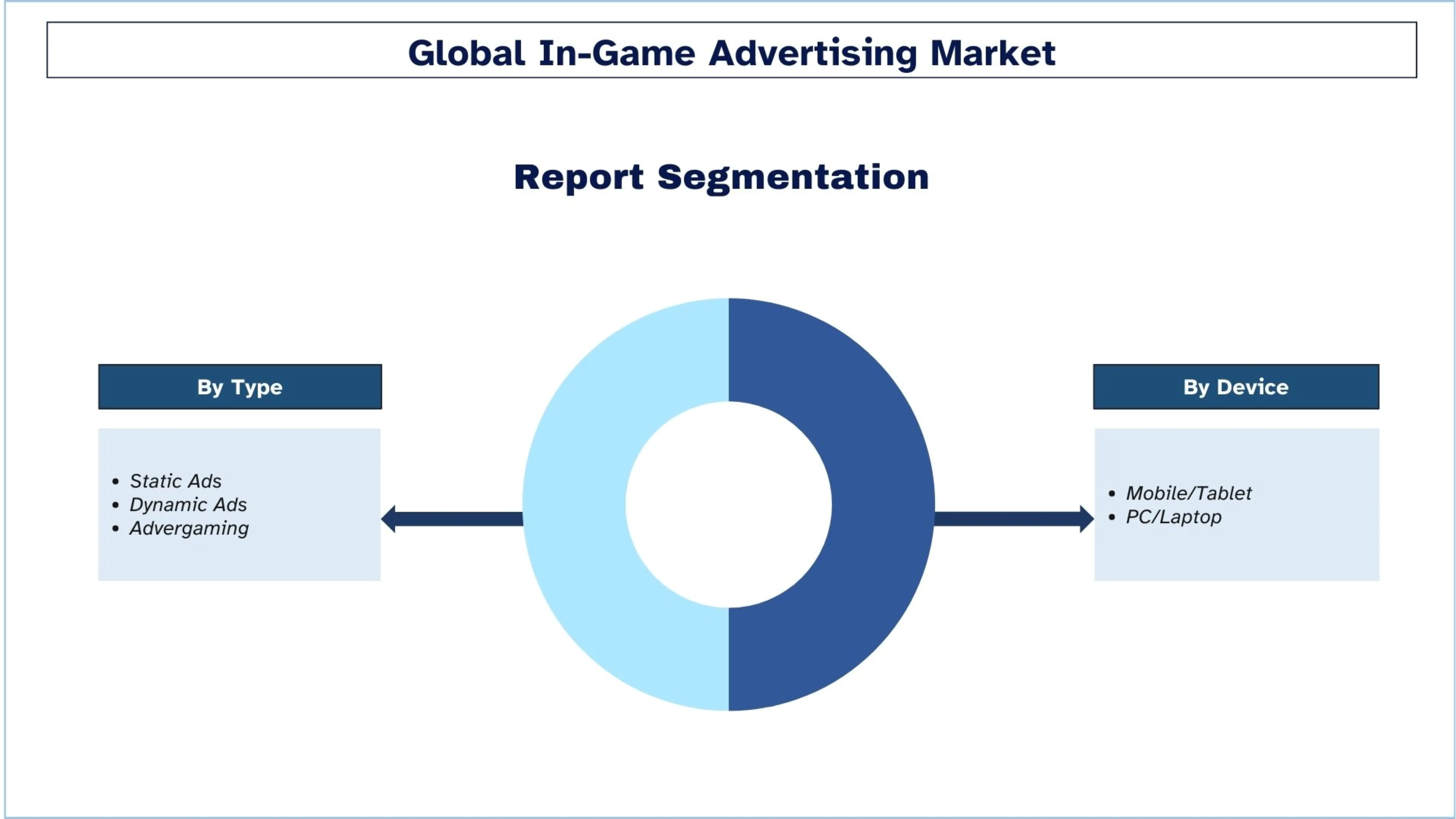
Emphasis on Type (Static Ads, Dynamic Ads, and Advergaming); Device (Mobile/Tablet and PC/Laptop); and Region/Country
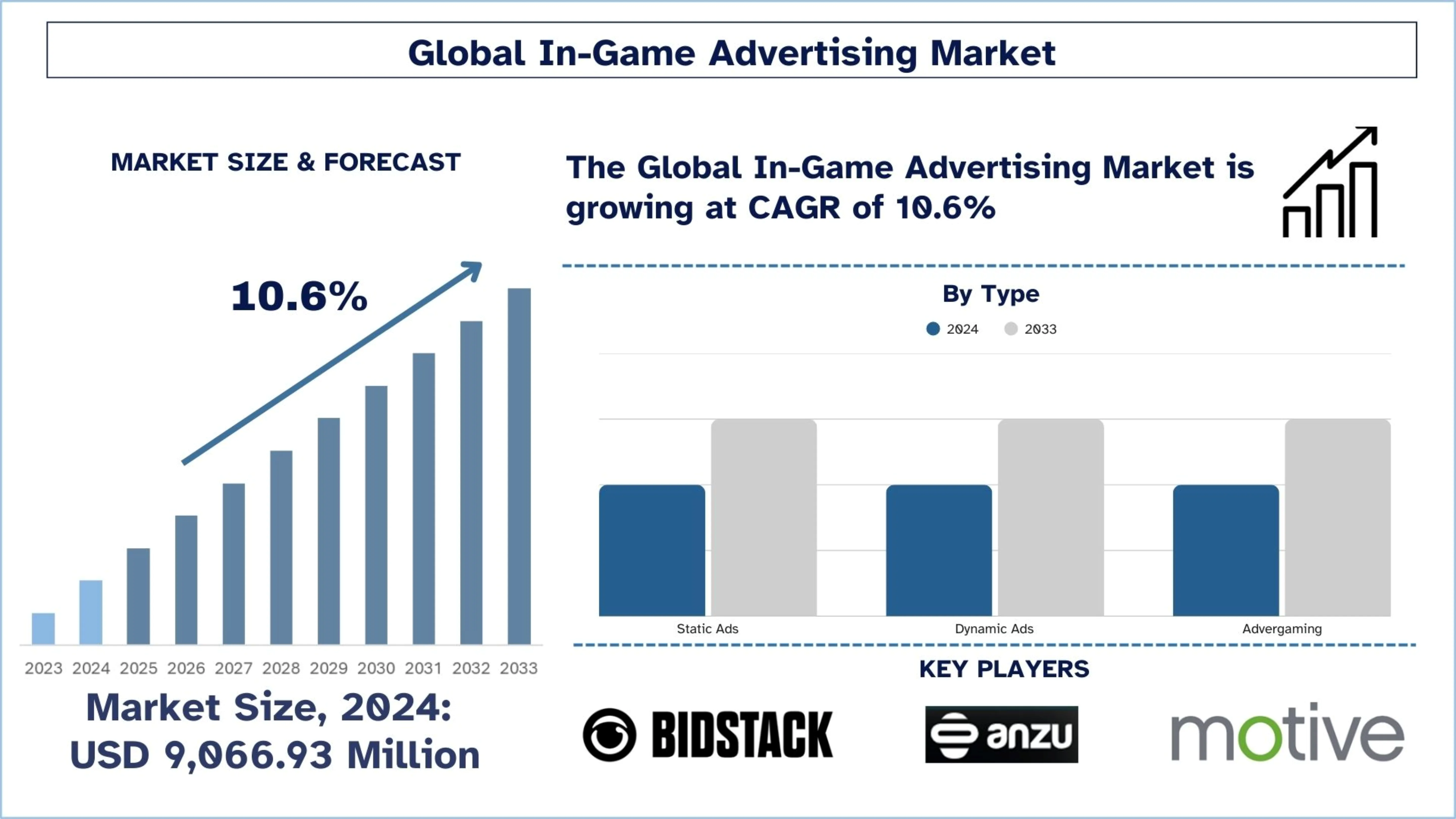
Global In-Game Advertising Market Size & Forecast
The Global In-Game Advertising Market was valued at USD 9,066.93 million in 2024 and is expected to grow at a strong CAGR of around 10.6% during the forecast period (2025-2033F), driven by the rapid growth of the global gaming population across mobile, PC, and console.
In-Game Advertising Market Analysis
New technologies in advertising, such as programmatic ad delivery, real-time bidding, and dynamic ads, are gaining popularity among the companies that are willing to make their campaigns more effective. Intrinsic in-game advertising, rewarded video advertising, and immersive formats in 3D environments are becoming increasingly popular. Moreover, it is being integrated with data analytics, AI-based targeting, and cross-platform advertising solutions to facilitate increasingly personalized and quantifiable ad experiences, driving higher engagement and monetization.
Global In-Game Advertising Market Trends
This section discusses the key market trends that are influencing the various segments of the global In-Game Advertising market, as found by our team of research experts.
Shift toward intrinsic in-game advertising (native placements within gameplay)
Organic in-game advertising is really taking off, becoming a major trend in the market. Businesses are increasingly favoring native ads, seamlessly integrated into the game world. This strategy typically improves the player's experience, since the ads don't constantly disrupt the gameplay.
As a result, brand recognition increases, and user interaction is stimulated. Because of this, intrinsic advertising is gaining traction with both advertisers and game developers, leading to greater acceptance and overall expansion within the market.
In-Game Advertising Industry Segmentation
This section provides an analysis of the key trends in each segment of the global In-Game Advertising market report, along with forecasts at the global, regional, and country levels for 2025-2033.
The static ads Segment Dominates the Global In-Game Advertising Market
Based on the type category, the market is categorized into static ads, dynamic ads, and advergaming. The static ads category is dominating the market due to the non-intrusive brand integration into game environments in the static ads segment, which is an effective way of market expansion because it provides seamless integration into the user experience and still allows the advertiser to be visible. These adverts are affordable and easy to implement, and this gives them appeal to developers and advertisers who want to have a regular brand positioning. Moreover, the capability to provide exposure that is long-term without distorting the gameplay contributes to consistent adoption on different gaming platforms.
The PC/Laptop Segment Dominates the Global In-Game Advertising Market.
Based on the device category, the market is segmented into mobile/tablet and PC/Laptop. Among these, the PC/Laptop category is expected to grow significantly during the forecast period as it has high penetration in high-performance and immersive gaming systems, which attract high-quality advertisers. High-quality ad placements allow better engagement and advertising-brand recognition due to advanced graphics capabilities. Also, the trend is further supported by the continuous development of the industry, such as in November 2024, one of the most popular US-based advertising platforms announced the acquisition of a dedicated in-game ad technology provider to boost its programmatic delivery of in-game ads in both console and PC games, further growing the field.
The Asia-Pacific region is the fastest-growing region in the Global In-Game Advertising Market
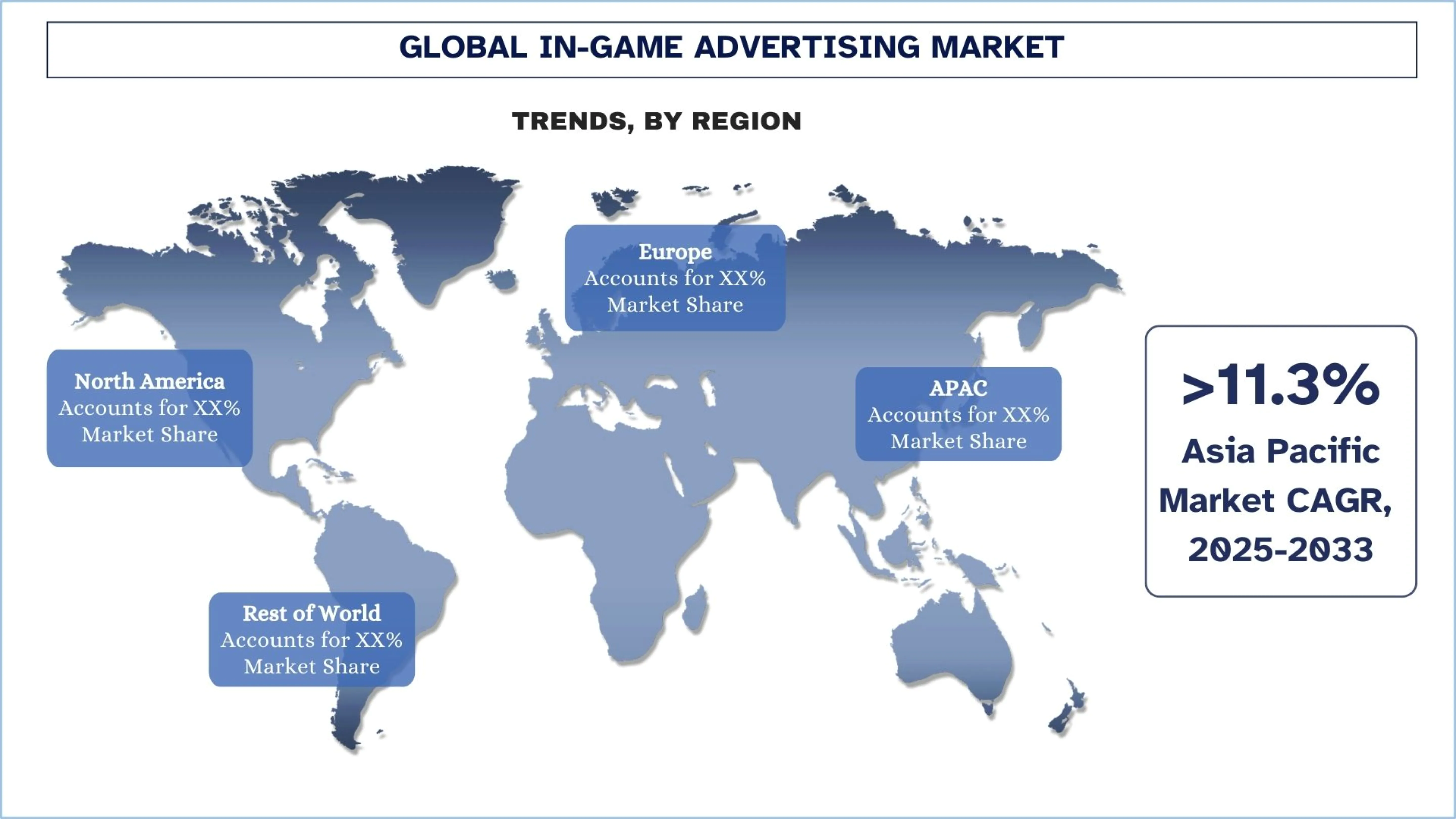
The fastest-growing region in the Global In-Game Advertising Market is Asia-Pacific due to the explosion in the growth of the gaming industry and rising smartphone usage. The area also has a large number of young gamers, especially in countries such as China, India, and Southeast Asia, which can sustain higher interest rates. Moreover, an increased internet penetration, the development of mobile games, and a rise in investment in online ads are also boosting the market adoption within the region.
China held a Dominant share of the Asia-Pacific In-Game Advertising Market in 2024
In-game advertising development in China is a significant growth market in Asia-Pacific due to the presence of many gaming users in the country and a high dominance in mobile gaming. The country has high internet penetration, and the entire digital ecosystem can be utilized to effectively incorporate advertisements within games. Moreover, the adoption of in-game advertising solutions is also growing fast due to increased investments in the development of games and the existence of large domestic platforms.
In-Game Advertising Industry Competitive Landscape
The global In-Game Advertising market is competitive, with several global and international market players. The key players are adopting different growth strategies to enhance their market presence, such as partnerships, agreements, collaborations, geographical expansions, and mergers and acquisitions.
Top In-Game Advertising Market Companies
Some of the major players in the market are Anzu Virtual Reality Ltd., Bidstack Limited, Frameplay, RapidFire Inc., Playwire LLC, InMobi, Unity Technologies, Meta, Alphabet Inc., Motive Interactive Inc.
Recent Developments in the In-Game Advertising Market
In June 2024, AppLovin acquired Wurl for USD 430 million to expand its mediation capabilities into connected TV and cloud gaming, aiming to build a unified advertising stack across multiple platforms.
In November 2024, Unity Technologies completed its merger with ironSource, consolidating two major ad monetization players to strengthen their position in the in-game advertising ecosystem.
Global In-Game Advertising Market Report Coverage
Report Attribute | Details |
Base year | 2024 |
Forecast period | 2025-2033 |
Growth momentum | Accelerate at a CAGR of 10.6% |
Market size 2024 | USD 9,066.93 million |
Regional analysis | North America, Europe, APAC, Rest of the World |
Major contributing region | The North America region is expected to dominate the market during the forecast period. |
Key countries covered | U.S., Canada, Germany, U.K., Spain, Italy, France, China, Japan, and India. |
Companies profiled | Anzu Virtual Reality Ltd., Bidstack Limited, Frameplay, RapidFire Inc., Playwire LLC, InMobi, Unity Technologies, Meta, Alphabet Inc., Motive Interactive Inc. |
Report Scope | Market Trends, Drivers, and Restraints; Revenue Estimation and Forecast; Segmentation Analysis; Demand and Supply Side Analysis; Competitive Landscape; Company Profiling |
Segments Covered | By Type, By Device, and By Region/Country |
Reasons to Buy the In-Game Advertising Market Report:
The study includes market sizing and forecasting analysis confirmed by authenticated key industry experts.
The report briefly reviews overall industry performance at a glance.
The report covers an in-depth analysis of prominent industry peers, primarily focusing on key business financials, type portfolios, expansion strategies, and recent developments.
Detailed examination of drivers, restraints, key trends, and opportunities prevailing in the industry.
The study comprehensively covers the market across different segments.
Deep dive regional-level analysis of the industry.
Customization Options:
The global In-Game Advertising market can further be customized as per the requirements or any other market segment. Besides this, UnivDatos understands that you may have your own business needs; hence, feel free to contact us to get a report that completely suits your requirements.
Table of Content
Research Methodology for the Global In-Game Advertising Market Analysis (2023-2033)
We analyzed the historical market, estimated the current market, and forecasted the future market of the global In-Game Advertising market to assess its application in major regions worldwide. We conducted exhaustive secondary research to gather historical market data and estimate the current market size. To validate these insights, we carefully reviewed numerous findings and assumptions. Additionally, we conducted in-depth primary interviews with industry experts across the In-Game Advertising value chain. After validating market figures through these interviews, we used both top-down and bottom-up approaches to forecast the overall market size. We then employed market breakdown and data triangulation methods to estimate and analyze the market size of industry segments and sub-segments.
Market Engineering
We employed the data triangulation technique to finalize the overall market estimation and derive precise statistical numbers for each segment and sub-segment of the global In-Game Advertising market. We split the data into several segments and sub-segments by analyzing various parameters and trends, including type, device, and regions within the global In-Game Advertising market.
The Main Objective of the Global In-Game Advertising Market Study
The study identifies current and future trends in the global In-Game Advertising market, providing strategic insights for investors. It highlights regional market attractiveness, enabling industry participants to tap into untapped markets and gain a first-mover advantage. Other quantitative goals of the studies include:
Market Size Analysis: Assess the current and forecast market size of the global In-Game Advertising market and its segments in terms of value (USD).
In-Game Advertising Market Segmentation: Segments in the study include areas of type, device, and region.
Regulatory Framework & Value Chain Analysis: Examine the regulatory framework, value chain, customer behavior, and competitive landscape of the In-Game Advertising industry.
Regional Analysis: Conduct a detailed regional analysis for key areas such as Asia Pacific, Europe, North America, and the Rest of the World.
Company Profiles & Growth Strategies: Company profiles of the In-Game Advertising market and the growth strategies adopted by the market players to sustain the fast-growing market.
Frequently Asked Questions FAQs
Q1: What is the global In-Game Advertising market’s current market size and growth potential?
The global In-Game Advertising market was valued at USD 9,066.93 million in 2024 and is expected to grow at a CAGR of around 10.6% during the forecast period (2025–2033). This growth is driven by the rising popularity of digital gaming across mobile, PC, and console platforms, as well as increasing brand investments in immersive and non-intrusive advertising formats.
Q2: Which segment has the largest share of the global In-Game Advertising market by device category?
The mobile/tablet segment holds the largest share in the global In-Game Advertising market, driven by high smartphone penetration and a massive global user base. Additionally, formats such as static ads and rewarded video ads are widely adopted due to their seamless integration and higher engagement rates.
Q3: What are the driving factors for the growth of the global In-Game Advertising market?
Major growth drivers include:
• Rapid growth of the global gaming audience across platforms
• Increasing adoption of non-intrusive and immersive ad formats
• Rising brand investments targeting younger, digitally native consumers
• Expansion of exports and online multiplayer gaming ecosystems
Q4: What are the emerging technologies and trends in the global In-Game Advertising market?
Key trends shaping the market include:
• Growing adoption of intrinsic (native) in-game advertising
• Rise of programmatic and AI-driven ad targeting
• Integration of AR/VR for immersive ad experiences
• Increased use of real-time and dynamic ad placements
Q5: What are the key challenges in the global In-Game Advertising market?
Major challenges include:
• Balancing ad integration without disrupting user experience
• Ad fraud and measurement complexities
• Limited standardization across gaming platforms
• Data privacy and user targeting regulations
Q6: Which region dominates the global In-Game Advertising market?
North America dominates the market due to its advanced gaming ecosystem, high digital ad spending, and strong presence of major gaming and advertising platforms. The region also leads to early adoption of innovative ad formats and programmatic advertising technologies.
Q7: Who are the key competitors in the global In-Game Advertising market?
Top players in the In-Game Advertising industry include:
• Anzu Virtual Reality Ltd.
• Bidstack Limited
• Frameplay
• RapidFire Inc.
• Playwire LLC
• InMobi
• Unity Technologies
• Meta
• Alphabet Inc.
• Motive Interactive Inc.
Q8: How are companies monetizing games through in-game advertising?
Companies are leveraging in-game advertising as a key monetization strategy by integrating formats such as rewarded video ads, intrinsic ads, and dynamic placements. These approaches enable developers to generate revenue while maintaining user engagement, making it a scalable and sustainable business model.
Q9: What investment opportunities exist in the global In-Game Advertising market?
The market presents strong investment opportunities in areas such as programmatic ad platforms, AI-driven targeting technologies, and immersive ad formats within AR/VR environments. Growing partnerships between game developers and ad tech firms are further creating avenues for strategic investments and long-term returns.
Related Reports
Customers who bought this item also bought





In-Game Advertising Market: Current Analysis and Forecast (2025-2033)
Emphasis on Type (Static Ads, Dynamic Ads, and Advergaming); Device (Mobile/Tablet and PC/Laptop); and Region/Country

Middle East & Africa Digital Out-of-Home (DOOH) Advertising Market: Current Analysis and Forecast (2025-2033)
Emphasis By Type ((Billboards/LED Screens, Street Furniture (ATM Kiosks, Pedestrian panels, Mall Ad Panels) and Transit)), by End User (Retail, Real Estate, Financial Services, Government, Automotive, and Others), By Country (Saudi Arabia, UAE, Egypt, South Africa, Turkey, Israel, and the Rest of Middle East & Africa)

Southeast Asia Cloud Gaming Market: Current Analysis and Forecast (2025-2033)
Emphasis on Device Type (Smartphones, Tablets, Gaming Consoles, PCs & Laptops, Smart TVs, Head-Mounted Displays, Others); Offering (Infrastructure, Gaming Platform Services); Solution Type (Video Streaming, File Streaming); and Country.

Manga Market: Current Analysis and Forecast (2025-2033)
Emphasis on Type (Printed and Digital); Genre (Action and Adventure, Sci-Fi and Fantasy, Sports, Romance and Drama, and Others); Audience (Children and Kids, Teenagers, and Adults); Gender (Male and Female); Distribution Channel (Online and Offline); and Region/Country