Middle East & Africa Rough Terrain Crane Market: Current Analysis and Forecast (2025-2033)
Emphasis By Payload Capacity (Up to 25 Tons, 26-74 Tons, 75-100 Tons, and Above 100 Tons), by Application (Construction, Utility, and Others), By Country (Saudi Arabia, UAE, Egypt, South Africa, Turkey, Israel, and the Rest of Middle East & Africa)
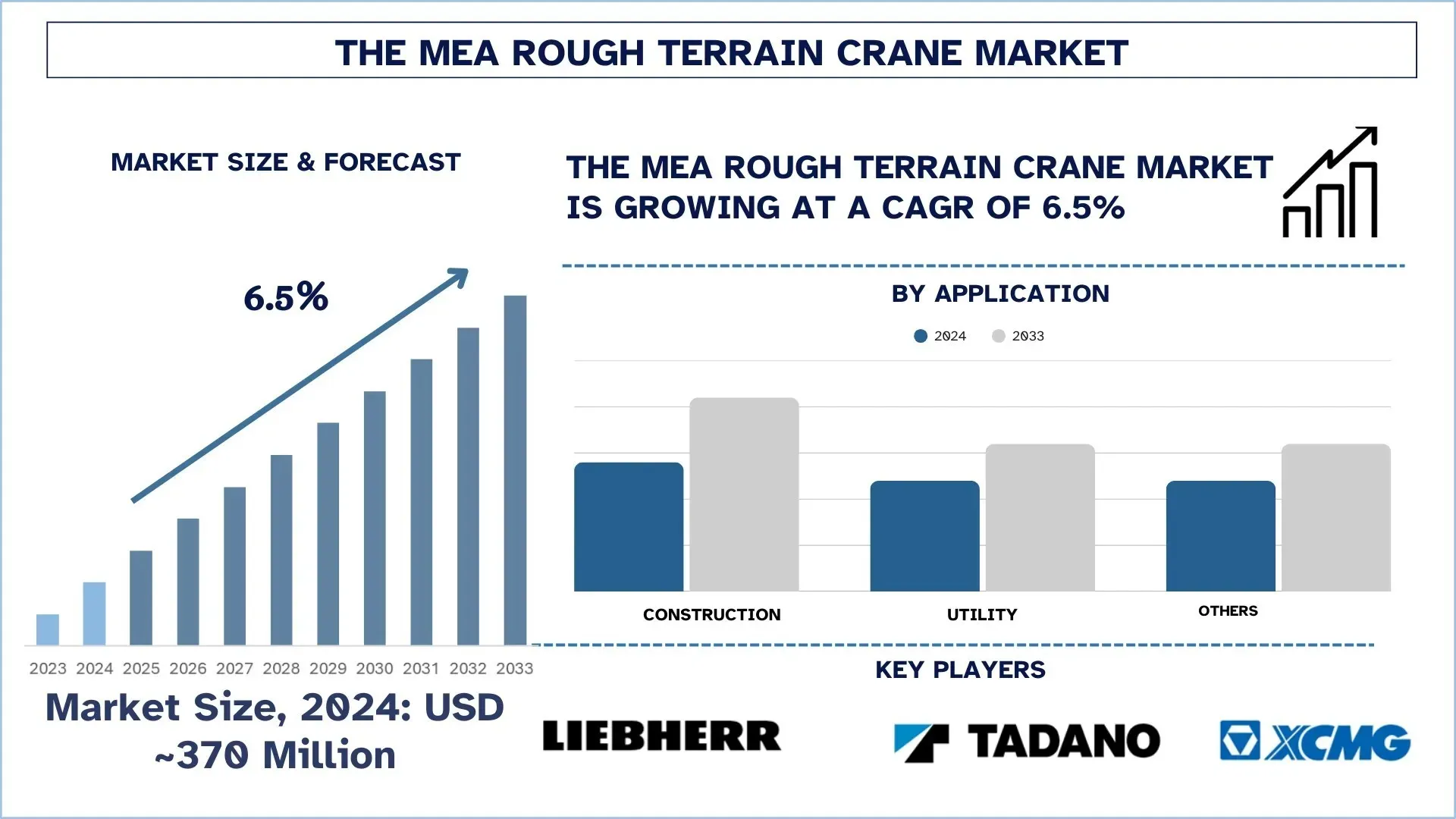
Middle East & Africa Rough Terrain Crane Market Size & Forecast
The Middle East & Africa Rough Terrain Crane Market was valued at USD 370 million in 2024 and is expected to grow at a strong CAGR of around 6.50% during the forecast period (2025- 2033F). Infrastructure and Construction Growth, and Oil & Gas Sector Investments are some of the key factors that have supported the need for the rough terrain crane market in the Middle East & Africa.
Middle East & Africa Rough Terrain Crane Market Analysis
The market of the Rough Terrain Crane in the Middle East and Africa is also experiencing gradual growth due to the continuous development of infrastructure, construction of industries, and activity in the energy sector throughout the region. Huge construction projects like highways, bridges, metro rail, airports, ports, and logistics centers provide a steady demand for lifting solutions that would be capable of working effectively even on rough and unprepared work sites. Rough terrain cranes are gaining popularity because they are mobile, have a high load-carrying capacity, and can operate in remote sites with minimal site preparation. Besides that, oil and gas maintenance, power generation projects, and utility installations are also increasing in demand, especially in GCC countries and new African economies. The growth of crane rental networks also helps the market; the contractor is able to acquire modern equipment without having to invest heavily in it.
Middle East & Africa Rough Terrain Crane Market Trends
This section discusses the key market trends that are influencing the various segments of the Middle East & Africa Rough Terrain Crane market, as found by our team of research experts.
Fleet Modernization and Telemetry:
As contractors and rental businesses work on the enhancement of the utilization, safety, and cost management in the rough terrain crane market of the Middle East and Africa, fleet modernization and telemetry are significant trends. To curb the rising costs of its operations, buyers are steadily upgrading older cranes to newer models, which have greater fuel efficiency, better load management, and increased operator comfort, which reduces the operating costs incurred in a long-term project. Meanwhile, telemetry solutions are being embraced to monitor the crane position, working hours, non-working time, fuel usage, and maintenance timetables in real-time. This allows predictive maintenance, minimizes the occurrence of unexpected failures, and prolongs equipment life, which is particularly important in remote locations of employment where the process of repairing is slow and costly. Telemetry facilitates compliance and safety as it helps to track cases of overload and driver activity. Connected fleets are also emerging as a competitive edge in MEA, as the process of digitalization gains momentum.
Key Market Segmentation.
This section provides an analysis of the key trends in each segment of the Middle East & Africa Rough Terrain Crane market report, along with forecasts at the country and regional levels for 2025-2033.
The 26-74 Tons category has shown promising growth in the Rough Terrain Crane Market.
The MEA Rough Terrain Crane market is further divided into Up to 25 Tons, 26-74 Tons, 75-100 Tons, and Above 100 Tons as per Payload Capacity. Among them, the largest market share has belonged to the 26-74 Tons category. The main reasons that would contribute to the increased market share include that it has a good balance between lifting and mobility, hence it can be employed in a diverse market of mid-sized infrastructure works, industrial construction, utility installations, and oil and gas maintenance. These cranes have also been noted to be more convenient to move between locations, less complicated to set up than larger classes, and affordable to hire by contractors and rental fleets. Furthermore, the segment is favored by the rental companies because of the increased utilization rates, quicker turnaround implemented in the projects, and high demand among general contractors. The segment also has improved fuel efficiency, reduced operating costs, and broader parts and service support in MEA.
The Construction category held a significant share of the Middle East & Africa Rough Terrain Crane Market.
According to the application, the Middle East and Africa market of Rough Terrain Cranes is divided into the following: construction, utility, and others. Among them, the construction sector has been the most dominant market share because of the massive construction of infrastructure, high commercial projects, and continuous investments in transport and energy infrastructure within the region. In other nations like Saudi Arabia and the United Arab Emirates, the government is investing heavily in smart cities, industrial zones, metro networks, and expansion projects in oil and gas. These sites have a great demand for rough terrain cranes due to the fact that they perform excellently in dissimilar and sandy grounds, which are prevalent within the region. They are also suitable in the construction sector because their mobility, high lifting capacity, and simple setup make them suitable for fast-paced construction activities, and this makes their dominance even stronger in the application segment.
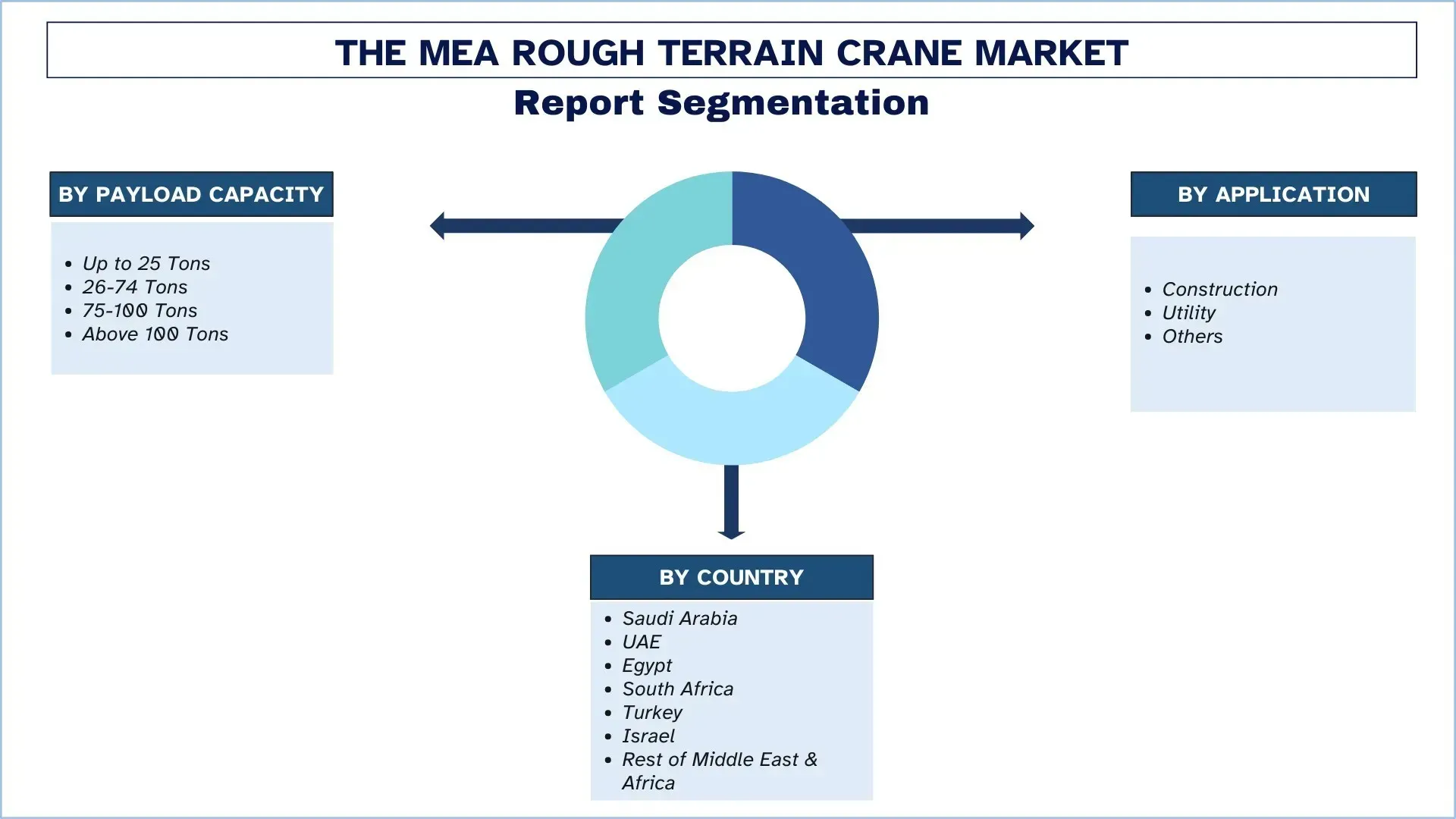
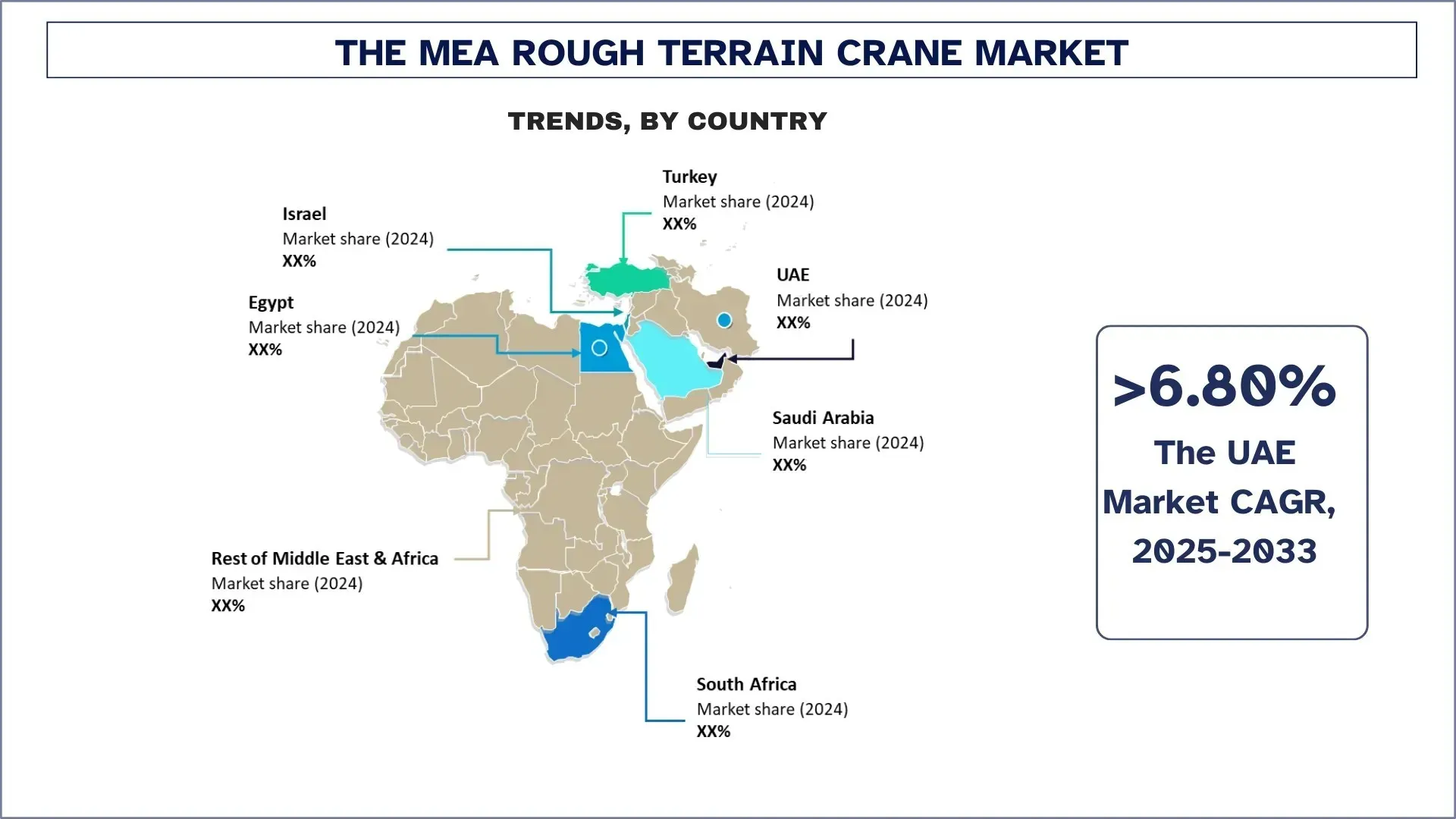
The UAE is expected to grow at a considerable rate during the forecast period.
The UAE Rough Terrain Crane market can be considered the fastest-growing market in the Middle East and Africa today due to intensive infrastructure investments, high urbanization, and the growth of the energy and industry sectors. Transport network, commercial real estate, logistics hubs, and tourism-related construction strategic projects have led to high demand for flexible lifting solutions that can perform on uneven grounds and in harsh climates. Modern cranes with a high level of safety systems, fuel efficiency, and telematics are being adopted in the market as the contractors shift their attention to priorities of productivity and optimization of the lifecycle costs. Rental and leasing systems also contribute to the expansion of the market as they provide the opportunity to access new equipment without the need to invest much capital. The UAE is one of the major development centers in the use of rough terrain cranes due to constant investment in mega-projects and well-developed service infrastructure.
Middle East & Africa Rough Terrain Crane Industry Competitive Landscape:
The Middle East & Africa Rough Terrain Crane market is competitive, with several global and international market players. The key players are adopting different growth strategies to enhance their market presence, such as partnerships, agreements, collaborations, new product launches, geographical expansions, and mergers and acquisitions.
Top Middle East & Africa Rough Terrain Crane Companies
Some of the major players in the market are Liebherr Group, Terex Corporation, Tadano Ltd., Zoomlion Heavy Industry Science & Technology Co., Ltd., Xuzhou Construction Machinery Group (XCMG), SANY Group, The Manitowoc Company, Inc., PALFINGER AG, Manitou, and KATO WORKS CO., LTD.
Middle East & Africa Rough Terrain Crane Market Report Coverage
Details | |
Base year | 2024 |
Forecast period | 2025-2033 |
Growth momentum | Accelerate at a CAGR of 6.50% |
Market size 2024 | USD 370 Million |
Country analysis | Saudi Arabia, UAE, Egypt, South Africa, Turkey, Israel, and the Rest of the Middle East & Africa |
Major contributing Country | Saudi Arabia is expected to dominate the market during the forecast period. |
Companies profiled | Liebherr Group, Terex Corporation, Tadano Ltd., Zoomlion Heavy Industry Science & Technology Co., Ltd., Xuzhou Construction Machinery Group (XCMG), SANY Group, The Manitowoc Company, Inc., PALFINGER AG, Manitou, and KATO WORKS CO., LTD. |
Report Scope | Market Trends, Drivers, and Restraints; Revenue Estimation and Forecast; Segmentation Analysis; Demand and Supply Side Analysis; Competitive Landscape; Company Profiling |
Segments Covered | by Payload Capacity, by Application, by Country |
Reasons to Buy the Middle East & Africa Rough Terrain Crane Market Report:
The study includes market sizing and forecasting analysis confirmed by authenticated key industry experts.
The report briefly reviews overall industry performance at a glance.
The report covers an in-depth analysis of prominent industry peers, primarily focusing on key business financials, type portfolios, expansion strategies, and recent developments.
Detailed examination of drivers, restraints, key trends, and opportunities prevailing in the industry.
The study comprehensively covers the market across different segments.
Deep dive Country-level analysis of the industry.
Customization Options:
The Middle East & Africa Rough Terrain Crane Market can be customized as per requirements or any other market segment. Besides this, UnivDatos understands that you may have your own business needs; hence, feel free to contact us to get a report that completely suits your requirements.
Table of Content
Research Methodology for the Middle East & Africa Rough Terrain Crane Market Analysis (2023-2033)
We analyzed the historical market, estimated the current market, and forecasted the future market of the Middle East & Africa Rough Terrain Crane market to assess its application in major countries. We conducted exhaustive secondary research to gather historical market data and estimate the current market size. To validate these insights, we carefully reviewed numerous findings and assumptions. Additionally, we conducted in-depth primary interviews with industry experts across the Rough Terrain Crane value chain. After validating market figures through these interviews, we used both top-down and bottom-up approaches to forecast the overall market size. We then employed market breakdown and data triangulation methods to estimate and analyze the market size of industry segments and sub-segments.
Market Engineering
We employed data triangulation techniques to finalize the overall market estimation and derive precise statistical numbers for each segment and sub-segment of the Middle East & Africa Rough Terrain Crane market. We split the data into several segments and sub-segments by analyzing various parameters and trends, by Payload Capacity, by Application, and by country within the Middle East & Africa Rough Terrain Crane market.
The Main Objective of the Middle East & Africa Rough Terrain Crane Market Study
The study identifies current and future trends in the Middle East & African Rough Terrain Crane market, providing strategic insights for investors. It highlights Country-level market attractiveness, enabling industry participants to tap into untapped markets and gain a first-mover advantage. Other quantitative goals of the studies include:
Market Size Analysis: Assess the current forecast and market size of the Middle East & Africa Rough Terrain Crane market and its segments in terms of value (USD).
Middle East & Africa Rough Terrain Crane Market Segmentation: Segments in the study include areas by Payload Capacity, by Application, and by
Regulatory Framework & Value Chain Analysis: Examine the regulatory framework, value chain, customer behavior, and competitive landscape of the Middle East & Africa Rough Terrain Crane industry.
Country Analysis: Conduct a detailed Country analysis for key areas such as Saudi Arabia, UAE, Egypt, South Africa, Turkey, Israel, and the Rest of the Middle East & Africa.
Company Profiles & Growth Strategies: Company profiles of the Middle East & Africa Rough Terrain Crane market and the growth strategies adopted by the market players to sustain the fast-growing market.
Frequently Asked Questions FAQs
Q1: What is the Middle East & Africa Rough Terrain Crane market’s current market size and growth potential?
The Middle East & Africa Rough Terrain Crane market was valued at USD 370 million in 2024 and is expected to grow at a CAGR of 6.50% during the forecast period (2025-2033).
Q2: Which segment has the largest share of the Middle East & Africa Rough Terrain Crane market by Payload Capacity?
The largest market share has belonged to the 26-74 Tons category. The main reasons that would contribute to the increased market share include that it has a good balance between lifting and mobility, hence it can be employed in a diverse market of mid-sized infrastructure works, industrial construction, utility installations, and oil and gas maintenance.
Q3: What are the driving factors for the growth of the Middle East & Africa Rough Terrain Crane market?
• Infrastructure and construction growth: Large-scale investments in transport networks, commercial complexes, smart cities, and industrial infrastructure are significantly increasing demand for high mobility lifting equipment across the region.
• Oil and gas sector investments: Expansion of upstream, downstream, and petrochemical projects is driving the need for reliable rough terrain cranes capable of operating in remote and harsh environments.
Q4: What are the emerging technologies and trends in the Middle East & Africa Rough Terrain Crane market?
• Fleet modernization and telemetry integration: Contractors are upgrading to advanced crane models equipped with telematics, real-time monitoring, predictive maintenance systems, and enhanced safety technologies.
• Rental and leasing growth: Increasing preference for asset-light models is encouraging rental adoption, allowing contractors to access modern equipment without heavy upfront investment.
Q5: What are the key challenges in the Middle East & Africa Rough Terrain Crane market?
• High initial costs: Rough terrain cranes require significant capital investment, which can limit direct purchases by small and mid-sized contractors and increase reliance on rental models. Additionally, costs related to transportation, maintenance, spare parts, and compliance with safety standards further elevate total ownership expenses.
• Skilled operator shortage: The shortage of trained and certified crane operators in several MEA countries affects operational efficiency and project timelines.
Q6: Which country dominates the Middle East & Africa Rough Terrain Crane market?
The market of Saudi Arabia's Rough Terrain Crane is on a steady and increasing trend with a robust investment in infrastructure, industrialization, and high-scale urbanization. The long-term demand for high-mobility lifting equipment is generated by mega projects associated with Vision 2030, such as smart cities, transport systems, airports, and construction related to the tourism industry.
Q7: Who are the key players in the Middle East & Africa Rough Terrain Crane market?
Some of the top Rough Terrain Crane companies in the Middle East & Africa include:
• Liebherr Group
• Terex Corporation
• Tadano Ltd.
• Zoomlion Heavy Industry Science & Technology Co., Ltd.
• Xuzhou Construction Machinery Group (XCMG)
• SANY Group
• The Manitowoc Company, Inc.
• PALFINGER AG
• Manitou
• KATO WORKS CO., LTD
Q8: What are the opportunities for companies within the Middle East & Africa Rough Terrain Crane market?
• Renewable energy projects: Expansion of solar and wind installations is creating new lifting requirements for turbine erection and plant construction.
• Local after-sales and service expansion: Strengthening regional service networks and spare parts availability is improving over time and enhancing long-term market penetration.
Q9: How are consumer preferences shaping product development in the Middle East & Africa Rough Terrain Crane market?
Consumer preferences in the Middle East and Africa Rough Terrain Crane market are driving demand for fuel-efficient, high-capacity, and technologically advanced models. Buyers increasingly prioritize safety systems, telematics integration, operator comfort, and low maintenance costs, influencing manufacturers to develop smarter, durable, and cost-optimized lifting solutions.
Related Reports
Customers who bought this item also bought




Middle East & Africa Rough Terrain Crane Market: Current Analysis and Forecast (2025-2033)
Emphasis By Payload Capacity (Up to 25 Tons, 26-74 Tons, 75-100 Tons, and Above 100 Tons), by Application (Construction, Utility, and Others), By Country (Saudi Arabia, UAE, Egypt, South Africa, Turkey, Israel, and the Rest of Middle East & Africa)

Smart Industrial Fence System Market: Current Analysis and Forecast (2025-2033)
Emphasis on Type (Chain Link Fences, Electric Fences, Privacy Fences, Automatic Gates, Barbed Wire Fences, and Others); Technology (IoT, AI, RFID, and Others); Application (Perimeter Security, Access Control, Intrusion Detection, and Others); End-User (Automotive, Manufacturing, Transportation, Government, Construction, and Others); and Region/Country

Southeast Asia Sorting and Grading Machines Market: Current Analysis and Forecast (2025-2033)
Emphasis on Machine Type (Optical Sorting, Weight-Based Grading, Size-Based Grading, and Others); Technology (Camera/Vision-Based Systems, AI and Machine Learning, Sensor-Based Systems, and Others); End-Use Industry (Agriculture & Food Processing, Recycling & Waste Management, Mining & Minerals, Pharmaceuticals, and Others); Sales Channel (Direct Sales and Indirect Sales); and Country.

Zero Turn Mower Market: Current Analysis and Forecast (2025-2033)
Emphasis on Propulsion (Gasoline and Electric); Cutting Width (Less than 50 inches, 50 to 60 inches, and More than 60 inches); Application (Residential and Commercial); and Region/Country