Southeast Asia Compressed Natural Gas Dispenser Market: Current Analysis and Forecast (2025-2033)
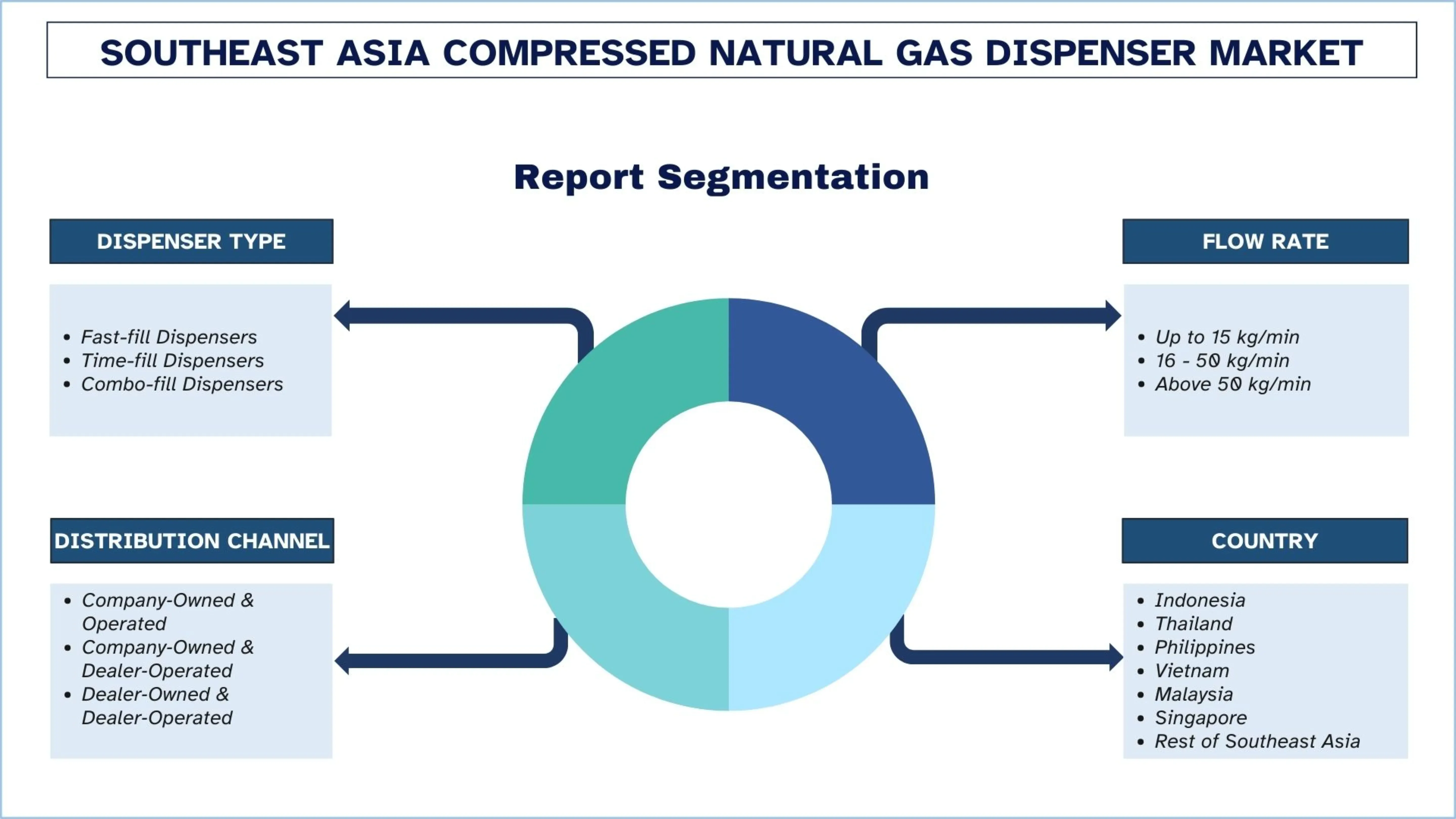
Emphasis on Dispenser Type (Fast-fill Dispensers, Time-fill Dispensers, Combo-fill Dispensers); Flow Rate (Up to 15 kg/min, 16 - 50 kg/min, Above 50 kg/min); Distribution Channel (Company-Owned & Operated, Company-Owned & Dealer-Operated, Dealer-Owned & Dealer-Operated); and Country.
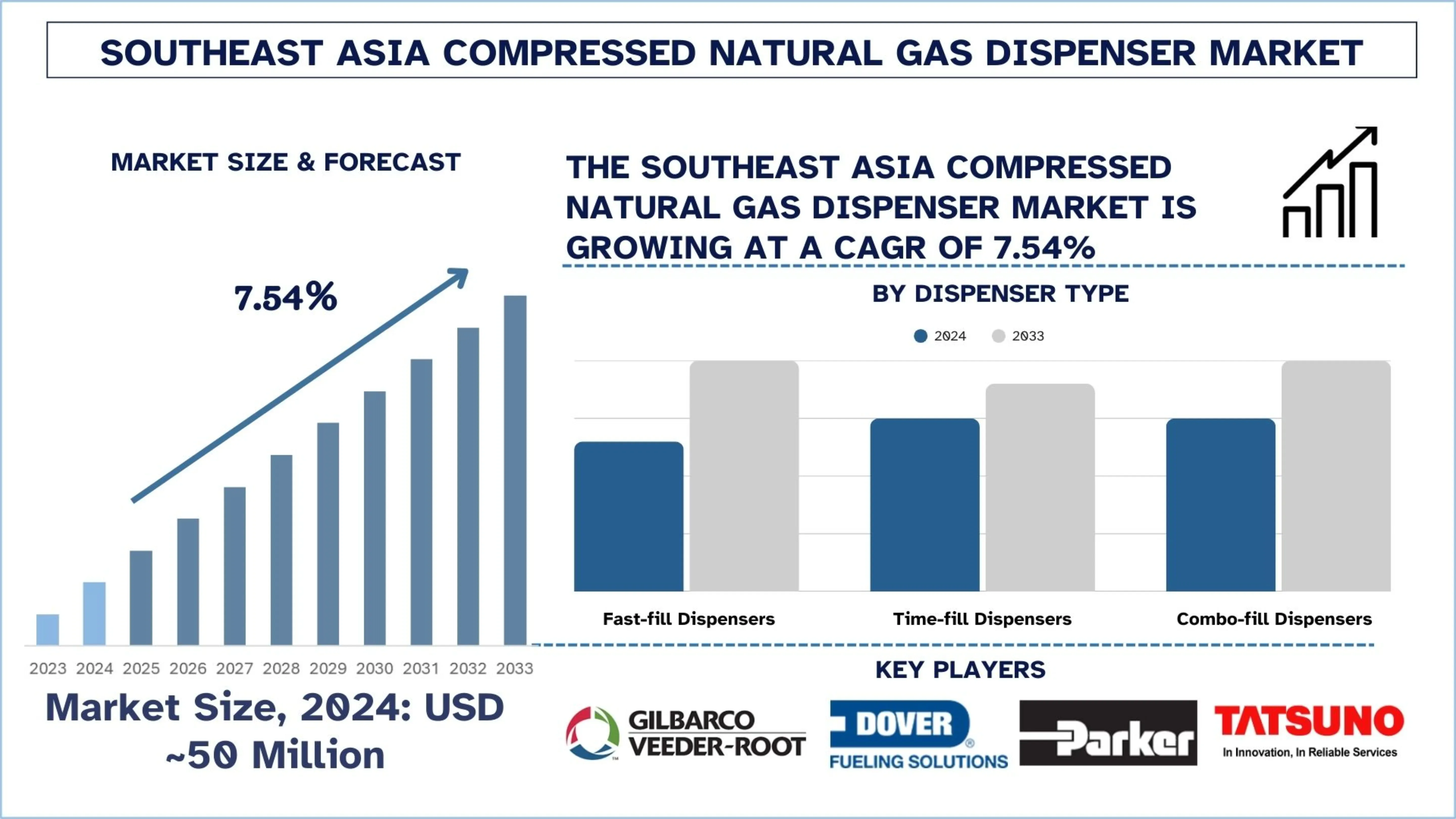
Southeast Asia Compressed Natural Gas Dispenser Market Size & Forecast
The Southeast Asia Compressed Natural Gas Dispenser Market was valued at ~USD 50 million in 2024 and is expected to grow at a strong CAGR of approximately 7.54% during the forecast period (2025-2033F), driven by the expansion of gas distribution infrastructure.
Southeast Asia Compressed Natural Gas Dispenser Market Analysis
A Compressed Natural Gas dispenser is the fueling device that provides high-pressure CNG from a storage tank to a vehicle and regulates the flow rate, pressure, and safety during filling. It works with integrated meters, hoses, and valves that provide proper and effective refueling.
In Southeast Asia, operators are driving towards high-flow dispensers, enhanced metering precision, enhanced safety integration, and hybrid fast-fill/time-fill configurations to accommodate an increasing number of fleets. Additionally, digital monitoring platforms, dispenser automation, and remote diagnostics are being implemented to minimize downtime and streamline station operations. The shift towards modular, mobile dispenser units to serve all areas without pipeline connections, as well as the incorporation of advanced valves, temperature compensation, and real-time flow optimization, is driving the market. Therefore, the implementations can assist operators in scaling capacity, reducing operating costs, and enhancing refueling efficiency as the use of CNG grows rapidly.
Southeast Asia Compressed Natural Gas Dispenser Market Trends
This section discusses the key market trends that are influencing the various segments of the Southeast Asia Compressed Natural Gas Dispenser market, as found by our team of research experts.
Increased Deployment of Multi-Hose Dispensers
The Southeast Asian stations are rapidly converting to multi-hose dispensers to accommodate increasing vehicle traffic and reduce waiting time, especially during rush hours. Also, the systems enable simultaneous fueling, enhancing station throughput, and supporting the growing taxi, bus, and logistics fleets. With infrastructure upgrades, multi-hose units are increasingly becoming a favorite option for achieving maximum efficiency while reducing land footprint. Moreover, the compatibility with mixed-use private and public CNG stations is also effective because it serves a wide variety of vehicles.
Southeast Asia Compressed Natural Gas Dispenser Industry Segmentation
This section provides an analysis of the key trends in each segment of the Southeast Asia Compressed Natural Gas Dispenser market, along with forecasts at the country level for 2025-2033.
The fast-fill dispensers market held the dominant share of the Compressed Natural Gas Dispenser market in 2024.
Based on dispenser type, the market is segmented into fast-fill dispensers, time-fill dispensers, and combo-fill dispensers. Among these, the fast-fill dispensers market held the dominant share of the compressed natural gas dispenser market in 2024. This is mainly due to high-throughput public stations, taxi fleets, and commercial logistics operations that cannot afford to wait. As cities demand cleaner transport, there is increased demand for high-speed refueling services without slowing operations. This makes fast-fill units the flagship technology for new CNG station rollouts in Southeast Asia.
The above 50 kg/min segment is expected to grow at a significant CAGR during the forecast period (2025-2033).
Based on flow rate, the Southeast Asian compressed natural gas dispenser market is segmented into up to 15 kg/min, 16 - 50 kg/min, and above 50 kg/min. Among these, the above 50 kg/min segment is expected to grow at a significant CAGR during the forecast period (2025-2033). The increasing trend toward buses, trucks, and heavy-duty fleets that demand faster, higher fill-ups. They are required to scale urban transit and freight systems to support their operations, even in continuous fleets, by reducing turnaround times. This segment is expanding rapidly because fleet electrification in most markets is slow, making high-flow CNG a viable transition measure.
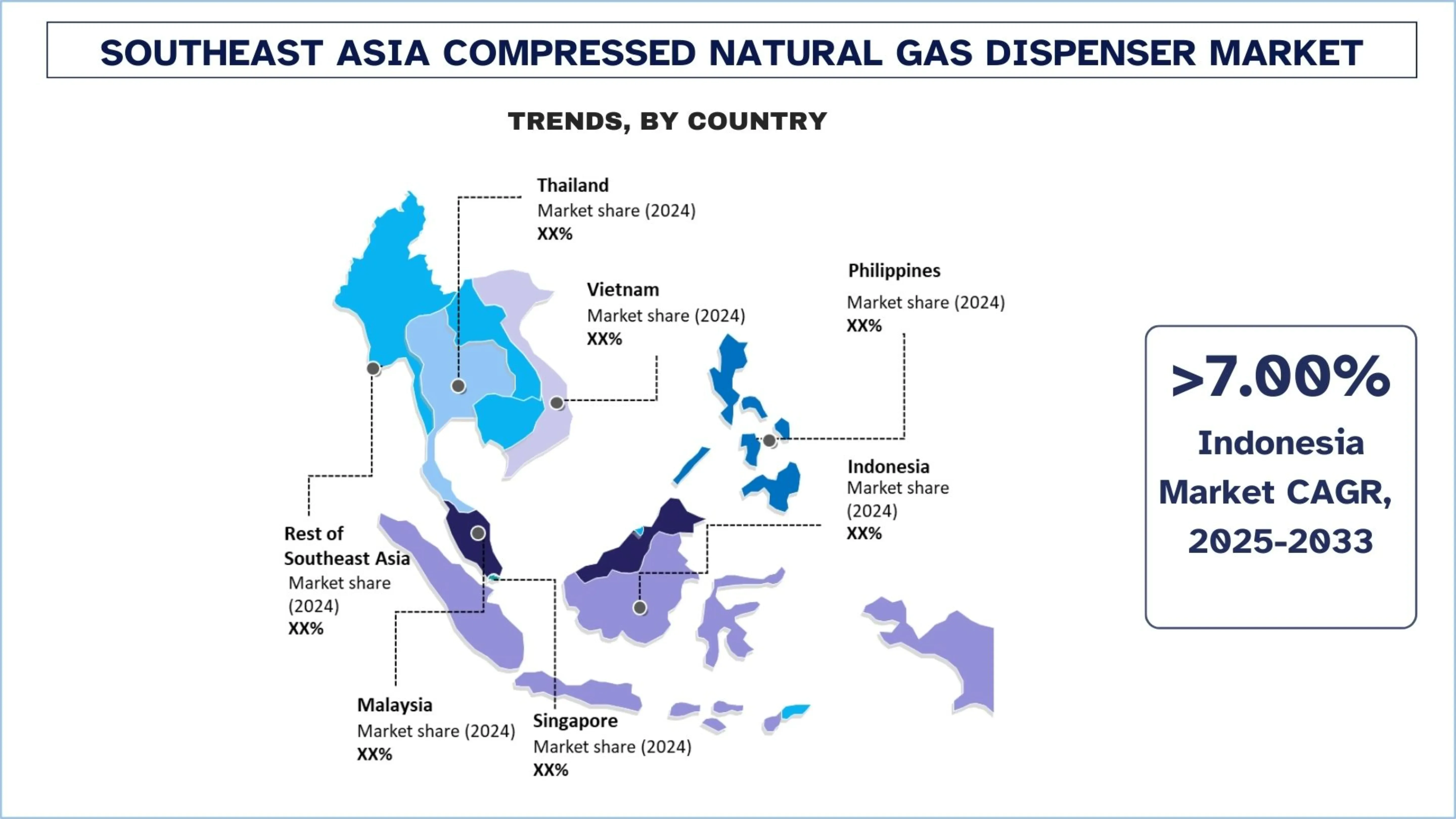
Indonesia held a dominant share of the Southeast Asian Compressed Natural Gas Dispenser market in 2024
The CNG dispensers market in Southeast Asia is dominated by Indonesia, with a massive number of vehicles, and the government is supporting the use of gas to facilitate mobility. Additionally, urban areas are developing CNG routes to reduce diesel use in cabs, buses, and other commercial vehicles. Moreover, new policies encouraging cleaner transport and infrastructure improvements put the deployment of the dispenser at the top of the agenda in the archipelago. Also, industrial and logistics operators are migrating to CNG to control fuel costs, which is driving consistent demand for high-capacity systems. With the expansion of national programs, Indonesia is key to long-term regional implementation and market growth.
On July 28, 2025, PT Citra Nusantara Gemilang Tbk (CGAS), a national integrated energy company, through its subsidiary PT Citra Nusantara Energi, officially inaugurated its Compressed Natural Gas (CNG) Station in Gresik, East Java. The event marks CGAS’s continued commitment to expanding clean energy distribution and supporting industrial and economic development in the eastern region of Java.
Southeast Asia Compressed Natural Gas Dispenser Industry Competitive Landscape
The Southeast Asia Compressed Natural Gas Dispenser market is competitive, with several global and international market players. The key players are adopting different growth strategies to enhance their market presence, such as partnerships, agreements, collaborations, new product launches, geographical expansions, and mergers and acquisitions.
Top Southeast Asia Compressed Natural Gas Dispenser Companies
Some of the major players in the market are Gilbarco Inc., Dover Fueling Solutions, Parker Hannifin Corp, TATSUNO Corporation, FTI Group Ltd, WEH GmbH Verbindungstechnik, China Hongyang, and others.
Recent Developments in the Southeast Asia Compressed Natural Gas Dispenser Market
On September 23, 2024, the State Government of Ho Chi Minh City announced plans to expand its compressed natural gas (CNG) infrastructure by building new CNG filling stations at bus terminals in District 8, Nga Tu Ga, and the new Mien Dong Bus Station in Vietnam. Currently, the city operates three CNG stations and serves 510 CNG buses on 18 subsidized routes. With 138 bus routes in total, 546 vehicles already run on clean fuel, while the rest use diesel. The Department of Transport aims to increase the use of CNG-powered vehicles, enhancing public transport and reducing emissions
Southeast Asia Compressed Natural Gas Dispenser Market Report Coverage
Report Attribute | Details |
Base year | 2024 |
Forecast period | 2025-2033 |
Growth momentum | Accelerate at a CAGR of 7.54% |
Market size 2024 | |
Country analysis | Indonesia, Thailand, Philippines, Vietnam, Malaysia, Singapore, Rest of Southeast Asia |
Major contributing Country | Vietnam is expected to grow at the highest CAGR during the forecasted period. |
Companies profiled | Gilbarco Inc., Dover Fueling Solutions, Parker Hannifin Corp, TATSUNO Corporation, FTI Group Ltd, WEH GmbH Verbindungstechnik, China Hongyang, and others |
Report Scope | Market Trends, Drivers, and Restraints; Revenue Estimation and Forecast; Segmentation Analysis; Demand and Supply Side Analysis; Competitive Landscape; Company Profiling |
Segments Covered | By Dispenser Type, By Flow Rate, By Distribution Channel, By Country |
Reasons to Buy the Southeast Asia Compressed Natural Gas Dispenser Market Report:
The study includes market sizing and forecasting analysis confirmed by authenticated key industry experts.
The report briefly reviews overall industry performance at a glance.
The report covers an in-depth analysis of prominent industry peers, primarily focusing on key business financials, product portfolios, expansion strategies, and recent developments.
Detailed examination of drivers, restraints, key trends, and opportunities prevailing in the industry.
The study comprehensively covers the market across different segments.
Customization Options:
The Southeast Asia Compressed Natural Gas Dispenser Market can further be customized as per requirements or any other market segment. Besides this, UnivDatos understands that you may have your own business needs; hence, feel free to contact us to get a report that completely suits your requirements.
Table of Content
Research Methodology for the Southeast Asia Compressed Natural Gas Dispenser Market Analysis (2023-2033)
We analyzed the historical market, estimated the current market, and forecasted the future market of the Southeast Asian Compressed Natural Gas Dispenser market to assess its application in major countries. We conducted exhaustive secondary research to gather historical market data and estimate the current market size. To validate these insights, we carefully reviewed numerous findings and assumptions. Additionally, we conducted in-depth primary interviews with industry experts across the Southeast Asia Compressed Natural Gas Dispenser value chain. After validating market figures through these interviews, we used both top-down and bottom-up approaches to forecast the overall market size. We then employed market breakdown and data triangulation methods to estimate and analyze the market size of industry segments and sub-segments.
Market Engineering
We employed the data triangulation technique to finalize the overall market estimation and derive precise statistical numbers for each segment and sub-segment of the Southeast Asia Compressed Natural Gas Dispenser market. We split the data into several segments and sub-segments by analyzing various parameters and trends, including dispenser type, flow rate, distribution channel, and country within the Southeast Asian Compressed Natural Gas Dispenser market.
The Main Objective of the Southeast Asia Compressed Natural Gas Dispenser Market Study
The study identifies current and future trends in the Southeast Asia Compressed Natural Gas Dispenser market, providing strategic insights for investors. It highlights market attractiveness, enabling industry participants to tap into untapped markets and gain a first-mover advantage. Other quantitative goals of the studies include:
Market Size Analysis: Assess the current and forecast market size of the Southeast Asia Compressed Natural Gas Dispenser market and its segments in terms of value (USD).
Southeast Asia Compressed Natural Gas Dispenser Market Segmentation: Segments in the study include dispenser type, flow rate, distribution channel, and country.
Regulatory Framework & Value Chain Analysis: Examine the regulatory framework, value chain, customer behavior, and competitive landscape of the Southeast Asia Compressed Natural Gas Dispenser industry.
Country Analysis: Conduct a detailed country analysis for key areas such as Indonesia, Thailand, the Philippines, Vietnam, Malaysia, Singapore, and the Rest of Southeast Asia.
Company Profiles & Growth Strategies: Company profiles of the Southeast Asia Compressed Natural Gas Dispenser market and the growth strategies adopted by the market players to sustain in the fast-growing market.
Frequently Asked Questions FAQs
Q1: What is the Southeast Asia Compressed Natural Gas Dispenser market’s current market size and growth potential?
The Southeast Asia Compressed Natural Gas Dispenser market was valued at ~USD 50 million in 2024 and is projected to expand at a CAGR of 7.54% from 2025 to 2033. The expansion is supported by rising fleet conversions, growing clean-mobility adoption, and increasing investments in CNG infrastructure across major Southeast Asian economies.
Q2: Which segment has the largest share of the Southeast Asia Compressed Natural Gas Dispenser market by Dispenser Type?
Fast-fill dispensers hold the largest market share due to their ability to meet high-throughput demand from taxis, buses, logistics fleets, and public fueling stations. Their shorter refueling time makes them the preferred choice as urban mobility scaling continues.
Q3: What are the driving factors for the growth of the Southeast Asia Compressed Natural Gas Dispenser market?
The market is driven by rising fuel-cost savings from CNG adoption, supportive government policies for clean mobility, expanding pipeline and daughter-station networks, and growing demand from commercial fleets. Increasing investment in fast-fill and high-flow dispensing systems further accelerates uptake.
Q4: What are the emerging technologies and trends in the Southeast Asia Compressed Natural Gas Dispenser market?
Key trends include the shift toward high-flow dispensers (>50 kg/min), increased deployment of multi-hose systems, integration of digital monitoring and remote diagnostics, modular and mobile fueling solutions, and the adoption of hybrid fast-fill/time-fill station models.
Q5: What are the key challenges in the Southeast Asia Compressed Natural Gas Dispenser market?
The market faces challenges such as uneven gas distribution infrastructure across countries, high upfront station development costs, varying regulatory frameworks, competition from fast-growing EV ecosystems, and limited availability of skilled technicians for CNG dispenser maintenance.
Q6: Which country dominates the Southeast Asia Compressed Natural Gas Dispenser market?
Indonesia leads the regional market due to strong government support, a large public transport base, rapid fleet conversions, and ongoing expansion of national CNG corridors in major cities like Jakarta and Surabaya.
Q7: Who are the key players in the Southeast Asia Compressed Natural Gas Dispenser market?
Leading companies in the Southeast Asia Compressed Natural Gas Dispenser market include:
• Gilbarco Inc.
• Dover Fueling Solutions
• Parker Hannifin Corp
• TATSUNO Corporation
• FTI Group Ltd
• WEH GmbH Verbindungstechnik
• China Hongyang
• Others
Q8: How is the shift toward cleaner energy impacting CNG dispenser adoption in Southeast Asia?
The region’s clean-energy transition is encouraging businesses and governments to move toward low-emission transport solutions. This shift boosts investment in CNG stations, increases demand for high-throughput dispensers, and accelerates adoption across logistics, transit, and fleet operations.
Q9: What investment opportunities exist in the Southeast Asia CNG Dispenser market?
Opportunities include station development in secondary cities, deployment of modular and mobile fueling units, technological upgrades such as smart metering, and expansion into industrial and mining fleets transitioning from diesel to CNG.
Related Reports
Customers who bought this item also bought

India Decarbonization HVAC Market: Current Analysis and Forecast (2026-2034)
Emphasis on Product Type (Heating Equipment, Ventilation Equipment, Air Conditioning Equipment, Others); Decarbonization Type (Direct, Indirect); Capacity (Up to 5 Tons, 5-20 Tons, Above 20 Tons); End User (Commercial Buildings, Residential Buildings, Industrial Facilities, Healthcare Facilities, Data Centers, Others); and Region/States
Midstream Oil & Gas Filtration Market: Current Analysis and Forecast (2026-2034)
Emphasis on Filter Technology (Coalescer Filters, Cartridge Filters, Mechanical Filters, Bag Filters, Particulate Filters, Activated Carbon Filters, Strainers, and Others); by Application (Gas Processing Plants, Compression Stations, Storage And Distribution, Pipeline Transportation, LNG Processing, and Others); by Filtration Stage (Oil Filtration and Gas Filtration), by End User (Refineries and Petrochemical Industry), and Region/Country
Hydrogen-Powered Hospital Backup Systems Market: Current Analysis and Forecast (2026-2034)
Emphasis on System Type (Portable, Stationary, Hybrid); Power Capacity (Below 100 kW, 100–500 kW, and Above 500 kW); End-User (Public Hospitals, Private Hospitals, Specialty Hospitals, and Emergency Care Facilities); and Region/Country
Wind LiDAR Market: Current Analysis and Forecast (2025-2033)
Emphasis on Product Type (Vertical Profiling Wind LiDAR, Ground-Based Wind LiDAR, Nacelle-Mounted Wind LiDAR, Airborne Wind LiDAR, and Others); Component (Sensor, Navigator, Laser, and Others); Location (Onshore and Offshore); Application (Wind Power, Meteorology & Environment, and Aviation); and Region/Country