Circulating Fluidized Bed Boiler Market: Current Analysis and Forecast (2025-2033)
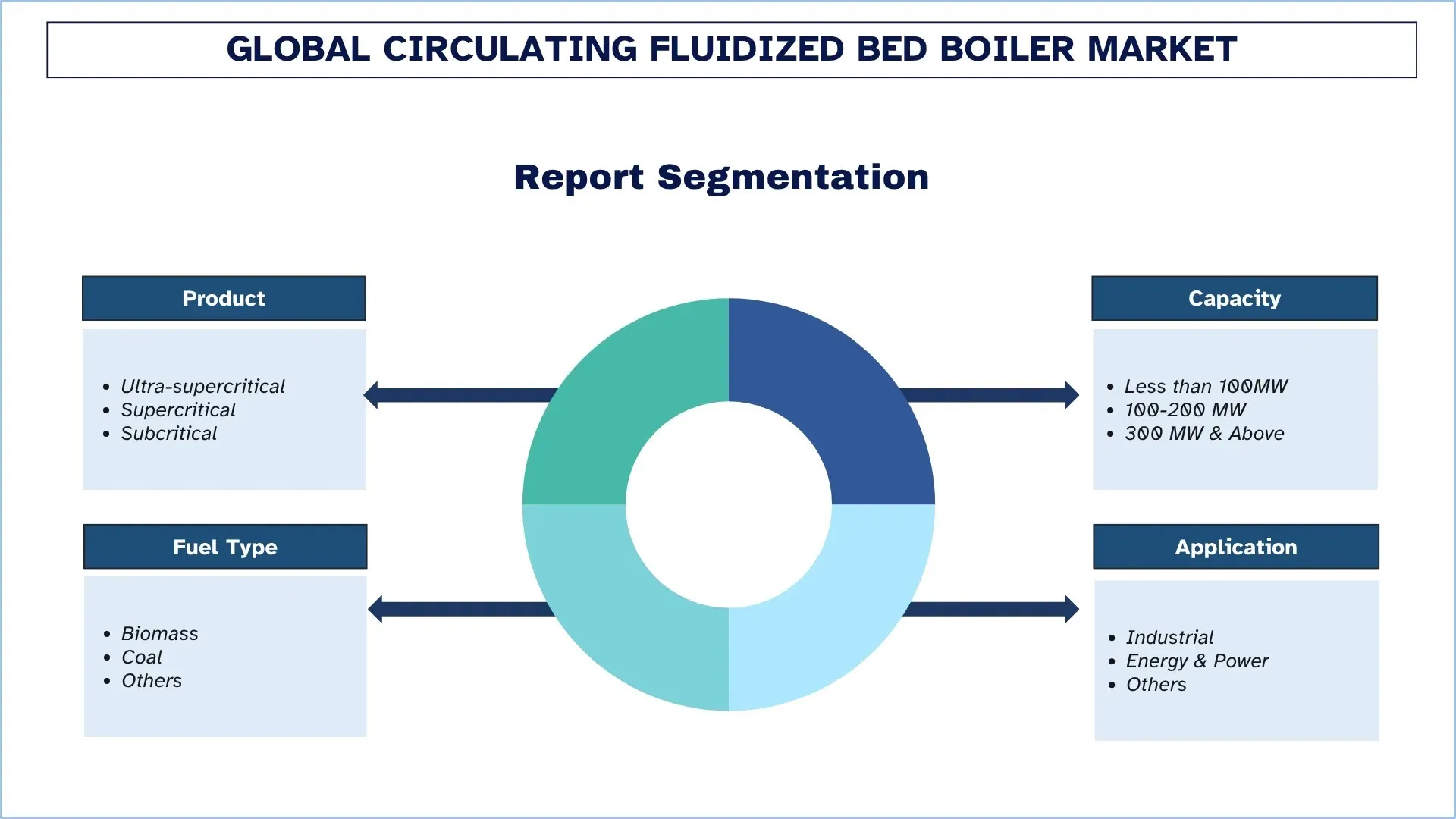
Emphasis on Product (Ultra-supercritical, Supercritical, and Subcritical); Capacity (Less than 100MW, 100-200 MW, and 300 MW & Above); Fuel Type (Biomass, Coal, and Others); Application (Industrial, Energy & Power, and Others); and Region/Country
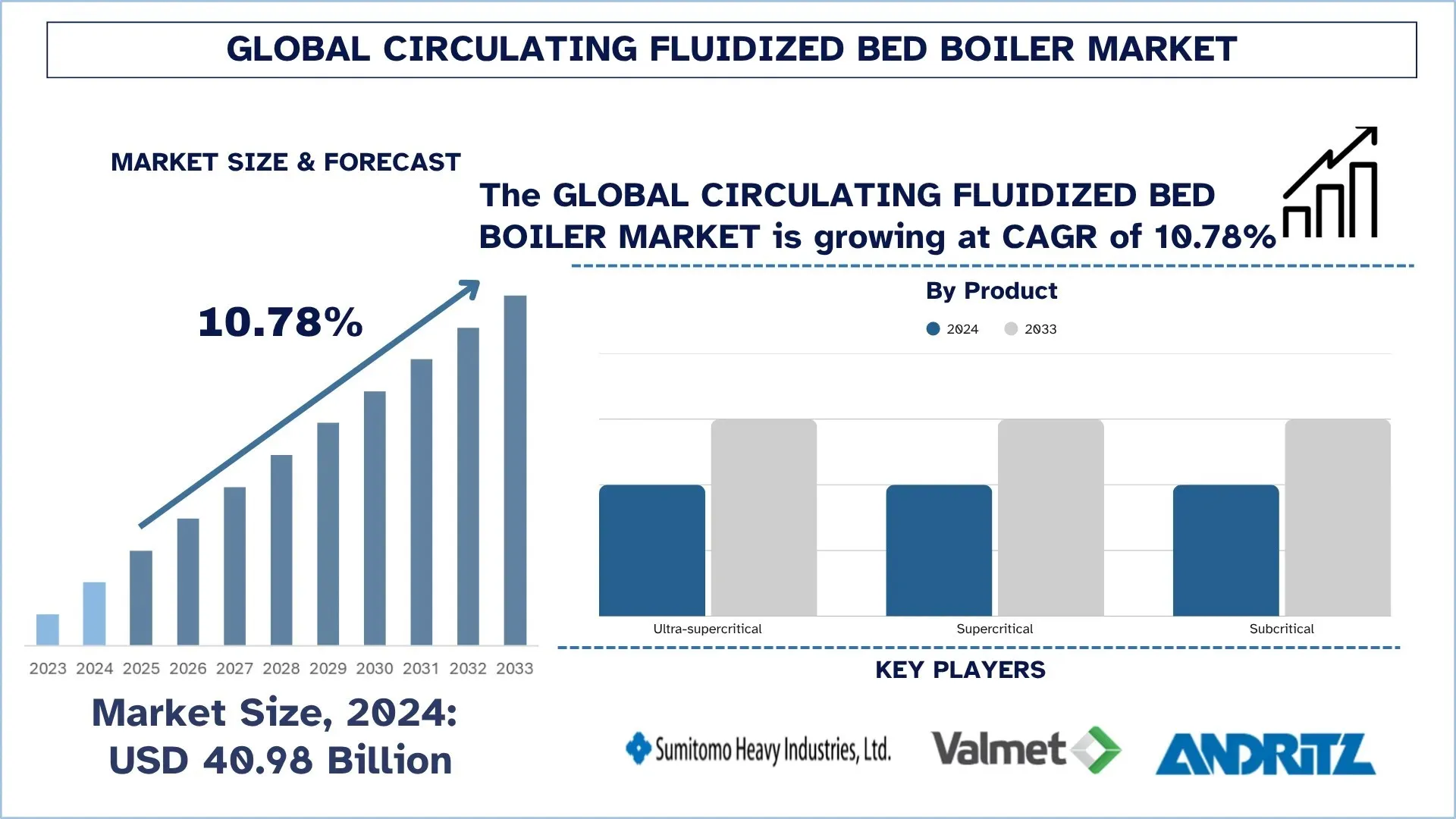
Global Circulating Fluidized Bed Boiler Market Size & Forecast
The Global Circulating Fluidized Bed Boiler Market was valued at USD 40.98 billion in 2024 and is expected to grow at a CAGR of around 10.78% during the forecast period (2025–2033), driven by rising demand for cleaner-combustion technologies, increased multi-fuel flexibility (coal, biomass, waste feedstocks), and tightening emissions regulations in power and industrial sectors.
Circulating Fluidized Bed Boiler Market Analysis
The use of circulating fluidized bed (CFB) boilers in the world market is constantly growing as the demand for cleaner and efficient energy generation technologies and the tightening of environmental requirements are on the rise. CFB boilers are considered to be very efficient and versatile combustion systems that can burn a very large range of fuels, including low-grade coal, biomass, and waste materials, which makes them a very appealing system to use in the area of sustainable energy generation. As the interest in minimizing carbon emissions and switching to renewable and hybrid fuel systems grows, the CFB boiler segment is developing at a very high rate, at a time when industries and power plants are in search of an alternative to traditional boilers that are reliable with low emissions. The latter trend in growth is closely connected with the growing demand for energy in developing economies and the transition of the world to the processes of cleaner industries. Furthermore, the ever-improving technological development, in terms of enhanced combustion efficiency and a heat recovery system, is adding value to the market's growth. There are also new designs and capacity innovations in the market, with CFB boilers now being manufactured in different sizes and configurations to meet the different industrial and utility-scale requirements around the world.
Global Circulating Fluidized Bed Boiler Market Trends
This section discusses the key market trends that are influencing the various segments of the global circulating fluidized bed boiler market, as found by our team of research experts.
Increase in Co-firing of Biomass & Waste with Coal-based Feedstock
One of the current trends being experienced in the Circulating Fluidized Bed (CFB) Boiler market is a higher co-firing of both biomass and waste materials alongside the traditional feedstock made of coal. This is the method that power producers are adopting to mitigate carbon emissions, saving on fuel expenditure while meeting strict environmental standards. Such mixed-fuel combustion is only possible in CFB boilers that have outstanding fuel flexibility and stable operation. This move is in tandem with the worldwide move towards cleaner energy without the full banning of the currently existing coal infrastructure. As an example, China Datang International Power Generation Co. started co-firing 20% biomass in the large-scale CFB units in 2025, with significant results in terms of emissions. This development shows the trend in the industry at large, toward sustainable and hybrid fuel power generation technologies.
Circulating Fluidized Bed Boiler Industry Segmentation
This section provides an analysis of the key trends in each segment of the global circulating fluidized bed boiler market report, along with forecasts at the global, regional, and country levels for 2025-2033.
The Ultra-Supercritical Segment Dominates the Circulating Fluidized Bed Boiler Market
Based on Product, the global circulating fluidized bed (CFB) boiler market is segmented into Ultra-Supercritical, Supercritical, and Subcritical. In 2024, the Ultra-Supercritical segment is anticipated to hold the largest market share and continue to dominate throughout the forecast period. This is largely attributed to its high efficiency, less fuel consumption, and low emissions that are in line with international efforts of sustainable and clean energy production. Ultra-supercritical CFB boilers are designed with higher pressure and temperatures, thus having higher thermal efficiency and minimized carbon footprints, which makes them the choice of large-scale power generation projects. The Supercritical segment is also experiencing consistent growth due to the growing investments in the modern power infrastructure and the progressive substitution of traditional boilers with more effective ones. The boilers are supercritical, and the cost of their operation is moderate, which makes them appropriate to both industrial and utility-scale use, where the performance and cost optimization are paramount.
The 100–200 MW Segment held the Largest Market Share in the Circulating Fluidized Bed Boiler Market.
Based on Capacity, the global Circulating Fluidized Bed (CFB) Boiler market is segmented into Less than 100 MW, 100–200 MW, and 300 MW & Above. In 2024, the 100–200 MW segment is anticipated to hold the largest market share and continue to lead throughout the forecast period. This is due to the fact that boilers of this size provide a perfect balance of power output, fuel flexibility, and operating efficiency, which makes them very well adapted to medium-sized industrial and utility processes. They are also favored in the emerging economies, where projects of medium-scale power generation are on the rise as a result of rising energy demand. The Less than 100 MW market is gaining momentum with a growing frequency of demand as a result of the growing need for small and captive power plants, industrial plants, and process industries in need of reliable and cost-effective energy solutions. Meanwhile, the 300 MW and Above segment will have the highest CAGR during the forecast period. This has been facilitated by the increasing character of huge power generation schemes, particularly in the developing economies, and the global propensity towards large capacity and ultra-supercritical technologies to increase efficiency and minimize emissions.
Asia Pacific Dominated the Global Circulating Fluidized Bed Boiler Market
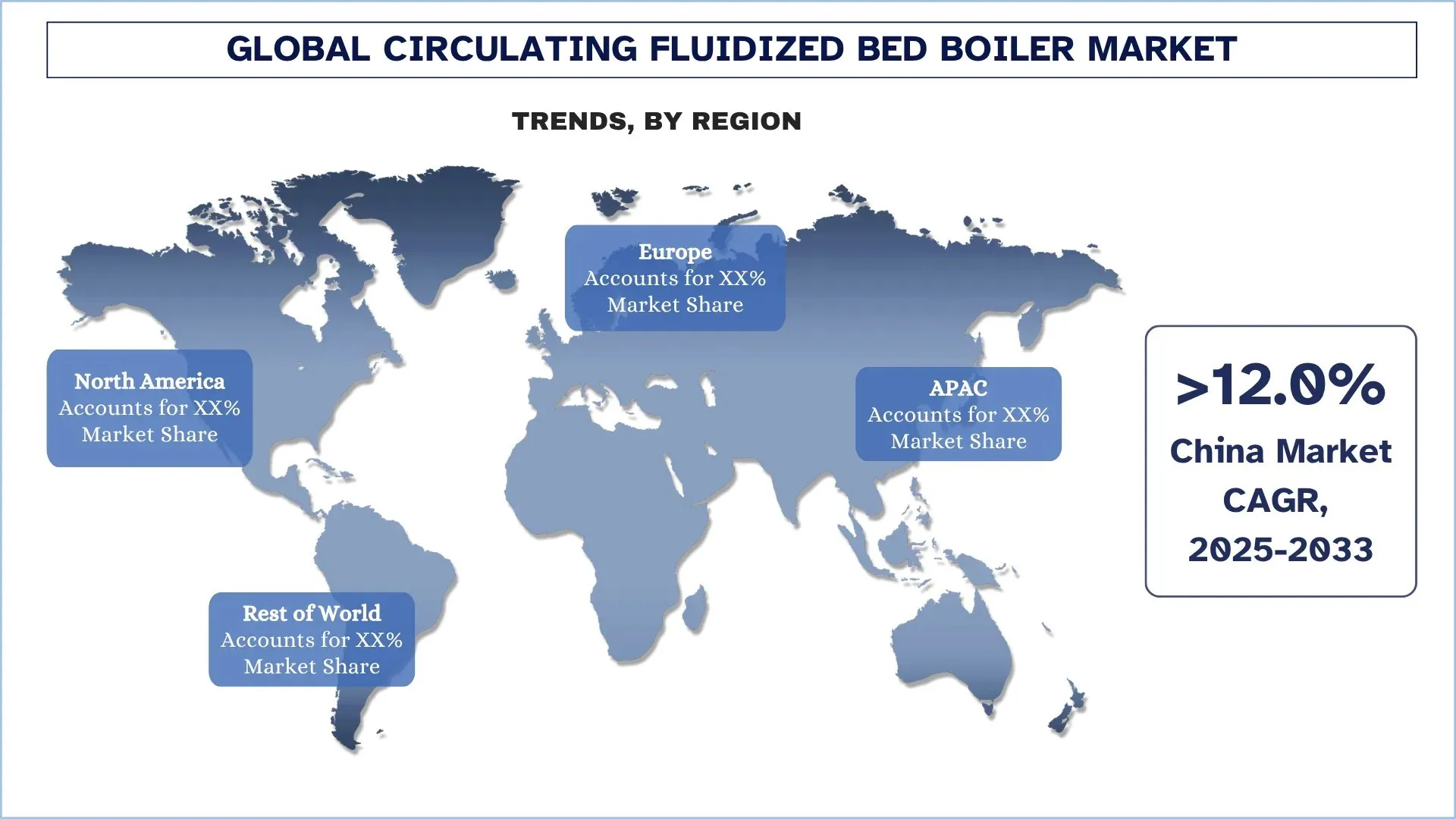
Asia-Pacific is projected to have a majority share of the global CFB boiler market in 2024 and is projected to lead the market during the forecast period. The major causes of this hegemony are the increasing industrialization, urbanization, and energy demand in the region, particularly in nations such as China and India. The existence of a large base of coal-powered plants and the extensive projects on the renewable integration have also reinforced the leadership role of the region. Asia-Pacific governments are also vigorously supporting the use of clean and efficient energy systems, and CFB boilers are spreading their tentacles because of their capacity to support a wide variety of fuel sources, such as low-grade coal and biomass, with minimal emission levels. The growth in heavy industries and the supportive policies of the government in encouraging the cleaner generation of power further increase the market growth. In addition, lower cost of installation and operation has been brought about by technological improvement and the ability of local manufacture, thus making CFB boilers the best option in this region. As the region invests more in energy infrastructure and concentrates on sustainable power supply, the Asia-Pacific region will continue to be the strongest and most vibrant market for CFB boilers in the world.
China held a dominant Share of the Asia Pacific Circulating Fluidized Bed Boiler Market in 2024
The Circulating Fluidized Bed Boiler market in China is in the midst of a massive growth opportunity that can be attributed to the fact that the nation is still in the process of upgrading to a cleaner and more efficient production of energy. As the focus on carbon emission reduction and coal optimization is increasing, CFB technology is becoming popular in industrial and utility-scale power plants. Government programs that encourage the use of low-emission and high-efficiency boilers and increasing investments in renewable and hybrid energy systems drive the market further. Further, the availability of major domestic producers and a growing export market is a strong base for market growth in terms of projects in the public and private sectors.
Circulating Fluidized Bed Boiler Industry Competitive Landscape
The global circulating fluidized bed boiler market is competitive, with several global and international market players. The key players are adopting different growth strategies to enhance their market presence, such as partnerships, agreements, collaborations, new product launches, geographical expansions, and mergers and acquisitions.
Top Circulating Fluidized Bed Boiler Companies
Some of the major players in the market are Sumitomo Heavy Industries, Ltd., Valmet, ANDRITZ, MITSUBISHI HEAVY INDUSTRIES, LTD., JFE Engineering Corporation, Alstom SA, Babcock & Wilcox Enterprises, Inc., Doosan Lentjes, Bharat Heavy Electricals Limited, and Isgec Heavy Engineering Ltd.
Recent Developments in the Circulating Fluidized Bed Boiler Market
In May 2024, Aboitiz Power Corporation (AboitizPower) partnered with REPCO NEX Industrial Solutions (REPCO NEX), one of the Thailand-based companies, to develop digital twins for AboitizPower’s existing circulating fluidized bed (CFB) coal-fired power plants.
In March 2024, NTPC Limited launched policies to promote the usage of renewable energy by petitioning for the approval of tariffs for 1,250 MW solar power projects.
Global Circulating Fluidized Bed Boiler Market Report Coverage
Report Attribute | Details |
Base year | 2024 |
Forecast period | 2025-2033 |
Growth momentum | Accelerate at a CAGR of 10.78% |
Market size 2024 | USD 40.98 Billion |
Regional analysis | North America, Europe, APAC, Rest of the World |
Major contributing region | Asia Pacific is expected to dominate the market during the forecast period. |
Key countries covered | U.S., Canada, Germany, U.K., Spain, Italy, France, China, Japan, and India |
Companies profiled | Sumitomo Heavy Industries, Ltd., Valmet, ANDRITZ, MITSUBISHI HEAVY INDUSTRIES, LTD., JFE Engineering Corporation, Alstom SA, Babcock & Wilcox Enterprises, Inc., Doosan Lentjes, Bharat Heavy Electricals Limited, and Isgec Heavy Engineering Ltd. |
Report Scope | Market Trends, Drivers, and Restraints; Revenue Estimation and Forecast; Segmentation Analysis; Demand and Supply Side Analysis; Competitive Landscape; Company Profiling |
Segments Covered | By Product; By Capacity; By Fuel Type, By Application; By Region/Country |
Reasons to Buy the Circulating Fluidized Bed Boiler Market Report:
The study includes market sizing and forecasting analysis confirmed by authenticated key industry experts.
The report briefly reviews overall industry performance at a glance.
The report covers an in-depth analysis of prominent industry peers, primarily focusing on key business financials, type portfolios, expansion strategies, and recent developments.
Detailed examination of drivers, restraints, key trends, and opportunities prevailing in the industry.
The study comprehensively covers the market across different segments.
Deep dive regional-level analysis of the industry.
Customization Options:
The global circulating fluidized bed boiler market can further be customized as per the requirements or any other market segment. Besides this, UnivDatos understands that you may have your own business needs; hence, feel free to contact us to get a report that completely suits your requirements.
Table of Content
Research Methodology for the Global Circulating Fluidized Bed Boiler Market Analysis (2023-2033)
We analyzed the historical market, estimated the current market, and forecasted the future market of the global circulating fluidized bed boiler market to assess its application in major regions worldwide. We conducted exhaustive secondary research to gather historical market data and estimate the current market size. To validate these insights, we carefully reviewed numerous findings and assumptions. Additionally, we conducted in-depth primary interviews with industry experts across the circulating fluidized bed boiler value chain. After validating market figures through these interviews, we used both top-down and bottom-up approaches to forecast the overall market size. We then employed market breakdown and data triangulation methods to estimate and analyze the market size of industry segments and sub-segments.
Market Engineering
We employed the data triangulation technique to finalize the overall market estimation and derive precise statistical numbers for each segment and sub-segment of the global circulating fluidized bed boiler market. We split the data into several segments and sub-segments by analyzing various parameters and trends, including product, capacity, fuel type, application, and regions within the global circulating fluidized bed boiler market.
The Main Objective of the Global Circulating Fluidized Bed Boiler Market Study
The study identifies current and future trends in the global circulating fluidized bed boiler market, providing strategic insights for investors. It highlights regional market attractiveness, enabling industry participants to tap into untapped markets and gain a first-mover advantage. Other quantitative goals of the studies include:
Market Size Analysis: Assess the current market size and forecast the market size of the global circulating fluidized bed boiler market and its segments in terms of value (USD).
Circulating Fluidized Bed Boiler Market Segmentation: Segments in the study include areas of product, capacity, fuel type, application, and regions.
Regulatory Framework & Value Chain Analysis: Examine the regulatory framework, value chain, customer behavior, and competitive landscape of the circulating fluidized bed boiler industry.
Regional Analysis: Conduct a detailed regional analysis for key areas such as Asia Pacific, Europe, North America, and the Rest of the World.
Company Profiles & Growth Strategies: Company profiles of the circulating fluidized bed boiler market and the growth strategies adopted by the market players to sustain the fast-growing market.
Frequently Asked Questions FAQs
Q1: What is the global circulating fluidized bed boiler current market size and its growth potential?
The global circulating fluidized bed boiler market was valued at USD 40.98 billion in 2024 and is expected to grow at a CAGR of 10.78% during the forecast period (2025-2033).
Q2: Which segment has the largest share of the global circulating fluidized bed boiler market by product?
The Ultra-Supercritical segment is anticipated to hold the largest market share and continue to dominate throughout the forecast period. This is largely attributed to its high efficiency, reduced fuel consumption, and low emissions, which align with international efforts to promote sustainable and clean energy production.
Q3: What are the driving factors for the growth of the global circulating fluidized bed boiler market?
• Increasing Power Generation Demand in Emerging Economies: Rising electricity consumption in developing regions is driving the installation of CFB boilers due to their ability to support large-scale, reliable, and efficient power generation.
• Fuel Flexibility and High Efficiency in Combustion: CFB boilers can efficiently utilize a wide range of fuels, such as coal, biomass, and waste, offering high combustion efficiency and cost-effective energy production across diverse industrial applications.
• Stringent Environmental Regulations and Clean Energy Mandates: Tightening global emission norms are encouraging industries to adopt CFB technology, which ensures lower NOx and SOx emissions and supports compliance with sustainability goals.
Q4: What are the emerging technologies and trends in the global circulating fluidized bed boiler market?
• Increase in Co-firing of Biomass & Waste with Coal-based Feedstock: Co-firing biomass and waste materials with coal enhances sustainability, reduces emissions, and aligns with global energy transition and circular economy goals.
• Growth of Ultra-Supercritical and High-Efficiency CFB Boiler Designs: Manufacturers are developing ultra-supercritical CFB technologies to improve efficiency, reduce carbon footprint, and meet growing demand for next-generation clean power solutions.
Q5: What are the key challenges in the global circulating fluidized bed boiler market?
• High Initial Capital and Installation Costs: The setup and integration of CFB systems involve high equipment and infrastructure costs, limiting adoption, especially among small and medium-scale energy producers.
• Fuel Quality and Feedstock Variability: Performance can be affected by inconsistent fuel quality or variable feedstock properties, requiring advanced control systems and increasing operational complexity.
Q6: Which region dominates the global circulating fluidized bed boiler market?
Asia-Pacific is projected to have a majority share of the global CFB boiler market in 2024 and is projected to lead the market during the forecast period. The major causes of this hegemony are the increasing industrialization, urbanization, and energy demand in the region, especially in such nations as China and India. The existence of a large base of coal-powered plants and the extensive projects on the renewable integration have also reinforced the leadership role of the region.
Q7: Who are the key players in the global circulating fluidized bed boiler market?
Some of the key companies include:
• Sumitomo Heavy Industries, Ltd.
• Valmet
• ANDRITZ
• MITSUBISHI HEAVY INDUSTRIES, LTD.
• JFE Engineering Corporation
• Alstom SA
• Babcock & Wilcox Enterprises, Inc.
• Doosan Lentjes
• Bharat Heavy Electricals Limited
• Isgec Heavy Engineering Ltd.
Q8: How are government policies and incentives shaping the global Circulating Fluidized Bed Boiler market?
• Regulatory Support for Clean Energy: Governments are promoting low-emission technologies, providing subsidies and tax incentives that encourage the adoption of CFB boilers across industrial and utility sectors.
• Emission Control Mandates: Stricter environmental standards are compelling power producers to transition toward cleaner combustion systems, directly boosting CFB installations.
• Public-Private Collaboration: Joint programs in energy efficiency and carbon reduction are fostering R&D investment and modernization of existing boiler infrastructure.
Q9: What role does digitalization play in enhancing Circulating Fluidized Bed Boiler operations?
• Real-time Monitoring: Advanced control systems and IoT sensors optimize combustion performance and improve operational safety.
• Predictive Maintenance: AI-enabled analytics help forecast equipment failures, minimizing downtime and maintenance costs.
• Data-driven Optimization: Integration of digital twins and remote diagnostics ensures better efficiency, lower emissions, and reduced operating expenses.
Related Reports
Customers who bought this item also bought


India Decarbonization HVAC Market: Current Analysis and Forecast (2026-2034)
Emphasis on Product Type (Heating Equipment, Ventilation Equipment, Air Conditioning Equipment, Others); Decarbonization Type (Direct, Indirect); Capacity (Up to 5 Tons, 5-20 Tons, Above 20 Tons); End User (Commercial Buildings, Residential Buildings, Industrial Facilities, Healthcare Facilities, Data Centers, Others); and Region/States
Midstream Oil & Gas Filtration Market: Current Analysis and Forecast (2026-2034)
Emphasis on Filter Technology (Coalescer Filters, Cartridge Filters, Mechanical Filters, Bag Filters, Particulate Filters, Activated Carbon Filters, Strainers, and Others); by Application (Gas Processing Plants, Compression Stations, Storage And Distribution, Pipeline Transportation, LNG Processing, and Others); by Filtration Stage (Oil Filtration and Gas Filtration), by End User (Refineries and Petrochemical Industry), and Region/Country
Hydrogen-Powered Hospital Backup Systems Market: Current Analysis and Forecast (2026-2034)
Emphasis on System Type (Portable, Stationary, Hybrid); Power Capacity (Below 100 kW, 100–500 kW, and Above 500 kW); End-User (Public Hospitals, Private Hospitals, Specialty Hospitals, and Emergency Care Facilities); and Region/Country
Wind LiDAR Market: Current Analysis and Forecast (2025-2033)
Emphasis on Product Type (Vertical Profiling Wind LiDAR, Ground-Based Wind LiDAR, Nacelle-Mounted Wind LiDAR, Airborne Wind LiDAR, and Others); Component (Sensor, Navigator, Laser, and Others); Location (Onshore and Offshore); Application (Wind Power, Meteorology & Environment, and Aviation); and Region/Country