Midstream Oil & Gas Filtration Market: Current Analysis and Forecast (2026-2034)
Emphasis on Filter Technology (Coalescer Filters, Cartridge Filters, Mechanical Filters, Bag Filters, Particulate Filters, Activated Carbon Filters, Strainers, and Others); by Application (Gas Processing Plants, Compression Stations, Storage And Distribution, Pipeline Transportation, LNG Processing, and Others); by Filtration Stage (Oil Filtration and Gas Filtration), by End User (Refineries and Petrochemical Industry), and Region/Country
Global Midstream Oil & Gas Filtration Market Size & Forecast
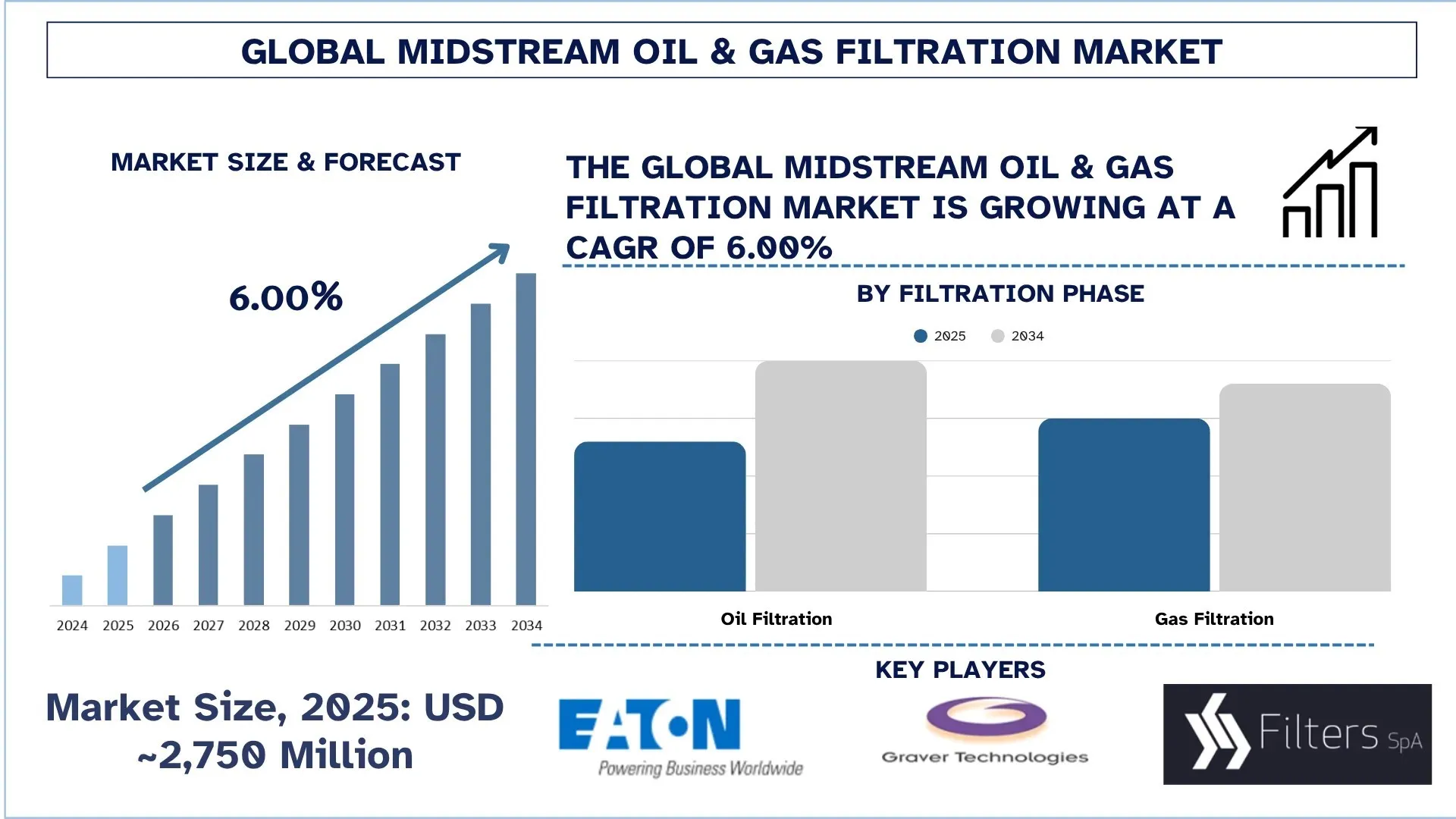
The global Midstream Oil & Gas Filtration Market was valued at USD 2,750 million in 2025 and is expected to grow at a strong CAGR of around 6.00% during the forecast period (2026-2034F). Rising Focus on Oil Contamination Control, and Regulatory Pressure on Emissions and Waste Management are some of the key factors supporting the market rise.
Midstream Oil & Gas Filtration Market Analysis
The midstream oil and gas filtration market worldwide is experiencing tremendous growth due to the growing demand for the filtration process of oil and gas in relation to controlling contamination, pipeline safety, and environmental conservation. The increasing demand for energy security and the stringent environmental policies are influencing operators to invest in high-tech filtration systems to enhance the efficiency and reliability of transportation infrastructure. The filtration solutions, like membrane and coalescing filter, are engineered to cleanse crude oil and natural gas of any impurities that include water, solids, and chemicals. Also, new advances in filtration technology are facilitating the move to cleaner energy, cost-effective operation, and the long-term sustainability of midstream operation. With energy companies striving towards minimizing the environmental effects, the demand for high-performance filtration systems is likely to increase, leading to the expansion of this market.
In January 2026, the U.S. Geological Survey (USGS) discovered new massive oil and gas reserves in the Permian Basin, which are enough to supply the United States for 10 months. As per USGS, it has found 28.3 trillion cubic feet of gas and 1.6 billion barrels of oil in Woodford and Barnett shale formations. With the growing discoveries of new reserves, the oil extraction and transportation services would further increase, subsequently leading to the upliftment of the midstream oil and gas filtration market.
Global Midstream Oil & Gas Filtration Market Trends
This section discusses the key market trends that are influencing the various segments of the global Midstream Oil & Gas Filtration market, as found by our team of research experts.
Integration of Filtration Systems with Advanced Monitoring and Automation:
The midstream oil and gas filtration market is taking a new shape with the integration of filtration systems and state-of-the-art monitoring and automation. This trend is oriented towards the integration of intelligent technologies like real-time sensors, data analytics, and AI-based algorithms to improve the performance and efficiency of the filtration processes. The automation of filtration systems enables the operators to observe the state of affairs on a regular basis, analyze the possible problems before they deteriorate, and arrange the maintenance shifts in the most efficient way. This cuts down the downtime, minimizes the cost of operations, and enhances the overall system reliability. Moreover, high-tech surveillance will allow achieving greater compliance with strict environmental policies, making the operations cleaner, and improving the quality of products. With the industry concerned with sustainability and operational efficiency, the incorporation of these technologies is likely to increase growth in the market, especially in pipeline transportation and gas processing applications.
Midstream Oil & Gas Filtration Industry Segmentation
This section provides an analysis of the key trends in each segment of the global Midstream Oil & Gas Filtration market report, along with forecasts at the global, regional, and country levels for 2026-2034.
The Coalescer Filter is expected to grow at a significant CAGR during the forecast period (2026-2034).
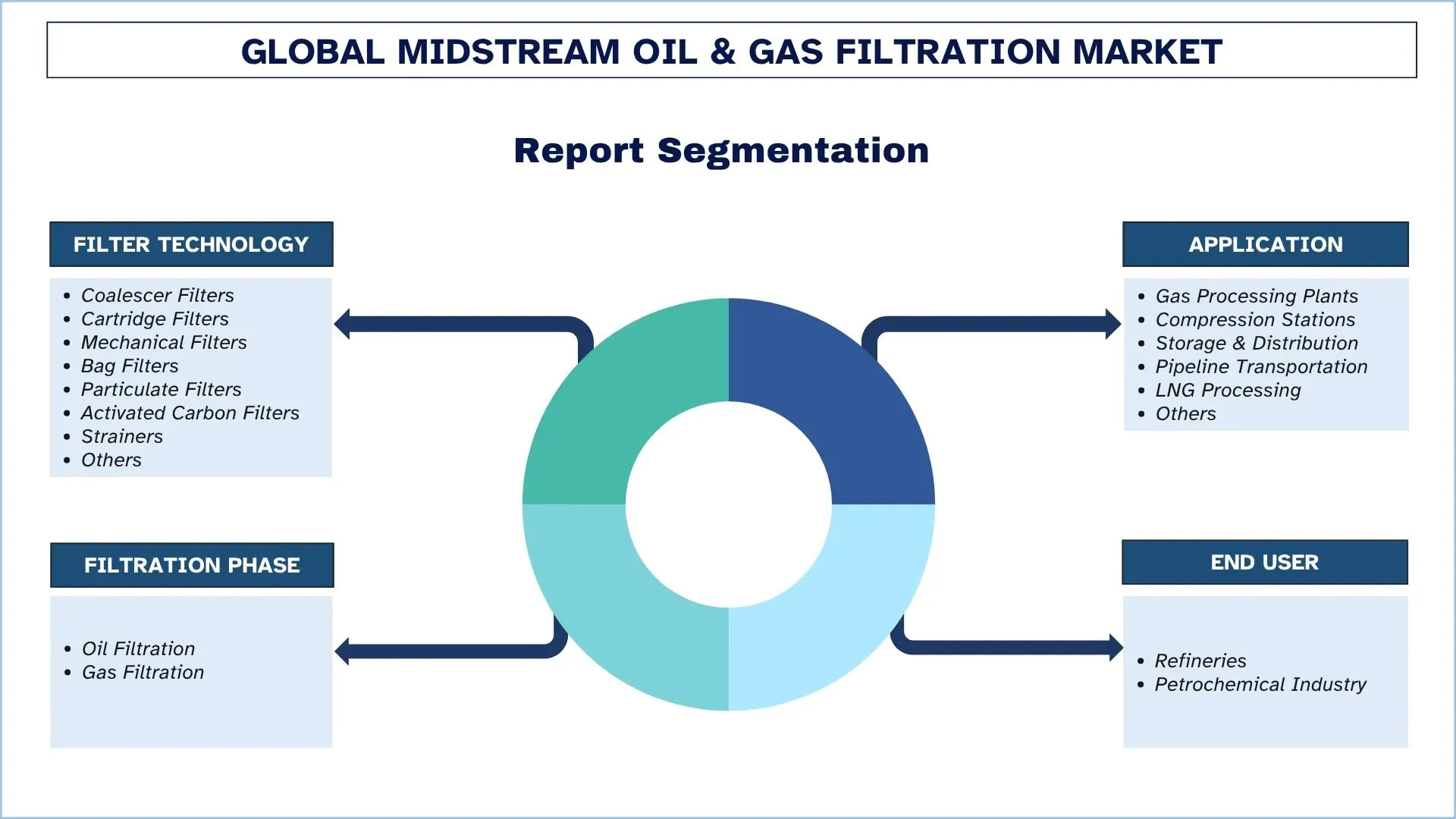
The Global Midstream Oil & Gas Filtration market, according to filter technology, is divided into coalescer filters, cartridge filters, mechanical filters, bag filters, particulate filters, activated carbon filters, strainers, and others. Most importantly, the coalescer filters command the greatest market share because of their efficiency in the removal of water and emulsified hydrocarbons in crude oil and natural gas. The need to have coalescer filters is informed by the fact that it not only prevents corrosion, but also protects equipment and enhances performance, which are critical in ensuring that pipeline integrity is intact, and that the engineering time is minimized. They also dominate the market even more by virtue of their extensive use in the refining processes and as regulatory compliance requirements. The cartridge filters and the particulate filters are also highly growing segments, due to the fact that they are able to eliminate fine particles and contaminants, which may hamper the equipment and the overall performance. Carbon filters are gaining popularity because of their ability to eliminate volatile organic compounds and impurities to enable the drive towards cleaner energy sources.
The Pipeline Transportation Segment Dominates the Global Midstream Oil & Gas Filtration Market.
Depending on its application, the global midstream oil and gas filtration market is classified into gas processing plants, compression stations, storage and distribution, pipeline transportation, and LNG processing, among others. The segment of transportation through pipelines has been the largest in the market, as there has been a necessity to make sure that natural gas and crude oil can be transported safely and efficiently over long distances. The necessity to eliminate contaminants, including water and solids, that may cause corrosion and blockage, is the primary source of the demand for filtration solutions in pipeline transportation. The rest of the segments, which include gas processing plants and LNG processing, are expanding as more production and refining operations are being done. Filtration systems have to be effective in compression stations to make compressors work effectively. Storage and distribution fields are concerned with product quality and contamination prevention in the stored goods. The individual components are required to ensure the integrity of operations and adherence to environmental standards.
Asia-Pacific exhibits the fastest growth in the global Midstream Oil & Gas Filtration market
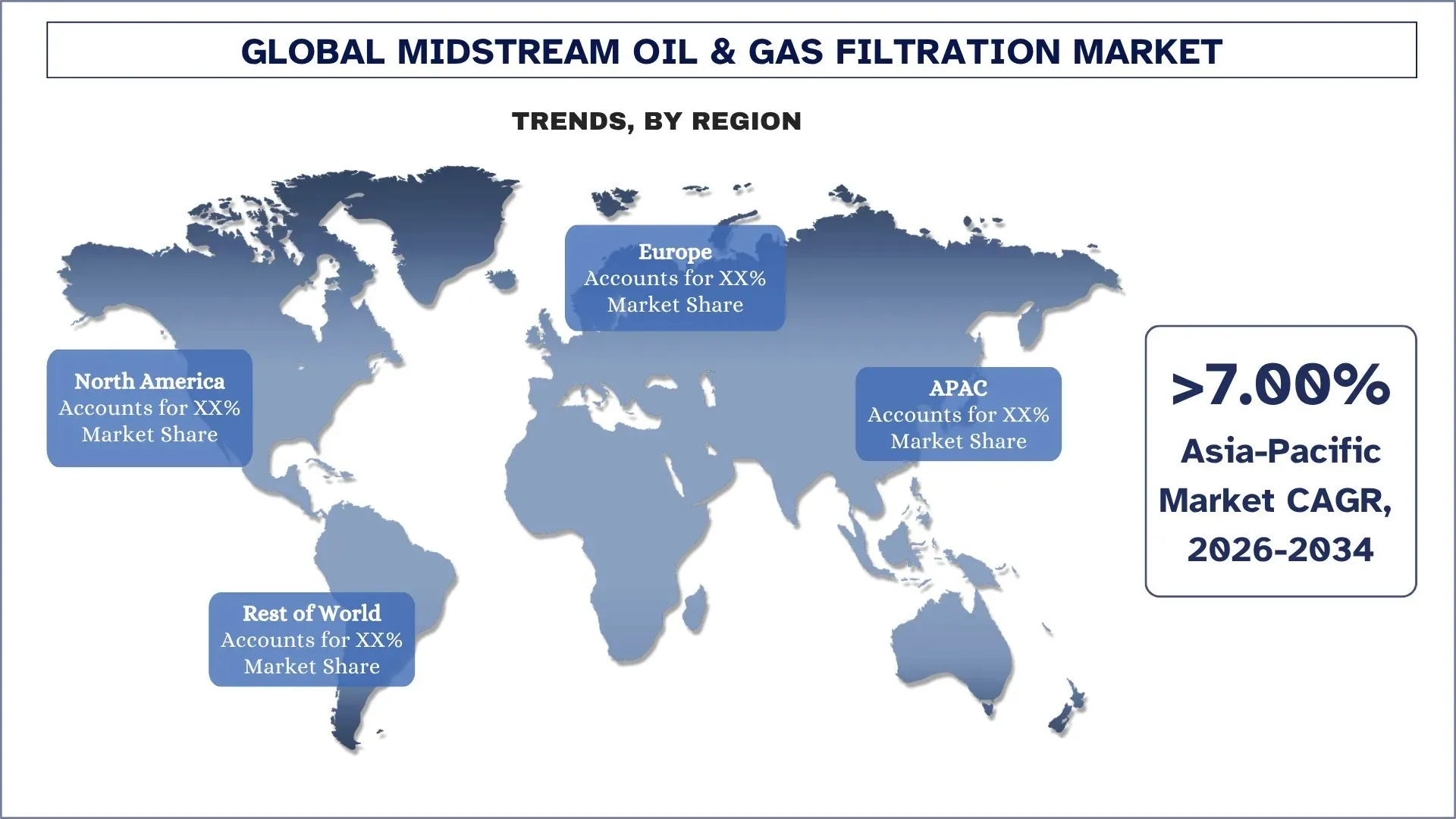
The APAC midstream oil and gas filtration is the most dynamic part of the world in terms of growth, as it is due to the high rate of industrialization, the rising energy consumption, and the development of infrastructure in such nations as China, India, and Southeast Asia. The emphasis on the region towards enhancing the efficiency of the pipeline, boosting its capacity to process the gas, and ensuring that the environmental conditions are highly maintained is driving the integration of sophisticated filtration methods. Increasing investments in the energy sector and the turn towards a cleaner energy practice also facilitate the necessity of efficient filtration systems. Due to the increased expansion of midstream operations within the region, the need to implement high-performance filtration technologies that would guarantee reliability in operations and regulatory compliance remains high.
In June 2025, the Ministry of Petroleum and Natural Gas India stated that India is close to identifying an oil field in the Andaman Sea with 184,440 crore liters of crude oil. The Indian government has authorized exploration and production (E&P) activities across over 1 million square kilometers of previously restricted sedimentary basins, particularly in offshore areas such as the Andaman Sea. Until recently, less than 8% of the country's 3.5 million square kilometers of sedimentary basins had been explored.
China held a dominant share of the APAC Midstream Oil & Gas Filtration Market in 2025
The biggest midstream oil and gas filtration market in the APAC region is China, which is powered by its large energy infrastructure and an increase in demand for cleaner and efficient energy services. With the country still preoccupied with industrial development and energy security, there has been a sharp increase in the demand for sophisticated filtration systems that would ensure the integrity of pipelines, processes, and compliance with the environment. Having invested heavily in both conventional and renewable energy sources, China is embracing the latest technology in filtration to enhance efficiency in operations, emissions, and regulatory compliance. This makes China one of the major market participants of midstream oil and gas filtration in the world.
For instance, on December 24, 2025, China National Offshore Oil Corporation (CNOOC) made a significant oilfield discovery in the central Bohai Sea, with estimated in‑place volumes surpassing 100 million tonnes of oil equivalent. The Qinhuangdao 29‑6 field, located in shallow Neogene formations, contains medium‑heavy crude and highlights China's growing offshore energy potential.
Midstream Oil & Gas Filtration Industry Competitive Landscape
The global Midstream Oil & Gas Filtration market is competitive, with several global and international market players. The key players are adopting different growth strategies to enhance their market presence, such as partnerships, agreements, collaborations, geographical expansions, and mergers and acquisitions.
Top Midstream Oil & Gas Filtration Market Companies
Some of the major players in the market are Pall Corporation, Jonell Systems, Parker Hannifin, Eaton, Pentair, Graver Technologies, PRAIMO, Filters Spa, Brother Filtration, and Clark-Reliance.
Recent Developments in the Midstream Oil & Gas Filtration Market
In March 2026, Vaquero Midstream is nearing completion of its Delaware Basin expansion, which includes a 70‑mile, 24‑inch high‑pressure pipeline loop and the launch of its third cryogenic processing plant. These upgrades will double gas gathering capacity to 800 MMcf/d and processing capacity to 600 MMcf/d, significantly enhancing infrastructure in West Texas. The expansion extends services across Loving, Ward, and Winkler counties, driven by increasing demand in the basin.
Global Midstream Oil & Gas Filtration Market Report Coverage
Report Attribute | Details |
Base year | 2025 |
Forecast period | 2026-2034 |
Growth momentum | Accelerate at a CAGR of 6.00% |
Market size 2025 | USD 2,750 million |
Regional analysis | North America, Europe, APAC, Rest of the World |
Major contributing region | The North America region is expected to dominate the market during the forecast period. |
Key countries covered | U.S., Canada, Germany, U.K., Spain, Italy, France, China, Japan, and India. |
Companies profiled | Pall Corporation, Jonell Systems, Parker Hannifin, Eaton, Pentair, Graver Technologies, PRAIMO, Filters Spa, Brother Filtration, and Clark-Reliance. |
Report Scope | Market Trends, Drivers, and Restraints; Revenue Estimation and Forecast; Segmentation Analysis; Demand and Supply Side Analysis; Competitive Landscape; Company Profiling |
Segments Covered | by Filter Technology, by Application, by Filtration Phase, by End User, and by Region/Country |
Reasons to Buy the Midstream Oil & Gas Filtration Market Report:
The study includes market sizing and forecasting analysis confirmed by authenticated key industry experts.
The report briefly reviews overall industry performance at a glance.
The report covers an in-depth analysis of prominent industry peers, primarily focusing on key business financials, type portfolios, expansion strategies, and recent developments.
Detailed examination of drivers, restraints, key trends, and opportunities prevailing in the industry.
The study comprehensively covers the market across different segments.
Deep dive regional-level analysis of the industry.
Customization Options:
The global Midstream Oil & Gas Filtration market can further be customized as per the requirements or any other market segment. Besides this, UnivDatos understands that you may have your own business needs; hence, feel free to contact us to get a report that completely suits your requirements.
Table of Content
Research Methodology for the Global Midstream Oil & Gas Filtration Market Analysis (2024-2034)
We analyzed the historical market, estimated the current market, and forecasted the future market of the global Midstream Oil & Gas Filtration market to assess its application in major regions worldwide. We conducted exhaustive secondary research to gather historical market data and estimate the current market size. To validate these insights, we carefully reviewed numerous findings and assumptions. Additionally, we conducted in-depth primary interviews with industry experts across the Midstream Oil & Gas Filtration value chain. After validating market figures through these interviews, we used both top-down and bottom-up approaches to forecast the overall market size. We then employed market breakdown and data triangulation methods to estimate and analyze the market size of industry segments and sub-segments.
Market Engineering
We employed data triangulation techniques to finalize the overall market estimation and derive precise statistical numbers for each segment and sub-segment of the global Midstream Oil & Gas Filtration market. We split the data into several segments and sub-segments by analyzing various parameters and trends, including Filter Technology, by Application, by Filtration Phase, by End User, and regions within the global Midstream Oil & Gas Filtration market.
The Main Objective of the Global Midstream Oil & Gas Filtration Market Study
The study identifies current and future trends in the global Midstream Oil & Gas Filtration market, providing strategic insights for investors. It highlights regional market attractiveness, enabling industry participants to tap into untapped markets and gain a first-mover advantage. Other quantitative goals of the studies include:
Market Size Analysis: Assess the current and forecast market size of the global Midstream Oil & Gas Filtration market and its segments in terms of value (USD).
Midstream Oil & Gas Filtration Market Segmentation: Segments in the study include areas by Filter Technology, by Application, by Filtration Phase, by End User, and by region.
Regulatory Framework & Value Chain Analysis: Examine the regulatory framework, value chain, customer behavior, and competitive landscape of the Midstream Oil & Gas Filtration industry.
Regional Analysis: Conduct a detailed regional analysis for key areas such as Asia Pacific, Europe, North America, and the Rest of the World.
Company Profiles & Growth Strategies: Company profiles of the Midstream Oil & Gas Filtration market and the growth strategies adopted by the market players to sustain the fast-growing market.
Frequently Asked Questions FAQs
Q1: What is the current market size and growth potential of the global Midstream Oil & Gas Filtration market?
The global Midstream Oil & Gas Filtration market is valued at USD 2,750 million in 2025, driven by factors such as growth in shale and tight gas production, the pressing need to discover new oil and gas rigs.
Q2: Which segment has the largest share of the global Midstream Oil & Gas Filtration market by Filter Technology?
The coalescer filters command the greatest market share because of their efficiency in the removal of water and emulsified hydrocarbons in crude oil and natural gas.
Q3: What are the driving factors for the growth of the global Midstream Oil & Gas Filtration market?
Key growth drivers include the rising focus on oil contamination control, regulatory pressure on emissions and waste management, and the growth of shale gas and tight oil production. These factors drive demand for advanced filtration solutions to ensure operational efficiency and environmental compliance.
Q4: What are the emerging technologies and trends in the global Midstream Oil & Gas Filtration market?
Major trends include the integration of filtration systems with advanced monitoring and automation technologies, and the shift toward modular filtration solutions. These innovations improve system efficiency, flexibility, and scalability, helping operators adapt to evolving filtration requirements and ensure cost-effective performance.
Q5: What are the key challenges in the global Midstream Oil & Gas Filtration market?
Key challenges include the evolving types of contaminants and the need for advanced filtration solutions to address these changes. Additionally, the cost-effectiveness of high-quality filtration remains a concern, as operators balance performance with budget constraints for system upgrades and maintenance.
Q6: Which region dominates the global Midstream Oil & Gas Filtration market?
The North America Midstream Oil & Gas Filtration Market is performing well with the growth of investments in the pipeline infrastructure, the tough environmental standards, and the growth in the volume of oil and gas production in the region.
Q7: Who are the key competitors in the global Midstream Oil & Gas Filtration market?
Top players in the Midstream Oil & Gas Filtration industry include:
Pall Corporation
Jonell Systems
Parker Hannifin
Eaton
Pentair
Graver Technologies
PRAIMO
Filters Spa
Brother Filtration
Clark-Reliance
Q8: What opportunities are emerging for new entrants and technology providers in this market?
Investments in oil and gas infrastructure in emerging economies and upgrades to aging pipelines create significant opportunities for advanced filtration technologies, driving demand for efficient, scalable, and compliant filtration solutions in the market.
Q9: How are current discoveries of oil and gas rigs anticipated to impact Midstream Oil & Gas Filtration?
Current discoveries of oil and gas rigs are expected to increase demand for midstream oil and gas filtration systems. As exploration expands, the need for advanced filtration technologies to handle higher production volumes, improve contamination control, and ensure operational efficiency will grow.
Related Reports
Customers who bought this item also bought



India Decarbonization HVAC Market: Current Analysis and Forecast (2026-2034)
Emphasis on Product Type (Heating Equipment, Ventilation Equipment, Air Conditioning Equipment, Others); Decarbonization Type (Direct, Indirect); Capacity (Up to 5 Tons, 5-20 Tons, Above 20 Tons); End User (Commercial Buildings, Residential Buildings, Industrial Facilities, Healthcare Facilities, Data Centers, Others); and Region/States
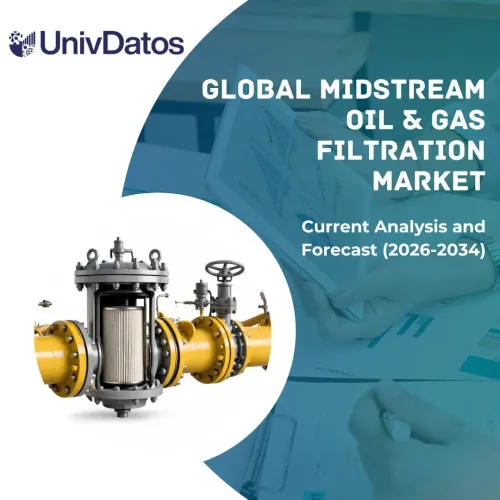
Midstream Oil & Gas Filtration Market: Current Analysis and Forecast (2026-2034)
Emphasis on Filter Technology (Coalescer Filters, Cartridge Filters, Mechanical Filters, Bag Filters, Particulate Filters, Activated Carbon Filters, Strainers, and Others); by Application (Gas Processing Plants, Compression Stations, Storage And Distribution, Pipeline Transportation, LNG Processing, and Others); by Filtration Stage (Oil Filtration and Gas Filtration), by End User (Refineries and Petrochemical Industry), and Region/Country
Hydrogen-Powered Hospital Backup Systems Market: Current Analysis and Forecast (2026-2034)
Emphasis on System Type (Portable, Stationary, Hybrid); Power Capacity (Below 100 kW, 100–500 kW, and Above 500 kW); End-User (Public Hospitals, Private Hospitals, Specialty Hospitals, and Emergency Care Facilities); and Region/Country

Wind LiDAR Market: Current Analysis and Forecast (2025-2033)
Emphasis on Product Type (Vertical Profiling Wind LiDAR, Ground-Based Wind LiDAR, Nacelle-Mounted Wind LiDAR, Airborne Wind LiDAR, and Others); Component (Sensor, Navigator, Laser, and Others); Location (Onshore and Offshore); Application (Wind Power, Meteorology & Environment, and Aviation); and Region/Country