Atmospheric Water Generator Market: Current Analysis and Forecast (2025-2033)
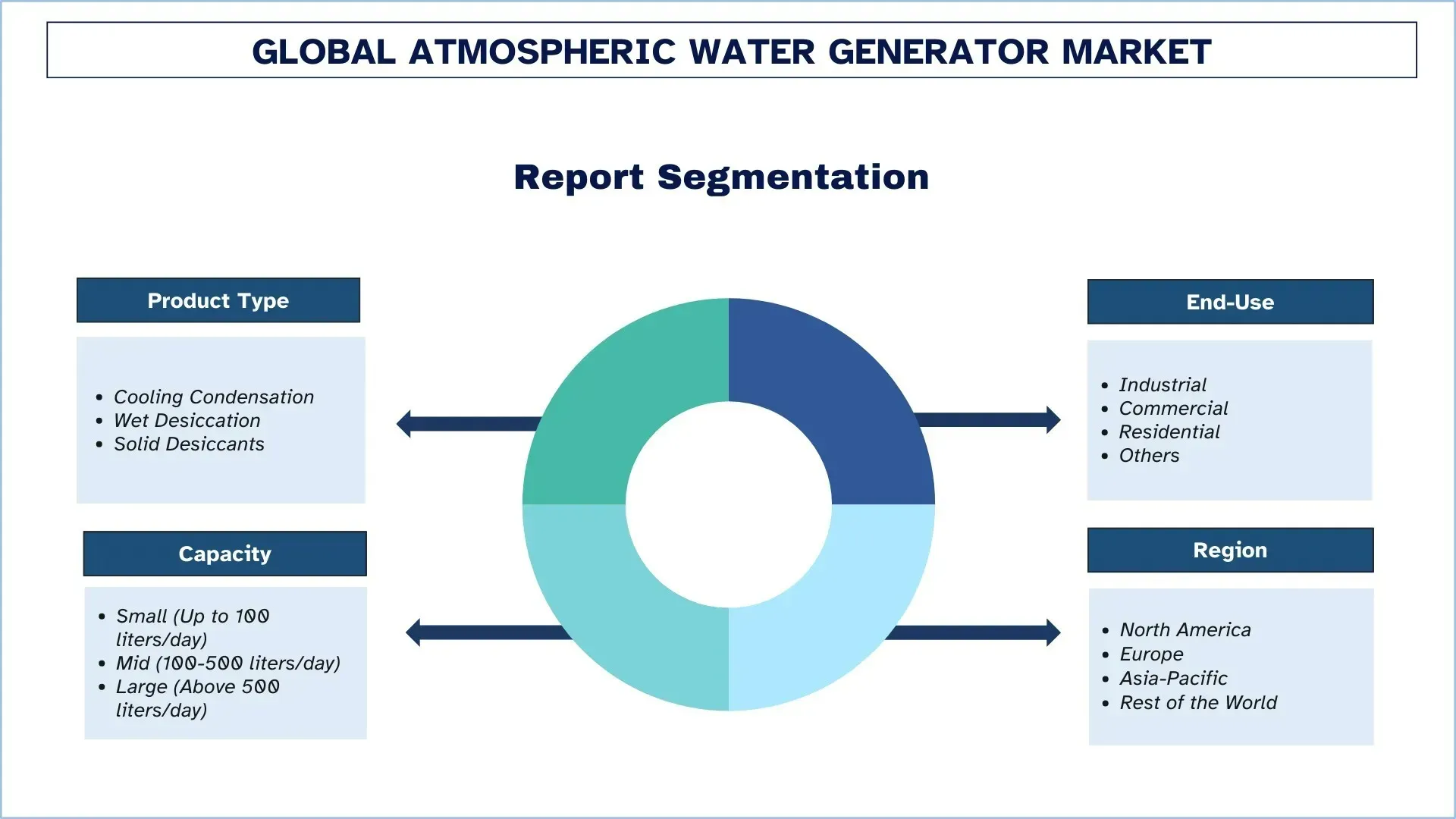
Emphasis on Product Type (Cooling Condensation, Wet Desiccation, and Solid Desiccants); Capacity (Small {Up to 100 liters/day}, Mid {100-500 liters/day}, and Large {Above 500 liters/day}); End-Use (Industrial, Commercial, Residential, and Others); and Region/Country
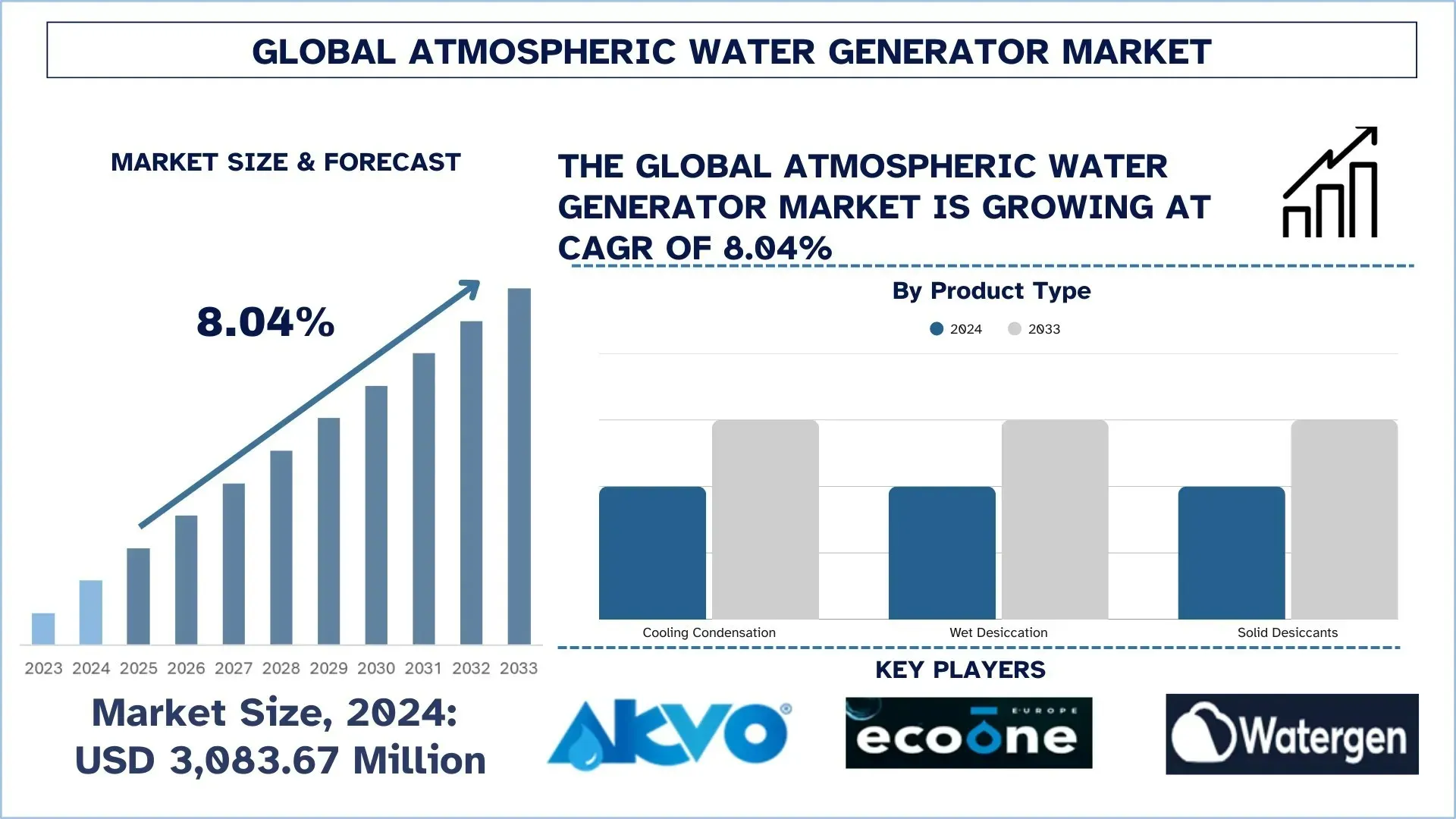
Global Atmospheric Water Generator Market Size & Forecast
The Global Atmospheric Water Generator Market was valued at USD 3,083.67 million in 2024 and is expected to grow at a strong CAGR of around 8.04% during the forecast period (2025-2033F), driven by increasing water scarcity, rising demand for decentralized and sustainable water sources, technological advancements in water-generation systems, growing adoption in commercial and residential sectors, and supportive government initiatives promoting alternative water solutions.
Atmospheric Water Generator Market Analysis
Atmospheric water generators produce potable water by extracting moisture from ambient air, offering a decentralized and sustainable solution. Adding to this, the atmospheric water generator market is experiencing rapid growth as global concerns about water scarcity and declining freshwater resources continue to rise. The increasing population, rapid urbanization, and industrial expansion are placing significant pressure on conventional water supplies, promoting the adoption of alternative water generation technologies. At the same time, technological advancements, including energy-efficient systems and improved filtration processes, are strengthening product performance and reliability. For instance, in June 2023, researchers at the Massachusetts Institute of Technology (MIT) created a salt-infused hydrogel that can collect water from desert air, effectively absorbing and retaining moisture. This represents a promising advance in materials for upcoming atmospheric water generation systems. Furthermore, increasing demand from residential, commercial, and industrial sectors, along with rising investments in sustainable water infrastructure, is fueling global market growth.
Global Atmospheric Water Generator Market Trends
This section discusses the key market trends that are influencing the various segments of the global atmospheric water generator market, as found by our team of research experts.
Integration of Smart Technologies and Renewable Energy in Atmospheric Water Generators
The integration of smart technologies and renewable energy is a major trend in the atmospheric water generator market. Manufacturers are integrating Internet of Things (IoT) sensors, remote monitoring systems, and automated controls to improve operational efficiency and maximize water output. Additionally, using renewable energy sources like solar power helps lower energy consumption and operating costs. For instance, in September 2025, Rainmaker Worldwide Inc. unveiled its ATMOCELL 5K atmospheric water generator. The system integrates with the SmartCell monitoring platform for real-time performance tracking, predictive maintenance, and water-quality monitoring. Furthermore, the system can also operate on solar, wind, grid, or hybrid energy sources. These improvements allow AWG systems to operate more sustainably, especially in off-grid and water-scarce regions. As demand for environmentally friendly water solutions rises, smart, energy-efficient atmospheric water generators are gaining significant global attention.
Atmospheric Water Generator Industry Segmentation
This section provides an analysis of the key trends in each segment of the global atmospheric water generator market report, along with forecasts at the global, regional, and country levels for 2025-2033.
The Cooling Condensation Segment Dominates the Global Atmospheric Water Generator Market
Based on product type, the market is categorized into cooling condensation, wet desiccation, and solid desiccants. In 2024, cooling condensation holds the largest share of the atmospheric water generator market due to its established technology, reliable operation, and popular use. It works by cooling humid air to extract water, which makes it suitable for areas with moderate to high humidity. Along with this, its straightforward design, lower operational complexity, and extensive application in residential, commercial, and small industrial sectors have solidified its market position. However, wet desiccation is showing the fastest growth because it can efficiently capture moisture even in low-humidity conditions. This technology uses hygroscopic liquids to absorb atmospheric moisture, making it suitable for dry, water-scarce regions facing rising water shortages. For instance, in January 2025, Spout unveiled a countertop atmospheric water generator. It uses a rotating zeolite-based desiccant wheel to collect moisture from the air and produce drinking water.
The Large (above 500 liters/day) Segment Dominates the Global Atmospheric Water Generator Market.
Based on the capacity, the market is categorized into small (up to 100 liters/day), mid (100-500 liters/day), and large (above 500 liters/day). In 2024, large-capacity (above 500 liters/day) atmospheric water generators hold the largest market share because of their extensive use in commercial facilities, industrial operations, the hospitality sector, and community water supply projects, where high-volume water production is essential. Also, governments, institutions, and disaster-relief programs prefer large-scale systems for centralized, continuous water generation. However, small capacity (up to 100 liters/day) is showing the fastest growth because of rising adoption in households, small offices, and remote locations. Their compact design, lower installation costs, improved energy efficiency, and rising consumer awareness of alternative drinking water solutions are driving global demand. For instance, in March 2025, Aeronero launched the Atmospheric Water Generator 2.0, made for homes and small businesses, emphasizing the increasing demand for compact and energy-efficient AWG systems.
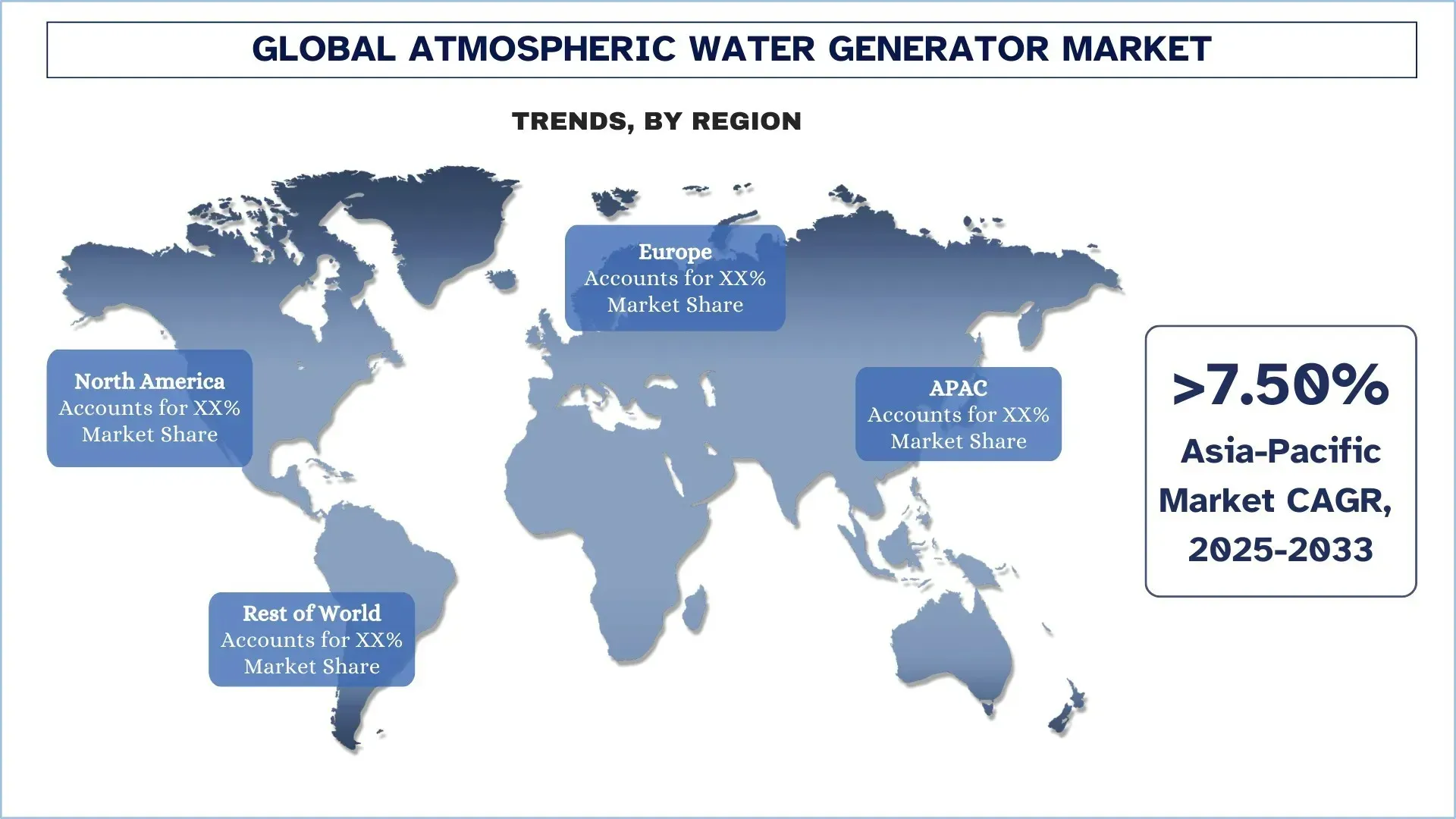
The Asia-Pacific holds the largest market share in the global atmospheric water generator market
The Asia-Pacific region holds the largest share of the atmospheric water generator market due to growing water scarcity, rapid urbanization, and rising population across countries such as India, China, and Southeast Asian nations. At the same time, many regions are grappling with falling groundwater levels and limited access to clean drinking water, prompting the adoption of alternative water-generation methods. For instance, in February 2025, ICICI Bank implemented atmospheric water generators at multiple offices throughout India. These devices can produce approximately 8,000 liters of drinking water daily from atmospheric moisture. Additionally, growing investments in sustainable water solutions, increasing commercial infrastructure, and rising awareness of decentralized water sources are boosting market growth. Furthermore, government programs, technological advances, and rising demand from residential, industrial, and disaster-relief sectors are driving market expansion throughout the region.
China held a Dominant share of the Asia-Pacific Atmospheric Water Generator Market in 2024
China holds the largest share of the global atmospheric water generator market because of its strong production capacity and early adoption of innovative water technologies. Through substantial investment in innovation and manufacturing, the country has achieved cost-effective, large-scale deployment of atmospheric water generator technology. At the same time, rising demand from commercial facilities, industrial operations, and public infrastructure projects has supported widespread installation of AWG systems. For instance, in December 2024, China invested around USD 187.8 billion in water conservancy projects, including 47,000 water infrastructure initiatives, to improve water security and supply systems. On the contrary, the government's emphasis on innovative water technologies and environmental sustainability has further accelerated adoption. Furthermore, the presence of various domestic technology providers and the growth of distribution networks continue to strengthen China's leadership in the global market.
Atmospheric Water Generator Industry Competitive Landscape
The global atmospheric water generator market is competitive, with several global and international market players. The key players are adopting different growth strategies to enhance their market presence, such as partnerships, agreements, collaborations, geographical expansions, and mergers and acquisitions.
Top Atmospheric Water Generator Market Companies
Some of the major players in the market are Akvo Atmospheric Water Systems Pvt. Ltd., ECOONE EUROPE s.r.o., Watergen (Michael Mirilashvili), GENAQ, EcoloBlue, SkyH2O, Atlantis Solar, SunToWater Technologies LLC., AirOWater, and Drinkable Air Technologies.
Recent Developments in the Atmospheric Water Generator Market
In October 2025, Beyond Water launched its atmospheric water generation technology in the United States, introducing a large-scale facility producing purified drinking water from air to address water scarcity sustainably.
In September 2025, Le Méridien New Delhi partnered with K2 Atmospheric Mineral Water and Watergen to launch India’s first atmospheric water initiative, producing mineral-enriched drinking water from air for guests sustainably.
Global Atmospheric Water Generator Market Report Coverage
Report Attribute | Details |
Base year | 2024 |
Forecast period | 2025-2033 |
Growth momentum | Accelerate at a CAGR of 8.04% |
Market size 2024 | USD 3,083.67 million |
Regional analysis | North America, Europe, APAC, Rest of the World |
Major contributing region | The Asia-Pacific region is expected to dominate the market during the forecast period. |
Key countries covered | U.S., Canada, Germany, U.K., Spain, Italy, France, China, Japan, and India. |
Companies profiled | Akvo Atmospheric Water Systems Pvt. Ltd., ECOONE EUROPE s.r.o., Watergen (Michael Mirilashvili), GENAQ, EcoloBlue, SkyH2O, Atlantis Solar, SunToWater Technologies LLC., AirOWater, and Drinkable Air Technologies. |
Report Scope | Market Trends, Drivers, and Restraints; Revenue Estimation and Forecast; Segmentation Analysis; Demand and Supply Side Analysis; Competitive Landscape; Company Profiling |
Segments Covered | By Product Type, By Capacity, By End-Use, and By Region/Country |
Reasons to Buy the Atmospheric Water Generator Market Report:
The study includes market sizing and forecasting analysis confirmed by authenticated key industry experts.
The report briefly reviews overall industry performance at a glance.
The report covers an in-depth analysis of prominent industry peers, primarily focusing on key business financials, type portfolios, expansion strategies, and recent developments.
Detailed examination of drivers, restraints, key trends, and opportunities prevailing in the industry.
The study comprehensively covers the market across different segments.
Deep dive regional level analysis of the industry.
Customization Options:
The global atmospheric water generator market can further be customized as per the requirements or any other market segment. Besides this, UnivDatos understands that you may have your own business needs; hence, feel free to contact us to get a report that completely suits your requirements.
Table of Content
Research Methodology for the Global Atmospheric Water Generator Market Analysis (2023-2033)
We analyzed the historical market, estimated the current market, and forecasted the future market of the global atmospheric water generator market to assess its application in major regions worldwide. We conducted exhaustive secondary research to gather historical market data and estimate the current market size. To validate these insights, we carefully reviewed numerous findings and assumptions. Additionally, we conducted in-depth primary interviews with industry experts across the atmospheric water generator value chain. After validating market figures through these interviews, we used both top-down and bottom-up approaches to forecast the overall market size. We then employed market breakdown and data triangulation methods to estimate and analyze the market size of industry segments and sub-segments.
Market Engineering
We employed the data triangulation technique to finalize the overall market estimation and derive precise statistical numbers for each segment and sub-segment of the global atmospheric water generator market. We split the data into several segments and sub-segments by analyzing various parameters and trends, including product type, capacity, end-use, and region within the global atmospheric water generator market.
The Main Objective of the Global Atmospheric Water Generator Market Study
The study identifies current and future trends in the global atmospheric water generator market, providing strategic insights for investors. It highlights regional market attractiveness, enabling industry participants to tap into untapped markets and gain a first-mover advantage. Other quantitative goals of the studies include:
Market Size Analysis: Assess the current and forecast market size of the global atmospheric water generator market and its segments in terms of value (USD).
Atmospheric Water Generator Market Segmentation: Segments in the study include areas of product type, capacity, end-use, and region.
Regulatory Framework & Value Chain Analysis: Examine the regulatory framework, value chain, customer behavior, and competitive landscape of the atmospheric water generator industry.
Regional Analysis: Conduct a detailed regional analysis for key areas such as Asia Pacific, Europe, North America, and the Rest of the World.
Company Profiles & Growth Strategies: Company profiles of the atmospheric water generator market and the growth strategies adopted by the market players to sustain the fast-growing market.
Frequently Asked Questions FAQs
Q1: What is the global atmospheric water generator market’s current market size and growth potential?
As of 2024, the global atmospheric water generator market is valued at USD 3,083.67 million and is projected to grow at an impressive CAGR of 8.04% from 2025 to 2033. The market growth is driven by increasing water scarcity, rising demand for sustainable water generation technologies, and growing adoption of atmospheric water generators across residential, commercial, and industrial sectors.
Q2: Which segment has the largest share of the global atmospheric water generator market by product type category?
Cooling condensation leads the global atmospheric water generator market. This technology is widely adopted due to its high efficiency in extracting moisture from humid air and its increasing use in commercial and residential water generation systems.
Q3: What are the driving factors for the growth of the global atmospheric water generator market?
Top growth drivers of the atmospheric water generator market include:
• Increasing Demand for Clean Water
• Growing Water Scarcity
• Supportive Government Initiatives
These factors are encouraging the adoption of atmospheric water generation technologies worldwide.
Q4: What are the emerging technologies and trends in the global atmospheric water generator market?
Emerging trends in the atmospheric water generator market include:
• Integration of Smart Technologies and Renewable Energy in Atmospheric Water Generators
• Advancements in Desiccant Materials and Heat Exchanger Technologies
Q5: What are the key challenges in the global atmospheric water generator market?
Key challenges in the atmospheric water generator market include:
• High Initial Cost
• High Energy Consumption
Q6: Which region dominates the global atmospheric water generator market?
Asia-Pacific dominates the global atmospheric water generator market, driven by rapid urbanization, increasing water stress, population growth, and rising investments in alternative water generation technologies across countries such as China, India, and Southeast Asian nations.
Q7: Who are the key competitors in the global atmospheric water generator market?
Top players in the atmospheric water generator industry include:
• Akvo Atmospheric Water Systems Pvt. Ltd.
• ECOONE EUROPE s.r.o.
• Watergen (Michael Mirilashvili)
• GENAQ
• EcoloBlue
• SkyH2O
• Atlantis Solar
• SunToWater Technologies LLC.
• AirOWater
• Drinkable Air Technologies
Q8: What are the key investment opportunities in the global atmospheric water generator market?
The atmospheric water generator market presents strong investment opportunities driven by rising water scarcity, increasing demand for decentralized water solutions, and growing adoption in commercial, industrial, and residential sectors. Opportunities are particularly emerging in renewable energy–powered AWGs, off-grid water solutions, and deployments in water-stressed regions across Asia-Pacific, the Middle East, and Africa
Q9: Which end-use industries are driving demand in the atmospheric water generator market?
Major end-use sectors driving demand for atmospheric water generators include residential, commercial, and industrial applications. Additionally, sectors such as healthcare, hospitality, military, disaster relief, and remote infrastructure projects are increasingly adopting AWG systems to ensure reliable access to clean drinking water in water-scarce environments.
Related Reports
Customers who bought this item also bought
India Decarbonization HVAC Market: Current Analysis and Forecast (2026-2034)
Emphasis on Product Type (Heating Equipment, Ventilation Equipment, Air Conditioning Equipment, Others); Decarbonization Type (Direct, Indirect); Capacity (Up to 5 Tons, 5-20 Tons, Above 20 Tons); End User (Commercial Buildings, Residential Buildings, Industrial Facilities, Healthcare Facilities, Data Centers, Others); and Region/States
Midstream Oil & Gas Filtration Market: Current Analysis and Forecast (2026-2034)
Emphasis on Filter Technology (Coalescer Filters, Cartridge Filters, Mechanical Filters, Bag Filters, Particulate Filters, Activated Carbon Filters, Strainers, and Others); by Application (Gas Processing Plants, Compression Stations, Storage And Distribution, Pipeline Transportation, LNG Processing, and Others); by Filtration Stage (Oil Filtration and Gas Filtration), by End User (Refineries and Petrochemical Industry), and Region/Country
Hydrogen-Powered Hospital Backup Systems Market: Current Analysis and Forecast (2026-2034)
Emphasis on System Type (Portable, Stationary, Hybrid); Power Capacity (Below 100 kW, 100–500 kW, and Above 500 kW); End-User (Public Hospitals, Private Hospitals, Specialty Hospitals, and Emergency Care Facilities); and Region/Country
Wind LiDAR Market: Current Analysis and Forecast (2025-2033)
Emphasis on Product Type (Vertical Profiling Wind LiDAR, Ground-Based Wind LiDAR, Nacelle-Mounted Wind LiDAR, Airborne Wind LiDAR, and Others); Component (Sensor, Navigator, Laser, and Others); Location (Onshore and Offshore); Application (Wind Power, Meteorology & Environment, and Aviation); and Region/Country