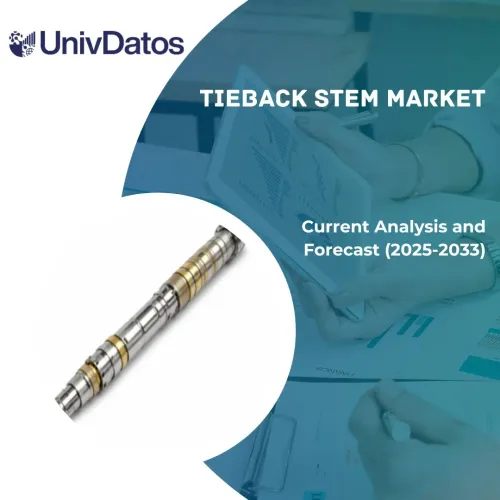
Tieback Stem Market: Current Analysis and Forecast (2025-2033)
Emphasis on Drilling Type (Horizontal and Vertical); Well Completion (Middle/Lower and Upper); Application (Onshore and Offshore); and Region/Country
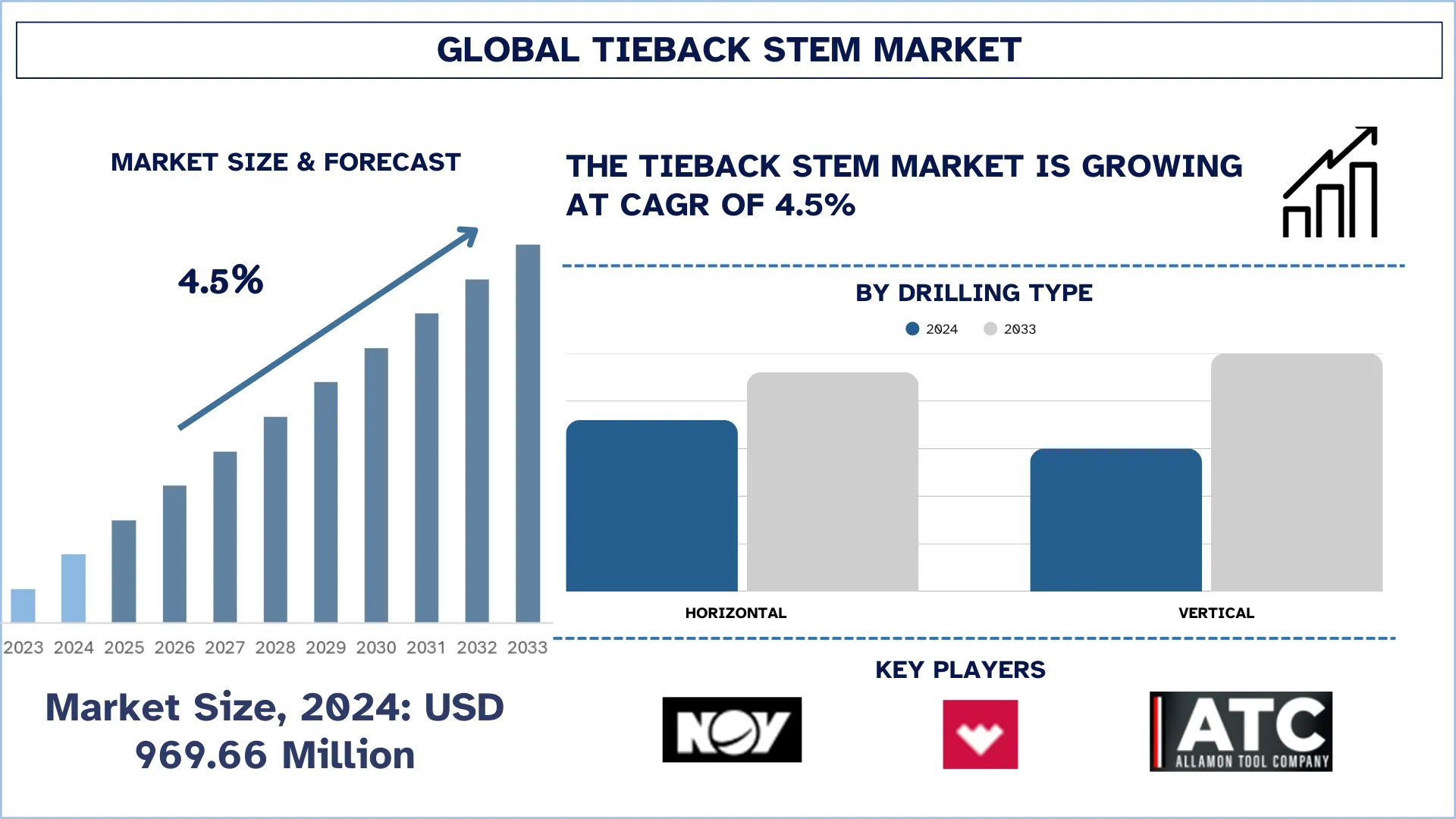
Global Tieback Stem Market Size & Forecast
The global tieback stem market was valued at USD 969.66 million in 2024 and is expected to grow at a strong CAGR of around 4.5% during the forecast period (2025-2033F), driven by the rising deepwater and ultra-deepwater exploration as operators target complex offshore reservoirs requiring robust subsea wellhead connections.
Tieback Stem Market Analysis
A tieback stem is a high-intensity mechanical connector applied in offshore drilling in the oil and gas industry to connect a subsea wellhead system with surface pressure control devices, including the blowout preventer (BOP) and marine riser. It grants stability and integrity of pressure between the wellhead installed on the seabed and the floating drilling platform, which drills and completes wells in the deepwater and ultra-deepwater environments safely.
The tieback stem market is expanding because of the rising levels of deepwater and ultra-deepwater exploration programs, as the operators turn to the complex offshore reserves instead of mature onshore and shallow-water reserves. Growing investments in subsea field development and long-distance tiebacks to existing floating production facilities have increased the demand for high-integrity wellhead connection systems. There is also the development of high-pressure, high-temperature (HPHT) drilling and the necessity of stable pressure control parts, which promote the adoption of products.
Global Tieback Stem Market Trends
This section discusses the key market trends that are influencing the various segments of the global tieback stem market, as found by our team of research experts.
Shift Toward Modular Subsea Systems
The movement towards modular underwater systems is becoming one of the major future trends in the tieback stem market as operators are becoming more concerned with the cost-effectiveness of the systems, faster deployment, and complexity offshore. Modular designs enable tieback stem and associated wellhead products to be engineered, standardized, and easily fitted with the existing subsea infrastructure, without a high degree of customization or delays during the development of a project. The methodology reduces lead times, minimizes installation risks, and improves operational flexibility, particularly in deepwater and ultra-deepwater developments.
Tieback Stem Industry Segmentation
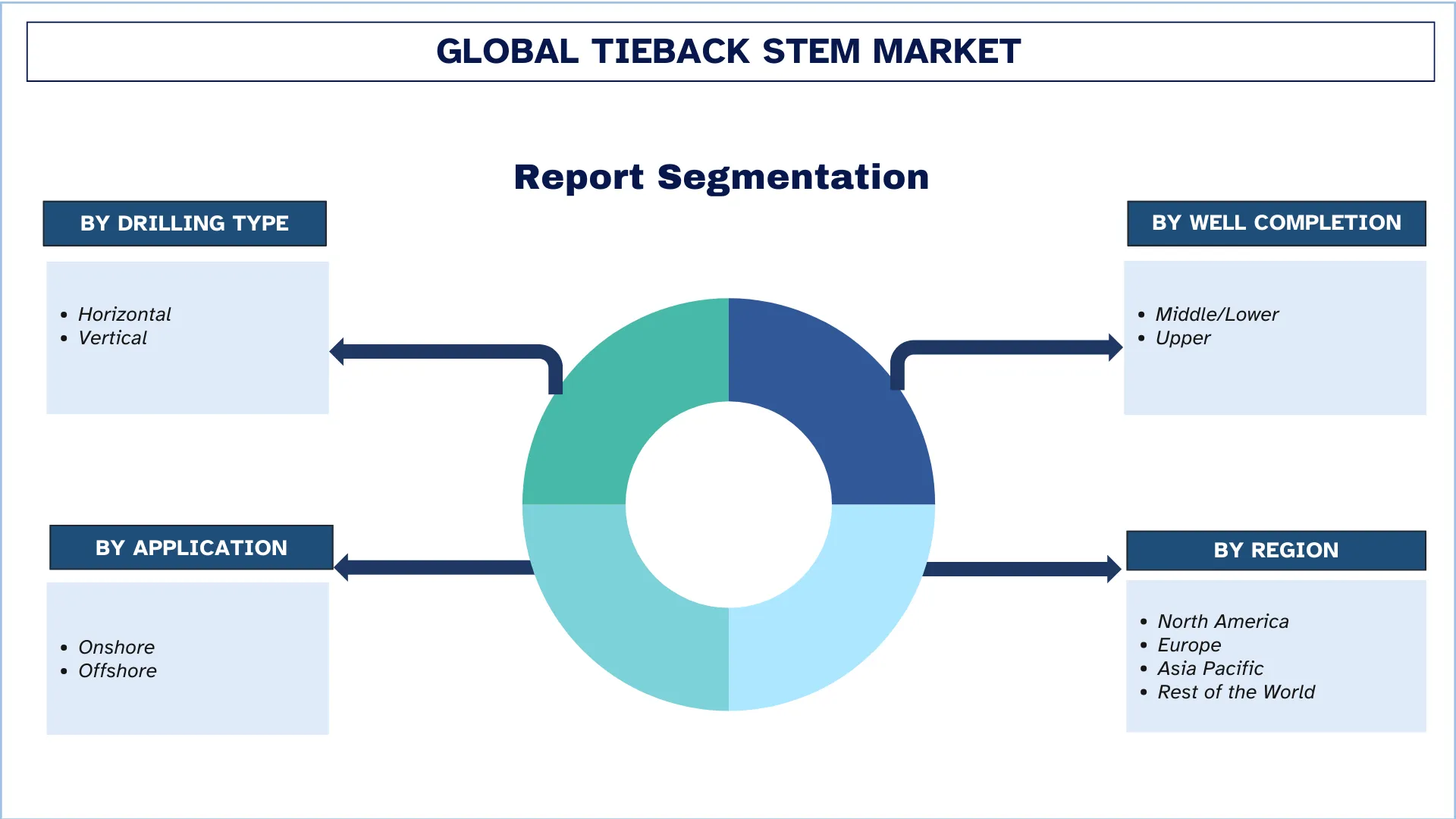
This section provides an analysis of the key trends in each segment of the global tieback stem market report, along with forecasts at the global, regional, and country levels for 2025-2033.
The Vertical Segment Dominates the Global Tieback Stem Market
Based on the drilling type category, the market is categorized into horizontal and vertical. Among these, the vertical segment currently holds the maximum market share because offshore exploration and subsea wellhead installation always start with vertical drilling to achieve well integrity and structural alignment, and tieback stems are mainly applied in pressure control and riser connection. Deepwater developments are still predominantly vertical because there is simpler well construction and less complexity. The horizontal segment is, however, set to grow at an accelerated rate in the future, owing to the growing rate of usage of directional drilling in order to make the most contact with the reservoirs, in order to increase the rate of recovery and efficiency of production in the complex offshore fields.
The Offshore Segment Dominates the Global Tieback Stem Market.
Based on the application category, the market is segmented into onshore and offshore. Among these, the offshore segment holds the maximum market share, because tieback stems are mostly applied in offshore drilling offshore wellhead systems, where the secure control of pressure is necessary and structural attachment to surface BOP systems is imperative, especially in deepwater and ultra-deepwater applications. Onshore uses are limited because of less complex wellhead designs and no subsea risers. The offshore segment will also be the fastest growing in the future due to the growing investments in deepwater exploration, the expansion of subsea tieback projects to the existing floating production facilities, and the growth of development activities in the emerging offshore basins around the world.
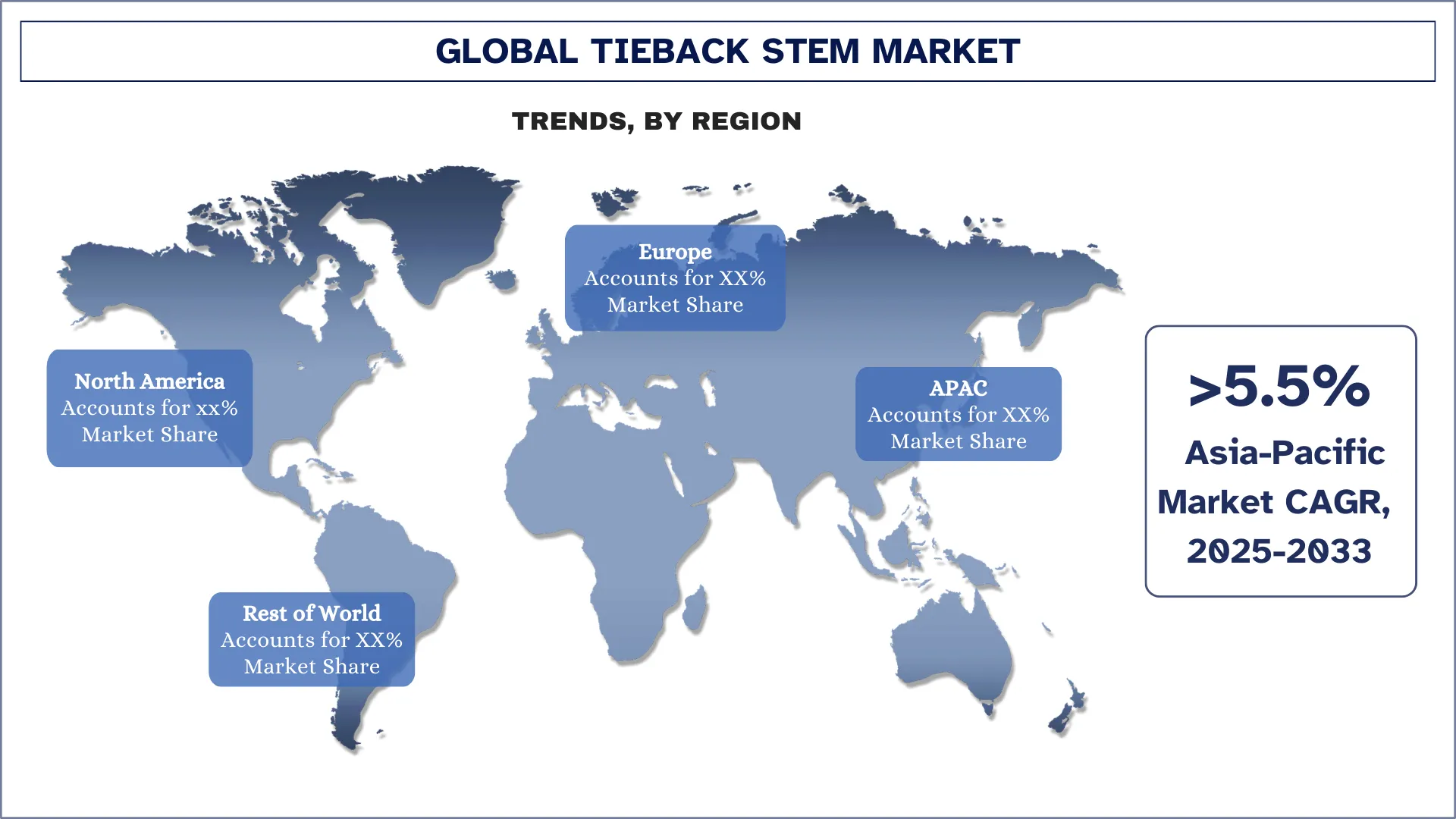
The Asia-Pacific region is the Fastest-Growing region in the Global Tieback Stem market
The Asia-Pacific region has the most promising tieback stems market, owing to growing offshore exploration and production activities driven by rising energy consumption and import reliance. Countries such as China, India, Malaysia, and Australia are developing deepwater and marginal field projects to boost local hydrocarbon production. Upstream capital expenditure by national oil companies and regional operators is growing, especially in the South China Sea and offshore India. Also, favorable government policies, increased investment into undersea infrastructure, and implementation of technologies with high pressure and high temperatures in the wells are driving the need to use advanced tieback stem systems in new offshore development projects.
China held a Dominant share of the Asia-Pacific Tieback Stem Market in 2024
China held the dominant share of the Asia-Pacific tieback stem market because it has a large base of offshore production and seems to be constantly drilling and developing new and mature offshore fields. Energy security has been a priority in the country, which has resulted in long-term investments in offshore drilling, especially in the deepwater basins. Due to the expansion of production systems under the sea, the increased use of advanced well-completion technologies, and the emphasis on the recovery rates of already existing fields, the growth of the demand for tieback stems has been constant. Moreover, the powerful financial support of state-owned energy firms and the current activities on the modernization of infrastructure assisted China in cementing its leading role in the regional market environment.
Tieback Stem Industry Competitive Landscape
The global tieback stem market is competitive, with several global and international market players. The key players are adopting different growth strategies to enhance their market presence, such as partnerships, agreements, collaborations, geographical expansions, and mergers and acquisitions.
Top Tieback Stem Market Companies
Some of the major players in the market are NOV Inc., Weatherford, Allamon Tool Company, SLB Limited, Wellcare Oil Tools Private Limited, Baker Hughes Company, Halliburton Energy Services, Inc., Mackeral Oil Tools Pvt. Ltd., Techmaster Oil Tools, and Torrent Oiltools.
Recent Developments in the Tieback Stem Market
In November 2025, DeepOcean was awarded a subsea tie-back contract to carry out subsea construction and tie-in work for a field being developed as a subsea tieback to an existing host facility on the UK Continental Shelf. The scope included installation of a flexible production riser, flowline, and umbilical, as well as protection and commissioning of the new infrastructure, with offshore operations planned in phased execution.
In May 2024, SLB’s OneSubsea joint venture was awarded a contract by Equinor for Phase 3, Stage 2 of the North Sea Troll project to deliver and accelerate a subsea tieback to existing infrastructure offshore Norway. The project aimed to boost gas production through standardised subsea systems tied back to the Troll A platform under an expanded long-term agreement.
Global Tieback Stem Market Report Coverage
Report Attribute | Details |
Base year | 2024 |
Forecast period | 2025-2033 |
Growth momentum | Accelerate at a CAGR of 4.5% |
Market size 2024 | USD 969.66 million |
Regional analysis | North America, Europe, APAC, Rest of the World |
Major contributing region | The North America region is expected to dominate the market during the forecast period. |
Key countries covered | U.S., Canada, Germany, U.K., Spain, Italy, France, China, Japan, and India. |
Companies profiled | NOV Inc., Weatherford, Allamon Tool Company, SLB Limited, Wellcare Oil Tools Private Limited, Baker Hughes Company, Halliburton Energy Services, Inc., Mackeral Oil Tools Pvt. Ltd., Techmaster Oil Tools, and Torrent Oiltools. |
Report Scope | Market Trends, Drivers, and Restraints; Revenue Estimation and Forecast; Segmentation Analysis; Demand and Supply Side Analysis; Competitive Landscape; Company Profiling |
Segments Covered | By Drilling Type, By Well Completion, By Application, and By Region/Country |
Reasons to Buy the Tieback Stem Market Report:
The study includes market sizing and forecasting analysis confirmed by authenticated key industry experts.
The report briefly reviews overall industry performance at a glance.
The report covers an in-depth analysis of prominent industry peers, primarily focusing on key business financials, type portfolios, expansion strategies, and recent developments.
Detailed examination of drivers, restraints, key trends, and opportunities prevailing in the industry.
The study comprehensively covers the market across different segments.
Deep dive regional-level analysis of the industry.
Customization Options:
The global Tieback Stem market can further be customized as per the requirements or any other market segment. Besides this, UnivDatos understands that you may have your own business needs; hence, feel free to contact us to get a report that completely suits your requirements.
Table of Content
Research Methodology for the Global Tieback Stem Market Analysis (2023-2033)
We analyzed the historical market, estimated the current market, and forecasted the future market of the global tieback stem market to assess its application in major regions worldwide. We conducted exhaustive secondary research to gather historical market data and estimate the current market size. To validate these insights, we carefully reviewed numerous findings and assumptions. Additionally, we conducted in-depth primary interviews with industry experts across the tieback stem value chain. After validating market figures through these interviews, we used both top-down and bottom-up approaches to forecast the overall market size. We then employed market breakdown and data triangulation methods to estimate and analyze the market size of industry segments and sub-segments.
Market Engineering
We employed the data triangulation technique to finalize the overall market estimation and derive precise statistical numbers for each segment and sub-segment of the global tieback stem market. We split the data into several segments and sub-segments by analyzing various parameters and trends, including drilling type, well completion, application, and regions within the global tieback stem market.
The Main Objective of the Global Tieback Stem Market Study
The study identifies current and future trends in the global tieback stem market, providing strategic insights for investors. It highlights regional market attractiveness, enabling industry participants to tap into untapped markets and gain a first-mover advantage. Other quantitative goals of the studies include:
Market Size Analysis: Assess the current and forecast market size of the global tieback stem market and its segments in terms of value (USD).
Tieback Stem Market Segmentation: Segments in the study include areas of drilling type, well completion, application, and region.
Regulatory Framework & Value Chain Analysis: Examine the regulatory framework, value chain, customer behavior, and competitive landscape of the tieback stem industry.
Regional Analysis: Conduct a detailed regional analysis for key areas such as Asia Pacific, Europe, North America, and the Rest of the World.
Company Profiles & Growth Strategies: Company profiles of the tieback stem market and the growth strategies adopted by the market players to sustain the fast-growing market.
Frequently Asked Questions FAQs
Q1: What is the global tieback stem market’s current market size and growth potential?
As of 2024, the global tieback stem market size is USD 969.66 million. The market is projected to grow at a strong CAGR of 4.5% between 2025 and 2033, driven by increasing offshore drilling activities, rising deepwater exploration projects, and growing demand for advanced subsea completion systems.
Q2: Which segment has the largest share of the global tieback stem market by drilling type category?
The vertical drilling segment currently holds the largest share of the global tieback stem market. Vertical wells remain widely used in offshore and conventional oil & gas fields due to their operational simplicity and cost efficiency.
Q3: What are the driving factors for the growth of the global tieback stem market?
Top growth drivers of the tieback stem market include:
• Growth in Deepwater & Ultra-Deepwater Exploration
• Aging Offshore Infrastructure Replacement
• Technological Advancements in Subsea Systems
Q4: What are the emerging technologies and trends in the global tieback stem market?
Emerging trends in the tieback stem market include:
• Shift Toward Modular Subsea Systems
• Increased Focus on Lightweight High-Strength Alloys
Q5: What are the key challenges in the global tieback stem market?
Key challenges in the tieback stem market include:
• High Capital & Manufacturing Costs
• Stringent Regulatory & Certification Requirements
Q6: Which region dominates the global tieback stem market?
North America dominates the global tieback stem market, primarily due to strong offshore drilling activities, advanced oilfield infrastructure, and the presence of major oilfield service providers.
Q7: Who are the key competitors in the global tieback stem market?
Top players in the tieback stem industry include:
• NOV Inc.
• Weatherford
• Allamon Tool Company
• SLB Limited
• Wellcare Oil Tools Private Limited
• Baker Hughes Company
• Halliburton Energy Services, Inc.
• Mackeral Oil Tools Pvt. Ltd.
• Techmaster Oil Tools
• Torrent Oiltools
Q8: What are the investment opportunities and future growth prospects in the tieback stem market through 2033?
The tieback stem market presents strong investment opportunities driven by rising deepwater and ultra-deepwater exploration, offshore brownfield redevelopment, and aging infrastructure replacement. Increasing capital expenditure in offshore projects across North America, Brazil, West Africa, and the Middle East is expected to create sustained demand.
Q9: How are regulatory standards and offshore compliance requirements shaping product innovation in the tieback stem industry?
Stringent offshore safety regulations and international certification standards are significantly influencing tieback stem design and manufacturing processes. Compliance with API standards, environmental regulations, and subsea pressure-control requirements is driving manufacturers to develop corrosion-resistant alloys, lightweight high-strength materials, and enhanced sealing technologies.
Related Reports
Customers who bought this item also bought
India Decarbonization HVAC Market: Current Analysis and Forecast (2026-2034)
Emphasis on Product Type (Heating Equipment, Ventilation Equipment, Air Conditioning Equipment, Others); Decarbonization Type (Direct, Indirect); Capacity (Up to 5 Tons, 5-20 Tons, Above 20 Tons); End User (Commercial Buildings, Residential Buildings, Industrial Facilities, Healthcare Facilities, Data Centers, Others); and Region/States
Midstream Oil & Gas Filtration Market: Current Analysis and Forecast (2026-2034)
Emphasis on Filter Technology (Coalescer Filters, Cartridge Filters, Mechanical Filters, Bag Filters, Particulate Filters, Activated Carbon Filters, Strainers, and Others); by Application (Gas Processing Plants, Compression Stations, Storage And Distribution, Pipeline Transportation, LNG Processing, and Others); by Filtration Stage (Oil Filtration and Gas Filtration), by End User (Refineries and Petrochemical Industry), and Region/Country
Hydrogen-Powered Hospital Backup Systems Market: Current Analysis and Forecast (2026-2034)
Emphasis on System Type (Portable, Stationary, Hybrid); Power Capacity (Below 100 kW, 100–500 kW, and Above 500 kW); End-User (Public Hospitals, Private Hospitals, Specialty Hospitals, and Emergency Care Facilities); and Region/Country
Wind LiDAR Market: Current Analysis and Forecast (2025-2033)
Emphasis on Product Type (Vertical Profiling Wind LiDAR, Ground-Based Wind LiDAR, Nacelle-Mounted Wind LiDAR, Airborne Wind LiDAR, and Others); Component (Sensor, Navigator, Laser, and Others); Location (Onshore and Offshore); Application (Wind Power, Meteorology & Environment, and Aviation); and Region/Country