Africa Solar Photovoltaic (PV) Market: Current Analysis and Forecast (2025-2033)
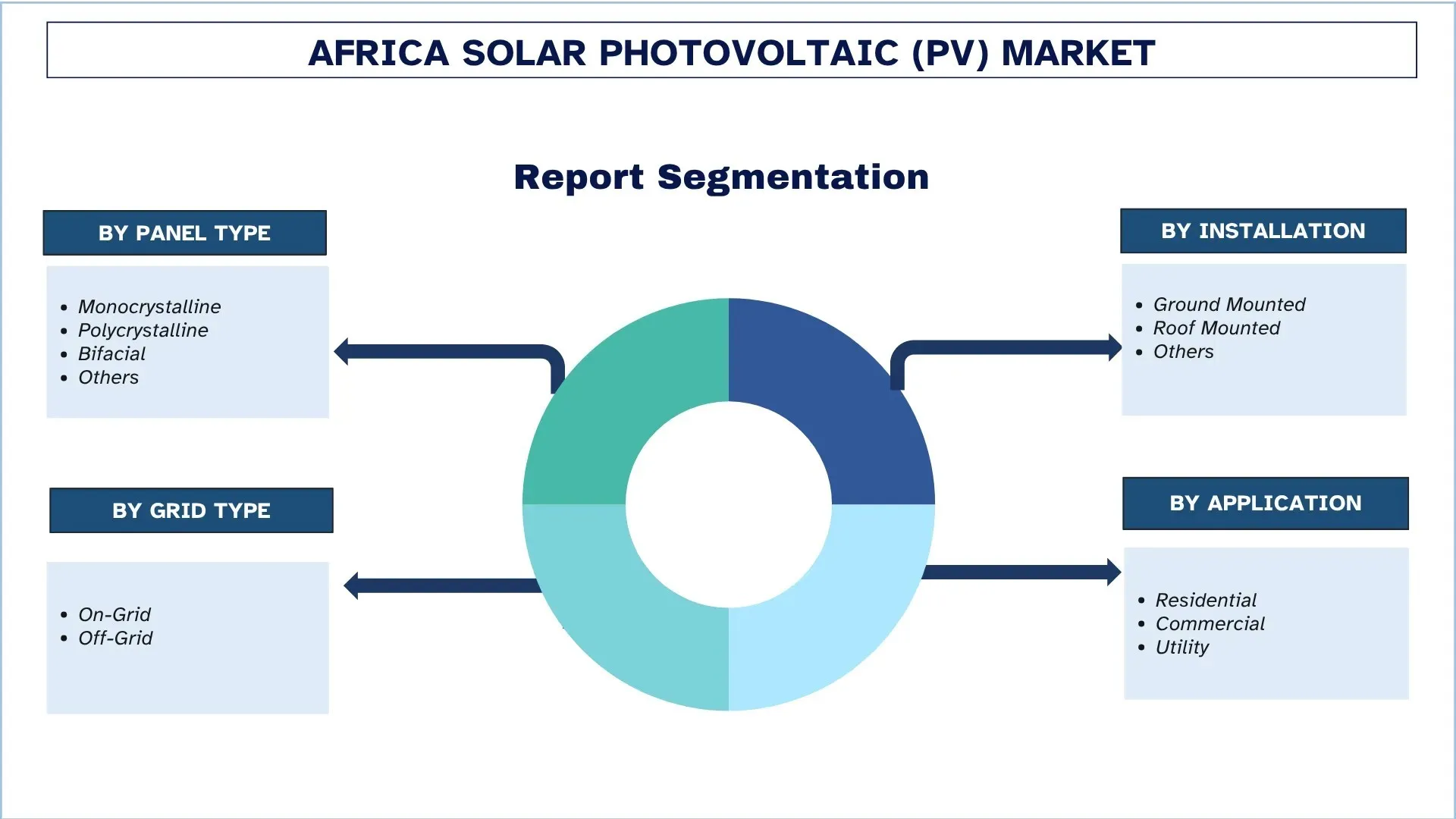
Emphasis By Panel Type (Monocrystalline, Polycrystalline, Bifacial, and Others), By Installation (Ground-Mounted, Roof-Mounted, and Others), By Grid Type (On-Grid, Off-Grid), By Application (Residential, Commercial, and Utility), By Country (Egypt, South Africa, Nigeria, Uganda, Kenya, Rest of Africa)
Africa Solar Photovoltaic (PV) Market Size & Forecast
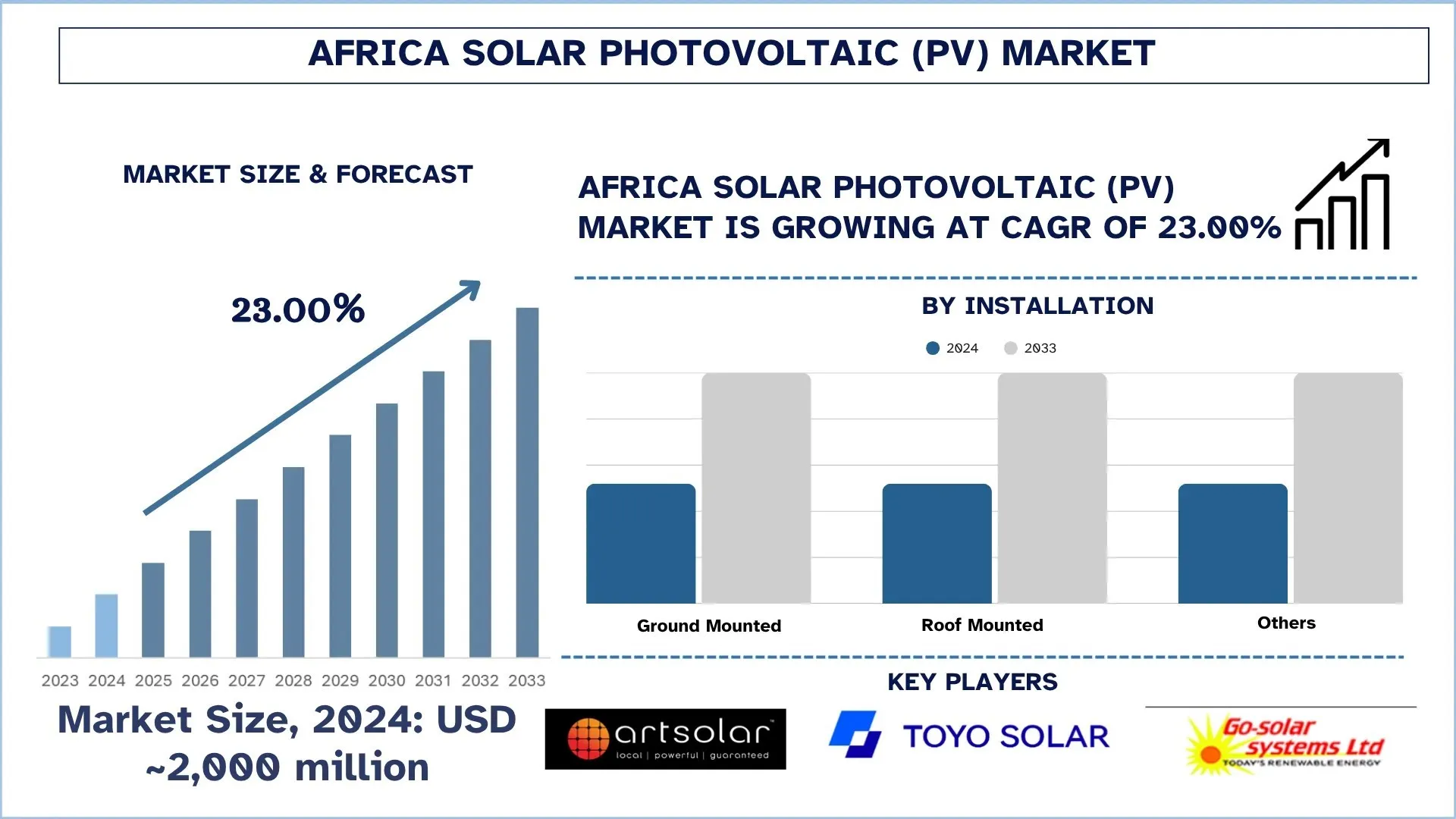
The Africa Solar Photovoltaic (PV) Market was valued at USD 2,000 million in 2024 and is expected to grow at a strong CAGR of around 23.00% during the forecast period (2025- 2033F). Large unmet electricity demand and grid deficits, falling solar PV costs, and increasing competitiveness have led to the market rise.
Africa Solar Photovoltaic (PV) Market Analysis
The African solar photovoltaic (PV) market is witnessing a rapid shift due to a massive rise in total energy consumption, various notable government policies, and increased investment in renewable energy infrastructure. Solar PV has emerged as one of the most promising options in various countries, such as Egypt, South Africa, Kenya, etc., that are striving to decrease their reliance on fossil fuels to improve energy security. Urbanization and population explosion are also surging to give rise to the demand for low-cost and green power. The growth of domestic production capacities, in combination with the strategic alliances with foreign energy companies, is also enhancing the availability of state-of-the-art solar technologies. Also, regional projects that encourage clean energy trade and finance are increasing the deployment and encouraging cross-border co-operation in the renewable energy business in Africa.
Africa Solar Photovoltaic (PV) Market Trends
This section discusses the key market trends that are influencing the various segments of the Africa Solar Photovoltaic (PV) market, as found by our team of research experts.
Rapid growth in solar PV installations and imports:
The African solar PV market is experiencing impressive growth, as it is an indication of rising trends in clean and decentralized forms of energy. The level of imports of solar components has been on the increase due to the fact that there has been an improvement in the accessibility of the technology and the export chain networks. This trend is demonstrated in both utility-scale and distributed-scale systems as solar is placed at the center of the national energy transition policies. Solar projects are being actively supported by governments, their private investors, and development institutions in an attempt to diversify the energy portfolios and increase energy security. The influx of installations and imports is a clear indication of how Africa takes the issue of renewable energy seriously and is also an indication of its changing status as a new center of sustainable power production.
Key Market Segmentation:
This section provides an analysis of the key trends in each segment of the Africa Solar Photovoltaic (PV) market report, along with forecasts at the country and regional levels for 2025-2033.
Polycrystalline segment has shown promising growth in the Solar Photovoltaic (PV) Market.
According to the panel type, the African market in solar photovoltaic (PV) is divided into monocrystalline, polycrystalline, bifacial, and others. Among them, the polycrystalline segment has captured a larger market share because it is cost-effective, it is widely available, and its production is not that difficult. Its efficiency-price ratio is the most effective to choose it in large-scale and off-grid solar systems throughout the continent. Moreover, the polycrystalline panels can work in high temperatures, which is appropriate in numerous African areas. They are further being adopted due to increased investment in commercial and residential projects. Nevertheless, as technology progresses and the price of monocrystalline and bifacial panels decreases, future development can be more diversified as developers search for more efficient solutions to both grid-connected and decentralized solar systems.
Ground-Mounted category held a significant share of the African Solar Photovoltaic (PV) Market.
Based on installation, the African solar energy market is segmented into ground-mounted, roof-mounted, and others. The ground-mounted segment has held a major market share due to the high number of solar farms, as well as the installation of industrial utility-scale solar power plants. Additionally, the rising demand for microgrid and coping with the challenge of providing renewable energy, the demand for ground-mounted installations is further anticipated to rise. However, many of the new projects are rising in the residential roof-mounted and floating solar farms, which would create a notable demand for the respective categories in the coming years.
Egypt is expected to grow at a considerable rate during the forecast period.
Egypt Solar Photovoltaic (PV) is one of the most active markets in Africa because of high-level government funding, favorable policies, and endowment of solar resources. Solar energy is one of the main points of the renewable transition in Egypt because the long-term energy policy of Egypt is oriented towards diversification of the energy mix and the exclusion of fossil fuels. This has been facilitated by the massive schemes such as the Benban Solar Park, which has propelled the country to the forefront of solar production in the region. The market is continually strengthening through investments in grid infrastructure, international cooperation, and the contribution of the private sector, which will help Egypt achieve its vision of becoming a clean energy hub in North Africa.
According to the General Authority for Investment and Free Zones (GAFI), Egypt is set to open several large-scale solar panel manufacturing units in 2026. This effort is in line with the aim to domestically manufacture solar panels for domestic projects as well as for export purposes.
In another instance, in 2024, AMEA Power commissioned the Abydos Solar PV Plant in Egypt with a total capacity of 500 MW. The new project is in line with the country’s ambition to produce 42% of the energy from renewable sources by 2030
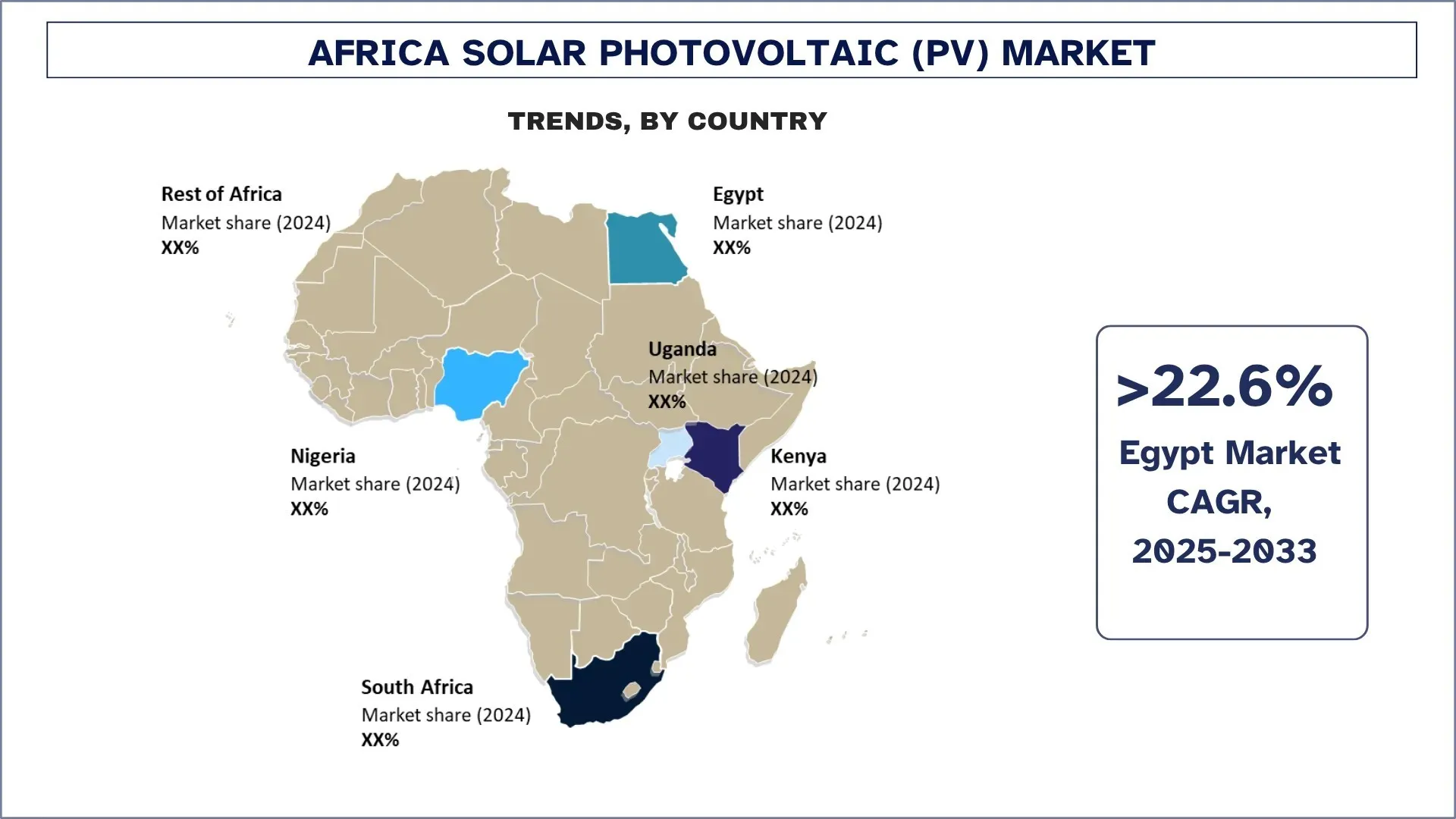
Africa Solar Photovoltaic (PV) Industry Competitive Landscape:
The Africa Solar Photovoltaic (PV) market is competitive, with several global and international market players. The key players are adopting different growth strategies to enhance their market presence, such as partnerships, agreements, collaborations, new product launches, geographical expansions, and mergers and acquisitions.
Top Africa Solar Photovoltaic (PV) Companies
Some of the major players in the market are ARTsolar, Jinko Solar, Canadian Solar, Seraphim, IBC SOLAR AG, Yingli Solar, Davis & Shirtliff, Go Solar Ltd., Wisolar, and Toyo Solar.
Africa Solar Photovoltaic (PV) Market Report Coverage
Report Attribute | Details |
Base year | 2024 |
Forecast period | 2025-2033 |
Growth momentum | Accelerate at a CAGR of 23.00% |
Market size 2024 | USD 2,000 Million |
Country analysis | Egypt, South Africa, Nigeria, Uganda, Kenya, and the Rest of Africa |
Major contributing Country | Egypt is expected to dominate the market during the forecast period. |
Companies profiled | ARTsolar, Jinko Solar, Canadian Solar, Seraphim, IBC SOLAR AG, Yingli Solar, Davis & Shirtliff, Go Solar Ltd., Wisolar, and Toyo Solar |
Report Scope | Market Trends, Drivers, and Restraints; Revenue Estimation and Forecast; Segmentation Analysis; Demand and Supply Side Analysis; Competitive Landscape; Company Profiling |
Segments Covered | by Panel Type, by Installation, by Grid Type, by Application, by Country |
Reasons to Buy the Africa Solar Photovoltaic (PV) Market Report:
The study includes market sizing and forecasting analysis confirmed by authenticated key industry experts.
The report briefly reviews overall industry performance at a glance.
The report covers an in-depth analysis of prominent industry peers, primarily focusing on key business financials, type portfolios, expansion strategies, and recent developments.
Detailed examination of drivers, restraints, key trends, and opportunities prevailing in the industry.
The study comprehensively covers the market across different segments.
Deep dive Country-level analysis of the industry.
Customization Options:
The Africa Solar Photovoltaic (PV) market can further be customized as per requirements or any other market segment. Besides this, UnivDatos understands that you may have your own business needs; hence, feel free to contact us to get a report that completely suits your requirements.
Table of Content
Research Methodology for the Africa Solar Photovoltaic (PV) Market Analysis (2023-2033)
We analyzed the historical market, estimated the current market, and forecasted the future market of the Africa Solar Photovoltaic (PV) market to assess its application in major countries. We conducted exhaustive secondary research to gather historical market data and estimate the current market size. To validate these insights, we carefully reviewed numerous findings and assumptions. Additionally, we conducted in-depth primary interviews with industry experts across the Solar Photovoltaic (PV) value chain. After validating market figures through these interviews, we used both top-down and bottom-up approaches to forecast the overall market size. We then employed market breakdown and data triangulation methods to estimate and analyze the market size of industry segments and sub-segments.
Market Engineering
We employed data triangulation techniques to finalize the overall market estimation and derive precise statistical numbers for each segment and sub-segment of the Africa Solar Photovoltaic (PV) market. We split the data into several segments and sub-segments by analyzing various parameters and trends, by Panel Type, by Installation, by Grid Type, by Application, and by country within the Africa Solar Photovoltaic (PV) market.
The Main Objective of the Africa Solar Photovoltaic (PV) Market Study
The study identifies current and future trends in the African Solar Photovoltaic (PV) market, providing strategic insights for investors. It highlights Country-level market attractiveness, enabling industry participants to tap into untapped markets and gain a first-move advantage. Other quantitative goals of the studies include:
Market Size Analysis: Assess the current forecast and market size of the Africa Solar Photovoltaic (PV) market and its segments in terms of value (USD).
Africa Solar Photovoltaic (PV) Market Segmentation: Segments in the study include areas by Panel Type, by Installation, by Grid Type, by Application, and by
Regulatory Framework & Value Chain Analysis: Examine the regulatory framework, value chain, customer behavior, and competitive landscape of the Africa Solar Photovoltaic (PV) industry.
Country Analysis: Conduct a detailed Country analysis for key areas such as Egypt, South Africa, Nigeria, Uganda, Kenya, and the Rest of Africa.
Company Profiles & Growth Strategies: Company profiles of the Africa Solar Photovoltaic (PV) market and the growth strategies adopted by the market players to sustain the fast-growing market.
Frequently Asked Questions FAQs
Q1: What is the Africa Solar Photovoltaic (PV) market’s current market size and growth potential?
The Africa Solar Photovoltaic (PV) market was valued at 2,000 million in 2024 and is expected to grow at a CAGR of 23.00% during the forecast period (2025-2033).
Q2: Which segment has the largest share of the Africa Solar Photovoltaic (PV) market by Panel Type?
The polycrystalline segment has captured a larger market share because it is cost-effective, it is widely available, and its production is simpler as opposed to its counterparts, making it an affordable option for cost-sensitive projects.
Q3: What are the driving factors for the growth of the Africa Solar Photovoltaic (PV) market?
• Large Unmet Electricity Demand and Grid Deficits: Limited grid access and frequent power shortages across the continent are driving demand for solar PV as a reliable alternative energy source.
• Falling Solar PV Costs and Increasing Competitiveness: Technological advancements and declining component prices have made solar power more affordable and attractive for large- and small-scale projects.
• Strong External Investment and Import of Solar PV Equipment: Growing international funding and imports of high-quality solar technologies are accelerating installation rates and supporting market expansion.
Q4: What are the emerging technologies and trends in the Africa Solar Photovoltaic (PV) market?
• Rapid Growth in Solar PV Installations and Imports: The continent is witnessing a surge in both distributed and utility-scale solar projects, highlighting the shift toward clean and decentralized energy systems.
• Integration with Storage and Off-Grid/Mini-Grid Solutions: Combining solar PV with battery storage and hybrid mini-grids enhancing energy reliability, particularly in remote areas lacking stable grid infrastructure.
Q5: What are the key challenges in the Africa Solar Photovoltaic (PV) market?
• High Cost of Capital and Financing Constraints: Access to affordable financing remains limited, with investors facing high perceived risks and lengthy project payback periods.
• Grid Integration, Infrastructure, and Regulatory Obstacles: Weak transmission infrastructure, inconsistent regulations, and bureaucratic delays hinder large-scale solar deployment and limit energy distribution efficiency.
Q6: Which country dominates the Africa Solar Photovoltaic (PV) market?
Egypt’s solar market is booming, thanks to government support, strong policies, and lots of sunshine. Major projects like Benban Solar Park are making Egypt a leader in African solar energy as the country shifts away from fossil fuels toward clean power.
Q7: Who are the key players in the Africa Solar Photovoltaic (PV) market?
Some of the top Solar Photovoltaic (PV) companies in Africa include:
• ARTsolar
• Jinko Solar
• Canadian Solar
• Seraphim
• IBC SOLAR AG
• Yingli Solar
• Davis & Shirtliff
• Go Solar Ltd.
• Wisolar
• Toyo Solar
Q8: What are the opportunities for companies within the Africa Solar Photovoltaic (PV) market?
• Industrial and Commercial (C&I) Solar Uptake, Including Mining and Manufacturing: The growing need for reliable and cost-effective energy solutions is encouraging industries and commercial enterprises to adopt solar PV systems. Sectors such as mining and manufacturing are increasingly investing in on-site solar generation to reduce operational costs, enhance sustainability, and ensure energy security.
• Geographic and Market Expansion into Lesser-Served African Countries: Emerging markets across Central and West Africa offer significant potential for solar PV deployment. Expanding into these regions provides investors and developers with new opportunities to tap into underserved areas, support rural electrification, and drive inclusive economic development through renewable energy adoption.
Q9: How are consumer preferences shaping product development in the Africa Solar Photovoltaic (PV) market?
Consumer preferences for affordable, reliable, and sustainable energy solutions are driving innovation in solar PV products across Africa, leading to efficient, modular, and off-grid systems tailored to diverse regional needs.
Related Reports
Customers who bought this item also bought



India Decarbonization HVAC Market: Current Analysis and Forecast (2026-2034)
Emphasis on Product Type (Heating Equipment, Ventilation Equipment, Air Conditioning Equipment, Others); Decarbonization Type (Direct, Indirect); Capacity (Up to 5 Tons, 5-20 Tons, Above 20 Tons); End User (Commercial Buildings, Residential Buildings, Industrial Facilities, Healthcare Facilities, Data Centers, Others); and Region/States

Midstream Oil & Gas Filtration Market: Current Analysis and Forecast (2026-2034)
Emphasis on Filter Technology (Coalescer Filters, Cartridge Filters, Mechanical Filters, Bag Filters, Particulate Filters, Activated Carbon Filters, Strainers, and Others); by Application (Gas Processing Plants, Compression Stations, Storage And Distribution, Pipeline Transportation, LNG Processing, and Others); by Filtration Stage (Oil Filtration and Gas Filtration), by End User (Refineries and Petrochemical Industry), and Region/Country

Hydrogen-Powered Hospital Backup Systems Market: Current Analysis and Forecast (2026-2034)
Emphasis on System Type (Portable, Stationary, Hybrid); Power Capacity (Below 100 kW, 100–500 kW, and Above 500 kW); End-User (Public Hospitals, Private Hospitals, Specialty Hospitals, and Emergency Care Facilities); and Region/Country

Wind LiDAR Market: Current Analysis and Forecast (2025-2033)
Emphasis on Product Type (Vertical Profiling Wind LiDAR, Ground-Based Wind LiDAR, Nacelle-Mounted Wind LiDAR, Airborne Wind LiDAR, and Others); Component (Sensor, Navigator, Laser, and Others); Location (Onshore and Offshore); Application (Wind Power, Meteorology & Environment, and Aviation); and Region/Country