Vetiver Oil Market: Current Analysis and Forecast (2025-2033)
Emphasis on Product (Organic and Conventional); Application (Spa and Relaxation, Medical, Food and Beverage, Cleaning and Home, and Others); and Region/Country
Global Vetiver Oil Market Size & Forecast
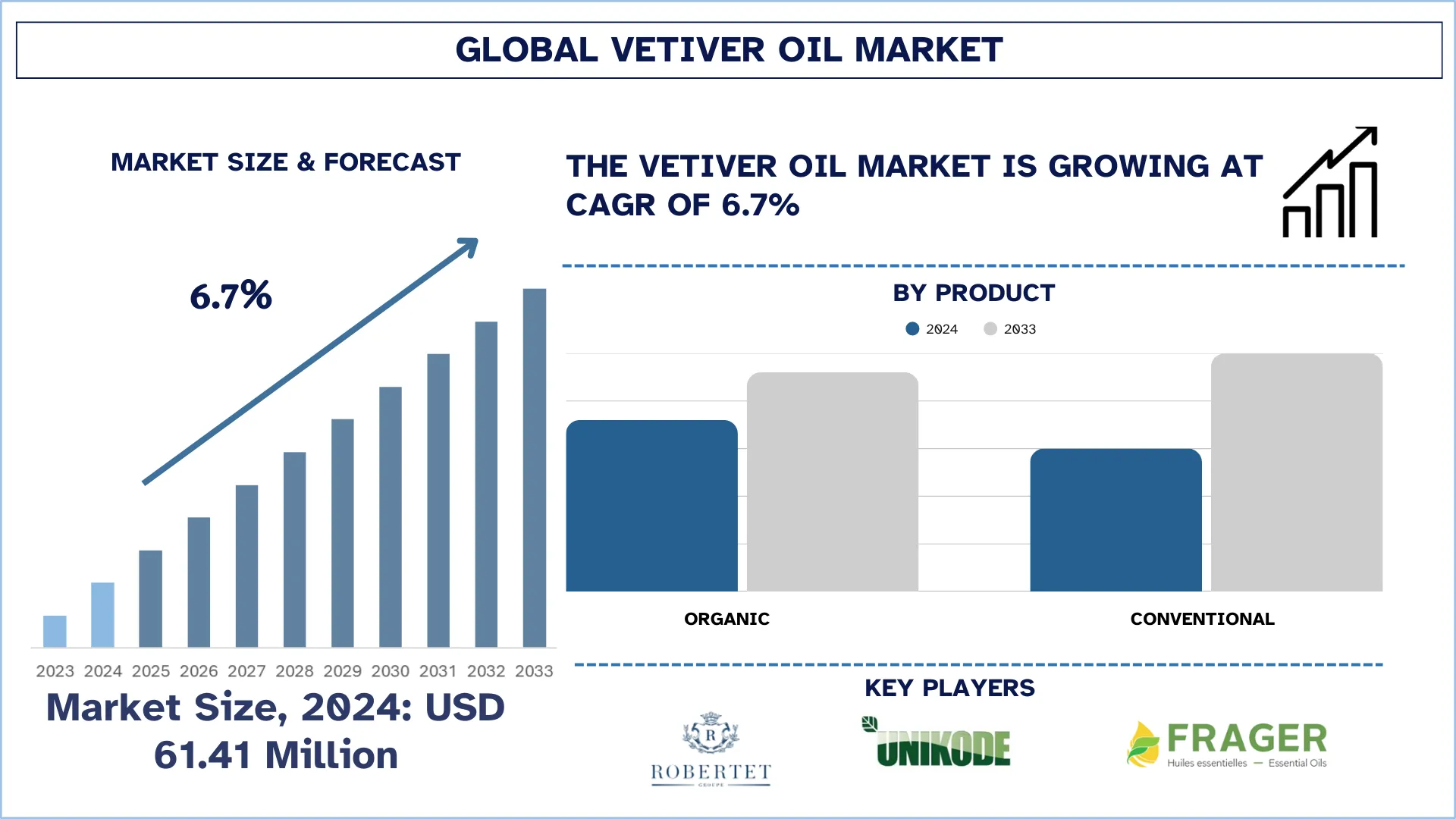
The global vetiver oil Market was valued at USD 61.41 million in 2024 and is expected to grow at a strong CAGR of around 6.7% during the forecast period (2025-2033F), driven by rising demand for natural and plant-based fragrances in perfumery, cosmetics, and personal care products.
Vetiver Oil Market Analysis
Vetiver oil is a natural essential oil that is made from steam distillation of the roots of the perennial grass (Chrysopogon zizanioides). It is famous because of its woody, deep, earthy scent and high fixation power. Due to this, it is used as a major constituent in fine perfumes, cosmetics, and personal care products.
The vetiver oil market is expanding as more people are demanding natural and plant-based products in different sectors such as fragrances, cosmetics, and personal care products. The increased interest of consumers in clean-label, eco-friendly, and aromatherapy-wise wellness products has largely increased the application of vetiver oil as calming and curing agents. It has a high fixative property that is catalyzing its usage in high-end perfumery and widening its applications in pharmaceuticals, food flavorings, and natural insect repellents.
Global Vetiver Oil Market Trends
This section discusses the key market trends that are influencing the various segments of the global vetiver oil market, as found by our team of research experts.
Growth in the Adoption of Advanced Extraction Technologies
Adoption of advanced extraction technologies is a crucial future market trend in the vetiver oil market, as manufacturers seek to increase oil yield, purity, and aroma consistency. Techniques used in the modern world include enhanced steam distillation, fractional distillation, and solvent-free extraction to preserve the oil's complex aromatic profile and minimize thermal degradation. Such technologies also contribute to increased process efficiency, reduced waste, and sustainable production. In addition, advanced technology makes the extraction process more efficient and provides more quality assurance, which is needed to achieve high standards of high-end use in fragrance, cosmetic, and pharmaceutical products, leading to the growth of the vetiver oil market.
Vetiver Oil Industry Segmentation
This section provides an analysis of the key trends in each segment of the global vetiver oil market report, along with forecasts at the global, regional, and country levels for 2025-2033.
The Conventional Segment Dominates the Global Vetiver Oil Market
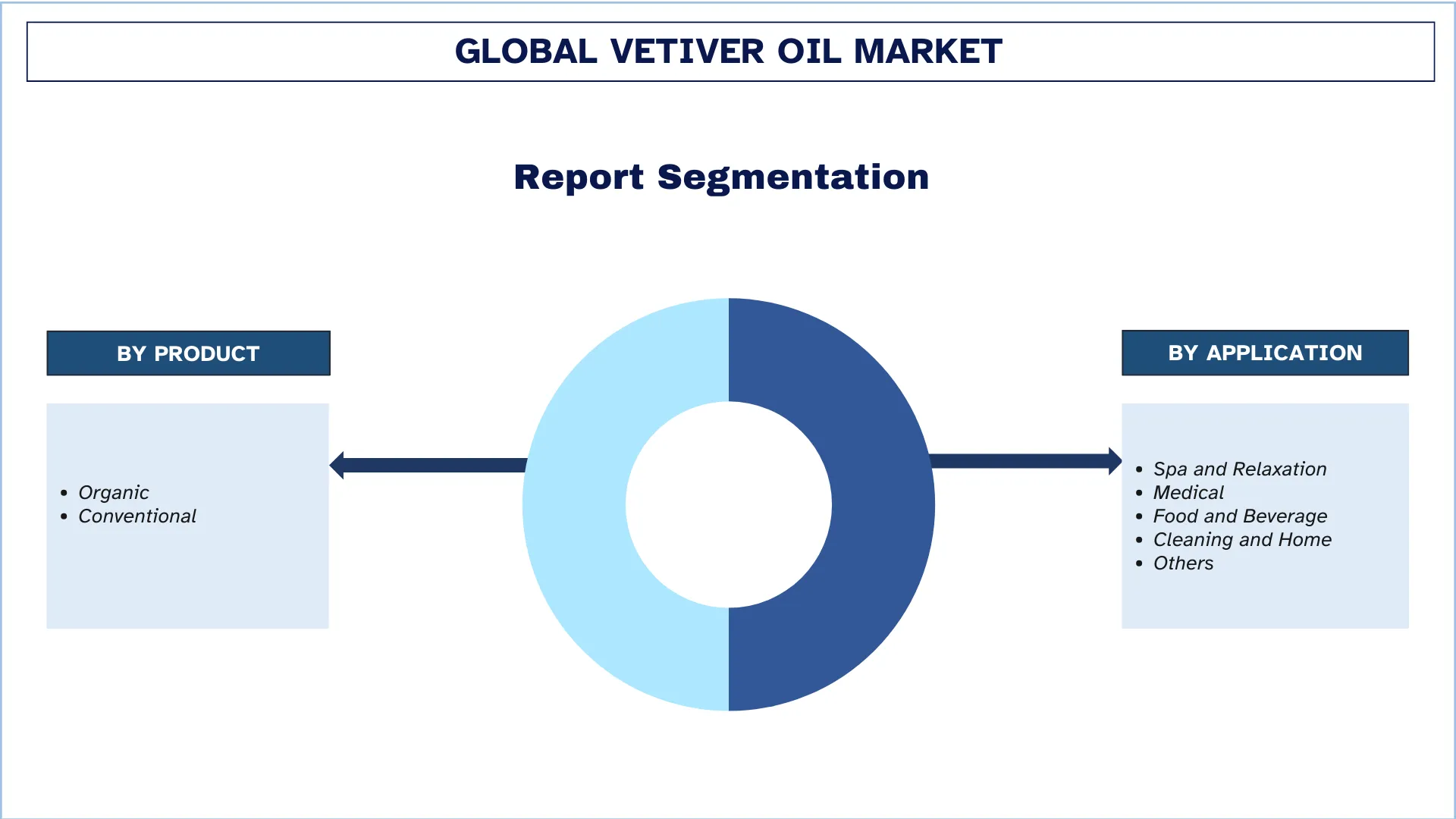
Based on the product category, the market is categorized into organic and conventional. Among these, the conventional vetiver oil segment currently holds the maximum market share since it has a more extensive market availability, cheaper production, and is highly acceptable in the perfumery, cosmetics, and industrial fragrance sectors. Conventional vetiver oil is advantageous due to the well-established cultivation and extraction methods, which enable a steady supply at reasonable prices. However, the organic vetiver oil market will experience a more rapid growth in the near future, because of the increasing popularity of natural, chemical-free, and sustainably sourced ingredients among consumers.
The Spa and Relaxation Segment Dominates the Global Vetiver Oil Market.
Based on the application category, the market is segmented into spa and relaxation, medical, food and beverage, cleaning and home, and others. Among these, the spa and relaxation segment holds the largest market share in the vetiver oil market, as it has many applications in aromatherapy, massage oils, and wellness products due to its calming and stress-relieving properties. This dominance is supported by high penetration in the high-end spa and wellness centers. However, the medical segment is expected to grow at a faster pace, due to the growing research on therapeutic advantages of vetiver oil, growing demand in natural remedies, and an increased use of the oil in pharmaceuticals and alternative medicine preparations.
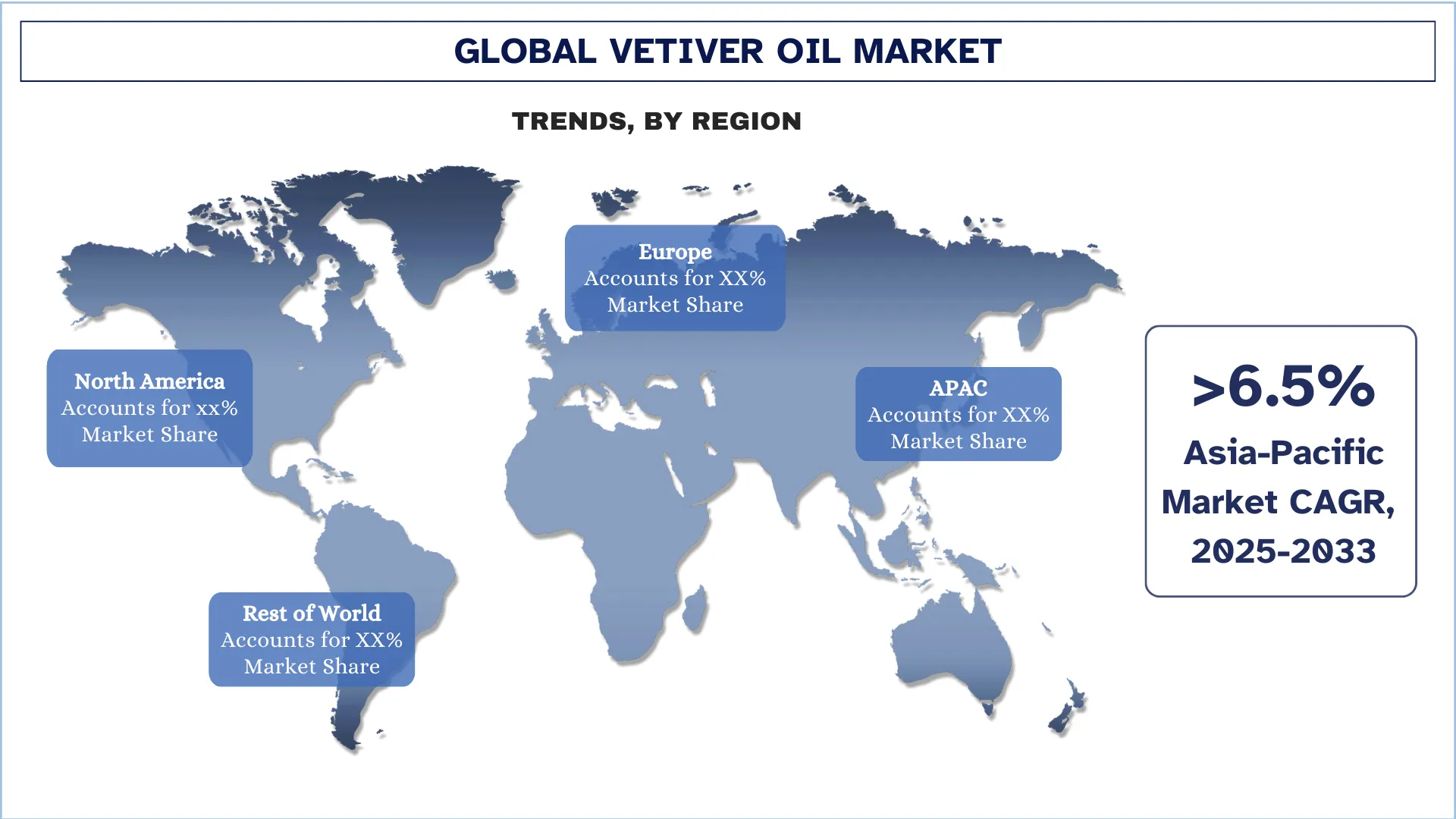
The Asia-Pacific region held the dominant market share in the Global Vetiver Oil Market
Asia-Pacific had the largest market share in the vetiver oil market because it has excellent agro-climatic conditions that support large-scale vetiver grass growth, and because it has a long tradition of using vetiver in traditional medicine, perfume, and wellness practices. India is among the prominent producers, as it enjoys the benefits of good distillation practices, abundant raw materials, and cheap labor. There is also good domestic demand and growing export of oil, which has enhanced the dominance of the Asia-Pacific region.
India held a Dominant share of the Asia-Pacific Vetiver Oil Market in 2024
India dominates the Asia-Pacific vetiver oil market due to its vast agricultural areas, and growing government support to enhance aromatic crop cultivation is further boosting market growth. For instance, under the CSIR Aroma Mission, the production of essential oils has been stimulated by the promotion of aromatic crops, such as lemongrass, palmarosa, and vetiver, among others, cutting the reliance on imports, especially of vetiver oil, by the cultivation of larger areas, such as Uttar Pradesh, Bihar, and Tamil Nadu. The nation has well-developed farming belts, especially in states like Tamil Nadu, Uttar Pradesh, and Rajasthan, which have ensured a supply of raw materials. The dominance of India is further supported by its large domestic fragrance and aromatherapy markets, strong export demand from global perfume brands, and numerous small- and mid-scale distillers supplying high-quality vetiver oil to international clients.
Vetiver Oil Industry Competitive Landscape
The global vetiver oil market is competitive, with several global and international market players. The key players are adopting different growth strategies to enhance their market presence, such as partnerships, agreements, collaborations, geographical expansions, and mergers and acquisitions.
Top Vetiver Oil Market Companies
Some of the major players in the market are Robertet Group, UniKode S.A., Frager S.A., Floracopeia Inc, BERJE Inc, International Flavors & Fragrances Inc, Aromatic Herbals Private Limited, Vee Kay International, Mountain Rose Herbs, Inc., and Plant Therapy Essential Oils.
Recent Developments in the Vetiver Oil Market
In November 2025, Loving Essential Oils unveiled its 2025 range of “Lavender and Vetiver” blends designed to support mood enhancement and better sleep, with formulations created by a certified aromatherapist to promote relaxation and wellness through natural aromatherapy.
In July 2023, Australian skincare brand Ipsum Skin introduced its first product in the Ipsum SPA range, the “Spa Body Balm Vetiver Citrus”, a luxurious, COSMOS-certified organic body conditioning balm formulated with natural plant oils, antioxidants, and Australian botanicals to deeply nourish and rejuvenate skin.
Global Vetiver Oil Market Report Coverage
Report Attribute | Details |
Base year | 2024 |
Forecast period | 2025-2033 |
Growth momentum | Accelerate at a CAGR of 6.7% |
Market size 2024 | USD 61.41 million |
Regional analysis | North America, Europe, APAC, Rest of the World |
Major contributing region | The Asia-Pacific region is expected to dominate the market during the forecast period. |
Key countries covered | U.S., Canada, Germany, U.K., Spain, Italy, France, China, Japan, and India. |
Companies profiled | Robertet Group, UniKode S.A., Frager S.A., Floracopeia Inc, BERJE Inc, International Flavors & Fragrances Inc, Aromatic Herbals Private Limited, Vee Kay International, Mountain Rose Herbs, Inc., and Plant Therapy Essential Oils. |
Report Scope | Market Trends, Drivers, and Restraints; Revenue Estimation and Forecast; Segmentation Analysis; Demand and Supply Side Analysis; Competitive Landscape; Company Profiling |
Segments Covered | By Product, By Application, and By Region/Country |
Reasons to Buy the Vetiver Oil Market Report:
The study includes market sizing and forecasting analysis confirmed by authenticated key industry experts.
The report briefly reviews overall industry performance at a glance.
The report covers an in-depth analysis of prominent industry peers, primarily focusing on key business financials, type portfolios, expansion strategies, and recent developments.
Detailed examination of drivers, restraints, key trends, and opportunities prevailing in the industry.
The study comprehensively covers the market across different segments.
Deep dive regional level analysis of the industry.
Customization Options:
The global Vetiver Oil market can further be customized as per the requirements or any other market segment. Besides this, UnivDatos understands that you may have your own business needs; hence, feel free to contact us to get a report that completely suits your requirements.
Table of Content
Research Methodology for the Global Vetiver Oil Market Analysis (2023-2033)
We analyzed the historical market, estimated the current market, and forecasted the future market of the global vetiver oil market to assess its application in major regions worldwide. We conducted exhaustive secondary research to gather historical market data and estimate the current market size. To validate these insights, we carefully reviewed numerous findings and assumptions. Additionally, we conducted in-depth primary interviews with industry experts across the vetiver oil value chain. After validating market figures through these interviews, we used both top-down and bottom-up approaches to forecast the overall market size. We then employed market breakdown and data triangulation methods to estimate and analyze the market size of industry segments and sub-segments.
Market Engineering
We employed the data triangulation technique to finalize the overall market estimation and derive precise statistical numbers for each segment and sub-segment of the global vetiver oil market. We split the data into several segments and sub-segments by analyzing various parameters and trends, including product, application, and regions within the global vetiver oil market.
The Main Objective of the Global Vetiver Oil Market Study
The study identifies current and future trends in the global vetiver oil market, providing strategic insights for investors. It highlights regional market attractiveness, enabling industry participants to tap into untapped markets and gain a first-mover advantage. Other quantitative goals of the studies include:
Market Size Analysis: Assess the current and forecast market size of the global vetiver oil market and its segments in terms of value (USD).
Vetiver Oil Market Segmentation: Segments in the study include areas of product, application, and region.
Regulatory Framework & Value Chain Analysis: Examine the regulatory framework, value chain, customer behavior, and competitive landscape of the vetiver oil industry.
Regional Analysis: Conduct a detailed regional analysis for key areas such as Asia Pacific, Europe, North America, and the Rest of the World.
Company Profiles & Growth Strategies: Company profiles of the vetiver oil market and the growth strategies adopted by the market players to sustain the fast-growing market.
Frequently Asked Questions FAQs
Q1: What is the global vetiver oil market’s current market size and growth potential?
As of 2024, the global vetiver oil market size is estimated at USD 61.41 million. The market is projected to grow at a robust CAGR of 6.7% from 2025 to 2033, driven by rising demand for natural fragrances, aromatherapy products, and clean-label personal care ingredients.
Q2: Which segment has the largest share of the global vetiver oil market by product category?
The conventional vetiver oil segment holds the largest market share globally, owing to its widespread availability, cost-effectiveness, and extensive use across perfumery, cosmetics, and aromatherapy applications.
Q3: What are the driving factors for the growth of the global vetiver oil market?
Top growth drivers of the vetiver oil market include:
• Rising demand for natural fragrances
• Growing adoption in aromatherapy and wellness products
• Expanding use in personal care products
Q4: What are the emerging technologies and trends in the global vetiver oil market?
Emerging trends in the vetiver oil market include:
• Shift toward sustainably sourced and traceable essential oils
• Growth in the Adoption of Advanced Extraction Technologies
Q5: What are the key challenges in the global vetiver oil market?
Key challenges in the vetiver oil market include:
• High production and extraction costs
• Regulatory compliance and certification requirements
Q6: Which region dominates the global vetiver oil market?
The Asia-Pacific region dominates the global vetiver oil market, supported by abundant raw material availability, strong agricultural base, and high production levels in countries such as India.
Q7: Who are the key competitors in the global vetiver oil market?
Top players in the vetiver oil industry include:
• Robertet Group
• UniKode S.A.
• Frager S.A.
• Floracopeia Inc
• BERJE Inc
• International Flavors & Fragrances Inc
• Aromatic Herbals Private Limited
• Vee Kay International
• Mountain Rose Herbs, Inc.
• Plant Therapy Essential Oils
Q8: What investment and expansion opportunities exist in the vetiver oil market?
Investment opportunities lie in organic and certified vetiver oil production, backward integration into cultivation and extraction, and value-added applications such as premium fragrances and wellness formulations, particularly in high-growth emerging markets.
Q9: How does sustainability and traceability impact competitiveness in the vetiver oil market?
Sustainability and traceability have become critical differentiators in the vetiver oil market, as global fragrance and personal care brands increasingly prioritize ethically sourced and environmentally responsible ingredients.
Related Reports
Customers who bought this item also bought




Middle East & Africa Bath and Shower Product Market: Current Analysis and Forecast (2025-2033)
Emphasis By Product Type (Bath Soaps, Body Gels, Bath Additives, and Others), by Product Form (Solid, Gels and Jellies, Liquid, and Others), By End-Users ( Men and Women), by Distribution Channel (Online stores and Offline stores), By Country (Saudi Arabia, UAE, Egypt, South Africa, Turkey, Israel, and the Rest of Middle East & Africa)

Southeast Asia Online On-Demand Home Services Market: Current Analysis and Forecast (2025-2033)
Emphasis on Platform (Mobile Application, Web Portal); Service Type (Home Cleaning, Repair & Maintenance, Beauty & Wellness, Pest Control, Laundry & Dry Cleaning, Moving & Relocation, Others); End User (Residential Users, Commercial Users); and Country.

Sage Essential Oil Market: Current Analysis and Forecast (2025-2033)
Emphasis on Source (Organic and Inorganic); Application (Aromatherapy, Cosmetics & Personal Care, Pharmaceuticals, Food & Beverages, and Others); Distribution Channel (Online and Offline); and Region/Country

Middle East & Africa Cat Litter Product Market: Current Analysis and Forecast (2025-2033)
Emphasis By Product Type (Clumping and Conventional), By Raw Material (Clay, Silica, Wood/Bamboo/Sawdust, Paper, Soy, Corn/ Grain, and Others), by Distribution Channel (Offline (Supermarket/Hypermarkets, Specialty Retail Stores, Convenience Stores & Others), and Online), By Country (Saudi Arabia, UAE, Egypt, South Africa, Turkey, Israel, and the Rest of Middle East & Africa)