Southeast Asia Feminine Hygiene Wash Market: Current Analysis and Forecast (2025-2033)
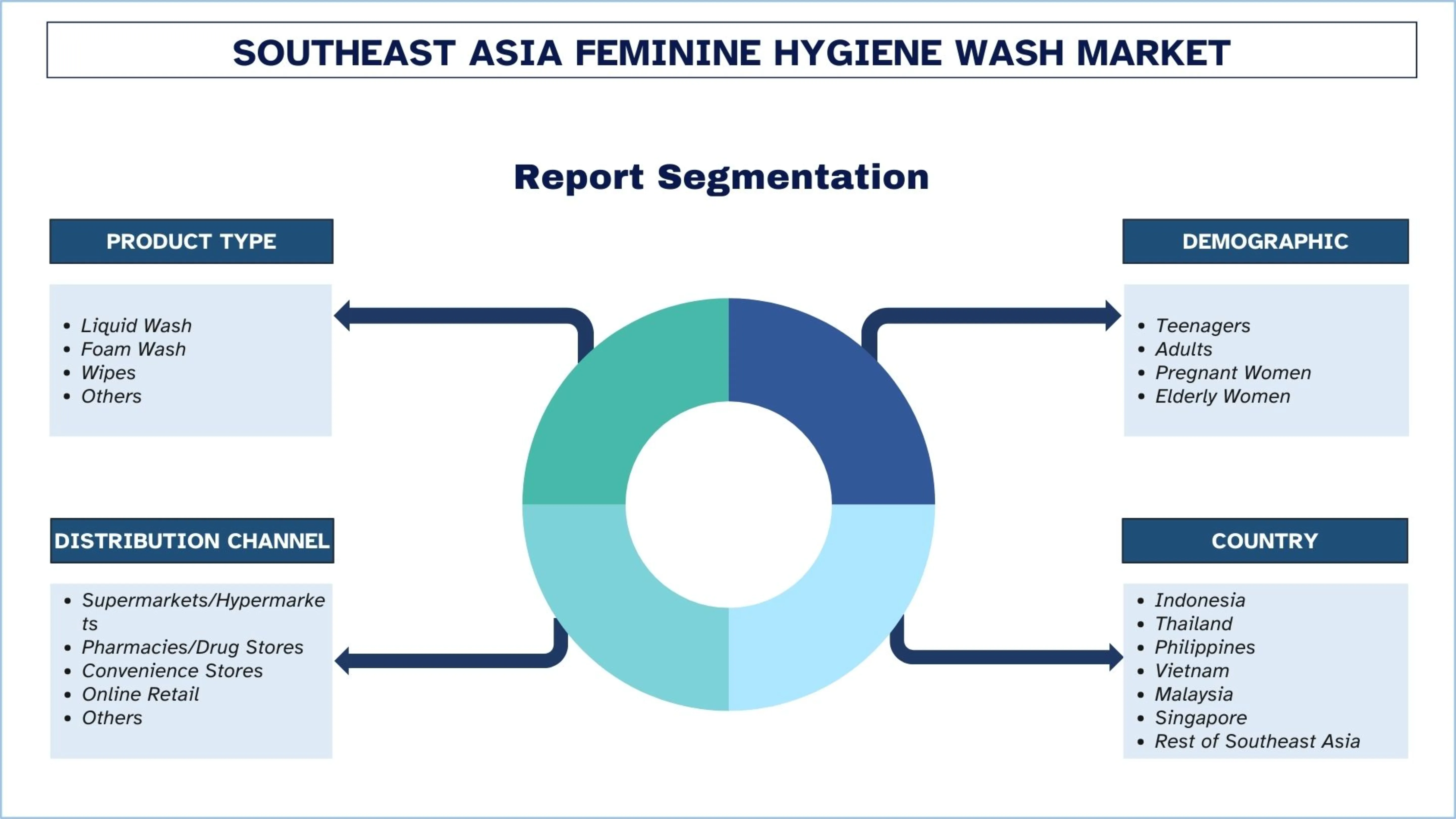
Emphasis on Product Type (Liquid Wash, Foam Wash, Wipes, Others); Demographic (Teenagers, Adults, Pregnant Women, Elderly Women); Distribution Channel (Supermarkets/Hypermarkets, Pharmacies/Drug Stores, Convenience Stores, Online Retail, Others); and Country.
Southeast Asia Feminine Hygiene Wash Market Size & Forecast
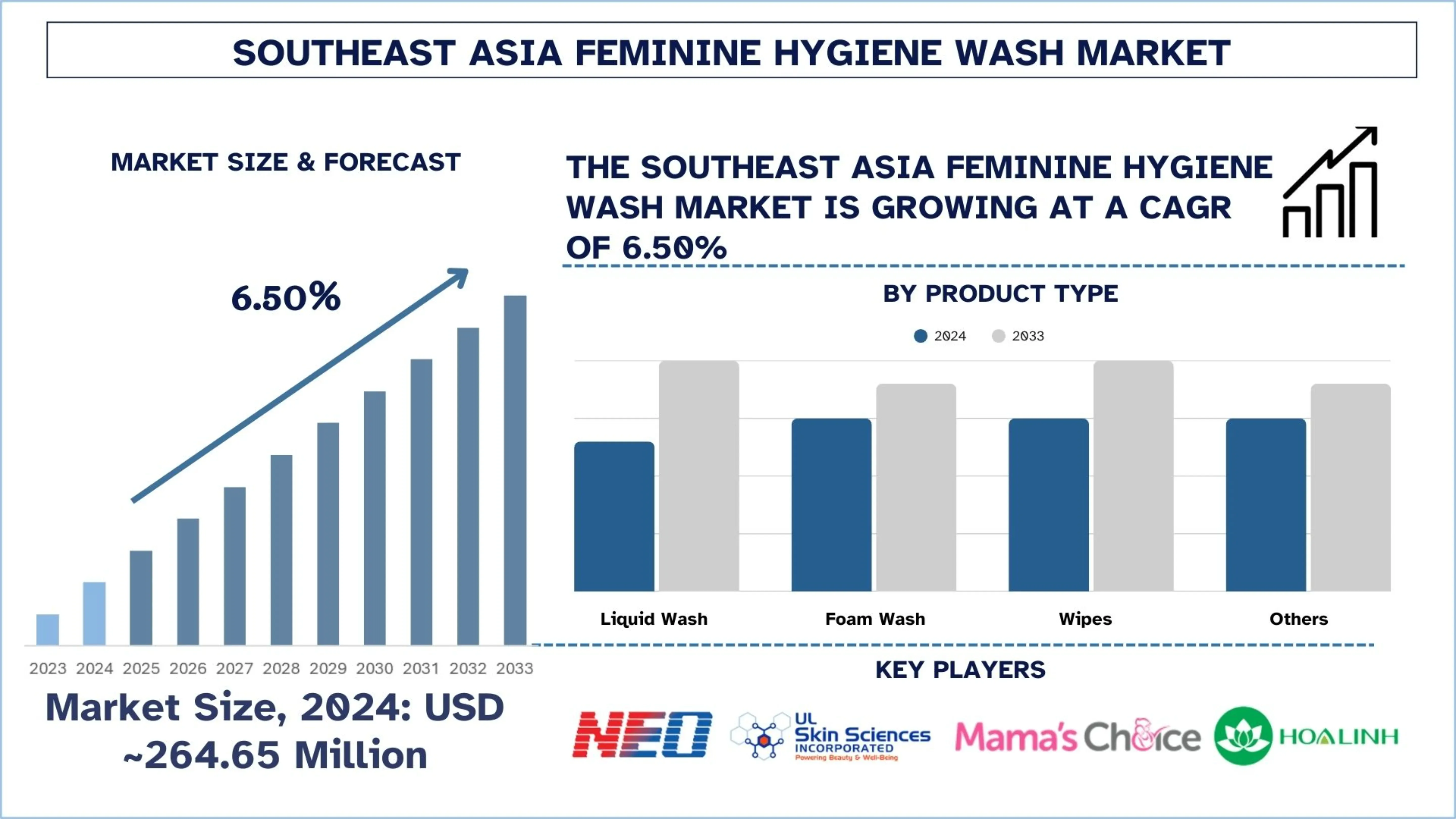
The Southeast Asia Feminine Hygiene Wash Market was valued at ~USD 264.65 million in 2024 and is expected to grow at a strong CAGR of approximately 6.50% during the forecast period (2025-2033F), driven by the rising intimate hygiene awareness supported by government health campaigns.
Southeast Asia Feminine Hygiene Wash Market Analysis
Feminine hygiene wash is a formulated, gentle cleanser that is specifically made to maintain the balanced pH and cleanliness of the intimate area. These products reduce irritation, odor, and the risk of infection, as well as support overall intimate wellness.
In Southeast Asia, companies are focused on developing pH-balanced, dermatologist-tested, and naturally derived formulations to build trust. Additionally, the rising shift towards plant-based and sensitive-skin-friendly products is addressing cultural inclinations and increasing health consciousness. Also, brands are spending on digital education campaigns to normalize intimate hygiene, building online-first product lines, and introducing subscription-based distribution models to enhance retention. Additionally, the innovations in packaging, environmentally friendly materials, and specific partnerships with pharmacies, influencers, and healthcare professionals are contributing to the spread among urban and semi-urban female consumers. Moreover, growing health awareness and the influence of Korean and Japanese beauty ideals are shaping consumer demand toward mild, pH-neutralized, and natural ingredients.
On August 31, 2025, Natural Nine, a Korean body care brand, announced that it will launch a feminine wash in the first half of next year, with plans to expand into overseas markets, including Singapore. Leveraging this technological capability, Natural Nine plans to develop the feminine cleanser for markets such as Singapore and other international regions. The product will be formulated with herbal ingredients sourced from Korea and tailored specifically for Asian skin types.
Southeast Asia Feminine Hygiene Wash Market Trends
This section discusses the key market trends that are influencing the various segments of the Southeast Asia Feminine Hygiene Wash market, as found by our team of research experts.
Halal-Certified Feminine Hygiene Products
The use of halal-certified feminine hygiene products is gaining momentum as consumers in Muslim-majority markets focus on products that comply with religious and ethical practices. The trend is influenced by increased scrutiny of product ingredients, particularly in wipes, washes, and sanitary pads, where transparency and purity are the main factors driving purchase decisions. The brands are responding by developing halal formulations, certifying production processes, and placing labels on packaging to build trust. The growth in the number of halal certification bodies and the enabling regulatory frameworks in Southeast Asia is increasing adoption. This actually implies that halal-certified products are no longer a niche trend but an essential differentiator in the mainstream feminine hygiene portfolio.
In August 2025, Indonesia accelerated its path to becoming a global hub for halal production. The government, through the Halal Product Assurance Agency (BPJPH), aims to achieve 7 million BPJPH-certified products by the end of 2025. Starting in October 2026, halal certification will be mandatory for consumer goods, including fashion, crafts, and leather products.
Southeast Asia Feminine Hygiene Wash Industry Segmentation
This section provides an analysis of the key trends in each segment of the Southeast Asia Feminine Hygiene Wash market, along with forecasts at the country level for 2025-2033.
The pregnant women market held a significant share of the Feminine Hygiene Wash market in 2024.
Based on demographic, the Southeast Asian Feminine Hygiene Wash market is segmented into teenagers, adults, pregnant women, and elderly women. Among these, the pregnant women segment held a significant share of the Feminine Hygiene Wash market in 2024. This is mainly due to rising demand for pH-balanced, gentle products that help reduce the risk of infection during pregnancy. With the rising number of females, specialized intimate washes are gaining popularity, are increasingly prescribed by healthcare professionals and doctors. Moreover, the increasing digital awareness, maternity forums, and education with influencers are also making intimate hygiene a regular part of prenatal care. For example, on June 26, 2025, Hoa Linh Pharmaceutical signed a cooperation agreement with Bao Son General Hospital, marking an important step forward in efforts to improve the quality of healthcare for pregnant women and mothers in Vietnam. From 2024 to present, Hoa Linh Pharmaceutical accompanied Bao Son General Hospital in prenatal class activities, with prestigious products that have been affirmed in the market, such as: Da Huong Daily Fresh Gentle Feminine Hygiene Solution - Safe care and protection of intimate areas throughout pregnancy; and Ong Bi Herbal Shampoo - suitable for the sensitive skin of mothers and babies.
The online retail segment is expected to grow at a significant CAGR during the forecast period (2025-2033).
Based on distribution channels, the market is segmented into supermarkets/hypermarkets, pharmacies/drug stores, convenience stores, online retail, and others. Among these, the online retail segment is expected to grow at a significant CAGR during the forecast period (2025-2033). The increasing product visibility enables easy comparison and private purchasing, driving online retailing. Through e-commerce platforms and digital campaigns, the companies have significant access to secondary and rural markets. Moreover, recurring sales and brand preference are supported by subscription models and online-exclusive packages. However, increasing cloud modernization enhances the velocity of e-commerce, which allows more effective tracking of inventory, quicker processing of orders, and more effortless collaboration with online retailers. For example, on August 28, 2025, Tata Consultancy Services (TCS) announced a partnership with Unilab, Inc., a leading pharmaceutical and healthcare company in the Philippines, to modernize its core business systems through a strategic cloud migration. This transformation will strengthen Unilab’s digital infrastructure, enhance operational agility, and drive long-term business growth.
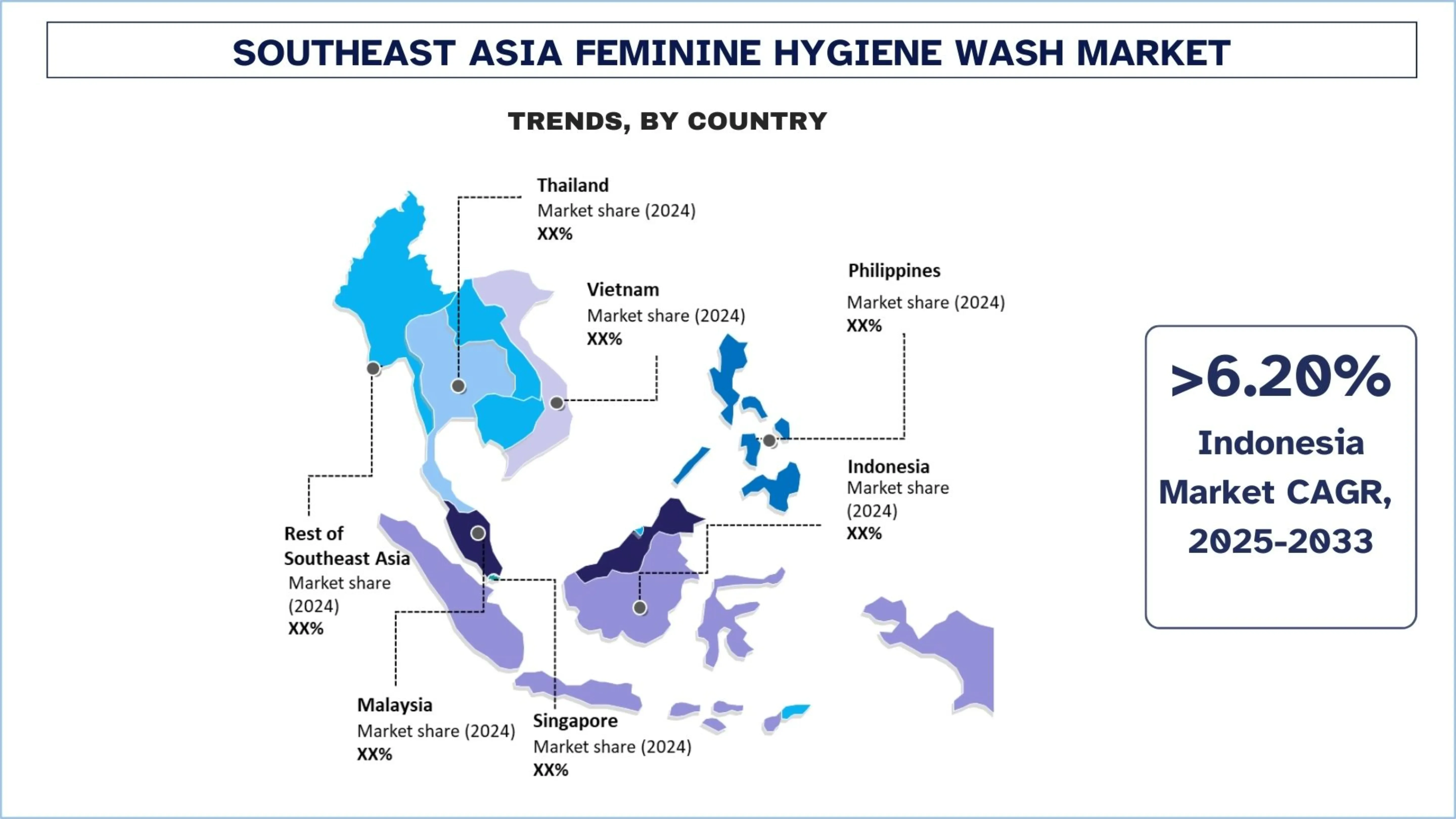
Indonesia held a dominant share of the Southeast Asian Feminine Hygiene Wash market in 2024
Indonesia held a dominant share of the market due to its large young female population and increased awareness of intimate hygiene. The increased urbanization and exposure to contemporary personal care practices are favouring the rapid adoption, particularly among working women. Competitive pricing and rapid category penetration are driven by the large number of local and regional brands. Additionally, halal certification is a key factor, and consumers are keen to use certified feminine wash products, reinforcing brand differentiation. Therefore, the development of e-commerce and product education guided by social media continues to expand reach and category acceptance.
On February 21, 2025, Mama’s Choice, a leading brand of high-quality products for mothers and families, announced its partnership with Mensa Binasukses (MBS) as the official distributor in Indonesia. This strategic collaboration aims to expand the availability of Mama’s Choice products, especially best-sellers such as Mama’s Choice Feminine Hygiene Wash, Stretch Mark Cream, and Gentle Face Wash, across Modern Trade (MT) and pharmacy channels, reinforcing Mama’s Choice’s commitment to reaching more Indonesian mothers and families.
Southeast Asia Feminine Hygiene Wash Industry Competitive Landscape
The Southeast Asia Feminine Hygiene Wash market is competitive, with several global and international market players. The key players are adopting different growth strategies to enhance their market presence, such as partnerships, agreements, collaborations, new product launches, geographical expansions, and mergers and acquisitions.
Top Southeast Asia Feminine Hygiene Wash Companies
Some of the major players in the market are Neo Corporate Public Company Limited (BeNice), UL Skin Sciences Inc. (UL Health Group), Mama’s Choice (The Parentinc), Betadine (iNova Pharmaceuticals), Sumber Ayu (WIPRO Consumer Care Holdings Ltd.), PT Kino Indonesia Tbk., Human Nature (Gandang Kalikasan Inc.), Hoa Linh Pharmaceutical Joint Stock Company, ORIENTAL PRINCESS, Vanity Cosmeceutical Sdn Bhd.
Recent Developments in the Southeast Asia Feminine Hygiene Wash Market
On October 24, 2025, Da Huong launched the NEW GENERATION feminine hygiene product line Da Huong Daily Fresh with ingredients containing beneficial bacteria Prebiotic (Bioecolia) combined with natural herbs to bring a balanced effect to help prevent inflammation and itching, while enhancing the moisturizing effect for sensitive areas.
On April 5, 2022, Mundipharma Healthcare Indonesia (MHI), the owner of the Betadine brand in Indonesia, signed an exclusive cooperation agreement for marketing and promotion services with PT Pyridam Farma Tbk, a public pharmaceutical company in Indonesia with the issuer code PYFA.
Southeast Asia Feminine Hygiene Wash Market Report Coverage
Report Attribute | Details |
Base year | 2024 |
Forecast period | 2025-2033 |
Growth momentum | Accelerate at a CAGR of 6.50% |
Market size 2024 | ~USD 264.65 million |
Country analysis | Indonesia, Thailand, Philippines, Vietnam, Malaysia, Singapore, Rest of Southeast Asia |
Major contributing Country | Vietnam is expected to grow at the highest CAGR during the forecasted period. |
Companies profiled | Neo Corporate Public Company Limited (BeNice), UL Skin Sciences Inc. (UL Health Group), Mama’s Choice (The Parentinc), Betadine (iNova Pharmaceuticals), Sumber Ayu (WIPRO Consumer Care Holdings Ltd.), PT Kino Indonesia Tbk., Human Nature (Gandang Kalikasan Inc.), Hoa Linh Pharmaceutical Joint Stock Company, ORIENTAL PRINCESS, Vanity Cosmeceutical Sdn Bhd. |
Report Scope | Market Trends, Drivers, and Restraints; Revenue Estimation and Forecast; Segmentation Analysis; Demand and Supply Side Analysis; Competitive Landscape; Company Profiling |
Segments Covered | By Product Type, By Demographic, By Distribution Channel, By Country |
Reasons to Buy the Southeast Asia Feminine Hygiene Wash Market Report:
The study includes market sizing and forecasting analysis confirmed by authenticated key industry experts.
The report briefly reviews overall industry performance at a glance.
The report covers an in-depth analysis of prominent industry peers, primarily focusing on key business financials, product portfolios, expansion strategies, and recent developments.
Detailed examination of drivers, restraints, key trends, and opportunities prevailing in the industry.
The study comprehensively covers the market across different segments.
Customization Options:
The Southeast Asia Feminine Hygiene Wash Market can further be customized as per requirements or any other market segment. Besides this, UnivDatos understands that you may have your own business needs; hence, feel free to contact us to get a report that completely suits your requirements.
Table of Content
Research Methodology for the Southeast Asia Feminine Hygiene Wash Market Analysis (2023-2033)
We analyzed the historical market, estimated the current market, and forecasted the future market of the Southeast Asia Feminine Hygiene Wash market to assess its application in major countries. We conducted exhaustive secondary research to gather historical market data and estimate the current market size. To validate these insights, we carefully reviewed numerous findings and assumptions. Additionally, we conducted in-depth primary interviews with industry experts across the Southeast Asian Feminine Hygiene Wash value chain. After validating market figures through these interviews, we used both top-down and bottom-up approaches to forecast the overall market size. We then employed market breakdown and data triangulation methods to estimate and analyze the market size of industry segments and sub-segments.
Market Engineering
We employed the data triangulation technique to finalize the overall market estimation and derive precise statistical numbers for each segment and sub-segment of the Southeast Asia Feminine Hygiene Wash market. We split the data into several segments and sub-segments by analyzing various parameters and trends, including product type, demographic, distribution channel, and country within the Southeast Asian Feminine Hygiene Wash market.
The Main Objective of the Southeast Asia Feminine Hygiene Wash Market Study
The study identifies current and future trends in the Southeast Asia Feminine Hygiene Wash market, providing strategic insights for investors. It highlights market attractiveness, enabling industry participants to tap into untapped markets and gain a first-mover advantage. Other quantitative goals of the studies include:
Market Size Analysis: Assess the current and forecast market size of the Southeast Asia Feminine Hygiene Wash market and its segments in terms of value (USD).
Southeast Asia Feminine Hygiene Wash Market Segmentation: Segments in the study include product type, demographic, distribution channel, and country.
Regulatory Framework & Value Chain Analysis: Examine the regulatory framework, value chain, customer behavior, and competitive landscape of the Southeast Asia Feminine Hygiene Wash industry.
Country Analysis: Conduct a detailed country analysis for key areas such as Indonesia, Thailand, the Philippines, Vietnam, Malaysia, Singapore, and the Rest of Southeast Asia.
Company Profiles & Growth Strategies: Company profiles of the Southeast Asia Feminine Hygiene Wash market and the growth strategies adopted by the market players to sustain in the fast-growing market.
Frequently Asked Questions FAQs
Q1: What is the Southeast Asia Feminine Hygiene Wash market’s current market size and growth potential?
The Southeast Asia Feminine Hygiene Wash market was valued at ~USD 264.65 million in 2024 and is projected to expand at a CAGR of 6.50% from 2025 to 2033. The market outlook remains strong, supported by rising awareness of intimate hygiene, improving access to modern retail, and growing preference for specialized pH-balanced formulations.
Q2: Which segment has the largest share of the Southeast Asia Feminine Hygiene Wash market by product type?
Liquid Wash holds the largest market share due to its broad acceptance, ease of use, and higher availability across supermarkets, pharmacies, and online platforms. Its strong brand visibility and consumer familiarity further reinforce its dominance.
Q3: What are the driving factors for the growth of the Southeast Asia Feminine Hygiene Wash market?
Growth is driven by rising awareness of intimate wellness, increasing disposable incomes, expanding urban female populations, and the growing influence of digital education on women’s health. The availability of Halal-certified, natural, and sensitive-skin formulations also supports broader adoption.
Q4: What are the emerging technologies and trends in the Southeast Asia Feminine Hygiene Wash market?
Key trends include microbiome-friendly formulations, natural and herbal ingredient blends, Halal-certified products, eco-friendly packaging, and strong digital-first strategies. Online retail expansion, influencer-led education, and personalized intimate care solutions are also accelerating market evolution.
Q5: What are the key challenges in the Southeast Asia Feminine Hygiene Wash market?
The market faces challenges such as limited awareness in rural areas, strong price sensitivity among consumers, the presence of counterfeit products, and cultural taboos surrounding discussions of intimate hygiene. Regulatory variations across Southeast Asian countries add further complexity.
Q6: Which country dominates the Southeast Asia Feminine Hygiene Wash market?
Indonesia leads the regional market, supported by its large female population, strong retail penetration, and high preference for Halal-certified hygiene products. The country also benefits from active domestic manufacturing and widespread brand availability.
Q7: Who are the key players in the Southeast Asia Feminine Hygiene Wash market?
Leading companies in the Southeast Asia Feminine Hygiene Wash market include:
• Neo Corporate Public Company Limited (BeNice)
• UL Skin Sciences Inc. (UL Health Group)
• Mama’s Choice (The Parentinc)
• Betadine (iNova Pharmaceuticals)
• Sumber Ayu (WIPRO Consumer Care Holdings Ltd.)
• PT Kino Indonesia, Tbk.
• Human Nature (Gandang Kalikasan, Inc.)
• Hoa Linh Pharmaceutical Joint Stock Company
• ORIENTAL PRINCESS
• Vanity Cosmeceutical Sdn Bhd.
Q8: What opportunities exist for new entrants and investors in the Southeast Asia Feminine Hygiene Wash market?
Significant opportunities lie in natural and organic formulations, Halal-certified product lines, localized branding, and digital-first distribution models. Rising consumer education and demand in emerging markets such as Vietnam and the Philippines also present strong expansion potential.
Q9: How is rising health and hygiene awareness shaping consumer behavior in this market?
Consumers are increasingly shifting toward preventive hygiene practices, favoring products with clinical testing, natural ingredients, and pH-balanced formulations. This shift is strengthening loyalty toward premium and trusted brands, while opening room for innovation in sensitive-skin and maternity-focused products.
Related Reports
Customers who bought this item also bought
Middle East & Africa Bath and Shower Product Market: Current Analysis and Forecast (2025-2033)
Emphasis By Product Type (Bath Soaps, Body Gels, Bath Additives, and Others), by Product Form (Solid, Gels and Jellies, Liquid, and Others), By End-Users ( Men and Women), by Distribution Channel (Online stores and Offline stores), By Country (Saudi Arabia, UAE, Egypt, South Africa, Turkey, Israel, and the Rest of Middle East & Africa)
Southeast Asia Online On-Demand Home Services Market: Current Analysis and Forecast (2025-2033)
Emphasis on Platform (Mobile Application, Web Portal); Service Type (Home Cleaning, Repair & Maintenance, Beauty & Wellness, Pest Control, Laundry & Dry Cleaning, Moving & Relocation, Others); End User (Residential Users, Commercial Users); and Country.
Sage Essential Oil Market: Current Analysis and Forecast (2025-2033)
Emphasis on Source (Organic and Inorganic); Application (Aromatherapy, Cosmetics & Personal Care, Pharmaceuticals, Food & Beverages, and Others); Distribution Channel (Online and Offline); and Region/Country
Middle East & Africa Cat Litter Product Market: Current Analysis and Forecast (2025-2033)
Emphasis By Product Type (Clumping and Conventional), By Raw Material (Clay, Silica, Wood/Bamboo/Sawdust, Paper, Soy, Corn/ Grain, and Others), by Distribution Channel (Offline (Supermarket/Hypermarkets, Specialty Retail Stores, Convenience Stores & Others), and Online), By Country (Saudi Arabia, UAE, Egypt, South Africa, Turkey, Israel, and the Rest of Middle East & Africa)