Middle East & Africa Food Gifting Specialty Retail Market: Current Analysis and Forecast (2025-2033)
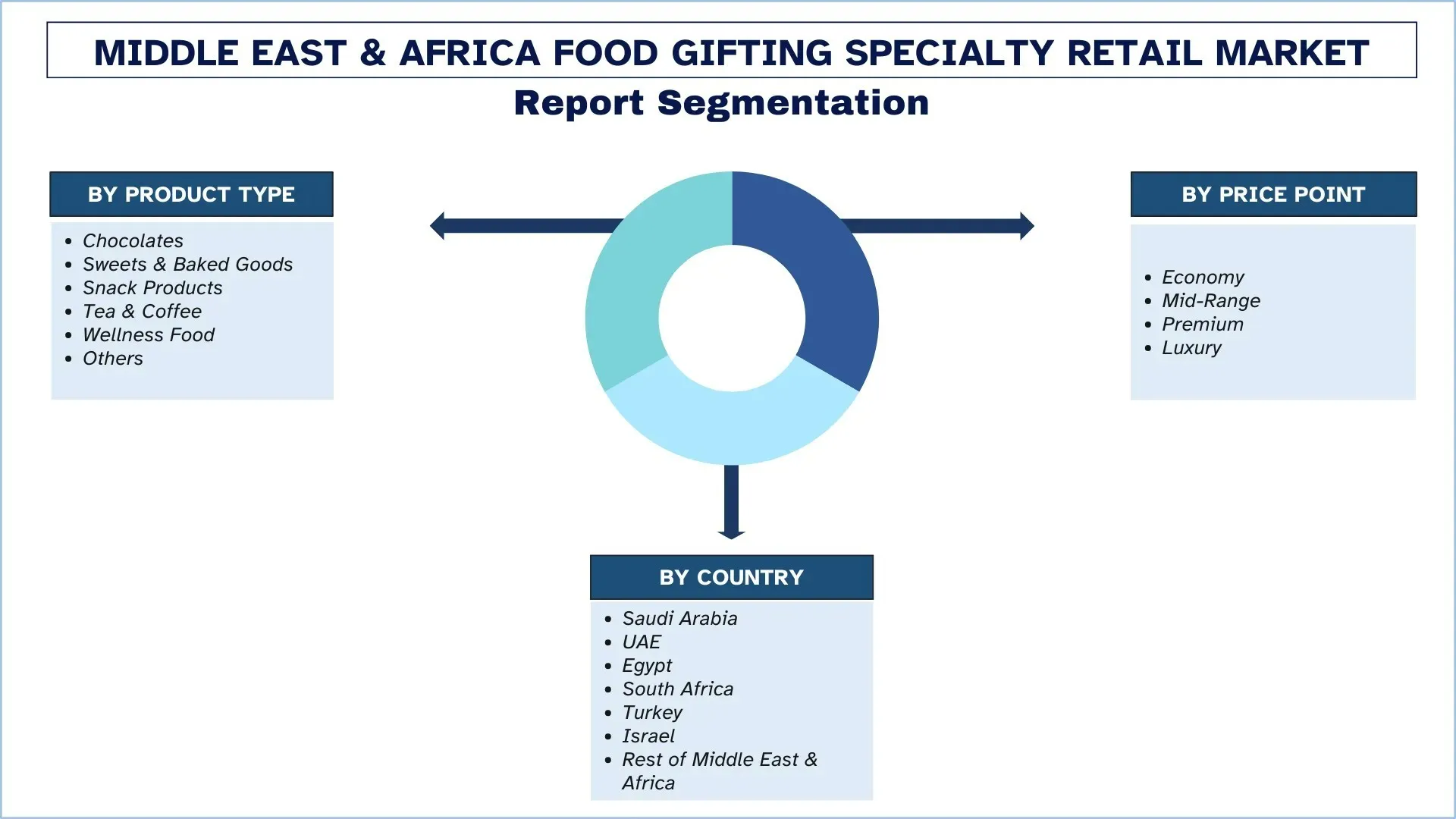
Emphasis By Product Type (Chocolates, Sweets & Baked Goods, Snack Products, Tea & Coffee, Wellness Food, and Others), By Price Point (Economy, Mid-Range, Premium, and Luxury), By Country (Saudi Arabia, UAE, Egypt, South Africa, Turkey, Israel, and the Rest of Middle East & Africa)
Middle East & Africa Food Gifting Specialty Retail Market Size & Forecast
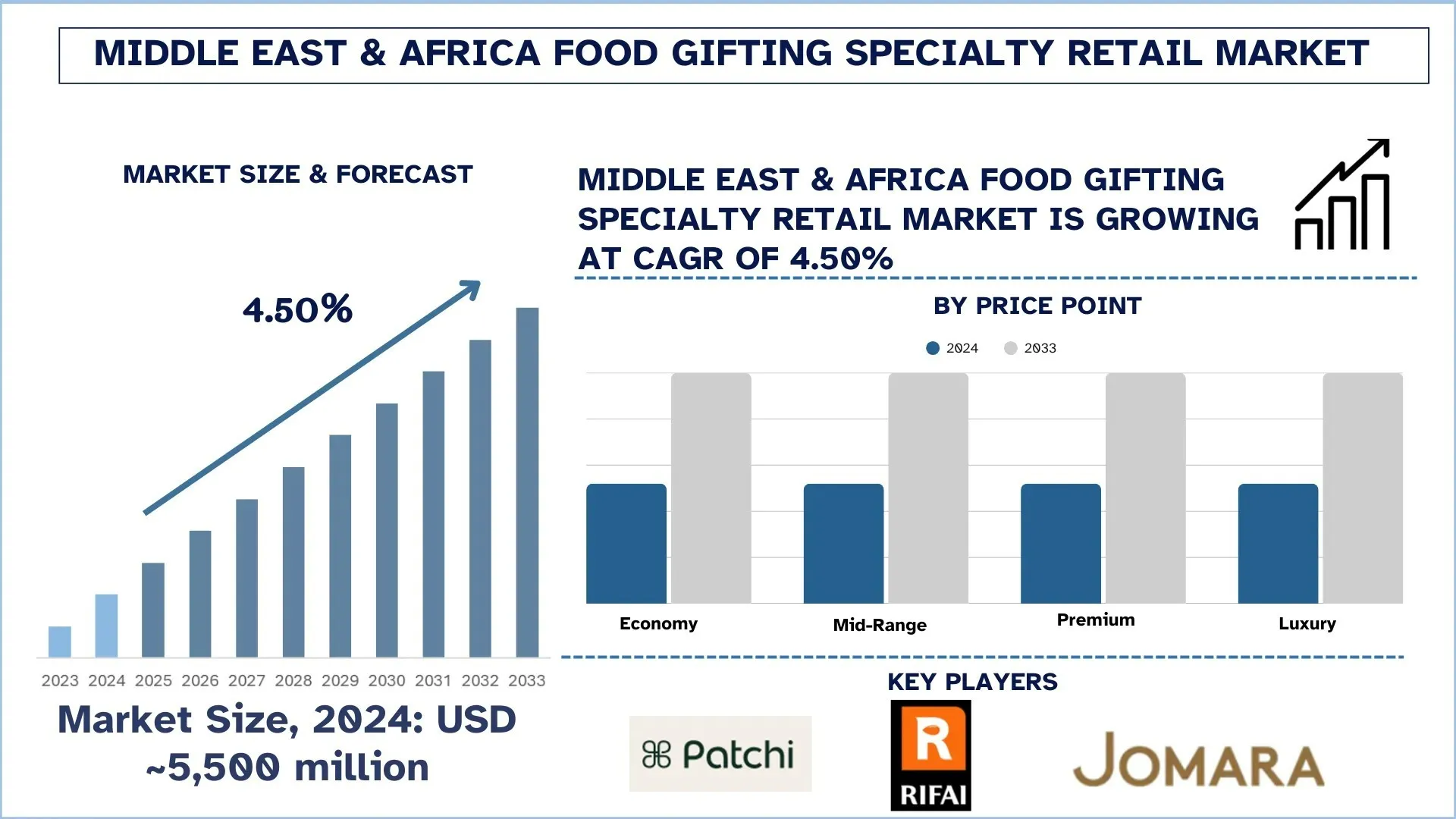
The Middle East & Africa Food Gifting Specialty Retail Market was valued at USD 5,500 million in 2024 and is expected to grow at a strong CAGR of around 4.50% during the forecast period (2025- 2033F). Rising incomes and a taste for premium treats, and a Deep-rooted gifting culture around festivals and life events are some of the key factors that have supported the market rise.
Middle East & Africa Food Gifting Specialty Retail Market Analysis
The retail market of the Middle East and Africa food gifting specialty is growing steadily with increased experience, premium, and personalized gifting. The trend toward urbanization, increased disposable income, and the culture of social and religious celebrations are driving demand towards the custom-made hampers, crafted confectionery, gourmet dates, specialty teas, coffees, and healthy snacks. Specialty brands are becoming more visible with organized retail, malls, airports, and modern trade forms, and product standards are being heightened by boutique chocolatiers and patisseries. Foreign companies are coming or increasing in major cities and, in most cases, collaborating with local manufacturers to localize flavors, formats, and packaging. Meanwhile, local brands are professionalizing their business, taking up branding, and using regional products, including dates, nuts, and spices, to distinguish themselves in a fast-growing competitive market.
Middle East & Africa Food Gifting Specialty Retail Market Trends
This section discusses the key market trends that are influencing the various segments of the Middle East & Africa Food Gifting Specialty Retail market, as found by our team of research experts.
Rising demand for wellness food product gifting:
The specialty food gifting retail sector is being transformed by the health-conscious consumers in the Middle East and Africa. It is observed that urbanite professionals, young families, and those with high incomes are slowly shifting to products that match their lifestyle of maintaining a balanced lifestyle and diet. Retailers are putting together hampers that include sugar-free chocolates, organic dates, protein-enriched snacks, gluten-free cookies, herbal teas, and functional beverages with immunity- or energy-boosting benefits. Clean ingredients and transparency in nutrition information are emerging as important shopping criteria, particularly for digitally savvy consumers who look up products online before giving them as gifts. Corporate consumers are also moving towards wellness-based gift boxes to support employee well-being agendas and brand values. This need is promoting partnership with nutritionists and high-end health products, leading to the creation of guilt-free indulgence. Consequently, wellness-focused gifting is already moving away from being a niche offering to a mainstream developmental pillar in the food gifting specialty station throughout the region.
Key Market Segmentation:
This section provides an analysis of the key trends in each segment of the Middle East & Africa Food Gifting Specialty Retail market report, along with forecasts at the country and regional levels for 2025-2033.
The Chocolates segment has shown promising growth in the Food Gifting Specialty Retail Market.
The Middle East & Africa Gifting Specialty Retail market is divided into chocolates, sweets and baked goods, snack products, tea and coffee, wellness food, and others, depending on the type of products. Among them, the chocolate category has occupied a significant market share due to its general attractiveness to people of all ages, high connection with luxury and festive gifting, and the broad presence of foreign and local brands. The demand is also supported by constant product innovation in flavors, packages, and formats with seasonal and limited-production collections to celebrate specific festivals like Ramadan and Eid. Besides this, striking gift boxes, customization of gifts, and powerful marketing by international confectionery players strengthen the role of chocolate as the ideal and most desirable food gifting option in the area.
The mid-range category held a significant share of the Middle East & Africa Food Gifting Specialty Retail Market.
The Middle East and Africa food gifting specialty retail market has been divided into economy, mid-range, premium, and luxury based on price point. Among them, the mid-range category has occupied a large market share, owing to its moderation of prices and apparent quality. The urban centers are seeing a growing demand by consumers for aesthetically packaged, branded gifts that convey thoughtfulness at a not-too-costly price. The mid-range box assortment of chocolates, dates, and snacks is also well received in terms of their frequent visitation to the social setting, office parties, and seasonal gift giving. The firm presence in the supermarkets, malls, and the web also contributes to mid-range volume growth in the region.
Saudi Arabia is expected to grow at a considerable rate during the forecast period.
Saudi Arabia’s food-gifting specialty retail market is changing at a rapid pace, which is necessitated by the increasing disposable incomes, a young population, and a gifting culture that is more than rooted in religious and family events. High-quality collections of chocolates, luxury dates, nuts, Arabic sweets, and health-aware snacks are becoming more popular instead of the generic hampers. The international and homegrown brands are getting increased exposure in modern malls, upscale supermarkets, and airport duty-free outlets. Simultaneously, digital platforms, in particular, social media boutiques and delivery apps, are becoming a key discovery, customization, and last-mile fulfillment during Ramadan, Eid, weddings, and country celebrations. The retailers are differentiating by sophisticated customized packaging, halal and clean-label positioning, and custom corporate gifting. In the future, it is possible that players who integrate good omnichannel with culture-sensitive and high-quality products will gain a competitive advantage in this expanding market within the Kingdom.

Middle East & Africa Food Gifting Specialty Retail Industry Competitive Landscape:
The Middle East & Africa Food Gifting Specialty Retail market is competitive, with several global and international market players. The key players are adopting different growth strategies to enhance their market presence, such as partnerships, agreements, collaborations, new product launches, geographical expansions, and mergers and acquisitions.
Top Middle East & Africa Food Gifting Specialty Retail Companies
Some of the major players in the market are Patchi, Bateel, Al Rifai, Neuhaus, Jomara, Godiva, Al Nassma, Forrey & Galland, Mirzam, and Hallab 1881.
Middle East & Africa Food Gifting Specialty Retail Market Report Coverage
Report Attribute | Details |
Base year | 2024 |
Forecast period | 2025-2033 |
Growth momentum | Accelerate at a CAGR of 4.50% |
Market size 2024 | USD 5,500 Million |
Country analysis | Saudi Arabia, UAE, Egypt, South Africa, Turkey, Israel, and the Rest of the Middle East & Africa |
Major contributing Country | Saudi Arabia is expected to dominate the market during the forecast period. |
Companies profiled | Patchi, Bateel, Al Rifai, Neuhaus, Jomara, Godiva, Al Nassma, Forrey & Galland, Mirzam, and Hallab 1881. |
Report Scope | Market Trends, Drivers, and Restraints; Revenue Estimation and Forecast; Segmentation Analysis; Demand and Supply Side Analysis; Competitive Landscape; Company Profiling |
Segments Covered | By Product Type, by Price Point, by Country |
Reasons to Buy the Middle East & Africa Food Gifting Specialty Retail Market Report:
The study includes market sizing and forecasting analysis confirmed by authenticated key industry experts.
The report briefly reviews overall industry performance at a glance.
The report covers an in-depth analysis of prominent industry peers, primarily focusing on key business financials, type portfolios, expansion strategies, and recent developments.
Detailed examination of drivers, restraints, key trends, and opportunities prevailing in the industry.
The study comprehensively covers the market across different segments.
Deep dive Country-level analysis of the industry.
Customization Options:
The Middle East & Africa FOOD GIFTING SPECIALTY RETAIL market can further be customized as per requirements or any other market segment. Besides this, UnivDatos understands that you may have your own business needs; hence, feel free to contact us to get a report that completely suits your requirements.
Table of Content
Research Methodology for the Middle East & Africa Food Gifting Specialty Retail Market Analysis (2023-2033)
We analyzed the historical market, estimated the current market, and forecasted the future market of the Middle East & Africa Food Gifting Specialty Retail market to assess its application in major countries. We conducted exhaustive secondary research to gather historical market data and estimate the current market size. To validate these insights, we carefully reviewed numerous findings and assumptions. Additionally, we conducted in-depth primary interviews with industry experts across the Food Gifting Specialty Retail value chain. After validating market figures through these interviews, we used both top-down and bottom-up approaches to forecast the overall market size. We then employed market breakdown and data triangulation methods to estimate and analyze the market size of industry segments and sub-segments.
Market Engineering
We employed data triangulation techniques to finalize the overall market estimation and derive precise statistical numbers for each segment and sub-segment of the Middle East & Africa Food Gifting Specialty Retail market. We split the data into several segments and sub-segments by analyzing various parameters and trends, by Product Type, by Price Point, and by country within the Middle East & Africa Food Gifting Specialty Retail market.
The Main Objective of the Middle East & Africa Food Gifting Specialty Retail Market Study
The study identifies current and future trends in the Middle East & African Food Gifting Specialty Retail market, providing strategic insights for investors. It highlights Country-level market attractiveness, enabling industry participants to tap into untapped markets and gain a first-mover advantage. Other quantitative goals of the studies include:
Market Size Analysis: Assess the current forecast and market size of the Middle East & Africa Food Gifting Specialty Retail market and its segments in terms of value (USD).
Middle East & Africa Food Gifting Specialty Retail Market Segmentation: Segments in the study include areas by Product Type, by Price Point, and by
Regulatory Framework & Value Chain Analysis: Examine the regulatory framework, value chain, customer behavior, and competitive landscape of the Middle East & Africa Food Gifting Specialty Retail industry.
Country Analysis: Conduct a detailed Country analysis for key areas such as Saudi Arabia, UAE, Egypt, South Africa, Turkey, Israel, and the Rest of the Middle East & Africa.
Company Profiles & Growth Strategies: Company profiles of the Middle East & Africa Food Gifting Specialty Retail market and the growth strategies adopted by the market players to sustain the fast-growing market.
Frequently Asked Questions FAQs
Q1: What is the Middle East & Africa Food Gifting Specialty Retail market’s current market size and growth potential?
The Middle East & Africa Food Gifting Specialty Retail market was valued at 5,500 million in 2024 and is expected to grow at a CAGR of 4.50% during the forecast period (2025-2033).
Q2: Which segment has the largest share of the Middle East & Africa Food Gifting Specialty Retail market by Product Type?
The chocolate category has occupied a significant market share due to its general attractiveness to people of all ages, high connection with luxury and festive gifting, and the broad presence of foreign and local brands.
Q3: What are the driving factors for the growth of the Middle East & Africa Food Gifting Specialty Retail market?
• Rising incomes and a taste for premium treats: Rising disposable incomes and a growing appetite for premium treats are pushing consumers to trade up from generic hampers to curated, higher-value food gifting assortments.
• Deep-rooted gifting culture around festivals and life events: A deep-rooted gifting culture around religious festivals, weddings, and family milestones creates frequent, high-volume occasions that structurally support demand for specialty food gifts.
Q4: What are the emerging technologies and trends in the Middle East & Africa Food Gifting Specialty Retail market?
• Rising demand for wellness food product gifting: Rising demand for wellness-focused food gifting is driving growth in sugar-free, organic, functional, and clean-label assortments tailored to health-conscious consumers and corporate well-being programs.
• Omnichannel and Occasion-Led Buying: Omnichannel and occasion-led buying, spanning boutiques, branded websites, marketplaces, apps, and social media, enables personalized, event-themed collections with flexible delivery options and data-driven recommendations.
Q5: What are the key challenges in the Middle East & Africa Food Gifting Specialty Retail market?
• Complex logistics and last-mile/cold-chain requirements: Large geographic distances, fragmented infrastructure, and variable climate conditions make it costly and operationally difficult to maintain product quality, freshness, and on-time delivery, especially for temperature-sensitive gourmet and wellness items.
• Inflation, currency pressure, and cautious discretionary spending: Persistent cost inflation and pressure on household incomes are squeezing margins and limiting consumers’ willingness to pay for premium gift hampers, forcing retailers to continuously rebalance pack sizes, price points, and promotions to protect volume.
Q6: Which country dominates the Middle East & Africa Food Gifting Specialty Retail market?
The Saudi Arabia food gifting specialty retail market has held a significant market share due to the increasing disposable incomes, a young population, and a gifting culture that is more than rooted in religious and family events
Q7: Who are the key players in the Middle East & Africa Food Gifting Specialty Retail market?
Some of the top Food Gifting Specialty Retail companies in the Middle East & Africa include:
• Patchi
• Bateel
• Al Rifai
• Neuhaus
• Jomara
• Godiva
• Al Nassma
• Forrey & Galland
• Mirzam
• Hallab 1881
Q8: What are the opportunities for companies within the Middle East & Africa Food Gifting Specialty Retail market?
• Tapping Africa’s accelerating online retail and grocery shift: Tapping Africa’s rapidly expanding online retail and grocery ecosystems offers significant upside, as marketplaces and delivery apps create new routes-to-market, wider geographic reach, and data-rich environments for targeted gifting propositions.
• Scaling B2B and corporate food gifting programs: Scaling B2B and corporate food gifting programs covering employee recognition, client appreciation, and event gifting presents a sizable, recurring revenue pool for players able to deliver customizable, branded, and logistically reliable solutions.
Q9: How are consumer preferences shaping product development in the Middle East & Africa Food Gifting Specialty Retail market?
Evolving consumer preferences toward quality, well-focused ingredients, and personalized experiences are pushing retailers to design cleaner-label assortments, customizable hampers, culturally resonant flavors, and omnichannel gifting formats tailored to specific occasions.
Related Reports
Customers who bought this item also bought



Middle East & Africa Bath and Shower Product Market: Current Analysis and Forecast (2025-2033)
Emphasis By Product Type (Bath Soaps, Body Gels, Bath Additives, and Others), by Product Form (Solid, Gels and Jellies, Liquid, and Others), By End-Users ( Men and Women), by Distribution Channel (Online stores and Offline stores), By Country (Saudi Arabia, UAE, Egypt, South Africa, Turkey, Israel, and the Rest of Middle East & Africa)

Southeast Asia Online On-Demand Home Services Market: Current Analysis and Forecast (2025-2033)
Emphasis on Platform (Mobile Application, Web Portal); Service Type (Home Cleaning, Repair & Maintenance, Beauty & Wellness, Pest Control, Laundry & Dry Cleaning, Moving & Relocation, Others); End User (Residential Users, Commercial Users); and Country.

Sage Essential Oil Market: Current Analysis and Forecast (2025-2033)
Emphasis on Source (Organic and Inorganic); Application (Aromatherapy, Cosmetics & Personal Care, Pharmaceuticals, Food & Beverages, and Others); Distribution Channel (Online and Offline); and Region/Country
Middle East & Africa Cat Litter Product Market: Current Analysis and Forecast (2025-2033)
Emphasis By Product Type (Clumping and Conventional), By Raw Material (Clay, Silica, Wood/Bamboo/Sawdust, Paper, Soy, Corn/ Grain, and Others), by Distribution Channel (Offline (Supermarket/Hypermarkets, Specialty Retail Stores, Convenience Stores & Others), and Online), By Country (Saudi Arabia, UAE, Egypt, South Africa, Turkey, Israel, and the Rest of Middle East & Africa)