Middle East & Africa Alcoholic Drinks Packaging Market: Current Analysis and Forecast (2025-2033)
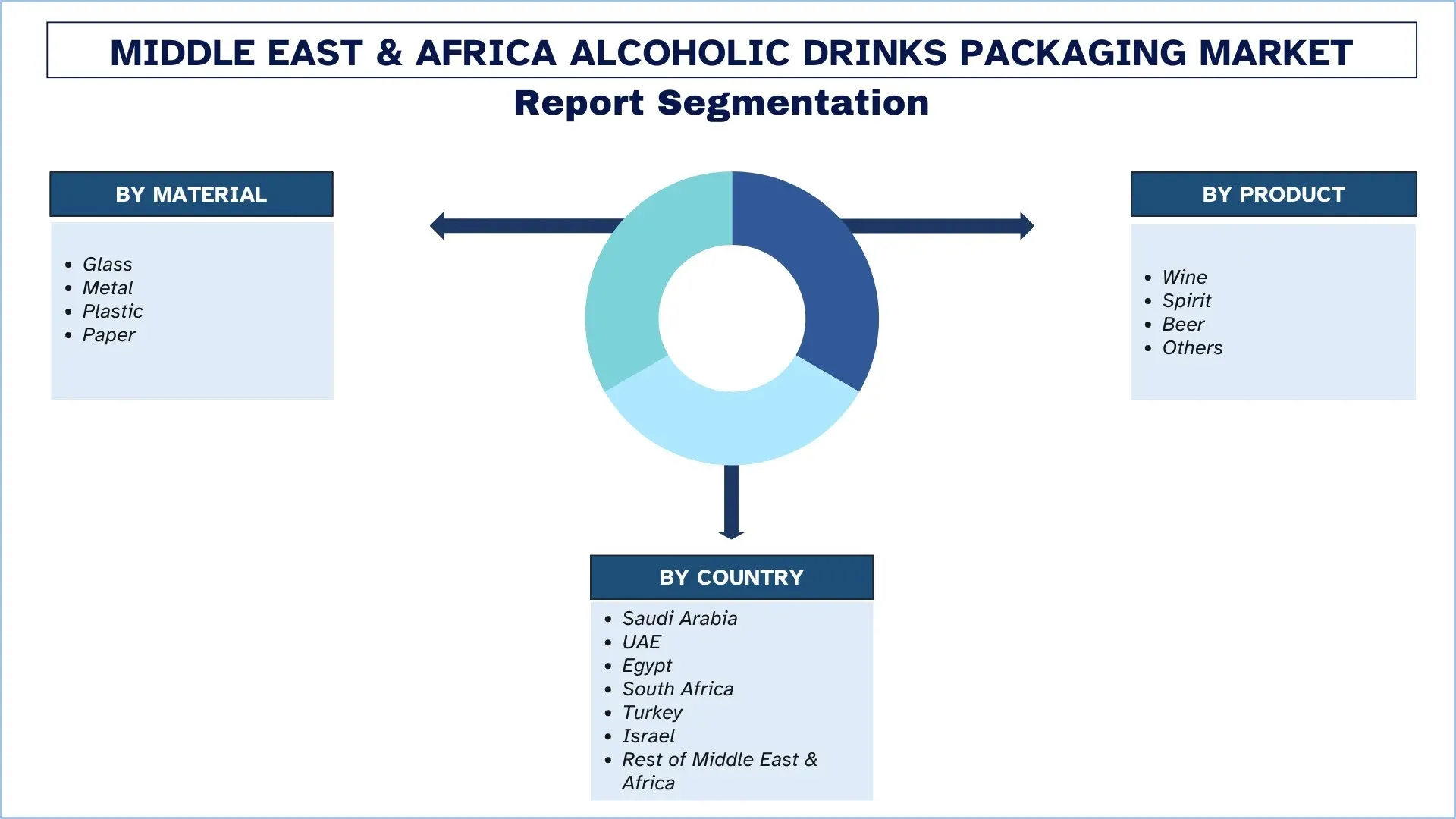
Emphasis By Material (Glass, Metal, Plastic, and Paper), By Product (Wine, Spirit, Beer, and Others), By Country (Saudi Arabia, UAE, Egypt, South Africa, Turkey, Israel, and the Rest of Middle East & Africa)
Middle East & Africa Alcoholic Drinks Packaging Market Size & Forecast
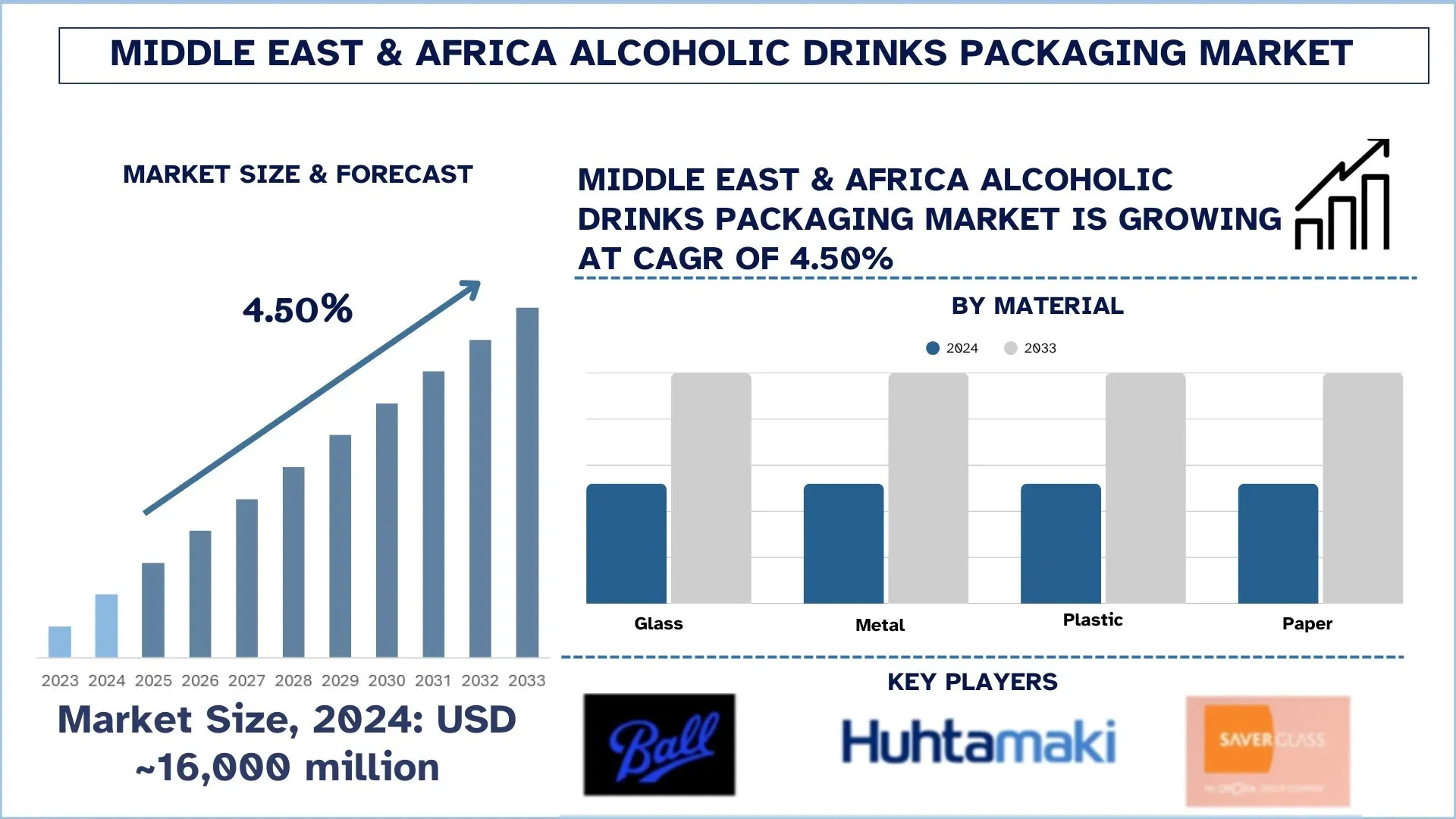
The Middle East & Africa Alcoholic Drinks Packaging Market was valued at USD 16,000 million in 2024 and is expected to grow at a strong CAGR of around 4.50% during the forecast period (2025- 2033F). Growing alcohol consumption, a youthful, urban population, and trading up to premium and craft alcoholic drinks are some of the key factors contributing to the market rise.
Middle East & Africa Alcoholic Drinks Packaging Market Analysis
The Middle East and Africa (MEA) alcoholic drinks market is undergoing steady growth, which is attributed to changing consumer tastes and preferences, a rising middle class, and a rise in tourism in the region. As urbanization is on the increase, especially in major markets such as the UAE, Saudi Arabia, and South Africa, the demand is growing for a wide range of alcoholic beverages. This has pushed the local producers as well as international brands to invest heavily in product innovation and a distribution network. Also, the emerging trend of high-end and artisanal drinks is transforming the market environment, as it has resulted in a pronounced need for high-quality packaging as well as high-quality ingredients. The governments and the private players are reacting to this and are tightening regulations and enhancing infrastructure to adapt to evolving consumer needs.
Middle East & Africa Alcoholic Drinks Packaging Market Trends
This section discusses the key market trends that are influencing the various segments of the Middle East & Africa Alcoholic Drinks Packaging market, as found by our team of research experts.
Glass remains core with more premium features and right-sizing:
Glass packaging is still a leading factor in the Middle East and African market of alcoholic beverages, more so for the premium brands. This is because of its capacity to provide a high aesthetic value and preserve the integrity of the beverage within, which makes it a favorite among high-end brands. Glass bottles are connected to luxury, quality, and tradition, and they are still used in the packaging of alcoholic drinks. With the increased demand for consumers towards high-end product packaging, the glass packaging is changing with new designs, right-sizing alternatives, and more functionality. The movement toward premium packaging is wider in the sense that consumer preference towards quality and sophistication is changing, and glass packaging is leading the change in packaging trends.
Key Market Segmentation:
This section provides an analysis of the key trends in each segment of the Middle East & Africa Alcoholic Drinks Packaging market report, along with forecasts at the country and regional levels for 2025-2033.
The glass segment has shown promising growth in the Alcoholic Drinks Packaging Market.
Based on material, the Middle East & Africa alcoholic drinks packaging market is segmented into glass, metal, plastic, and paper. Of these, glass has held a major market share due to ease of storage, manufacturing glass bottles, ease of supply chain, recyclability, etc. Additionally, glass bottles are less expensive to produce, which does not add up to the cost of the final product to a notable degree that could deter the end consumers. However, with the rise of beer and other premium spirits, metal packaging has also gained traction. Furthermore, as small packaging spirits have also gained traction in plastic and paper-based packaging, this is apt for reducing the cost.
The beer category held a significant share of the Middle East & Africa Alcoholic Drinks Packaging Market.
Based on product, the Middle East & Africa alcoholic drinks packaging market is segmented into wine, spirits, beer, and others. This beer has held a sizeable market share. Due to ease of consumption, low alcohol percentage, etc., the category has been in high demand. Furthermore, due to being served as cold beverages better suited to hot and humid African and Middle Eastern regions, the category has also been at the center of demand. Considering all the aforementioned factors, the beer category is further anticipated to dominate and help build a robust demand for the packaging in the glass and metal can category.
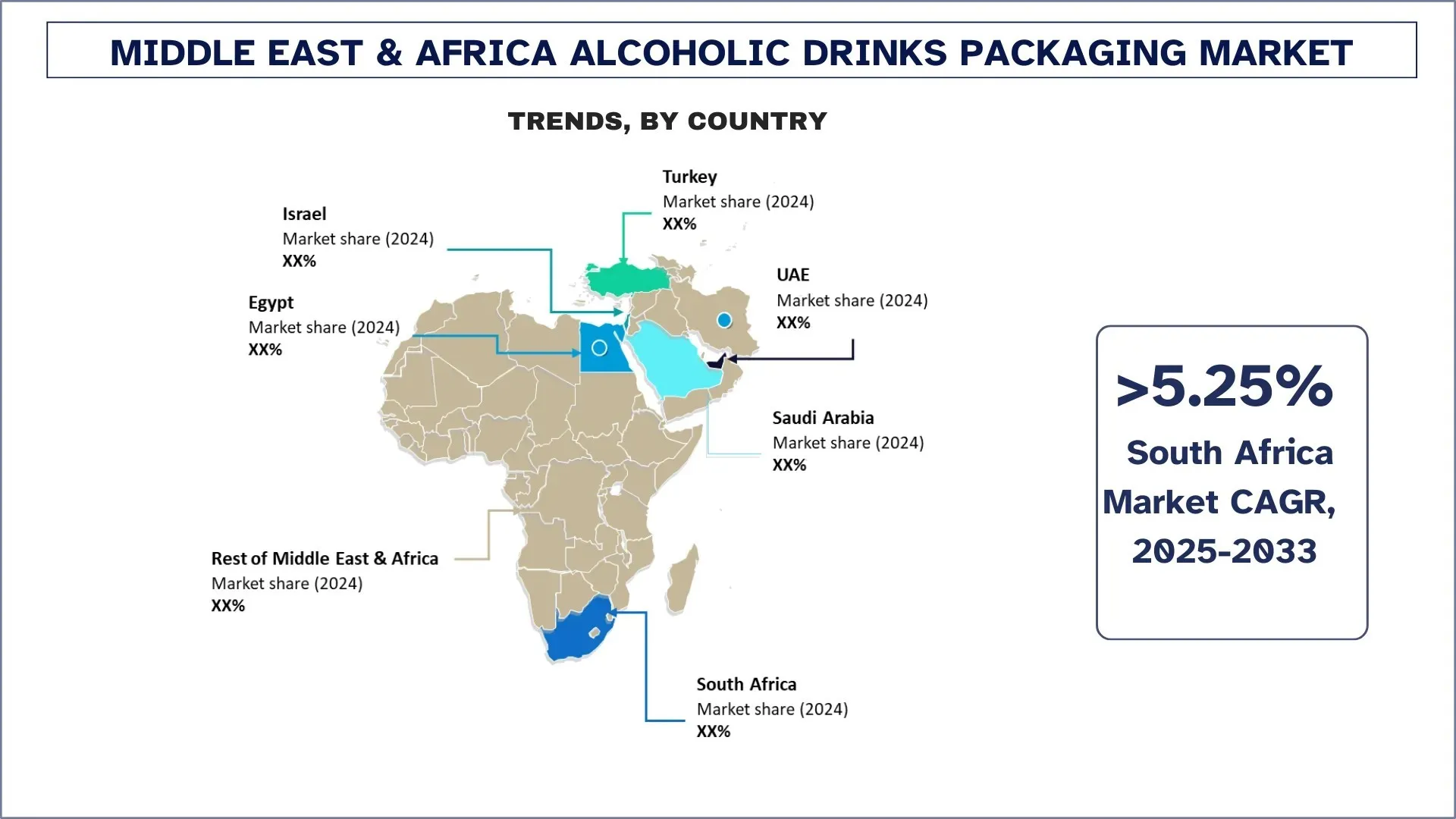
South Africa is expected to grow at a considerable rate during the forecast period.
The South African alcoholic beverages market has held a significant market share with a strong beer and wine segment, a cider segment, and an emerging spirits segment. A large population of people of drinking age, urbanization, and a well-established retail and hospitality network serve as supportive factors to loyalty and demand. Another significant production and export of the country is major wine, which increases the local supply of bottled and boxed wine. Premiumisation applies to craft beer, gin, and cider, with the middle-income consumer moving to better and more branded products. Simultaneously, stricter regulations, health consciousness, and financial pressure are promoting innovation in low-cost packages and reduced-alcohol extension.
Middle East & Africa Alcoholic Drinks Packaging Industry Competitive Landscape:
The Middle East & Africa Alcoholic Drinks Packaging market is competitive, with several global and international market players. The key players are adopting different growth strategies to enhance their market presence, such as partnerships, agreements, collaborations, new product launches, geographical expansions, and mergers and acquisitions.
Top Middle East & Africa Alcoholic Drinks Packaging Companies
Some of the major players in the market are Ball Corporation, Crown Holdings Inc., Huhtamäki Oyj, Saudi Arabian Glass Co. Ltd, Saverglass SAS, Ardagh Group S.A., Middle East Glass Manufacturing Company SAE, Bonpak (Pty) Ltd, The National Company for Glass Industries (Zouja), and Majan Glass Company SAOG.
Middle East & Africa Alcoholic Drinks Packaging Market Report Coverage
Report Attribute | Details |
Base year | 2024 |
Forecast period | 2025-2033 |
Growth momentum | Accelerate at a CAGR of 4.50% |
Market size 2024 | USD 16,000 Million |
Country analysis | Saudi Arabia, UAE, Egypt, South Africa, Turkey, Israel, and the Rest of the Middle East & Africa |
Major contributing Country | South Africa is expected to dominate the market during the forecast period. |
Companies profiled | Ball Corporation, Crown Holdings Inc., Huhtamäki Oyj, Saudi Arabian Glass Co. Ltd, Saverglass SAS, Ardagh Group S.A., Middle East Glass Manufacturing Company SAE, Bonpak (Pty) Ltd, The National Company for Glass Industries (Zouja), and Majan Glass Company SAOG. |
Report Scope | Market Trends, Drivers, and Restraints; Revenue Estimation and Forecast; Segmentation Analysis; Demand and Supply Side Analysis; Competitive Landscape; Company Profiling |
Segments Covered | by Material, by Product, by Country |
Reasons to Buy the Middle East & Africa Alcoholic Drinks Packaging Market Report:
The study includes market sizing and forecasting analysis confirmed by authenticated key industry experts.
The report briefly reviews overall industry performance at a glance.
The report covers an in-depth analysis of prominent industry peers, primarily focusing on key business financials, type portfolios, expansion strategies, and recent developments.
Detailed examination of drivers, restraints, key trends, and opportunities prevailing in the industry.
The study comprehensively covers the market across different segments.
Deep dive Country-level analysis of the industry.
Customization Options:
The Middle East & Africa ALCOHOLIC DRINKS PACKAGING market can further be customized as per requirements or any other market segment. Besides this, UnivDatos understands that you may have your own business needs; hence, feel free to contact us to get a report that completely suits your requirements.
Table of Content
Research Methodology for the Middle East & Africa Alcoholic Drinks Packaging Market Analysis (2023-2033)
We analyzed the historical market, estimated the current market, and forecasted the future market of the Middle East & Africa Alcoholic Drinks Packaging market to assess its application in major countries. We conducted exhaustive secondary research to gather historical market data and estimate the current market size. To validate these insights, we carefully reviewed numerous findings and assumptions. Additionally, we conducted in-depth primary interviews with industry experts across the Alcoholic Drinks Packaging value chain. After validating market figures through these interviews, we used both top-down and bottom-up approaches to forecast the overall market size. We then employed market breakdown and data triangulation methods to estimate and analyze the market size of industry segments and sub-segments.
Market Engineering
We employed data triangulation techniques to finalize the overall market estimation and derive precise statistical numbers for each segment and sub-segment of the Middle East & Africa Alcoholic Drinks Packaging market. We split the data into several segments and sub-segments by analyzing various parameters and trends, by Material, by Product, and by country within the Middle East & Africa Alcoholic Drinks Packaging market.
The Main Objective of the Middle East & Africa Alcoholic Drinks Packaging Market Study
The study identifies current and future trends in the Middle East & African Alcoholic Drinks Packaging market, providing strategic insights for investors. It highlights Country-level market attractiveness, enabling industry participants to tap into untapped markets and gain a first-mover advantage. Other quantitative goals of the studies include:
Market Size Analysis: Assess the current forecast and market size of the Middle East & Africa Alcoholic Drinks Packaging market and its segments in terms of value (USD).
Middle East & Africa Alcoholic Drinks Packaging Market Segmentation: Segments in the study include areas by Material, by Product, and by
Regulatory Framework & Value Chain Analysis: Examine the regulatory framework, value chain, customer behavior, and competitive landscape of the Middle East & Africa Alcoholic Drinks Packaging industry.
Country Analysis: Conduct a detailed Country analysis for key areas such as Saudi Arabia, UAE, Egypt, South Africa, Turkey, Israel, and the Rest of the Middle East & Africa.
Company Profiles & Growth Strategies: Company profiles of the Middle East & Africa Alcoholic Drinks Packaging market and the growth strategies adopted by the market players to sustain the fast-growing market.
Frequently Asked Questions FAQs
Q1: What is the Middle East & Africa Alcoholic Drinks Packaging market’s current market size and growth potential?
The Middle East & Africa Alcoholic Drinks Packaging Market was valued at 16,000 million in 2024 and is expected to grow at a CAGR of 4.50% during the forecast period (2025-2033).
Q2: Which segment has the largest share of the Middle East & Africa Alcoholic Drinks Packaging market by Material?
Glass has held a major market share due to ease of storage, manufacturing glass bottles, ease of supply chain, recyclability, etc.
Q3: What are the driving factors for the growth of the Middle East & Africa Alcoholic Drinks Packaging market?
• Growing alcohol consumption and youthful, urban population: Rising numbers of young, urban consumers are increasing demand for branded alcoholic beverages, boosting volumes for modern packaging formats.
• Trading up to premium and craft alcoholic drinks: Consumers are shifting toward higher-value, premium, and craft products, driving the need for sophisticated, design-led packaging.
Q4: What are the emerging technologies and trends in the Middle East & Africa Alcoholic Drinks Packaging market?
• Glass remains core with more premium features and right-sizing: Producers are enhancing glass bottles with embossing, special finishes, and optimized sizes to elevate shelf impact and match specific consumption occasions.
• Momentum toward greener and more convenient formats (cans, PET, rPET): Lightweight, recyclable cans and PET/rPET bottles are gaining traction as brands respond to sustainability goals and on-the-go lifestyles.
Q5: What are the key challenges in the Middle East & Africa Alcoholic Drinks Packaging market?
• Restrictive and uneven alcohol regulations: Varied rules on alcohol sale, marketing, and distribution across countries complicate packaging decisions and limit growth in certain markets.
• Cost, infrastructure, and supply-chain constraints: High input and transport costs, limited local manufacturing capacity, and logistics bottlenecks can disrupt packaging supply and squeeze producer margins.
Q6: Which country dominates the Middle East & Africa Alcoholic Drinks Packaging market?
The South African alcoholic beverages market has held a significant market share with a strong beer and wine segment, a cider segment, and an emerging spirits segment.
Q7: Who are the key players in the Middle East & Africa Alcoholic Drinks Packaging market?
Some of the top Alcoholic Drinks Packaging companies in the Middle East & Africa include:
• Ball Corporation
• Crown Holdings Inc.
• Huhtamäki Oyj
• Saudi Arabian Glass Co. Ltd
• Saverglass SAS
• Ardagh Group S.A.
• Middle East Glass Manufacturing Company SAE
• Bonpak (Pty) Ltd
• The National Company for Glass Industries (Zouja)
• Majan Glass Company SAOG
Q8: What are the opportunities for companies within the Middle East & Africa Alcoholic Drinks Packaging market?
• Building regional, sustainable packaging capacity: Expanding local production of glass, cans, and PET/rPET packaging can reduce import dependence, lower logistics costs, and help brands meet tightening sustainability and recyclability targets.
• Value-added design for premium, tourism, and online channels: Custom shapes, embossing, sleeves, gift-ready formats tailored to tourists, duty-free outlets, upscale venues, and e-commerce create strong differentiation and support higher price points.
Q9: How are consumer preferences shaping product development in the Middle East & Africa Alcoholic Drinks Packaging market?
Consumers are demanding premium-looking, convenient, and sustainable packs, pushing brands toward refined glass designs, lightweight cans, PET and rPET formats, right-sized servings, and distinctive packaging tailored to tourism occasions regionwide.
Related Reports
Customers who bought this item also bought


Middle East & Africa Bath and Shower Product Market: Current Analysis and Forecast (2025-2033)
Emphasis By Product Type (Bath Soaps, Body Gels, Bath Additives, and Others), by Product Form (Solid, Gels and Jellies, Liquid, and Others), By End-Users ( Men and Women), by Distribution Channel (Online stores and Offline stores), By Country (Saudi Arabia, UAE, Egypt, South Africa, Turkey, Israel, and the Rest of Middle East & Africa)

Southeast Asia Online On-Demand Home Services Market: Current Analysis and Forecast (2025-2033)
Emphasis on Platform (Mobile Application, Web Portal); Service Type (Home Cleaning, Repair & Maintenance, Beauty & Wellness, Pest Control, Laundry & Dry Cleaning, Moving & Relocation, Others); End User (Residential Users, Commercial Users); and Country.

Sage Essential Oil Market: Current Analysis and Forecast (2025-2033)
Emphasis on Source (Organic and Inorganic); Application (Aromatherapy, Cosmetics & Personal Care, Pharmaceuticals, Food & Beverages, and Others); Distribution Channel (Online and Offline); and Region/Country
Middle East & Africa Cat Litter Product Market: Current Analysis and Forecast (2025-2033)
Emphasis By Product Type (Clumping and Conventional), By Raw Material (Clay, Silica, Wood/Bamboo/Sawdust, Paper, Soy, Corn/ Grain, and Others), by Distribution Channel (Offline (Supermarket/Hypermarkets, Specialty Retail Stores, Convenience Stores & Others), and Online), By Country (Saudi Arabia, UAE, Egypt, South Africa, Turkey, Israel, and the Rest of Middle East & Africa)