- Home
- About Us
- Industry
- Services
- Reading
- Contact Us
Bags Market: Current Analysis and Forecast (2025-2033)
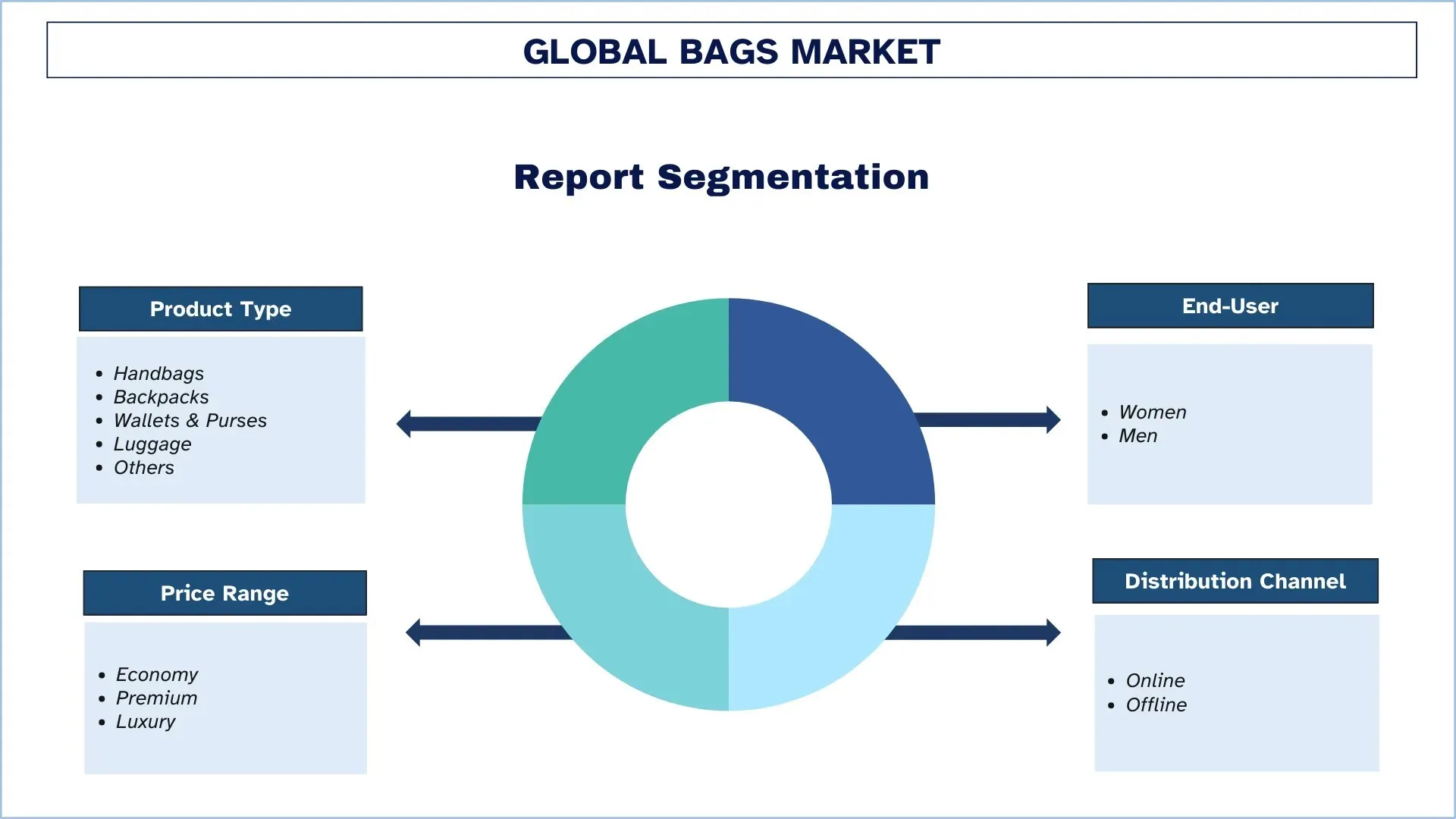
Emphasis on Product Type (Handbags, Backpacks, Wallets & Purses, Luggage, and Others); Price Range (Economy, Premium, and Luxury); End-User (Women and Men); Distribution Channel (Online and Offline); and Region/Country
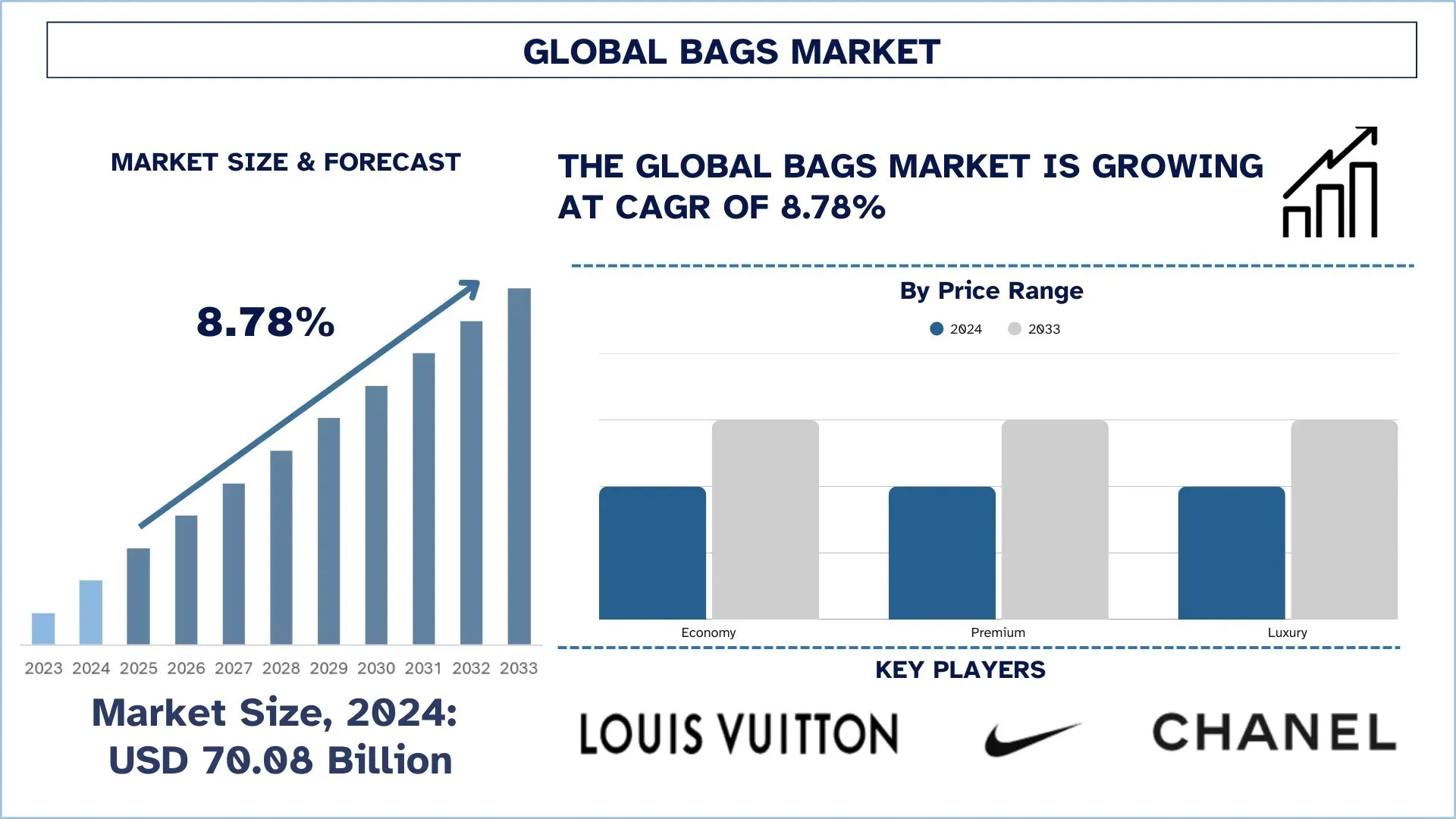
Global Bags Market Size & Forecast
The Global Bags Market was valued at USD 70.08 billion in 2024 and is expected to grow at a strong CAGR of around 8.78% during the forecast period (2025-2033F), driven by expanding travel and tourism, rapid e-commerce adoption, rising demand for premium and luxury bags, and increasing consumer preference for customized and sustainable products.
Bags Market Analysis
The global bags market is showing consistent growth fueled by changing fashion trends, increased disposable incomes, and expanding urban populations. The popularity of handbags, backpacks, luggage, and crossbody bags is on the rise due to lifestyle changes, increased travel, and professional needs. E-commerce and social media are reshaping shopping habits by offering personalized suggestions and boosting brand exposure. Asia-Pacific continues to be the manufacturing hub and the quickest-growing consumer market, supported by cost-effective production and a rising middle class. The premium and luxury sectors are also expanding as consumers seek high-quality, durable, and fashionable products.
Global Bags Market Trends
This section discusses the key market trends that are influencing the various segments of the global bags market, as found by our team of research experts.
Rising Popularity of Customized Bags
The growing popularity of customized bags is one of the prominent trends in the global bag market, due to increasing consumer demand for personalization, uniqueness, and self-expression. As fashion leans more towards individualism, customers want items that represent their identity, including features like monograms, custom colors, embroidered initials, patches, or fully tailored designs. This trend is especially strong among Gen Z and millennials, who value products that provide exclusivity and a personal connection. Brands are reacting by launching online customization tools, exclusive personalized releases, and smart personalization initiatives. For example, in 2025, Louis Vuitton expanded its "Mon Monogram" program, enabling customers to personalize travel bags, city bags, luggage, and small leather goods with initials, stripes, patches, and different colors. These initiatives improve exclusivity, elevate customer experience, and strengthen brand loyalty. As consumers prefer unique, made-to-order products over mass-produced items, customized bags are becoming more popular among both luxury and mainstream brands.
Bags Industry Segmentation
This section provides an analysis of the key trends in each segment of the global bags market report, along with forecasts at the global, regional, and country levels for 2025-2033.
The Handbags Segment Dominates the Global Bags Market
Based on product type category, the market is segmented into handbags, backpacks, wallets & purses, luggage, and others. Among these, handbags hold the largest share of the global bags market because of their exceptional versatility, growing fashion appeal, and rising demand for practical, multi-purpose accessories. Handbags' design makes them suitable for work, shopping, travel, and daily commuting, thereby attracting a broad range of consumers. The global shift toward sustainable lifestyles has further boosted the popularity of reusable fabric totes, replacing single-use bags in many areas. Fashion brands, from fast fashion to luxury houses, have improved designs with premium materials, artistic prints, and limited-edition collaborations, increasing their appeal. Additionally, the rise of the female workforce and urbanization has increased demand for stylish and functional carry-all options, which further drives the growth of the market.
The Economy Segment Dominates the Global Bags Market.
Based on price range category, the market is segmented into economy, premium, and luxury. Among these, the economy segment holds the largest share of the global bags market as it serves the demand of the largest and most price-sensitive consumer base. In developing areas like India, Southeast Asia, Latin America, and parts of Africa, consumers favor affordability rather than premium features, leading to high sales of budget handbags, backpacks, and luggage. Rising urbanization, increasing student populations, and growing disposable income further boost the demand for low-cost and durable bags. Furthermore, the strong presence of unorganized and local manufacturers allows for competitive pricing and wide product availability. E-commerce platforms, flash deals, and private-label brands further boost the growth of the market by providing low-cost options with frequent discounts. As a result, widespread accessibility and high purchase volume make the economy segment a popular category worldwide.
Asia-Pacific holds the largest market share in the global bags market
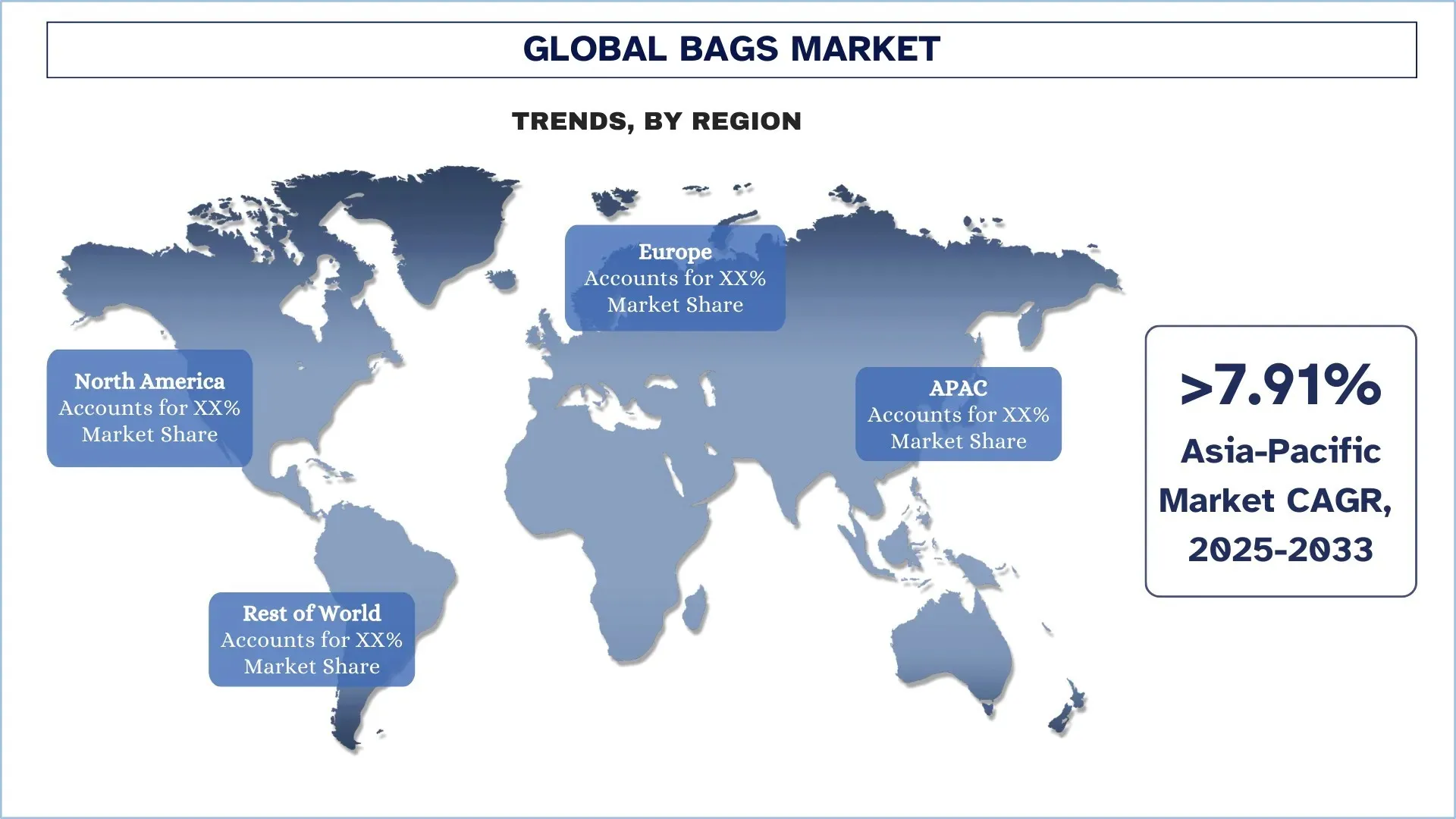
Asia-Pacific holds the largest share of the global bags market due to its large manufacturing infrastructure, access to raw materials, and affordable labor. These advantages allow large-scale production for local and international markets. Key manufacturing centers like China, India, Vietnam, and Bangladesh produce a wide variety of textile, leather, and synthetic bags at competitive prices and with faster turnaround times. Rising disposable incomes, growing fashion awareness, and increasing urbanization across APAC further increase demand for handbags, backpacks, luggage, and luxury accessories. The region also benefits from widespread e-commerce adoption and increased travel activity. Furthermore, strategic investments in smart bags, environmentally friendly materials, and creative designs bolster the region's position in the global bags market.
China held a Dominant share of the Asia-Pacific Bags Market in 2024
China leads the Asia-Pacific bags market due to its large consumer base, vibrant fashion culture, and a fast-growing premium market. Rising numbers of urban professionals and fashion-conscious young shoppers are driving demand for designer handbags, trendy backpacks, and versatile work bags. The country's sophisticated e-commerce platforms like Tmall, JD.com, Douyin, and Xiaohongshu influence purchasing trends and promote direct-to-consumer sales. Domestic brands are gaining popularity with contemporary designs and affordable prices. Furthermore, increasing focus on eco-friendly materials, high-quality craftsmanship, and innovative features further strengthens the country's position in the bag industry.
Bags Industry Competitive Landscape
The global bags market is competitive, with several global and international market players. The key players are adopting different growth strategies to enhance their market presence, such as partnerships, agreements, collaborations, geographical expansions, and mergers and acquisitions.
Top Bags Market Companies
Some of the major players in the market are Louis Vuitton Malletier SAS (LVMH), Nike, Chanel, KATE SPADE LLC. (Tapestry, Inc.), The North Face (VF Corporation), Prada S.p.A., Samsonite Group S.A. (CVC Capital Partners), Guccio Gucci S.p.A. (Kering), Michael Kors, and Hermès.
Recent Developments in the Bags Market
In April 2025, Latico Leathers introduced its Spring collection featuring new multiple leather crossbody bags, including standout models like the Grace Crossbody, Grit Crossbody, Canyon Crossbody, and Stevie Studs Crossbody. These bags combine full-grain, buttery-soft leather with functional features, adjustable and detachable straps, roomy interiors, and multiple compartments offering flexible wear as shoulder bags or crossbodies. The launch strengthened Latico’s focus on functional, fashion-driven crossbody styles.
In September 2024, Net-A-Porter launched its top new-season bags, featuring standout designs from luxury houses such as Alaïa’s ‘Le Teckel’, Balenciaga’s ‘Bel Air’ tote, Bottega Veneta’s ‘Lauren’ clutch, Chloé’s ‘Bracelet’ bag, Gucci’s ‘Milano’ tote, and Saint Laurent’s ‘Bea’ tote. These curated styles combine classic elegance with modern silhouettes, featuring artisanal craftsmanship and versatile shapes designed for both everyday wear and standout seasonal looks.
Global Bags Market Report Coverage
Report Attribute | Details |
Base year | 2024 |
Forecast period | 2025-2033 |
Growth momentum | Accelerate at a CAGR of 8.78% |
Market size 2024 | USD 70.08 billion |
Regional analysis | North America, Europe, APAC, Rest of the World |
Major contributing region | The Asia-Pacific region is expected to dominate the market during the forecast period. |
Key countries covered | U.S., Canada, Germany, U.K., Spain, Italy, France, China, Japan, and India. |
Companies profiled | Louis Vuitton Malletier SAS (LVMH), Nike, Chanel, KATE SPADE LLC. (Tapestry, Inc.), The North Face (VF Corporation), Prada S.p.A., Samsonite Group S.A. (CVC Capital Partners), Guccio Gucci S.p.A. (Kering), Michael Kors, and Hermès |
Report Scope | Market Trends, Drivers, and Restraints; Revenue Estimation and Forecast; Segmentation Analysis; Demand and Supply Side Analysis; Competitive Landscape; Company Profiling |
Segments Covered | By Product Type, By Price Range, By End-User, By Distribution Channel, and By Region/Country |
Reasons to Buy the Bags Market Report:
The study includes market sizing and forecasting analysis confirmed by authenticated key industry experts.
The report briefly reviews overall industry performance at a glance.
The report covers an in-depth analysis of prominent industry peers, primarily focusing on key business financials, type portfolios, expansion strategies, and recent developments.
Detailed examination of drivers, restraints, key trends, and opportunities prevailing in the industry.
The study comprehensively covers the market across different segments.
Deep dive regional-level analysis of the industry.
Customization Options:
The global bags market can further be customized as per the requirements or any other market segment. Besides this, UnivDatos understands that you may have your own business needs; hence, feel free to contact us to get a report that completely suits your requirements.
Table of Content
Research Methodology for the Global Bags Market Analysis (2023-2033)
We analyzed the historical market, estimated the current market, and forecasted the future market of the global bags market to assess its application in major regions worldwide. We conducted exhaustive secondary research to gather historical market data and estimate the current market size. To validate these insights, we carefully reviewed numerous findings and assumptions. Additionally, we conducted in-depth primary interviews with industry experts across the bags value chain. After validating market figures through these interviews, we used both top-down and bottom-up approaches to forecast the overall market size. We then employed market breakdown and data triangulation methods to estimate and analyze the market size of industry segments and sub-segments.
Market Engineering
We employed the data triangulation technique to finalize the overall market estimation and derive precise statistical numbers for each segment and sub-segment of the global bags market. We split the data into several segments and sub-segments by analyzing various parameters and trends, including product type, price range, end-user, distribution channel, and regions within the global bags market.
The Main Objective of the Global Bags Market Study
The study identifies current and future trends in the global bags market, providing strategic insights for investors. It highlights regional market attractiveness, enabling industry participants to tap into untapped markets and gain a first-mover advantage. Other quantitative goals of the studies include:
Market Size Analysis: Assess the current and forecast market size of the global bags market and its segments in terms of value (USD).
Bags Market Segmentation: Segments in the study include areas of product type, price range, end-user, distribution channel, and region.
Regulatory Framework & Value Chain Analysis: Examine the regulatory framework, value chain, customer behavior, and competitive landscape of the bags industry.
Regional Analysis: Conduct a detailed regional analysis for key areas such as Asia Pacific, Europe, North America, and the Rest of the World.
Company Profiles & Growth Strategies: Company profiles of the bags market and the growth strategies adopted by the market players to sustain the fast-growing market.
Frequently Asked Questions FAQs
Q1: What is the global bags market’s current market size and growth potential?
As of 2024, the global bags market is valued at USD 70.08 billion and is projected to grow at an impressive CAGR of 8.78% from 2025 to 2033, driven by rising consumer preference for trendy and aesthetic bags.
Q2: Which segment has the largest share of the global bags market by product type category?
The handbags segment currently accounts for the largest share of the global bags market, driven by its versatility, strong demand in both casual and professional use, and rising preference among urban consumers.
Q3: What are the driving factors for the growth of the global bags market?
Top growth drivers of the bags market include:
• Expanding global travel and tourism activities are boosting demand for travel bags and luggage.
• Rapid growth of e-commerce platforms, enabling wider product accessibility and brand visibility.
• Rising demand for premium and luxury bags fueled by higher disposable incomes and fashion-conscious consumers.
Q4: What are the emerging technologies and trends in the global bags market?
Emerging trends in the bags market include:
• Growing adoption of customized and personalized bags due to shifting consumer preferences.
• Increasing demand for sustainable and eco-friendly bags, especially those made from recycled or biodegradable materials.
Q5: What are the key challenges in the global bags market?
Key challenges in the bags market include:
• Rising raw material and manufacturing costs are impacting product pricing and margins.
• Supply chain disruptions, affecting inventory availability and distribution timelines.
Q6: Which region dominates the global bags market?
The Asia-Pacific region dominates the global bags market due to strong manufacturing capabilities, expanding retail networks, and a growing consumer base.
Q7: Who are the key competitors in the global bags market?
Top players in the bags industry include:
• Louis Vuitton Malletier SAS (LVMH)
• Nike
• Chanel
• KATE SPADE LLC. (Tapestry, Inc.)
• The North Face (VF Corporation)
• Prada S.p.A.
• Samsonite Group S.A. (CVC Capital Partners)
• Guccio Gucci S.p.A. (Kering)
• Michael Kors
• Hermès
Q8: What strategic opportunities exist for companies operating in the global bags market?
Businesses can leverage opportunities such as adopting sustainable materials, expanding through direct-to-consumer channels, and investing in smart manufacturing technologies to improve product innovation and cost efficiency.
Q9: What role does digital transformation play in the future of the bags market?
Digital transformation enables brands to improve customer engagement through AI-driven personalization, virtual try-ons, online customization tools, and data-driven inventory management.
Related Reports
Customers who bought this item also bought


Middle East & Africa Cat Litter Product Market: Current Analysis and Forecast (2025-2033)
Emphasis By Product Type (Clumping and Conventional), By Raw Material (Clay, Silica, Wood/Bamboo/Sawdust, Paper, Soy, Corn/ Grain, and Others), by Distribution Channel (Offline (Supermarket/Hypermarkets, Specialty Retail Stores, Convenience Stores & Others), and Online), By Country (Saudi Arabia, UAE, Egypt, South Africa, Turkey, Israel, and the Rest of Middle East & Africa)
March 10, 2026
Middle East & Africa UHT Milk Market: Current Analysis and Forecast (2025-2033)
Emphasis By Fat Content (Whole/Full Cream, Semi-Skimmed, and Skimmed), by Flavor (Flavored and Unflavored), by Packaging Format (Cartons, Bottles, Pouches, and Others), by Distribution Channel (Foodservices/HoReCa, Retail, Supermarkets/Hypermarkets, Convenience Stores, Online Retail, and others), By Country (Saudi Arabia, UAE, Egypt, South Africa, Turkey, Israel, and the Rest of Middle East & Africa)
March 10, 2026
Nootropic Food Ingredients Market: Current Analysis and Forecast (2025-2033)
Emphasis on Source (Synthetic, Natural, and Semi-Synthetic); Product Type (Botanical, Vitamins/Minerals, Adaptogens, Amino Acids & Derivatives, and Others); Form (Powder, Liquid, Capsules, Gummies, and Others); Functionality (Cognitive Health, Stress, Anxiety, Mood Management, and Others); and Region/Country
March 5, 2026