- Home
- About Us
- Industry
- Services
- Reading
- Contact Us
Magnesium Glycinate Market: Current Analysis and Forecast (2025-2033)
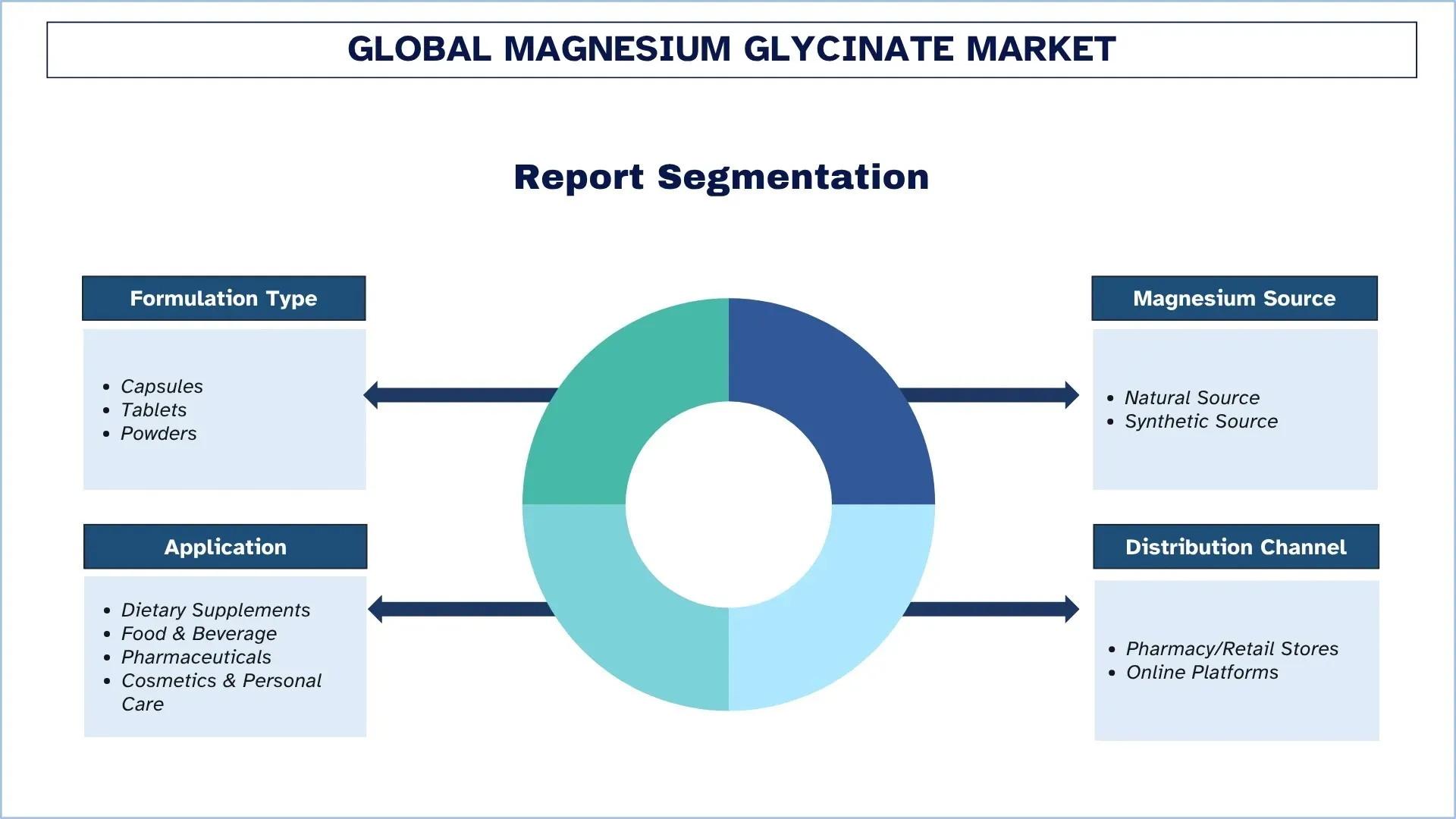
Emphasis on Formulation Type (Capsules, Tablets, and Powders); Magnesium Source (Natural Source and Synthetic Source); Application (Dietary Supplements, Food & Beverage, Pharmaceuticals, and Cosmetics & Personal Care); Distribution Channel (Pharmacy/Retail Stores, and Online Platforms); and Region/Country
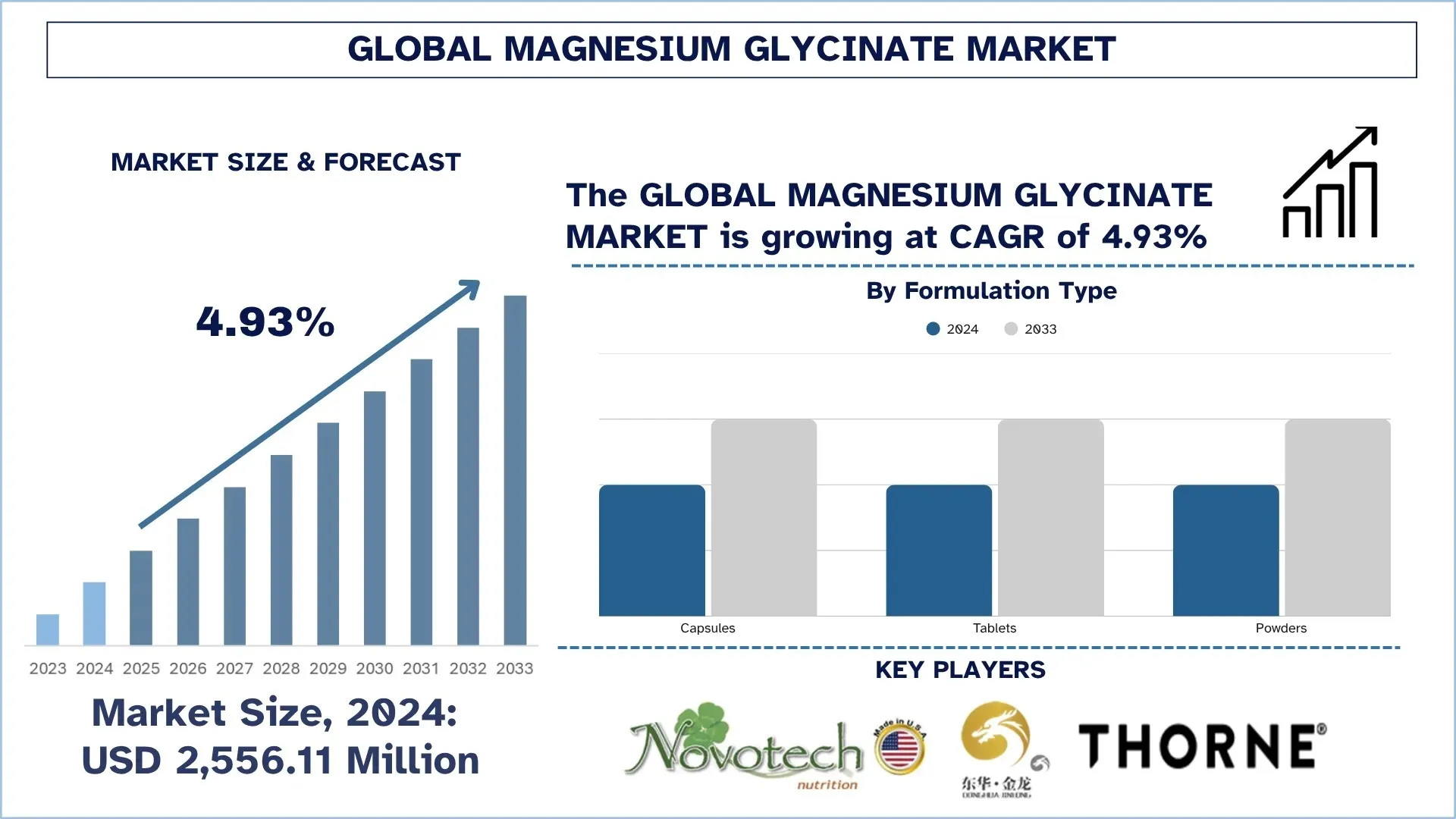
Global Magnesium Glycinate Market Size & Forecast
The Global Magnesium Glycinate Market was valued at USD 2,556.11million in 2024 and is expected to grow at a CAGR of around 4.93% during the forecast period (2025–2033F), driven by rising awareness of magnesium deficiency and growth in health and wellness trends.
Magnesium Glycinate Market Analysis
The demand for magnesium glycinate in the world market is on a continuous increase due to the increasing awareness of its health advantages, as well as the increasing intake in dietary supplements. Magnesium glycinate is a chelated form of magnesium, and it is very bioavailable, so it is a good substitute when one wants to enhance the amount of magnesium in their body without the digestive side effects that other magnesium compounds can cause. With the increasing trend toward the topic of health and wellness globally, the market of magnesium glycinate is growing at a rapid pace, and people seek natural remedies to enhance the functionality of their muscles, the well-being of their bones, and their overall well-being. This demand wave is also strongly linked to the increasing rate of magnesium deficiency, which has been seen to increase the demand for supplements in the developed and emerging markets. Moreover, the increased popularity of personalized nutrition and functional foods that can be adjusted to suit a particular health requirement contributes to the increased magnesium glycinate demand even more. The innovations in the product forms are being experienced in the market with magnesium glycinate presently available in different formats, including powders, capsules, and liquid supplements, and hence can be consumed by a broad segment of the population.
Global Magnesium Glycinate Market Trends
This section discusses the key market trends that are influencing the various segments of the global magnesium glycinate market, as found by our team of research experts.
Personalized Nutrition and Functional Formulations
There is a rising consumerist trend of specialized nutrition, and this has a great impact on the magnesium glycinate market. Customers are demanding more and more specialized supplements, i.e., sleep or muscle recovery supplements, stress relief or sleep support supplements, etc. Magnesium glycinate, a very bioavailable and least irritating substance to the digestive system, is being considered as an ingredient in these special preparations to meet these personal health issues. To take a specific example, such a wellness product will as a high absorption magnesium supplement, designed to contend with one of the most commonly undermentioned, but currently very prevalent, health problems in the country, magnesium deficiency. In July 2025, Rasayanam, one of the fastest-growing wellness brands in India, released a new wellness product: Rasayanam Magnesium Glycinate. The product involves Albion (r) TRAACS(r) factory in Balchem USA, a gold standard in the field of mineral science, to produce Magnesium Bisglycinate in their product. It provides 440mg of elemental magnesium in one dose (100% RDA) and therefore the body obtains what it really requires without the guesswork and the side effects. The change represents the industry trend in designing supplements that meet certain health-related concerns, which correlates with the trend of customized nutrition.
Magnesium Glycinate Industry Segmentation
This section provides an analysis of the key trends in each segment of the global magnesium glycinate market report, along with forecasts at the global, regional, and country levels for 2025-2033.
The Capsule Segment Dominates the Magnesium Glycinate Market
Based on Formulation Type, the global magnesium glycinate market is segmented into Capsules, Tablets, and Powders. In 2024, the capsules segment is anticipated to hold the largest market share and continue to lead throughout the forecast period. This is mainly because they are convenient, easy to use, and a perfect dose of these makes them a favorite among consumers. The capsules also have better bioavailability, and magnesium glycinate is efficiently absorbed by the body, which also makes the capsules popular among dietary supplements. The tablet market is equally increasing at a steady pace, owing to its affordable nature and viability in terms of shelf life, thus a popular product for both the consumer and the producer. Moreover, the powders are becoming popular, and this is particularly among those who like having a personalized dosage or individuals who like combining their magnesium supplement with other beverages. Powder formulations are also flexible and versatile, which attracts consumers interested in customized supplements, particularly those who are health-conscious. The development of the segment is also facilitated by the innovations in the range of the offered products, where magnesium glycinate can be offered in other flavors and forms, to meet the needs of a wide range of consumers.
The Natural Source Segment held the Largest Market Share in the Magnesium Glycinate Market.
Based on Magnesium Source, the global magnesium glycinate market is segmented into Natural Source and Synthetic Source. In 2024, the natural source segment is expected to dominate the market and continue to hold a significant share throughout the forecast period. This has grown due to the rising trend of consumers favoring natural and organic products, and also the high demand for magnesium, which is extracted through plant and mineral-based sources. Natural magnesium glycinate is viewed as a more sustainable and cleaner alternative, and it targets the health-conscious customers who will consider the ingredients as environmentally friendly and organic. Conversely, the synthetic source segment is also expanding, especially since it is economical and more predictable in production. Large-scale production of synthetic magnesium glycinate is mostly reliable and cheap. The natural source segment is, however, likely to continue its leadership because of the current trend of clean-label products and the growing importance of natural health solutions.
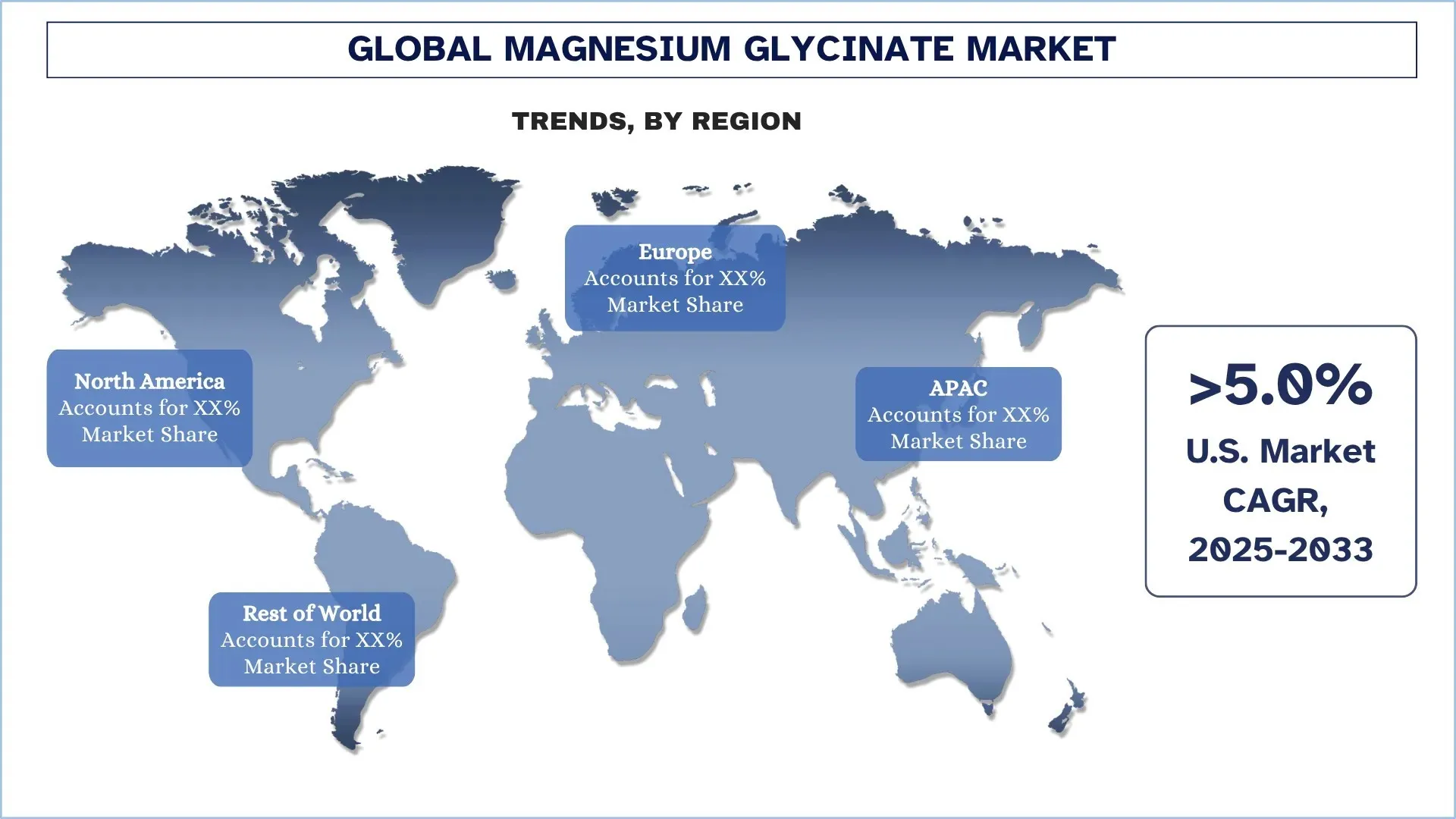
North America Dominated the Global Magnesium Glycinate Market
North America is expected to dominate the global magnesium glycinate market in 2024 and is anticipated to maintain its leadership throughout the forecast period. The main drivers of this dominance are increasing consumer awareness of health and wellness, as well as the high demand for dietary supplements in the region. The availability of well-established pharmaceutical and supplement companies, coupled with the growing health trend in the US and Canada, makes North America the most powerful market. The trend in North America is toward more personalized health and wellness solutions, as consumers increasingly turn to supplements tailored to their own needs. With the constantly rising popularity of personalized nutrition, it is logical to expect that more consumers in North America will consider magnesium glycinate as an addition to their personalized nutrition regimen. With the convenience of online shopping and access to a wide range of magnesium glycinate products, some with novel formulations, the trend in the market is towards consumers in North America buying supplements online. This trend is further strengthened by the emergence of health-conscious online communities and the ease of product comparison, which has helped give the market the required push in the region.
U.S. held a dominant Share of the Asia Pacific Magnesium Glycinate Market in 2024
U.S Magnesium Glycinate market offers a good outlook, given that the sales of the supplement continue to expand in scope, given that consumers are becoming more conscious regarding the health benefits of the compound, and given that the compound has a high bioavailability. The trend and increase in demand for plant-based and natural goods, as well as the growth of trends in health and wellness, are the driving forces. Additionally, it offers accessibility and growth in the market, as it has numerous channels of distribution that can be leveraged, including e-commerce.
Magnesium Glycinate Industry Competitive Landscape
The global magnesium glycinate market is competitive, with several global and international market players. The key players are adopting different growth strategies to enhance their market presence, such as partnerships, agreements, collaborations, new product launches, geographical expansions, and mergers and acquisitions.
Top Magnesium Glycinate Companies
Some of the major players in the market are Novotech Nutrition, Shijiazhuang Donghua Jinlong Chemical Co., Ltd., Thorne (L Catterton), Life Extension, Jarrow Formulas, Inc. (New Mountain Capital), Solgar Inc. (Nestle), Natural Factors USA, BASF, Chaitanya Agro Biotech Pvt. Ltd., and KAL Vitamins.
Recent Developments in the Magnesium Glycinate Market
In July 2025, Rasayanam, one of India’s fastest-growing wellness brands, announced the launch of Rasayanam Magnesium Glycinate, a high-absorption magnesium supplement crafted to address one of the country’s most overlooked yet widespread health issues: magnesium deficiency.
In June 2023, Trace Minerals opened a magnesium glycinate gummy and powder facility in Texas. Sports Nutrition, functional beverages, and personalized health formulation require powdered supplements.
Global Magnesium Glycinate Market Report Coverage
Report Attribute | Details |
Base year | 2024 |
Forecast period | 2025-2033 |
Growth momentum | Accelerate at a CAGR of 4.93% |
Market size 2024 | USD 2,556.11 Million |
Regional analysis | North America, Europe, APAC, Rest of the World |
Major contributing region | North America is expected to dominate the market during the forecast period. |
Key countries covered | U.S., Canada, Germany, U.K., Spain, Italy, France, China, Japan, and India |
Companies profiled | Novotech Nutrition, Shijiazhuang Donghua Jinlong Chemical Co., Ltd., Thorne (L Catterton), Life Extension, Jarrow Formulas, Inc. (New Mountain Capital), Solgar Inc. (Nestle), Natural Factors USA, BASF, Chaitanya Agro Biotech Pvt. Ltd., and KAL Vitamins |
Report Scope | Market Trends, Drivers, and Restraints; Revenue Estimation and Forecast; Segmentation Analysis; Demand and Supply Side Analysis; Competitive Landscape; Company Profiling |
Segments Covered | By Formulation Type; By Magnesium Source; By Application, By Distribution Channel; By Region/Country |
Reasons to Buy Magnesium Glycinate Market Report:
The study includes market sizing and forecasting analysis confirmed by authenticated key industry experts.
The report briefly reviews overall industry performance at a glance.
The report covers an in-depth analysis of prominent industry peers, primarily focusing on key business financials, type portfolios, expansion strategies, and recent developments.
Detailed examination of drivers, restraints, key trends, and opportunities prevailing in the industry.
The study comprehensively covers the market across different segments.
Deep dive regional-level analysis of the industry.
Customization Options:
The global magnesium glycinate market can further be customized as per the requirements or any other market segment. Besides this, UnivDatos understands that you may have your own business needs; hence, feel free to contact us to get a report that completely suits your requirements.
Table of Content
Research Methodology for the Global Magnesium Glycinate Market Analysis (2023-2033)
We analyzed the historical market, estimated the current market, and forecasted the future market of the global magnesium glycinate market to assess its application in major regions worldwide. We conducted exhaustive secondary research to gather historical market data and estimate the current market size. To validate these insights, we carefully reviewed numerous findings and assumptions. Additionally, we conducted in-depth primary interviews with industry experts across the magnesium glycinate value chain. After validating market figures through these interviews, we used both top-down and bottom-up approaches to forecast the overall market size. We then employed market breakdown and data triangulation methods to estimate and analyze the market size of industry segments and sub-segments.
Market Engineering
We employed the data triangulation technique to finalize the overall market estimation and derive precise statistical numbers for each segment and sub-segment of the global magnesium glycinate market. We split the data into several segments and sub-segments by analyzing various parameters and trends, including formulation type, magnesium source, application, distribution channel, and regions within the global magnesium glycinate market.
The Main Objective of the Global Magnesium Glycinate Market Study
The study identifies current and future trends in the global magnesium glycinate market, providing strategic insights for investors. It highlights regional market attractiveness, enabling industry participants to tap into untapped markets and gain a first-mover advantage. Other quantitative goals of the studies include:
Market Size Analysis: Assess the current market size and forecast the market size of the global magnesium glycinate market and its segments in terms of value (USD).
Magnesium Glycinate Market Segmentation: Segments in the study include areas of formulation type, magnesium source, application, distribution channel, and regions.
Regulatory Framework & Value Chain Analysis: Examine the regulatory framework, value chain, customer behavior, and competitive landscape of the magnesium glycinate industry.
Regional Analysis: Conduct a detailed regional analysis for key areas such as Asia Pacific, Europe, North America, and the Rest of the World.
Company Profiles & Growth Strategies: Company profiles of the magnesium glycinate market and the growth strategies adopted by the market players to sustain the fast-growing market.
Frequently Asked Questions FAQs
Q1: What is the global magnesium glycinate current market size and its growth potential?
The global magnesium glycinate market was valued at USD 2,556.11Million in 2024 and is expected to grow at a CAGR of 4.93% during the forecast period (2025-2033).
Q2: Which segment has the largest share of the global magnesium glycinate market by formulation type?
The capsules segment is anticipated to hold the largest market share and continue to lead throughout the forecast period. This is mainly because they are convenient, easy to use, and a perfect dose of these makes them a favorite among consumers.
Q3: What are the driving factors for the growth of the global magnesium glycinate market?
• High Bioavailability and Digestive Tolerance: Magnesium Glycinate is easily absorbed and well-tolerated by the digestive system, making it a preferred choice for consumers seeking effective and gentle supplementation.
• Rising Awareness of Magnesium Deficiency: As more people recognize the widespread issue of magnesium deficiency, demand for supplements like Magnesium Glycinate grows to address health concerns such as muscle cramps and fatigue.
• Growth in Health and Wellness Trends: With the rising focus on healthy living, consumers are increasingly turning to supplements like Magnesium Glycinate to enhance well-being and support a balanced lifestyle.
Q4: What are the emerging technologies and trends in the global magnesium glycinate market?
• Personalized Nutrition and Functional Formulations: Consumers are increasingly seeking supplements tailored to their individual health needs, driving demand for personalized Magnesium Glycinate products with specific benefits for various health conditions.
• Expansion of E-Commerce Channels: The growth of online retail is making Magnesium Glycinate more accessible to a broader audience, enabling easier purchasing and enhancing market visibility for brands in the supplement industry.
Q5: What are the key challenges in the global magnesium glycinate market?
• Regulatory Scrutiny and Labeling Concerns: As demand for supplements rises, so does regulatory oversight. Companies must ensure accurate labeling and compliance with health claims to avoid legal and reputational issues that may impact consumer trust.
• Fluctuating Raw Material Prices: The cost of sourcing raw materials for Magnesium Glycinate can vary, potentially impacting product pricing and profit margins, especially in times of supply chain disruption.
Q6: Which region dominates the global magnesium glycinate market?
North America is expected to dominate the global magnesium glycinate market in 2024 and is anticipated to maintain its leadership throughout the forecast period. The main drivers of this dominance are increasing consumer awareness of health and wellness, as well as the high demand for dietary supplements in the region. The availability of well-established pharmaceutical and supplement companies, coupled with the growing health trend in the US and Canada, makes North America the most powerful market.
Q7: Who are the key players in the global magnesium glycinate market?
Some of the key companies include:
• Novotech Nutrition
• Shijiazhuang Donghua Jinlong Chemical Co., Ltd.
• Thorne (L Catterton)
• Life Extension
• Jarrow Formulas, Inc. (New Mountain Capital)
• Solgar Inc. (Nestle)
• Natural Factors USA
• BASF
• Chaitanya Agro Biotech Pvt. Ltd.
• KAL Vitamins
Q8: How is the rise of e-commerce impacting the global Magnesium Glycinate market?
• Broader Market Reach: E-commerce platforms are expanding the global reach of Magnesium Glycinate products, enabling companies to access a wider consumer base and streamline direct-to-consumer sales.
• Increased Consumer Education and Engagement: Online platforms allow for targeted marketing, educational content, and consumer reviews, empowering buyers to make informed purchasing decisions about Magnesium Glycinate and its benefits.
• Enhanced Convenience and Accessibility: The growth of online retail and subscription models is making Magnesium Glycinate more accessible, offering consumers the convenience of home delivery and personalized product options.
Q9: How are advancements in manufacturing technology influencing the global Magnesium Glycinate market?
• Improved Production Efficiency: Technological advancements in production processes are enabling manufacturers to produce high-quality Magnesium Glycinate more efficiently, reducing production costs and increasing supply to meet growing demand.
• Enhanced Bioavailability and Formulations: Innovations in formulation technologies allow for improved bioavailability of Magnesium Glycinate, enhancing its absorption and effectiveness, which attracts more consumers seeking optimal health benefits.
• Sustainability in Manufacturing: With increasing focus on sustainable practices, manufacturers are investing in eco-friendly production methods and sourcing raw materials responsibly, aligning with the growing consumer preference for environmentally conscious products.
Related Reports
Customers who bought this item also bought

Middle East & Africa Masterbatch Market: Current Analysis and Forecast (2025-2033)
Emphasis By Type (Black, White, Additives, Color, Fillers, and Others), by Polymer (Polyethylene, Polypropylene, Polyethylene Terephthalate, Polystyrene, and Others), by End-User Industry (Automotive, Packaging, Agriculture, Electrical & Electronics, and Others), By Country (Saudi Arabia, UAE, Egypt, South Africa, Turkey, Israel, and the Rest of Middle East & Africa)
March 9, 2026
Styrene-Butadiene-Styrene (SBS) Copolymer Block Market: Current Analysis and Forecast (2025-2033)
Emphasis on Product Type (Linear SBS, Radial SBS, and Others); Application (Adhesives & Sealants, Asphalt Modifiers, Footwear, Plastomers & Thermoplastic Elastomers, and Others); End-Use Industry (Automotive, Construction, Consumer Goods, Packaging, Healthcare, and Others); and Region/Country
March 9, 2026