- Home
- About Us
- Industry
- Services
- Reading
- Contact Us
Polyphenylene Ether (PPE) Market: Current Analysis and Forecast (2025-2033)
Emphasis on Type (PPE Resin, PPE Blends, Modified PPE Compounds, and Others); End-Use Industry (Automotive, Electrical and Electronics, Healthcare, Aerospace, and Others); and Region/Country
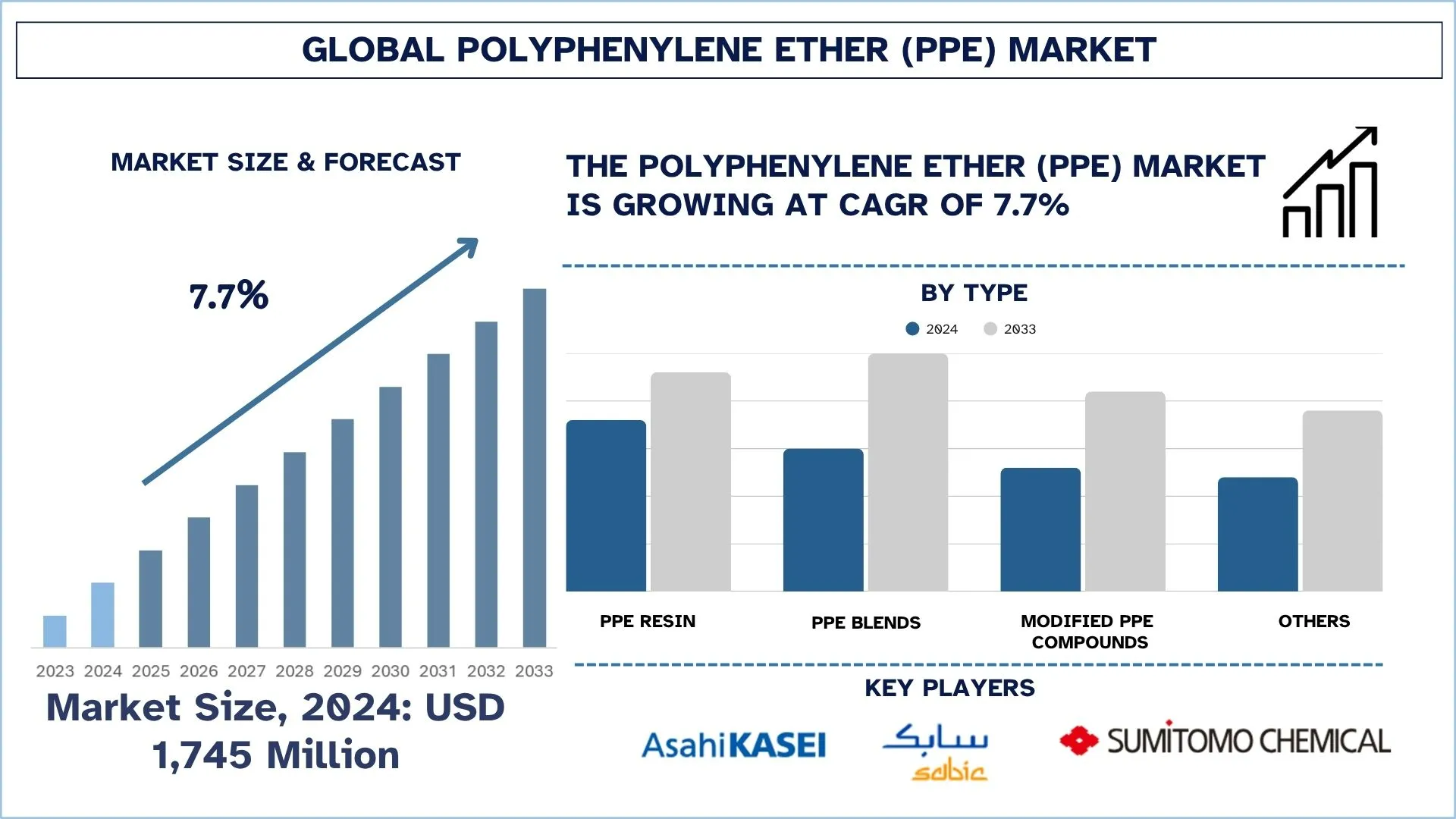
Global Polyphenylene Ether (PPE) Market Size & Forecast
The Global Polyphenylene Ether (PPE) Market was valued at USD 1,745 million in 2024 and is expected to grow at a strong CAGR of around 7.7% during the forecast period (2025-2033F), driven by the rising demand for lightweight and high-performance materials in the automotive and electronics industries to improve fuel efficiency and device reliability.
Polyphenylene Ether (PPE) Market Analysis
Polyphenylene Ether (PPE) or Polyphenylene Oxide (PPO) is a high-performance engineering thermoplastic that exhibits excellent mechanical, thermal, and electrical properties. It is produced by oxidizing 2, 6-dimethylphenol, and its polymer has high dimensional stability, low moisture retention, and excellent heat and chemical resistance. PPE has dielectric excellence that makes it the best material to use in electrical and electronic applications.
The Polyphenylene Ether (PPE) market is expanding because of its increasing application in the automotive, electronic, and industrial sectors due to the need to have lightweight, durable, and heat-resistant materials. Excellent mechanical strength, dimensional stability, electrical insulation properties, and other characteristics of PPE also enable it to be used in components of electric vehicles, consumer electronics, and high-performance equipment. Also, the international trend of energy efficiency and sustainability is increasing the use of PPE since it facilitates the replacement of metals and enhances fuel efficiency.
Global Polyphenylene Ether (PPE) Market Trends
This section discusses the key market trends that are influencing the various segments of the global Polyphenylene Ether (PPE) market, as found by our team of research experts.
Adoption of PPE in medical devices and healthcare equipment
The application of PPE in medical devices and healthcare equipment is a major emerging trend in the global PPE market, driven by its high biocompatibility, resistance to sterilization, and great mechanical properties. PPE is resistant to repeated autoclaving and exposure to chemicals; therefore, it can be used in surgical equipment, diagnostic equipment, and medical enclosures. It is lightweight and exhibits a high level of dimensional stability, enhancing the performance of products and increasing design flexibility. Moreover, as the need for durable, safe, and inexpensive medical materials increases, PPE is becoming a polymer of choice for advanced medical and healthcare applications.
Polyphenylene Ether (PPE) Industry Segmentation
This section provides an analysis of the key trends in each segment of the global Polyphenylene Ether (PPE) market report, along with forecasts at the global, regional, and country levels for 2025-2033.
The PPE Blends Market Dominates the Global Polyphenylene Ether (PPE) Market
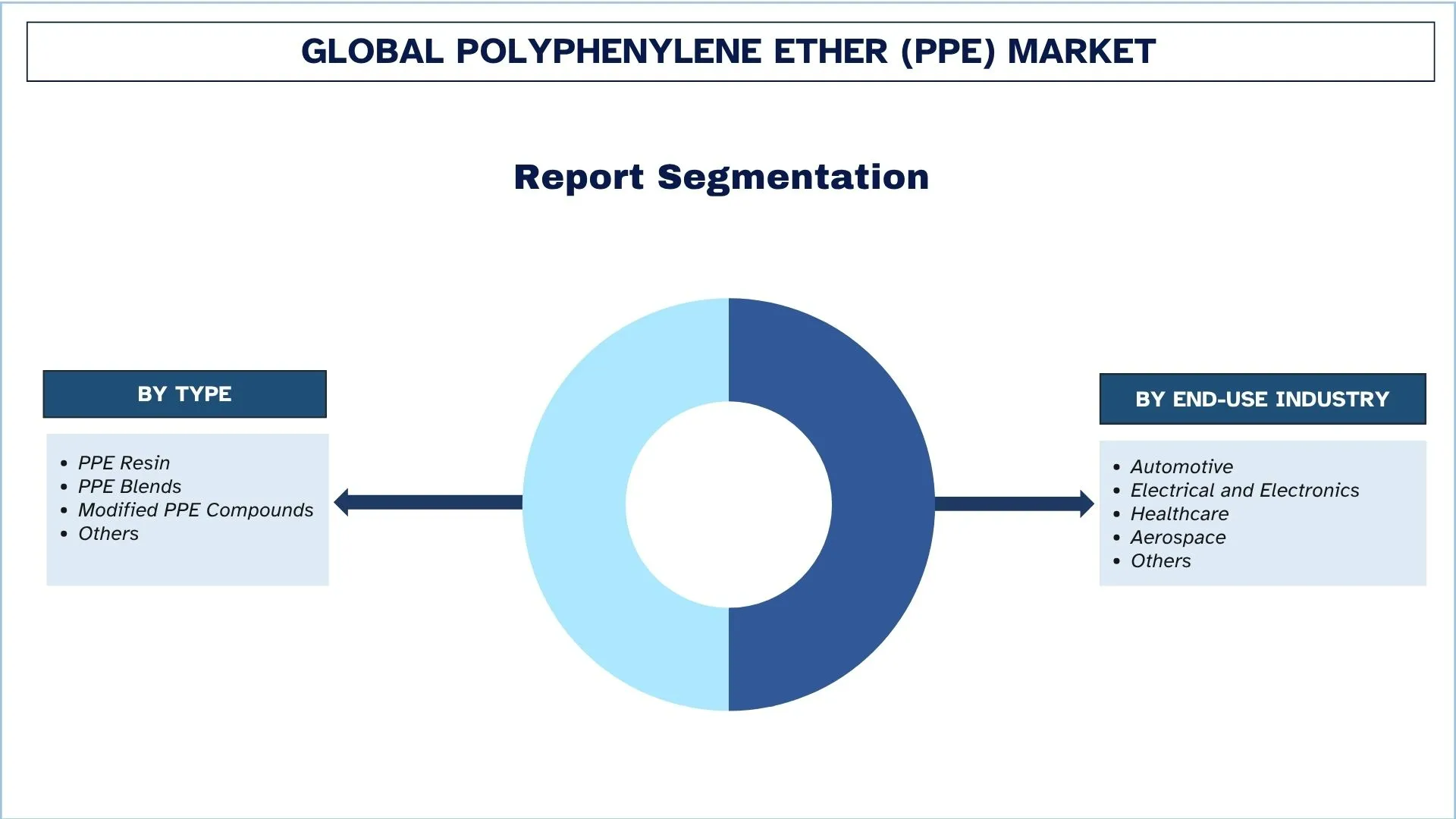
Based on the type category, the market is categorised into PPE resin, PPE blends, modified PPE compounds, and others. Among these, PPE blends hold the maximum market share as they are better in mechanical strength, impact resistance, and processing, and hence are best used in auto parts, electrical parts, and electronic parts. These blends are more thermally stable and economical than pure PPE resin. However, the modified PPE compounds segment is expected to witness the fastest growth in the coming years, due to the increased demand in high-performance materials in lightweight vehicles, in sustainable product designs, and in advanced electronics production, which demands higher heat resistance, dimensional stability, and flame-resistance.
The Automotive Segment Dominates the Global Polyphenylene Ether (PPE) Market.
Based on the end-use industry category, the market is segmented into automotive, electrical and electronics, healthcare, aerospace, and others. Among these, the automotive industry currently holds the maximum market share because of the increasing use of PPE-based materials in the production of lightweight and high-performance products made of bumpers, grilles, and under-the-hood components. The high thermal stability, dimensional stability, and chemical stability of PPE make it a better substitute for metals and decrease the weight of the vehicle to improve fuel efficiency. However, the electrical and electronics segment is predicted to be the most rapidly expanding field in the future, driven by increasing demand for miniaturized, high-heat-resistant components in consumer electronics, EV batteries, and 5G infrastructure, along with expanding applications in connectors, housings, and insulating parts.
Asia-Pacific holds the largest market share in the global Polyphenylene Ether (PPE) market
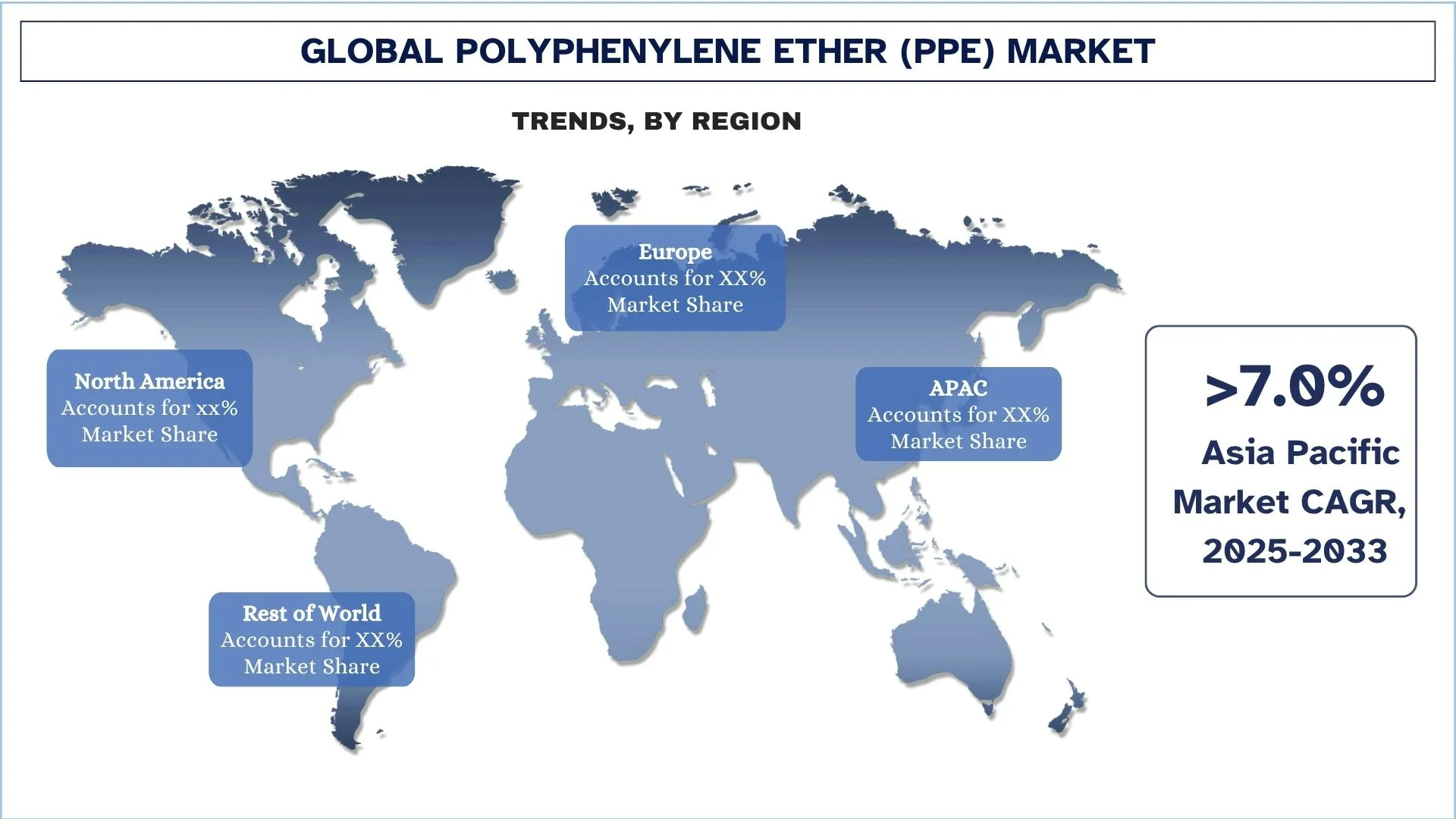
Asia-Pacific had a leading market share in the Polyphenylene Ether (PPE) market owing to the high industrial base, large-scale production of automobiles and electronics, and availability of large end-use industries, in countries such as China, Japan, and South Korea. High rates of urbanization, the increase in disposable incomes, and the demand for consumer electronics and electric vehicles are the primary reasons behind the massive growth in PPE consumption. Moreover, the presence of affordable raw materials in the region, a supportive government focus on the development of the industrial sector, and growing production abilities of the major manufacturers have reinforced the position of the region as the leading power in the global PPE market, which makes Asia-Pacific the hub of the demand and production of PPE.
China held a Dominant share of the Asia-Pacific Polyphenylene Ether (PPE) Market in 2024
China has the largest market share in the Asia-Pacific Polyphenylene Ether (PPE) market owing to its well-established automotive, electronic, and industrial manufacturing industry. The existence of a high production base, accessibility of raw materials, and low-cost, efficient labor in the country has ensured that it is a major location in PPE production and consumption. The sudden increase in the production of electric vehicles, the growing consumer electronics demand, and the adoption of high-performance engineering plastics also contributed to the supremacy of the Chinese market. Furthermore, the government policies regarding sustainable materials and technological development in polymer processing have stimulated the expansion of using PPE, which further proves the central role of China in the Asia-Pacific market.
Polyphenylene Ether (PPE) Industry Competitive Landscape
The global Polyphenylene Ether (PPE) market is competitive, with several global and international market players. The key players are adopting different growth strategies to enhance their market presence, such as partnerships, agreements, collaborations, geographical expansions, and mergers and acquisitions.
Top Polyphenylene Ether (PPE) Market Companies
Some of the major players in the market are Asahi Kasei Corporation, SABIC, Nagase America LLC, Evonik Industries AG, ROMIRA GmbH, Mitsubishi Gas Chemical Co., Inc., LG Chem, Sumitomo Chemical Co., Ltd., Kingfa Sci.&Tech. Co.,Ltd., and Polymer Resources.
Recent Developments in the Polyphenylene Ether (PPE) Market
In February 2025, SABIC, which is a global leader in the chemical industry, launched NORYL GTX™ LMX310 resin, which is the first in a new family of resins with enhanced dimensional stability. This innovative material is well-suited for inline paintable automotive applications, such as service flaps for electric vehicles (EVs). Also, this new grade addresses the challenges of larger, asymmetrically shaped service flaps that are common in hybrid and fully electric vehicles.
In March 2024, Nagase America LLC, which is a global leader in material sciences and ingredients, announced its formal integration with Nagase Specialty Materials NA LLC. This integration was done to strengthen business operations, enhance responsiveness, and improve service to both customers and suppliers.
Global Polyphenylene Ether (PPE) Market Report Coverage
Report Attribute | Details |
Base year | 2024 |
Forecast period | 2025-2033 |
Growth momentum | Accelerate at a CAGR of 7.7% |
Market size 2024 | USD 1,745 million |
Regional analysis | North America, Europe, APAC, Rest of the World |
Major contributing region | The North America region is expected to dominate the market during the forecast period. |
Key countries covered | U.S., Canada, Germany, U.K., Spain, Italy, France, China, Japan, and India. |
Companies profiled | Asahi Kasei Corporation, SABIC, Nagase America LLC, Evonik Industries AG, ROMIRA GmbH, Mitsubishi Gas Chemical Co., Inc., LG Chem, Sumitomo Chemical Co., Ltd., Kingfa Sci.&Tech. Co., Ltd., and Polymer Resources. |
Report Scope | Market Trends, Drivers, and Restraints; Revenue Estimation and Forecast; Segmentation Analysis; Demand and Supply Side Analysis; Competitive Landscape; Company Profiling |
Segments Covered | By Type, By End-Use Industry, and By Region/Country |
Reasons to Buy the Polyphenylene Ether (PPE) Market Report:
The study includes market sizing and forecasting analysis confirmed by authenticated key industry experts.
The report briefly reviews overall industry performance at a glance.
The report covers an in-depth analysis of prominent industry peers, primarily focusing on key business financials, type portfolios, expansion strategies, and recent developments.
Detailed examination of drivers, restraints, key trends, and opportunities prevailing in the industry.
The study comprehensively covers the market across different segments.
Deep dive regional level analysis of the industry.
Customization Options:
The global Polyphenylene Ether (PPE) market can further be customized as per the requirements or any other market segment. Besides this, UnivDatos understands that you may have your own business needs; hence, feel free to contact us to get a report that completely suits your requirements.
Table of Content
Research Methodology for the Global Polyphenylene Ether (PPE) Market Analysis (2023-2033)
We analyzed the historical market, estimated the current market, and forecasted the future market of the global Polyphenylene Ether (PPE) market to assess its application in major regions worldwide. We conducted exhaustive secondary research to gather historical market data and estimate the current market size. To validate these insights, we carefully reviewed numerous findings and assumptions. Additionally, we conducted in-depth primary interviews with industry experts across the Polyphenylene Ether (PPE) value chain. After validating market figures through these interviews, we used both top-down and bottom-up approaches to forecast the overall market size. We then employed market breakdown and data triangulation methods to estimate and analyze the market size of industry segments and sub-segments.
Market Engineering
We employed the data triangulation technique to finalize the overall market estimation and derive precise statistical numbers for each segment and sub-segment of the global Polyphenylene Ether (PPE) market. We split the data into several segments and sub-segments by analyzing various parameters and trends, including type, end-use industry, and regions within the global Polyphenylene Ether (PPE) market.
The Main Objective of the Global Polyphenylene Ether (PPE) Market Study
The study identifies current and future trends in the global Polyphenylene Ether (PPE) market, providing strategic insights for investors. It highlights regional market attractiveness, enabling industry participants to tap into untapped markets and gain a first-mover advantage. Other quantitative goals of the studies include:
Market Size Analysis: Assess the current and forecast market size of the global Polyphenylene Ether (PPE) market and its segments in terms of value (USD).
Polyphenylene Ether (PPE) Market Segmentation: Segments in the study include areas of type, end-use industry, and region.
Regulatory Framework & Value Chain Analysis: Examine the regulatory framework, value chain, customer behavior, and competitive landscape of the Polyphenylene Ether (PPE) industry.
Regional Analysis: Conduct a detailed regional analysis for key areas such as Asia Pacific, Europe, North America, and the Rest of the World.
Company Profiles & Growth Strategies: Company profiles of the Polyphenylene Ether (PPE) market and the growth strategies adopted by the market players to sustain the fast-growing market.
Frequently Asked Questions FAQs
Q1: What is the global Polyphenylene Ether (PPE) market’s current market size and growth potential?
As of 2024, the global Polyphenylene Ether (PPE) market size is USD 1,745 million. The market is projected to grow at a strong CAGR of 7.7% between 2025 and 2033, driven by increasing demand for high-performance engineering plastics across automotive, electrical, and healthcare industries.
Q2: Which segment has the largest share of the global Polyphenylene Ether (PPE) market by type category?
The PPE blends segment dominates the global Polyphenylene Ether (PPE) market by type, owing to its superior mechanical strength, impact resistance, and cost-effectiveness. These properties make PPE blends ideal for automotive components and electronic device manufacturing.
Q3: What are the driving factors for the growth of the global Polyphenylene Ether (PPE) market?
Top growth drivers of the Polyphenylene Ether (PPE) market include:
• Rising demand for lightweight materials in automotive applications
• Increasing use of PPE in electrical and electronic components
• Growing preference for high-performance engineering plastics
Q4: What are the emerging technologies and trends in the global Polyphenylene Ether (PPE) market?
Emerging trends in the Polyphenylene Ether (PPE) market include:
• Shift toward PPE blends and alloys
• Adoption of PPE in medical devices and healthcare equipment
Q5: What are the key challenges in the global Polyphenylene Ether (PPE) market?
Key challenges in the Polyphenylene Ether (PPE) market include:
• High production and processing costs
• Fluctuations in raw material prices
Q6: Which region dominates the global Polyphenylene Ether (PPE) market?
The Asia-Pacific region dominates the global Polyphenylene Ether (PPE) market, fueled by rapid industrialization, expanding automotive and electronics manufacturing bases, and strong demand from emerging economies such as China, Japan, and India.
Q7: Who are the key competitors in the global Polyphenylene Ether (PPE) market?
Top players in the Polyphenylene Ether (PPE) industry include:
• Asahi Kasei Corporation
• SABIC
• Nagase America LLC
• Evonik Industries AG
• ROMIRA GmbH
• Mitsubishi Gas Chemical Co., Inc.
• LG Chem
• Sumitomo Chemical Co., Ltd.
• Kingfa Sci.&Tech. Co., Ltd.
• Polymer Resources
Q8: What are the major investment opportunities and growth prospects in the Polyphenylene Ether (PPE) market?
The PPE market presents strong investment opportunities in automotive lightweighting, electrical insulation materials, and healthcare applications. Emerging economies in the Asia-Pacific and Europe are witnessing increased R&D investments in advanced PPE blends and eco-friendly manufacturing, providing long-term growth potential for investors and market entrants.
Q9: How is technological innovation influencing product development in the global Polyphenylene Ether (PPE) market?
Technological advancements such as polymer modification, nanocomposite integration, and enhanced recyclability are transforming PPE material performance. These innovations enable manufacturers to develop high-strength, thermally stable, and sustainable PPE compounds, supporting next-generation automotive, electronic, and medical applications.
Related Reports
Customers who bought this item also bought


Middle East & Africa Masterbatch Market: Current Analysis and Forecast (2025-2033)
Emphasis By Type (Black, White, Additives, Color, Fillers, and Others), by Polymer (Polyethylene, Polypropylene, Polyethylene Terephthalate, Polystyrene, and Others), by End-User Industry (Automotive, Packaging, Agriculture, Electrical & Electronics, and Others), By Country (Saudi Arabia, UAE, Egypt, South Africa, Turkey, Israel, and the Rest of Middle East & Africa)
March 9, 2026
Styrene-Butadiene-Styrene (SBS) Copolymer Block Market: Current Analysis and Forecast (2025-2033)
Emphasis on Product Type (Linear SBS, Radial SBS, and Others); Application (Adhesives & Sealants, Asphalt Modifiers, Footwear, Plastomers & Thermoplastic Elastomers, and Others); End-Use Industry (Automotive, Construction, Consumer Goods, Packaging, Healthcare, and Others); and Region/Country
March 9, 2026